
HOW LONG could Mithradates’ “honeymoon of absolute power and freedom” last? That question was answered by the gods of war in 86/85 BC. The heartbreaking loss of Mithradates’ favorite son Arcathius was followed by inexplicable losses in Greece. How on earth could Sulla’s five legions have destroyed so many multitudes?
Mithradates’ friends encouraged the king to suspect treachery. Dorylaus had voiced his own suspicions after the defeats in Greece. Traitors were a genuine threat—betrayals were involved in the Greek losses, and there were others who conspired with the Romans. Mithradates feared that his Anatolian allies would withdraw their support, perhaps abet his enemies—even plot assassination. Before disaffection could spread throughout his realm, he sent out agents to arrest turncoats. There was a new urgency for the royal toxicologists to perfect an antidote to all forms of poison.1
Mithradates still held the strategic island of Euboea, and he trusted his generals in the Aegean. But Archelaus’s army contained many Galatian soldiers. Had some of them aided Sulla? Galatians had a reputation for treachery. If Sulla advanced to Anatolia, Mithradates felt certain that Galatia would aid him. Something had to be done.
GALATIA
Mithradates invited sixty princes from Galatia’s ruling families to reside in Pergamon as his “guests.” They were really hostages, under surveillance. One chieftain named Poredorix, a very large, robust man, plotted to kill Mithradates. The assassination was to take place during a tribunal in a small pavilion perched on a ravine. In a Superman-like feat, Poredorix and his friends intended to tip the structure into the gorge. But informers overheard and Mithradates canceled his court appearance.
Poredorix devised a new plan. The Galatian “guests” would attack Mithradates at the next banquet. But this plot also reached the king’s ears. He seized Poredorix and his coconspirators, and summoned the other chiefs, along with their families, to a feast. Enough arsenic was on the Poison King’s menu to murder all the guests. Somehow, however, three princes survived and managed to escape to Galatia, where they raised an army. They drove out Mithradates’ satrap Eumachus. Despite his careful planning, this outcome was just what Mithradates had feared. He no longer controlled Galatia.
Now an example had to be set. In Pergamon, Poredorix and his friends were sentenced to death by the sword. Their bodies were to be denied burial, left to rot on the outskirts of the city.2
As the Galatians were marched away to the execution ground, Mithradates reflected on his affection for one of them, a handsome youth named Bepolitanus. They’d enjoyed such friendly conversations. Surely this innocent young man did not deserve to die for the older men’s conspiracy! Plutarch says Mithradates became extremely distressed imagining the death of this youth. Did Bepolitanus remind Mithradates of his lost son Arcathius? The king sent an emergency order to spare the youth’s life. Poredorix and the others had already been thrown out for the crows. But, as Plutarch relates, by a stroke of luck Bepolitanus was wearing beautiful, costly clothing when he was seized. His executioner wanted this fine outfit for himself. To keep the garments from being bloodstained, the soldier was “stripping them off in a leisurely way when he saw Mithradates’ messengers running towards him and shouting the youth’s name.”
So Bepolitanus lived, while his friends lay unburied. The next day, Mithradates’ guards discovered a young woman weeping by the naked corpse of Poredorix. For the crime of trying to cover him with dirt, she was brought before the king. The girl’s lovely appearance, her touching grief and innocence stirred pity in Mithradates. Why had she dared to disobey his orders? When he discovered that she was Poredorix’s lover, Mithradates relented. He allowed her to give the would-be assassin a proper burial. Mithradates knew the famous tragedy Antigone by Sophocles, in which a tyrant executes a young girl for this very same crime. By giving this widely known story a happy ending, Mithradates enhanced his reputation for mercy.
According to Plutarch, these two realistic and detailed stories of Mithradates’ empathy for innocent lives circulated by word of mouth more than a century after his death, as counterpoints to other tales of his cruelty and hard heart. Leavening harsh behavior with chivalrous gestures made one’s power seem godlike; it commanded the respect of enemies and friends, and might salve a bad conscience too. Mithradates was familiar with the stories of the great Alexander’s gallantry toward courageous men and women, and mercy was an important virtue of the ancient Persian kings.
Mithradates still trusted his Galatian general Konnakorix and he loved a Galatian princess named Adobogiona, the sister of a prince distrusted by Mithradates. Part of a portrait bust of Adobogiona has been discovered by archaeologists in the ruins of Pergamon. Perhaps she captured Mithradates’ heart during his purge of the Galatian royal families. We might guess that the king saved her from succumbing to the poison he served at the deadly banquet.3
CHIOS
Mithradates’ paranoid thoughts kept returning to Chios, that prosperous island whose sailors had rammed his royal warship during the battle for Rhodes. Chios had allied with Rome in the past: was it another nest of traitors? Some Chian aristocrats had joined Sulla after the massacre of 88 BC. When Mithradates sent spies to Chios, their reports doomed the island.
Master of malicious punishments on a theatrical scale, Mithradates wrote detailed instructions to his generals Dorylaus and Zenobius. Mithradates’ revenge began with a surprise attack on Chios. Zenobius’s army took over the city and delivered a proclamation: The citizens of Chios were to come to the Assembly to hear a message from Mithradates. In happier times, he had won chariot races in Chios. One of the island’s prized possessions was a letter from Alexander the Great, written after he captured Chios in 333 BC (now displayed in the island’s museum). Alexander had exiled all Chians who aided his enemies. Now Mithradates the Great wrote his own letter to Chios. He accused them of aiding his enemies, noting that his suspicions were first aroused when the Chian trireme tried to sink his boat.
Why, he demanded, “have you refused to confiscate the Romans’ property, as agreed? Why have you allowed Romans to flee to Sulla? For cooperating with Sulla and conspiring against me, all my friends say I should condemn you to death! But I am merciful,” wrote Mithradates. “I will be satisfied if you turn in your weapons and send the children from the leading families of Chios to me as hostages.” The Chians gave over their arms and the young men and women of aristocratic families to Zenobius and Dorylaus, who sent them to Pergamon.
But Mithradates was not finished with Chios. Zenobius read out another royal letter. “I know that you still favor the Romans! But instead of the death you deserve, I sentence you to pay a penalty of 2,000 talents.” One talent was equal to 6,000 drachmas; 2,000 talents was a very large amount of silver. The total yearly income of Athens at the height of its empire was 1,000 talents. In Mithradates’ day, 2,000 talents was equal to 12 million drachmas. A mercenary soldier’s pay averaged about 1 drachma per day of active service, so 2,000 talents would provide a year’s pay for an army of about 35,000 soldiers.
Crying out lamentations, the Chians gathered ornaments from their temples and women’s jewelry to pay the fine. Following Mithradates’ secret orders, Zenobius summoned everyone—men, women, children, and slaves, but no foreigners—to the theater to weigh out the goods. Fear shot through the crowd as Zenobius thundered: “You have short-changed the king!”
His soldiers had surrounded the theater and lined the street to the harbor. Inside the theater, Zenobius singled out the slaves owned by the Chians and declared them free. This act by Mithradates carried a powerful propaganda message. Chios was notorious in antiquity for introducing the slave trade to the Greek world, a commerce that later became so profitable on Delos under the Romans. Chios was a wealthy society with an inordinate number of slaves—as early as the fifth century BC, the island possessed more domestic slaves than any other Greek state except Sparta.4
Next, the soldiers roughly separated the men from the women and children. They marched the two groups down the gauntlet of soldiers to the sea. The entire population of Chios was loaded onto Mithradates’ ships. While their former household slaves watched from shore, the ships full of wretched, wailing Chians sailed away. They were destined for the Black Sea, where they were to spend the rest of their lives as slaves in Mithradates’ mines in remote Colchis. Again, in devising this theatrical punishment for Chios, it appears that Mithradates may have been replaying yet another famous Greek tragedy, Euripides’ Trojan Women.5
For their payment of 2,000 talents, the Chians had purchased slavery! The calamity inspired an ironic proverb in antiquity: “The Chian has finally bought himself a master.” The Roman writer Athenaeus blamed the slave-trading Chians for their fate, and the “ancient villainy of Chios” was often recalled in the nineteenth century by antislavery groups. For example, the abolitionist-poet John Greenleaf Whittier penned his famous poem “Mithridates at Chios” in 1864, during the American Civil War. Whittier praised Mithradates for his “just punishment of that slave-cursed land.”
Chained and scourged, the slaves of slaves
The lords of Chios into exile went.
The fisher in his net is caught
The Chian hath his master bought.6
From Chios, Mithradates plucked another prize for his harem, a captivating young woman named Berenice. She must have been very young, since her mother accompanied her to the royal harem. Berenice was probably selected from among the aristocratic children sent to Pergamon. Like the Galatian princess Adobogiona, Berenice was saved from her people’s fate by the all-powerful, compassionate—and lustful—king.
Another honeymoon was now over: Mithradates had grown dissatisfied with Queen Monime. Plutarch says that their marriage became unhappy—she complained that her beauty had “won a master instead of a husband.” Maybe the king superstitiously believed that his strong-willed Greek wife had brought him bad luck in the Greek campaign. At any rate, at some point after the terrible omen of the crashing statue of Victory and the defeats in Greece that this event seemed to foretell, Monime was sent away. She traveled in opulent fashion, probably in a Persian-style harmamaxa, a private four-wheeled golden chariot with purple awnings, attended by royal eunuchs, to live the rest of her days in luxury in Pontus.7
Mithradates found comfort with his recently acquired lovers. He savored the sound of Berenice’s name on his tongue. She was his new lucky charm. A Macedonian name, Berenice means “bringer of victory.”
REBELLION AND REPRESSION
His tasks completed in Chios, Zenobius approached Ephesus with his army. Unnerved by Mithradates’ setbacks in Greece and the fate of Chios, the Ephesians insisted that Zenobius enter the city alone and unarmed. He agreed and visited Philopoemen, Monime’s father, Mithradates’ overseer in Ephesus—perhaps to reassure him that Monime was well cared for in Pontus. Ephesus had been an early supporter of Mithradates, complying with his orders to murder Romans just two years ago. We don’t know what Mithradates had in mind for Ephesus, but the citizens of the wealthy commercial city were nervous enough to disobey Zenobius’s ominous summons to the theater the next day. That night the Ephesians murdered Zenobius. Nothing personal, just business—the city depended on stable trade and gambled that Rome would prevail. After the murder, Ephesus went on red alert, hoarding food supplies and preparing to defend the city.
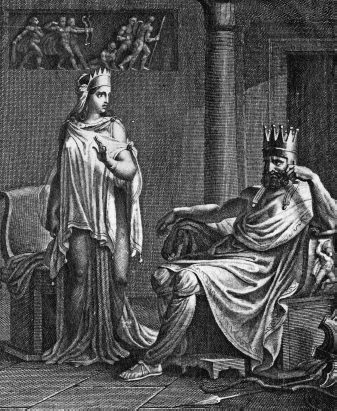
FIG. 10.1. Monime and Mithradates, a tense scene. Illustration for Racine’s play Mithridate, engraving by Girardet.
Other towns now had two violent models to follow, Chios or Ephesus. Tralles, Hypaepa, Mesopolis, Smyrna, Colophon, Sardis, and other towns previously allied with Mithradates followed the example of Ephesus and revolted. Mithradates reacted with rage, dispatching armies to inflict terrible vengeance on these rebels (was this when Mithradates poisoned his rival in chariot racing, Alcaeus of Sardis?). To preempt further defections, Mithradates sent proclamations to many Anatolian cities freeing slaves, canceling debts, and bestowing citizenship rights on resident foreigners. These privileges irritated the local aristocracy but won strong popular support among former slaves, debtors, and new citizens in each town.8
Some of the king’s closest associates, alarmed by the events in Greece and western Anatolia, began to hold secret meetings. Prominent Greeks began to reconsider their devotion to Mithradates. Two men of Smyrna invited two men of Lesbos to join a cabal against Mithradates. But one of them, a personal friend of the king, informed on the others. He arranged for Mithradates himself to hide under his couch to hear the plot from their own mouths. The three men were tortured to death.
Mithradates’ paranoia emerged in full force now. His fears were justified: betrayals and revolts were not imaginary. But his draconian reactions cut his support among the upper classes, and many people took advantage of the climate of fear to turn in their personal enemies. Mithradates rewarded informers lavishly. Plots continued, very close to home. One night in Pergamon, eighty citizens were discovered planning to murder the king. Mithradates executed them. According to Appian’s sources, about sixteen hundred men suspected of treason lost their lives in this purge.9 We don’t have the details of how they died. But many of these men must have been involuntary guinea pigs for Mithradates’ poison experiments. The king was known to test toxins and antidotes on prisoners condemned to death.
In 85 BC, Mithradates’ spies reported more bad news. Sulla’s aide, Lucullus, had done the impossible! Despite pirates and winter storms, he had assembled a navy. Ptolemy of Egypt welcomed Lucullus, inviting him to visit the Pyramids in luxurious style. But Lucullus declined, worried about his commander in chief Sulla enduring hardships at the siege of Athens. Lucullus accepted an emerald-and-gold ring engraved with Ptolemy’s likeness, and enough cash to hire ships and sailors from Syria, Cyprus, Phoenicia, Pamphylia, and Rhodes. He sailed on the Rhodian flagship, commanded by Mithradates’ old enemy Admiral Damagoras, who had chased the Pontic navy away from Rhodes in 88 BC. Moving north, they took possession of Cos, Samos, and Chios. But Mithradates’ admiral Neoptolemus (Archelaus’s brother) was lying in wait near the small island of Tenedos. In the naval battle that followed, Damagoras put Neoptolemus to flight.
Is this the moment when Mithradates finally began to realize that he would not be victorious in the war against Rome, as suggested by the historian Reinach? Sulla had the upper hand. Yet there were some positive signs for the king. His defeats in mainland Greece had not been due to disloyalty or disillusionment on the Greeks’ part; his armies fought courageously but were overwhelmed by professional, technologically advanced Roman legions. Even so, Sulla had struggled for nearly two years to take Greece, and Archelaus held Euboea, a key position. Flaccus, Sulla’s rival, lost most of his ships in a tempest in the Adriatic. Through intelligence sources, Mithradates learned that Flaccus was detested by his soldiers; many deserted to join Sulla. Meanwhile in Rome, Marius was dead, but Sulla’s supporters were murdered on a daily basis, exerting a strong pull on Sulla to return as soon as possible.
Flaccus had bypassed Sulla, marching across Thrace. It appeared that he intended to invade Mithradates’ territory by himself! Sulla was tracking this rival Roman army with his own legions, and Lucullus was bringing up a vast navy. Mithradates still commanded two hundred ships and an army of eighty thousand men in Anatolia, under the command of Dorylaus. It was time to make contingency plans. Perhaps diplomacy—a truce—could buy time. Reflecting on the enormity of his losses in Greece and calculating that Sulla must be itching to get home, Mithradates sent word to Archelaus to make peace on the best terms possible.10
THE PEACE OF DARDANUS
Sulla and Archelaus met at the Roman camp near Delion, Boeotia. Both men were practical soldiers of fortune looking to make the best bargain. Their first volleys over the peace table were tests of the other’s commitments. As Archelaus well knew, Sulla was in a great hurry to conclude the war so he could take his army back to Italy, kill his foes there, celebrate a Triumph, and become the absolute dictator of Rome. Archelaus proposed that Sulla should be satisfied with recovering Greece and leave Asia to Mithradates. “If you promise to return to Italy now, my king Mithradates promises to give you a very generous war chest, many ships, and as many soldiers as you need. With these, you can destroy Marius’s Populars and take over Rome!
Sulla’s counteroffer was equally audacious. “Why don’t you desert Mithradates and bring me all his mercenary armies? Together we can crush Mithradates and I’ll crown you king of Pontus!” Each general professed to be insulted by the other’s treasonous proposal. With their cards on the table, they began the negotiations.11
Sulla summarized Mithradates’ crimes, deploring his takeover of vast territories; his confiscations of public and sacred funds of cities allied with Rome; his seizures of Roman property, land, and slaves; his murder of Roman allies; and the great massacre of Italian men, women, and children and even slaves of Italian blood in 88 BC. “Such hatred did Mithradates bear towards Italy! And now he professes to want our friendship and mercy—but only after I destroyed 160,000 of his troops in Greece!”
Archelaus responded coolly: “It was the greed of other Roman generals that caused this war. My king will agree to fair terms.” These were the conditions the generals hammered out:
• Return to territorial status quo of 89 BC: Greece belongs to Rome. Mithradates keeps his possessions as of 89 BC, but withdraws from Paphlagonia, Bithynia, and Cappadocia, allowing Nicomedes and Ariobarzanes to recover their thrones.
• Sulla promises that Mithradates will be declared a Friend and Ally of Rome, upon Mithradates’ payment of a fine equal to the cost of the war.
• Mithradates must give Sulla seventy fully equipped bronze-armored war ships.
• Mithradates must release all Roman prisoners of war, including captive ambassadors and officers.
• All Roman deserters and runaway Roman slaves who had joined Mithradates’ armies must be surrendered to Sulla.
• A general amnesty would be declared; no reprisals against partisans.
Archelaus had been fighting as a mercenary general for Mithradates for several hard years. The war to liberate Greece was lost, with sobering casualties. As Sulla enjoyed pointing out, Boeotia was left “impassable for the multitude of dead bodies,” the remains of Mithradates’ grand army. Archelaus negotiated an armistice remarkably favorable to Mithradates, by playing to Sulla’s impatience. One of the terms of their agreement was personal: Sulla gave Archelaus an estate of ten thousand acres in Euboea. Archelaus withdrew his troops from Euboea and agreed to accompany Sulla to Dardanus to finalize the treaty with Mithradates.
On the way, Archelaus fell ill. Sulla tended Archelaus as if he were one of his own officers. Sulla’s favors and concern for Archelaus made some in Mithradates’ court suspicious that there had been collusion, that Archelaus had somehow “thrown” the battles at Chaeronea and Orchomenus, a dubious notion. Sulla defended his treatment of Archelaus in his memoirs, now lost. It seems likely that Sulla respected the commander as a noble adversary and realized that he needed his cooperation in convincing Mithradates to accept the treaty quickly.
Mithradates sent envoys to Sulla and Archelaus, to contest two of the conditions. Mithradates wanted to keep Paphlagonia, which he had always maintained was his by inheritance. And he refused to turn over seventy ships. The ambassadors slyly hinted that Mithradates might obtain a better deal if he were to negotiate with “your other general, Fimbria.” Sulla flew into a rage. “What! Mithradates has been sitting in Pergamon all this time, directing a disastrous war from afar! He should humbly thank me for not chopping off his right hand, with which he signed the death warrant for thousands of innocent Romans. He’ll sing a different tune when I march into Asia!”
Archelaus intervened. According to Sulla’s memoirs, the general tearfully begged for a chance to personally persuade Mithradates to accept the treaty. “If I fail,” Archelaus vowed, “I’ll kill myself!” That emotional scene may have been concocted by Sulla, but he did send Archelaus to confer with Mithradates.12
FIMBRIA AND LUCULLUS INTERVENE
Mithradates held a stronger hand than it might seem, but it had to be played carefully. Civil war was raging in Italy. Sulla was desperate to return, but suddenly he found himself caught in new emergencies. And Mithradates himself was in the same boat. An incredible situation was developing. Before their peace treaty could be ratified, a strange parallel war loomed on the horizon.
Sulla’s rival, Flaccus, had now reached Bithynia with his army. But, taking advantage of his superior’s ineptitude, Flaccus’s young officer Fimbria led a mutiny against the older man. Flaccus (“Rabbit Ears”) fled to Bithynia’s capital, Nicomedia. But Fimbria and his men hunted him down and discovered Flaccus cowering in a well. Fimbria chopped off Flaccus’s head and flung it into the sea, leaving the body on the beach for the gulls.
The Roman Senate angrily withdrew support for Fimbria, who was now an outlaw but in control of two legions. Mithradates now faced two rogue Roman armies in his territory, commanded by outlawed generals who were bitter enemies, each lusting to win credit for Mithradates’ downfall. Sulla feared that the ruthless, hotheaded Fimbria, a Marius loyalist, would steal his hard-won victory over Mithradates. These unforeseen developments meant that Fimbria was now the common enemy of both Mithradates and Sulla!
Cut off from Rome, Fimbria desperately needed to reward his troops with rich booty. He fixed his sights on Pergamon. He would sack Mithradates’ palace and take all the credit for concluding the war on Mithradates. Along the way, Fimbria devastated the land “like a hurricane,” destroying towns that refused to open their gates to his army. At Ilium, ancient Troy, the citizens reminded Fimbria that, according to the Roman foundation myth, Troy was Rome’s sacred mother city. Fimbria sardonically thanked the citizens and demanded entry. Once inside, he slaughtered the men, women, and children. Many fled into the Temple of Athena; Fimbria ordered the temple burned down along with the entire town, and unleashed his men to pillage. Witnesses described the awesome sight of the marble statue of Athena left standing in the ashes of her temple. Plutarch remarked that Troy had not experienced such utter destruction since Agamemnon had sacked Priam’s city in the legendary Trojan War. Indeed, Fimbria crowed that it took him only ten days to raze Troy, while it took Agamemnon ten years.13
While Sulla sped to intercept the rival outlaw general, Mithradates sent out a contingent led by his oldest son, Mithradates the Younger. But Fimbria set a trap and killed six thousand of Mithradates’ cavalry. Fimbria continued toward Pergamon. Pergamon’s walls were strong, but after the recently discovered plots, Mithradates could no longer trust the citizens. Fearing they might sell him out to Fimbria before he could make peace with Sulla on advantageous terms, Mithradates was compelled to flee for his life. From Pergamon, he rushed to Pitane on the coast. Fimbria pursued and laid siege to Pitane.
As if on cue, Lucullus suddenly arrived on the scene with his armada. Fimbria ordered Lucullus to block Pitane’s harbor, trapping Mithradates, Rome’s dire enemy, inside the city. “Together you and I will win all the glory in this war,” promised Fimbria, “and Sulla’s exploits in Greece will be forgotten!” What would happen now?
Lucullus was loyal to Sulla; he loathed Fimbria, an ally of the hated Marius. Lucullus announced that his navy belonged to Sulla. He refused to block Mithradates’ escape route, so that the king could approve the treaty worked out between Sulla and Archelaus. It was an extremely close call. Had Lucullus thrown in with Fimbria, Mithradates would have been finished. Instead, Lucullus allowed Mithradates to take a boat from Pitane to Lesbos. There Mithradates joined Neoptolemus’s navy and arrived in Dardanus.14
Here on a plain, not far from Troy, in view of both their armies, in late 85 BC, Sulla and Mithradates met face-to-face. Both were wary, but extremely eager to declare peace.
SEALED WITH A KISS
Each man was a master showman, skilled in the art of self-presentation. Each man scored propaganda points with oratory and body language, witnessed by thousands on the plain at Dardanus and recorded for history by Appian and Plutarch. Mithradates, defeated but still not beaten, wanted to make a strong impression. He was accompanied by Neoptolemus’s 200 ships, Dorylaus’s 20,000 infantry and 6,000 cavalry, and “a throng of scythe-bearing chariots.” The victor’s party was more modest: Sulla brought 1,000 men and 200 cavalry.
Mithradates, in his old-fashioned Persian finery, walked forward, hand outstretched. Sulla, standing at attention in Roman army attire, stiffly asked whether Mithradates accepted the terms agreed to by his general Archelaus. Mithradates did not reply immediately. “Surely,” spat out Sulla, “it is the victor who has the right of silence, while a suppliant should ask forgiveness!”
Mithradates broke his dramatic silence, pointing out that he and his father had been good friends of Rome. “But Roman ambassadors, governors, and generals started this war out of pure greed—the vice of most Romans. They wronged me by taking away Phrygia and Cappadocia, and they urged Nicomedes to attack my kingdom. Everything I’ve done since then was in self-defense and out of necessity.”
“I know you are a clever orator,” Sulla cut in, “always justifying your wrongdoing. You should have sent an embassy to Rome long ago if you thought you were the victim of injustice. You had no right to Cappadocia and Phrygia. Nicomedes attacked you because you sent the assassin named Alexander to kill him and you armed his rival Socrates the Good. You have been planning this war a long time, thinking you could rule the whole world—why else have you allied with Thracians, Sarmatians, and Scythians? That’s why you built up such a huge army and navy—and that’s why you timed your takeover of our Asian Province while we were subduing revolts in Italy! You freed our slaves and canceled debts! You killed sixteen hundred men on false accusations; you poisoned the princes of Galatia! You butchered or drowned all the residents of Italian blood in Provincia Asia, including mothers and babies, not even sparing victims who fled into temples! What cruelty, what impiety, what boundless hatred you showed toward us!”
Playing to the audience of officers, soldiers, and officials, Sulla continued to castigate Mithradates for war crimes, even declaring himself the “liberator” of Greece from the “slavery” of Mithradates. “You invaded Greece and deprived the Greeks of their freedom!”
Mithradates’ final card was unspoken: Deal with me or I deal with Fimbria. Knowing he had the upper hand, he calmly broke in on Sulla’s vehement discourse. “I consent to the terms agreed by my general Archelaus.”
Before the crowd, Sulla and Mithradates embraced and sealed the Peace of Dardanus with a kiss. What were the sentiments of each man during this intimate, traditional ritual? It’s interesting to consider the cultural differences. Romans sealed treaties with theosculum pacis, a mutual kiss on the cheek. Persians kissed equals on the mouth, but superiors accepted a kiss from inferiors on the cheek. Did Mithradates fake his kiss and accept Sulla’s lips on his cheek as that of an inferior? What passed through Sulla’s mind as he kissed the man who had snuffed out the lives of tens of thousands of Romans?
Mithradates promised to withdraw from Bithynia, Cappadocia, and Paphlagonia. He hated to give up the title “King of Kings.” It was galling to go through the motions of a formal reconciliation with the loathsome puppet kings. Mithradates had agreed to hand over Roman deserters and former Roman slaves in his armies, but he had no intention of following through. He did release Oppius, the captive Roman general who had served as the king’s personal servant since his defeat in 89 BC (Oppius went to the temple of healing on Cos, to recover from his ordeal).
Mithradates paid the fine demanded by Sulla—2,000 talents. As we saw above, Mithradates had recently imposed a fine of 2,000 talents on Chios, as a penalty for their revolt. Considering the king’s present circumstances and wealth, the fine requested by Sulla was a piddling sum—Mithradates could simply transfer the Chian payoff to Sulla. He turned over 70 ships to Sulla, along with 500 archers, but he still commanded more than 100 ships and an army of 80,000.15
Mithradates the Great sailed away to Pontus, his original stronghold, leaving Sulla to deal with the loose cannon Fimbria. The war between Mithradates and Rome was over. All parties had given their word to abide by the truce—with one exception. The Roman Senate, controlled by Marius’s Populars, never recognized Sulla’s Peace of Dardanus. Yet who—besides the irrepressible king of Pontus—could imagine in 85 BC that this was only the first round in a conflict that would last a lifetime?
SULLA MOPS UP
Sulla’s soldiers were not impressed with the Peace of Dardanus. In fact, they were enraged. They had witnessed Sulla’s eloquent speech, reminding everyone of the crimes of Rome’s most hostile enemy. Mithradates had killed 150,000 innocent Romans in a single day! Now they saw Sulla kiss this vicious murderer and allow him to simply sail off, loaded with fabulous wealth, to his kingdom by the sea. Where was justice?
Sulla’s mild conditions were due to his haste to return to Rome, after regaining Greece and punishing Anatolia, and his belief that Aquillius, an ally of Marius, bore responsibility for starting the war.16 But Sulla perceived his soldiers’ anger and deflected it, explaining that Fimbria was the clear and present danger now. What if Mithradates had joined Fimbria? How could they carry on a war against those combined forces? After we defeat Fimbria, Sulla promised, there’ll be riches galore and victory will be ours in Italy.
Sulla marched to Fimbria’s camp and demanded that he surrender the two legions, which he held illegally. Fimbria refused, pointing out that Sulla had been voted Rome’s Public Enemy. War between Roman legions on foreign soil seemed inevitable. While Sulla’s soldiers fortified their camp and dug trenches around Fimbria’s camp, a wondrous thing occurred. Fimbria’s men came out and pitched in to help their fellow Romans. In despair, Fimbria fled to Pergamon and entered the great Temple of Asclepius, where so many Romans had lost their lives in 88 BC. There Fimbria fell on his sword and died. In the words of the contemporary Greek historian Diodorus, “Fimbria should have died a thousand deaths” for the terror he had spread.17
Issuing proclamations praising Lycia, Rhodes, Stratonicea, Magnesia, Patara, and other places that had cooperated with Rome, Sulla dispatched troops to punish all the towns that had allied with Mithradates. Blatantly ignoring the treaty’s amnesty terms, banning reprisals against partisans, he proceeded to take savage revenge on Anatolia for supporting Mithradates. Sulla imposed a penalty on the entire Province of Asia in the extraordinary amount of twenty thousand talents, ten times what he had demanded of Mithradates.
He assigned his mild-mannered and efficient officer Lucullus to collect this money. Sulla billeted his unruly troops in private homes and forced the Anatolians to pay outrageous sums for the “privilege” of feeding and clothing their insolent “guests.” All freed slaves were ordered back into slavery. In Ephesus and other cities, Sulla compelled citizen assemblies to borrow money at exorbitant interest rates, “mortgaging their theaters, gymnasiums, harbors, city walls, statues, and every other scrap of public property.” Sulla also plundered artworks and treasures on a massive scale. All this money and property went into Sulla’s personal war chest.
Many towns resisted. In retaliation, massacres were carried out by Sulla’s soldiers, despite his many speeches claiming that “Romans would never dream of indiscriminate slaughter or other acts of barbarism.” In this chaotic period of Mithradates’ withdrawal and Sulla’s vindictive rampage, swarms of pirate ships plagued the Aegean coast, attacking harbors and castles in coastal cities and islands from Miletus to Samothrace. Sulla callously allowed the brigands access to sack and burn towns, such as Iasus, that had supported Mithradates. The economic devastation was deep and long-lasting. Many of these cities would not recover the prosperity they had enjoyed under Mithradates until the reign of Constantine four hundred years later.18
In 84 BC, Sulla declared his mission accomplished. He left his eager young officer Murena to occupy Phrygia with the two legions that had served Fimbria. On his way back to Italy, Sulla stopped briefly in Greece. He visited a hot spring to treat a mysterious illness and arranged for the shipment of thousands of objets d’art, famous paintings, precious manuscripts, fine sculptures, and other antiquities, including colossal columns from the unfinished Temple of Olympian Zeus in Athens. Several ships laden with Sulla’s loot sank in a storm on the way to Italy; archaeologists have identified the contents of at least one shipwreck as part of his plunder. From the bottom of the sea, modern divers hauled up a great number of marble columns, bronze statues of Eros and Dionysus, and marble sculptures of Aphrodite, Pan, Satyrs, and other figures.19
Sulla returned to Italy with forty thousand men, many of them recruits from Macedonia and Thrace. Historian Barry Strauss speculates that one of these auxiliaries may have been Spartacus, a Thracian who, in ten years’ time, would become the gladiator who led the great slave revolt in Italy.20
The horrors visited upon Asia and Greece were now repeated in Italy. In 83 BC, Sulla’s ruthless confiscations of land, proscriptions, and murders culminated in a partisan bloodbath of such horrendous proportions that, in the view of the Roman historian Cassius Dio, Sulla’s cruel tortures and killings of his fellow Romans surpassed even Mithradates’ massacre of 88 BC. “Husbands were butchered with their wives, mothers and babies were slain,” wrote Plutarch, “homes and even temples were soaked in blood.” “What a sea of Roman blood was shed,” wrote Saint Augustine, the scale of death “beyond computation.” Sulla’s men annihilated 18,000 of Marius’s men at Fidentia; at Capua, 7,000 enemies were slaughtered; at Signia, 20,000; one day Sulla ordered a massacre of 6,000 innocent people locked inside the Circus of Rome; on yet another day, Sulla executed 12,000 men accused of favoring Marius. Sulla became dictator in 81 BC. At his Triumph, Pliny the Elder says Sulla paraded 115,000 pounds of silver and 15,000 pounds of gold, the combined loot from all his victories.21
THE SECOND MITHRADATIC WAR, 83–81 BC
What was Mithradates’ state of mind as he retired to his drastically reduced corner of the world after a grueling Round One with Rome? Among the conflicting emotions of chagrin, resentment, relief, despair, hope, determination, suspicion, and calculation, one conviction stood out. He was King Mithradates VI Eupator Dionysus Vazraka (“The Great”), proud descendant of Persian and Macedonian monarchs, emperor of the Black Sea Empire, the divinely chosen champion of liberty, Light, and Truth, the enemy of Darkness and Deceit, the one true alternative to Roman imperialism in the East.22
He was aware that the Roman Senate had failed to ratify the Peace of Dardanus, which he and Sulla had sealed with a kiss. In fact, there had been no written, signed document setting out the terms of the truce. Just exactly how binding was a verbal agreement with a renegade Roman bent on ravaging Italy? The same idea occurred to Murena, the commander in charge of the twelve thousand “Fimbrians” that Sulla left in Anatolia. Murena (the “Eel”), who had rallied Sulla’s men at the battle for Piraeus, was among those disgusted by the lenient terms of the treaty. He decided to take matters into his own hands. Murena’s ill-considered, self-serving decision to resume the war played right into the hands of Mithradates.
But first Mithradates had to do some housecleaning. He decided not to restore all of Cappadocia to Ariobarzanes—the populace favored Mithradates, and he had always considered Cappadocia part of his kingdom. Disturbances brewing in Colchis and among some of the tribes around the Cimmerian Bosporus demanded immediate attention. To convince the tribes of the northern Black Sea of his power, Mithradates enlarged his navy and recruited another huge army. Learning from his defeats in Greece, Mithradates gave up the old-fashioned, lockstep hoplite formation and drilled his foot soldiers in smaller, more flexible units dispersed in thin lines, better able to fight Roman legions. He increased the number of lightly armed skirmishers and archers. He made a personal decision to fight in the front ranks when necessary. A large cavalry, made up of courageous, highly skilled Persian and Armenian knights, was the centerpiece of his new army. These forces were dispatched to quell the restive north, where his son Machares was viceroy of the Bosporan Kingdom.23
The Colchians requested that the king’s eldest son, Mithradates the Younger, be their ruler. As soon as Mithradates agreed, they renewed their allegiance. Without any evidence, Mithradates instinctively suspected that his son harbored ambitions to supersede his father. Mithradates sent for his son and heir, who had served faithfully in the war against Fimbria. But after all, this son was the offspring of Queen Laodice the Younger, the king’s sister, his first wife, who had to be executed for plotting against him. Had Laodice’s oldest son inherited the treachery inbred in his maternal lineage? Perhaps he held a grudge for the murder of his mother. In sorrow, Mithradates bound his son in golden fetters and put him to death. We can imagine that for this regrettable necessity, he administered the most gentle and rapid poison in his apothecary, perhaps hemlock mixed with opium (the deadly cocktail drunk by the philosopher Socrates), or the microscopic toxin from India, dikairon. A trusted Persian, Moaphernes from Amasia (great-uncle of the historian Strabo) became Mithradates’ viceroy in Colchis.
Paranoid thoughts continued to assail the king. The question of Archelaus’s loyalty preyed on his mind. The more Mithradates mulled it over, the more convinced he became that his star general had yielded far too much to Sulla in the peace negotiations. Word of the king’s suspicions reached Archelaus. Was Archelaus was really planning to jump ship? That is unknown, but the veteran soldier of fortune understood that it was time to look out for himself. Archelaus defected to the Romans. (His brother Neoptolemus remained loyal, as commander of Mithradates’ navy in the Aegean.) It seems likely that Archelaus was the source of much of the information available to Roman historians about Mithradates’ personality, strategies, troop numbers, and other facts.
Archelaus requested a meeting with Murena. He convinced the Roman commander that Mithradates was creating the large fleet in the Black Sea and training another grand army with the secret intention of renewing hostilities against Rome. Murena, eager for plunder and a triumph of his own—and seeking “trifling pretexts for war”—was persuaded to launch a preemptive strike before Mithradates could make the first move.24
In the summer of 83 BC, without any declaration of war, Murena marched deep into western Cappadocia and made a lightning strike on Mithradates’ garrison at Cappadocian Comana. In this large sacred city, said to have been founded by Agamemnon’s descendants after the Trojan War, was a fabulously rich Temple of Love, similar to the sanctuary at Comana in Pontus. In the temple was an archaic statue of Artemis. It was said that Agamemnon had sacrificed his daughter Iphigenia to Artemis—Iphigenia’s sword was one of the precious relics displayed in Comana.25
Many of Mithradates’ cavalry were killed in Murena’s attack. Taken by surprise, and angry over Archelaus’s treason, Mithradates nevertheless scrupulously refrained from escalating the war. He sent ambassadors to Murena, protesting that he had broken the treaty. Murena’s sarcastic reply: “Treaty? What treaty? I’ve never seen a treaty document!” Murena proceeded to rob all the money and ornaments in the Temple of Love and set up winter quarters in Cappadocia.
Still Mithradates held back, following a strategy of restraint and statesmanship. He sent an embassy to Rome to appeal to the Senate and Sulla, registering a formal complaint that Murena had broken the terms of the Peace of Dardanus. He would await their reply before reacting to Murena’s unauthorized aggression. Meanwhile, his old Cappadocian friend Gordius replaced the traitor Archelaus as general.
In the spring of 82 BC, Murena crossed the Halys, flooded with melted snow, into Mithradates’ home territory. That summer and fall, Murena’s legions raided four hundred villages in Pontus, amassing wagonloads of plunder. He departed with his haul across Roman-controlled Galatia. Still Mithradates did nothing but sent spies to track Murena.
Sulla and the Senate dispatched a commissioner to investigate Mithradates’ complaint about Murena in 81 BC. The official met Murena and announced that the Senate ordered him to cease attacking Mithradates, who had made peace with Rome. But, as Mithradates’ spies reported, the commissioner also admitted that the Senate had not issued a written decree to that effect. Then the spies observed the official whispering privately with Murena. Murena invaded Mithradates’ home territory again! Mithradates was now perfectly justified in assuming that the commissioner had conveyed a secret message from Rome to Murena, authorizing him to attack Mithradates in an all-out war. This was even more bald-faced than the unauthorized war begun by Aquillius and Nicomedes back in 89 BC.
Mithradates gave Gordius the order to retaliate. Gordius quickly collected a local citizen army eager to fight for Mithradates. They took up a position across the Halys River from Murena’s two legions. Mithradates himself arrived, riding a fine horse at the head of his very large new army. With little personal combat experience, Mithradates vigorously threw himself into battle against Murena, a determined young veteran of Roman victories under Sulla. Well aware that his royal Persian ancestors never took part in actual combat, Mithradates—at age fifty-one—was now emulating young Alexander in his decision to rush into the thick of battle.
The opposing armies exploded into fierce fighting at the riverbank. Mithradates prevailed, pushing across the river and sending Murena and his men running up a hillside. Commanding his smaller, flexible units, Mithradates decisively routed the Romans. In the hail of arrows from Mithradates’ Armenian archers, the jackal Murena and his men fled west over the mountains “by a pathless route.” Mithradates and Gordius drove the rest of Murena’s garrisons out of Cappadocia. The entire country welcomed Mithradates as liberator. The brilliant victory over Murena was a much-needed jolt of good news. Ebbing popular devotion surged back, and Mithradates Eupator was again hailed as the people’s savior-king against rampaging Romans. He was still the “Good Father” who drove off the ravening wolves.26
At some point in this period, a young patrician in the Marius faction named Julius Caesar (b. 100 BC) enlisted in the Roman army. Sailing to Anatolia, he was captured by Cilician pirates and held for ransom—Caesar escaped by a clever ruse involving poison wine. He earned his first battle honors at Lesbos, where Romans killed five hundred soldiers allied with Mithradates and enslaved six thousand people. Caesar was sent to Bithynia to request ships from Nicomedes IV. It seems that Caesar’s sojourn in the Bithynian court took much longer than necessary. For the rest of his life, Caesar’s enemies taunted him with the nickname “Queen of Bithynia,” claiming that he had become Nicomedes’ lover.27
In Rome, meanwhile, Sulla had been urgently scrambling to try to stop Murena, before his foolish war obliterated Sulla’s victory over Mithradates. Sulla sent a stern tribune, Gabinius, to threaten Murena with severe punishment. As Sulla’s peacemaker, Gabinius also arranged a conference between Mithradates and Ariobarzanes, whose throne in Cappadocia was wobbling again. Mithradates, arguing from a position of righteous indignation and military strength, had his conditions ready. He betrothed his little daughter Athenais, age four, to Ariobarzanes to seal their new friendship under Mithradates’ terms. As part of the alliance, Mithradates stipulated that he not only retain western Cappadocia but receive another large chunk of central Cappadocia. Desperate to ensure stability in the region where Mithradates suddenly held all the cards, Gabinius and Ariobarzanes had to agree.
Then everybody attended a lively Persian-Macedonian-style banquet hosted by an expansive and jubilant Mithradates. As in the old days before the wars, Mithradates was the master of ceremonies, surrounded by happy friends and beautiful consorts. He bestowed lavish rewards on the best singers and cithara players, the most amusing jesters, and the most amazing jugglers. He doled out prizes of gold to those who excelled in boisterous drinking and eating contests. According to Appian, everyone at the party—Ariobarzanes, Gordius, Dorylaus, even Monime—joined in the jolly excess, everyone except for the glum Roman at the foot of the table, Gabinius.28
FIRE ON THE MOUNTAIN
Mithradates also celebrated his victory over Murena with a solemn ritual, a mountaintop fire ceremony to thank Zeus and Mithra. Appian described this ceremony, which he says Mithradates performed according to the ancient traditions of his ancestors, Cyrus and Darius. He had learned the ceremony at his father’s side as a boy in Sinope.
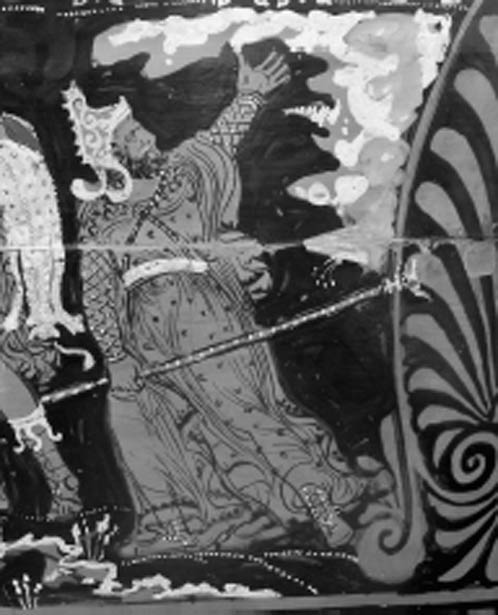
FIG. 10.2. Persian Magus-king performing fire ritual. Mithradates’ fire ceremony was carried out in the traditional manner of his Persian ancestors. Detail, red figure vase 3297, side A, Underworld Painter, 4th c BC. Staatliche Antikensamm lungen und Glyptothek, Munich.
Mithradates and his entourage ascended Buyuk Evliya Dag, to the sanctuary of Zeus the Warrior. Archaeologists have discovered many inscriptions in this important site of native Anatolian and Iranian- influenced worship. At this and many other similar shrines in Cappadocia, Zoroastrian priests, called “Fire-keepers,” tended an eternal flame (the source was petroleum) on the altar. Mithradates’ Magi, wearing high felt turbans, murmuring incantations, and waving their barsoms (myrtle wands), sacrificed white animals to fire, earth, wind, and water. Then, following old Persian custom, the chief Magus Mithradates himself dragged logs to the hilltop, creating an immense woodpile. Around the altar, he arranged trestles made of logs and branches and laid out a feast of meat and bread for the celebrants.
Mithradates donned a purple headdress studded with silver stars and the pure white cape of the Magus over his purple robe of kingship. He climbed to the top of the woodpile to pour the sacred libations: milk, honey, wine, and oil. Throwing handfuls of sweet-smelling frankincense and myrrh over the offerings, Mithradates recited a heartfelt prayer to the gods. His prayer was not recorded, but it was probably something like the prayer offered by Cyrus, according to Xenophon: “O ancestral Zeus and Helios and all of the gods, accept these offerings as tokens of gratitude for help in achieving many glorious enterprises.” After the king descended, the Magi knelt at the bottom of the high woodpile and kindled a fire with laurel fans, taking care not to pollute the sacred flames with their breath.
The spectacular bonfire to the gods burned for many days, lighting up the night sky. The heat was so intense that no one could approach the altar. The towering flames could be seen for a distance of 1,000 stades, about 115 miles, visible to Mithradates’ ships at sea. Gazing up at the fire on the mountain, Mithradates and his followers could still fervently believe in his grand destiny.29