
FOUR snow-white horses pulled the golden chariot, encrusted with gems flashing in the sun’s first rays. There was no driver. The beautiful horses galloped at full speed across the windswept cliff and plunged into the sparkling sea below.
It was dawn, the first day of spring, 74 BC. Mithradates’ magnificent sacrifice, reported by Appian, to the Sun gods Mithra and Helios, and to Poseidon god of sea and earthquakes, was performed to ensure success in the new war on Rome. The vivid image of the majestic white horses plunging into the sea persisted in the later Roman, Byzantine, medieval, and modern imagination. Some five hundred years later, for example, the early Christian writer Sidonis Apollinaris described a splendid castle in Gaul adorned by a dramatic painting of Mithradates’ sacrifice. In 1678, the English playwright Nathaniel Lee pictured Mithradates sending “a chariot, all with emeralds set, and filled with coral tridents, [and] a hundred horses, wild as wind” over the precipice.1
The grandiose ritual is ignored by modern historians, but its multicultural significance was not lost on Mithradates’ followers. Horse sacrifices to the Sun were practiced by the ancient Greeks, Trojans, Scythians, and Persians. Ancient kings of Persia sacrificed horses to honor the Sun; the Magi traditionally killed fine white horses at the Euphrates River; and when Xerxes invaded Greece, they sacrificed horses at the River Strymon in Thrace. Mithradates must also have been influenced by—and perhaps even witnessed—the great horse sacrifice of Rhodes. Each spring the Rhodians—those brilliant seafarers who had bested Mithradates’ fleet—drove a chariot and four horses into the sea to honor Helios, who guided his sun-chariot across the skies.2
For good measure, Mithradates also performed the great fire sacrifice, as he had done after his victory over Murena. After the rituals to appease these powerful male deities, Mithradates marched into Paphlagonia at the head of his army. There he delivered a rousing speech to his soldiers.
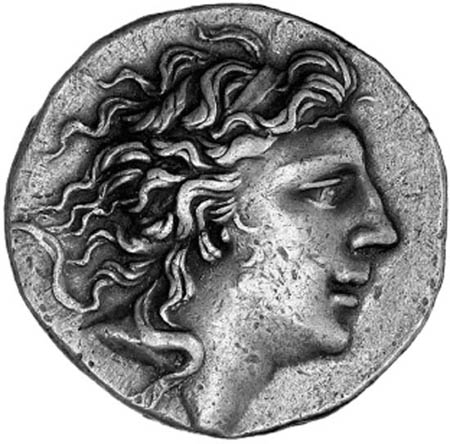
FIG. 12.1. Portrait of Mithradates, silver tetradrachm, 75/74 BC. His open mouth and manelike hair, even more windblown than previous coin images, evoke a kinetic sense of forward movement at great speed. 1944.100.41480, bequest of E. T. Newell, courtesy of the American Numismatic Society.
GROUNDS FOR WARM.
Mithradates expounded on his illustrious ancestry and described with pride how his small kingdom had grown great under his rule. Pointing out that his armies had never been defeated by Romans when he was present to lead them, Mithradates extolled his vast resources and strong defenses. The Romans, he declared, were driven by “boundless greed” to enslave everyone. “Why did the Senate refuse to sign the Peace of Dardanus? Because Rome never intended to give us peace! They intended to break the treaty all along! Now this phony will of Nicomedes of Bithynia reveals their lust to dominate us.”
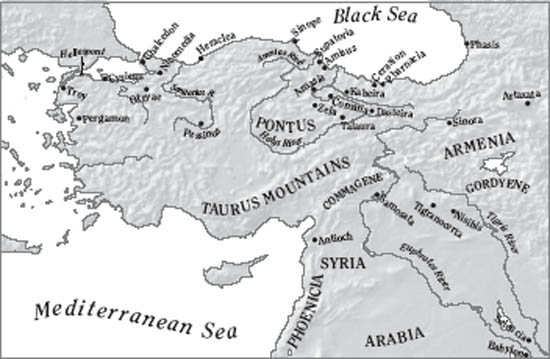
MAP 12.1. The Second and Third Mithradatic Wars: campaigns in Anatolia, Armenia, and Mesopotamia. Map by Michele Angel
Mithradates emphasized Rome’s troubles at home and abroad. “The Romans are losing the war with our new ally Sertorius in Spain. Italy is ravaged by civil strife and slave uprisings. Because of their wickedness, the Romans have not a single ally and not one of their subjects obeys them willingly!” Gesturing to his three Roman generals, Varius, Fannius, and Magius, Mithradates shouted, “Look! Some of Rome’s noblest citizens are at war with their own country and allied with us!”
After this stirring speech, Mithradates marched into Bithynia. The Roman governor Cotta fled to Chalcedon. Cyzicus sent 3,000 hoplites to Cotta, but the people of Bithynia overwhelmingly welcomed Mithradates as their liberator—they had been crushed under the heel of Sulla’s tax collectors. At Mithradates’ approach, fearful Romans rushed to Chalcedon, crowding around the city’s gates. But the gates were bolted shut by Cotta, huddling inside. When Mithradates’ army arrived, there was a pitiless slaughter. The Roman civilians and Cyzicene soldiers stranded outside the gates “perished, caught between their friends and their foes, beseeching both for mercy.”3
Meanwhile, Mithradates’ Bastarnae smashed through the massive bronze chain protecting the harbor of Chalcedon, burning 40 boats and capturing 60. Only 30 Bastarnae died in the naval battle, but more than 3,000 Roman, Chaceldonian, and Cyzicene sailors lost their lives. On land, Mithradates lost 700 men, but more than 5,000 Romans were killed and 4,500 were taken prisoner in this first battle of the Third Mithradatic War. The Roman general Lucius Licinius Lucullus, encamped on the Sangarius River, struggled to encourage his legions after this great disaster.4
Mithradates, reveling in victory, looking forward to regaining his Anatolian empire, marched on the fortified port of Cyzicus, gateway to Asia. The army of 120,000 infantrymen, 16,000 horsemen, and 100 scythed chariots trailed a horde of camp followers and road and bridge builders; Mithradates’ total forces were said to approach 300,000.5
MEANWHILE IN ROME
Lucullus, Sulla’s protégé, had become consul in Rome in 74 BC. His coconsul Cotta was sent to govern the new Province of Bithynia. Lucullus was envious of his rival Pompey (a younger and more ruthless protégé of Sulla), who was winning honors fighting Mithradates’ new ally Sertorius in Spain. Determined to be the general who would triumph over Mithradates once and for all, Lucullus schemed to keep Pompey occupied in Spain.
Sure enough, Lucullus was chosen to fight Mithradates in 74 BC. The Senate, fearing that Mithradates planned to attack Italy itself with his armada, pledged three thousand talents to raise a fleet. But Lucullus bragged that he would not need a navy to overcome Mithradates. He raised three legions himself and took command of the two “Fimbrian” legions still stationed in Anatolia, for a total of about 30,000 infantry and 2,500 cavalry.
Not only was Lucullus seriously outnumbered, but the Fimbrian legions would prove to be a problem. They had been complicit in mutinies and the deaths of their two previous generals, Flaccus and Fimbria. Tough fighters, but insolent and unmanageable, the soldiers were, in Plutarch’s words, “spoiled by habits of greed and luxury” and Murena’s undisciplined leadership. Like rotten apples, these Fimbrian legionnaires would insidiously infect Lucullus’s army with demands for booty and with outright insubordination.
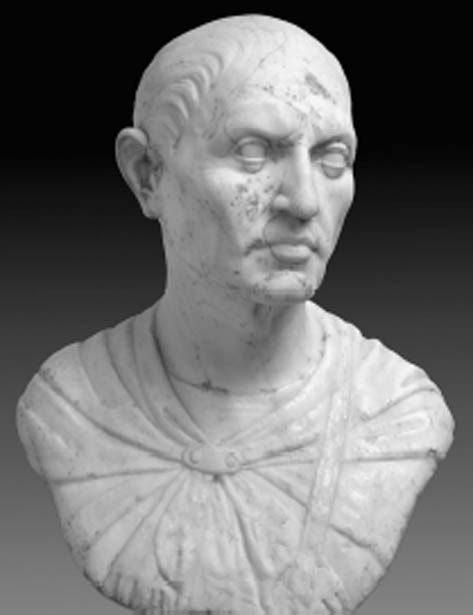
FIG. 12.2. Lucullus, marble bust. Photograph © The State Hermitage Museum, St. Petersburg.
Rome’s renewed war, to destroy the enemy Lucullus called the “new Hannibal,” was marked by ripsawing loyalties, devastating mayhem, and shocking reversals. This conflict—which has been described as a struggle between Roman oligarchic hegemony and democratic ideals of suffrage, freedom, and nationalization of land—drew participants from all corners of the classical world, from Spain to the Caspian Sea, from the River Don to the Persian Gulf. Treacherous terrain, cataclysmic weather—even celestial marvels, strange prodigies, and the gods themselves—would be players in this epic contest between Lucullus and Mithradates.6
THE FALLING STAR
Lucullus’s advisers urged him to take over Pontus, undefended while Mithradates was in Bithynia. The chief proponent was Archelaus—Mithradates’ turncoat star general. Perhaps Archelaus recalled Sulla’s earlier offer to crown him king of Mithradates’ rich Kingdom of Pontus during the negotiations at Dardanus. But Lucullus scoffed: “Why would I hunt for a wild beast in his empty lair?” Then Lucullus caught sight of the massive army drawn up by Mithradates. Stunned, he hung back—he needed a cunning strategy to overcome such an immense force.
Mithradates immediately provoked a battle, sending out an army led by the Roman M. Varius, Sertorius’s one-eyed general. At Otryae, Lucullus marched out to meet the challenge. The two armies faced each other on the plain under a clear blue sky and were just on the verge of combat.
Suddenly, the sky burst asunder. A huge, flaming object of molten silver ripped through the heavens and slammed into the ground between the two armies. The stunned armies “separated,” in Plutarch’s words, but the retreat must have been frantic. Fiction writer Michael Curtis Ford, in his adventure novel about the Mithradatic Wars, imagines the two armies pelted with a shower of clods of dirt and searing metal shrapnel as the burning celestial object plowed into the earth. Ford creates a scene in which Lucullus and Mithradates peer into the mysterious crater across from each other. The two generals lock eyes, each attempting to read the divine message that the other has taken from this event. In Ford’s fantasy, the commanders wordlessly agree to fight another day.7
What was the extraterrestrial object? Richard Stothers, a NASA meteorologist who studies ancient observations of astronomical events, analyzed this incident using the scientific categories of Unidentified Flying Objects. Because there were thousands of eyewitnesses at close range, Stothers considers Plutarch’s account credible. The blinding flash in daylight indicates a high scale of magnitude. To be clearly observed overhead by armies standing just out of bowshot distance, the flaming object, Stothers estimates, must have measured more than four feet across.
A fresh meteorite (a meteor that lands and survives impact) is usually black, leading Stothers to suggest that the bright silvery color recorded was that of an incandescent fireball or bolide—an extremely bright meteor—while it streaked across the sky, before impact. Meteorites were revered in antiquity in shrines at Pessinus, Troy, Cyzicus, Abydus, and Ephesus. No surviving ancient sources indicate that the object at Otryae was recovered and placed in a shrine. Although Stothers believes that the evidence points to a meteorite, in strict scientific terms this event must be classified as a “Close Encounter of the First Kind,” an observation at close range of a large unidentified space object that leaves no apparent physical evidence. Since Plutarch’s original Greek terminology indicates that witnesses did examine the object on the ground, it seems safe to say that the battle was interrupted by a spectacular meteorite—perhaps the meteor crater will be identified at Ortryae someday. After the impact, the witnesses compared the meteorite’s size and shape to those of a pithos, a very large earthenware storage jar with a pointed end. Notably, as meteors hurtle through the earth’s atmosphere, they can take on a tapered “nose-cone” shape, similar to a Hellenistic storage jar.
Modern historians pay little attention to this incident, except to assume that both sides saw it as an evil omen. Reinach, for example, says only that Lucullus used the ill-omened “chute d’un bolide” as an excuse to avoid fighting when outnumbered. No record survives to tell us how Mithradates’ Magi or Lucullus’s seers really did interpret this extraordinary prodigy. But we can make some educated guesses. It is true that Romans in this period feared comets, falling stars, and meteors. Both armies were alarmed and ran away. But afterward, I think it is likely that both Mithradates and Lucullus and their respective omen readers could find positive meaning in the event.
Meteors were associated with the Anatolian mother goddess Cybele, who was represented as a stone that fell to earth. Lucullus—as well as Mithradates and his circle—knew that Cybele’s sacred black stone was worshipped at Pessinus—Marius made a pilgrimage there in 98 BC, hoping for victory against Sulla. Lucullus had been present when Sulla himself was encouraged by a dream of Cybele handing him a thunderbolt. Cybele worship became popular in Rome after the Second Punic War. The Sibylline Books had declared that Rome could defeat Hannibal only if Cybele’s “sky-stone” was brought to Italy. With great pomp, her sacred meteorite was transported from Pessinus to Rome in 204 BC. So, in 73 BC, when a meteorite at Otryae saved him from a battle against vastly superior forces, Lucullus may well have considered the prodigy as a sign of Cybele’s protection.
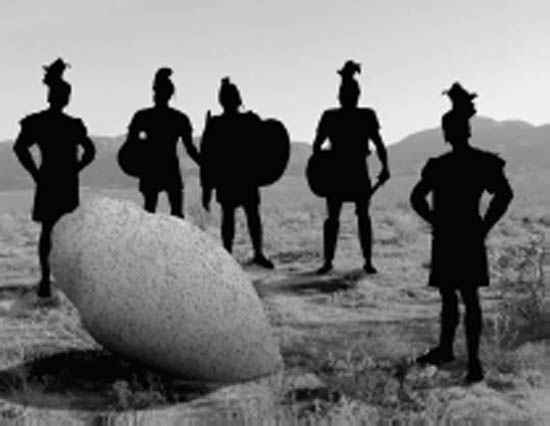
FIG. 12.3. Witnesses described the meteorite that slammed onto the battlefield between the armies of Lucullus and Mithradates as a large, flaming object that resembled a giant pithos (storage jar) of molten silver. This artist’s impression illustrates the scale and shape of the meteorite. Image by Michele Angel.
Mithradates, aware that Cybele was a goddess of victory and protector of Anatolian cities, could have seen the meteor as a positive sign too. Because the meteorite halted the battle, his seers could take it to mean that he would be victorious against Lucullus without bloodshed, or that the gods forbade a battle at that time. Mithradates and his priests usually considered a blazing light in the sky to be a good omen, recalling the awesome comets that had attended his birth, his coronation, and his massacre of Romans in 88 BC.8
After the silvery fireball from heaven aborted the battle at Otryae, Mithradates took advantage of a dark, rainy night to march to Cyzicus, undetected by Lucullus. Mithradates captured about three thousand inhabitants of Cyzicus’s chora and established what he assumed would be a brief siege to take the city.
SIEGE OF CYZICUS, 73–72 BC
Mithradates sent Metrophanes to blockade the harbor while his army camped on the slopes of the mountains. Cyzicus was losing hope—there had been no word from Lucullus since the ignominius defeat at Chalcedon. Menacing siege towers began to encircle the city walls, the work of Mithradates’ engineer Niconides. Finally, Lucullus advanced. But Mithradates’ soldiers terrified the Cyzicenes by pointing to the army far in the distance. “See those campfires? Those are Tigranes’ great armies of Armenians and Medes, come to help Mithradates!”9
Lucullus’s intelligence reported that Mithradates depended on foraging and supplies delivered by sea to feed his vast army. “All we have to do is stomp on Mithradates’ belly,” remarked Lucullus to his officers, “and simply wait for him to surrender without a fight.” But Mithradates, on the advice of Taxiles, held the mountain pass to the territory Lucullus needed to occupy, to block Mithradates’ foragers and feed his own legions. Lucullus’s men were unhappy with the idea of camping idly all winter. No chance for plunder!
Mithradates, meanwhile, received dispiriting news from Spain. His ally Sertorius had been murdered. The hero of Marius’s Populars was stabbed while at dinner with “friends.” Pompey’s legions had easily overcome what remained of the Spanish rebellion. The assassination of Sertorius was a severe blow to the Populars who had joined Mithradates. One of these was Lucius Magius, the general sent by Sertorius to advise Mithradates.
Magius told Mithradates that the two Fimbrian legions—once loyal to Marius—wanted to desert Lucullus. “So, let Lucullus camp wherever he likes,” reasoned Magius. “With those Fimbrian legions on our side, we’ll be victorious with no need for battle.” Mithradates trusted Magius and pulled his guards from the mountain pass. Crucial details are missing to explain this apparently irrational move. Was Magius a traitor? Maybe, but a different possibility was suggested by the biographer of Lucullus. Magius may have acted in good faith, based on secret communications with the unreliable Fimbrians. After all, they had betrayed two previous commanders, and they chafed at Lucullus’s restraint. The ancient historian Memnon alluded to a deal initiated by the Fimbrians that went terribly wrong.10
Whatever Magius’s true motives, to give up the pass was a grave blunder. The Fimbrians did not defect, and Lucullus now occupied the heights above Mithradates. Hemmed in by Romans and mountains, Mithradates could receive supplies only by sea. But winter would halt shipping. Lucullus could hardly believe his good luck.
Speed was key now. Mithradates attacked Cyzicus with everything he had. His men brought up battering rams and catapult towers. One stupendous tower, more than 100 cubits high (about 140 feet), supported a superstructure for raining catapult bolts, stones, and fire missiles into the city. Another immense contraption, straddling two large ships lashed together, moved into position against the city’s seawalls. This was a new version of the huge sambuca at Rhodes, with a drawbridge to allow men to swarm over the walls.11
Mithradates, like Lucullus, hoped to win without risk: both men wanted to avoid a bloody battle or long siege. Accordingly, Mithradates’ first move was to herd three thousand prisoners of war from Cyzicus onto his ships. He directed his captains to row into the harbor, in full view of the Cyzicenes defending their seawall. As Mithradates expected, the captives shouted to their fellow citizens, begging them to spare them in their perilous position.12 But the Cyzicene general was unmoved: “You are in Mithradates’ hands now—we cannot save you! Meet your fate like men!”
When he saw that the Cyzicenes would not surrender even to save their compatriots, Mithradates let down the sambuca drawbridge. The Cyzicenes were dumbfounded to see enemy soldiers running across the skyway to their walls. But the rest of Mithradates’ men hesitated to follow the first sortie, and the Cyzicenes quickly recovered from their shock. They poured burning pitch onto the ships, forcing the whole contraption to back away from the wall.
Next Mithradates deployed all his siege engines on land. Again, the city manned an amazing defense, hurling boulders to break the battering rams and wrecking the machines with gigantic grappling hooks. The defenders had draped their wooden parapets with wet hides and doused the stone walls with vinegar to fireproof them against Mithradates’ hail of fiery missiles. In Appian’s words, the Cyzicenes “left nothing untried within the compass of human energy” to repulse the attack. But, as Mithradates knew (and as modern scientists have proven), if vinegar-soaked limestone is heated enough, it crumbles. The intense heat of his fire bolts collapsed a section of wall.13
The Cyzicenes toiled all night to repair the breach. Then, “as if in admiration for their resolve and bravery,” Plutarch claims that Cyzicus was aided by female deities, who appeared to oppose Mithradates in all his wars. A tremendous winter gale suddenly toppled all Mithradates’ siege towers. Inside the city, it was time for the annual sacrifice to Persephone, protector of Cyzicus. Her ritual called for a black heifer, but the herds were in pastures across the water. Miraculously, a black heifer swam over to the city. Then Persephone herself appeared, urging her people to be resolute against the “Pontic trumpeter.” Spirits soared in Cyzicus.14
Spirits plunged in the camp of Mithradates. Was he always fated to incur the wrath of goddesses? His friends and advisers strongly counseled a retreat from Cyzicus, obviously under the protection of very powerful deities—or magicians.
But the king had received some good news. In Italy, a gladiator named Spartacus had gathered an army of six hundred slaves, which eventually swelled to seventy thousand and defeated a series of Roman legions. Spartacus was said to be Thracian; he may have belonged to a tribe allied with Mithradates. Spartacus sympathized with and apparently planned to join Sertorius’s rebellion; he may have seen military action in Greece when Sulla defeated Mithradates there. In the pantheon of Rome’s three most dangerous enemies, Spartacus stood alongside Hannibal and Mithradates. Notably, both Plutarch and Appian wrote admiringly of Spartacus’s military skill and his humane ideals. The news of Spartacus’s victories against Rome encouraged Mithradates. He had lost his ally Sertorius in Spain, but now the Romans faced a formidable foe on Italian soil.15
In another piece of cheering news, Mithradates learned that his general Eumachus (former satrap of Galatia) was victorious in southern Anatolia, killing a great many Romans there, along with their families. Yet Mithradates desperately needed to succeed here in Bithynia, before supplies ran out. He stubbornly devised an ambitious strategy. All winter, his sappers dug tunnels under the city walls, and his soldiers constructed an enormous ramp out from Mount Dindymus (ominously for Mithradates, a mountain sacred to Cybele). New siege towers were built all along this mound.
Provisions dwindled. Winter storms prevented ships from bringing Mithradates’ great stores of grain around the Black Sea. Some of his famished soldiers looking for food were captured by Lucullus, who slyly asked each man how much food was left in his cohort’s tents. From their replies, Lucullus calculated that Mithradates would run out very soon. Exulting that his strategy of “kicking Mithradates in the stomach” was working, Lucullus promised his impatient troops, whining for loot, that they would be victorious without bloodshed.
Mithradates’ generals tried to keep him in the dark about the specter of starvation. But the king soon learned the truth. He was appalled to discover his soldiers eating weeds, pack camels and mules, and even dead comrades. Plague had arisen from hundreds of unburied corpses, killing as many as the famine. There was no grass for the starving horses. Mithradates decided to send his entire cavalry on a roundabout route over the mountains for the winter. The horses, pack mules, and shaggy Bactrian camels were accompanied by a large contingent of wounded and sick soldiers. In freezing weather, the weak men and animals struggled through ice and snow.16
Lucullus pursued them with 5,000 men and cavalry. A blizzard struck; many Romans fell behind with frostbite. But Lucullus forged on and attacked Mithradates’ limping cavalry at the River Rhyndacus. Many were slain in the snow, and Lucullus captured 15,000 of Mithradates’ men, 6,000 horses, and the beasts of burden. For many of the Roman soldiers, this was their first sight of two-humped camels, imported from distant Bactria to the snows of Bithynia. Lucullus deliberately marched this long train of feeble prisoners and animals before the eyes of Mithradates’ demoralized men.17
That humiliating spectacle was compounded by more bad tidings. Galatia hated Mithradates for murdering their leading families, and now the Galatian army, allied with Rome, had driven Mithradates’ general Eumachus out of southern Anatolia.
The Cyzicenes still had plenty of grain, which they had cleverly preserved from spoilage by mixing it with Chalcidic earth (lime carbonate). Lucullus sent some Roman soldiers into the city to dig a countertunnel. They managed to trick Mithradates himself into entering his own tunnel. A Roman centurion inside Cyzicus sent a message to the king promising to betray the city. That Mithradates actually agreed to meet this man in the tunnel reveals his desperation at this point, as well as his personal courage. Mithradates went down alone into the subterranean passage. As he cautiously approached the shadowy figure, the Roman suddenly rushed forward with his sword. Mithradates turned and dove behind the tunnel’s door, slamming it shut in the nick of time!
The Cyzicenes rejoiced when yet another winter storm struck. The wind tossed up immense waves, and Mithradates’ new siege towers began to creak and sway. Suddenly a gust of wind burst forth “with incredible fury,” shattering the towers. In nearby Ilium (ancient Troy)—where the statue of Athena still stood after Fimbria’s sacking—it was reported that an apparition of Athena had appeared. The goddess, panting and disheveled, had just come from saving Cyzicus. Centuries later, Plutarch read all about the goddess’s marvelous manifestation on a marble inscription in Ilium.
Vengeful goddesses, treacherous weather, awful reversals of fortune, the irritating fortitude of Cyzicus, dreadful plague, and famine combined with Lucullus’s constant pressure convinced Mithradates that he had no choice but to withdraw. Ironically, he had a fantastic amount of gold in his camp, but no food. As a last resort, Mithradates directed his admiral Aristonicus to sail with a shipload of ten thousand pieces of gold. The idea was to bribe loot-hungry Romans with the gold while distracting Lucullus, so Mithradates and his army could escape. But someone betrayed the plan to Lucullus. The Romans captured all the gold before the ship even set sail. Mithradates’ situation was dire indeed.18
POISON PILLS
Mithradates abandoned the siege of Cyzicus. He sneaked out to his ships at night and sailed with his navy to the Hellespont, while his infantry marched overland by night. Many drowned trying to cross a river flooded with heavy snows. Lucullus set out in pursuit and slaughtered about twenty thousand men and took a great many prisoners. The survivors plodded on and took refuge in Lampsacus.
Lucullus set up a siege there. But Mithradates sent a pirate fleet to rescue his soldiers and the entire population of Lampsacus. Lucullus was left besieging a ghost town. Mithradates sailed for Nicomedia, leaving fifty ships in the Hellespont with ten thousand of his best soldiers, under the command of three generals: the one-eyed Roman M. Varius, Alexander of Paphlagonia, and Dionysus the Eunuch. Yet another winter storm swept across Bithynia; many of Mithradates’ naval divisions perished at sea.
Lucullus hurried back to Cyzicus to accept the victor’s laurel wreath, then returned to the Hellespont to raise a fleet. To mop up his victory, he divided his forces among several officers. One, Voconius, was directed to sail east to Nicomedia to defeat Mithradates. The others subdued Bithynian cities. In these places, Appian and Memnon report that the Roman armies not only fought each other over booty, but they butchered a great many people inside temples where they had sought refuge, replaying the dreadful scenes of the massacre of Roman civilians in 88 BC. Ships full of plunder, including a golden statue of Hercules, set sail for Rome, but many, massively overloaded, sank in the Black Sea winter storms.19
Near Troy, Lucullus decided to pitch his tent inside the sanctuary of Aphrodite. Goddesses had been good to him. One night, Aphrodite appeared in a dream, shaking him awake: “Why are you sleeping, Great Lion? The deer are in reach!” Lucullus hopped out of bed and discovered that messengers had arrived in the night. Thirteen of Mithradates’ warships had been sighted in the Aegean, going to join the rest of Mithradates’ fleet commanded by Varius, Alexander the Paphlagonian, and Dionysus the Eunuch at Lesbos. The Romans believed that Mithradates’ navy was poised to sail across the Mediterranean to attack Italy.20
Lucullus’s fleet pursued the three generals. But the latter drew their bronze-prowed warships up onto the beach of a small island off Lesbos. Frustrated, Lucullus sailed behind the island and sent soldiers ashore. They hiked across the island to attack the entrenched enemy from the rear. With this clever pincer movement, Lucullus trapped Mithradates’ men. Some remained ashore inside their beached ships to fight the Romans on both fronts; others tried to set sail. They were surrounded and slaughtered; the survivors fled inland.
Lucullus ordered his troops, “Spare any soldier missing an eye.” According to Plutarch, Lucullus wanted to capture Varius alive so that he could personally inflict a degrading death upon the Roman senator who had supported Marius and served Sertorius and then Mithradates. Lucullus’s men discovered Varius hiding with Dionysus the Eunuch and Alexander the Paphlagonian in a cave. Mithradates always supplied his commanders with poison for this kind of emergency. At the approach of the Romans, the eunuch broke open his capsule, gulped down the bitter poison, and died immediately.
Alexander and Varius were taken prisoner. Lucullus kept Alexander alive to be paraded as a trophy in his Triumph. The Senate awarded a formal Triumph if a commander had killed at least five thousand enemies in a single action in a foreign war. Hundreds of thousands of Romans would come to gawk at the defeated barbarians and their families, wearing their native dress and in chains, trudging behind elaborate tableaux illustrating major battles and events in the campaign, and cartloads of weapons, armor, and other spoils. At the end of the parade, captives could be imprisoned, sold as slaves, freed, or strangled before the statue of Mars, god of war. According to Appian, Lucullus immediately tortured and killed Varius on the island, claiming that it would be “unseemly” to parade a Roman senator in a Triumph.21
According to Plutarch’s sources, Mithradates’ losses were devastating. In this first campaign against Lucullus, nearly all 300,000 of Mithradates’ land forces and camp followers were killed or taken prisoner (Memnon says 13,000 were captured). Lucullus sent an official communiqué wreathed in laurel leaves, signifying a great victory, to the Senate in Rome. His letter brought great relief, since it was feared that Mithradates had intended to invade Italy by sea. Lucullus set sail for Nicomedia, where he expected to find the “wild beast” of Pontus cornered by his officer Voconius. Lucullus looked forward to personally capturing Mithradates alive for his Triumph.
But his confidence was misplaced. His man Voconius had taken a detour for personal reasons. Instead of going after Mithradates at Nicomedia, Voconius had sailed off to Samothrace, where he was busy celebrating his initiation into a sailors’ mystery cult.22Gnashing his teeth, Lucullus discovered that his prey had already departed Nicomedia, sailing for Pontus with his surviving ships. The war Lucullus had declared over was still on.
PIRATES TO THE RESCUE
Weather and goddesses turned against Mithradates yet again. Another severe storm raged across the Black Sea. Everyone said this tempest was sent by the goddess Artemis. She was enraged because some of Mithradates’ pirates had plundered her shrine at Priapus, a place renowned for excellent wine and all manner of lewd and lascivious activities. The pirates had partied there on their way to rescue the soldiers and people of Lampsacus, described above. Now high winds and towering waves destroyed about sixty of Mithradates’ ships. For many days afterward, the sea tossed up wreckage and nearly ten thousand bloated, battered corpses onto the shore.
At the height of this storm, Mithradates’ own ship, weighed down with royal equipment and treasure, was damaged, swamped by cresting waves. It began to sink. A light brigantine drew alongside. It was manned by pirates; Admiral Seleucus of Cilicia had come to rescue the king. Mithradates’ companions, fearing the buccaneer’s motives, urged the king not to abandon ship. But Mithradates and Seleucus were old friends; he respected the pirates’ seamanship. Their craft were fast and seaworthy.23
Mithradates daringly leaped overboard onto the heaving deck of the small cruiser, entrusting his life to the pirates. They disappeared into the teeth of the howling storm. His companions expected never to see Mithradates alive again.
Against all odds, Mithradates and his pirate rescuers made it to Heraclea. Some friends there distracted the citizens with a sumputous feast outside the city, while Mithradates, Seleucus, and his pirates sneaked in. The next morning, the king assembled the populace, greeted them cheerfully as their liberator, and distributed gold and silver coins to everyone. Leaving a garrison of four thousand men with his Galatian commander Konnakorix at Heraclea, Mithradates and his pirates sailed away through rough seas and foul weather, home to Sinope.24
From Sinope, Mithradates sailed on to Amisus. Taking stock there, reflecting on his miraculous multiple narrow escapes from the jaws of death, Mithradates remained optimistic. The situation was certainly perilous, but his subjects in Pontus were steadfast and willing to fight bravely against the Romans. What would Lucullus do now? Would he withdraw, assuming he had neutralized Mithradates, or would he pursue and invade Pontus? As usual, Mithradates intended to cover all contingencies.
Mithradates could not allow his extended family and harem to fall into Roman hands. It was intolerable to think of the terror, rape, and torture they would suffer before being dragged to Rome and killed in the wolves’ den. Several of his children were already safe in the Bosporan Kingdom. Other members of the royal family, including his sister Nyssa, were confined in the towers of Kabeira. His lover Stratonice and son Xiphares were also in Kabeira. Drypetina, Mithradates’ doting daughter with double teeth, was the Lady of Laodicea—she now moved for safety to the fort at Sinora, accompanied by Menophilus, a trusted eunuch-doctor.25
Mithradates decided to send the rest of his royal household to a fortress in Pharnacia, on the rugged east coast of Pontus, the land of his old allies the Turret-Folk. Eunuchs accompanied this caravan, which included the two spinster sisters Roxana and Statira, Queen Monime, and the Chian concubine Berenice and her mother.
Descending into his secret vaults at Sinope, Mithradates filled a chest with a large quantity of gold and precious gifts. He ordered a courtier to deliver this treasure to his allies in Scythia, in exchange for more aid. But unbeknownst to the king, this man was more of an opportunist than an optimist. He defected and delivered the treasure to Lucullus. Undeterred, the king sent messengers to his son Machares, viceroy of the Bosporus, and to his son-in-law Tigranes, requesting assistance. Mithradates placed the city of Amisus under the command of his master of siegecraft, Callimachus. With his friend Dorylaus, the Magus Hermaeus (a Greek-Bactrian name), and the rest of his inner circle, Mithradates traveled to his stronghold at Kabeira for the winter of 72/71 BC.
From this secure base, he and Dorylaus raised a new army, bringing together about forty thousand foot soldiers and four thousand cavalry. Most modern historians assume that neither Machares nor Tigranes replied to Mithradates’ urgent messages. But these new reinforcements surely came from Scythia and Armenia. According to Memnon, Macha-res did intend to send grain and supplies to Sinope, and Mithradates’ daughter Cleopatra convinced Tigranes to help her father.26 Some reinforcements went to defend Amisus and Sinope. Mithradates also stationed garrisons and scouts along the routes to Kabeira to watch for Lucullus’s approach in spring. He placed Phoenix, his son by a Phoenician concubine, in command, with orders to relay fire beacons from the borders to Kabeira, to signal Roman troop movements.
Lucullus was in a jam. He had officially—and prematurely—declared victory over Rome’s most feared enemy, and then let Mithradates slip away. Meanwhile, the detestable Pompey not only had smashed the insurgency in Spain but took (many said unfairly) all the credit for putting down the great slave uprising in Italy. Spartacus was killed and six thousand of his followers were crucified on the Appian Way. For very different reasons, this dramatic news dismayed both Mithradates and Lucullus. Mithradates had lost an important political ally in Italy; Lucullus’s rival Pompey was now ascendant in power.
Lucullus’s own supplies were running very low. Morale in his legions was rocky, the soldiers carped at the lack of looting opportunities. Many in Lucullus’s command urged him to abandon the war. Lucullus ignored their advice. Realizing that the only way to stop Mithradates was to kill him, Lucullus ordered his army to invade Pontus—just as Mithradates had anticipated. To do this, Lucullus had to hire thirty thousand Galatians. Each of these human beasts of burden lugged a bushel of wheat on his shoulders, slogging along behind the Roman legions.27
Invasion of Pontus
As the Romans crossed into western Pontus, they found untold wealth and abundance. Lucullus’s soldiers seized so much booty and so many prisoners that the glut drastically devalued everything. The price of a male slave dropped to four drachmas and an ox sold for one drachma (a soldier’s daily wage). As they marched across Mithradates’ land of plenty, the soldiers who had howled for booty now abandoned or destroyed their worthless loot and captives.
Lucullus left troops to besiege Amisus and Eupatoria and sent another legion to besiege Themiscrya, a remote castle on the River Thermodon, one of the fabled lands of Amazon horsewomen. Mithradates had sent men and weapons to these cities. At Amisus, the defenders constantly raided the Roman camp, and even provoked the legionnaires into single combat, as if they were reenacting the glorious duels of Homer’s champions on the fields of Troy. At Themiscrya, named for an Amazon queen, the Romans toiled underground digging “tunnels so large that great subterranean battles were fought in them.” But Lucullus’s men abandoned the siege after the defenders resorted to wildly unconventional tactics. They tossed hives of furious bees into the tunnels. Then, while the frantic Romans flailed at the stinging swarms, the ingenious Themiscryans released wild beasts—weasels, foxes, wolves, boars, and bears—into the underground passages.28
While these Romans contended with Mithradates’ stalwart, resourceful subjects, Lucullus himself led most of his legions on a wandering course around the Pontic countryside that fall and winter. Leaving rich and sophisticated western Pontus far behind, they entered the territory of rustic tribes like the Chalybes and Tibareni. Ironically, Lucullus had no idea that this wild landscape hid more than seventy secret fortresses and secret treasuries built by Mithradates.
Lucullus busied his men raiding tiny villages and ravaging orchards. A gourmand, Lucullus was enchanted by the luscious red fruits of Cerasion (“city of cherries”). Cherries were unknown in Italy. Carefully stashing away the pits from his repasts, Lucullus also dug up several cherry saplings to bring back to Rome. Perhaps he was emulating Alexander the Great, who had introduced the Armenian apricot tree to Greece. In the opinion of his impatient men and officers, however, Lucullus seemed to have completely lost focus, coddling trees and ordering useless raids. They agitated anew for battle and loot.
“We haven’t taken a single city by storm! Why are we wasting time raiding these worthless villages of poor tribes? When will we enrich ourselves with plunder? Why are we leaving Mithradates’ wealthy city of Amisus behind? Why should we follow our feckless general into the wilderness, while our greatest enemy rebuilds his army?”
“That’s exactly why we are lingering here!” Lucullus retorted in a speech to his army, justifying his strategy of delay. “I am waiting for Mithradates to become powerful again! I want him to gather up a force that will be worth our while to fight and so that he will stand his ground at Kabeira instead of fleeing again. Don’t you see that he has a vast and trackless wilderness to fall back on? The Caucasus Mountains could hide ten thousand wily enemy kings like Mithradates!”
Lucullus remembered the advantages enjoyed by Jugurtha and his son-in-law Bocchus, who repeatedly vanished into the North African hinterlands and surged back with new forces. His warning about Mithradates’ ability to disappear into the Caucasus was more prescient than he knew.
Lucullus also raised the daunting image of Tigranes’ vast hordes. “Only a few days’ ride from Kabeira lies Armenia, ruled by Tigranes, King of Kings, Mithradates’ son-in-law. Tigranes rules such armies that he levels cities and transplants entire populations, subduing Parthia, Syria, Media, Palestine, murdering the rightful rulers and ravishing their wives and daughters! Tigranes is eager to make war on Rome—if we drive Mithradates into his arms, then we’ll have to fight Tigranes the Great and his Medes and Armenians! No,” declared Lucullus, “we’ll give Mithradates the time to gather up his own motley forces and muster up fresh courage. Then we’ll crush him forever at Kabeira.”
Lucullus was an able and fair commander, trying to stave off a strike by his men—most of them landless, homesick legionnaires seeking riches and glory, exhausted by years of duty in Anatolia since the First Mithradatic War. As Plutarch foreshadowed, Lucullus, a Roman aristocrat who lacked rapport with the common soldier, underestimated his men’s grievances, “never dreaming that their resentment and insubordination would later send them to commit acts of madness and mutiny.”29
THE BATTLE FOR KABEIRA
In spring, Lucullus finally marched on Kabeira. Warned by the fire signals sent by his son Phoenix from the watchtowers, Mithradates himself led four thousand cavalry to meet Lucullus. His fierce horsemen—Scythian nomads—sent the Romans fleeing in terror. Lucullus’s bravest cavalry officer was captured. He was taken to Mithradates’ tent, grimacing in pain from several arrow wounds. “Will you be my friend if I spare your life?” asked Mithradates, smiling encouragingly. “Only if you surrender to Rome,” the soldier shot back, “otherwise I remain your foe!” The king admired the Roman’s spirit and spared his life.30
Phoenix, Mithradates’ son by a courtesan, was torn between filial loyalty and fear of defeat. Phoenix dutifully relayed signals to warn his father of Lucullus’s approach, but then deserted to the Romans, bringing along his scouts. Lucullus was stymied, however. How to avoid Mithradates’ superior cavalry? There was no way to sneak up on impregnable Kabeira, defended by mountains and thick forests. Luck was with Lucullus. His men happened to capture two Greek huntsmen. They agreed to guide the Romans up a mountain trail to a stronghold overlooking Kabeira. At nightfall, Lucullus lit all his campfires as a ruse. Then he and his army followed the hunters up switchbacks and over a deep ravine by an arched stone bridge (its foundations still exist). Lucullus set up camp by dawn, with a view of Mithradates’ camp at Kabeira, just out of reach. Stalemate—neither commander dared to risk outright battle.31
One day Mithradates’ men went hunting. Chasing a stag, they were cut off by some Roman horsemen. Watching from their camp high above the skirmish, Lucullus’s men cheered. But Mithradates’ reinforcements arrived and routed the outnumbered Romans. Lucullus bravely rode down to the plain alone and ordered his fleeing cavalrymen to wheel around and attack Mithradates’ force. His disciplined audacity won the day.
In another battle at Kabeira, Lucullus’s men were winning. This time it was Mithradates in gleaming armor who leaped on his white horse, galloped out alone, and rallied his men. The king—remarkably fit and courageous for a man over sixty—led a formidable cavalry charge, sending the terrified Roman army crashing though the trees up the mountainside.
Mithradates sent messengers throughout the land proudly announcing this impressive victory over the Romans. His spies reported that Lucullus, low on supplies, had sent out ten cohorts (about five thousand men) to Cappadocia to get grain. Here was a chance for Mithradates to stomp on the Roman belly, as Lucullus had done to him at Cyzicus.32
Mithradates dispatched Menander to intercept Lucullus’s convoys returning from Cappadocia. Constant battle stress and inconclusive outcomes were beginning to fray nerves, interfering with judgment. Menander’s advance cavalry caught the Roman supply train, marching single file down a steep trail into Pontus. But Menander was too impatient to wait until they reached the open plain. His cavalry horses slipped on the rocky trail, and the Roman foot soldiers were able to force the men and horses over the cliff. A few cavalry reached Mithradates’ camp before the others. They exaggerated the calamity into a disaster of great magnitude, claiming they were the sole survivors. As Appian remarked, the losses were large but not overwhelming, yet the rumors whipped up fear in Mithradates’ camp.
Mithradates remained steady. He sent out another large force to cut off another of Lucullus’s returning convoys led by Adrian. But Mithradates’ forces really were annihilated his time. According to Plutarch, only two survivors returned to Kabeira. Mithradates tried to hide the extent of this true catastrophe. Plutarch says he blamed “this slight setback” on the inexperience of his generals. But when Adrian “marched back pompously past Mithradates’ camp,” showing off hundreds of wagons groaning with grain and the armor and weapons of Mithradates’ dead cavalrymen, everyone in Kabeira—already tense—learned the terrible truth.
Finally, after this string of disasters, including the loss of his navy, Mithradates’ optimism deserted him. A “great despair fell upon the king,” reported Plutarch, and his soldiers were seized by “confusion and helpless fear.” As soon as Lucullus received the news of Adrian’s victory, he would attack Kabeira. That night, Mithradates called his close companions—Dorylaus, the Magus Hermaeus, eunuch-advisers Bacchides and Ptolemaeus, and his generals—to his tent. All agreed that flight was the only option. The plan was to meet at Comana, the rich, fortified town of the Temple of Love, and then seek refuge in Armenia with Tigranes. Before dawn, each man hastily packed his own baggage on horses outside the gates, and helped to load a mule train with bag upon bag of gold, royal regalia, and treasure.33
I imagine that Mithradates followed the practical advice of his old friend King Parisades of the Bosporus: “Always wear your finest costume to address your soldiers. But when it is necessary to flee, put on commoners’ clothing to conceal your identity from the enemy as well as your subjects.”34 Changing from royal garb into nondescript apparel for the flight, Mithradates concealed his daggers and essential drugs under his clothes. He had one final task before daylight. As Appian tells us, in “utter despair for his kingdom,” Mithradates assigned the eunuch Bacchides to carry out a terrible mission. The eunuch was to ride to the castle at Pharnacia. There he was to put to death the royal harem before the Romans could find them.
Mithradates planned to give the general order for retreat at daybreak. But his frightened soldiers heard the commotion in the night and jumped to the conclusion that their high command was abandoning them. Panic raced through the camp. Fear mingled with rage scattered soldiers helterskelter in the dark. In the chaos, the men attacked their own baggage trains. Mithradates dashed out of his tent and ran among his soldiers, shouting and pleading for calm in every dialect he knew. His second in command, Dorylaus, throwing on his purple robe, rushed out to join the king in the tumult. They tried to reassure the crowd that they were not abandoning them, that all would depart together at daylight.
But no one could hear the king’s words in the mad crush. He and Dorylaus were separated. Hermaeus, the royal seer, was one of those trampled to death by the mob at the gates. And Mithradates? The king was swept up—alone and on foot—in the torrent, borne along by the crowd surging out onto the dark road to Comana.
Without his diadem and finery, Mithradates was an anonymous figure in the fleeing throng. Far behind, at the gates of Kabeira, desperate soldiers were still pillaging the baggage train of the king’s friends. Some seized fine horses, while others murdered for an officer’s fancy dagger, another man’s glittering rings, or someone’s money belt of gold. It was in this frenzy that Dorylaus—Mithradates’ steadfast companion since their childhood and years in exile—met his end. Dorylaus was stabbed to death by one of his own men for the possession of his purple cloak.35
When Lucullus received the news of Mithradates’ flight, he sent his cavalry to pursue the fugitives. Strict orders: the king was to be captured alive, along with his private papers. Lucullus himself led his infantry to take Kabeira. As they surrounded the city, still a scene of confusion and hysteria, Lucullus ordered the legionnaires to refrain from killing anyone and to hold off looting, until they could impose order. But the men, extremely resentful at having been starved of loot for two years and contemptuous of their leader’s restraint, refused to listen. Dazzled by the eye-popping riches of Kabeira—silver vessels, jewelry and gems, royal ornaments, and exquisite purple and gilt-embroidered garments—the Romans snatched up whatever spoils they could carry. They set about killing indiscriminately. Lucullus stood by powerless to stop them.
At last, while his exhausted legionnaires slept cradling their treasures, Lucullus investigated the desolate palace, castles, and towers of Kabeira. He found even more treasure stored in vaults. He also found dungeons; breaking the locks, he discovered many relatives of Mithradates, long given up for dead. Plutarch described their release as “more of a resurrection than a rescue.” Among these wretched souls was Nyssa, Mithradates’ younger sister. For nearly forty years, since she was a little girl, Nyssa had been hidden away so that she could never marry. Nyssa joined Mithradates’ captive general Alexander, to be paraded later in Lucullus’s Triumph. No records explain exactly how Stratonice and her son Xiphares escaped—but somehow they reached the secret stronghold of Kainon Chorion, undetected by Lucullus.
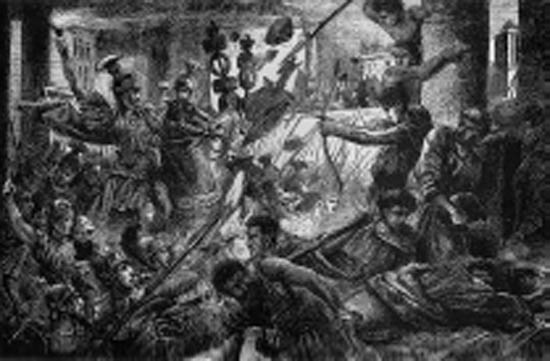
FIG. 12.4. Lucullus’s soldiers sacked Mithradates’ fortress and residence at Kabeira. Artist unknown.
While Lucullus took possession of Kabeira, Bacchides arrived in Pharnacia to carry out his grim duty. He was the perfect choice. Strabo described this eunuch as a ruthless paranoid, always suspecting treachery. Bacchides enlisted the help of the other eunuchs to execute Mithradates’ family in the most expedient ways at hand, to prevent their capture by a mob of Roman soldiers.
Detailed descriptions of that harrowing night were related by Plutarch, who had access to the accounts of witnesses who were later captured or deserted to the Romans. The scene in all its poignant horror has inspired artists, composers, poets, and playwrights to imagine the tragedy. Among the women at Pharnacia were young Berenice and her mother, rescued from their enslaved island of Chios, only to die now on the stormy shores of the Black Sea. Monime, the intelligent Greek beauty who had resisted Mithradates’ gold, holding out for the diadem and title of queen, was also in Pharnacia. Plutarch wrote, “Bacchides ordered them all to die, in what ever manner each woman deemed easiest and most painless.” The eunuch’s inner thoughts are unknowable, as he stood there with his dagger in one hand and a chalice of poison in the other. But the last words of some of the women were recorded for posterity.36
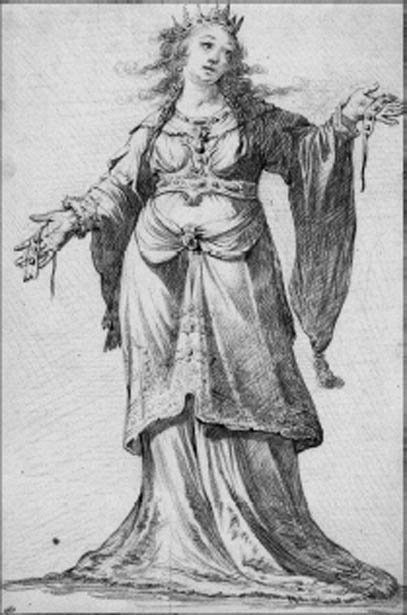
FIG. 12.5. Mithradates’ queen Monime tried to hang herself with her diadem, a tragic scene popular in early modern Europe. Drawing, Claude Vignon the Elder (1593–1670), Louvre, Réunion des Musées Nationaux/Art Resource, NY.
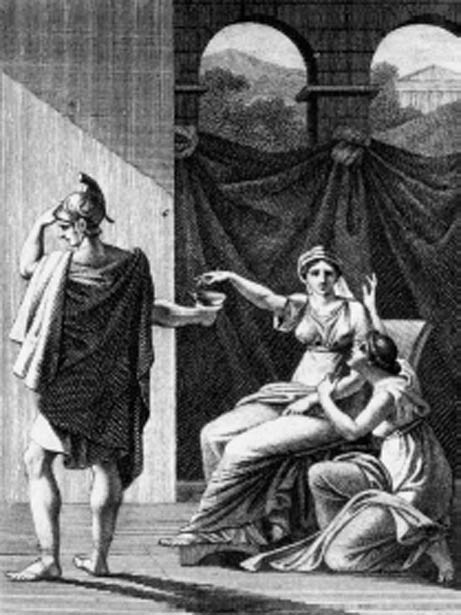
FIG. 12.6. Mithradates’ sisters Statira and Roxana take poison. Illustration for Racine’s play Mithridate, engraving by P. J. Simon.
Monime bewailed her unhappy marriage. Tearing off the purple ribbon that decorated her hair, she twisted it in her hands, sobbing. “I traded my freedom and beauty for captivity, surrounded by barbarian eunuchs!” Mithradates, she claimed, had once promised to take her to Greece, where she had hoped to find happiness. “All the blessings I yearned for are nothing but dreams!” Monime knotted the diadem around her neck and hanged herself from the rafters. But the ribbon snapped. Clutching the frayed ends in her fist, she screamed, “You cursed bauble! You have never been any use to me, not even for hanging!” She spit on the diadem, hurling it away. Monime bared her throat to Bacchides’ knife.
Berenice took the cup of poison. As she lifted it to her lips, her mother cried out, begging to share the same cup. Together they drank the poison, the daughter making certain that her mother drank more. The dose killed the older woman immediately, but Berenice was young and strong. “As Berenice was long in dying, and Bacchides was in a hurry,” writes Plutarch, the eunuch strangled her.
Mithradates’ two unmarried sisters, Roxana and Statira, in their forties, were next. Both chose poison. Like Monime, Roxana was embittered, heaping curses upon her brother. But Statira drank calmly from her cup, without uttering a single reproach. Instead, Statira asked Bacchides to convey her thanks to her brother. For even when his own life was in danger, she declared, he had not neglected his sisters and concubines. She praised Mithradates for ensuring that they would not suffer at the hands of the Romans but would die in eleutheria, freedom.37