
DREADING that his enemies in the palace would succeed with the sword what they had failed to accomplish with poison,” Mithradates was compelled to protect himself.1 There were only two choices. Young Mithradates could remain in Sinope dominated by his treacherous mother, hoping to survive until he was old enough to wrest power away from her. Or he could take decisive action, the sort of path advocated by Sinope’s philosopher, Diogenes. Mithradates’ destiny, promised by oracles and comets, demanded that he seize the second option.
In devising a plan, Mithradates could consider the experiences of Cyrus of Persia, Alexander, and Mithradates I, the founder of the Pontic Kingdom. Each had left home and family for a period of time before assuming power. While in exile, these leaders gained wisdom, faithful followers, political clout, and popular favor. The rebel leader Aristonicus had also found refuge and support in the Anatolian heartland.
Listening to Persian tales of his ancestors and reading Xenophon’s writings, Mithradates could identify with Cyrus the Great, whose enemies had tried to kill him as an infant. At age thirteen, Cyrus left the royal palace at Susa and lived in Media, eventually returning to become ruler of all Persia. In action-packed descriptions of Cyrus’s big-game hunts and other adventures, Xenophon told how the future king of Persia and his friends learned self-reliance and decision making through daring exploits together in the Iranian highlands. In Xenophon’s On Hunting, written for young Greek noblemen, a boy could find exciting anecdotes and practical advice. The experience of hunting together instilled virtue, leadership, and military prowess in adolescent aristocrats. Xenophon not only detailed all the proper clothing, equipment, and methods for chasing game, but the great Greek general declared that excellence in the hunt naturally produced heroic warriors and commanders.
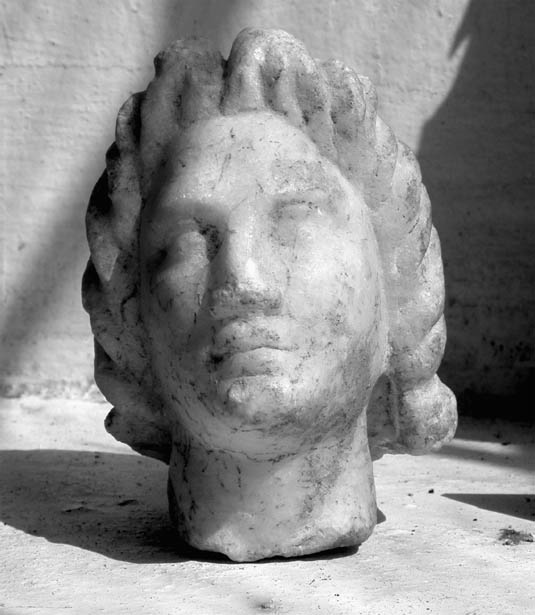
FIG. 4.1. Youthful Mithradates, marble head (3 inches high) from miniature statue, discovered in 1992 in the temple on the acropolis of Pantikapaion. Zin’ko 2004 and Kerch Museum, “Ancient Sculptures,” Kiev, 2004. Photo courtesy of Jakob Munk Højte.
Mithradates’ hero Alexander had loved to hunt with his friends—they relaxed by chasing rabbits and weasels and proved their manhood by killing lions and bears. A headstrong, reckless teenager, Alexander was famous for risking danger in both hunting and war. Mithradates surely envied Alexander’s opportunity to go on his own authority to battle at age sixteen, while his father was away. Later, during a family crisis, Alexander summoned his companions and rode off to the wilds of Illyria, in the far west of the Macedonian Empire. There Alexander and his friends lived on their own by hunting. When Alexander’s father was murdered, Alexander had to act quickly to win the trust of the Macedonian army. Ideas for a similar venture, one that would combine hunting with statecraft, began to take form in Mithradates’ mind.2
According to Justin, Mithradates came up with “a bold plan that called for great resourcefulness and perseverance.” Justin’s account is terse but revealing: beginning in childhood, Mithradates was fixated on survival. On guard against plots, especially poisoning, he fortified himself with antidotes and athletics. After his father’s death, Justin says, Mithradates and some companions disappeared from Sinope. For seven years, they never slept under a roof and survived by hunting, bivouacking in the mountains. The young king built endurance by chasing wild beasts on foot and outrunning them when they turned to attack him. Sometimes, like the Greek superhero Hercules, Mithradates even dared to pit his might against dangerous wild animals by wrestling and killing them bare-handed.3
Justin is describing exactly the kind of Greco-Persian aristocratic “boy scout” activities encouraged by Xenophon. By these methods, says Justin, Mithradates not only evaded the attempts on his life, but also developed great strength and passed amazing tests of stamina and courage. After seven years away, Justin writes in his concise style, Mithradates returned to Sinope, dealt with his enemies, and began his reign.
Regrettably, the laconic Justin is our only surviving source for this important period, the time after the assassination of Mithradates’ father in about 120 BC until the beginning of Mithradates’ independent reign in about 115 BC. Because Justin was condensing the lost work of another historian, Trogus, his version omits, conflates, or repeats some events. If only we had Trogus’s original full accounts! Some modern historians, faced with inexact dates, reject Justin’s chronology altogether, pointing out that statues and inscriptions honoring Mithradates and his younger brother were erected in Delos in 116/115 BC, five years after their father’s murder, while Mithradates was supposed to be away from Sinope. But Queen Laodice could easily have erected statues and inscriptions on behalf of the young coheirs, during Mithradates’ absence. Indeed, this would have been a wise propaganda move to counter rumors that the missing prince had been done away with. In response, Mithradates’ supporters might have issued coins featuring his birth comet while he was in exile, as a way to advertise the young king’s destiny and prepare for his eventual return. Both factions had good reasons to publicize his image while Mithradates was absent.4
It is true that Justin’s “seven years” is a suspiciously mythic number: seven often stands for “several years” in folklore contexts. Stripped of the folkloric flourishes, however, Justin’s account is neither sensational nor illogical. There is nothing incredible about the idea that Mithradates disappeared after his father’s murder. He faced real peril in Sinope: there are many examples of murdered royal children in this era. There is no reason to doubt that the crown prince departed with some companions in the manner described by Justin (and perhaps detailed by Trogus). We cannot know exactly how long Mithradates was actually away, but four or five years is a reasonable interval.5
How did Mithradates organize his escape? What happened during the most mysterious period of Mithradates’ life, the years between his father’s murder and the day that Mithradates returned to power? What follows is a plausible scenario for how Mithradates’ self-imposed exile might have unfolded, based on known facts and informed speculation.
THE PLAN
The journey was not a spontaneous lark but would have required months of meticulous planning. A secretive, creative, and daring youngster, sure of his place in history, Mithradates thought up a strategy that recapitulated episodes from the lives of his heroes and incorporated his love of the hunt. The royal heir of Pontus was surrounded by close friends his own age and a little older, including some noblemen in their twenties. This circle of comrades replicated the elite retinues that had surrounded Alexander and Cyrus.
Mithradates’ best friend Dorylaus helped with logistics. His life was threatened too. As the nephew of the murdered king’s general Dorylaus, young Dorylaus would have been targeted by the conspirators in the palace. We can imagine the two boys whispering late into the night, deciding who among their schoolmates could be trusted to accompany them. Mithradates’ spoiled little brother, Mithradates the Good, was not included. From inscriptions on portrait busts found in Delos, we have the names of some of Mithradates’ closest associates in his early reign. Some may have been members of his youthful entourage, such as Gaius son of Hermaeus, and Diophantus son of Mithares, and Gordius, the Cappadocian who became Mithradates’ special envoy.
The runaways expected to keep on the move for some years, until they felt strong enough to seize victory. Too large a group might attract attention. A group of eight or ten could efficiently hunt and provide for themselves. Mithradates must have radiated confidence and intellect by age fourteen or fifteen, to have such devoted companions who agreed to follow him in exile. Impelled by friendship and adventure, they could also hope for great rewards. They knew that Alexander’s companions had inherited his kingdom. The incentive for Mithradates and Dorylaus was powerful: they were running for their lives.
Now, with the plan roughly plotted out, Mithradates talked incessantly about hunting; Justin tells us he “feigned a great passion for the hunt” before he disappeared. His band stayed away longer on each outing, without drawing suspicion. Maybe the group cached provisions and coins in secure outposts during forays before the big day. The young king could requisition extra horses from the royal stable for an extended hunting trip. After all, hunting was his favorite activity, an obsession really. I imagine that Mithradates and his friends were prepared to depart by 118/117 BC. Mithradates could portray the expedition as a special occasion to celebrate his sixteenth birthday and his first year as the boy-king of Pontus.
As Mithradates and his companions rode out after his birthday banquet that spring, each wore practical hunting attire of subdued colors, as recommended by Xenophon—no bright white or purple! The young men wore dun-colored tunics, hats, short woolen cloaks, and high leather boots; some wore Persian trousers, like Mithradates. Their leader was distinguished by his simple diadem and a heavy gold signet ring with the royal seal of Pontus. Each boy took a pair of javelins, staff and cudgel, bow and arrows, sword and dagger. Favorite hounds trotted alongside the pack horses loaded with bedding, nets for big game, cups and utensils, personal items such as musical instruments, gaming pieces, fishing hooks and line, and best-loved books. Each adventurer carried a leather pouch bulging with coins for necessities and food, and to reward citizens of Pontus. Money would also be needed for temple dedications.6
Mithradates could procure a map of Pontus, and information about mountain ranges, rivers, and springs; towns and villages, fortifications, temple precincts; royal highways, minor roads, and trails over mountain passes.7 The group had long ago scouted out their first campsite, a full day’s ride away. The boys bid casual farewells to families and friends, acting as though they would soon return, but knowing they would not see them again for several years—if ever.
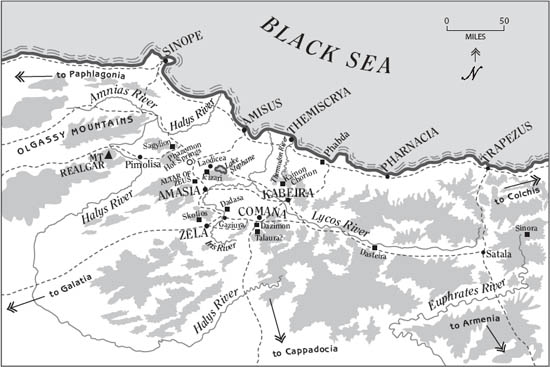
MAP 4.1. The Kingdom of Pontus. Map by Michele Angel.
OUTWARD BOUND
At sunrise, the band set out south from Sinope’s gates, taking the middle fork over the hills to the Amnias River valley. The west fork headed along the rocky coast to the tiny coves of Paphlagonia; the east route followed the coast to Amisus. The mountains and valleys of Anatolia run east-west. Crossing the foothills, the hunting party forded the Amnias and turned their horses southeast on the old Persian road along the Halys River. On the riders’ right rose heavily forested mountains with good campsites, pure water, and excellent hunting. But they would not linger within reach of Sinope. Crossing the stone bridge over the Halys, the riders continued past small villages along the ancient road. The first nights were filled with excitement tinged with anxiety at the enormity of their mission.
The conversation might have turned to poisons as the group bypassed the road to the fortress guarding Mount Realgar Mine, where slaves dropped dead from inhaling the grievous fumes of Sinopic red earth. This deadly substance—arsenic—was probably what killed their king, Euergetes. Mithradates intended to continue his toxicological studies, looking forward to testing new pharmaka in the field. To live long enough to attain all the ambitious goals he had set for himself, he needed to perfect his antidote.
But first, keeping in mind Alexander’s first move after the assassination of his father, Mithradates understood how vital it was to win the trust of his father’s military commanders in the kingdom. Many might regard him as the puppet of his powerful mother, unlikely to live to celebrate his twentieth birthday. He had to send a strong signal to Pontus’s armies to assure them that Mithradates VI Eupator was now their leader in fact as well as name. He must convince them that he had a real strategy for regaining power in Sinope. They needed to know that Mithradates would bring glory to the kingdom and wealth and victory to its warriors.
In the first century BC, Pontus and the other eastern territories of Anatolia resembled a medieval feudal landscape. A system of roads connected major cities; minor routes linked villages, temple lands, and hereditary estates; and there were many horse trails and footpaths. Castles and strongholds guarded strategic locales. Mithradates’ logical first goal would have been the citadel of Amasia, about 150 miles from Sinope.
At the next major crossroads, Mithradates’ party reached the Iris River and a well-known spa called Phazemon, where the travelers made dedications to the healing god Asclepius and to the lovely nymphs who were said to frolic in the warm springs. Refreshed after relaxing in the medicinal baths, the young riders continued to Amasia.There was no reason to avoid the main roads; they were not yet missed in Sinope. Near Amasia, they ascended the hilltop Temple of Zeus Stratios (leader of armies), where Mithradates had often watched his father perform fire sacrifices at the high altar (Mithradatids worshipped Zeus as a form of Ahuramazda/ Mithra). Perhaps Mithradates himself now performed the ceremony for the first time. The ruins of this altar, with inscriptions dedicated to Zeus, are still visible today.8
Queen Laodice’s power lay within the palace at Sinope and perhaps extended to a few nearby towns. Mithradates’ father’s friends and troops still controlled the fortifications of Pontus; they would welcome Mithradates and his companions. The citizens of thechora (countryside) were faithful to the murdered king and his son, and Amasia was the home of Dorylaus’s family. The historian Strabo lavished praise on the beauty and strategic position of his native Amasia, the former capital (the royal residence was moved to Sinope in about 183 BC). The fertile valleys of the chora were famous for fruit and grain, and rich silver mines lay to the northwest.
Amasia was guarded by an impregnable fortress perched on twin peaks connected by a natural rock bridge. Subterranean staircases and several secret reservoirs enabled the fort to withstand long sieges (these features can be seen today in the ruins at Amasia). When Mithradates and his company arrived, the soldiers showed the king these secret passages and water tanks, and outlying watchtowers that communicated with Fortress Amasia. This was just the sort of valuable knowledge Mithradates needed to have as commander of Pontus’s armies.9
Writing a few decades after the death of Mithradates, Strabo visited all of the old Mithradatic strongholds. He climbed up to the ancient stone tower at Sagylion in the chora of Amasia, overlooking the hot springs. This tower, noted Strabo, contained yet another large reservoir, once “very useful to the kings of Pontus.” By Strabo’s day, however, all of Mithradates’ secret cisterns were bone dry, choked with huge boulders on the orders of Pompey the Great after the end of the Mithradatic Wars.10
But on that fresh spring day in 117 BC, the fragrance of apple blossoms on the breeze, Mithradates and his friends ascended Sagylion Tower and Amasia’s walls to inspect the fortifications and admire the view. From the bracing heights north of Amasia, they could gaze down on the treeless plain around Lake Stephane some miles away. By the lake, one could make out Laodicea, founded by Mithradates’ mother after his father’s murder. She had accepted Roman loans—money from slavery and taxes bled from Anatolia—to build an extravagant lakeside villa and Castle Icizari on a limestone bluff. As he surveyed the scene, Mithradates could not suppress a grin. His mother had located her castle based on proximity to the hot springs and the pretty lake. She was thinking of ease of travel and entertaining, instead of a defensible location.
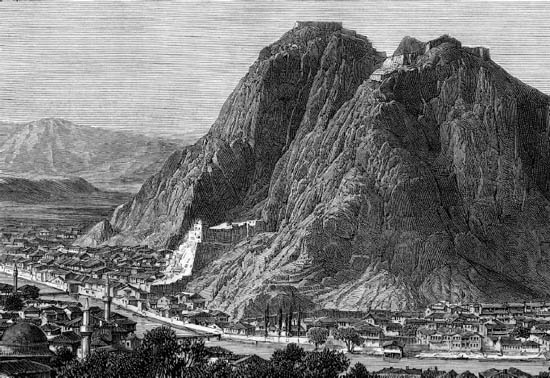
FIG. 4.2. Amasia, former capital of Pontus. Ruins of the Mithradatic fortress are visible atop the peaks, high above the Iris River. Engraving, Taylor, 1884, courtesy of F. Dechow.
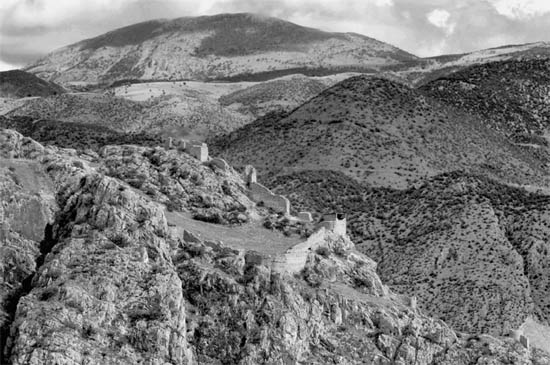
FIG. 4.3. Ruins of Amasia’s fortifications on the peaks above the Iris River. Photo courtesy of Dick Osseman, 2007.
After the end of the Mithradatic Wars, Strabo visited Lake Stephane, reporting it to be jumping with fat fish. But Strabo found Laodice’s fine palace a pile of rubble, overgrown with vines, surrounded by fields of grain. Her castle was deserted, but still standing. Today one can still see Castle Icizari (Kizari) near the village that retains her name in Turkish, Ladik. Archaeologists have discovered bronze coins here, engraved with Laodice’s name, issued during Mithradates’ absence. These finds and other coins stamped with her name and portrait, along with the star-and-crescent emblem of Pontus, indicate that Laodice considered herself the legitimate sovereign of Pontus. Some historians suggest that she intended Laodicea to be the new capital of Pontus.11
Mithradates avoided this region controlled by his mother. But the rest of Pontus was dotted with hundreds of other strongholds, fortresses, towers, and guard stations manned by loyalists and “nobles of ancient Persian stock ruling their secluded fiefs from craggy castles deep in the forest.”12 They would welcome Mithradates as their chieftain and supply provisions and new horses. Mithradates meant to visit as many fortifications as possible, to win support throughout his kingdom. It was also imperative to claim Mithradatic treasures and arrange to safeguard the gold and silver that his father had stored in these isolated castles over the years. Gaining the trust of the garrison at Amasia, Mithradates would receive travel information and more detailed military briefings about secret treasuries, armories, and lesser-known routes over the mountains.
If reports of the Romans’ activities reached Amasia, he must have agonized over their imperial designs on western Anatolia and his mother’s acquiescence. Laodice allowed the Romans to take away Greater Phrygia, which the Roman Senate had presented to his father after the rebellion of Aristonicus and the Sun Citizens. In about 116 BC, while Mithradates was in exile, a party of ten Roman officials arrived in Sinope to arrange the takeover of this new province. Queen Laodice withdrew the Pontic army from Phrygia and disbanded the kingdom’s forces. She also advised her daughter, Laodice the Elder, queen of Cappadocia, to ally with Rome. His mother was selling out the great accomplishments of the reign of Mithradates’ father.13
One important key to winning the Pontic armies’ loyalty was to demonstrate continuity of the royal line. Alexander, for example, had visited the tomb of Cyrus the Great as a way of portraying himself as the next true king of Persia. Mithradates’ emotions must have intensified when he and his friends paid their respects at the mausoleum of his royal ancestors in Amasia. Five elaborate sepulchers of the kings of Pontus were carved into the cliffs high above the river, in accordance with ancient Iranian and Anatolian funeral customs. This magnificent necropolis and the handsome walls of the fortress on the acropolis of Amasia are the most impressive archaeological remains in all Pontus. In 2002, archaeologists discovered internal staircases and tunnels connecting the tombs with the castle above. An inscription identifies the resting place of Mithradates’ grandfather Pharnaces I. Each tomb had a terrace planted with wildflowers. In Zoroastrian belief, the king’s personal fire was extinguished upon death, but his xvarnah (spirit) might still cling to the bones interred in the tomb. If Mithradates’ ancestors’ spirits remained nearby, surely they smiled on the boy’s daring plans to escape assassination and avenge his father’s murder.14
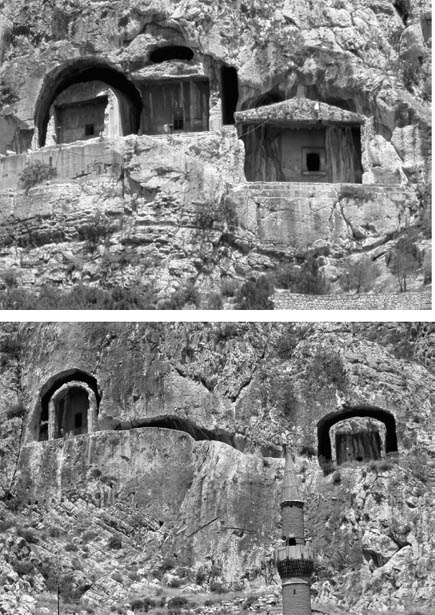
FIG. 4.4. Rock-cut tombs of Mithradatid kings at Amasia. (Top) tombs of Mithradates I and II and Ariobarzanes; (bottom) tombs of Mithradates III and Pharnaces I. Mithradates V Euergetes and Mithradates VI Eupator were buried here too. The Persian-style tombs were accessible by long ladders or by rock-hewn tunnels from the acropolis fortifications. Photos courtesy of Jakob Munk Høtje.
A warm welcome at Amasia bolstered Mithradates’ confidence and his companions’ enthusiasm for their great adventure. Vowing to return one day when Amasia’s famed golden apples were ripe, Mithradates traveled southward along the Iris River, stopping at another of his father’s fortresses, Dadasa, on a high bluff above the village of Gaziura. From Gaziura, a road led west toward Zela, defended by another fortress, Skotios. There was a large temple-domain at Zela, founded centuries earlier by Scythian nomads, sacred to the Persian goddess Anahit. If the boys from Sinope were lucky enough to arrive during her annual festival, they would have joined crowds of intoxicated men and women dressed in Scythian costumes—leggings knitted in zigzig patterns, leather tunics, and pointed, tassled caps—and, in Strabo’s words, “reveling wantonly.”
After Zela, the boys returned to the easterly route, crossing the bridge over the Iris to visit more castles at Dazimon and Talaura. From here they may have made a foray south to the Halys River, on the road to Cappadocia. With each face-to-face consultation with his father’s commanders, Mithradates received pledges of their support and ensured that he controlled his inheritance. The coin and treasure hoards hidden in each of these forts would be of great importance to Mithradates in the wars to come.15
THE TURRET-FOLK
As the leaves began to turn red and gold, Mithradates led the group north, toward the mild sea coast, a good place to spend their first winter. The route went by way of Kabeira, a fortified palace of the ancient kings of Pontus. Strategically placed on the Lycos River, the defensible location and wild beauty of Kabeira made a very strong impression on young Mithradates. Strabo noted that it was encircled by heavily wooded mountains, with plenty of game.
One of the most impressive features near Kabeira was a year-round natural spring on a high crag above the river, some miles to the northwest. The spring gushed forth in a powerful waterfall that cascaded down the sheer rock face into the deep ravine below. Besides the fortified royal residence, Kabeira maintained a large sanctuary dedicated to the Anatolian moon god Men and the moon goddess Selene. At the temple, founded by Pharnaces I, the kings of Pontus traditionally swore their sacred oaths, invoking Men to bestow health, safety, and prosperity. The boys of Sinope admired the image of the god holding his javelin, astride his horse, with the crescent moon over his shoulder.16
From Kabeira, Mithradates might have decided to take the little-used winding trail over the mountains to the Black Sea. Strabo describes this region’s herds of gazelle and grain fields, and grapes, pears, apples, and nuts in such abundance that one could gather food all year long. Strabo even mentions the deep carpets of fallen leaves, for cushioning wayfarers’ beds. Continuing to follow the narrow seashore road toward the sunrise, the riders from Sinope were retracing the route traveled by Xenophon and his ten thousand Greek mercenaries, and by Jason and the Argonauts. Exporing the rocky coast, the group discovered hidden coves frequented by pirates plying the Black Sea. The road petered out into a rough track in the remote chora of Trapezus, a town with an excellent harbor. From Trapezus, a route headed south over the Zigana Pass into the upper Euphrates River valley and Armenia. To the northeast lay Colchis, “legendary land of gold, poisons and witchcraft.” In the distance were the forbidding Caucasus Mountains, and beyond that, the boundless steppes of Scythia.17
As their horses picked their way along the coastal path, Mithradates called in at the forts of Side, Phabda, Chabaca, and Pharnacia. Villagers here made their living mining silver and zinc and fishing for tuna. Each hamlet was deeply honored to be visited by the young king of Pontus; they greeted the royal hunting party with fish, bread, and wine. Three hundred years earlier, Xenophon and his army had enjoyed similar hospitality from the villagers’ ancestors. When Mithradates and his friends arrived at Trapezus, they would have recalled how Xenophon’s homesick soldiers had shouted for joy upon finally coming in view of the Black Sea here.
During their travels, Mithradates was becoming familiar with his future subjects and his kingdom’s natural resources and geography, its fertile valleys, harbors, and strongholds in majestic mountains. He and his young friends embraced the risks and hardships, always vigilant for sudden storms in the mountains, several species of venomous snakes, and fierce wolves, boars, and bears. Another danger came from isolated peoples and their deadly flora. In the mountains of Pontus and Armenia, pocked with silver, zinc, tin, and iron mines, dwelled many “strange, primitive tribes,” the Paryadres, Sanni, Byzeres, Cercitae, and Mosynoeci, to name only a few listed by Strabo. Mithradates, with his knack for languages, was quite eager to meet these exotic groups and see whether he could communicate with them. The shamans must know rare toxins and arcane antidotes. Would the archers reveal secret recipes for poison arrows? Toxic hellebore, belladonna, and blue monkshood flourished in the meadows and mountainsides. The travelers had to make sure their horses did not eat these lethal plants. Mithradates carefully collected specimens, keeping notes on their properties and antidotes.
The boys had probably already experimented with hellebore-tipped arrows, used by the Gauls and others for hunting rabbits. The technique worked well, as long as one quickly cut away the tainted flesh around the wound. The Gauls carried antidotes with them, in case of self-injury with an arrow, as did the Scythians. One day, Mithradates could hope to meet the Soanes, a tribe of remote Colchis famous for their arrow drug. Strabo remarked that the stench of a Soane arrow whizzing past one’s head was noxious enough to kill a man!
The Mosynoeci (“Turret-Folk”) were the “worst of the savage mountain tribes,” in Strabo’s opinion. Subsisting on chestnuts, pickled fish, and the flesh of wild animals, the Turret-Folk carved dugout canoes, wielded iron battle-axes and spears, and constructed tree houses on scaffolds in the dense rhododendron forests on the mountainsides above the sea. Xenophon, who had led his Ten Thousand through their territory, reported that the tribe elected a “king” to dispense justice. This king was kept captive on the highest scaffold. If his judgments failed to please, the people starved him to death. The Turret-Folk, observed Xenophon, relished having sex in public, and the pale skin of the men and women—and even the children—was heavily tattooed, “covered with colorful patterns of all sorts of beautiful flowers.” The Turret-Folk were hostile to strangers, notorious for attacking unsuspecting wayfarers by leaping down on them like killer apes from their mosyni, “turrets.” This must be how Mithradates and his friends first made their acquaintance. Somehow Mithradates won this warlike group over: the Turret-Folk would prove to be an important ally in the last Mithradatic War.18
When spring arrived, the lost boys from Sinope led their horses up the switchbacks into the mountains and disappeared into the cool, high forests where the last snowflakes sifted down from the evergreen boughs. Whooping with exhilaration, the young men celebrated the first anniversary of their freedom to live by their own wits, like Robin Hood and his Merry Band in Sherwood Forest. They looked forward to seasons to come, dodging any authorities with ties to the traitors back in Sinope, plotting their triumphal return.
Munching almonds, pistachios, chestnuts, and dried figs collected at the lower elevations, and copying wise old Diogenes’ austere regime of foraging, the boys gathered tender green shoots through spring and into summer. Remembering how young Cyrus exhorted his companions centuries before in Persia, Mithradates declared that pure, icy water from melted snow was perfect for slaking thirst, and that the earth herself provided the finest bed. Golden pears, dziran (apricots), and plums ripened through the months. As summer faded, the youths gorged on the wild cherries native to Pontus and the steppes and dried some for provisions. Mithradates’ band may even have met some rustic folk who taught them how to curdle mare’s milk with cherry juice, to make the refreshing fermented drink enjoyed by Scythian nomads. The fruit seemed to ease the strains of their vigorous outdoor life—and indeed, cherry juice has been shown to soothe aching muscles.
Weeks passed, months, then years. Mithradates’ party hunted hares, gazelles, wild goats, and deer, draping trophies of their kills on tree branches as dedications to the local gods. Fishing in pristine lakes and streams added variety. Some of the older boys showed off by making artificial flies, tying feathers artfully to the fish hooks, a new technique invented in Greece a century earlier. One day the hunters killed a Pontic beaver and dared each other to eat the testicles, reputed to fortify one’s manhood. Everyone kept on the lookout for ferocious lions and bears that still roamed here, just as in the glorious days of Hercules.19
PERILOUS PASTIMES
As the boys gained confidence and skill, they sought more dangerous game. The most experienced hunters boasted of facing down fierce wild boars. Hunting boar was the essential test of manhood in Alexander’s Macedonia: only those who had personally killed a boar with a spear (without a net) were considered worthy. Recalling the great boar hunts of the Greek heroes of myth (and one heroine, Atalanta), the boys wondered, Was it really true that the more enraged the boar, the more fiery the tusks? Old hunters claimed that the red-hot tusks could singe the fur of the hunting hounds.
Xenophon explained the method of hunting boar. Wielding nine-foot war spears with fifteen-inch blades, fitted with a crosspiece to prevent the beast from running up the lance, Mithradates and his friends, yelling with excitement, pursue the beast until it is cornered. Warily, the muscular and brave prince approaches. If he misses his mark, the desperate animal will charge and gore the boys and dogs. Mithradates dispatches the boar with a well-aimed thrust, and his friends dine royally that night.20
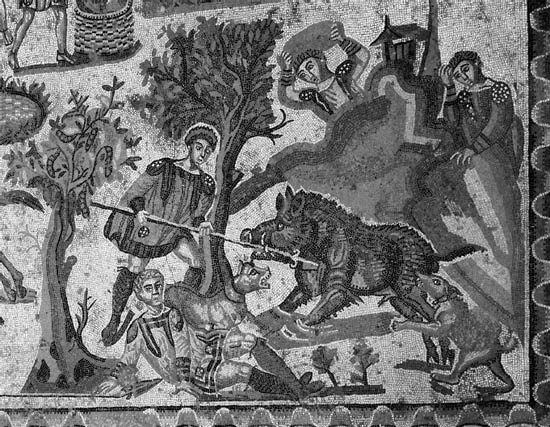
FIG. 4.5. Young men hunting boar, mosaic, Piazza Armerina, Sicily. Scala/Art Resource, NY.
One early spring near Trapezus, after dropping in on their new friends the Turret-Folk, the explorers ride through lush stands of magenta, pink, and white rhododendron blossoms. They have learned that the poison sap of these flowers makes arrows lethal. Along the winding trail in the forest, they notice a number of wild beehives, the waxy combs dripping tempting honey. Mithradates, his mind buzzing with his toxicology experiments, recalls the warnings of the Turret-Folk to avoid eating any honey in these beautiful forests. What a delicious paradox: a sweet poison! Suddenly he understands why Xenophon’s entire Greek army had mysteriously collapsed, unable to rise for three days after sampling the wild honey of Trapezus. Xenophon wrote that he was mystified to see all his men strewn on the ground, totally defenseless in unfamiliar territory.
Mithradates regales his friends with Xenophon’s lurid description of the powerful effects of rhododendron nectar.21 Curious, the boys investigate: the honey is thin and runny, reddish and slightly bitter, nothing like the golden honey cakes served at their birthday banquets back home. A dab of the dark stuff tickles their palms. The tongue tingles after a tiny taste. Mithradates challenges his companions to a devilish contest. He’ll be the judge. Who can eat the most honey without slurring his words, stumbling around like a drunkard, shitting his trousers, or finally passing out cold?
No doubt there were many other competitions, as Mithradates coolly expanded his scientific knowledge of poisons and antidotes and as the young men tested themselves. They were absorbing lessons in loyalty, teamwork, trust, and leadership, and gaining practical knowledge. How far could one shoot an arrow or throw a javelin? How many stades (8 stades = about 1 mile) could one ride in a day? Who could tolerate the most hornet stings? What is the best treatment for snakebite? Just how fast could one run when chased by an angry bear? Contests showed who was best at reciting Homeric verses, quoting poety, wrestling, mock combat, swimming. The boys challenged each other to footraces, horse races, and countless other daredevil games.
THE TEMPLE OF LOVE
This was a pack of energetic, athletic teenage boys, reveling in their freedom, seeking experience and adventure. What were their sex lives like during those years alone together? Some of the youths in the group paired off as lovers, in the traditional aristocratic Greek style. Others enjoyed bisexual encounters, paralleling the well-known inclinations of Alexander the Great and his Macedonian companions, as well as many leading Roman aristocrats of Mithradates’ day. That was not the traditional Persian way, however, according to the Greek historian Herodotus—he claimed that the Persians had learned from the Greeks to accept homosexuality. Roman historians remarked—with surprise, given his Greek tutors—that Mithradates was attracted only to women, never to boys or men. Others in his circle probably shared this interesting quirk.22 But where would young Mithradates and his friends find willing girls in rural Pontus?
At his father’s banquets, Mithradates, Dorylaus, Gaius, and their schoolmates had overheard the men bragging about their sexual exploits in certain notorious temple sanctuaries in Anatolia. Devoted to the cults of Near Eastern goddesses of love (Mylitta, Ma, Enyo, Anahit, and Bellona), these rich temple complexes maintained vast holdings of sacred land and employed thousands of priests, priestesses, and workers. In Pontus, the high priest was very powerful; his only superior was the king who appointed him. The temples’ great wealth came from sacred prostitutes, a well-known but little-understood ancient practice. In Pontus, Cappadocia, Armenia, Babylon, Lydia, and some other ancient cultures, it was the custom for young women to have sex with strangers in the temple before they married. They donated the silver they earned to the goddess.
The most renowned of these temples of love were Comana Cappadocia and Comana Pontica. The historian Diodorus described a visit to Comana Pontica as a relaxing and entertaining romp, rather than a solemn religious ritual. While still in Sinope, Mithradates and the boys dreamed of one day visiting these pleasure gardens, imagining themselves welcomed by bevies of beautiful girls dedicated to enjoying sacred sex with strangers who happened by. In the flowery words of the Epicurean philosopher Lucretius, a contemporary of Mithradates who wrote of love and lust, The dreams of young boys on the verge of manhood are often invaded by images of alluring, delightful women, and the boys’ bodies discharge fluids while fast asleep—even the costly splendors of oriental coverlets do not escape a soaking.23
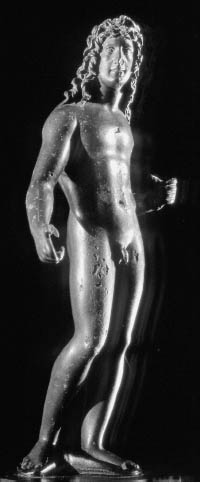
FIG. 4.6. Youth with long hair, late Hellenistic bronze statue from Pontus, identified as Mithradates. Note similarity of head and leonine hairstyle in the Hellenistic coin portrait of Alexander in fig 5.2. Sothebys, Werner Forman/Art Resource, NY.
Now the youths had the opportunity to make those dreams come true! The head priest at Comana Pontica, in the picturesque Iris River valley, had been appointed by Mithradates’ father. Second only to the king, the priest was in a position to know many secrets and to give and receive many favors. Here was a unique chance for Mithradates to mix business with pleasure. This most trusted person, a relative or close friend of the murdered king, would receive Mithradates as his new monarch. So, driven by what Lucretius called the “tyranny of lust” that comes with an “adolescent’s ripening years and strengthening loins,” Mithradates and his friends, we may reasonably assume, visited the gardens of Comana more than once in the years they were out on their own.
What happened in Comana stayed in Comana. But a translation of Lucretius’s discreet, scientific Latin description of the ideal sexual encounter gives a sense of Mithradates’ interludes in Comana: Both men’s and women’s yearning for bliss comes in irresistible waves. . . . Body clings greedily to body, eager limbs entwine, moist lips are pressed against lips in fierce kisses, breaths are drawn through clenched teeth, and it is seed-time in the fields of Venus. Several ancient writers describe the customs at these temples. It seems that the young women could refuse offers and choose partners based on their own taste, beckoning to those whose status and physical appeal most matched their own. We can imagine that Mithradates’ young aristocrats were embraced as handsome, rich “strangers” known to be very generous with silver coins.24
Shared experiences at Comana strengthened the bond between Mithradates and his friend Dorylaus. At some point, Mithradates promised Dorylaus that as soon as he regained control of his kingdom, he would appoint him high priest of the Temple of Love.
RUSTIC LESSONS
Living close to nature, observing plants, animals, insects, birds, and reptiles, appealed to Mithradates. Like Alexander, he was keenly interested in natural history and possessed an experimental turn of mind. A discovery, while gathering firewood, of a salamander under a rotting tree, for example, might end badly for the amphibian. What boy could resist testing the folk beliefs surrounding salamanders? Were they really impervious to fire? Dried “salamander” skins were used in antiquity to store precious royal possessions. Traders in Sinope displayed sheets of the gray, fibrous “wool” shed by giant salamanders in remote India (in fact, natural asbestos from Tajikistan). The salamander’s reputed invulnerability to burning would fascinate a young man preoccupied with acquiring personal immunity to poisons and making himself invincible. Mithradates recalled the assertion by Alexander’s tutor, Aristotle, that salamanders could not only walk through fire but could actually extinguish flames. If Mithradates experimented with a salamander in the fire, he probably proved Aristotle mistaken. The boys may have tested other folklore about salamanders—they were toxic, yet their flesh mixed with honey was supposed to be an aphrodisiac.25
Conversation around the campfire often turned to military history and tactics. What substances, for instance, would best protect wooden siege machines, stone walls, and palisades from flaming arrows or burning naphtha? Some military experts recommended dousing walls and siege engines in sour wine (vinegar) as a defense against fire. Vinegar is a real fire retardant. But Mithradates, recalling Hannibal’s campaigns against the Romans, would have pointed out that vinegar-drenched stones had a tendency to crack and crumble if they overheated in a fire attack. Everyone agreed that alum, if one could import enough of this rare mineral from Egypt or Syria, was the superior fire retardant for military defense.
During the years away from Sinope, Mithradates and his friends could continue their interrupted education by reciting epic poetry, discussing history, debating philosophy, and reading books. The new technique of binding vellum (sheepskin) parchment into a book form had been invented in Pergamon about fifty years earlier, to replace Egyptian papyrus scrolls. This technology allowed the young aristocrats to carry durable, compact editions of their favorite works. Vellum books also enabled Mithradates to keep written records of his scientific investigations through all his travels and campaigns.26
Mithradates knew that Alexander had cherished his copy of Homer’s Iliad, annotated by his teacher Aristotle. Even on war campaigns, Alexander kept this scroll beside his dagger under his bed. After he defeated Darius III, Alexander stored his Iliad in a richly wrought casket, one of the Persian monarch’s most precious treasures. It’s not unthinkable that the prince of Pontus copied Alexander and kept his own book of Homer in a similar bejeweled casket, perhaps discovered among the heirlooms of Darius I.27
In Homer’s epic about the first “world war” between Europe and Asia, Mithradates found engrossing descriptions of the Trojans, who defended Anatolia against the Greek aggressors. From Mithradates’ perspective, to resist the invaders from the West, who came to Asia to plunder and loot under the pretext of retrieving a king’s stolen wife, seemed just and righteous. Imagine Mithradates’ scorn when he learned from his tutors in Sinope that the uncouth Romans actually believed that they were descended from the magnificent Trojans of Anatolia.
Like his Persian ancestors, who had their own translations of the Iliad, Mithradates appreciated the epic from the point of view of the Trojan king Priam. He knew that Xerxes made a special trip to Troy (480 BC). Xerxes had climbed the stone stairway of the highest tower of Priam’s citadel, and his Magi had sacrificed one thousand cattle to the spirits of the Trojan heroes. Alexander had visted Troy, too, and poured a libation to the Greek champion Achilles. Mithradates hoped to see Troy one day, to marvel at the oversized bronze weapons of the Trojan hero Hector and the harp plucked by Paris. A royal visitor might try on Ajax’s huge bronze helmet, even touch the enormous bones of the ancient warriors.
Like Xerxes, Mithradates would imagine King Priam in his tower, surveying the polyglot legions of Persia’s allies from around the Black Sea and beyond. Priam’s armies massed on the plain below Mount Ida, at the grave mound of the Amazon queen Myriné. The homelands of Priam’s allies were at the edge of the world for the ancient Greeks, who called them barbarians. But their names, recited by Homer, would have rung wonderfully familiar to Mithradates. There were Paphlagonians from wild-horse country and Scythian nomad-archers, quivers bristling with poison arrows, riding sturdy steppe ponies. Expert bowmen came from Pontus, joined by Bithynian and Lydian knights resplendent in golden armor. Mystic seers from the eastern hinterlands mingled with bronzeclad warriors of Caria where bird augurs told the future. Battalions from cave-riddled Cappadocia and silver-rich Mysia, even far Armenia sent warriors to help defend Troy. Finally, a contingent of Amazons rode in, led by their beautiful warrior queen, Penthesilea. She would fight the mighty Achilles himself. As the Amazons joined the masses of far-flung tribes gathering on the Trojan plain, amid swirling dust and clanging spears and dancing horses, “there arose the tremendous din of myriad tongues.” Yet the Trojans united all these scattered tribes in one cause, to defend Anatolia.28
Mithradates’ own lands were replete with romantic Amazon lore. Amazon grave mounds marked the countryside; Amazons were believed to have founded many Anatolian cities, including Sinope, Amasia, Amastris, and Themiscrya in Pontus, and Ephesus, Mytilene on Lesbos, Smyrna, Priene, Cyme, Pitane, Magnesia, Thyatira, Amazonion, and Myrina. The greatest Greek heroes of myth had fought and loved warrior women from the East. Even Cyrus and Alexander had encountered strong-willed Amazon queens. Mithradates would have known all these tales by heart. Such independent women were foreign to the ancient Greeks, but in Mithradates’ world, queens were powerful rulers, like his mother and sister. Fierce women warriors were not imaginary, but real. Among the war-loving Sarmatians, Alans, Scythians, Sirginni, Massagetae, and other nomads around the Black Sea, men and women dueled before marrying, and the women rode into battle with the men. As they traveled deeper into Eastern lands, Mithradates and his friends teased each other with the possibility of meeting a party of young, independent horsewomen. Perhaps they would agree to go on together as a tribe of equals, like the romantic story of the young Scythian hunters and the Amazon warriors who joined forces and became the Sarmatians, recounted by Herodotus and Justin.29
Priam’s legendary army was surpassed by that of Xerxes. Herodotus, born in Caria under Persian rule, conjured up colorful panoramas of Xerxes’ millions of troops mustered from the corners of the Persian Empire. In the exotic pageantry of Xerxes’ multitudes massed on the plain, each contingent displayed the distinctive armor and weapons of their homelands. Brandishing scimitars, lances, swords, poison darts, quivers fashioned from the tanned skins of human foes, they rode scythed chariots, cavalry horses, and war camels.30 King Darius had commanded equally diverse and vast hosts of Persians and allies to fight Alexander. And like King Priam in the Iliad and the great Persian rulers, Alexander also recruited multiethnic warriors from remote, mysterious places, as far away as Afghanistan and India. Reading about these diverse armies in myth and history, the youthful Mithradates could glimpse his own polyglot armies of the future, recruited from the same marvelous lands described by Homer, Herodotus, and Xenophon.
HOMEWARD BOUND
Occasional news of the Romans reached the hinterlands, and Mithradates was creating his own information network. He knew that Roman slave traders and tax collectors were preying on western Anatolia, and heard reports of his mother’s collusion with the Romans. As they increased the distance between themselves and Sinope, Mithradates and his band could reveal their true identities. Rumors of Mithradates sightings probably filtered back to his mother and her faction, even to the Romans in Pergamon. Mithradates probably intended for some news to get back to supporters in Sinope, to counter any attempt by his mother to spread rumors that he was dead. Popular tales of his exploits enhanced his reputation, while his band remained elusive, always on the move.
People in the East remembered the two spectacular comets and the Magi’s ancient prophecies. Men and women handled the small-denomination coins stamped with Mithradates’ name and his comet whenever they went to market. They were thrilled to meet the exiled king in person or to hear exciting rumors that he and his band of young knights were traveling around the Kingdom of Pontus, gathering strength. Stories probably circulated about the handsome young king’s adventures, with romantic details about his feats and sayings. Pontus awaited the day when Mithradates VI Eupator, the savior-king, would emerge from hiding and begin his reign, like the divine hero Mithra emerging from the dark cave in a burst of brilliant light.
Reflecting on all he has learned in the years away from Sinope, Mithradates—perhaps eighteen or twenty now—feels pride mixed with restlessness. Alexander, he knows, took over the Macedonian throne at age twenty. The future of Mithradates’ kingdom obsesses him; he is weary of brooding on his father’s assassination and the queen’s treachery. Is his young brother still a passive creature controlled by his calculating mother? Have his sisters fallen under her spell too? His outrage at the Roman depredations in Anatolia inflames his idealistic commitment to what is true and bright. Mithradates feels strong, invincible, impatient for action. His friends agree: it is time to seize power, time to punish the wicked, time to fulfill the oracles sent by the gods.