
During the first two centuries ce, the Kushans created a powerful and expansionary empire between the Par- thians and the Chinese. The Kushan Empire lay along a strategic portion of the Silk Road and played an important role in the promotion of both trade and Buddhism. Throughout this period, the Kushans took territory from the Parthians and, at times, fought with the Chinese against common enemies, such as the Sogdians, and, at times, fought against the Chinese. Mostly, they maintained uneasy trade relations with China.
Although there is still some dispute over this, the Chinese sources, coinage, and other artifacts from the region indicate that the Yuezhi were the Kushans. Or, rather, the Kushans were one tribe of Yuezhi who migrated from Central Asia and created an empire sometime in the first century CE.
The height of Kushan power and influence came with the reign of Kanishka, who ruled during most of the first half of the second centur y CE. He took the empire to its greatest extent, ruling most or all of present-day Uzbekistan, Tajikistan, Afghanistan, Pakistan, and northern India, including the lands of Magadha. He located his capital at Kashgar, thus indicating that the Rushans’ Central Asian domains remained the most important to them. Stories about Kanishka include one about the destruction of a Parthian army of 900,000, after which he suffered a great deal of remorse for the death he had inflicted—a retelling of the Ashoka story (see Chapter 2). Kanishka’s actions in the promotion of Buddhism led to his being considered by Buddhists to be the greatest friend of the religion since Ashoka.
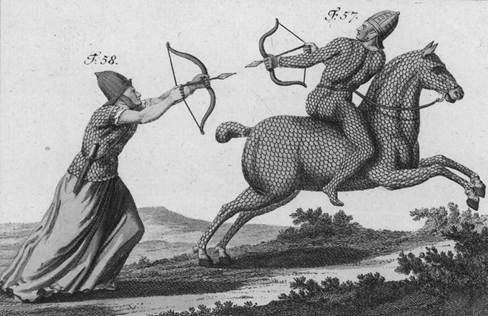 A Sarmatian Cataphract
This somewhat fanciful drawing shows the scale armor and conical helmet (but not the heavy lance) that made such cavalry a formidable weapon of shock combat. It also shows (though in an impossible way) that the horse, too, was fully armored.
Kanishka and the Kushan rulers before and immediately after him benefited from the weakness of their two main neighbors, the Parthians to the west and the Chinese to the east. There is also some evidence of a sort of informal alliance with the Roman Empire against Parthia.
The earliest accounts of the Yuezhi/Kushans show their military forces to be essentially typical Inner Asian mounted bowmen, with weapons, tactics, and formations much like those of the Xiongnu. However, as the Kushans conquered the lands of northern India, their armies became much larger, incorporating many new elements. Elephant units and Indian infantry forces became part of the mix, and much of the nobility went into battle much more heavily armored, including— according to some depictions—riding armored horses. Thus, the armies of Kanishka were not only much larger than but also more capable of more varied types of combat than those of his predecessors.