
Chapter 4
One day, early in the first century, in a hovel in the little Galilean town of Nazareth, an angel appeared to a young Israelite girl who was perhaps no more than fourteen or fifteen years old, and they had a rather extraordinary conversation. The angel greeted her: “Hail, favored one! The Lord is with you” (Lk 1:28). As is invariably the case when an angel makes an appearance, the girl was afraid. “Do not be afraid,” the angel told her, “for you have found favor with God. Behold, you will conceive in your womb and bear a son, and you shall name him Jesus” (Lk 1:30–31). When she wondered how this would be possible, since she had had no sexual experience, the angel explained, “The holy Spirit will come upon you, and the power of the Most High will overshadow you. Therefore the child to be born will be called holy, the Son of God” (Lk 1:35). And the girl responded to this overwhelming message with utter simplicity: “Behold, I am the handmaid of the Lord. May it be done to me according to your word” (Lk 1:38). With that the angel departed.

The Annunciation by Fra Angelico (Prado, Madrid). WORD ON FIRE
This young Israelite woman has beguiled the finest poets of the West, from Dante to T. S. Eliot; she has been the subject of paintings by the greatest masters, from Fra Angelico and Michelangelo, to Rembrandt and El Greco; over the centuries, millions of people have visited her shrines seeking her aid and calling out to her, their mother. She is referred to as the Queen of all the saints, the Queen of the angels, and the Queen of heaven. And she has been invoked, over and over again, across the centuries, in the words of the simplest and most beautiful prayer in the Catholic tradition: the Hail Mary.
Why has she had this staggering impact? The best answer is found in the angelic encounter, in which the essence of the biblical drama is distilled. We see the nature of God on display in the graceful, nonviolent manner of the invitation. In story after story from the mythological tradition, we note that when the gods intervene in human affairs, they do so violently, interruptively, in the manner of a rape. But in the sweet invitation of the angel at the Annunciation something altogether different is on display. Mary’s freedom and dignity are respected and her curiosity is encouraged; she is, if I can put it this way, courted by the heavenly messenger. We also see a human being in full in the Virgin Mary. The church fathers were eager to contrast Mary, the Mother of God, with Eve, the mother of all the living. At the decisive moment, Eve took the fruit of the tree of the knowledge of good and evil, succumbing to the temptation to seize at godliness and committing, thereby, the fundamental sin. Why had God prohibited the eating of that fruit? The serpent suggests that a competitive God was envious of his human creatures, not wanting them to “be like him, knowing good and evil,” but we know that the devil is the father of lies. For God in fact had given to our first parents practically free rein in the garden, inviting them to eat of all of the trees save one. This generous permission is a symbolic expression of God’s desire that we exercise our powers to the full. The church fathers saw the Garden of Eden, in all of its beauty, as a sign of the full range of possibilities and opportunities available to us: politics, philosophy, art, science, friendship, and so forth. So why the prohibition? God forbade the eating of that particular tree not because he is our rival but precisely because he wanted us to fall in love with him.
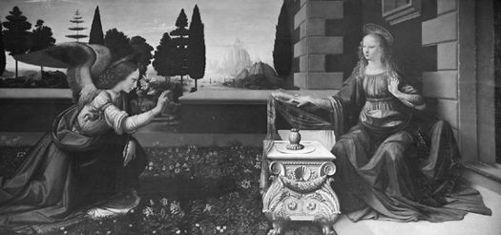
Annunciation by Leonardo da Vinci (Uffizi Museum, Florence). WORD ON FIRE
When two people meet and are mutually attracted, they use their reason and their powers of perception and analysis in order to assess each other. To fail to do this would be irresponsible. Yet their relationship will come to life only to the extent that in the end they surrender to each other; they, as the phrase has it, “fall in love” with each other. We witness something similar in the arts. John Coltrane, Eric Clapton, and Daniel Barenboim—all masters of their respective musical instruments—each commented that he plays his best when he lets his instrument “play him,” when he surrenders control and lets the music seize him. God has no interest in dominating us. He wants us to use the full range of our intellectual and moral energies when relating to him, but he also wants us, finally, to let go and to fall in love with him. And this is why he prohibited Adam and Eve from grasping at the uniquely divine prerogative of knowing good and evil: not because he wanted them to be less alive but because he wanted them to be fully alive.
With this clarification in mind, let us return to the maiden of Nazareth. None of Mary’s integrity, freedom, or intelligence is negated in the course of her conversation with the angel, but at the limit of her striving and knowing, she willingly surrenders to the alluring power of God. Barely grasping the full extent of what this surrender would entail, she nevertheless says, “I am the handmaid of the Lord.” And in obediently adding, “May it be done to me according to your word,” she reversed the grasping disobedience of Eve. This is why the medieval illustrators and commentators—so in love with the parallels, rhymes, and echoes within the Bible—imagined the Ave (“hail”) of the angel reversing Eva (Eve). On the basis of the angel’s greeting, “Kecharitomene,” Mary has been called “full of grace,” (charis is the Greek for “grace”), and this means, basically, that she is someone who is profoundly disposed to receive gifts. In this, she becomes the new Eve, the mother of all those who would be reborn by being receptive to God’s life as a gift.
THE TRUE ISRAELITE
Let us move now from the simple hovel of the Annunciation in Nazareth to one of the most sumptuous and beautiful enclosed spaces in the world, the Cathedral of Chartres. Like almost all of the other Gothic cathedrals that sprang up in France in the twelfth and thirteenth centuries, Chartres is dedicated to Notre Dame (Our Lady). In his magisterial Mount-Saint-Michel and Chartres, Henry Adams argues that the medievals would have seen Chartres not only as dedicated to Mary, but in a very real sense as Mary’s dwelling place, or even as Mary’s body. In accord with this last suggestion, we might imagine the apse of the church as corresponding to the Virgin’s head, the transept to her breasts and arms, and the labyrinth to her womb. The Chartres labyrinth is a carefully designed circular path that lies about one-third of the way up the nave and that winds, intestine-like, around on itself. It is thought that pilgrims to the cathedral would walk it on their knees, making their way symbolically to the heavenly Jerusalem, which was depicted in bronze at the center of the intricate set of paths. The labyrinth is the exact same circumference as the rose window that graces the façade of the cathedral, and this means that when the sun is correctly positioned in the sky the colors of the rose window gently and perfectly play on the labyrinth. This juxtaposition speaks, therefore, of the Incarnation, which took place through Mary’s acquiescence: the impregnation of her virginal womb by heavenly light. Just as the labyrinth is not obliterated by the light of the rose window but is enhanced and illumined by it, so Mary’s humanity is not compromised by God’s proximity but transfigured and made fruitful.
All around this building dedicated to the Blessed Mother are depictions of figures from the Old Testament—Adam, Job, David, Moses, Aaron—and this is only appropriate, for Mary, the Mother of God, is the fulfillment of Zion. She recapitulates all of the great figures of the holy people whom God had prepared, in the course of many centuries, to receive his Word and make it flesh. She is, accordingly, the daughter of Abraham, the first one to listen to God in faith; she is like Sarah, Hannah, and the mother of Samson, since she gave birth while trusting in God against all expectations; she is the true Ark of the Covenant and the true temple, for she bore the divine presence in the most intimate way possible; she is like the authors of the Psalms and the books of Wisdom and Proverbs, for she becomes the very seat of Wisdom. And she is like Isaiah, Jeremiah, and Ezekiel—the prophets who longed for the coming of the Messiah. This last connection can be seen very clearly in the account of the wedding feast at Cana in the Gospel of John. In the midst of their celebration (wedding banquets went on for days in first-century Palestine), a young couple runs out of wine, and Mary brings this problem to the attention of Jesus. We can read this story at the literal level and see Mary as graciously acting to spare the young people embarrassment, but we can also read it more symbolically and appreciate Mary as expressing the prophetic longing of Israel. Wine—delicious, refreshing, intoxicating—is a sign, throughout the Old Testament, of the divine life. Running out of wine, therefore, is an incisive description of the spiritual condition of Israel, alienated in its sin from God’s grace. In asking Jesus to act, Mary is speaking according to the rhythms and cadences of the great prophets, who continually called upon Yahweh to visit his people, and when she turns to the waiters and says, “Do whatever he asks,” she is summing up the instruction of every teacher, every patriarch, and every prophet of Israel. Saint Irenaeus says that throughout the history of salvation God was, as it were, trying on humanity, gradually suiting divinity and humanity to each other—in a word, preparing for the Incarnation. All of that preparation was a prelude to the Israelite girl, full of grace, who would say yes to the invitation to be the mother of God. A telling detail: just after the Annunciation, Mary, we are told, “set out and traveled to the hill country in haste to a town of Judah, where she entered the house of Zechariah and greeted Elizabeth” (Lk 1:39–40). For centuries Israel had heard the word of Yahweh, but more often than not the people were sluggish in responding. The true Israelite, once she had heard the word of the Lord, moved!
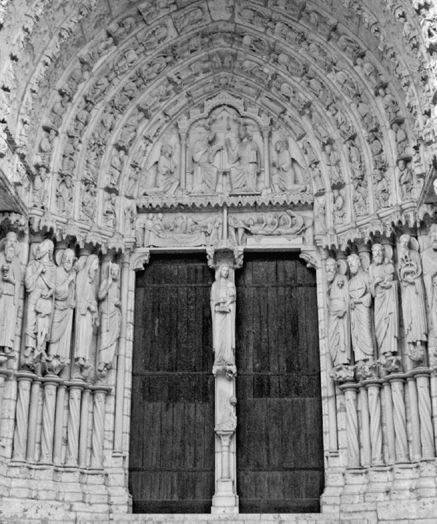
Portal of Chartres Cathedral, France. DENIS R. MCNAMARA
THEOTOKOS
As he was dying on the cross, Jesus looked to his mother and to the disciple whom he loved, and he said to Mary, “Woman, behold, your son,” and then to John, “Behold, your mother” (Jn 19:26–27). We are told that “from that hour the disciple took her into his own home” (Jn 19:27). This text supports an ancient tradition that the apostle John took Mary with him when he traveled to Ephesus in Asia Minor and that both ended their days in that city. Indeed, on the top of a high hill overlooking the Aegean Sea, just outside Ephesus, there is a modest dwelling that tradition holds to be the house of Mary. In the year 431 a great council of the church met in the cathedral of Ephesus in order to adjudicate a bitter dispute about the identity of Jesus, but the debate became focused on a technical question in regard to Mary, namely, whether she could legitimately be called Theotokos, or Mother of God. The council fathers were trying to understand Jesus more accurately, precisely by teasing out the implications of the conversation that took place between the girl of Nazareth and the angel of the Annunciation.

Theotokos, Chora Church, Istanbul. WORD ON FIRE
The background for this council meeting at Ephesus is fascinating. We have to begin by returning, once more, to that conversation at Caesarea-Philippi, when Jesus asked the disciples, “Who do people say that I am?” That question, especially in light of the resurrection, haunted the minds of the members of the ancient church, and the best intellects of the time strove to answer it accurately. Important steps were taken at the Council of Nicaea in 325, when Jesus was declared to be homoousios (one in being) with the Father, and at the Council of Constantinople in 381, when that teaching was reiterated. But in the 420s a controversy arose over the teaching of Nestorius, who was the patriarch of Constantinople and a much-revered theological figure. Influenced by the school of Antioch, which placed a great stress on the humanity of Jesus, Nestorius said that in Christ two distinct persons—one divine and one human—come together in a kind of moral union. This meant that Mary, who was responsible only for the human element in Jesus, could be called Christotokos (mother of Christ) but not Theotokos (mother of God). In fact, Nestorius argued, the use of that latter title would be the height of blasphemy, since it would imply that a mere human being had a sort of primacy over God. Cyril, the bishop of Alexandria, and another theological heavyweight, was so outraged by Nestorius’s position that he called the bishop of Constantinople a heretic. The ecumenical council of Ephesus was summoned in order to resolve this controversy.
After much deliberation during the summer of 431, the council fathers taught that Jesus ought not to be understood as a human person with a particularly intense relationship to the person of God, for that would make him a kind of supreme saint but not the incarnate Son of God. And if he were not himself divine, he would require a savior as much as anyone else. Rather it was decided that in the unity of his person both divinity and humanity come together. And this meant, they concluded, that Nestorius was wrong to deny Mary the title Theotokos, for if Jesus was divine and Mary was the mother of Jesus, then Mary could and should be called the Mother of God. To Nestorius’s point about the blasphemous nature of this description, the council fathers said that Mary is not the mother of Jesus’s divinity, but the mother of Jesus, who is, in fact, divine. Historians report that when this resolution was publicly declared, the people of Ephesus responded with a joyful torch-lit parade through the streets of the town. Perhaps these ordinary Christians did not fully grasp the theological subtleties of the conciliar definition, but they understood viscerally that the statement glorified the Virgin Mary whom they loved and who had once lived among them—and so they celebrated.
I would like to spend just a bit more time with those Ephesians who celebrated the Theotokos, for some have suggested that the cause for their celebration was deep in their cultural DNA. For centuries Ephesus had been the center for the lively cult of Artemis, the great mother goddess. In fact, the temple to Artemis, which stood just outside the city, was one of the wonders of the ancient world, more magnificent, Herodotus said, than the pyramids of Egypt or the gardens of Babylon. Statues of Artemis—covered in dozens of breasts, signifying her nurturing motherhood—were produced at Ephesus and distributed all over the Mediterranean world. Therefore some have insinuated that Mary simply replaced Artemis in the imagination of the common people, as one more iteration of the mother goddess archetype. Without denying that there might have been confusion in the minds of some on this score, there in fact yawns a huge gulf between a mother goddess and the Mother of God. The fathers of the council of Ephesus were not declaring the divinity of Mary; they were not turning the humble handmaid of the Lord into a goddess. But in a certain way they were saying that Mary was indeed greater than Artemis, for she had the privilege, through grace, of bringing into the world the God who would save the world. The declaration of Mary as Mother of God is an instance of the general principle that whatever is said about Mary is meant not so much to draw attention to her as to throw light on Christ. To say that Mary is the Mother of God is to insist on the density of the claim that God truly became human, one of us, bone of our bone and flesh of our flesh. As Archbishop Fulton J. Sheen commented, “Mary is like the moon, for her light is always the reflection of a higher light.”

Theotokos. DENIS R. MCNAMARA
Catholic theology has drawn a further implication from Mary’s status as Mother of God, namely, her role as mother of the church. If she is the one through whom Christ was born, and if the church is Christ’s mystical body, then she must be, in a very real sense, the mother of the church. She is the one through whom Jesus continues to be born in the hearts of those who believe. This is not to confuse her with the Savior, but it is to insist on her mission as mediator and intercessor. At the close of the great prayer the Hail Mary, we Catholics ask Mary to pray for us “now and at the hour of our death,” signaling that throughout one’s life Mary is the privileged channel through which the grace of Christ flows into the mystical body. Here again, the principle of God’s noncompetitive transcendence is apposite. God is not threatened by his creation. On the contrary, he delights in drawing secondary causes into the dense complexity of his providential plan, granting to them the honor of cooperating with him and his designs. The handmaid of the Lord, who is the mother of the church, is the humblest of these humble instruments—and therefore the most effective. Hans Urs von Balthasar has argued that the Marian form is the matrix of all church life and ministry. He means that her fiat (be it done to me according to your word) opens up the creaturely space within which God can work. Mary’s freedom, surrendered utterly to God, becomes the condition for the possibility of all forms of mission and outreach in the life of the church. The Petrine ministry of office, the Johannine ministry of prayer and contemplation, and the Pauline ministry of theologizing and evangelization—the kingly, priestly, and prophetic offices, if you will—are all finally reducible to the Marian form. This is why in much medieval and early modern Christian art Mary is often depicted gathering all manner of life under her protective mantle. This is not sentimental piety, but a robust presentation of Mary, the mother of the church.
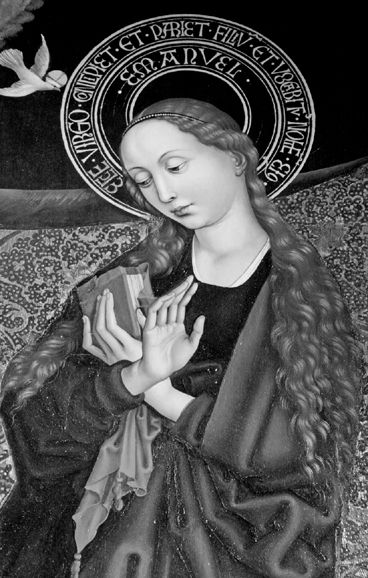
Isenheim Altarpiece, detail, by Matthias Grünewald (Unterlinden Museum, Colmar, France). WORD ON FIRE
THE IMMACULATE CONCEPTION
AND THE ASSUMPTION OF MARY
The doctrines of the Immaculate Conception and the Assumption of Mary were formally declared only in recent years (the first in 1854 and the second in 1950), but their provenance is quite ancient. Indications of the doctrine of the Immaculate Conception can be traced to the New Testament in the angel’s greeting to Mary, and the roots of the second doctrine go back to the liturgies and theologies of the church fathers. Perhaps what we notice first about these dogmas is how physical, even disturbingly so, they are—how they compel us to see God’s activity in the functions and destiny of the lowly human body. The English Catholic novelist David Lodge has observed that upon hearing of these and similar doctrines his Protestant school friends were ashamed to tell their parents about them! Here again, the ultimate purpose of these teachings is to speak of Christ and his Incarnation.
In 1854 Pope Pius IX declared the dogma of the Immaculate Conception of Mary, which is to say, the truth that Mary, through a special grace, was preserved free from original sin from the first moment of her conception. Were this not the case, the angel would not have referred to her at the Annunciation as Kecharitomene (full of grace). Two questions naturally present themselves when this doctrine is proposed: why would God do such a thing? And wouldn’t this imply that Mary does not need to be redeemed? The traditional answer to the first question is that God wanted to prepare a worthy vessel for the reception of his Word. Just as the holy of holies in the Temple was kept pure and inviolate, so the definitive temple, the true Ark of the Covenant, which is Mary herself, should all the more be untrammeled. In this context, the stories concerning the young Mary’s close association with the Temple in Jerusalem (found in the Protoevangelium of James, a third-century text) are, if not necessarily historically accurate, nevertheless theologically suggestive. Even some of the finest minds in the church have found the second question difficult to answer. Though liturgies celebrating the Immaculate Conception date from the seventh century, theologians as weighty as Alexander of Hales, Saint Bonaventure, and Saint Thomas Aquinas himself couldn’t find a sufficient justification for the teaching. It appeared to them that to declare Mary free of original sin from the moment of her conception would preclude the universality of Christ’s redemptive act, which took place many years after Mary was conceived. It was Blessed John Duns Scotus who, in the early fourteenth century, showed a way forward. He argued that Mary is indeed, like the rest of the human race, redeemed by the grace of her Son, but since that grace exists, properly speaking, outside of time, it can be applied in a way that transcends the ordinary rhythms of time. Therefore, Mary was preemptively delivered by Christ’s grace from original sin. With typical scholastic laconism, Duns Scotus said with regard to God’s effecting of this deliverance: “potuit, decuit, ergo fecit” (he could do it; it was fitting that he do it; therefore, he did it).
This teaching of the church received its strangest and most surprising ratification just four years after it was promulgated. The setting was a town in far southern France, in the Pyrenees region quite near the Spanish border, a town that at the time was unknown to practically anyone and that today is renowned across the world. And it happened through the ministrations of an unlettered shepherd girl named Bernadette Soubirous.
In February of 1858 the six members of the Soubirous family were living in a tiny one-room hovel in a poor section of Lourdes. The locals referred to the place as the Cachot because it was a converted prison. The city officials of Lourdes evidently felt that the conditions there were too harsh and primitive for the prisoners, and they had allowed it to be sold. With its single fireplace, low roof, and tiny window, it was really little more than a cave. On February 11, Bernadette, who was the eldest child in the family, made her way from the Cachot to Massabielle, a garbage dump on the outskirts of Lourdes, a place where trash from the town and detritus from the local hospital were piled up to be burned. She had come there with one of her sisters and a friend to look for scraps of wood with which to heat her family’s tiny home. While the other two girls scampered away in search of firewood, Bernadette, due to her asthma, tarried for a time by the Gave, a fast-flowing stream. She felt a puff of wind and heard a sound. When she turned to see what had caused the stir, she spied a beautiful young woman, clothed in white, with a yellow rose on each foot, standing in the niche of massy rock of Massabielle. Afraid, Bernadette instinctually reached for her rosary and made the sign of the cross. The Lady only smiled and began to pray along silently with Bernadette on her own rosary made of pearls. When the girl finished her prayer, the Lady smiled again and vanished.
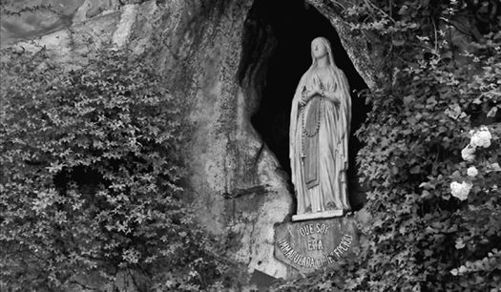
Site of the Apparition, Lourdes, France. WORD ON FIRE
Bernadette felt compelled to return to Massabielle, so the next day she went to the spot with a handful of her friends. Again she saw the lady, but this time the mysterious visitor spoke: “Would you do me the favor of returning for the next fifteen days?” She also had a message for Bernadette to convey to the local priest: “Build a temple on this site and let processions come.” When the girl brought this word to the priest, Father Perymale, he responded with scorn and a stern warning never to return to the place. Yet the young Bernadette continued to visit Massabielle, despite official opposition and the mockery of many. During one encounter the Lady asked Bernadette to dig in the ground to find a spring of water. Bernadette dug and dug but uncovered just a bit of muddy earth. At the Lady’s prompting, the girl smeared some of the mud on her face and also ate a few roots and weeds from the site. Those witnessing these strange happenings thought that the girl had lost her mind. But in time water indeed flowed from the spot where Bernadette had dug, and a young crippled boy who bathed in it was cured.
Bernadette kept returning for those fifteen days and communed with the Lady, falling into a kind of trance during which she remained impervious to pain and oblivious to her surroundings. Even the most skeptical of observers came away impressed by the eerie, otherworldly quality of the girl’s concentration. But despite the speculations of many, Bernadette never claimed to know who the mysterious visitor was. She referred to her consistently as “the Lady” or, in her local patois, Aquero (that one). On March 24, the eve of the feast of the Annunciation, Bernadette felt an inner impulse to go to the grotto. The Lady was there to meet her, and Bernadette this time asked her interlocutor for her name. Three times she petitioned, and finally the Lady looked at her with a serious expression and, her voice trembling with emotion, said, “I am the Immaculate Conception.” The uneducated Bernadette had never heard the expression before and had no idea what it meant. She kept repeating it to herself on the way to Father Perymale’s residence, making sure that she would remember it. Keep in mind that the apparitions took place only four years after the declaration of the dogma by Pope Pius IX. When she repeated to the priest what the Lady had said, he initially balked, insisting that the Lady should have said “I am the fruit of the Immaculate Conception,” not “I am the Immaculate Conception.” But Bernadette insisted that she had accurately reported the Lady’s communication, and eventually Perymale and the entire town were won over both by the girl’s sincerity and by the stunning content of what the Lady had spoken.
Why would the Mother of God have chosen to reveal this particular name to Bernadette at Lourdes? Obviously, chronology had something to do with it, but I also believe that there is an important correlation between the dogma of the Immaculate Conception and the particular gift that was given at Lourdes through Bernadette. To this day people go to Lourdes to bathe in and drink the water that Bernadette uncovered, in the hopes of finding healing for body, soul, and mind, and every single night a magnificent candlelight procession of thousands of pilgrims takes place in front of the “temple” that was built according to the Lady’s directive. What is the Immaculate Conception but a great act of healing on the part of Jesus, the preemptive removal of the stain of original sin from the soul of his mother? And therefore how appropriate that Mary’s ratification of that title would be forever accompanied by, and associated with, the curing of the sick. And finally, how wonderful and how typical that Mary would appear to such a person in such a place. In her great Magnificat in Luke’s Gospel, Mary sings the praises of the God who “has thrown down the rulers from their thrones and lifted up the lowly” (Lk 1:52). Bernadette, who was something of a cave girl, was visited in a garbage dump by the Immaculate Conception, by the Queen of heaven, who herself had received the message of an angel in a hovel and who had given birth to the Son of God in a cave.
Now we turn to the dogma of the Assumption of the Virgin, declared as such by Pope Pius XII in 1950. Before the formal promulgation of the doctrine, Pius sponsored a worldwide survey of the Catholic people, a consultation of the faithful, to see whether they sanctioned this teaching, and the response was overwhelmingly positive. Also, as I have already suggested, the roots of this dogma in the tradition of the church are old and deep. But what precisely does the dogma teach? That Mary, upon leaving this life, was taken, body and soul, into heaven. I fully realize that this assertion can strike the contemporary mind as bizarre, mythological, a holdover from a naïve, prescientific world. First, let us place it within the context of the radically nondualistic perspective of the Bible in regard to the soul and the body. Greek philosophy tends to construe salvation as an escape of the soul from the prison of the body. To see this attitude on full display, consult Plato’s dialogue, the Phaedo, in which Socrates urges his friends not to mourn over his coming death but to see it as a much longed for liberation. This philosophy is utterly alien to the biblical imagination, which does not envision salvation as the separation of the soul from the body, but rather as the transfiguration of the entire self. To give just two examples of this pervasive attitude, the authors of both the book of Revelation and the first letter of Peter dream not of an escape from the world but of “a new heavens and a new earth” (Pet 3:13). The dogma of the Assumption of Mary describes the full salvation of this prime disciple of Jesus—Mary’s entry, in the fullness of her person, into the presence of God. At the close of the Apostles’ Creed, we speak of our hope for “the resurrection of the body.” Mary, assumed body and soul into heaven, has experienced precisely this kind resurrection and hence becomes a sign of hope for the rest of the human race.
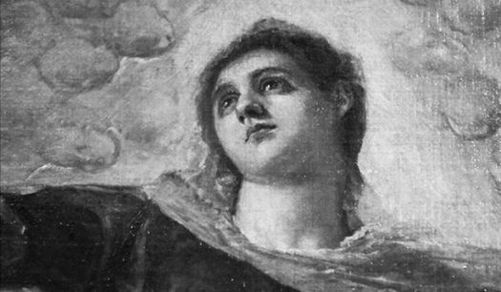
Assumption of Mary by El Greco (Art Institute of Chicago). WORD ON FIRE
If we are to respond adequately to the skeptics, a second observation must be made. When we speak of the Assumption of the Blessed Mother’s body, we are not envisioning a journey through space, as though Mary moved up into the sky. The “heavens” are a rich and consistent biblical symbol for the transcendent, for a manner of existence that lies beyond our familiar dimensions of space and time. The Assumption of Mary means that the Blessed Mother was “translated,” in the totality of her being, from this dimensional system to the higher one for which we use the symbolically evocative term “heaven.” Perhaps a comparison would help here. Think of a square, a circle, and a triangle plotted out on a two-dimensional plane. Now imagine those figures elevated throughthe introduction of a third dimension into a cube, a sphere, and a pyramid. They have not so much lost their former identities as found them heightened, deepened, and perfected. What if there were a conscious subject who lived exclusively in a two-dimensional world? He would know only squares, circles, triangles, and so on, and if you spoke to him of cubes, spheres, and pyramids, he would find your language utterly impenetrable, so much nonsense. Heaven is a symbol for a higher dimensional system that contains the dimensions with which we are familiar but that also elevates them and situates them in a richer context. Mary, who exists now in this other world, is not so much somewhere else as somehow else, and this helps to explain why we can speak of her, especially in her heavenly state, interceding, helping us and praying for us. Again, to people who have known only this world, such a concept will necessarily seem opaque, even ridiculous. The doctrine of Mary’s Assumption both whets our appetite for this higher world and teases our minds into the consideration of it.
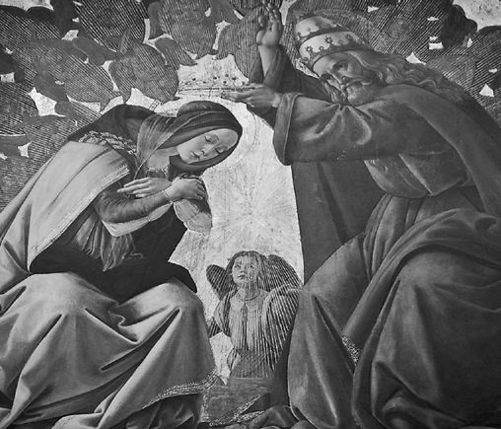
Coronation of the Virgin, detail, by Botticelli (Uffizi Museum, Florence). WORD ON FIRE
At this point I could offer just a word of reflection on an idea that is related to the dogma of the Assumption but that is not a formal doctrine of the church: the teaching concerning the “dormition” or the “falling asleep” of Mary. According to this notion, at the end of her days Mary did not so much die in the ordinary sense but fell asleep in the Lord. Again, although this can strike us as strange, it actually conveys something of great spiritual importance. Death can be taken in a purely biological or physiological sense to mean the cessation of bodily activity: heartbeat, breathing, brain waves, and so on. Or it can be construed in a wider psychological and spiritual sense to mean the full range of feelings, reactions, and fears that accompany this biological dissolution. At the prospect of death, most of us recoil in terror, either at the mystery of it (the unknown is what frightens us the most) or because of the judgment that awaits us. In either case, our horror is prompted by sin, a lack of confident trust in the love of God. What would it be like for a sinless person to approach death? Wouldn’t he or she face it with utter calmness of spirit, the way most of us fall effortlessly into the oblivion of sleep each night, convinced that we shall awaken the next morning? That the sinless Mary didn’t “die,” in the full sense of that term, but merely “fell asleep,” confidently expecting a transition into God’s dimension, strikes me as a not altogether unreasonable way to speak of the end of Mary’s earthly life.
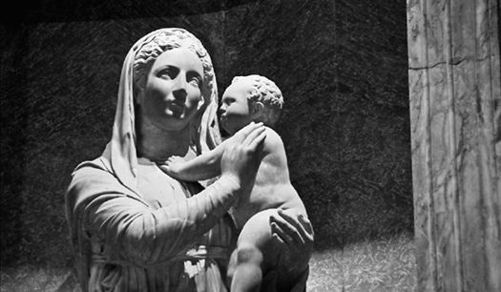
Statue of Mary and Child, Pantheon, Rome. WORD ON FIRE
MARY IN THE LIFE OF THE CHURCH
Immaculate Mary, the Mother of God, assumed body and soul into heaven, is not of merely historical or theoretical interest. Nor is she simply a spiritual exemplar. Instead as “Queen of all the saints” (another of her titles) Mary is an ongoing presence, an actor in the life of the church. In entrusting Mary to John (“Behold, your mother”), Jesus was, in a real sense, entrusting Mary to all those who would be friends of Jesus down through the ages. The Blessed Mother’s basic task is always to draw people into deeper fellowship with her son. The church’s conviction is that the Blessed Mother continues to say yes to God and to “go in haste” on mission around the world. She does so usually in quiet, hidden ways, responding to prayer and interceding for the church, but sometimes she does so in a remarkable manner, breaking into our world strikingly and visibly. There have been literally tens of thousands of reports of apparitions of the Blessed Mother up and down the Catholic centuries. Many, perhaps most, can be traced to the overexcited subjectivities of certain believers, but there are some that are much more difficult to dismiss. We’ve already considered one of them, the manifestation to Bernadette at Lourdes; I would like to look at another that is similarly marked by simplicity, credibility, and rich efficaciousness. It is the extraordinary encounter between the Queen of heaven and, typically enough, one of her little ones; and it is, without doubt, the manifestation of Mary that has had the most explosive impact on the wider world. I’m speaking of Tepeyac and of Our Lady of Guadalupe.
On December 9, 1531, just about ten years after the Spaniards had first brought the faith to Mexico, an Indian man named Juan Diego, a recent convert to Christianity, was making his way along the hill of Tepeyac, just outside the city of Tenochtitlan, which would later evolve into Mexico City. He was heading to morning Mass. He heard a burst of birdsong and turned to see where it was coming from. What he saw took his breath away, for standing before him was a woman clothed in celestial light. The Lady announced herself as the “Mother of the Most High God,” and she had a request for Juan Diego: “Would you ask the bishop to construct a temple here in my honor?” Being a simple man, Juan Diego obeyed. He was ushered into the presence of Bishop Juan Zumárraga, a Franciscan friar and a good man, the builder of the first hospital and university in the Americas, and a protector of the native population. Bishop Zumárraga listened patiently to Juan Diego’s story, but, understandably enough, he asked Juan Diego for a confirming sign from the heavenly Lady. On December 12, Juan Diego went once again to Tepeyac and found the Virgin there. She invited him to remove his tilma, the simple, coarse poncho-like garment he was wearing, and then, with her help, he gathered up a bunch of roses that were, despite the lateness of the year, in bloom. This, she said, would be a sign for the bishop. Juan Diego hurried with his bundle to the bishop’s office, but he was made to wait. It is said that officious aides of Zumárraga’s tried, without success, to find out what the Indian was carrying in his tilma. Finally Juan Diego was brought into the bishop’s presence. He opened his cloak and the roses spilled out, but then, to Juan Diego’s amazement, the bishop and his assistants were kneeling, for on the inside of the tilma was something extraordinary: an image of the woman clothed in light. On the spot, Zumárraga vowed to build the temple the Lady had asked for, and it still stands near the hill of Tepeyac.
One might be tempted to dismiss this as a charming story from a simpler, more credulous time, but the best contradiction to this kind of skepticism is the tilma itself, which is displayed in the massive basilica of Our Lady of Guadalupe in Mexico City. Careful studies have shown that the tilma is indeed from the sixteenth century and woven from cactus fibers. This juxtaposition is itself puzzling, since that kind of garment, under the best of conditions, usually lasts for at most twenty or twenty-five years. And then there is the image, the strange and beautiful image, which has beguiled millions for the past five hundred years. Scientific analysis has revealed that no known pigmentation was involved and that no under-drawing is discernible. Therefore, just how those colors were transferred onto the tilma is mysterious. Moreover, the symbolic power of the image is extraordinary. The Virgin on the tilma is not a European or an Indian, but a mestiza, a blend of the two races. Mexicans today refer to her affectionately as La Virgen Morena (the brown-skinned Virgin). It is as though the Blessed Mother was humbly identifying herself with the new people who were emerging in that time and place. The cincture that she wears was an Aztec sign of pregnancy, and therefore it is clear that La Virgen Morena is bringing a new life and a new birth to the people of Mexico. She stands in front of the sun, whose rays can be seen behind her, her feet are on the moon, and her mantle is bedecked with stars. The sun, moon, and stars were all deities for the ancient Aztecs, and thus the Lady is declaring herself to be more powerful than the Indian gods. At the same time, she keeps her eyes down and her hands folded in an attitude of prayer, acknowledging that there is one still greater than she. In recent years astronomers have noted that the arrangement of the stars on her cloak corresponds precisely to the position of the constellations on December 12, 1531. And perhaps most astonishingly, through microscopic investigation ophthalmologists have discovered images of human figures in the eye of La Virgen Morena that correspond to the positions such images would have in a functioning eye, and these reflections are credibly of Zumárraga and his confreres at the moment of the unfolding of the tilma. Her name, “Guadalupe,” is probably a Spanish deformation of the Nuatl term coatlaxopeuh, (pronounced coat-la-soupay), which means “the one who crushes the serpent.” This name has a double sense, for the serpent was another chief divinity of the Aztecs, and, in the Christian context, the book of Genesis speaks of the serpent (the tempter) that would “strike at the heel” of the offspring of the archetypal woman.

Our Lady of Guadalupe. WORD ON FIRE
What no one, even the most stubborn skeptic, can dispute is that within ten years of the apparition to Juan Diego almost the entire Mexican nation—nine million people—converted to Christianity. That amounts to approximately three thousand people per day for ten years, a mini-Pentecost every day for a decade. And the image continues to beguile, fascinate, and beckon. The shrine of Our Lady of Guadalupe is the most visited religious site in the Christian world, surpassing Lourdes, the Church of the Holy Sepulchre, and St. Peter’s itself. People still go there by the millions every year in order to commune with La Virgen Morena, many journeying to her over many miles on their knees. There is a story told about a charismatic evangelical preacher in California who was trying to draw Hispanics away from what he took to be the heresies of Catholicism. He gathered a huge crowd in central Los Angeles and proceeded to harangue them about the outrages of the papacy, the superstition of the Rosary, and the silliness of invoking the saints. After each of these sections of his speech, the people cheered lustily. Then the preacher took out a large reproduction of the image of Our Lady of Guadalupe and proceeded to tear it in two. There was a moment of shocked silence. Then the people rushed the stage, and the poor preacher had to be removed by the police!
The total capturing of the hearts of the Mexican people—across five hundred years—is but one dimension of La Virgen Morena’s impact. Because of her, another major cultural shift was effected, namely, the ending of human sacrifice in the New World. The Aztec divinities—the gods of the stars, the moon, and the sun, as well as the great serpent god—were regularly appeased through human sacrifice, the offering of the heads and hearts of innocent victims. The cultural anthropologist and philosopher René Girard helps us to understand the pervasiveness of this practice in the ancient world as well as the presence of it, in mitigated forms, today. When tensions arise within a society, Girard argues, a scapegoating mechanism is triggered. Following this largely unconscious impulse, we find someone or some group to blame and then, together, we discharge our anxiety onto him or them. In doing so we feel, however fleetingly, a rush of relief and a sense of common purpose. This is why we tend to feel that the gods are pleased with the scapegoating move. Human sacrifice is the extreme expression of this mechanism, and that is why it was so widely practiced, especially in societies that felt most acutely threatened by enemies or by the capricious elements of nature. The great pyramids of Teotihuacan outside Mexico City are architectural masterpieces, but they were also the setting for thousands upon thousands of human sacrifices offered to the bloodthirsty gods of the Aztecs. As I have suggested, Girard feels that to one degree or another all human groups—from the coffee klatch, to the faculty lounge, to the nation-state—tend to organize themselves around scapegoating, blaming, and recrimination.
When she appeared to Juan Diego, Mary said that she was the Mother of the Most High God, the one who had brought the God-man into the world. When her child came of age, he conquered violence through the power of nonviolent love. He became, himself, the victim of scapegoating violence and thereby unmasked the usually hidden dynamic that drives and orders most human societies. The cross of Jesus undermined any claim that the true God is pleased with human sacrifice, and it showed the way toward a culture grounded in love, what Jesus called the Kingdom of God. Therefore it is not the least surprising that the announcement of Mary’s Son to the New World was the death knell for a religion centered on human sacrifice. Mind you, I labor under no illusions about the atrocities perpetrated by the Spaniards of the sixteenth and seventeenth centuries. I fully realize that they were no angels. But by God, the Son of Our Lady of Guadalupe was introduced to Mexico, and human sacrifice ended. In the sixteenth century, as Christianity was moving into an entirely new world, Mary was on mission. It is the conviction of the church that she will “proceed in haste” in her work until the return of her Son.
CONCLUSION
In the first chapter of the Gospel of Luke, we find Mary’s great hymn of praise to Yahweh. It commences with the simple declaration, “My soul proclaims the greatness of the Lord.” Mary announces here that her whole being is ordered to the glorification of God. Her ego wants nothing for itself; it wants only to be an occasion for giving honor to God. But since, as we have seen, God needs nothing, whatever glory Mary gives to him returns to her benefit so that she is magnified in the very act of magnifying him. In giving herself away fully to God, Mary becomes a superabundant source of life; indeed, she becomes pregnant with God. This odd and wonderful rhythm of magnifying and being magnified is the key to understanding everything about Mary, from her divine motherhood, to her assumption and Immaculate Conception, to her mission in the life of the church.
The great nineteenth-century Jesuit poet Gerard Manley Hopkins caught this in his ballad “The May Magnificat.” He wonders aloud in the first few stanzas why May should be a month dedicated to Mary, and he provides Mary’s own answer:

The Madonna of the Pomegranate by Botticelli (Uffizi Museum, Florence). WORD ON FIRE.
Ask of her, the mighty mother:
Her reply puts this other
Question: What is Spring?—
Growth in every thing—
Then, with typical verbal dexterity and spiritual enthusiasm, Hopkins delineates the modes of growth in springtime:
Flesh and fleece, fur and feather,
Grass and greenworld all together;
Star-eyed strawberry-breasted
Throstle above her nested
Cluster of bugle blue eggs thin
Forms and warms the life within;
And bird and blossom swell
In sod or sheath or shell.
And he imagines Mary the Mother of God surveying all of this life with limitless pleasure:
All things rising, all things sizing
Mary sees, sympathising
With that world of good,
Nature’s motherhood.
Mary’s utter willingness to magnify the Lord made of her a matrix of life. The spring itself, in all of its wild fecundity, is but a hint at the vitality that she unleashes.