
3
Quickness of eye and foot, strength of arm in throwing, confidence in themselves, an ardent desire to win, and good temper under defeat.
First independent assessment of Australian-born cricketers, 1832
It is the Sunday morning before Christmas. I am not at home with my wife and children, but on the other side of the world, in a four-poster bed in a country house outside Melbourne.
Thick curtains cover the tall windows of this mansion, which was the finest in Australia in the late Victorian era, but from early morning the midsummer sun pierces. In the grounds of the estate, a galah laughs, un-Englishly.
Why am I here, at Rupertswood, alone?
The answer, in large part, lies very close at hand. In this bedroom, on the Sunday before Christmas 133 years earlier, another Englishman had stayed. He was somewhat more youthful, aristocratic and eligible – and in a state of rare passion.
The Honourable Ivo Bligh had been charged by Lord Harris, ruler of MCC and English cricket, to lead a cricket team to Australia. They were to avenge England’s defeat at the Oval in the sole Test of 1882 by seven runs. It was said then that the body of English cricket had been cremated, and the ashes taken to Australia; for honour’s sake, and as good sport, they had to be recovered. (I do not think I am alone in ignoring the slightly macabre nature of what is involved: the symbolic contents of the urn are the remains of a cremated body, that of English cricket.)
On the voyage to Australia, Bligh had met Sir William and Lady Janet Clarke, the owners of Rupertswood, who had undertaken a European tour while a ballroom was being built. Bligh had been invited to visit once his team had arrived in Melbourne. The Clarkes slept across the stairwell from my room, which was then the main guest bedroom, where Bligh would have stayed.
Sir William Clarke, the first man born in Australia to be made a knight and baronet, was worthy of these honours, to judge by his philanthropy. His father, ‘Big Clarke’, had emigrated from Somerset and bought large tracts of Tasmania and Victoria. William dedicated his life to spending his inheritance wisely. Apart from building Rupertswood, which was named after his first son, William Clarke funded the first hall of residence for women at the University of Melbourne and named it after Janet, his second wife. When their servants were ill, the story goes, he and Janet would visit them with soup. In London, while receiving his knighthood, he endowed the Clarke Music Scholarship at the Royal College of Music, one of numerous grants and endowments. He was also president of the Melbourne Cricket Club.
Aboard the SS Peshawur, daily at 4 p.m., Lady Janet served tea on deck for Bligh and his team, mostly his Cambridge chums augmented by four northern professionals. And Janet seems to have been the first woman to whom Bligh warmed. A repressed childhood at Cobham Hall in Kent – his mother, daughter of the Earl of Chichester, was renowned in society as an icicle – was followed by Eton and Cambridge, where women continued to be conspicuously absent. Janet offered tea and sympathy. When Bligh cut his hand in a tug-of-war on board, she bandaged it. A few months later Bligh composed a long poem about Rupertswood and its inhabitants, dedicated to Janet:
What pleasant times there were upon that good old ship,
What games we played, what cosy teas at four o’clock
You did dispense so kindly to us thirsty ones.
Not inspired, yet heartfelt.
Janet had arrived at Rupertswood as the governess, from the outback, basking in the surname of Snodgrass – and had stepped into the breach in an emergency. Sir William’s first wife had been driving a horse and trap down a street in Sunbury, a town less than a mile from Rupertswood, when the horse was startled by a rabbit and bolted. His wife was thrown from the trap and killed before their children’s eyes. Janet seized the reins, brought the horse to a standstill and saved the children. A couple of years later, the marriage shocked Melbourne society, as she was of such lowly birth. But Janet seems to have been a strong, good woman, who embraced Sir William’s philanthropy, and the children of his first marriage, as well as their own.
At the time of this voyage, Janet was 31 while Bligh was 22. He was clearly enchanted by her Aussie warmth and generosity, the like of which he had never known from his mother. Did he fall in love with her? In a sense, yes: the poem suggests some romantic yearnings. But propriety forbade anything further. In their correspondence, which has been preserved, she addressed him as Mr Bligh. Besides, Janet may have had someone else in mind for him.
Straight after his team had landed in Melbourne, Bligh took the train to Rupertswood, which had its own private station just outside Sunbury. From there, he had a short walk through the estate, past the lake which had been dug in the shape of Australia – the mainland, without Tasmania, where Big Clarke had begun to make his fortune. On arrival, Bligh was introduced to Florence Morphy, the 19-year-old piano teacher and governess of the Clarke children – and he was smitten. From her Irish parentage she had derived bright auburn hair, which in her old age was to go black, not white; she had the eyes of a tigress; and her character matched the flaming hair.
During Bligh’s stay at Rupertswood before Christmas 1882, he was joined by his fellow amateurs as house guests ahead of the first Test starting on 30 December; and on Christmas Eve, Lady Janet and Florence together created something that would embody the myth of the ashes. A game had been played on the paddock, between the English amateurs and the menfolk of Rupertswood, whether members of the Clarke family or estate workers. The English amateurs, though outnumbered, had been sufficiently strong to win; and afterwards the two women put their heads together to see if they could come up with a suitable prize. They did; they surely did. The passion of these two women gave birth to the physically smallest prize in sport, yet the most coveted, given how long it has been competed for: cricket’s holy grail, the Ashes urn.
My mobile rings on the bedside table. The Telegraph’s sports editor in London says that Graeme Swann has announced his immediate retirement in his column in a rival Sunday newspaper. A story of eight hundred words, please, to be composed and filed in half an hour.

After Swann’s retirement, England’s tour of 2013–14 went from bad to worse, to the worst ever. England had lost an Ashes series 5–0 twice before. Once was in 1920–21, when they had every excuse because so many of their pace bowlers had not survived the First World War. Their pace attack then might have comprised John Hitch of Surrey, who did survive the war; Major Booth of Yorkshire, who died at the Somme; and Percy Jeeves, the Warwickshire all-rounder whose name and fastidious appearance had attracted the attention of P.G. Wodehouse, before he too was killed at the Somme. The second whitewash had occurred in 2006–07, but then England had rallied to win the one-day series that followed. In 2013–14 it was a remorseless descent into disintegration: defeat by a margin of 5–0 in the Tests, 4–1 in the one-day series, and 3–0 in the 20-over internationals.
If Australia had been ceaselessly whitewashed in England, I am confident the public would have grown weary. The essence of sport is unpredictability, and England’s disintegration in Australia in 2013–14 made the outcome all too predictable. Yet the appetite of Australia’s public and players for winning did not visibly diminish. If holding the Ashes is fundamental to the Australian sense of manhood, this went further, because it lasted long after the urn had been recovered. In every limited-overs game, the players went flat out to beat the Poms, and their enjoyment – their relish, their sense of fulfilment whenever they defeated England – never ebbed. It was inexplicable, except in the context of the origins of cricket in Australia.
Native-born Australians, from the outset of colonisation, grew up intensely motivated to beat the British at cricket. Their parents had been deported and often treated brutally by this British elite, both civilian and military. The native-born could not fight back physically: Sydney was still garrisoned by regiments. The alternative was to beat those regiments at their own game. The native-born were desperate to forge a new identity for themselves, by winning. So deep was this desire that it is still alive 200 years later whenever Australia’s cricketers take the field against – always against, never with – England.
For the first three decades of its existence, Sydney was too preoccupied with the basics – finding fertile soil, growing crops, building and fortifying the settlement, treating diseases – to have much leisure. Before 1830 there is just one brief report of a cricket match, in Sydney’s Hyde Park in 1826. We can infer, nevertheless, that the match was between the British military and the native-born. Regiments had been posted to Sydney from the foundation in 1788, and some brought cricket implements with them, before the General Order of 1841 decreed a cricket ground in every barracks at home. According to the chief historians of early cricket in Sydney, Dr Richard Cashman and Stephen Gibbs, most of the original games took place in Barrack Square, where the regiments were quartered.
In this first recorded match of 1826, we know that one of the native-born players was Edward Flood. He performed much the same role in the growth of Australian cricket as George Smith had in London and Richard Nyren in Hambledon. Flood, the son of Irish convicts, was not only a skilled all-rounder, but also the landlord of the Australian Hotel in George Street, where the first cricket club for native-born players – the Australian Cricket Club – held their meetings. He was known to challenge to single-wicket contests players such as a soldier from the 4th Regiment, the King’s Own. A man of ever-increasing substance, Flood took up umpiring after playing, and was elected to the City Council and the Legislative Assembly.
The snootiness – the sheer snottiness – of the British establishment looking down on the early efforts of Flood and his teammates is still palpable. In a report of the 1826 match, the Monitor derided the native-born team as ‘a few mechanics of Sydney’, adding that ‘their mode of handling their bats and balls was most unskilful, and worse playing was never witnessed either in England or the Colony.’ Flood determined to beat ’em on the field, then join ’em off it.
The British-born establishment in Sydney also looked down on the rudimentary dress and equipment of these native-born cricketers. Some used bats hewn from cedar, because equipment imported from England – via the Cape of Good Hope until the Suez Canal was opened in 1869 – was prohibitively expensive. These native-born players also had to do without shoes. So prevalent was this fashion, or absence of fashion, according to Cashman and Gibbs in Early Cricket in Sydney, that when the first intercolonial match was staged in 1856, the New South Wales team played ‘in bare feet or in socks, which occasioned considerable surprise among the spectators.’ These spectators were the free-born burghers of Melbourne, far more refined and respectable; but the lack of cricket boots did not stop NSW beating Victoria by two wickets.
Some of these native-born players were tough enough to spurn headwear as well as footwear in Sydney’s summer sun. ‘The military went to the wickets in black or tall hats, à la Lillywhite, and with shoes having spikes in them. The native boys, members of the Australian Club, took the field either bareheaded, with a handkerchief tied around their heads, or with the popular cabbage-tree hat encircled with its broad blue ribbon, and with long streamers floating behind.’ They were very proud to be different.
This distinction between British and native-born cricketers was spelt out in the names of their clubs. The native-born represented the Australian Cricket Club. British-born players played for the Amateur Club, if they were civilians; or the Victoria Club, founded after the Queen’s accession in 1837; or their regiment. The first flag of the Australian Club was the corn stalk, after the cereal which had been transported from North America to become Australia’s staple (the sobriquet for the Australians who toured England in 1878 was ‘the Cornstalks’). After the Australian ClubFN23 achieved an innings victory over the Amateur Club in 1833, a patriotic newspaper proclaimed: ‘The Corn-stalk . . . once more towers in its native pride, triumphant over the rose, the thistle, and the shamrock.’ Not only were the English put in their place, but the Scots and Irish, too.
From these earliest beginnings, the chief characteristics of Australian cricket were manifest – in fielding, for a start, because this was something everyone could do without costly kit. ‘The fielding of the [Australia] Club was unrivalled by anything ever seen before in the Colony,’ reported the Australian after the club’s defeat of the 4th Regiment in 1833, and that newspaper was disposed towards the British elite. We also have the more impartial testimony of J.R. Hardy, a Cambridge blue who had just emigrated to Sydney: ‘They field beautifully – run like kangaroos – and throw to perfection.’ He added that the Australian Club fielders were ‘so correctly stationed in their places and kept such an eye on the game that their opponents . . . possessed no chance.’
In the same unbiased vein, ‘Etonian’ wrote to the Australian newspaper in 1832 with his assessment of native-born cricketers. In his anonymous opinion, they needed to decide upon one wicketkeeper. This, I suspect, was a function of their lack of any wicketkeeping gloves, forcing a player to take a turn as keeper until his hands hurt so much he had to swap places. Overall, though, the raw material so pleased ‘Etonian’ that he offered one of cricket’s most perceptive insights: ‘In my opinion, the native youth shew qualities of cricket-playing that I never saw surpassed. Quickness of eye and foot, strength of arm in throwing, confidence in themselves, an ardent desire to win, and good temper under defeat.’
Almost two centuries later, what, if anything, has changed?
Thus we can see Australia’s environment already exerting its beneficial effect. ‘The two best cricket coaches are sunshine and space,’ so the free-thinking England all-rounder Trevor Bailey told me after he had been on three tours of Australia. The native-born were growing up in sunshine and space like no cricketers before, and in the process combating two adversaries: their opponents and the conditions. It was not like England, where on the rare hot day a cricketer can usually find somewhere to hide in the field because the pitch is slow; where a batsman, after being dismissed, can find comfortable compensations in the pavilion, while his Australian counterpart returns ‘to the shed’; where the overall softness is summed up in sandwiches and cake for tea, not a meat pie and water. Only those Australians who had an ardent desire were going to play cricket in heat and bare feet.
When I first sat metaphorically at Sir Leonard Hutton’s feet as his ghostwriter, he leaned forward in his armchair at his home in Kingston upon Thames to make his first Delphic utterance: ‘In Australia the ball is harder, and the pitches are harder.’ He paused. ‘And the people are harder too.’
The scoreboard at the Melbourne Cricket Ground makes grim reading for the colonials at lunch on Thursday, 15 March 1877, the first day of Test cricket: 3–1–41. Or as the Englishmen, captained by James Lillywhite, prefer to say: 41 for three wickets, last man 1.
Expecting Australian cricketers to compete on level terms with England’s finest professionals was always asking a lot! So it is proving.
Only one hour of Test cricket has been played so far, because the start had to be delayed until 1 p.m. Some Melbourne newspapers had advertised the start time as 11 a.m., but the match committee decided to allow the Englishmen more time to find their land-legs. Only yesterday did they arrive from New Zealand, after crossing the Tasman.
It is the Australians, however, who have been at sea in the opening hour. Only Charles Bannerman has come to terms with the English bowling, scoring an unbeaten 27 out of the 41 runs made by the interval, and showing the benefits of almost a week of hard practice by the colonials at the MCG.
The five New South Welshmen had arrived by steamer from Sydney five days before the match and put up at the Duke of Rothesay Hotel in Elizabeth Street. There were to have been six of them, but Frederick Spofforth had refused to play if he could not have his own choice of wicketkeeper: he wanted Billy Murdoch, who kept for NSW, not Jack Blackham of Victoria, who had been selected by the match committee.
On the afternoon of their arrival, the New South Welshmen had gone to practise at the MCG, and twice Bannerman had hit the ball out of the ground. His brilliant driving set him apart from the other Sydney men, although the 18-year-old Tom Garrett was noted as a fine all-rounder in the making, and from the Victorians, too.
But at least the Victorians could claim to have the finest cricket ground in the Colonies. Soon after the foundation of Victoria in 1837, the Melbourne Cricket Club had conceived the ambition of making their ground at least the equal of MCC’s back home. Sydney’s cricketers had tried Hyde Park, but the 4th Regiment held their parade on it every Monday, which was practice day for the Australian Club. The Outer Domain had been tried, but it too was used by the military and their horses’ hooves. Then the Military Ground had been opened at the barracks in Moore Park in 1854, with proper boundaries measured and marked. But it was still in military, not civilian, hands.
The MCC of the New World had all the space required for a cricket ground and more, once native bush had been burnt. The resources, too: Melbourne had boomed since gold had been discovered inland at Ballarat and Bendigo. Coal came up the River Yarra from the new Newcastle; bushels of hay and barley by the thousand were harvested in the Victorian outback. Bursting with railway stations, government buildings, libraries, art galleries and a university, though not yet a cathedral, Melbourne had overflowed into suburbs like St Kilda, Richmond and Prahran. ‘This was the golden age of the bourgeoisie,’ wrote the eminent Australian historian Manning Clark, who had kept wicket for Oxford University. He was wearing a most unacademic digger’s hat when I met him in Canberra on my first tour of Australia in 1978, and recalled being bowled by Hedley Verity when he played against Yorkshire in 1939. (Well, he was a Rhodes scholar, not a Verity scholar.)
When the first match on level terms between an English touring team and a combined Australian XI had been mooted, no serious alternative to the MCG was advanced. The first permanent stand had been built in 1862 for the arrival of the first English cricket tourists, who made a satisfactory replacement for Charles Dickens after he had cancelled a lecture tour originally planned by the restaurateurs Spiers and Pond. By 1877, a ladies’ stand had been constructed, and a lawn where gentlefolk could promenade.FN24
The MCC of the New World was so keen to be Australia’s premier cricket club that, shortly before the inaugural Test, they signed three players from East Melbourne as professionals: Bransby Cooper, born in Dhaka and schooled in England, Tom Horan and Billy Midwinter, both born in the British Isles but taken to Australia at an early age, like Bannerman. These signings did not go down well with Melbourne’s other clubs, until the MCC agreed to allow their opponents an extra man for each professional the MCC fielded. Thus, if they played all three professionals, their opponents could field 14 players.
Horan had shared a useful stand with Bannerman for the second wicket after Nat Thomson of NSW had been the first person to be dismissed in Test cricket: Thomson had been bowled by Allen Hill, the Yorkshireman from Lascelles Hall who bowled wicket to wicket. Bannerman and Horan had taken the score up to 40, when Horan had been dismissed by George Ulyett, the fastest bowler on view. A ball had landed in a heel-mark and hit Horan on the thumb. It ‘thence bounded into the sure hands of Hill at short slip. 2–12–40’: so the correspondent for The Argus recorded. Horan, Victoria’s best batsman, had contributed 12 runs to the partnership of 38 with Bannerman, the New South Wales ‘crack’.
Even though only an hour had been scheduled for the morning session, there was still time for a third wicket to fall before lunch, that of Australia’s captain, Dave Gregory. ‘Handsome Dave’ had been born in New South Wales, only for his mother to die and his father to return ‘home’ to England after a few years of teaching at a grammar school. He abandoned David and his siblings (one, Ned, also played in this first Test) in an orphanage in Sydney. David joined the National Cricket Club, which had succeeded the Australian Cricket Club as the base for the native-born. He was not much of a batsman – an orphanage is not the best nursery – but made himself into a fine fielder and captain, and was so handsome, beard and all, that he had three wives and sixteen children. At the dawn of Test cricket, Australia’s players had elected him their captain. According to The Argus: ‘The choice lay between him [Gregory] and Mr Cooper, and there can hardly be any doubt that the Sydney man was the fittest of all the eleven for the position. They showed by the appointment that no silly rivalry between two colonies was to be allowed to interfere with prudent conduct of the match.’
Gregory had gone in to face the best bowler in England, Alfred Shaw: a length bowler, or rather the length bowler. For Nottinghamshire, at medium pace, he would concede one run per four-ball over. Not the most athletic of figures, he was built to bowl all day and make the most of what was in the pitch. According to the correspondent of The Age, Gregory ‘went out to the first ball, off which he got a single to long-on.’ James Lillywhite, England’s captain, reacted by bringing in the fielder at long-on – Harry Jupp – to mid-on. As The Age reported: ‘in trying a single in Shaw’s next over to mid-on Gregory was run out through the splendid return of Jupp.’ Gregory had set the tone for Australian Test cricket by taking these two aggressive options: he had gone after the opposition’s best bowler from his first ball, and he had put pressure on the fielders, even if the second option had failed.
Such is the position confronting Bannerman as he walks to the middle with Cooper after lunch. Two and a half hours remain of this abbreviated first day of Test cricket and, as the scoreboard announces all too clearly, Australia’s cricketers have yet to prove a match for the Mother Country’s. One of the Melbourne newspapers goes so far as to say it is impertinent of colonial cricketers to think they can compete on level terms with those from home. The attitude of the British elite lingers on.
Bannerman alters the mood as he begins to unleash his drives on both sides of the wicket and his pulls. ‘The former [Bannerman] made matters very warm for the field, and knocked the bowling about all over the ground,’ reports The Herald. ‘Cooper showed a splendid defence, but scored very slowly.’ Cooper is often observed playing the ball only six inches from his stumps.
In mastering the English bowling, Bannerman is assisted by Lillywhite’s captaincy. Instead of bringing back Shaw after lunch, the English captain tries Tom Armitage of Yorkshire. This is spreading the load, which day-in day-out county cricket tends to do, as opposed to flogging your four main bowlers, then resting them after the match, in the Australian style. Armitage is the least of the players in the party; he has only been selected for this match because Ted Pooley was arrested in New Zealand on a charge of damaging hotel property in Christchurch, after a dispute over betting during the game had turned nasty. What is more, Armitage tries lobs – he had bowled them successfully the previous season in taking 13 wickets against Surrey at Sheffield, but here they are greeted with amusement and derision.
Bannerman hits the four balls of Armitage’s first over for four, nought, two and four: ten runs for minimal risk and effort. Any lingering sense of awe about English cricket which the crowd may be feeling is largely dispelled in this one over. The correspondent of The Age scoffs: ‘Such rubbish as was delivered by Armitage has probably never been seen at the ground, full tosses high over the batsman’s head being varied by common domestic grubbers.’
But Cooper is bowled for 15 by James Southerton: 118 for four. Bannerman meanwhile has raced to 81, turning the game in the colonials’ favour. When Bannerman reaches 87, he drives Southerton to long-off, but the Australian – 13 runs short of his century – has good luck not bad. The fielder is the burly or even bulky Shaw, who is slow to the ball and lets it go for four.
In Southerton’s next over, Bannerman again drives towards long-off, but he places the shot more precisely and takes his score to 95. Bannerman has never made a century in his few first-class games, but he shows no sign of seizing up in the nervous nineties. In the same Southerton over, he hits another four to square-leg, taking him to 99.
Lillywhite then bowls, Bannerman takes a single and the crowd rises to applaud the first century in international cricket.FN25 Spectators inside the ground number only 4000 – it is a weekday and the hours of play are abbreviated – but they are augmented by those outside the MCG. ‘The gum-trees in Yarra-park bore the usual number of black clusters of free onlookers,’ notes the correspondent of The Argus.
Bannerman, after reaching his hundred, does not take the safe option of playing for stumps. He keeps attacking until 5 p.m., and scores the astonishing number – for any period – of 99 runs in the session off his own bat, and against the finest bowlers England can muster apart from W.G. Grace. For readers of The Herald’s country edition, their correspondent writes after stumps have been drawn: ‘At that time the score stood at no less than 166 for six wickets, a result mainly attributable to the splendid cricket of Bannerman, who, without giving a chance, made a total of 126. His innings will long be remembered in the colonies as about the most noteworthy exhibition of cricket ever witnessed. The 126 put together by him yesterday consisted of twelve fours, nine threes, twelve twos, and the rest in singles.’
None of Bannerman’s teammates makes 20, but it takes a brilliant catch by Ulyett to dismiss Midwinter for five. Midwinter ‘stepped out to Southerton, and the ball flew swiftly through the air towards the grand-stand. Ulyett, stationed at the very edge of the turf, backed across the path till pulled up by the fence; then curved his back into the form of a bow, and stretched up his hands. The ball was taken, and securely held. Had it been six inches higher Midwinter would have saved his life, and the scorers would have written down 5. Ulyett was loudly applauded.’ In other words, Ulyett used what we now call the Australian method, fingers pointing upwards. Unfortunately, neither J.R. Hardy nor ‘Etonian’ indicate whether the original Australian fielders caught the same way.
Next morning, Friday, 16 March, the wonder increases. Bannerman not only picks up from where he left off, but his strokeplay goes from strength to strength, until it matches anything seen in the Old World. For The Herald, their correspondent writes at the close of day two: ‘Bannerman’s play yesterday was, if anything, better than it was on Thursday, and when he had to discontinue his innings he had made 165 runs – the grandest display ever seen on the Melbourne ground, and as admitted by the Englishmen themselves, equal to anything they had seen in England. His hitting, especially to the off, was perfection – clean and hard.’
The correspondent for The Argus adds: ‘Lillywhite says he has seen as good a display in England (which may well be believed), but never better.’ Grace, we should bear in mind, has just enjoyed the finest summer any batsman has ever known, hitting the first two triple centuries in first-class cricket and the enormous total of 839 runs in three consecutive innings.
All of Bannerman’s practice in the week before this match is paying off, not least financially. ‘Bannerman’s splendid score is now certain to be recognised by a testimonial commensurate with the brilliancy of the performance,’ The Herald reports. ‘In this matter Victorians are anxious not only to recognise undoubted skill, but also to show that to them whether an Australian hails from one side or the other of the Murray it is all the same – he is still an Australian.’ The rivalry between Melbourne and Sydney is serving as a creative tension.
Bannerman’s innings is ‘discontinued’ after a ball from Ulyett hits the second finger of his right hand. Unlike Horan, Bannerman is not wearing batting gloves: he hails from rougher, tougher, less affluent Sydney. He retires with a split finger, which needs stitching. Correspondents assume he will play no further part in this match, but already Bannerman has had his impact. To this day, Bannerman’s 165 out of Australia’s total of 245 remains the highest percentage of runs – 67.3 per cent – scored by one batsman in a side’s completed Test innings. He has emboldened the home players, pressmen and public. Before the game, the Melbourne newspapers had headlined their reports ‘The Cricket Carnival: Old World v New World’ or ‘England v Victoria and New South Wales’. After Bannerman has shown the way with his century, the headline in The Herald reads simply ‘England v Australia’.
SOUTH AFRICA’S FIRST TEST
In the first Test between England and South Africa, at Port Elizabeth in March 1889, there was not the same difference between ‘them’ and ‘us’ as in the first Test between England and Australia.
Australia’s first captain, Dave Gregory, was a Cornstalk from Sydney. South Africa’s first captain, Owen Dunell, though born in South Africa, had been educated at Eton and Oxford. Another member of their inaugural Test side, and chief organiser of the English tour, was William Milton, born in England and schooled at Marlborough College, before becoming Cecil Rhodes’s private secretary. Two other members had been born and educated in England, while a fifth had been born in India and educated in England. Of the five members of the first Australian side born in Britain, four had emigrated at an early age; only Bransby Cooper had been educated there.
A cap was awarded to the members of this first South African XI, with ‘SA’ stitched on by Mrs Dunell, the captain’s wife. But the two teams were composed of men of largely similar background. As the English captain, Aubrey Smith, said in a speech in Cape Town: ‘When they come to a colony, Englishmen find brothers and cousins extending to them the right hand of welcome and they feel then that in reality they are Englishmen one and all.’
Only one member of the first South African team was an Afrikaner, Arthur or ‘Okey’ Ochse (at 19 years and one day, he remains South Africa’s youngest Test debutant). Christian missionaries in the Eastern Cape preached cricket and rugby to divert the Xhosa elite from their tribal customs. But apart from the Cape Coloured all-rounder Charles Llewellyn, before the First World War, no non-white player was selected for South Africa until 1992.
Without an ardent desire to establish their own new identity, South Africa lost in two days by eight wickets. They had no batsman like Bannerman to spark excitement and forge a new identity. When South Africa batted first, the Eastern Province Herald referred to ‘the batsmen seeming to confine their efforts to defending their wickets.’
By 1907, when South Africa played their first Test in England, a national style had emerged. It was not so aggressive as Australia’s. After their game against Lancashire at Old Trafford, the Manchester Guardian summarised on 2 August 1907: ‘The South African batting, apart from its soundness, was not greatly to be admired. The men played for a long time in a depressingly grim spirit – as if they had needed, say, ten more runs to win. There was really no need for this excessive caution, especially in the case of a batsman who can hit like Nourse. But it is probably a habit with them to play in this grim fashion until their position is assured.’ This tendency, to save a game before thinking about winning it, has always made South Africa hard to beat, especially at home, but not the most exciting or successful side: the desperation not to lose leads to ‘choking’.
South African bowling has, overall, been more admirable. The Manchester Guardian in 1907 noted ‘its originality and versatility’, as the tourists had four wrist-spinners. A lot of South African cricket was played on matting until the 1930s, especially on the dry High Veld, where a googly could bounce chest-high. After the Second World War, a tradition of fine fast bowling emerged, reinforced when Afrikaners took up the sport in greater numbers. After apartheid, indigenous Africans – notably Makhaya Ntini – were permitted.
South Africa’s hot spots have been their elite schools, originally for whites only. Durban High School has produced 27 players who have represented South Africa in one format or another. Their finest XI might be: Barry Richards, Trevor Goddard, Hashim Amla, Lee Irvine, Dennis Dyer, Lance Klusener, Dennis Gamsy, Hugh Tayfield, Geoff Griffin, Richard Dumbrill and Richard Snell. Diocesan College (aka Bishops), in Cape Town, and King Edward VII, in Johannesburg, come second equal, with 18 players. Thanks to these schools, South Africa has seldom been anything less than sturdy, competitive, and excellent at fielding. But if there was an excess of one virtue, it was of collective discipline, at the expense of individual spontaneity – before A. B. de Villiers became the world’s most brilliant batsman.
The day after the first Test a match was arranged in Port Elizabeth between Married and Single, according to the Eastern Province Herald, ‘in which several of the English cricketers will take part.’ A day after the inaugural Test in Melbourne, I cannot imagine Australia’s cricketers playing alongside England’s.
At the start of England’s first ever Test innings, on the second afternoon, an umpiring controversy arises. Jupp leg-glances a ball for two off Australia’s left-arm medium-pacer, John Hodges – and a bail is seen to fall. Jupp, in this inaugural Test match, does not give himself out, or walk.
The umpire at the bowler’s end is Curtis Reid, who in the terminology of the period is standing ‘for’ Australia. The one at square-leg is Richard Terry, standing ‘for’ England, and from there originally, although now employed by the Melbourne Cricket Club. Reid refers the appeal to Terry, who gestures that he has not seen how the bail fell from its groove. In these circumstances, the umpires have to say ‘not out’. England play on, without losing a wicket, but the MCC members are none too happy, and Terry is jostled when he returns to the pavilion at stumps on the second day. In the words of The Argus: ‘Terry was bounced at the close of play for his inability to see the bail drop from Jupp’s wicket.’ A batsman not walking, members of the premier club not accepting the umpire’s decision: not much sign of the Spirit of Cricket at the dawn of Tests.
Why Hodges is playing at all, let alone opening Australia’s bowling, is a story in itself. Australia’s bowling attack was to have consisted of Frank Allan, Edwin Evans and Spofforth. Allan, a left-arm pace bowler, was known as ‘the wonder of the age’ because he made the ball swerve, or swing as we would say, like no one else either side of the Equator. Several weeks before what was advertised as ‘the Combination Match’, Allan had agreed to participate, but the match committee received a letter from him only a day or two before the game to say he was pulling out: a carnival was coming up in Warrnambool, where he was working as a land commissioner, and he preferred to socialise with his friends. Melbourne’s newspapers lambasted Allan for letting the side, and the whole country, down. The Argus thundered:
As the matter stands at present these bowlers appear in the most puerile light, and whatever may be their abilities, we can only regret that the colonies have to place their cricketing reputation in the hands of such weak-minded persons as Messrs Allan and Spofforth, one of whom, on his own showing, prefers the mild dissipation of a provincial carnival to the great contest in which it was hoped he would play a prominent and honourable part; while the other is content to cast public interests and the reputation of his native land overboard simply because a request of his, based on a strong vanity, is not complied with.
The only point to be made in Allan’s favour is that, from what we know of his character, his dissipation at the carnival would have been very far from ‘mild’.
Edwin Evans – ‘certainly the best bowler on this side of the line [i.e. the Equator]’, according to The Herald – had already declined to travel from his native New South Wales. ‘Banjo’ Paterson, the author of Waltzing Matilda, described the occasion he saw Evans: he was ‘a first-class horseman. Then he astounded us by taking his rifle and killing a kangaroo that was going past at full speed . . . Evidently the keen eye that had made him a crack slip fieldsman was also useful looking along the sights of a gun.’
Allan, Evans, Spofforth: Australia’s three finest bowlers all refused to play. As there was no time to summon someone from Sydney, the match committee had to resort to Melbourne grade cricket for reserves. One bowler was Hodges, a bootmaker, who had not played for Victoria but was in form for Richmond: he had taken five wickets for 16 against East Melbourne a few days before. The second call-up was his Richmond teammate, Thomas Kendall, a left-arm spinner. Although Kendall and Hodges were to bat at ten and eleven for Australia, both had batted in the top four for Richmond and scored 30s earlier in the month, seizing their chance to play a competitive innings.
In the first of all Tests, a second controversy arises, this time concerning Ulyett, England’s all-rounder and prodigious hitter. Ulyett, like Sir Ian Botham, bowled fast with lots of bouncers, hit the ball enormous distances, enjoyed life to the full and once scored 149 not out against Australia. (The parallel does not extend to Botham throwing an Arab boatman into the Red Sea at Port Suez when he demanded extra baksheesh for ferrying him back to his steamer.) In his short innings so far, Ulyett has already struck a ball into the pavilion bar, though it counted four only; and England have reached 98 for two in reply to Australia’s 245 when he is given out lbw by Reid, Australia’s umpire.
As the correspondent for The Argus sees it: ‘There could be no doubt, from the way Ulyett shook his head, that he had no mind to leave.’ Another report says he ‘strongly expressed his dissent, and lost his temper so much as to dig his heel into the ground where he said the ball had pitched.’ The Argus viewed Ulyett’s behaviour more benignly: ‘Though he undertook subsequently to prove to friends and listeners, if they would only go down to the wickets with a tape-line, that his leg could not have possibly been in the way, he did not show his disapprobation in a very open manner to the spectators.’
England end the second day on 109 for four. Apart from Jupp, who has prospered after his umpiring reprieve to reach 54 not out, only Henry Charlwood made a score: his 36 included a ‘draw’ between his legs. Had cricket commentary on the radio been inaugurated at this Test, rather than at Bannerman’s benefit match in Sydney in 1922, we might have had the prototype of Brian Johnston’s ‘leg-over’ episode, for Charlwood, according to the newspapers, ‘put Kendall nicely under his leg for 3.’
Although England and Australia lie at opposite ends of the earth, no difference in the Laws of Cricket or their interpretation is evident. A dispute had arisen in a game between Victoria and New South Wales about whether the ball had been dead at the end of an over, and after the matter had been referred by letter to Marylebone Cricket Club, their judgment had been enforced. But some differences in playing method are discernible in this first Test. For one, the England professionals are much better at taking quick singles, according to the Melbourne critics: in this game their batsmen have sometimes pushed the ball five yards and easily completed a run, when the Australian batsmen would never have contemplated one.
The weather for the third day, Saturday, 17 March, is perfect for cricket after Friday’s cloud. The crowd is estimated at between ten and twelve thousand, the highest of the four days, in spite of all the sporting counter-attractions. A special train is leaving ‘Spencer-street’ at 10 a.m. to take people to Kyneton Races, which the Governor of Victoria will graciously attend. The Northern Rifle Club is staging their monthly competition at Sandridge. Sculling on the Yarra is popular too: only the previous year Edward Trickett had won the Championship of the World by rowing from Putney to Mortlake on the Thames in 24 minutes and 36 seconds and become the first Australian world champion in any sport. Furthermore, the coursing season opens with a meeting on the estate of W.J. Clarke – soon to be Sir William – at Donnybrook. On Monday morning, however, the Melbourne newspapers report that this meeting was hampered by ‘the excessive warmth of the weather’ and ‘the scarcity of game’.
EARLY DAYS IN NEW ZEALAND
Compare these conditions with the disadvantages cricket faced when trying to get off the ground in New Zealand. On this 1876–77 tour, Lillywhite’s men played several games in New Zealand, including one at Wellington which was reported by ‘A Special Correspondent’ for The Australasian: ‘Considering that everything was against good play – ground, weather, and attendance – it is not so wonderful that the local twenty-two were disposed of with such ease. Rain fell heavily each day; the ground, which is in a hollow at the bottom of a gully and extremely small, was more like a sponge than anything, and the visitors did not exceed more than 1,500 during the whole time. There was nothing to remark on in the first innings of the Wellington men; they were simply so afraid of Shaw that he was able to mow them down as he pleased.’
Already a feeling of superiority over New Zealand was developing in Australia. ‘The result of the English matches, so far, goes to prove that both New South Wales and Victoria are a long way in advance of their southern friends, and that a really good Australian eleven would play and defeat any fifteen the respective provinces could produce.’ The Australian board did not condescend to a Test match against New Zealand until after the Second World War. New Zealand’s cricketers were left in isolation, except for an occasional visit by tired England players after an Ashes tour. Anybody who wanted to be a professional cricketer had to emigrate, like Clarrie Grimmett to Australia, or Ces Dacre or Tom Pritchard to England, until Glenn Turner broke the mould in the 1970s.
New Zealand has, therefore, depended on the miniature hot spot of the family: they have had the highest proportion of Test players who have been fathers and sons, and the highest proportion of brothers. This trend includes their best batsman, Martin Crowe, and best bowler, Sir Richard Hadlee: perhaps the two cricketers who have come closest to technical perfection.
The cultural change began with versatile groundsmen who produced pacey drop-in pitches in multi-sports stadia. Brendon McCullum then turned New Zealand from the most defensive Test-playing country into the most attacking, and led his buccaneers to the World Cup final of 2015. It was the style of cricket which he and his players believed that New Zealanders wanted to see.
Saturday’s crowd sees England pushed close to the indignity of following on. According to the Laws of the day, if the side batting second are 80 or more runs behind on first innings, they are forced to bat again. But after Jupp is given out lbw to Tom Garrett for 63, and England are reduced to 145 for eight, ‘a free, dashing innings’ of 35 not out by Hill limits Australia’s lead to 49.
After Australia’s first innings, the correspondent of The Herald had prophesied about their second attempt: ‘The batting power of the colonials is so great that, under any circumstances, they are not likely to be disposed of for less than 100.’ Here we have an early example of the commentator’s curse. (No black magic is involved, however: the commentator is tempted to make his big statement when a cricketer is at his peak and can only decline.) Sure enough, Australia in their second innings slump to 75 for nine, only 124 runs ahead. Shaw is accuracy personified, while The Age reports that Ulyett bowled ‘very viciously – pitching half-way and bumping.’ At the close of day three, The Herald summarises: ‘Such bowling as that of Shaw and Ulyett in the second innings of the Australians has never before been witnessed here, and the fielding was splendid.’
England’s cricketers are quartered at the White Hart Hotel. Sunday is a rest day. On Saturday night, does the hotel do a roaring trade, perhaps into the early hours, behind locked doors? Australia have ended the third day on 83 for nine wickets, only 132 ahead, and the widespread assumption is that the Englishmen will win.
On Monday morning, however, Australia’s last-wicket pair of Kendall and Hodges score at almost a run a ball: such is the value of grade cricket. Four byes cannot be prevented by either Selby, England’s stop-gap keeper, or Armitage, his long-stop. Australia’s tenth wicket adds 29, the highest stand of their second innings. England’s target has been swiftly extended to 154.
Gregory had tinkered with Australia’s batting order in their second innings: he promoted Tom Garrett, who scored an unbeaten 18 first time round, and demoted himself. Lillywhite, his counterpart, alters his order completely: of his first nine batsmen, only Shaw occupies the same position in both innings. Selby may have been demoted from opener to number five because he has been keeping wicket, but why has Jupp been demoted from opener to number three after his first innings of 63? Lillywhite’s objective may be to hit off the runs quickly and get to the station early on Monday afternoon. Their next game is in Bendigo the following day.
England’s opening batsmen in their second innings are two men from Lascelles Hall: Andrew Greenwood, normally a middle-order bat, and Hill, presumably on the strength of his hitting in the first innings, even though he has just been bowling. For once, they can do their village no credit. Confronted with Kendall’s left-arm spin, Hill gives his team the worst of starts when he is caught at mid-off off the second ball of England’s innings.FN26
England’s start worsens as they collapse to 22 for four. ‘The wicket had become a good deal worn from having been played on for four days, and made the ball “bite” a bit’: so reports the correspondent of The Age with his practised eye. Buoying Australia’s morale, after that last-wicket partnership, Bannerman has decided to field in spite of his stitching: ‘His appearance on the ground was hailed with a hearty cheer.’ Then another twist, as Selby and Ulyett raise England’s total to 62 for four – halfway to their target but for Australia’s last-wicket stand.
AUSTRALIA V ENGLAND
(1st Test)
Played at Melbourne Cricket Ground, Melbourne, on 15, 16, 17, 19 March 1877
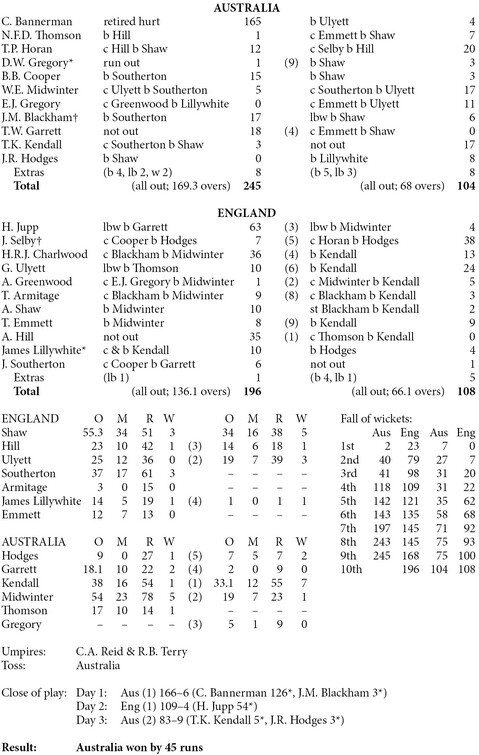
This is as close as England come to winning the inaugural Test. They have been one step behind from the moment Bannerman raised his game. Selby is dismissed for the top score of 38, Ulyett is bowled by a ‘leg shooter’ for 24 and England fold for 108, to lose by 45 runs. Kendall ends the innings with seven wickets for 55.
Enthusiastic are the celebrations. According to The Herald, a large proportion of the 5000 spectators ‘swarmed in front of the pavilion, and clamoured for the most prominent players to show themselves, each one being greeted with a round of applause as he appeared. Then someone suggested “three groans for Allan”, which were given with great gusto. Then “three groans for Spofforth” also met with due attention, and the proceedings wound up with “three more for Allan”.’ So much for refusing to represent Australia: anyone doing so in future would be pilloried in the stocks of public obloquy.
The collection made on Bannerman’s behalf realises the grand sum of £83. Yet Victorian pride, while acknowledging Bannerman’s prowess, cannot be entirely contained. ‘If New South Wales can point to the most brilliant batting performance ever seen in the colonies, Victoria can confidently refer to wicketkeeping that has never been excelled, both for smartness and general effectiveness. Blackham’s wicketkeeping has never been surpassed – even if equalled – here, and he kept without a longstop nearly the whole time without allowing a single bye.’
An editorial in The Australasian proclaims:
The match between a combined eleven of this colony and New South Wales and the Eleven of England will be ever memorable in the annals of cricket as the first occasion on which, meeting on even terms, the representatives of the old world have succumbed to those of the new . . . and their success must be doubly gratifying to all who have the welfare of these colonies at heart. For although cricket is, when all is said in its favour, merely an amusement and recreation, yet, nevertheless, the great proficiency attained by colonial players is a most hopeful sign, and gives us reason to believe that the same energy and determination which have led to such happy results in the cricket field will be displayed also in the more important concerns which tend to the advancement of the colonies at large.
Tangible, amidst these Australian celebrations, is relief. An earnest debate has been taking place as to whether the Englishman degenerates when transported from Anglo-Saxon soil to the heat of the colonies. Trickett’s rowing victory on the Thames was the first evidence that Australia’s climate was not too enervating. Here is further proof. After the game, The Argus proclaims: ‘The event marks the great improvement which has taken place in Australian cricket and shows, also, that in bone and muscle, activity, athletic vigour, and success in field sports, the Englishmen born in Australia do not fall short of the Englishmen born in Surrey or Yorkshire . . . Here we need only to compliment the victors on their achievement, and Australia at large on the proof which the victory affords that the physical qualities of the English race show no sign of decline in these sunny southern lands.’ Alert to the wider social scene, The Herald adds: ‘For there is still a very large class of persons even in the colonies themselves who hold that anything from the old country must for that simple reason be superior to a colonial production. These were principally people who knew little or nothing of cricket . . .’
Most of England’s cricketers catch the evening train to Bendigo. A few stay on at the White Hart for one more night. Do some of the Australian players join them? They have enjoyed their victory over the Englishmen, but they want their visitors to have a good time while being beaten in the colonies, otherwise they will not return. The Australian cricketer’s attitude to touring teams is a bit like a boxer’s: he holds his opponent close with one hand while slugging him with the other.
The pattern of English professional cricket is already established: to play, and play. The Australians practised for five days before the game, performed and peaked, then rested. Time has proved the efficacy of their methods. English cricketers have made more money in the course of time; Australians have had more success.
The remainder of Lillywhite’s men catch the train to Bendigo at seven the next morning, except for one: Armitage is seen to arrive on the platform as it steams out. He does not reach Bendigo until four that afternoon, long after the game has started. The advancement of Australian cricket has left him and his lobs behind.
‘Mateship’ was the supreme attribute for those living in Australia’s outback. ‘Ignorant of the consolations of religion, untouched by the traditions and conventions of European society, they looked for a comforter to offset the loneliness of their lives and to protect them against its dangers,’ Manning Clark wrote of bushmen in A Short History of Australia. ‘They found it in mateship.’ Mateship is mutual trust and working together, without shirking, in a small, tight group. These values are also integral to a successful cricket team, and no national team has been anywhere near so successful as Australia’s. They have won a higher proportion of Tests, and more one-day World Cups, than any other country.
One of Australia’s original XI was soon dropped for letting his teammates down. Thomas Kendall turned up for a game in New Zealand the worse for alcohol, and was thrown out of Dave Gregory’s team to tour England in 1878. Here again, the culture of Australian cricket was established, once and for all: drink as much as you like, but never turn up unfit to play. When Andrew Symonds appeared in a similar state to represent Australia against Bangladesh at Bristol in 2005, he too was dropped. It has always seemed to me that Australia’s cricketers have resembled their states: autonomous, responsible for their own development, but ready to pull together in the national cause.
Gregory was captain again when the first white Australian cricketers toured England in 1878, using Lillywhite to arrange their fixtures. It turned out to be a lucrative venture – the players put up £50 each to finance the tour and received a return of £750 each – once they had beaten MCC at Lord’s in a single historic day. (‘The Australians came down like the wolf on the fold,’ Punch parodied.) Gregory’s men were not professional cricketers, but men of substance who made themselves even more substantial when they took time off from their jobs to play cricket. Gregory went on to become Paymaster to the Treasury in New South Wales; his brother Ned, who also played in the first Test, became the curator of the SCG, which had been demilitarised; Garrett qualified to be a clerk in the Supreme Court; Murdoch, who took over the captaincy from Dave Gregory, was a solicitor; Blackham and Spofforth worked in banks. Midwinter died in an asylum aged 39, driven mad by the sudden death of his wife and children.
The colours of the 1878 Australians were blue – the same as that of the Currency Lads – and white. Not until the twentieth century was the cap of green and gold introduced. The Australian historian Gideon Haigh has shown how a modern myth was made of ‘the baggy green’ when Steve Waugh became captain, and how it was monetised: Don Bradman’s cap for the 1948 tour of England fetched A$402,500 at an auction in 2008. Even so, before then, the baggy green had inspired fear. The English journalist Dudley Carew wrote of Bradman’s 1938 Australians and ‘those broad green caps which for so long seem to paralyse English elevens by their very presence in the field.’
In ‘the baggy green’, we have one facet of a cult. Then we have the communion rite of sharing a beer together in the dressing room after each day’s play; and, more recently, a creed in the Australian team song that celebrates victory. Such rituals keep the desire ardent.
The most widely accepted version of the Ashes legend has a bail being burnt. So it was, I believe, but not in the first instance.
While the Clarkes were on their European tour, early in 1882, they had visited the Swiss Lakes. There Lady Janet purchased, or was presented with, an urn – which subsequent analysis has shown to have been made of clay from northern Italy. It was designed to hold henna-like make-up, to adorn a woman’s eyes.
But when Janet and Florence decided to fill this tiny urn with ashes on Christmas Eve – to symbolise the body of English cricket which had been cremated after the Oval Test back in the English summer – and to present it flirtatiously to Bligh, they would not have had time to burn a bail. A bail, of hard wood, could only have been incinerated as part of an elaborate fire.
Besides, the memory of Rosemary Trasenster, Florence’s daughter-in-law, was crystal clear on this subject. Although she never met Bligh, she knew Florence, in England, for many years. And although Rosemary was into her nineties when I met her, she was living independently, and cooked lunch for her grand-nephew Rupert and me, and was thoroughly compos mentis. She was adamant that Florence had told her that the ashes that went into the urn were those of a veil. ‘A veil, not a bail,’ Rosemary insisted.
Ladies of Melbourne in the 1880s, Rosemary explained, wore chiffon scarves: such can be the winds in Victoria that a woman can easily have her hair blown around, so anybody who was anybody would have possessed several scarves, or veils. It would have been the work of a few minutes, amid the bustle of Christmas and the cricket match, to burn a veil and place the ashes in the terracotta urn, then to present the prize to Bligh – perhaps, in Florence’s case, as an earnest of what was to follow.
After England had won the 1882–83 series 2–1 – it was originally scheduled to be three Tests, although a fourth was added – Bligh was presented with, or took, a pair of bails from the stumps used in the third Test at Sydney as a memento. One of these two bails was made into a holder for a knife to be used for opening letters. It is highly feasible that the other bail was burnt ceremonially at Rupertswood, and its ashes placed in the urn, being more appropriate than those of a veil.
When Bligh returned to England, with Florence, he took his urn and placed it on his mantelpiece at Cobham Hall, after he eventually inherited the title. But the contents were either diluted or completely replaced: family stories of the urn being cleaned by servants, or knocked from the mantelpiece and the contents spilled, are too numerous to be disbelieved. Marylebone Cricket Club, unsurprisingly, have declined to reveal the findings from the analysis of the ashes themselves. But no matter what they are or were made of, the ashes have fanned the flames of the contests between Australia and England. Without the Ashes being transmuted into physical form, if they had simply remained a myth, Test cricket between England and Australia would surely have survived. But it would not have reached anything like the same level in the public consciousness.
A long, grim recession struck Australia in the 1890s. Drought spread from the deserts, wool prices slumped. The Clarkes moved into their town house in Melbourne, Cliveden, and from its kitchen Janet supervised the feeding of hungry people by the hundred. Many others wandered the streets of Sydney in search of work. From his window, the poet Henry Lawson watched them, and told those who cared to listen:
They lie, the men who tell us, for reasons of their own,
That want is here a stranger, and that misery’s unknown;
For where the nearest suburb and the city proper meet
My window-sill is level with the faces in the street –
Drifting past, drifting past,
To the beat of weary feet –
While I sorrow for the owners of those faces in the street.
And cause I have to sorrow, in a land so young and fair,
To see upon those faces stamped the marks of Want and Care;
I look in vain for traces of the fresh and fair and sweet
In sallow, sunken faces that are drifting through the street –
Drifting on, drifting on,
To the scrape of restless feet;
I can sorrow for the owners of the faces in the street.
In this period, about one-third of Australia’s white population was of Irish descent: virtually the bottom third in socio-economic terms, except for a few achievers like Edward Flood had been. So it would be wrong to claim that cricket offered consolation to this section of society. Yet enough has been said and written for us to see that Victor Trumper, who was coached by Charles Bannerman and inherited his mantle, was something more than a sporting hero.
Trumper came from the masses in Sydney, out of wedlock as he was born six years before his parents married, and they might not have been his natural parents. He was teetotal, non-smoking, untidy, generous to a fault, pigeon-toed and superstitious: he wore the cap in which he scored his first Test century for the rest of his career. He was wirily strong from playing rugby league, and habitually shrugged his shoulders while batting in order to cool the sweat under his shirt – shoulders that could throw or hit a cricket ball prodigious distances. When he scored 335 for Paddington against Redfern in 1903, one of his on-drives was measured at 150 yards to the point where the ball hit a building. This cannot be myth or fable: the second-floor window of the boot factory could not have moved.
In addition to these physical attributes, Trumper was saint-like in his selflessness; after his death, his widow Sarah attended Mass almost every day for the rest of her 85 years. ‘To those of us who were privileged to meet him during his illness, his cheerfulness under great suffering was amazing,’ wrote his Australian teammate Frank Iredale. ‘Just as in his cricket, so in his illness, he refrained from choosing the middle way, but fought the foe face to face. His was a noble nature, free, unrestrained, and open. He made no foes, his opponents always recognised the fearless fighter and the generous friend.’ Another teammate, Charlie Macartney, himself one of the most brilliant of all strokeplayers as one of the few to score 300 in a day, wrote: ‘I say, without hesitation, that he was the best batsman I ever saw. He excelled on any wicket, and against any bowling, but beyond all his cricket he was a man, a fighter on the cricket field, and a thorough gentleman at all times.’
Trumper’s essence, of physical prowess and spiritual softness, was best encapsulated by Arthur Mailey, of Irish descent. Mailey grew up in Sydney in the 1890s, his family so poor that he and his six siblings took it in turns at breakfast to eat the top of their father’s boiled egg. When Mailey’s dream was fulfilled and he bowled at Trumper in a grade match, he had him stumped off a googly. Mailey’s famous reaction: ‘I felt like a boy who had killed a dove.’
Trumper had a direct connection with the masses. Those who could not afford the entrance money when he represented New South Wales or Australia could watch him playing for his club, Paddington, then Gordon. He scored 36 centuries in grade cricket, in addition to 42 in first-class. His 335 was watched by a crowd estimated at between nine and ten thousand. After his death in 1915 from Bright’s disease, the procession headed by Bannerman stretched for almost three miles through Sydney’s streets.
Although indigenous Australia is filled with spirits, white Australia has produced relatively few religious figures. This cannot be solely a function of recentness: the United States of America, not much older, has produced several prophets, not least in Salt Lake City. Cricket has filled some of the functions of a religion in white Australia, and Trumper had some of the qualities of a saint.
In addition to the Ashes, the rivalry between New South Wales and Victoria has maintained the heat in Sydney and Melbourne. During the 1920s, Bill Ponsford twice made the world-record score for Victoria, 429 and then 437, before Don Bradman surpassed it with 452 not out for New South Wales. Bradman went on to make unprecedented Test scores against England in the 1930s, at a time when many Australians thought the tariffs and taxes imposed on them by Britain were turning a recession into depression. But this was not the source of Bradman’s motivation in hitting a century once every three innings, in Tests or first-class cricket, and 12 Test double centuries – a record unequalled for almost 70 years after his retirement.
A two-hour train ride from Sydney to Bowral gave me an insight into what drove Bradman to heights never scaled before or since. Whisper it not in Bowral that Australia is egalitarian: the town is to Sydney what Windsor or Sunningdale is to London, a weekend retreat for the social elite. Sydney’s establishment took to these hills to escape from the masses, and such was their abhorrence of everything wild and indigenous that Bowral’s hills were planted with European trees, any trace of native bush extirpated.
Bradman entered this strict social hierarchy at the bottom. His father had moved to Bowral from Cootamundra, where he had been ‘a bush carpenter’: not equipped with machinery, that is, but a rough-and-ready manual labourer. The son aspired to better himself. He courted a girl attending a boarding school in Bowral and won the heart of Jessie; he joined a real estate firm at 16. On the field, he scored slightly quicker than his contemporaries, but what distinguished him was an unrelenting ambition to make bigger scores than anyone had ever done before, even – especially – the Melburnian Ponsford.
When Len Hutton visited Australia for the last time, I asked him if he wanted to see Sir Donald Bradman. As a lad in the crowd at his home ground of Headingley in 1930, Hutton had watched Bradman score 334 against England. Hutton had trumped this score at the Oval in 1938, grinding down the Australian bowling under Bradman’s captaincy for more than 13 hours to score 364. The two champions, I naively thought, would want to meet one final time. ‘No,’ said Sir Leonard, without pausing as he used to do for a Delphic utterance, before repeating the allegations about insider-trading which were made after Bradman moved to Adelaide and joined the stock exchange. To compete with Bradman during his career, Hutton had to be obsessive, and that obsession was not going to die before he did. The hatchet, if thus it was, went unburied.
From Bannerman to Trumper, from Macartney to Bradman, the greatest of all batsmen, from Doug Walters to Mark and Steve Waugh, to Michael Clarke, David Warner and Steve Smith, the torch of Sydney batsmanship has been passed on. They have made the most of the space, and the sunshine which Sydney receives in more lavish abundance than Melbourne, where the cricket season starts a full month later. Not even Bombay’s school of batsmanship can equal Sydney’s.
In only one respect would I say that male Australian cricket has failed to maximise the country’s resources. Given more humanity and generosity of spirit on the part of politicians and cricketers, Australia could have unleashed a counter to Harold Larwood in the Bodyline series of 1932–33.
The first of all cricket teams to tour England was the Aboriginal team of 1868. Some of them contracted European diseases, or failed to take to the game, or concentrated on the circus acts they also did, such as throwing boomerangs and running backwards. But two of them were sterling all-rounders who scored more than 1000 runs and took more than 100 wickets, Johnny Cuzens and Johnny Mullagh, as did their English captain Charles Lawrence. With this triumvirate carrying the team, they won 14 and lost 14 of their matches, taking a first-innings lead over MCC at Lord’s.
It was, however, no bridgehead. When the survivors returned home, their knowledge and experience were lost. Mullagh played a couple of games for Victoria, and that was it. The opportunity to make cricket the sport of Australia’s immigrant and indigenous people drained into the Nullarbor Plain. The two cultures remained polarised.
It could have been different. Two indigenous bowlers, though both were only five feet seven in height, bowled faster than any of their contemporary countrymen: Jack Marsh and Eddie Gilbert. On his first-class debut, for New South Wales in 1900, Marsh bowled five batsmen in South Australia’s only innings while Clem Hill scored 365, the highest Sheffield Shield score to date.FN27 In his third match, Marsh took ten wickets, six of them bowled, as NSW exacted some revenge for Hill’s effort: they beat South Australia by an innings and 605 runs.
In Marsh’s fourth match, he was no-balled 17 times for throwing. ‘The great sensation of the day was the no balling of Marsh, the New South Wales bowler,’ reported the Sydney Morning Herald. ‘It appears that his very fast ball is fair, but that it is his slow and medium balls which are doubtful.’
Illustrating how throwing, like beauty, can be in the eye of the beholder, the umpire who no-balled Marsh was Bob Crockett, who had officiated in Marsh’s second game and not called him for throwing. In Marsh’s fourth game, Crockett also called another NSW bowler, Howard, for throwing three times in the same innings. Yet the umpire at the other end, Sam Jones, did not no-ball Marsh at all – and Jones had played plenty of Tests (including the one at the Oval in 1882, when he had been run out by Grace), whereas Crockett never played at first-class level.
Even when Marsh subsequently put his arm in a wooden splint and bowled at the same pace, he could not exonerate himself. Less than two years after his debut, his first-class career was over, after he had taken 34 wickets in only six matches at an average of 21. He took to alcohol, and was killed in a street brawl aged 42.
Gilbert had much the same action, generating pace with exceptionally long arms and following through until his right arm almost swept the ground. Don Bradman faced him on a damp pitch at Brisbane’s Gabba in 1931–32. Gilbert brushed his cap with one delivery, knocked Bradman’s bat out of his hands with another and had him caught behind for nought – but it was still long enough for Bradman to say it was the fastest bowling he ever faced. Gilbert lasted a little longer than Marsh, taking 87 wickets at less than 30 runs each in the highest-scoring period that first-class cricket has known, before being no-balled out of the game. Both Marsh and Gilbert bore the mark of the fast bowler not truly assimilated: they were always made to bat at number eleven.
Not until 2001, when another quick bowler, Jason Gillespie, proclaimed he was part-Aborigine, were indigenes openly represented again on the first-class field. I played against an indigenous team once in Alice Springs, and the characteristics of their cricket were similar to those of uncoached cricketers in the West Indies, and the Cape Coloured community, and Afghanistan. They bowled as fast as they could, and hit the ball as far as they could, which is the best of starting points. Coaching, nets, bowling machines, nutrition, psychology and the rest can come later.
Australian indigenes who live in the outback, perhaps more than any other community on earth and certainly in the English-speaking world, develop the power of throwing from an early age. They throw stones at birds or reptiles, and spears at fish or game. But without encouragement from cricket’s authorities, they gravitated towards baseball, and towards Australian Rules football in the footsteps of a role-model. Doug Nicholls joined the Carlton club in Melbourne, where their members would not let him play, so he moved to struggling Northcote and helped turn them into a premiership-winning side in 1929; he went on to become a pastor; and the first indigene to be knighted, as Sir Douglas Nicholls; and the Governor of South Australia. The chance to turn those throwing arms into bowling arms was thrown away.
Aside from the indigenes, a vigorous boy was delivered into the cricket world in March 1877. He grew to excel not only at batting but every aspect of the game. Jack Blackham was agreed to be the best wicketkeeper of his time; Adam Gilchrist to be the best wicketkeeper-batsman of all time. The finest Australian spinners have learned to turn the ball on any surface: from Mailey, who strengthened his fingers as a teenage glass-blower, to Bill ‘Tiger’ O’ReillyFN28 to Shane Warne, agreed to be the best spinner of all time. Fast bowlers have run in with the whole country roaring them on, like Ray Lindwall, Dennis Lillee, Glenn McGrath and Brett Lee, men who have defined our image of what a fast bowler should be. (There has been one excess of this ardent desire: the practice of a fielder throwing the ball at the batsman as much as to the wicketkeeper, mainly during Steve Waugh’s captaincy, was contemptible bullying.) And Australia’s representatives have never fielded poorly, for that would be letting their country down. Even the spectators in Australia field well: from my observation, a ball hit into the crowd there is far more likely to be caught than in any other country. Good on yer, mate.
The shortest of verbs sums up all the elements which have gone into making Australia the country that has been best at cricket. ‘Australia is three down for 200,’ their commentators or spectators say, or ‘Australia is going to win the first Test.’ It is as if their cricketers do not represent their country, they embody it. Other countries, like England or India, have won the toss and are batting. Australia, the very country, is playing cricket.
Does Australia’s cricket contain the seeds of its own decline, if not destruction?
The MCG was not used during the winter until around 1860, when some MCC members designed a game based on Gaelic football to keep the club’s cricketers in trim during the off-season. This sport grew into the Victorian Football League, part-time and amateur, then into the Australian Football League, sprouting professional clubs in every state capital on the mainland. From 2010, ‘Aussie Rules’ offered about 800 playing jobs around the country, on salaries from A$100,000 upwards. The back pages of newspapers nationwide feted the teenage athletes who were drafted into the clubs. Cricket offered around 100 jobs, mostly at lower salaries.
Will the offspring, more than 150 years down the line, devour the parent and replace cricket as Australia’s national game? Perhaps not. Cricket’s roots, in Sydney at least, are too deep.