
4
Cricket, if I may judge from the boys I coached at Cooch Behar College, has done a little to bring friendship between races where there might otherwise have been greater bitterness.
Harry Lee, Middlesex professional
He resembled the Ancient Mariner in having witnessed something beyond the ken of ordinary mortals. But what this old Yorkshire villager had seen was not sailors made into skeletons by thirst in the Great Southern Ocean; he had seen one of the seven wonders of the cricket world, and bowled to him.
In the early 1900s, Kumar Shri Ranjitsinhji, long established in the England Test team, had come to spend his holidays in the North Riding. Ranji had first met the Reverend Louis Borissow, the Rector of Gilling East when he had been the chaplain of Trinity College, Cambridge, and Ranji had stayed with him before going up. A fine rectory it was too, being the castle above the village of Gilling East, and most agreeable for a holiday. We now know, however, that Ranji visited not only for the air and the view: it has emerged that he had a child by one of Mr Borissow’s daughters, Edith.
This mariner’s eyes may have had cataracts, as he was well into his eighties, yet there was more to the gleam than that. ‘He’d come down from the castle,’ said the villager. ‘He’d come down in the evenings with a bat, and we’d bowl at him in the field over there . . .’
He did not have to hold me with his skinny hand. Though only 16, I had read enough about Ranji to know he had been a novelty and more. The first major sensation in cricket had been W.G. Grace in his summer of 1876. The second had been the Australian touring team of 1878, when they had beaten MCC at Lord’s. The third was Ranjitsinhji.
Ranji was not only the first Indian, or non-white, to represent England at cricket; not only the first to score 3000 runs in a first-class season; not only the first to score a century before lunch in a Test match (on his debut, too, against Australia at Old Trafford in 1896, when he hit 113 runs in the morning session of 130 minutes). Ranji had also revolutionised batting by opening up the leg-side. It was there as Holy Writ in one of the first Wisdens I owned, that of 1896, which referred to Ranji’s batting for Sussex the previous season: ‘his wonderful placing on the leg side quite disheartening many of the leading professionals, who were unaccustomed to see perhaps their best ball turned to the boundary for four.’
‘He said we could bowl as fast as we liked,’ the villager said, ‘even though he didn’t wear pads or anything.’ In a field, too, not on a proper pitch. ‘Afterwards, he would give us sixpence each. Think of it, sixpence each – for bowling at Ranji! And sixpence meant something in them days.’
Ranji was not everything he claimed to be. Having arrived at Trinity and set himself up in a ménage as exotic as Lord Byron’s – it was claimed Ranji owned the first car in Cambridge, not a mere bear – he gave the impression that he was a prince by styling himself Kumar Shri. He lived the life of royalty, and bestowed lavish gifts, but only by running up bills that often went unpaid. He was then as remote from the throne of Nawanagar in terms of lineage as mileage. It was only after he had established himself as the most famous cricketer in England, and suppressed the scandal of his illegitimate son by giving him away for adoption and cutting him off for ever, and after a palace coup, that he succeeded in claiming the throne as Jam Sahib.
In the meantime, nobody could question the authenticity of his batting: it was based on the simple premise of ‘play back or drive’, which is still a fitting technique against spin bowling more than a century later. Nobody could question his fielding either: his sleight of hand made him the finest slip in England, and he once wrote that he actually preferred fielding to batting. The old villager’s eyes were testimony to Ranji’s unprecedented brilliance. So too were the words of W.G. Grace, when he told the guests at a dinner in Cambridge in 1908: ‘I assure you that you will never see a batsman to beat the Jam Sahib if you live for a hundred years.’
Was W.G.’s prophecy correct? The heights of batsmanship in England have been scaled by Jack Hobbs, Wally Hammond, Len Hutton, Denis Compton, David Gower, Graham Gooch and Kevin Pietersen, and maybe a few others on their day. But I do not think that the wonder they excited at their peak, when they made their Ashes centuries – not even Pietersen’s at the Oval in 2005 – exceeded the awe Ranji generated. Equalled, perhaps, but not exceeded.
If nothing else, statistics confirm Grace’s prophecy. To this day, nobody who has had a career based in England has achieved a higher first-class average than Ranji. On uncovered and sometimes minimally prepared pitches, in games that never lasted longer than three days, he averaged 56 – which would have been 57 had he not returned to play a few innings for Sussex in 1920, as the Jam Sahib of Nawanagar, with one eye. He had lost the sight of his right eye during the First World War, in an accident when shooting on the North Yorkshire moors not far from Gilling.

I went to Ranji’s palace in Jamnagar to research my first book, on England’s 1981–82 tour of India. At university I had read Arabic Studies and thought I wanted to be the Middle East correspondent of The Observer, based in Beirut. But the week after I visited that city in 1975, the civil war in Lebanon began, not to cease for 25 years. After spending a couple of years in the Middle East, I considered the Foreign Office, and had an interview with MI6, but a friend who worked for the organisation said it was ‘90 per cent paperwork abroad’. I met Dame Freya Stark, in her eighties but still travelling intrepidly, in Sana’a, the capital of North Yemen as it was. She said discerningly: ‘You are still searching, aren’t you?’ And it was not until I joined The Observer to cover cricket that I found.
The Observer’s photographer, Adrian Murrell, and I flew from Bombay to Jamnagar as the Jam Sahib’s guests and stayed in the biggest bedroom I have ever slept in: a cross between a baroque cathedral and a millionaire’s mansion in Las Vegas. Our host did not appear on the first day, or the second. He sent a note instead about meeting the following day, which gave me the line: ‘It seemed to be a case of the Jam yesterday, and the Jam tomorrow, but never the Jam today.’
Ranji’s bedroom had been preserved as it was on the day he died in 1933. His spectacles lay on his dressing table along with a selection of six glass eyes. On day three, the Jam Sahib appeared and showed us around Ranji’s princely state, telling us tales of intrigue in the harem or ‘zenana’, including a poisoning, that opened the way for Ranji to take the throne.
But the story of Indian cricket, I learnt, did not begin with Ranji. Indeed, he could be said to have played no part in it after leaving his boarding school, Rajkumar College in Rajkot; he was then taken to Cambridge by his headmaster, Chester Macnaghten, a Trinity graduate, who entrusted Ranji to Revd Borissow. Ranji may have been an Indian cricketer but he represented England, and when he returned to rule Nawanagar, he had little to do with Indian cricket except help select the All-India party to tour England in 1932. It was only after his death, to commemorate him, that the Ranji Trophy was instituted as the prize for domestic cricket.
The other Indian princes who took up cricket did not leave much of a legacy either. When the first All-India team arrived in England in 1911, the Maharajah of Patiala abandoned all thoughts of captaincy and batting. He went off to enjoy the London season, and promote his political prospects, taking the team’s best batsman as his secretary: Colonel Mistri, a Parsi. When the Maharajah of Porbandar captained the second Indian team to tour England, in 1932, he was such a poor player he had to stand down for India’s inaugural Test match. When the equally hopeless Maharajah of Vizianagram captained the third Indian team in 1936, his ego was such that he sent home the best all-rounder, Lala Amarnath, on an exaggerated charge of indiscipline.
India’s Test cricket set off on the wrong foot, led by princes who owed their captaincy to wealth and influence. Richer maharajahs, like Patiala, would hire English cricketers as well as local ones to do the bowling and fielding for them. Their bad habits became ingrained. There was no prestige in bowling – low-caste manual labour – and less in fielding. It is tempting not to dive on a dry south Asian ground that does not have underground sprinklers,FN29 but lordly Indian princes set the worst example. As captains, they had a sense, not of team or country, but of entitlement.
Indian cricket teams became divided between cricketers of one region and those of another, based on language. Alone of Test-playing countries, India had to build a national team out of a population that spoke 800 languages.When I was researching my first book, Cricket Wallah, I was told by more than one Indian Test player of the 1950s that a fielder from one region might not try to stop the ball if the bowler came from another.
By way of redemption, it was a princeling who paved the way for India to become unofficial world champions. Schooled at Winchester, the Nawab of Pataudi Jnr was brought up on a soft surface beside the River Test to give everything in the field. India’s spinners of the 1960s needed the support of infielders and close catchers, and finally they were given it. The effectiveness of Bhagwat Chandrasekhar, Bishan Bedi and Erapalli Prasanna was increased by Pataudi, and his emphasis on fielding, to the extent that they shared more than 700 Test wickets in what was still, outside England, the amateur era.
Batting was the one on-field activity that interested India’s princes, but again their style of batting did not set the best example. The Maharajah of Patiala had more children, 88, than his highest score, 83, his only fifty in first-class cricket; and the feature of his batting was hitting, not running between wickets or rotation of the strike.FN30 This innings came in a match billed as ‘India v England’ at the Bombay Gymkhana in 1918. When the Maharajah walked in at 44 for three, Harry Lee, in Forty Years of English Cricket, remembered that he had been told: ‘Whatever you do, don’t get the Maharajah out for a duck. He doesn’t like it.’ The Maharajah then hit Lee ‘for several sixes in the course of two or three overs’. When V.V.S. Laxman retired from Test cricket in 2012, having authored several of the greatest innings, he summed up: ‘By nature Indian batsmen are aggressive and love to hit boundaries.’
These Indian princes generated colourfulness, amusement and scandal, not heat. It was no thanks to them that India’s first hot spot was Bombay.
The temperature at ten o’clock on 30 January 1890 was no higher than 77 degrees Fahrenheit, according to the following day’s Bombay Gazette. Yet this was the day when Bombay became the hot spot of Indian cricket. This was the first day of the match that anticipated the mass-hit film Lagaan by more than a century.
The only place where this spontaneous combustion could take place was the Bombay Gymkhana, the city’s one cricket ground, lying in the Fort, a few hundred yards from where ships dock or anchor. For decades British regiments had come ashore here, bringing not only their military but their cricket equipment, and certain people had long regarded them with special interest: members of the Parsi community, whose first cricket club was founded in 1848.
The Bombay Gymkhana, however, was a club for Europeans only: native Indians were excluded. Parsis who wanted to play with bat and ball were forced to find another space, and when they did, they found themselves thwarted again. An area near the Fort was used by Parsis until a European lady (no mere ‘woman’) was out walking her dog and was hit by a stray cricket ball. Another open space the Parsis used was sometimes required by British polo players. ‘This makes the ground so rough and bumpy that the Parsi cricketers became apprehensive of a fractured rib, or a twisted nose, a black eye or loss of teeth and avoid playing on the ground in summer until it becomes green and not so fiery in the monsoon.’ So wrote Mehallasha Pavri, who had toured England with the second Parsi team of 1888, before returning to qualify as a doctor.FN31
In January 1890, however, the Parsis had been granted the privilege – not given to any other native Indians – of playing against the first English team to tour India. It was led by Lord Hawke, until he fell ill, then by George Vernon, the Middlesex amateur who had gone on Bligh’s tour of Australia in 1882–83 and had represented England at rugby as well as cricket. And just as the match had to be staged at the Bombay Gymkhana, the fixture itself had to be played, for political reasons. The British government had invited the Parsis to send a cricket team to England in 1886, and although they had been pretty useless – the party consisted of those wealthy enough to pay their passage, not their best cricketers – the Parsis had served to strengthen the bonds of empire, and their successors on the tour of England in 1888 had improved commendably; so they could hardly be ditched now.
‘Divide et impera’: so Julius Caesar had decreed. After the Indian Mutiny (or National Uprising) from 1857 to 1858, when no other community had stayed completely loyal to the British, the Raj decided that it was in their interests to divide the Parsis from the other communities. That was why the British government had showered hospitality on the Parsi teams of 1886 and 1888: one game was against MCC, captained by W.G. Grace, at Lord’s; another at Windsor Great Park against a side including two of Queen Victoria’s grandsons, Princes Victor and Christian. It would have been impolitic to refuse the Parsis a fixture against Vernon’s XI – although club rules could not be relaxed, and no native Indian could be allowed into the Gymkhana clubhouse, except servants and the Parsi groundsman, Pestonjee.
At least the chance of Vernon’s men losing to this native team, and damaging imperial prestige, was minimal. The Parsis had arrived from Persia with some tradition of sporting and athletic prowess a millennium before, when expanding Islam had pushed out the worshippers of Zoroaster and his fire. In Persia they had played Chugan Gui, which translates as ‘bat and ball’, while Persian ladies were reputed to have played polo. But, since arriving in India, the Parsis had settled into mercantilism: they were middlemen, adept at commerce, rather than men in the middle. According to one of their founding myths, the leader of a group of Parsis who had landed in Gujarat went to the local ruler and asked permission to stay. When the ruler asked why he should let the Parsis in, when his land was already packed with people, the Parsi leader took a glass of water filled to the brim and placed a coin in it, without spilling a drop. This is how the Parsis would fit in, without disturbance.
When the Honourable East India Company arrived in the eighteenth century, Parsis transferred their loyalty to these new rulers. It was even said they revered the Englishman as a second Zoroaster. British ships brought goods to Bombay, and who was going to arrange for onward transportation into the ‘mofussil’ or interior? Given their knowledge of local languages and terrain, and loyalty to the British, Parsis could be trusted. In return, they began to adopt British values, study English literature as they had no secular literature of their own, and educate their girls. They had no priests imposing traditional values or taboos, thereby restricting contact with Europeans. The very surnames adopted by the Parsis illustrated their keenness to adapt to the new economic order: Doctor, Writer, Readymoney, Engineer, Warden, Merchant (not all Merchants were Parsis: for example, Vijay Merchant, a Hindu), and Contractor.
Sealing this bond of trust was the Parsis’ enthusiasm for cricket: they tried tennis, football, racquets, billiards and other sports, but cricket was their game. Even in the early stages, when the British had spurned their efforts at cricket, the Parsis had persisted. The indifference of the British, like that of the woman beloved, was infatuating. After watching soldiers and civilians playing at the Gymkhana, they went away and improvised with pieces of wood as best they could. Simultaneously, in the United States of America, the exact opposite was happening: cricket was being rejected for being the English sport, except in Anglophile Philadelphia, and destined for extinction.
A picture of the early Parsi cricketer was painted by J.M. Framji Patel, a member of this community who had studied at Cambridge in the 1880s and won his colours in three sports at Gonville and Caius:
He went to the wicket with a white band around his forehead, giving him quite the air of the inmate of some hospital, and a still whiter apron dangling from his waist, which was encircled by the sacred thread of his faith. Thus equipped, with patent-leather boots and silken trousers, he was a fit study for an artist . . . Parsi cricket in its infancy was sui generis – the players had their peculiar phraseology, strokes, dress and nicknames.
Against such weird opponents, Vernon’s men simply could not lose – and plenty of bets were placed on them. Besides, they were a capital team. Although Lord Hawke was indisposed, most of the remaining tourists played first-class cricket in England. Vernon and three others played for Middlesex, and three more for Cambridge University. The only player not of high standard was the Honourable A.N. Curzon, who happened to be doing a grand tour of India, along with his elder brother Nathaniel, when he was asked to fill in for Lord Hawke.FN32
Vernon’s team had naturally not been beaten in any of their matches in Oudh and Bengal against indigo planters and the military, or even looked like being so. They had one outstanding player in Hylton Philipson, universally known as ‘Punch’, who had won a blue at Oxford in four different sports. Now a wicketkeeper-batsman for Middlesex, he was rated the third best keeper in England behind a couple of professionals, and was soon to play five Tests against Australia. If the 1889–90 tour contained the slightest element of controversy, it involved Punch’s sola topi: it was so broad-brimmed, to keep off the sun, that when he was standing up to the stumps his topi protruded in front of them. Should the square-leg umpire call no-ball?
Vernon’s proclivity for drink could have been a second source of controversy – off the record of course, old boy! He had missed the start of a game on Bligh’s tour of Australia after being detained by nocturnal activities in Melbourne. When Vernon’s team visited Meerut, their captain socialised all too well. Bit of a rag in the mess of the 5th Lancers, so Lord Hawke later recounted in his memoirs. Vernon ‘was brought on a stretcher at 3 a.m. to the house of his host, Sir George Greaves, who was in command.’ Mrs Vernon was summoned from upstairs, and ‘his dear, pretty little wife came down in a pink dressing-gown to receive the living remains of her husband.’
In the first of their two fixtures in Bombay, Vernon’s men were far too good for the Gymkhana Club – British players – and won by an innings. John Hornsby, of Middlesex and MCC, a left-arm spinner who took over 50 first-class wickets at only 17 runs each, ran through the Gymkhana’s batting, taking 13 wickets. ‘Several of their batsmen played back in a weak, undecided way to balls which they could have easily smothered by playing forward,’ The Times of India reported. Their correspondent then previewed the second game: ‘The visitors, we think, should have no difficulty in keeping their laurels untarnished, but the Parsees with their well known pluck and capacity for playing an up-hill game are sure to put them on their mettle. The chances of cricket are such that if Mr Vernon’s XI take it too easy, or run away with the idea that they may hold their adversaries cheap, it is just possible that the Zoroastrians may score a victory after all. In any case the public may look forward to a capital match with good bowling and fielding on both sides. In batting the visitors are no doubt the stronger side, but the Parsees have improved much of late, and will no doubt make a good show.’
The Times of India also supplied their readers with some gossip about the wife of the next Governor of Bombay. Lord Harris, the former captain of Kent and England, had been appointed to succeed Lord Reay. Now the newspaper quoted Vanity Fair to say that Lady Harris, accompanied by her daughter, would go out to India ahead of her husband. She would travel ‘before the end of the cold season, in order to avoid the intense heat of the Red Sea later on’, and stay at Government House with Lord and Lady Reay until ‘the arrival of the new Governor in March’. One for the diary, what?
On the morning of Thursday, 30 January 1890, the Bombay Gazette lists ‘Cricket – Mr Vernon’s Team v The Parsis’ as the first event of the day.FN33 Underneath this item comes the meeting of the Municipal Corporation at 3 p.m., and the Prize Distribution by Lord Reay at Lower Colaba Schools, these events listed in chronological order rather than order of social importance. Not that the Parsi community needs any reminder about the first item: they had been ‘present in very large numbers’ at Vernon’s victory over the Gymkhana Club. And a photograph from this period of a cricket match in Bombay shows a stand full of seated Parsi women in white headscarves, highly animated. If it was not the same as playing polo back in Persia, it was better than being confined to the house, like upper-class women of the Hindu and Muslim communities.
‘So intense was the enthusiasm that merchants, bankers and all others forsook business for the day and came to see the most exciting cricket match ever played in India.’ If this sounds biased, coming from Dr Pavri, a more impartial judgement is offered by Captain Philip Trevor, who attended the game and wrote about it in his book The Lighter Side of Cricket (he went on to become the cricket and rugby correspondent of the Daily Telegraph). Trevor called it ‘the most famous match ever played in India’ and estimated the crowd at between ten and twelve thousand on each of the two days.FN34
‘The canvas tents pitched on the western side of the ground were closely packed with the elite of Bombay Society, European and Indian,’ wrote Framji Patel, back home from Cambridge to captain the Parsis. ‘The dark-eyed daughters of the land for the first time mustered strongly . . . The Parsee priests in their white garb invoked the aid of the “Asho Frohers” to secure victory to the Zoroastrian arms. The schoolboy managed to take French Leave, and his interest in the game was so keen that he had provided himself with bits of paper on which to jot down the placing of the field by the English Captain, Mr G.F. Vernon, a thorough sportsman. The “man in the street” was out enjoying his holiday, and in tiers of five and six deep the eastern and northern boundaries of the ground were closely packed by impatient sightseers. Some perched themselves (to get a good view of the game) on the trees surrounding the enclosure.’ Nowhere can there be a surer indicator of popular interest in cricket than spectators watching from trees.
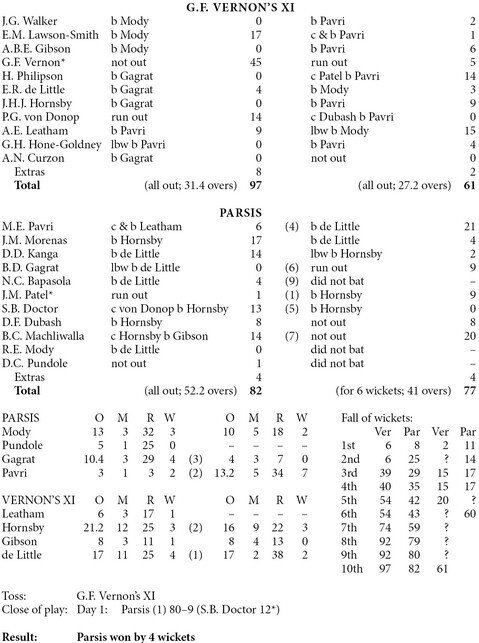
Vernon wins the toss and decides to bat. Thereafter the match against the Parsis does not go according to his plan. One of his opening batsmen is clean-bowled for nought: James Walker, an Oxford blue who was to play 44 matches for Middlesex and represent Scotland at rugby. The Times of India says that Walker has ‘a grand pair of wrists to make runs between cover point and third man, as well as being a first-rate point.’ His opening partner, Edward Lawson-Smith, who represented Gentlemen of Yorkshire, is also clean-bowled; so too Arthur Gibson, who played a couple of games for Lancashire. The bowler in each case is R.E. Mody, fast round-arm. Framji Patel later writes of him: ‘It was his terrific pace that upset me and many others. For a fast bowler his length was very good and he often shot in a yorker with deadly effect.’
It is with some consternation that the Bombay Gazette summarises the first innings of Vernon’s team after they have been dismissed before lunch for a total of 97 off 31.4 five-ball overs. The only individual score of note was Vernon’s unbeaten 45, after the captain had entered at number four and played some vigorous off-drives (his ‘dear, pretty little wife’ must have done her job in limiting the chota-pegs of whisky the night before):
This is the first time that our English visitors have been opposed by a purely native team, and their performance yesterday must have been rather surprising to them . . . Those who had seen the immense improvement in Parsi cricket fully expected that they would give a good account of themselves but it is safe to say that the most sanguine did not expect that they would come off as well as they did yesterday. Their bowling was fine as a reference to the analysis will show, Mody’s performance being particularly creditable. Gagrat is a fast underhand bowler, and the destructive effect of his delivery is a proof that a good underhand bowler is a great acquisition in a team. The fielding of the Parsees was all but perfect – as good at any rate as that of their opponents.
In other words, the Parsis’ fielding is not remotely like that of the Indian princes other than Ranji.
A few minutes remain before tiffin, and the Parsis’ opening batsmen survive until the interval. Both teams then adjourn, not to the Gymkhana clubhouse because the Parsis are forbidden entry, but to ‘Mr Tatta’s bungalow’, as the Gazette describes it.
At least it is no ordinary bungalow, for Jamsetji Nusserwanji Tata (more commonly than Tatta) is no ordinary man. He is the founder of what became India’s biggest business. He is his own man, with his own vision of what India should become. He ought to be considered ‘the most important innovator of the Indian economy’, according to the German author of The Parsees in India, Eckehard Kulke (who adds that the first Muslim woman to unveil in Bombay society did so at Tata’s bungalow). Parsis had made themselves indispensable to the British by organising their supplies in wartime, starting in Afghanistan, and Tata had started out by supplying the British-Indian army during their war in Abyssinia, before building up a textile business. By 1890 he was planning an iron and steel industry for India, instead of relying on British imports.FN35
Tiffin at Tata’s is so prolonged that the afternoon session of play does not begin until 3.20 p.m. Framji Patel, a member of MCC and Surrey, uses the occasion to deliver a welcoming speech which could be faulted for prolixity but not any lack of loyalty to the Empire (when he subsequently wrote Stray Thoughts on Indian Cricket, he was rather more aggrieved about the exclusiveness of Anglo-Indian clubdom):
We thoroughly appreciate your sportsmanlike spirit in coming here to play us at personal inconvenience in the home of Parsi cricket. I need not tell you that your cricketing expedition was looked forward to by us with feelings of great pleasure, because we believe that just as your real invasion a century ago had been the means of making us prosperous and loyal citizens, [so] would your cricketing invasion make us efficient and better cricketers. I for one am quite sure that you will carry pleasant recollections of your Indian tour, especially of this first meeting of the cricketers of the East and West in the first city in India, just as the Parsi cricketers have brought happy recollections of their two trips to England. I must at once tell you that the Parsi cricketers did not go to England to try conclusions with the great cricketers of your native land, but they went there as artists go to Italy in search of knowledge, or as pilgrims go to Jerusalem to pay homage at a shrine . . . In a country like India cricket is a very useful agency in bringing the rulers and the ruled together, and I am glad that the destinies of this Presidency will be in future in the hands of a famous cricketer. I have had already a long innings, but before I sit down I thank heartily once more Mr Vernon and his team for the honor [sic] they have done us to-day in coming here, and we who are brought up in your language and great and glorious traditions, have adopted your national game as our own, and I now ask you to drink to the health of the best exponents of the English game in India, and wish them long and prosperous lives and a safe journey to their native land, the land of liberty, and the land of cricket.
In reply, Vernon thanks Framji Patel for his kind words and the hospitality his team have received. Rather convivial hospitality? Parsis, unlike Muslims, have no ban on alcohol and it is possible that during luncheon Vernon and his men down a chota-peg or two. They seem a little sluggish in the field after tiffin. Twice the Parsi batsmen run five, and the Gymkhana ground is not huge.
The first occasion is when Dinshaw Kanga cuts Albert Leatham, a left-armer who played for Gloucestershire, ‘very prettily for five’; the second when S.B. Doctor ‘drove De Little beautifully to near the boundary for five.’ A whisky-flavoured oath of ‘dammit, sir!’ wafts down through the ages as a well-fed fielder watches the ball pull up a few feet short of the rope and sets off in warm, if not hot, pursuit.
The Parsis, without an England batsman like Vernon to hold them together, lose wickets regularly. They also appear to be more adversely affected than the tourists by the law which limits a hit over the boundary to four runs. (Not until 1910 did a hit over the rope count as six.) As one instance, Dinshaw Kanga ‘put one of Hornsby’s into the tent in fine style’; Kanga ‘ran up his 14 with very free hitting’, according to The Times of India.FN36
In addition to Kanga’s hit into the tent, Jal Morenas gets ‘one of Gibson’s over the tent ropes’, while B.C. Machliwalla makes ‘a hit over the boundary off Gibson’. Machliwalla came to be known as ‘the Parsi Jessop’ on account of his big hitting, often done from down the pitch, even though the keeper was standing up. From consecutive balls, Machliwalla hits 4, 3 and 4 before being caught on the off-side from the next ball.
The Parsis now have some decent bats and are no longer wielding home-made pieces of wood. One of their community leaders, Sir Cowasji Jehangir, had donated cricket kit, which was expensive after being imported from Britain. During this prestigious week for cricket, the Bombay Gazette carries a front-page advertisement which lists an ‘all cane bat’, the finest available, at 14 rupees and 8 annas – twice as much as a set of stumps, or wicketkeeping gauntlets, or batting gloves (‘best improved Vulcanised Tubular Indiarubber’). Leg guards of chamois skin are priced at 8 rupees and 4 annas, while the Duke’s Treble Seam ball costs 5 rupees and 8 annas.
Lacking anyone to hold up one end, the Parsis finish the first day at 80 for nine wickets, still 17 runs behind. Almost a century and a half has elapsed since the 1744 match between Kent and England at the Artillery Ground, yet the totals have increased by only half. Pitches, rolled by hand, still begin bumpy and are liable to disintegrate. The Gymkhana pitch, according to The Times of India, played ‘fast and true till toward the end of each innings, when the pitch towards the pavilion end, where there appeared to be a slight rise, got exceedingly bumpy.’ Mouthpiece of the Raj in Bombay since 1838, The Times of India adds: ‘The visitors appeared to recognise that they had met with a tough lot, and though it is not generally expected that the Parsi team will win, yet the day’s results portend a tough contest for the morrow.’
The first day is far from over. If Vernon’s men are too late to attend Lord Reay’s Prize Distribution, the last of the four events listed in the Bombay Gazette remains for their delectation: ‘Evening Entertainment, Mr Vernon’s Team, Petit Hall, Malabar Hill.’
Numerous are the political nuances behind this invitation from Sir Dinshaw Petit, as behind Tata’s. Petit’s great-grandfather had worked for the East India Company in the opium trade, as numerous Parsis had done, before making a fortune of his own. The relationship was cosily symbiotic: the British were the shareholders, and kept their hands and consciences clean, while the Parsis loaded ships with opium grown in India and cut deals with Chinese merchants in Canton. Several European powers wanted a slice of this trade, irrespective of its illegality and immorality. It was French traders who had dubbed Sir Dinshaw’s great-grandfather ‘le petit Parsi’, and the diminutive attribute had stuck.
By 1890 the Petits are moving in the more reputable spheres of brokerage and textiles. Sir Dinshaw is a philanthropist too, and later in this same year is upgraded to a baronet. What more generous mark of the Empress of India’s favour could there be than honouring members of the Parsi community? Not Tata (too independent) but the Petits, Jeejeebhoys and Cowasjis. The first Parsi to be knighted, Jamsetji Jeejeebhoy, had been a well-known opium trader; his loyalty to the Empire was deemed more significant.
Thus the Petits are ‘sound’ as well as wealthy. No doubt they are Freemasons too, as Bombay is booming with Masonic halls, where Indians were admitted long before the Gymkhana let them in. Sir Dinshaw can therefore be trusted to give the English cricketers a good time at his palatial residence on Malabar Hill. The Bombay Gazette reports next morning, on Friday, 31 January, the second day of this match:
On Thursday night an entertainment was given by the Parsis at Petit House. The grounds were tastefully illuminated with vari-coloured buttees, and presented a beautiful appearance. At about nine o’clock the numerous guests who had been invited began to arrive and were ushered into the drawing-room, where, later on, some of the guests played and sang. Shortly after 10 o’clock the company adjourned to a mandap which had been erected in the compound. Refreshments were partaken of and the assembly did not disperse till a late hour.
But perhaps the ultimate accolade for the Parsi community comes in The Times of India, which lists the most important guests at Petit Hall in the following order: Sir Jamsetji Jeejeebhoy, Bart.; the Hon. Sir Frank Forbes Adam; the Hon. Mr Justice Bayley; and so forth. A Parsi subject tops the list, ahead of the Raj’s rulers! Sir Jamsetji is the son of the first native Baronet, not an opium trader himself, and he has made it to the pinnacle of Bombay society. His community has surely pinned its colours to the right political mast.FN37
In the week before this match between Vernon’s XI and the Parsis, the Indian National Congress held their annual meeting in Bombay. It had nearly not been held in Bombay at all, but in Poona, such was Parsi opposition to the Congress with their notions of Indian independence. When the meeting did go ahead in Bombay, the Parsis boycotted it. Native Indian women, however, attended it for the first time. Subscriptions amounting to 63,000 rupees were raised to open a permanent agency of the Congress in London. It would be close not only to Parliament but also to Ireland, where their independence movement was working with India’s.
In the very same week as this match at the Gymkhana came the news that the Raj was going to use the Parsis militarily as well as politically and economically. ‘Our readers will be glad to learn that the Government have at last sanctioned the enrolment of Parsis as Volunteers,’ the Bombay Gazette proclaimed. ‘We congratulate the Parsis community [sic] on this appreciation by the Viceroy of their loyalty . . . We are informed that his Royal Highness the Commander-in-Chief expressed himself very much in favour of it, and that the Bombay Government also supported it.’ Thus, in the event of a second national uprising, Parsi militias would fight alongside the British against their fellow Indians.FN38
When Lord Harris arrived later in 1890 to take over as Governor of Bombay, he was to use cricket even more than Lord Reay. Back Bay, or what is now the Queen’s Necklace, was claimed from the Arabian Sea so that the Parsis could have a cricket ground of their own. The Parsis were granted regular fixtures against the Presidency – a team of Europeans which the Governor of Bombay selected, and which included some notable first-class players on his staff, such as ‘Jungly’ Greig and Major R.M. Poore, who both played for Hampshire on home leave (Poore averaged 91 in the English first-class season of 1899). From 1892 these biannual matches were staged in Bombay and, during the Hot Weather, in Poona. This was the official seal of social and political approval for the Parsis. Framji Patel wrote, a touch fawningly, of Lord Harris: ‘During his regime generally physical culture in the Western Presidency received much-needed stimulus and encouragement in many ways, and Parsi cricket particularly improved its status and position.’ (The Harris Shield is still contested by Bombay schools: it was in this competition that Sachin Tendulkar shared the world record partnership of 664 with Vinod Kambli.)
In 1907, fifteen years after the first Presidency v Parsis match, the Hindu community joined in, so it became a triangular tournament in Bombay. In 1912, the Muslim community joined in, so it became a quadrangular; and, in 1936–37, a pentangular when minority communities, such as native Indian Christians, joined in as ‘The Rest’. We should not conclude, however, that social or economic or political advancement was the primary motivation for those who competed. It was apparent on 30 January 1890 that Indian cricketers and spectators derived much delight from playing the English at their own game, even if there were benefits from networking off the field. Surely the primary motivation was pleasure: to walk out on a grassy ground in Bombay on a warm day, the humidity tempered by a sea breeze with a salty tang, and to play a competitive game against people who were different but with whom one nevertheless had something in common. Cricket was used as a tool by the British Empire; but, in the process of becoming the hottest spot in India, Bombay enjoyed fun and games along the way.
When play resumes on the second morning at 11.30, the tenth Parsi wicket adds only a couple of runs, leaving Vernon’s XI with a lead of 15 on first innings. Now comes some clever captaincy by Framji Patel. In the first innings of Vernon’s team, the Parsi bowling was opened by Mody, who took three wickets for 32, and Pundole, who had toured England in 1888 but was expensive here, conceding 25 runs from 25 balls without taking a wicket. Instead, the captain pairs Mody with Pavri, a versatile athlete. Pavri can throw ambidextrously; and he did the double of 1000 runs and 100 wickets on the 1888 Parsi tour of England.
Pavri is a bowler of a type not uncommon in the late nineteenth century: his pace is medium and, in the expression of the day, he ‘breaks both ways’. Pavri is also a man of moods, according to Framji Patel, and this morning he is in the mood. A band has been advertised for the second day, and it might be their music which is inspiring him. The Times of India reports:
This time the Parsi Captain put on Mr Pavri to bowl instead of Mr Pundole. His judgment proved to be perfectly correct, as Mr Pavri was in rare form, and in his first over disposed of Mr Lawson-Smith, whom he caught with one hand off his own bowling. One for two; or anything but a cheerful beginning. Mr Gibson came in and quickly got Mr Mody away for 4. A brief stand was made, but presently Mr Pavri gave fresh evidence that he was on the spot by bowling the last comer, who played on. Mr Vernon next appeared, and almost immediately cracked Pavri to the on for 4. After he had scored but one more Mr Walker called him for a run and then sent him back with the result that he was run out. It was a very near thing indeed, and a wonderful bit of luck for the Parsis. Indeed, we may say that this piece of good fortune practically determined the match in their favour. Mr Philipson was next, but he had hardly taken his place before Mr Pavri shot down Mr Walker’s stumps. Three for 15 and four for 15. Mr De Little came in and started with a two to leg. He only scored one more, however, before Mr Mody bowled him clean. Five for 20, a truly wretched state of things. Mr Philipson and Mr Hornsby were now together, and for a time they raised the hopes of their side by scoring freely. Mr Hornsby made a four in the slips, upon which the grubs [i.e. the under-armers of Gagrat] were put on, but without effect. Mr Philipson then cracked Mr Pavri to the boundary three times in succession for four each time. In attempting to repeat the stroke for the fourth time he failed to get well hold of the ball, and was caught at mid-on by Mr Patel. He had made a good and plucky attempt to turn the fortune of the day by hard hitting, but luck was against him and it was not to be. Major Von Donop was well caught at short leg before he had time to score, and Mr Hornsby was bowled by Mr Pavri when his score amounted to 9.
Framji Patel, with pardonable pride, fleshes out this newspaper report with the detail that Mr Philipson was ‘in fine fettle and in a smiting mood. He drove Pavri in the direction of mid-on thrice, but luckily the fourth time I managed to hold him close to the ground.’ A one-handed catch, to boot. Again, not the sort of example that princely captains were to set.
The procession of Vernon’s men continues unabated. Mr Hone-Goldney ‘had his stumps uprooted by Mr Pavri and the innings came to an end for 61 only. There was nothing in the state of the ground to account for this very poor display of batting, and the very highest credit must be given to the Parsis for their excellent bowling and close fielding.’ (Credit, too, to Tata and Petit for their lavish entertaining?)
Thus do the Parsis turn on the heat. The total is by far the lowest that Vernon’s XI make on their tour of India. Pavri takes seven wickets for 34, Mody two for 18. Vernon’s men, nine of whom played first-class cricket in England, are bowled out on a pitch which is ‘apparently playing nearly all right again’ in only 27.2 five-ball overs.
The target of 77 remains, however, before history can be made. The Parsis reach 11 without loss in their second innings, then slump to 17 for four wickets. Nerves no doubt set in at the prospect of a native team beating an English team for the first time in India. The game, and with it great prestige, is anybody’s. Objectivity goes out of the flap in the press tent. The Times of India reports: ‘Victory seemed still to hang in the balance if not to incline towards the strangers.’ These ‘strangers’, in the reporter’s eyes, are the Parsis who live down the road, not the tourists from England. His later reference to ‘the strangers’ allows no room for ambiguity.
But Pavri, who has opened the batting in both innings as well as the bowling second time round, is still at the crease, and he begins to turn the tide with Gagrat. Ernest de Little is bowling, an Australian pace bowler who has just won a Cambridge blue and dismissed W.G. Grace twice in one game, but his length seems variable. Against the Gymkhana Club, de Little bowled ‘a head ball’, and now he bowls to Gagrat ‘a very long hop, which he promptly dispatched to the off for six. Had it travelled a yard or two further it would have reached the boundary and scored four only.’ We can still hear ten thousand voices, male and female, roaring on Pavri and Gagrat as they turn for a fourth run, and a fifth, then a sixth, while a ruddy-faced Englishman removes his sola topi to give chase, and priests offer thanks to Zoroaster.
Gagrat is run out soon afterwards amidst the excitement, but Pavri continues ‘a good sound innings. His defence was excellent, and he occasionally got the ball well away to the boundary,’ according to The Times of India. ‘In conjunction with Mr Machliwalla he raised the score rapidly. The latter played the right game for the crisis. He jumped out courageously to fast and slow bowlers alike and despatched the ball vigorously to all parts of the field. Mr Pavri was got rid of at 60 for an excellent 21, but it was of no avail. There were now too few runs to get for there to be any chance of saving the match, and Mr Dubash and Mr Machliwalla soon knocked off the required number, thus leaving the Parsis victorious by four wickets. They are heartily to be congratulated on their really splendid victory.’ The Bombay Gazette adds the detail: ‘Dubash finally hit the winning stroke with a slog into the tent for four.’
PARSIS V G.F. VERNON’S XI
Played at the Gymkhana Ground, Bombay, on 30, 31 January 1890 (two-day match)
Captain Trevor, on the other hand, is appalled – utterly appalled. So is Anglo-Indian clubdom. ‘I was in the tent of the Byculla Club when the end came, and the head of one of the largest firms in the city of Bombay said to me, “I know nothing of cricket and I care less, but I could have collected a lac of rupees on the ground to prevent this, if money could have prevented it.”’
Captain Trevor then embarks on one of the finest paragraphs in the history of dyspepsia:
Of that vast multitude not a thousand knew the name of the thing at which they were looking, not a hundred had even an elementary knowledge of the game of cricket. But they were dimly conscious that in some particular or another the black man had triumphed over the white man, and they ran hither and thither, gibbering and chattering and muttering vague words of ill omen.
The Parsis’ victory is greeted with some official approbation, too. ‘The first to congratulate the Parsi Captain on his victory were English gentlemen, Sir N.G. Lyttelton and Sir Charles Sargent, the Chief Justice of Bombay. I shall never forget the kind and encouraging words of these two sportsmen,’ wrote Framji Patel.
After a weekend of reflecting upon the contest, ‘A Correspondent’ for The Times of India chivalrously concludes: ‘It may fitly stand as the greatest achievement the Parsi cricketers have yet done that they should defeat a team which has beaten all the picked elevens of Bengal and Northern India . . . It was hard to see the Parsis beat our Englishmen at their own game, but all the more credit to them; they played the game right well, and fairly astonished everyone, including most of those whose money changed hands at the result! The match cannot fail to have a most stimulating effect on Parsi cricket . . . Their fielding and their fast bowling are exceptionally good, their batting improves every year, while in keenness and smartness they are second to none, and they only want at present two good slow bowlers.’
Vernon and his men have to leave for the railway station straight after this match, to take the train to Lucknow, but before doing so they are garlanded by Parsi ladies and presented with some beautiful Indian artwork, so Framji Patel related: ‘The English cricketers took this solitary reverse in their Indian tour like good sportsmen.’ The Parsi community turn out in force at Victoria Terminus to fare them well, and their luminaries are listed in the Bombay Gazette the next day. No Europeans are listed. Do they feel that Vernon’s men have let the whole side down?
On Saturday morning the Bombay Gazette, after disposing of the cricket match, turns its sporting attention to the horse races at the Gymkhana.FN39 The Parsis continue to celebrate. ‘It is quite on the cards that the imaginative and emotional Parsi youth felt for a day or two that he was the victor of the victors of Waterloo,’ Framji Patel recollected. ‘Cricket was affected everywhere for some days and the Parsi Team was dined by the leading clubs in Bombay. In short, like Byron, they found themselves famous when they woke the next morning.’
There is, however, a sting in the tail. Mody, the Parsi fast bowler, is publicly accused of throwing. And it is done in the semi-official channels of The Times of India, by ‘A Correspondent’, who sounds as though he has been briefed by the departed and defeated captain, Vernon:
Having thus given them their measure of well merited praise, we hope they [the Parsis] will pardon us if we allude to one defect which we think should be rectified at once. We are of opinion, and always have been, that Mr Mody is a thrower and not a bowler at all. Under the circumstances we think he should not be allowed to play. We have the authority of those of Mr Vernon’s XI who are best qualified to express an opinion on the subject that his action is a pronounced and unmistakable throw, and if he is allowed to go on it will be all against the interests of Parsi cricket. He is certain to be no balled if he goes to England, and worse than that, as he is successful with his throws, he will have a lot of imitators among the rising generation unless he is checked, and we are sure that the Parsis themselves will realize how fatal this would be to the progress of their future bowling strength.
Framji Patel adamantly disagreed with this judgement that Mody threw. Mody was his quickest bowler one minute and gone the next, though he played a few more games as a batsman only. From this distance, without any action photographs, we cannot know what the objection was. Perhaps, being round-arm, quick, uncoached and with a fine yorker, Mody was like Sri Lanka’s Lasith Malinga.
When he looked back in later life and wrote Stray Thoughts, Framji Patel was a successful industrialist; he had been honorary secretary as well as captain of Parsi Gymkhana; and he was to become president of the Indian Olympic Association. He cannot have had many regrets or gripes, but here was one. He mentioned that Mody was a champion swimmer and, among his feats of athletic prowess, once ran from the Parsi Gymkhana ground into the sea and swam frantically for fifteen minutes to save the lives of two drowning Hindus.
‘Unfortunately, his brilliant career came to an early end, as his action was objected to,’ Patel wrote. ‘I think the no-balling of Mody was the tragedy of Parsi cricket.’
Had Bombay been left to set the standard without princes to interfere, and if regional differences had not intervened, Indian cricket might have fulfilled its potential sooner, on the lines of India’s hockey team. (They were Olympic champions from 1928 until Pakistan displaced them in 1960.)
In an annual tournament based on sectarian divisions such as the Bombay Pentangular, heat was guaranteed, and intensity, and selection on merit. Before the First World War, the Hindus selected a net bowler from Poona, Palwankar Baloo, because he was an excellent left-arm spinner, overlooking the fact that he was an Untouchable: a unique story narrated by Ramachandra Guha in A Corner of a Foreign Field.
During the Second World War, when the Pentangular was augmented by British military personnel playing for the Europeans, the batting bar was progressively raised. First, in December 1941, Vijay Merchant made 243, the highest score in the tournament to date. In December 1943, in the semi-final, Vijay Hazare of The Rest topped that with 248. Then Merchant reclaimed the record in the final with 250 and, in the same game, Hazare trumped it with 309. Hazare did not live in Bombay but went there for the Pentangular, like other cricketers from the main cities such as Karachi and Madras. When these players of different religions played against each other, they set a high standard, even if they did not always pull together when they played alongside each other for India.
In every Test-playing country the top batsmen are celebrated, but even more so in India. Merchant and Hazare, then Sunil Gavaskar in the 1970s, paved the way for the mass adulation of V.V.S. Laxman, Sourav Ganguly, Rahul Dravid and, above all, Sachin Tendulkar. ‘Given the rewards and associated publicity it was not surprising that cricketers in India ranked as high socially, or almost as high, as film stars,’ Dr Richard Cashman wrote as long ago as 1978 in Patrons, Players and the Crowd. ‘Cricket’s prestigious status was and is sustained by the government, the media, the business community, the social elite and the spectators.’ To which list I would add the army and police: nothing is more likely to reinforce the cult of a personality than hundreds of armed men surrounding him.
Bombay has long had miniature hot spots to nurture players from an early age: its schools, often founded by Christian missionaries. In the rest of India, not so well endowed, colleges of tertiary education have been the incubators. Like Pakistan’s Test team in the 1950s, India’s in the 1960s was filled with graduates: ‘more than two-thirds’ according to Cashman. Colleges offered coaches and grounds, but it was often too late for an aspiring batsman to catch up by that stage of life. The prime product of colleges were India’s spin bowlers, from Prasanna and Bedi to Anil Kumble.
There is no touchier subject in Indian cricket – almost a taboo – than the down-played fact that a disproportionate number of India’s international cricketers have come from one of Hinduism’s four main castes: Brahmins. This trend – ‘Brahmins are about four percent of the population’, according to Guha, ‘but perhaps thirty per cent of our cricketers’ – does not sit comfortably with modern, or westernised, thinking. So it is dismissed as coincidence. But this is failing to understand the nature of hot spots, and their impact on the development of batsmen. Brahmins are the educated class; therefore they go to school and college; therefore they have access to cricket facilities; therefore they become the nation’s cricketers, particularly batsmen. It is cause and effect, not directly a function of caste.
Pace bowlers are less bound by social convention than any other type of cricketer. In India, as everywhere else, they owe most to nature, least to nurture. So while middle-class players have preferred to bat – the least physically demanding activity, as those maharajahs knew – pace bowling has been left to those aspiring on the margins. The country’s pace bowlers have come less from the Hindu college-educated middle-class and more from small towns and villages, and from the Muslim communities there: from Mohammad Nissar, whose new-ball burst shocked England in India’s inaugural Test at Lord’s in 1932, to Zaheer Khan, the single most important player – I would argue – in India’s rise to number one in the Test rankings in 2010. I selected Zaheer as one of Wisden’s Five Cricketers of the Year because he turned the runs made by his famous teammates into victory. In the World Cup final of 2011, Zaheer’s first three overs were maidens; nobody else in the match bowled one.
And there she was, skipping down the hotel steps in Poona, wearing a very tight pair of jeans and an equally mischievous smile. She jumped into a car, and was gone.
After visiting Jamnagar on my first tour of India, I had gone to Poona to reconnoitre the venue of England’s opening first-class game and was staying at what was to be the team hotel. Wow, she has to be one of the top ten stunners I have ever seen. That was my immediate reaction, even though I beheld her for only a few seconds. How to see her again? This was India. She was not a girl in a million, but one in a billion.
The misfortune I had in losing my mother was made up for by the fortune in finding my wife. I saw her again the following day, in the hotel, and she gave me the phone number of the college in Bombay where she was studying. Miraculously – for this was still the age of wires and landlines, when connections were infrequent – the number worked and she came to the phone. Decades later Sunita remains, still with the most beautiful smile I have seen, the basis of my life. We named our daughter Freya.
It had all the ingredients, from the moment the Indian Premier League was launched in Bangalore on 18 April 2008. Opening ceremonies in general? No, thanks. But this one featured the captains of the eight franchises – and even if some were past their peak, Sachin Tendulkar, Virender Sehwag, Rahul Dravid and Shane Warne were still stellar names. I was sure before the start that this 20-over tournament was bound to be an instant spectacular success. It was offering the form of cricket India’s people wanted to watch.
I was also at the Sydney Cricket Ground on 27 November 1979 for the first one-day international after Kerry Packer’s revolution (one-day internationals had previously consisted of white clothes, a red ball, more than 50 overs per side and no razzamatazz). That format was not quite the same instant success as the IPL, in that it took several hours to get off the ground. It was early afternoon when Australia and West Indies began their 50-over international and the members, representing the establishment, had stayed away from the SCG to express their disapproval of the popularist Packer. It was when the sun went down, and lights illuminated the first floodlit international cricket, that the crowd poured in and filled the ground to bursting. This was cool cricket, the place to go and be seen, and for both genders, not just middle-aged men. It was the one-day cricket of the future.
The IPL was a brilliant concept, by the extremely controversial entrepreneur Lalit Modi. The natural vehicle for competition in India was the eight main cities, with a franchise in each, playing against each other home and away. A total of 56 games, plus the knockout stage of semis and final, made for a time span of six weeks. A team – your team – could start badly but still have time to rally and reach the knockout stage; or the reverse. It was not so short that one or two defeats would end your season, and not so long that your attention would wander.
Allowing each franchise team to play up to four overseas stars was another brilliant concept. What glamour was brought by Chris Gayle, Kevin Pietersen, Ricky Ponting, Dale Steyn – and, after he had hit 158 off 73 balls on that opening night in Bangalore, Brendon McCullum. This proportion of overseas players made the IPL seem cosmopolitan, and captured the attention of cricket followers in other countries, without alienating the home market. Each team still had its own Indian Test players – and local rookies. They might be medium-pacers scarcely above club standard, and clubbed they were, but Indian television viewers could identify with them as not being impossibly better than themselves.
If these were the chief ingredients, the cake’s icing was spot-on. Dancing girls gyrated whenever a four or six was hit – and boundaries were brought in to ensure that was at least once an over – but they were not scantily clad like their American counterparts, so as not to shock local sensibilities. Fireworks: who can be so world-weary as not to enjoy fireworks in a night sky? But, above all, warmth. From March to May in India you want to be outdoors in the evening, when most IPL matches are staged. In England, there are not ten evenings a year when I want to sit out after sunset.
Bollywood had been the mass entertainment of India. The IPL offered not only escapism but the illusion of involvement. The man in the street – the man living in the street – could be swept into a stadium that was not full enough for the organisers’ liking and appear on a million screens if he cheered wildly or caught a crowd catch. About one hundred million middle-class Indians had their evenings to fill, and the IPL offered plots more plausible than the soaps, and more celebrities on and off the field.
The IPL was also a return to the heyday of Parsi cricket, in that females watched. For decades, the crowds at India’s international matches had consisted of young men. Only they were prepared to queue for hours to buy a ticket, scrummage to get into the ground, sit all day on concrete in the sun and endure the occasional lathi charge whenever the army or police wanted something to do. Elderly persons, women and children were never to be seen at most grounds outside the VIP enclosure and, that Indian speciality, the VVIP enclosure – until the IPL came along and welcomed spectators of all kinds, letting them in for free if necessary, so that television could display capacity crowds.
Although corruption set in, and players were found guilty of spot-fixing, and the rumours were rife, the concept was still flawless. Traditionalists in Sydney on that historic evening in 1979 lamented the World Series Cricket revolution by Packer because it changed the old, tranquil, ill-paid order for ever. I think the IPL would have happened with or without Packer. All the ingredients for its success in India were present – and simply had to be brought together.
Cricket spread to what was to become Pakistan for the same reason that it began in Bombay: in Karachi there were Parsi middlemen to incubate the game. A quadrangular tournament was set up on the same communal lines, raising the standard. But after Partition the sport’s hot spot in Pakistan was Lahore, and not because of the Gymkhana ground in the Bagh-i-Jinnah, lovely though it is. It was because Lahore had parks, or maidans, like Minto Park and Zaman Park, where anybody skilled and persistent enough could get a game.
Given that it was once a single country, the styles of Indian and Pakistani cricket are remarkably dissimilar. The difference in physiques has been one factor but more important, perhaps, has been the difference in pitches. The stock description of the Pakistani cricketer is ‘volatile’: this fails to grasp the conditions with which they have to contend. Pakistan’s pitches, if well maintained, are the most unresponsive to bowlers: they begin as concrete, and at the end of five days they remain concrete, not wearing and tearing like Indian pitches. Twice I have played at the Gaddafi Stadium in Lahore on the Test strip two days after a Test, and it was still unresponsive.
Hence the Pakistani cricketer has been conditioned to resemble a volcano: dormant most of the time, then flaring into life. If they played as England play, at the same level of intensity throughout, there would never be a result on a traditional Pakistani pitch, not in 27 and a half hours, which used to be the length of a Test match there. But by flaring into action at the right time, and busting a gut, their bowlers could force the breach on a flat pitch. One of my great privileges has been to watch Pakistan teams get a sniff, swarm through the breach and sweep aside England in a session.
PAKISTAN
Pakistan’s cricket was born in austerity and run on a shoestring – a shoestring donated by the first secretary of the Pakistan board, Bobby Cornelius. He was a judge in the Lahore High Court, who lived with his wife in ground-floor rooms at Faletti’s hotel, and he gave me a lengthy interview in his retirement. The stationery and stamps for communicating with MCC and other boards came out of his law firm’s budget; the first Tests in Pakistan had to last only four days as an economy measure; the players could not travel first-class by train, let alone fly; and it was 1953–54 before they could afford to stage a domestic tournament.
Pakistan’s cricketers of the 1950s radiated the same integrity. Not charm – match-fixers radiate charm – but decency and a quiet pride in what they had achieved. Their early Test teams consisted almost entirely of university graduates from Lahore and the Mohammad brothers from Karachi, under Abdul Hafeez Kardar, who added to his aura by being Oxford-educated and having played for Warwickshire. Kardar was soon known as the Douglas Jardine of Pakistan. I remember being woken by a phone call in Lahore one morning at 7 a.m. – not an alarm call but, far more urgent, Kardar picking on something I had written in The Observer.
Pakistan’s tightly knit group made the strongest entry into Test cricket of any country since 1877. They had few resources, yet they won a Test match in the first series they played against every country. I am pretty sure the home umpires – both Pakistani in those days – were proud and nationalistic: they wanted Pakistan firstly to be given Test status, then to uphold the honour of this young Muslim country. When MCC toured Pakistan in 1951–52, it was to judge whether they were fit for Test status, and Tom Graveney subsequently told me that some of the umpiring was ‘extremely dodgy’. Yet, I think, it was for the greater good: cricket was better served by Pakistan being given Test status than by Pakistan losing badly to MCC and being denied Test status.
Necessity being the mother of invention, Pakistan made the most of the little they had by preparing in camps. England and Australia had never seen the need for them; but Pakistan’s players prepared with an intensity born of patriotism. Here they benefited from a patron: the Pir of Pagaro, the only religious leader to have had his own first-class team. Venerated, and a powerful political influence, the Pir made available his garden in Karachi to create a very grassy cricket pitch. (It is difficult to interview someone whose father has been hanged by your countrymen, for being a terrorist/freedom-fighter, but when the Pir talked to me in Islamabad in 1987 he made no accusation of collective responsibility.) These were the conditions the Pakistan team would find in England on their inaugural tour in 1954, and there the batsmen practised as sunset approached, to simulate the light in England. Pakistan were outclassed for much of their tour, yet shared the series 1–1.
Their match-winner was Fazal Mahmood, who took 12 wickets for 99 in the Oval Test. In 1978, on the outfield at Harrogate before rain curtailed a press match, he bowled a few looseners: one ball fizzed through the air at medium pace and cut back sharply from the off, the next fizzed and cut back sharply from leg. Fazal was one of those bowlers with a vast array of theories, and wrote a book about religion, but he was of the same mould as the other Test cricketers who had put Pakistan on the map in the 1950s. Fazal was a former policeman – some were in the army – and they were all disciplined, smart and patriotically proud.
One of Pakistan’s few assets at Partition was Lawrence Gardens, or the Bagh-i-Jinnah as they were renamed after Independence. The ground was presided over by Sir George Abell, on the lines of the Oxford Parks, where he had played as a student (Abell was a good enough batsman to make 210, the first double century in the Ranji Trophy, before becoming Field Marshal Wavell’s private secretary). I would say the ground is even more beautiful than the Parks, because the trees are closer and more luxuriant. When England arranged a practice game there against the Gymkhana Club on my first tour in 1977, the atmosphere was so relaxed I umpired when England fielded. And such were the times that when John Lever swung a ball back into one of the club’s openers, he shook his head almost imperceptibly to indicate that the batsman should be spared.
On the edge of the gardens is the museum, where John Lockwood Kipling was in charge, and his son sat astride the great gun Zam-Zammah. Laid out in the museum is some of the sumptuousness of Mughal life – clothes, Korans, calligraphy and everyday artefacts, so simple yet tasteful, even serene. It is a world of Islamic civilisation which has passed, but should never be forgotten, in the hope that one day it will be revived.
The value of the maidan has been conclusively proven since 2000. Bangladesh played their inaugural Test match then, against India, and while their limited-overs team has defeated a main country occasionally, the standard of their Test cricket has remained woeful. I ascribe this failure to improve, firstly, to the absence of maidans in their cities, notably Dhaka and Chittagong. From what I have seen in Bangladesh, any spare land in the countryside is used for food production: the changing course of the rivers of the Delta, and the growing population, force people to look for any cultivable land. In a city, any spare land is built on and inhabited. There is nowhere to play, unless you are a member of one of the few elite sports clubs. Bangladesh has sunshine but no space where youngsters can practise for ten thousand hours.
When India toured the West Indies in 1961–62, four members of their party played for a single club on Bombay’s Azad Maidan. Parsi Cyclists is only a hundred metres from the Gymkhana, but three other clubs have squeezed into this gap, each with its own tent which has become a permanent pavilion. The club was founded in 1909 for cyclists who also wanted to play some cricket, and in the more demotic surroundings of the maidan, rather than at the Parsi Gymkhana which Lord Harris had built for their community.
In the second Test of the 1961–62 series in the West Indies, members of the Parsi Cyclists club batted for India at numbers two, three, five and nine. Nari Contractor opened, and captained; Rusi Surti batted at three, opened the bowling, bowled spin and came to be known as ‘the poor man’s Sobers’; at five came Pahlan or ‘Polly’ Umrigar, who was India’s highest Test run-scorer by the time he retired; and at number nine was Farokh Engineer, who kept wicket in addition to being the top-scorer in India’s second innings. The community was still living up to Framji Patel’s prayer: ‘I hope to see the industrial and the sporting spirit of the race go hand in hand.’ In all, eleven Parsis played Test cricket: the equivalent would be a town the size of Cambridge producing a Test XI in half a century.
Contractor, when I interviewed him in his late seventies, still had an excellent power of recall in spite of having his skull fractured on that tour of the West Indies by Charlie Griffith. This accident was the most serious in Test cricket in pre-helmet days and, I would venture, as much of a tragedy for Parsi cricket as the no-balling of Mody. Contractor was India’s youngest captain when appointed at the age of 26, and he was only a few days past his 28th birthday when he ducked into Griffith’s bouncer and was struck on the temple. His exceptional bravery had already been proven. In the Lord’s Test of 1959 he had a rib cracked in the opening hour by Brian Statham, yet he batted on without a runner until tea and scored 81, the highest innings of the match. After his fractured skull, and more than one emergency operation, he returned to first-class cricket and played well into his thirties; but no more Tests.
Contractor was the first to captain India in a Test series victory against England, 2–0 in 1961–62. His counterpart, Ted Dexter, told me how he was batting out for a draw on the last day in Calcutta when the second new ball became due, and India’s seamers loosened up to take it; but Contractor gave it instead to his spinners, and the left-armer Salim Durrani had Dexter leg-before to break England’s resistance. If he had not been struck down in his prime, Contractor might have led India, skilfully, right through the 1960s and, owing to his bravery, become a famous role model.
When I rang Contractor, he said with a laugh that he was ‘into the mandatory overs’: that is, into the last hour of his life. I asked him why he had not played for Parsi Gymkhana but for the Cyclists instead.
‘You had to be very affluent [to join the Gymkhana],’ he said. ‘As schoolboys and college boys we couldn’t afford it. The entry fee itself we couldn’t afford, let alone the monthly fee. For Parsi Cyclists the monthly fee was six rupees, and that covered everything, including the match fee. You had to take your own lunch but tea and snacks were provided.
‘Playing on the [Parsi] Gymkhana would be more enjoyable because the outfield at Cyclists was terrible. In the rainy season [when the Kanga Shield was staged] the grass is knee-high. But the pitches were always pretty good, almost as good as the Gymkhana, and we had a lot of fun on the Maidan with all the other players. Rusi, Polly, Farokh, we all played there. When we went to the West Indies in 1961, four of us came from one club, Parsi Cyclists.’
Gradually they faded away. Every Parsi female who marries outside her faith is deemed to be no longer a Parsi, and the same applies to her children. The community died away in other cities, in Pakistan as well as India, and found it increasingly difficult to maintain their religious practices: cremation came to be a substitute for exposing their dead to vultures in Towers of Silence. Young men, heeding half of Framji Patel’s hope, devoted themselves to education but not sport.
I saw Nari Contractor’s son opening the bowling against England on their 1981–82 tour in a warm-up game. On the same tour, in the nets in Bombay, England faced the left-arm wrist-spin of Diana Edulji, who captained the Indian women’s team. When I asked the late Graham Dilley to rate her bowling, he said it was of county second XI standard. As an opening batsman, Zubin Bharucha played for Mumbai in the first half of the 1990s, without losing a game. But that seems to be that; on the field, the Parsis’ last hour has expired.
The Parsi Gymkhana is now the most discreet of the gymkhanas along the Queen’s Necklace or Esplanade. The Hindu Gymkhana has an enormous clubhouse, dated 1894. Next door a sign on the main road proclaims ‘Islam Gymkhana’. But the Parsis’ clubhouse hides behind a petrol station, without any sign, and it is tucked almost underneath the flyover which turns from the sea into the city centre.
Bombay’s maidans are still crammed with cricketers, but they are office workers rather than the next generation of Gavaskars and Tendulkars. Bombay’s new heartland has moved north, out of the narrow peninsula, to Dadar and Shivaji Park, Tendulkar’s club. This is not cosmopolitan old Bombay, but Marathi-speaking Mumbai. When the founder of the Hindu right-wing party Shiv Sena died, Bal Thackeray’s funeral took place in Shivaji Park.
While cricket was centred in old Bombay, the cricketers were liable to be upper or affluent middle class. Dadar and Shivaji Park are where ‘the Maharashtrian middle and lower middle class reside’, according to Richard Cashman. ‘The change has occurred because the more affluent youth of Bombay central often chose to pursue other diversions such as social tennis, swimming and the cinema, unlike the inhabitants of Dadar and Shivaji Park who have fewer recreational alternatives.’ Dadar Union and Shivaji Park also charge nominal fees or waive them for promising youngsters. Further north come the lower-class suburbs and slums, without any space for a cricket ground, like Bangladesh.
When I last visited the Parsi Gymkhana, their display cupboard was still stacked with trophies, but not of recent manufacture. Their cricket team was competing in Division F of the Times of India Shield. The Gymkhana was home to training camps in the school holidays for Parsi boys from several western Indian cities; and the community, not far short of its heyday population of 100,000, still contains some of the biggest names in Indian business. But not a single adult Parsi was playing for the Gymkhana. Their community is a hot spot of cricket no more.
Over on the Maidan, Parsi Cyclists claimed to have ‘six or seven’ Parsi adult players. In the match that I saw, though, on their strip of bare reddish earth, the only Parsi was the smallest boy there, wearing very thick spectacles, sitting beside the scoreboard and doing the tins.
Everyone else in India seems to be playing cricket: every religion, every caste, and increasingly both genders. But of all the hot spots on earth, none is so hot as Bombay. They have won the Ranji Trophy 36 times since it was launched in 1934–35 – even more dominant than New South Wales or Yorkshire. In 1979, precisely one-quarter of India’s Test players had been born in Bombay: 32 out of 128, leaving Madras languishing in second place with seven. Merchant still comes second only to Don Bradman for the highest first-class average, 72; Gavaskar was the first to equal and overtake Bradman’s record of 29 Test centuries; and Tendulkar was the first, and maybe last, to score 100 international hundreds. These three have led the Bombay School of Batting, which specialises in an insatiable appetite for runs; and the Hindu practice of deification has done nothing to diminish their fame.
The locals proudly tell you that land, selling at US$50,000 per square foot, is now more expensive than in Manhattan. Yet the maidans and gymkhanas along the Queen’s Necklace are still given over to cricketers. It is as if London not only gave Hyde Park and Regent’s Park over to cricket, but Pall Mall too, so that Anglicans, Catholics, Methodists and Muslims could all play the game.