
5
Emancipate yourselves from mental slavery.
None but ourselves can free our minds.
Bob Marley, ‘Redemption Song’
Earth at dawn has few places more delicious than the Garrison in Barbados. In the dewy freshness, jockeys canter their horses around the rails or lead them down to the beach for a splash in the calm Caribbean, where they look like Loch Ness Monsters in miniature. Old stone buildings surround the racetrack, leaving green savannah in between, and are terracotta, two-storeyed, unmilitary. The house where George Washington stayed on a visit to his brother is older still. Quite a few Barbadian civilians start their day with a walk or jog around the Garrison, before the sun consumes the shade.
Cricket in the West Indies was born in these auspicious surroundings. Here the British West Indies Regiment was quartered, to keep its eyes and cannons trained on French designs on other sugar plantations in the West Indies. British officers and their men brought bats and balls from home. Nothing is recorded of scores and results until 1860, when Barbados played British Guiana at the Garrison in the first inter-colonial match. But we know that cricketers in Barbados, of every colour, have always had one supreme advantage – beyond the heat and the trade winds to temper it.
David Holford scored a century for West Indies in the Lord’s Test of 1966 in a partnership of 274 with his cousin, Garfield Sobers. In the days when touring teams and media were officially entertained together, I met Holford at a reception at the start of an England tour of the West Indies. He had graduated from the University of the West Indies with a knowledge of the region’s geology and geography. ‘Barbados is made of coral limestone,’ Holford said. ‘No other West Indian island is, except for Antigua, which is partly coral.’
It is by nature’s favour, therefore, that Barbados has produced more fine cricketers per capita than anywhere else on earth. Look at the all-time teams that each of the main West Indian territories could turn out: every one is stocked with brilliant cricketers, but Barbados above all. From a population that has only recently reached 250,000, an XI of all the talents can be selected: not only have they collectively scored more than 40,000 Test runs and taken a thousand Test wickets, but they can bat deep, bowl everything except off-breaks, unleash a four-man pace attack to terrify, and include the greatest all-rounder ever. As Holford explained, the Windward Islands, such as St Vincent, Dominica and St Lucia, are volcanic, with black sand, high rainfall, very little flat land, slow pitches; Trinidad and Guyana have alluvial soil, and slow pitches again. The coral of Barbados, on the other hand, allows rain to drain through the soil into the underground aquifers, and the turf has only to be tended for a cricket ball to bounce consistently and speed through to the wicketkeeper.

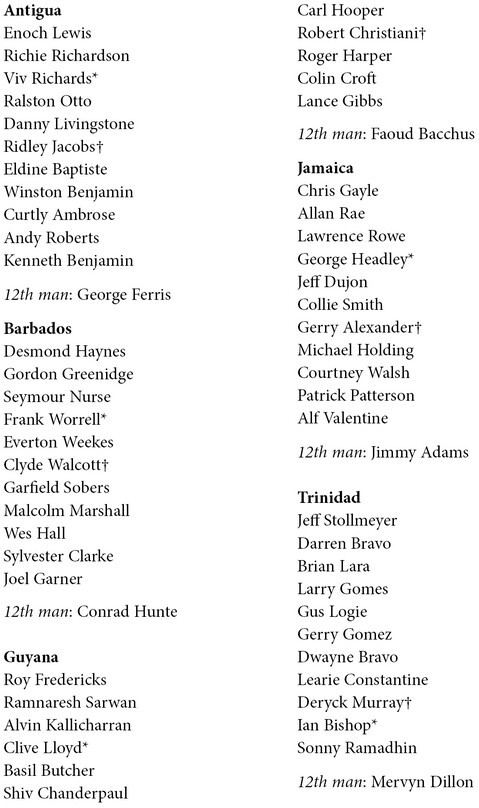
WEST INDIES TERRITORIES – ALL-TIME XIs
Note: Players born in the West Indies who have played for other Test countries are excluded.
Back in 1860 it was a white man’s game. Almost every black person in Barbados worked on the sugar plantations, free in name, not in reality. They – or those lucky enough to have survived deportation from Africa – were still ranked below the ‘savages’ of the British Empire such as Australia’s Aborigines. The established churches did not think they were human enough to have souls and refused to marry them. The emancipation of black West Indians took far longer than the British conscience might like to admit. Capitalism was clever enough to make sure that the Emancipation Act of 1834 was only the beginning of a very prolonged and gradual process.
In the sheds where they were penned at night, black people sang: they remembered African rhythms, even if the words of their native languages had been obliterated, along with anything else they had ever owned. Their other active form of self-expression came to be cricket, once they were allowed to pick up a ball and bowl it with the muscles magnified by manual labour in the plantations. Another world was opened up: one in which white master and black servant could compete on a level playing field, until the game was over and the established order restored.
‘We alone, of all people in human history, had to invent ourselves as a people, as a nation,’ wrote Tim Hector, a polymath and senator in Antigua’s parliament, an academic and cricket administrator, in A Spirit of Dominance. ‘We had to put our own stamp on their language, their economic and political structures, their literature, their fashions, their cricket, and make them our own and distinctly so. The distinction is the thing.’
Tommy Burton was one of the first black Barbadian cricketers. He joined the Pickwick club, the lowest on the island’s social ladder, in the late 1890s. Clearly he could bowl: in a first-class career of ten matches he took 57 wickets at 15.03 runs each, and bowled W.G. Grace more than once. He was selected for the first West Indian tour of England in 1900 – a group of white players had toured North America in 1886, but this was the first tour of England – and he took 78 wickets at 21 each. These games were not granted first-class status, but they were against first-class counties in the main, and hard going for a team that had never seen English conditions. As their opening bowler, Burton lacked support. When Gloucestershire ran riot – Gilbert Jessop smote 157 – and totalled 619 at five runs per over, Burton alone kept control, with five for 68. When Nottinghamshire scored 501, Burton bowled 73.2 six-ball overs and took five for 159.
On their second tour of England, in 1906, West Indies were granted first-class status, and Burton was again selected, but he did not see the tour through. In the eyes of the white management, he had an attitude problem. In addition to playing, and doing most of the bowling, the handful of black members of the first two West Indian touring parties were expected to transport the team luggage: to load all the suitcases into cabs and trains, then unload them at hotels and grounds. Imagine bowling 73 overs in one innings, then carrying the team luggage. Burton dared to put his foot down.
He was sent home immediately. He was blackballed in Barbados. When he went to British Guiana, Burton could not get a game there either. He was banned from cricket for life in the whole region. He was gone. He emigrated to Panama to find work and spent the rest of his life there, only returning to Barbados to die.
One day in 1998, I found his son sitting in a stand at Kensington Oval, one of the many grounds from which Burton had been blackballed. The son told me this story. He had watched every single Test match at Kensington from the first in 1930, except for one when he had been studying in North America; and he had become Sir Carlisle Burton, head of the Civil Service in Barbados.
Emancipation, on and off the cricket field, was an incremental process from generation to generation. Simply playing the game as well as white cricketers was not enough; words and statements, as well as actions, were needed to break down the barriers. Clifford Roach was a dark-skinned Trinidadian. When West Indies played their inaugural Test series, in England in 1928, they could not make enough runs: they were weekend amateur players who did not know how to build a long innings. They scored only three half-centuries in the three Tests, and Roach made two of them. Back in the West Indies for the return series of 1929–30, Roach scored their first Test century and, later in the series, their first double century, setting up West Indies’ first victory.
In 1980 I tracked him down to a house outside Port-of-Spain, where he lived with his daughter. Roach sat in a chair with a blanket over his legs, except that he had none: owing to diabetes, they had been amputated. He had trained to become a lawyer and practised in Trinidad, one of the first to break the barrier between non-whites and the professional classes. But the pain of not being heard or recognised also seemed to nag. When Michael Manley, Jamaica’s former prime minister, published A History of West Indies Cricket a few years later, Roach was given the most cursory mention. He made ‘the first-ever century for West Indies in a Test match’ and ‘a fine double century’: that was about it for recognition, for being the first to do what only batsmen of England, Australia and South Africa had done before.
The first Afro-Caribbean cricketer to ‘put his stamp’ on cricket, as Tim Hector phrased it, and to be recognised for doing so, was Learie Constantine. He was the first to embody what we came to consider all the attributes of West Indian cricket. The son of Lebrun Constantine, the only black batsman picked for the 1906 West Indian tour of England, he was low-slung, long-armed and the most dynamic all-round fielder the world had seen. He bowled fast when he wanted to, and plenty of bouncers, as only Harold Larwood was doing. He was not so much a batsman as a hitter: if he made a century it would not take much more than an hour. ‘To all of this he added an exuberant, dramatic good humour in the field, characteristics that can be traced directly to his African roots,’ wrote Manley. And Constantine had someone to blow his trumpet, so that people not only saw but listened, until he was eventually ennobled by the British establishment as Lord Constantine of Maraval and Nelson.
When C.L.R. James wrote Cricket and I for Constantine in the 1930s, the first book by a black cricketer, the pair formulated a creed: ‘They are no better than we.’ Further, if black West Indians were allowed full self-expression and to captain their own teams, ‘we’ could become better than ‘they’ – and distinctly so. James began to lay the groundwork with his journalism and more books, like his history of the revolution that made Haiti the first western country governed by black people, and Beyond a Boundary. In the course of his essay about the beautiful strokeplayer Wilton St Hill, ‘The Most Unkindest Cut’, James relates how he walked past a shoemaker’s shop in central Trinidad and a man ran up to him, awl in hand, to ask James if he was Wilton St Hill. James said no, regretfully, but stayed to talk with the men in this shop.
Their enthusiasm boiled over. One said weightily: ‘You know what I waitin’ for? When he go to Lord’s and the Oval and make his century there! That’s what I want to see!’ I have to repeat: It took me years to understand. To paraphrase a famous sentence: It was the instinct of an oppressed man that spoke. If further proof of this were needed it is the hostility with which anti-nationalists and lukewarm supporters respond to this now so obvious truism. As for those who believe that all this harms cricket, they should produce ways and means of keeping it out. They are blind to the grandeur of a game which, in lands far from that which gave it birth, could encompass so much of social reality and still remain a game.
To that first West Indian Test victory, which had been set up by Roach, Constantine contributed nine wickets. When West Indies won their first Test series, against England in 1934–35, Constantine, Manny Martindale and Leslie Hylton bowled quick and often short to take 47 wickets at only 15 runs each in the four Tests. England’s batting line-up of Wally Hammond, Patsy Hendren, Les Ames, Bob Wyatt and Maurice Leyland would eventually score over 600 first-class centuries, but in this series no England batsman averaged as much as 30, while Headley averaged 97. Larwood had been forced out of Test cricket by Bodyline politics and a foot injury; Australia and South Africa had nobody outright quick. In fast bowling, the one area of the game where they were selected on merit and allowed to express themselves fully, ‘we’ were already better than ‘they’.
Not for another generation did West Indian cricketers, and Afro-Caribbean people, take the next incremental step. Movements towards independence and self-government surfaced around the Caribbean in the 1930s, under leaders of light skin. Captain Cipriani in Trinidad and Alexander Bustamante in Jamaica, together with the teachings of Marcus Garvey, inspired mass demonstrations. But the masses prioritised the needs of Great Britain in the Second World War, and stifled their own cause until the 1950s. It would have been so much quicker, easier, to have broken free when Britain turned its back to face Germany. Generously, they did not.
Not until the end of the 1950s did political emancipation arrive. The attempt at a Federation of the West Indies failed when Jamaicans voted in a referendum to pull out, but independence followed, island by island. Another Jamaican of light skin, Gerry Alexander, declared that he should no longer be captain of the West Indies, but the black Barbadian Frank Worrell should. What is even more, when Worrell was appointed, Alexander served as his vice-captain and wicketkeeper. Their working together helped to make the Australia v West Indies series of 1960–61 the most exciting there had been, outside the Ashes at any rate, energising the whole of cricket after its dullest decade.
The nearest I came to meeting Worrell, who died of leukaemia in 1967, was in the archives of The Observer. He started writing for the newspaper in 1961, on England’s home series against Australia, the summer after he had become a world figure. While I was researching among back copies of The Observer in a basement in Battersea, out of the dust emerged a photograph of Worrell. It had been taken by Jane Bown, short, slight and known as ‘the Gentle Eye’, but steely. She would disappear in the room where her subject was sitting, like a bird perching in the branches. Only when the subject had relaxed into being his natural self would she click her shutter.
Bown’s black-and-white photograph of Worrell is as insightful as a portrait in oils. He has a moustache, a thin and discreet one, clipped well above the upper lip: he is differing from clean-shaven convention, but ever so slightly. He has high cheekbones, and eyelashes which curl up and around: when his grandmother brought him up in Barbados, he must have been the apple of her eye. After West Indies had won their first Test series in England in 1950, and Worrell had been chosen as one of Wisden’s Five Cricketers of the Year, the editor Hubert Preston alluded to a ‘dreamy casualness’, before concluding: ‘For beauty of stroke no one in the history of the game can have excelled Worrell.’
Bown has captured the inner strength, of unblinking conviction, beneath the calm. If Worrell’s captaincy was anything like his writing, it had the quiet firmness of an authority you would not think to question. There was no more informed observer of one of the most historic days in English cricket, and probably the most traumatic: the last day of the Ashes Test of 1961 at Old Trafford, when England sailed to 150 for one in pursuit of 256 and a 2–1 lead, then collapsed. In his Observer column the following Sunday, Worrell observed that Peter May, England’s captain, had been at fault for taking off David Allen after Alan Davidson had hit his off-spin for 20 from one over; but May was not at fault for trying to sweep Richie Benaud when he was bowling round the wicket. Worrell wrote that he had never seen Benaud bowl better; that Fred Trueman’s running down the pitch had disadvantaged England because they had more left-handed batsmen than any other country; and that Brian Close’s innings was the turning point. ‘A more unorthodox exhibition will surely never again be seen in Test cricket’: a prophecy that has not been obviously overtaken more than half a century later.
It was only when I interviewed his wife, Velda, Lady Worrell, that I found out that Worrell had first been selected for Barbados as a left-arm spinner, and had batted at number 11. Even in the 1940s, it was so much easier for a black cricketer to be selected as a bowler than a batsman – even a player whose beauty of stroke would not be excelled. Like the other two Ws, Sir Everton Weekes and Sir Clyde Walcott, he had been born within a mile or so of Kensington Oval, and had sunshine and space in which to learn the game. The difference between them was that Worrell had a rebellious streak, and no parents to crush it, because like so many people in the West Indies they had to emigrate to find a job. Worrell, too, had to emigrate, not a prophet in his own land.
An iron fist in a velvet glove: this was the verdict of more than one of Worrell’s contemporaries. A pivotal decision was to drop the white Barbadian wicketkeeper David Allan for the 1963 series in England and replace him with the 20-year-old Trinidadian Deryck Murray. It could be argued, and was argued by some of Worrell’s Barbadian contemporaries, that this decision was racist; and no doubt Allan in 1963 was the better wicketkeeper. On the other hand, Murray was always going to be a better batsman, and he held his end up in 1963, and he set a record for the most dismissals in a series by a West Indian wicketkeeper. And Murray is predominantly Indian.
West Indian cricket flowered under Worrell’s captaincy as never before: ‘exuberance’ and ‘flair’ became the conventional epithets. The 1950s had been the slowest-scoring decade in Test cricket – Len Hutton the pioneer of slow over-rates, it has to be admitted – and West Indies, before Worrell took over, followed suit. In the 1959–60 series at home to England, West Indies scored at 2.3 runs per over: not much self-expression by Rohan Kanhai or Garfield Sobers or Worrell himself. In the Bridgetown Test, Sobers and Worrell batted together for two whole days, like no pair before or since, and they added ‘only’ 399 runs. Once Worrell was captain, ‘Calypso Cricket’ took over.
Sobers was inspired by Worrell to become the finest all-round cricketer ever. The numbers are merely a confirmation: his Test batting average was 23 points higher than his bowling average, 57 to 34; and if you add the two series in which he captained the Rest of the World in England and Australia, Sobers scored 8961 runs at 58.18 and took 265 wickets at 33.53. Jacques Kallis of South Africa would come next in many estimations, but he would have had to bowl off-spin and wrist-spin, in addition to his other accomplishments, to match Sobers.
Worrell not only batted, but bowled left-arm pace and finger-spin – yet Sobers was still more versatile. Cricket’s Bob Beamon moment has not been sufficiently recognised: it came after Sobers had been signed by Sir Donald Bradman to play for South Australia. In ten first-class matches in 1962–63, he did the double of 1000 runs and 50 wickets, and repeated it in only nine matches in 1963–64. Nobody else has come close to accomplishing this double in Australia, even all these years later, with the number of matches increased. After starting as an orthodox left-arm spinner like Worrell, then taking up pace bowling to get a job in Lancashire’s leagues, Sobers chose wrist-spin in Adelaide, consistently the truest batting surface in the game worldwide.
Although Worrell anointed him as his successor, Sobers was human when it came to captaincy. Worrell could not have foreseen that English county cricket would be opened to overseas players in 1968, so they no longer had to qualify by residence, and that Sobers would start to play all year round and lose his enthusiasm. When West Indies lost 3–1 in Australia under Sobers in 1968–69, the captain spent his spare time on the golf course.
Bown photographed him too, and while the two Barbadians had so many features in common, an inner strength of conviction was not one. Sobers had pride in his people: when South Australia played the South Africans in 1963–64, he put on his West Indian cap and marked apartheid’s first encounter with a black West Indian by scoring a century. He announced in the dressing room that he wanted the South Africans to have ‘a nice long look’ at his maroon cap. But Sobers was no politician, and was gullible enough to play in Southern Rhodesia, unaware he would be condemned by people and governments back home.
The next and final incremental step in West Indian cricket would have to come from elsewhere. Not from Barbados, where the three Cs – Christianity, conservatism and cricket – lived together in a comfort zone. But from an island where the coral was mixed with something no less elemental.
Viv Richards was the most charismatic cricketer I have seen.
He was the most charismatic because he had the greatest sense of mission or purpose. His mission was to change the perception of, and attitude to, West Indians in general and Afro-Caribbeans in particular. Nobody in cricket has effected more change, for the better, than Richards. The one person to approach him is Basil D’Oliveira, of South Africa by birth and upbringing and England by adoption. Both fundamentally altered the mentality of white people, especially in Britain, towards non-white people: very few have done it to the same extent in any walk of life. Richards brought about this change intentionally; D’Oliveira accidentally, although when he became the central figure in the fight against apartheid in South Africa, he was not found wanting.
THE LONG STROLL TO FREEDOM
Basil D’Oliveira was unknown outside the Cape Coloured community when he left South Africa in early 1960 to become a professional cricketer in England. He had written to John Arlott, who had fixed him up with the job of pro at Middleton in the Central Lancashire League.
He made a bad start. Cold, lonely, and exposed to grassy pitches after having learned a back-foot game on matting, D’Oliveira was on the verge of despair after failing in his early games for Middleton. But he fought and persevered, the runs flowed, and he secured the highest batting average among the professionals in his league, higher than Garfield Sobers, and won himself a contract for two more seasons.
So when he returned home in September 1960, he was not a star in the eyes of Dr Verwoerd’s government, which had just perpetrated the Sharpeville Massacre – quite the opposite. But in the eyes of many people in his native Cape Town he had, by proving himself through sport, done something quite heroic.
After his ship had docked, there was ‘a tremendous reception on his arrival and [D’Oliveira] was driven in an open car headed by a pipe band to the city Hall,’ according to the Cape Argus on 22 September 1960. There, he was received by the mayor, Mrs J. Newton Thompson, the first female mayor of Cape Town. She was ‘one of the most publicised mayors in Cape Town’s history – and one of the best’, according to ‘The Wanderer’ in the newspaper’s diary of 23 September.
D’Oliveira declared modestly on his return: ‘I did not expect to get as far as I did in my first season and despite my success I still have a long way to go before I master the English playing conditions.’
Unlike many a professional sportsman, he thought not only of himself. He had recommended another member of his community, Cecil Abrahams, to another club in the Central Lancashire League, Milnrow, and Abrahams had been accepted for the season of 1961. ‘But he will have to get his wickets in the first six or seven overs when the shine is still on the ball,’ added D’Oliveira the cricketer.
What there was by way of a politician in him, after being brought up to have no such thoughts, then gave the pot a little stir. ‘What I would like to see is a series of matches played in South Africa between White and non-White Springbok teams,’ D’Oliveira was quoted in the Cape Argus as saying. The language of apartheid said it all: ‘white’ had to have a capital letter.
‘Or, better still, to improve our cricket standard, a series of matches between mixed White and non-White Springbok teams,’ D’Oliveira went on. ‘Whether there is any possibility of this I can’t say.’
He was not without support in some higher places. The president of the Western Province Board of Control, Mr J. van Harte, gave a welcoming speech in which he said that D’Oliveira ‘had set a stirring example not only to Western Province cricketers but to sportsmen throughout South Africa . . . I hope the time is not too distant when all non-White cricketers in the Union will have a chance to get to the top.’
In reply, D’Oliveira said: ‘I must warn them [i.e. future players who go to England] that it is not an easy task to adjust oneself to English conditions and to the fact that there is no colour bar.’ The most pointed of his stories was about the time he got on a train in England for the first time and, search and search though he did, could not find a carriage for non-whites.
The biggest privilege in my journalistic career was to accompany D’Oliveira on his first visit to Cape Town after the end of apartheid. He had initially done a deal with the Daily Mirror, to go back to his native city and give them his reminiscences for £1,500 – enough to cover his flight and some hotel nights. They pulled out, and the Sunday Telegraph stepped in to pay his costs. He might have raked in millions of dollars if someone had been alive to the wonderful film to be made of his life.
We walked around the streets of Bo-Kaap on the steep hillside overlooking Green Point; it was on the more horizontal ones that D’Oliveira had started to play cricket with other boys labouring under the same disadvantages. The Cape Coloured community had been ordered to live there. ‘Best place to live in Cape Town,’ he said, not burning at the injustices inflicted by apartheid, but amused at how its authorities could be so stupid. (It was alchohol that made him burn with injustice.)
I did not think it right to trouble him with questions as he walked along the street of his childhood home, which he had not seen for decades – the same measured, immensely dignified walk, virtually a stroll, that had taken him out to the middle at Lord’s in 1966, when he had become the first non-white South African to represent England, and had been applauded to the echo.
But I could not help asking him about how old he really was. He had always given his date of birth as 1931. He would not have been selected for Middleton, let alone Worcestershire and England, if he had been known to be older.
He said his actual age was more than two years more than the official one. I pressed, but he would not go further, and my final impression was that it was somewhere between three and five years more. If so, among his achievements, it is noteworthy that he was skilled enough to represent England in 1972 in his mid-forties, and Worcestershire until 1979, when he would have been over 50.
Alzheimer’s and Parkinson’s ultimately claimed him. He ended up in a nursing home in Worcester, speaking his first language of Afrikaans, recognising nobody except his wife, Naomi. But, by then, millions of people had recognised ‘Dolly’ as the pivotal figure in the fight for humanity in South Africa and the boycott which brought apartheid to an official end.
When Richards walked out to bat, his head told much of the story. His eyes did not look at the ground; if he deigned to look at an opponent, it was down his aquiline nose. He would wear his maroon West Indies cap, or bat bare-headed. Never did he wear a helmet, as all other of his contemporaries stooped to do. Either the cap or his bare head: one or other was his crown.
After winning the preliminary skirmish of eye contact by staring the bowler down, nonchalantly chewing his gum, Richards squared up. He would take on, for preference, the most threatening bowler. After his front leg had advanced down the pitch – before the first ball had landed – the ball did not seem to be alone in being whipped through midwicket.
As a fellow Antiguan, Tim Hector saw the beginning of Richards’s career. Hector, indeed, contributed significantly to it. Before the combined Leeward and Windward Islands were given first-class status in the late sixties, Antigua’s cricketers had no platform other than club games and an annual tournament, lasting a week, of two-day matches against Montserrat, Nevis and St Kitts. Hector expanded these into four-day matches, giving Richards and his contemporaries the chance to ‘bat time’ and make big hundreds, so they were prepared for the transition to first-class cricket. The Combined Islands had no formal coach, no money to sign an experienced batsman, just a tradition of being neglected by the West Indies Cricket Board; they had to use their own resources and learn for themselves.
‘Something of the passion and intensity with which Viv Richards played cricket was entirely a Leewards phenomenon,’ Hector wrote before his death in 2002. ‘It was the same with Andy Roberts, only that Andy Roberts, like Richie Richardson, was more shaped by the Puritan tradition, which masks passionate intensity beneath what the French would call sang froid.’ Hector went on to claim that Richards, as captain of the West Indies, never lost a Test series ‘because the Afro/Indian people of the English-speaking Caribbean needed these triumphs to negate their marginalization in global history, trade and politics. To Viv Richards more so, cricket and anti-apartheid struggle were inseparable. West Indies against all comers, particularly England and Australia was, to him, an extension of the struggle against apartheid. It was a consciously held view by Isaac Vivian Alexander Richards, and it was consciously executed. Therein lies his immortality. Not the first man of pan-African views to lead the West Indies. Worrell was. But the first West Indian captain to see cricket and to play cricket with the view uppermost that cricket played by West Indians was part and parcel of the global struggle against racism and, in particular, apartheid. This was Viv Richards.’
But while I could see where Richards was heading, I did not know – even with Hector’s help – where he came from. I saw Antigua taken over by mass celebrations when the island staged its first Test match in 1981 and Richards his wedding a couple of days before. I saw that Antigua, one big sugar plantation until after the Second World War, no longer grew a single cane – whereas neighbouring Francophone islands like Marie-Galante still happily grew sugar and drank its rum. I heard that Antiguan men were renowned, even among fellow West Indians, as the prickliest in the Caribbean. But for a long time I did not understand.
Richards himself never met Papa Sammy, who died at the age of 105 in 1982. But he knew and liked Papa Sammy’s grandson, Keithlyn Smith, who listened to the stories about Antigua that his grandfather told him, memorised them and later wrote them down for the book To Shoot Hard Labour. Keithlyn Smith worked in Antigua’s trades union movement and opposed the dynasty of Vere and Lester Bird that channelled arms to apartheid South Africa. After the Bird dynasty had gone, to be followed by their notorious business partner Allen Stanford, Keithlyn Smith became Antigua’s ambassador at large and was knighted, without forgetting his roots. He was still living in his bungalow in Freeman’s Village, after retiring as an ambassador, when I last met him.
What happened in Antigua after the Emancipation Act of 1834 happened, in effect, behind closed doors. If, in Barbados, women and children lent some kind of civilising influence to the sugar plantations as resident members of the planters’ families, the planters who lived in Antigua were very few, and they usually appointed an overseer to crack the whip while they enjoyed the profits back in Britain. Nobody acted as a conscience when the gibbets around the island swayed with ‘strange fruit’.
Papa Sammy did not recount his memories to his grandson in a spirit of bitterness. He kept on working on the plantations far longer than he had to, until he was 85, and claimed he did not take a single day off sick in 72 years. He simply told it how it was: how conditions did not perceptibly improve after the Emancipation Act until well into the twentieth century. The branding of slaves ceased in 1828, but that did not mean a black Antiguan was allowed his own identity.
Using the term ‘bakkra’ for plantation owners, ‘nega’ for people like himself, and ‘picknee’ for children, Papa Sammy recalled: ‘Back then nega picknee carry the name of the estate owner. That practice live on a long time after slavery end. People seriously had the feeling that the child belong to the bakkra and the mother would usually take the child to the massa. In most cases, it would be massa that name the baby. The man that was the rightful father couldn’t have nothing to do with the child.’ So Papa Sammy recounted to his grandson.
Why did these ex-slaves not leave a brutal plantation and transfer to another? ‘Things was not as easy as that. A nega-house man could not live on another estate if he offend even one planter. If one planter tell him to leave, the others would usually refuse to let him work and live on their plantation, and that poor fellow wouldn’t have had a place to turn to for a long, long time. Dog better than he when that happen.
‘The conditions of the houses rapidly run down after the Emancipation even though they were strongly built. The normal size house was about sixty feet long by forty feet wide . . . Nothing to separate one family from the other. We use to live together like a flock of cattle, like goats or sheep in a pen. The truth is, there was no difference to speak of between the life of the animals and ours . . . Rats, mice, spiders, centipedes, scorpions and other creatures also lived in the houses.’
We British pride ourselves on having liberated slaves before the French or Spanish. We like to think that ending the slave trade was tantamount to ending slavery; we give ourselves a pat on the back while singing ‘Amazing Grace’. But emancipation was as much a matter of economics as conscience. Paying a wage to the plantation workers cost the owner less than feeding, clothing and housing slaves – especially if they started a company store where the workers had to spend their wages.
Why didn’t these ‘emancipated’ slaves fight back? According to the census of 1844, Antigua had 36,178 inhabitants, of whom 323 had the vote, which suggests the ratio of black to white was about a hundred to one. ‘No way for us to fight back – it was like worm going against nest of ants – for the bakkra was the militia and the magistrates and the jail-house and the government. Whatever happen to us, we must grunt and bear it. If you didn’t have manners, them give you the cat-o-nine and them hang you in jail. Nothing for it. You dead and gone. Them give you coffin and that’s that.’
In that case, why didn’t these ‘emancipated’ slaves simply leave the estates? Some did. They set up villages, like Liberta and Freeman’s Village, but how do you build a house when neither you nor anybody you know has got a nail – a house that is not blown away in hurricanes? But hunger was the main deterrent from leaving the estates. ‘There was widespread hunger, there was starvation. I am not lying: there was not a single one of us that did not suffer terrible hunger.’ Slaves had not been taught how to swim so, once freed, they could fish only from the shore. The soil in the West Indies was never so fertile as Columbus made out, as he omitted to mention wind erosion in his reports to venture capitalists in Europe; and drought was frequent in Antigua after the native forest had been cut down to make way for cane.
Papa Sammy got his first job on the sugar estate at North Sound, where the Sir Vivian Richards Stadium was opened for the World Cup in 2007. It was a cricket ground Antiguans were loath to attend, and which seemed cursed when the 2009 Test match against England had to be called off after ten balls because of the unfit outfield. Never had it been happy place. ‘One of the first things I learnt at North Sound was that we could not talk to each other at work. As soon as you reach the estate’s works all talk must stop. In fact, gathering together was strictly not allowed. If massa would see us talking, we have to say what the talk was about.’ So much for free speech after 1834.
‘One morning after the roll call, we have to wait for orders from the planter in charge of the gang. While we were there waiting, Massa Hinds youngest boy, Ralph, starts to imitate his father and goes calling our names. Everybody answer like usual, until he gets to Harty Bab. At least she didn’t answer, “Yes, Massa.” Now Massa Hinds was close by, and he tell her that she was marked absent for not answering. He say she disrespect his son and she was not going to get pay for that day. Then he further accuse her of grumbling bad words at him. In the end he so annoyed he decide to lash her with a cart whip. When he try this, she resist him, but that didn’t last for too long for she was over-powered and he beat her mercilessly. Then he forced her into the estate cellar where he leave her locked up for some days.
‘When he give the order to release her, she was dead. Rats had bitten off her lips and nose . . . I was at that cellar and saw the body. I’ll never forget that day. I was fifteen years old and still in the small gang, doing a man’s job for a boy’s pay.’ Papa Sammy later heard the magistrate’s verdict: Harty Bab had died of ‘misadventure’. So much for the system of justice after 1834.
The established Church did not offer much consolation. When the North Sound planters went to St George’s, they often used their workers not their horses to pull the buggy. On arrival, the workers were not allowed to wait near the church, let alone in it. Having cleansed his soul, the master would ring a bell when ready to go home. This was happening no less than six decades after the Emancipation Act.
Even after the First World War, living conditions for plantation workers did not improve noticeably. It was as late as 1918 that black Antiguans held their first meeting. ‘This was the first of that kind of meeting to happen in the island in my time. Except for church service, you couldn’t hold any meeting in this island.’ The issue was that ‘house-negas’ who farmed a piece of land on an estate did not receive full payment for the sugar they grew: the factory paid the estate owner instead, and he took a sizable cut before passing on the rest to his workers. The reprisals for holding this meeting were savage. The Riot Act was read. People were shot by the militia. Well into the twentieth century, the system had not even begun to relent.
Governors of Antigua who did not side with the plantocracy tended to be recalled, after lobbying in London. One who did care about the people managed to stay from 1921 to 1929: Eustace Fiennes, according to Papa Sammy, was the best governor Antigua had in his lifetime. Not his successor, though: ‘Under Governor St Johnson there was no work. Everything crash. People min a dead for hungry [people died from starvation]. Nineteen thirty-four came, the one hundredth anniversary of the end of slavery. It should have been a time for celebration, a time for joy, but there was nothing to jump for. Most of the people were still living in misery on the estates and one hundred years after slavery the living conditions on the estates was no better than during slavery time. The bakkra neglect our people except when they go to jail. When that happen, the bakkra always make sure them wasn’t neglected by the full weight of the law.’
Not until the Second World War, when the first trade union was organised, did workers on the estates get paid in full for what they grew. And even then a worker still could not move from one estate to another without the owner’s permission: a woman who tried was given six days’ hard labour.
The leader of the white planters, Alexander Moody-Stuart, withdrew recognition of the trade union in 1951. ‘The union hit back by calling a general strike. It was head on strike between the planters and the union. War between Moody-Stuart and the union. Antigua hot like fire. The people was behind the union. Moody-Stuart said he was going to starve out the people. The fight was on. There were violence here and there. Some buildings in St John’s was set ablaze. Governor Blackburne got afraid the thing would get out of hand and he called in the British fleet from Jamaica.’
Into this crucible, in the following year of 1952, Vivian Richards was born. No wonder he was, to borrow the phrase of Papa Sammy, ‘hot like fire’.
Like most of the great West Indian cricketers, Richards came from what could be called the lower middle class; only the occasional fast bowler has come from the masses. His father was a warder at the prison in St John’s, next to the Recreation Ground. His elder brother Donald tried politics and was a founder of the Afro-Caribbean Movement in Antigua. The music industry in Antigua was tiny, so Viv Richards chose the only other viable, non-violent means of effecting change.
‘The body belonging to the oppressed is a powerful means of communication,’ wrote Professor Rex Nettleford, artistic director of the National Dance Theatre in Jamaica, for another essay in A Spirit of Dominance, ‘and personal control over it places it beyond the reach of the oppressor. Cricketers and dancers without a command of the scribal language can nonetheless communicate.’ As he grew up, Richards communicated.
Richards’s younger brother Mervin has explained the origin of the stroke that must have demoralised more bowlers than any other. ‘We used to play in a park where straight shots were not advised. There used to be a fisherman who used to stand behind the bowler’s arm and every time you hit it to him he used to cut the ball in half and throw it back. So we needed to hit it to midwicket. And Viv mastered it.’ What is implied here is no less significant: Viv Richards had no formal coaching. He learned for himself to take a pace forward and whip the ball with a vertical bat through midwicket. Given a blank sheet of paper, he stamped on it his indelible mark.
Some cricketers have been labelled great without making a side stronger than when they first played in it. Richards’s mission was to exalt those of low degree, and he transformed five sides: for the sixth that he represented, Queensland, he played only a handful of games. No other cricketer, by my reckoning, has transformed so many teams. Perceptions, social attitudes, and teams.
Combined Islands was the first team that Richards exalted, in conjunction with Andy Roberts, whose fast bowling ensured that Richards’s runs were not wasted. When Richards made his first-class debut for Combined Islands, the new team had played a dozen games in the Shell Shield as the poor relation of Barbados, Guyana, Jamaica and Trinidad. The impact of Richards was immediate, although he was only 19. He top-scored in one innings or the other of his first and second first-class matches for Combined Islands.
As he began to play for West Indies, Richards played less for the Combined Islands, but in 1980–81 he captained them to their first Shell Shield. His habit was to make his first innings of a competition or series a statement of his intent; and here he scored 168 out of his team’s 317 in Trinidad, who fielded three international spinners. In the second match he contributed a century, and Roberts seven for 30, to an innings win over Jamaica. Even when he did not score runs, Richards competed and contributed, whether bowling flat off-spin, or clapping his hands at second slip, or swooping at midwicket, where he ran out three Australians in the 1975 World Cup final. Yet some modern batsmen have been labelled great even though they have disappeared for hours at a time in the field.
West Indies were the second team transformed by Richards. After Worrell had retired, they had gone up and down under Sobers and Rohan Kanhai, but they were never so down as in 1975–76 when they lost 5–1 in Australia under Clive Lloyd. Amidst this wreckage Richards stood up to fight. ‘Overall there was a distinct lack of effort by their players . . . Richards was the exception,’ Wisden reported. ‘After losing so disappointingly in Sydney all the fight had gone out of the West Indies.’ Richards got himself promoted from number five, too low for a great batsman to shape events, to open the batting. He began with two centuries in a first-class game against Tasmania, top-scored in three of his next four Test innings with 30, 101, 50 and 98, and went on to score more Test runs in the calendar year of 1976 than anyone ever before. Never again would a West Indian team containing Richards fail to fight.
This fight was nearly literal on one tour of Australia. The worst feature of Australian cricket has been the racist abuse by their players, which came to a height in the 1980s. Richards confronted it head-on during a game in Sydney while he was batting. He challenged any opponent who made another racist remark to a fight outside the ground at the end of play. Nobody cared to enter the ring with a young Joe Frazier. The attitude of Australian players to non-white opponents was forced to change.
Richards formed, if not transformed, another team when World Series Cricket was promoted by Kerry Packer from 1977 to 1979. When WSC West Indies played Supertests against WSC Australia, he top-scored in the first three innings and propelled his team to victory in the first two matches; and top-scored with a century in the third. The world’s best fast bowlers queued up to be paid properly for the first time, and tore in on untried surfaces such as VFL Park in Melbourne, when cricket switched on floodlights for the first time. Everyone bowed his head to wear a helmet, except Richards.
Taking over from Lloyd for the 1985–86 home series against England, Richards captained West Indies in 50 Tests without losing a series. True, he was blessed with great fast bowlers – one way in which the past had worked in his favour – and he may have been too much of a martinet at times. The Antiguan all-rounder Eldine Baptiste told me he had been reduced to tears in the captain’s room one day, then pumped with pride in himself and Antigua and West Indies. Baptiste played only ten Tests yet won every one, uniquely.
Richards rounded off his first series as captain with the fastest Test century recorded in terms of balls received.FN40 West Indies were 4–0 up and they were not going to ease off at the Antigua Recreation Ground. To set up a second-innings declaration, against a presentable if not powerful England attack, Richards hit a century off 56 balls, treating them like net bowlers. Once he had set this world record, he declared and sauntered back towards the pavilion. He could not claim, like Jack with his house, that he had built the Recreation Ground, although his father used to prepare its pitches with the aid of prisoners. But he, along with Roberts, had put Antigua on the map.
Some batsmen, in those days before big money, used to run the last few yards back into the pavilion after a century: they were amateurs modestly representing their country. Richards did the opposite. Halfway to the pavilion he halted, for a moment, and looked ahead. The crowd was going wild with adulation. Antiguans were no longer oppressed, as they had been only a generation before. West Indies were about to win 5–0, only the third time England had been whitewashed, and their own Viv Richards was captain. He had beaten the former masters, conclusively, at their own game. He had put his own distinctive stamp on West Indian cricket. He had proved not only that ‘we’ were as good as ‘they’. Richards made West Indies the world champions of cricket for more than a decade.
All this Richards seemed to drink in while pausing. His saunter was then resumed towards the pavilion and its celebrations. No man, of his time and place, could really have achieved more. He had put the words of his Jamaican contemporary Bob Marley into action. He had emancipated his people from mental slavery and freed their minds.
At the same time as he was transforming West Indies into world champions, Richards proved he was no racist by doing something similar to the small, white, conservative, agricultural backwater of Somerset. The county had never won a thing: third in the Championship was the best their limited resources and mindsets had ever attained. Richards could not win Somerset the Championship, which has remained elusive to this day, but he did win their first trophies. He dragged them through one-day knockout matches at Taunton’s rickety ground – the West Country equivalent of the Antigua Recreation Ground – and into the final at Lord’s, where a century by Richards was almost as much a formality as it had been in the World Cup final of 1979.
The fifth and last team he transformed was Glamorgan. Before he arrived, the Welsh county was the laughing stock of English cricket for in-fighting and bad signings. When Glamorgan reached Canterbury in September 1993, they had been through what Wisden called ‘23 seasons of often abject failure’. They faced Kent in what was effectively the final of the Sunday League competition: Glamorgan went into this last game in second place, Kent in first, and the title would go to the team that won in front of the television cameras and a 12,000 crowd inundating the old ground. Chasing 200, Glamorgan were 98 for three when Richards went in. In a triumph of will as much as skill (he was 41), he scored an unbeaten 46 and led them over the line.
Almost as noteworthy was an incident in the County Championship game into which this Sunday League match was sandwiched. Glamorgan fell 380 runs behind on first innings after a double century by Carl Hooper, yet Kent chose to bat a second time instead of enforcing the follow-on. Richards went mad on the balcony: this was not the way to play the game, he shouted at Kent’s players. He had been brought up to respect and conform, by Bible-reading parents, not only to change and reform.
The very last time I saw Richards bat was in an exhibition of beach cricket organised by Antigua’s tourist board. Most of us do not age gracefully; greatness can, even in a pair of shorts and T-shirt. Against a tennis ball, he obviously batted without gloves or helmet, and I saw this extraordinary sight. As the bowler ran in over the sands, Richards flexed his fingers on the bat handle like a concert pianist about to embark on a concerto, and he kept on flexing them until the ball had been bowled – and whipped through midwicket. I checked afterwards, and he said he had always done it, only these movements had never been visible inside his batting gloves. He was no bully or bruiser, except if fools needed to be bruised. Under the surface, Viv Richards was full of feeling.
At Kensington Oval in Barbados in the 1980s, it was my observation that a higher proportion of the Test crowd was female than anywhere else. In Asia, from the time the Parsis faded until the Indian Premier League, females in the stands outside the VIP enclosure were scarce, if any. In England, a few women have always tagged along. Australian women and girls used to flock to a one-day international, especially a day-nighter, when cricket was cool, but not to a Test match.
No research was done about West Indian crowds until the history department of the University of the West Indies interviewed Barbadians after they had staged a mass boycott of the inaugural West Indies v South Africa Test at Bridgetown in 1991. (They found that the primary reason was political – South Africa had been restored to Test status too soon after apartheid – and that the omission of the Barbadian Anderson Cummins was secondary.) So I can only guess why Barbadian women in such large numbers used to line the wooden benches of the Kensington Stand and watch West Indies play.
They came by bus from the countryside to the main bus station in Bridgetown, and maybe did some shopping at the central market before walking on to the Oval. Saturday was their day out. Some must have been single mothers, after the father of their children had left home, perhaps to find work in North America or Britain. The magnetic line of the St Lucian poet Derek Walcott – ‘There is too much nothing here’ – can be taken to mean ‘There is no lawful work to be had in the West Indies outside manual labour in the tourist industry.’ Half of the West Indian population lives in diaspora.
These women came not merely to see West Indies win, but to watch these cricketers – their menfolk – walk, saunter, run, strut, throw, bat and bowl. Nettleford again, rhapsodically: ‘The early West Indian cricketers, even when they were losing, were brashly and defiantly beautiful to behold! The celebration of the male body as hot-blooded power and authority in itself, as icon of athleticism, line and form, became a psychic threat to opponents in colder climes but a source of visual joy for West Indians, and especially for the tens of thousands of West Indian women whose love for, and expertise in the understanding of, this chauvinistically manly sport is nothing if not astounding.’
By the start of the twenty-first century, however, West Indian cricket was set in long-term decline. No infrastructure had been installed by the West Indies Cricket Board to cater for the drying-up of the stream of great players. Two board members from each territory continued to represent the interests of each territory, at a considerable cost in travel expenses and per diem allowances. Together they allowed the pitches of the region to become slow; in fact, for commercial reasons, they encouraged groundsmen to slow down the Test pitches from the late 1980s, to make the games last five days. So Courtney Walsh told me, and he had to bowl on them for more than a decade before he broke the world record for Test wickets.FN41 For short-term gain, the West Indian board sowed the seeds of their sport’s decline. The finest features of Caribbean cricket were now discouraged: the fast bowlers and the batsmen who would take them on.
In 2004 in Jamaica, on a fast yet true pitch at Sabina Park, West Indies were dismissed by England for 47. Steve Harmison blew away seven wickets for 12 runs as emphatically as if he had been Curtly Ambrose or Malcolm Marshall in their prime. The second Test, in Port-of-Spain, was attended by the Rolling Stone Mick Jagger. He visited the Trini Posse Stand and sang for them during play. Other spectators in the small, desultory crowd joined in singing the lyric ‘Can’t get no satisfaction.’ West Indian cricket was playing to its own rhythms no longer.
Society in the West Indies was unravelling, as it was globally, yet perhaps faster. The street was no longer the place for a piece of wood and a taped tennis ball, but for hanging around, unemployed. Cricket had been cool when a player could have himself a good time in county or league cricket in England and make some decent money. Not any more. Cricket became another sport, not the medium of West Indian self-expression. The physical body was no longer ‘oppressed’; no cricketer was ‘hot like fire’. The message, if not fully enacted, had been articulated and delivered.
Small is weak in the global economy, but even its one advantage was wasted. In an island where everyone knows everyone or his or her cousin, mentoring should be easy – whether the system is official or not, whether the former greats are paid to keep an eye on youngsters or not. The first professional coach in the West Indies that I know of was employed by a sugar company in British Guiana in the 1950s. To all intents, West Indies became world champions in the 1960s without any coaching, and again in the 1980s. The mentoring of junior players by senior players was sufficient. Pakistan in the 1980s was similar: the two regions of the world that played the most exciting cricket effectively had no coaching.
Yet while there was ‘too much nothing’ in the Caribbean in general, what West Indian cricket had in abundance was wasted. In the Kolkata Test of November 2011, the West Indian fast bowler Kemar Roach had India’s captain Mahendra Singh Dhoni caught behind off a no-ball when he had scored nine, and again when he had scored 16 off another no-ball. Dhoni not only went on to make a century but to trash the bowling. India passed 600 before declaring and winning by an innings.
Andy Roberts told me that earlier in the year, when West Indies had played in Antigua, he had asked permission from the team management to speak to Roach. The young Barbadian had pace, real pace, but Roberts thought his delivery stride was too long and wanted to talk to him about it. Roberts, the father of modern West Indian fast bowling, was refused permission. A few months after that Kolkata Test, in the Trent Bridge Test of May 2012, Roach again overstepped and had England’s opening batsman Alastair Cook caught behind off a no-ball, twice.
West Indies in effect went back to where they started. They settled in as eighth and last of the traditional nations in the Test rankings, ahead of only Bangladesh and Zimbabwe. In these extreme circumstances, their cricket fell back on their redoubt of Barbados, there to watch, wait and, let us hope, re-group with a new generation. Barbados had the same role to play as Yorkshire when England were in trouble, and Sydney when Australia were.
Ultimately, however, we should not wonder at West Indian cricket becoming so moderate, but at its once having been so magnificent.
This distinction was the thing.