
CHAPTER 10
The advance to quantitative thinking moved in sync with the happenings of an era in which the technical developments in probability theory and statistics were abundant, amazing, and profound. Where we are now in the story, the early nineteenth century, was a time of transition, both for its historical events and in terms of people’s thinking. In this chapter, I first describe the contextual history (picking up from the description in Chapter 7 of events leading to the French Revolution) and then move to the mathematical innovations that prompted people toward quantification at this point.
In 1815, Napoleon suffered his infamous defeat at the Battle of Waterloo. Although he resigned as emperor shortly thereafter (for a second time; he had previously resigned, had been sentenced to exile on Elba, and later escaped and returned to France), the battle itself did not end the Napoleonic Wars or immediately close the Napoleonic era. The defeat is significant in world history primarily because it placed France in a weak position during the ensuing peace negotiations with the coalition countries (principally Great Britain and Germany) at the Congress of Vienna in 1815.
This was the most comprehensive treaty in European history, and it set the terms for much of Europe’s political interaction, from its signing to the outbreak of WWI in 1914. But the Congress of Vienna was itself as tumultuous as the times. Some ministers began their negotiations before others had arrived, and it was unclear as to who could vote on what. After its acts were signed, nearly everyone criticized them, with some saying the terms were too reactionary against the European (mostly French) aristocrats, while others saw it as too liberal. Regardless, this important event did finally end the frightful and exhausting period of the French Revolution and the Napoleonic era.
It also initiated the slow ascendency to power by Germany, which, at the time, was helpful to many mathematicians and other academics. The German people already had a culture of hard work and intellectual pursuits, which was further encouraged by their new freedom. With the constant wars and military campaigns now behind them, ordinary people could at last go about their daily lives with a sense of personal security, and even tranquility. Consequently, the period was ripe for adopting a new view of things. This is yet another place in our story where a reformed worldview advanced because the social, cultural, and political milieu fostered such change. We know by now that this expression is a metonymy for “the times supports its developments.”
One outcome of the peace was a redirection of public attention and resources toward improving the lives of the many forgotten people who lived in poverty and subjugation to an inflexible class system; indeed, it was almost an unspoken caste system. Writers, in particular, were influential in developing this new social consciousness. Charles Dickens first gained fame by writing comic characters in The Pickwick Papers, but as he saw the inequalities among classes persist, he turned to writing more serious works, including David Copperfield, Oliver Twist, A Tale of Two Cities, and Great Expectations. These works brought a shared sense of social responsibility to people and helped to unify them in a purpose larger than self-preservation. When thinking of Dickens, who can forget the wonderful array of names he created: the Artful Dodger, Uriah Heep, Mr. Micawber, and Sergeant Buzfuz. I have a friend who called his dog the Artful Dodger, and many of Dickens’s colorful names have been usurped by unimaginative celebrities and pop musicians.
Herman Melville wrote the most famous opening line in literature by using just three words: “Call me Ishmael.” Although Moby Dick is outwardly a whaling story, through its heavy symbolism it tacitly brings to ordinary people an exploration into the “self” and finding purpose in life. This, too, is part of a new way of thinking. Remember, Freudian psychoanalysis had not yet been invented.
In America, Ralph Waldo Emerson penned his essay Self-Reliance, which put forth a distinctly American approach to living and opened the philosophy of the New England transcendentalists. His ideas were tremendously influential not only on the general public but on other authors, including Henry David Thoreau, Margaret Fuller (an early feminist), Walt Whitman, and John Muir (founder of the Sierra Club and credited by some as the first environmentalist). Frederick Douglass, a respected abolitionist speaker, wrote his autobiography, The Narrative of the Life of Frederick Douglass, which was popularly received and contributed to growth in the number of people opposing slavery. Once again, we see a new way of thinking and imagining things.
This time in history is sometimes called the “Romantic period,” but the designation is most often linked with accomplishments in music. The Romantic composers include Beethoven, Schubert, Schumann, Chopin, Mendelssohn, and a few others. However, unlike Mozart, with his affinity for mathematical expression, these artists were almost the opposite. For the most part, their masterworks had flowing rhythms with little mathematical symmetry; there is almost no syncopation or staccato. The point–counterpoint of the several Bach composers (the most famous of whom is J. S. Bach) is noticeably absent. Nonetheless, their accomplishments did show an individualism of expression that is linked to the self-determination of the age.
Also in this era, two curious inventions had an unexpected effect on advancing quantification: the stereoscope and the slide rule. Both were great levelers of society, bringing together experienced mathematicians and ordinary people. Just by hearing the names of these clever inventions, readers of a certain age will immediately recognize them and may even have owned one or both—or perhaps used them in school a long time ago. Although I did not own a stereoscope, I loved to use the one in our elementary school (whenever it was not already being hogged by other students!). I did own a slide rule and used it regularly throughout high school and into college, when the first four-function calculators appeared. Today, it sits proudly on a shelf in my study, like a piece of petrified wood, interesting only because it is so old and obsolete.
As for the stereoscope, it was “virtual reality,” only happening about 180 years ago! In 1838, a British scientist named Charles Wheaton discovered a way to mimic binocular vision, the normal way humans and almost all other animals see. In our binocular vision, each eye takes in a slightly different perspective on whatever is in our field of view. The brain combines them into a single image, giving depth— hardly technical, but this is the core of how we see. Wheaton discovered that the illusion also works when two nearly identical pictures, each taken from a slightly different perspective, are presented to a subject. The viewer perceives depth in the picture, and voilà—a three-dimensional (3D) image.
Working from Wheaton’s discovery, British scientist David Brewster made an invention to put the idea into practice. In Brewster’s “stereoscope,” two photographs of the same scene, each taken from a slightly different perspective, are held in a wooden frame a few inches away from someone’s eyes. To the viewer, the picture appears to be 3D. The invention was an immediate hit, and the London Stereoscopic Company produced stereoscopes by the thousands. The company still exists. People were quickly making their own “two-pictures” and having a lot of fun in viewing them. Folks had stereoscopic pictures of their families, famous paintings, illustrations from stories, landscapes, landmarks such as cathedrals—all sorts of things. I recall from my elementary school days having scenes from stories, as well as—no kidding—famous quotes! All were presented in 3D. Figure 10.1 shows a typical stereoscope.
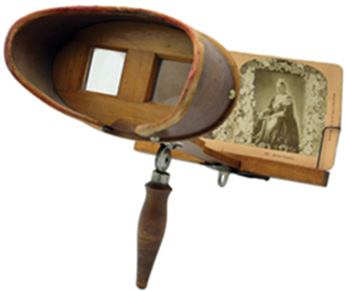
Figure 10.1 Early stereoscope
(Source: http://commons.wikimedia.org/wiki/Category:Public_domain)
The stereoscope contributed to quantification in an unexpected way. According to one historian of these novelties:
The device crossed all cultural and class boundaries: intellectuals used it to ponder the mysteries of vision and mind, while kids merely goggled at the cool views … You could stay at home and go to France, to Italy, to Switzerland and China, and you could visit all these places by your fireside. (Thompson 2017, 21)
Further, the historian asserts:
Stereoscopy began to transform science. Astronomers realized that if they took two pictures of the moon—shot months apart from each other—then it would be like viewing the moon using a face that was the size of a city … The technique indeed revealed new lunar features. (Thompson 2017, 21–2)
This leveling effect helped to make experiences common to people of all classes, occupations, and educational levels. Today, we have a similar device but with a different name: “virtual reality,” or “VR.” Present-day VR headsets, of course, are much more sophisticated in their technology, allowing you to have an entire 360-degree experience, but the idea is the same as in Wheaton’s discovery and Brewster’s stereoscope. And the leveling aspect inherent in the viewing is still extant. Today, astronauts practice space visits with VR headsets, and many youngsters with VR headsets shoot to kill the bad guy around the next corner (it is shameful, though, that the scenarios too often have graphic detail that is disturbing in its realism).
The second invention at this time that brought still more common ground between academics with their mathematical skills and ordinary folks (in this instance, mostly students) was the slide rule. For those who don’t already know (likely anyone who grew up after the advent of Apple and IBM personal computers), a slide rule is a small slip stick with several logarithmic scales printed on each of three slides. As one rule slides past the other, the scales align, and the results to a problem can be read on one or another of the scales. These little devices made many arithmetical operations easy, especially multiplication and division. That was not all they could do: they also allowed calculations for square roots, exponentials, logarithms, and trigonometric functions. Remember, before this invention, such calculation could only be done manually—in longhand, as it was termed. This is how Newton, Euler, Bernoulli, de Moivre, Gauss, and all the others did their daily work. Figure 10.2 shows a popular version of a slide rule, used in the nineteenth and well into the twentieth century.

Figure 10.2 Log-log slide rule
(Source: http://commons.wikimedia.org/wiki/Category:Public_domain)
To get the idea of what can be done with a slide rule, try solving this simple problem manually: (192 − 88) ÷ 8 = ? This is certainly an easy problem but it will take a few minutes. (The correct answer, by the way, is 13.) Next, try this slightly more difficult problem, again by longhand:  . (The answer is 343.) Again, solvable manually (presuming one remembers—or was ever taught—how to manually compute cube values and square roots) but, obviously, it would take quite a bit of time—say, ten minutes at least. Finally, consider solving an algebraic equation like the one below:
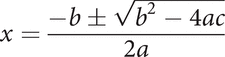
It, too, can be done with just hand calculation (as it was for many, many years), but, with the slide rule, you can solve it in a less than a minute, regardless of what values are given for a, b, and c. (You probably realize that just two of the values are required, as the third can be deduced from them—an easy conclusion with a slide rule). You get the idea. Slide rules were a quantum leap forward in ease of solution.
The slide rule was ingenious and manifestly useful. Moreover, it remained widely used in schools and industry (e.g., by engineers, mathematicians, physicists, statisticians, and almost anyone dealing with calculations) until finally being replaced by handheld calculators in the 1970s. Before then, slide rules were not quite as ubiquitous as cell phones are today, but certainly common.
A bit of history might be useful here. Shortly after the Scottish mathematician John Napier published a first concept of the logarithm in the early 1600s, calculating devices appeared. Some of these simple mechanical devices are considered to be early slide rules. An English minister and amateur mathematician named William Oughtred is credited with inventing the first of these. But his scale device did not use logs with the base that modern logs employ, and it was thus of limited utility. As soon as Oughtred’s invention appeared, people realized that it was only modestly practical, but it still seemed a good idea. Soon, several other inventors offered their versions of a log-based calculating device. But these tweaks were only minor adjustments, and the small appliance remained impractical.
It was not until years later, in 1815, that Peter Roget (yes, of Roget’s Thesaurus) made the modern “log-log” slide rule, which has several scales displaying the logarithm of the logarithm with a base 10, the modern base for this scale in most applications. The log scales slide past one another to align on the correct number. Roget’s slide rule dramatically increased the device’s usefulness, allowing calculations of all sorts.
These two simple mechanical devices—the stereoscope and the slide rule—were possible only because of the mathematics behind them, which itself stems from the work of the ingenious individuals we have met thus far. For quantification, both devices were great levelers in society, bringing together in a common experience the accomplished mathematician and the ordinary person. With these inventions, we see increased efforts to infuse numeracy into the daily lives of ordinary people, now operating on a wide scale. Quantification was advancing—not yet to the point of an internalized worldview, but certainly moving numeracy into the cognitive domain. We are thus trudging toward a transformation, surely and inexorably.
From the context of the post-Napoleonic era, and with these new inventions on the scene, we can see that quantification was decidedly moving into the experiential realm of ordinary people. No longer was a numerical achievement known solely within the confines of academia. Nor was it unusual for an ordinary individual to cite something numerical, like actuarial tables, tide movements, or phases of the moon. Mariners (finally, with chronometers) knew their position at sea (latitude and longitude) with relative accuracy. Every day, people were having more and more contact with things that are wholly quantitative. Despite the now-daily numerical experiences, however, people still held their personal identity in a qualitative realm. But, by bits and pieces, that too was changing.
* * * * * *
Earlier, we saw that Laplace sought to bring quantification to Everyman, but his efforts were limited in scope and only modestly persuasive to society at large. However, a student of Laplace, Lambert Adolphe Jacques Quetelet, a mid-nineteenth-century French astronomer and mathematician, pursued the same intention but with even more zeal. In fact, today he is more famous for bringing quantification into the contemporary society than for making mathematical inventions. Quetelet expressed his point of view by saying, “I am less desirous to explain phenomena than to establish their existence” (Quetelet 1968, vii). He spoke this in the context of his “originalism” belief, giving God credit for all things that are then only “discovered” by humankind. This was a persistent view throughout the period.
Quetelet was a scholar of immense intellect, and one with a variety of interests. He was the first person to receive a doctoral degree (in 1819, at just twenty-two years of age) from the newly founded University of Ghent, in Franco-Belgium. While there, he studied two disparate subjects: mathematics and literature. He remained energetic throughout his life, writing dozens of books and more than three hundred scientific papers and even wrote a libretto for an opera.
Upon graduation, he started work as an astronomer in Brussels. There, he founded and directed the Royal Observatory and became active in academic circles. He was soon a public figure, something that he apparently enjoyed. As such, he stayed in close touch with one of his professors, Simon Laplace, who had a profound impact on his thinking and work. For all of his accomplishments, it is surprising his work generally included little mathematics, or only relatively simple ideas that were already well established. Regardless, his application of mathematics and probability to social science data was a significant contribution to quantification.
To Quetelet, promoting probability to ordinary people was like proselytizing for God, since to him, everything came from God. He advocated a philosophy wherein “constant causes produce constant effects” (quoted in Porter 1986, 55), meaning that living for God yields a godly and predictable, consistent outcome. Living apart from predictable behavior is a kind of deviant (read: not normal) behavior. For instance, if poverty leads someone to commit a crime, more poverty will yield the same result: more crime. He had allied ideas concerning “variable causes” (wherein change is the result of variation, such as in the four seasons) and “accidental causes” (for things that change randomly and act indifferently in any direction).
He saw life as almost literally fitting into a probability theorem, a sort of real-world application of Laplace’s advanced version of the central limit theorem, something that captured his interest. Probability theory was Quetelet’s route to understanding human behavior. To Quetelet, you have choice in a number of life’s experiences, and the more your choices align in a particular direction—as, say, toward God or toward something else, such as criminal activity—the more likely that future choices will be of the same type, in the manner of “constant causes produce constant effects.” According to his line of thought, this is like fitting life experiences to a normal curve. He was the first to hypothesize behaviors as causes for “errors” in a normal distribution. Remember, at the time, the normal distribution was still known as the “law of error,” to reflect the mean and deviations about (above and below) it.
He believed that society can be understood—even “estimated”—by probability prediction. This is Quetelet’s notion of predictable effects resulting from known causes, whether they be “constant,” “variable,” or “accidental.” Hence, events that compose social order (such as marriages, births, deaths, and crime statistics) can be identified, measured, and plotted as a distribution, showing the features to be either normally distributed or skewed. He sought to learn as much as he could about such mathematically defined errors. In doing so, he believed he would understand much about how society functions and what gives it order. He wrote frequently about social order versus chaos.
He appreciated particularly that although social statistics are gathered individual by individual, separate peculiarities tend to be washed out when considered against those same choices or characteristics for the population. He said,
The greater the number of individuals observed, the more do individual peculiarities, whether physical or moral, became effaced, and allow the general facts to predominate, by which society exists and is preserved. (Quetelet and Beamish 1839, 12)
But Quetelet also realized the value of the individual as a basic building block for both social order and the aggregate display of the bell-shaped curve—again, his idea of plotting data as a means to understand phenomena and hence preserve social order over chaos. From this understanding, he turned around the notion of looking at aggregated data and began to focus on the individual. From this perspective, he made the point that group statistics do not apply to the individual. This is the flip side of the individual being washed out (“effaced,” in his words) when considered only as a small bit of data in the larger distribution of lots of numbers.
Whereas today the maxim of “group statistics do not apply to the individual” appears ordinary and matter of fact, Quetelet was the first to bring this perspective to public attention.
Quetelet’s interest in the individual was made manifest in two particular and closely related ways: first, his focus on sociological phenomena, and, second, his desire to codify the average man. Both features came to dominate much of Quetelet’s professional activities throughout his career and today constitute the areas for which he is best known. He had an intense interest in sociological phenomena (such as social demographics, health characteristics, and deviant behavior such as crime).
Prior to Quetelet, the focus of probability was usually on games of chance or on astronomy and geodesy. The extent to which social demographic data was captured and tracked or studied was certainly minor. Quetelet made it mainstream by working with zeal and from a particular philosophy of understanding society as a means to preserve social order over chaos. According to one historian of probability theory, “Adolphe Quetelet was among the few nineteenth-century statisticians who pursued a numerical social science of laws, not just of facts” (Porter 1986, 41).
Quetelet’s second area of focus was describing l’homme moyen (“the average man”). He thought that, by describing the social behaviors of a lot of people, he could codify what was ordinary and what was not. He saw this as a problem of probability: estimating what was likely and what wasn’t. His methodology was simple: gather statistics on many individuals and plot them as data in a normal distribution. He would thereby describe what was average and what was apart from average; namely, the mean of a distribution and its “errors.” Recall, again, the term “standard deviation” was not used at the time. Rather, deviation scores were referred to as a “theory of errors.” He was thus fitting data to a distribution as findings in a research problem and then drawing conclusions for the fit. This was a novel approach at the time.
His efforts to describe l’homme moyen became almost an obsession, for he sought data on all kinds of things, including physical features, sociological characteristics, mental capacities, and especially all manner of crime statistics. He collected data for literally hundreds of such variables. He called these the “facts of life.” Per his professional predisposition, he viewed these facts of life in probability terms. Accordingly, as he collected data, he fit them to a normal distribution, noting especially the errors.
True to his academic disposition, he carefully noted his philosophy toward sociological phenomena and his methods and results for identifying and describing the average man. Quetelet was a prolific and detailed writer. His most famous work is Sur l’homme et le développement de ses facultés; this title would directly be translated as On Man and the Development of His Faculties, but somehow it came to be known as A Treatise on Man and the Development of His Faculties (Quetelet 1968). He wrote this work early in his career, originally publishing it in 1835. It was well received by his peers not only for its novel idea of characterizing the average man but also for its level of exacting detail in description.
Shortly after Quetelet published his work and saw its favorable acceptance, he wrote an essay in which he more fully laid out his beliefs for society generally—the constant effects notion introduced earlier. He incorporated this essay into a second edition of his main work and even added it to the original work’s title, now is Sur l’homme et le développement de ses facultés, ou Essai de physique sociale. The translation of the last part of the expanded title is “Essays on Social Physics,” which introduced a new direction for research and a new term to go along with it: “social physics.” This new essay was popularly received, too.
Today, the complete work is viewed as one of the earliest publications on sociology, and it brings together several of Quetelet’s ideas that he had previously considered independently: social order as defined by quantifying events into normal distributions; probability as a route to describing the average man; and Quetelet’s belief that the science of probability should be applied to all sorts of social phenomenon.
Although generally popular, the work was not well received by everyone, particularly Auguste Comte, a contemporary of Quetelet. Comte was a French philosopher who also thought a lot about society and social order. Remember, the Napoleonic period—a time characterized by social upheaval and chaos—had just ended, and it was still uncertain whether the post-Napoleonic peace settling on the Continent would last. People had not yet reached a sense of tranquility in their social order, and personal homeostasis was unset. Comte attempted to address this anxiety by offering a viewpoint in which science would pervade society, and order would result. He studied social phenomena empirically and eschewed metaphysical explanations of Quetelet and others. Science, he thought, was the route to understanding society, and, through science, social order would promulgate. This is the philosophy of positivism. (For reference, today “postmodernism” challenges the basic assumption of positivism.)
Comte described his way of thinking as “social physics.” When he learned of Quetelet’s Essays on Social Physics he was incensed and accused Quetelet of appropriating a term that he had invented. We do not know Quetelet’s reaction, but we do know that his essay was widely read at the time and that Quetelet was a popular public speaker. Presumably, he refused to change the title. Although displeased, Comte apparently did not want to get into a row with such a public figure, so he changed his label for his notion to “sociology.” This turned out to be a good decision by Comte, as he is now given credit for inventing the term, if not the science.
Early in his career, Quetelet had a notion of conducting a census of the Low Countries of the Continent. To him, this was a perfect application of his theory of social physics. He intended to describe rates for births and deaths and some other events, such as marriages, more accurately than was done before, and he would use the Laplace methodology of making probability ratios from a combination of observations in the manner of Tobias Mayer, which we saw earlier. The idea was to divide the region into a number of districts and then sample from each of them. However, since exact records of births and deaths were not uniformly kept, he was confronted with a problem of reliability. He realized that varied local record keeping could lead to bias in his counts. So, he devised a special application of Laplace’s probability ratios in which he would use estimated numbers divided by reported numbers, making a ratio that he thought would smooth out many of the irregularities in the official records.
Unfortunately, a colleague—Baron de Keverberg of the Netherlands—pointed out to Quetelet that the heterogeneity in social structure among the districts went beyond just irregular records. For instance, the regions had differences in caring for the elderly, with longevity being affected. This fact made for dissimilarities in the birth and death rates. Also, he did not like the Laplace probability sampling idea. Apparently, the baron was doing more than just offering constructive criticism. He was influential in government funding, and he got the census monies stopped. In his defense, however, the government was rebuilding during this period, and money was in short supply for everything. Quetelet, it seems, was not too upset, for he dropped the idea of a census, and so the inconsistencies between local records persisted.
But Quetelet, true to his active nature, simply redirected his professional energies. He continued his pursuit of describing the average man—l’homme moyen—almost obsessively counting everything in sight: rates of births and deaths; suicides; physical characteristics of conscripts; body dimensions of ordinary people; crime statistics; and on and on. Always, he fitted them in distributions and examined the errors, or deviations from the mean.
As Quetelet’s ideal, the average man was a true expression of supreme goodness. He said, “If an individual at any epoch of society possessed all the qualities of the average man, he would represent all that is great, good, or beautiful” (quoted in Porter 1986, 103). In other words, the closer you are to the apex of the normal distribution (the mean), the more beautiful and good. Ultimately, for Quetelet, describing the average man was effectively giving structure to laws that govern chaos in society. He claimed to have come to this perspective while reading Aristotle, who also considered the ideal man, though not in the probability terms used by Quetelet.
Continuing his work in collecting “average” statistics, Quetelet began tracking obesity for ordinary people, a rather novel statistic at the time. At first, he simply measured body dimensions and plotted them on the normal distribution. But, with obesity in particular, he took a special interest and devised a standardized set of values, which he called the Quetelet obesity index (or QI). The index was almost immediately adopted by healthcare personnel, and it remains almost unchanged to today, although it is now more popularly called the “body mass index” (or BMI). Today, the BMI is employed as the international measurement of obesity. It is universally expressed in units of kilograms per square meter (from mass in kilograms and height in meters).
The World Health Organization has developed BMI charts showing cutoffs for various categories, including “Underweight,” “Normal Weight,” “Overweight,” and “Obese.” These charts are commonplace in healthcare facilities. There is even a reasonable chance that you have used them yourself—again, quantification makes an appearance in our daily lives! (Maybe, in this instance, one wishes the zeal toward quantification was more muted.)
As mentioned, Quetelet also had a special interest in tracking crime statistics. He not only examined whether a crime had been committed but also looked at the individual’s behavior, such as if the accused showed up for the trial, and if the person did appear, the likelihood of a conviction. It seems he examined everything about crime for which data was available, such as crimes by knives, guns, poisons, drowning, or suffocation, and even death by hanging. He reasoned that, the more data was known about an individual, the greater was the probability of accurate prediction about the future behavior of that individual. He calculated that if the only piece of information available for an individual was that the person had been accused of a crime, there would be about a 61 percent chance of a conviction but that this number would change as additional information became known, such as whether the crime was against another person or against property.
The changing predictions followed his lifelong philosophy of “constant causes produce constant effects.” Again, his interest was in determining the error in these group statistics for identifying significant deviations and, above all, preserving social order over chaos—quite a novel approach at the time.
He wrote of this theory in his thesis on probability, Instructions populaires sur le calcul des probabilités (Quetelet 1996; first published in 1825; translated as Popular Instructions on the Calculation of the Probability (Quetelet and Beamish 1839)). In that work, he advocated for broad application of his theory, famously saying,
It seems to me that the calculation [calcul] of probabilities … ought … to serve as a foundation for the study of all the sciences, and particularly for that of observation. (Quetelet and Beamish 1839, ix)
For Quetelet, using probability to describe the average man was effectively giving structure to laws that govern civil society, as opposed to social chaos— this is the idea we saw earlier. It would seem he viewed order in society as an either-or proposition.
As time went on and Quetelet continued codifying the average man, his views on the topic evolved. No longer was it sufficient to merely record his facts of life to map an average or typical man. He began to portray the notion of the average man as an ideal to which all humankind should aspire. To Quetelet, to be at the mean in all facts of life was to be ideal. The mean became both the literal and the metaphorical apex for humankind. To whatever extent an individual deviated from the mean, he had fallen. According to Quetelet, for l’homme moyen, “virtue consists in a just state of equilibrium, and all our qualities, in their greatest deviation from the mean, produce only vices” (quoted in Porter 1986, 103).
In other words, man lived in a balanced state as represented by the mean in the facts of life, and deviations from that mean were the equivalent of defects. Quetelet had, apparently, a philosophy with no room for complexity of behavior. One imagines he would have been sympathetic to views held by Jonathan Edwards and the Puritans in America (still popular there at the time), but, of course, this is conjecture, and there is no record whatsoever of Quetelet making any related comment.
Still, in one attempt to identify the ideal soldier, he plotted body dimensions for conscripts, including chest circumference. But he ran into an unexpected complication when he found that the conscripts’ chest measurements varied considerably depending upon both the geographic area that a given individual was from and his ethnic heritage. Celts were decidedly different from Scots, for instance. Although the mean values for each group were not too dissimilar, the standard deviations were vastly disparate. He found that the largest deviations were for those of Scottish lineage. He reasoned that Scottish ancestry was actually an amalgamation of various heritages, including British, Welsh, Danish, and other Anglo-Saxon, leading to greater intrarace variability, whereas the Celts were more homogeneous in their descendance.
This discovery was more than just of novel interest to Quetelet. Following his concentration on the errors of the normal distribution, he wondered what amount of error would be significant, because, clearly, he would need different values for the conscripts of each heritage.
To determine what was a significant difference for each group, he tried a procedure that (true to his bent) used ratios in a probability of proportions. He contrasted the ratio of each group’s chest statistic with that for everyone, regardless of ethnic heritage, and then compared them across the groups. Some readers will recognize from even this tiny bit of information that Quetelet had suggested a sort of rudimentary analysis of variance procedure, a statistical test that was not fully developed until much later. Regardless, this approach shows an ingenious component to Quetelet’s efforts.
He used this information to suggest that he could predict height with uncanny accuracy. He measured conscripts’ height and then, using the known deviation, he invented a rather clever system to extrapolate height measurements for a very large sample, which he construed to be a population of one million measurements. Then, he presented his data in an ingenious manner. Rather than plot heights in a histogram or on a distributional scale, he made a single, vertical bar and “filled” it with points, one for each height in his population. From tables of his height data, he made eighty equal divisions, noting from one million (his supposed population) the number of points that fell within each category. His scale, which he published in his book on social physics, is shown in Figure 10.3.
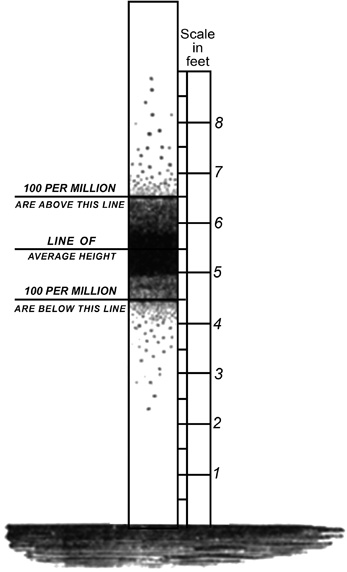
Figure 10.3 Quetelet’s height measurements, distributed in categories with divisional lines
(Source: from A. Quetelet, A Treatise on Man and the Development of His Faculties)
From this, he developed a law of deviation in which any measurable event with enough similar measurements (i.e., ones that occur within the same range) would be governed by the same predictable deviation that he saw for the conscripts. He felt he could predict for a population the exact distribution for a large number of cases, and even how many would fall above and below any of his lines of division.
This work influenced Francis Galton greatly, who applied it to intelligence measurements in his seminal Hereditary Genius. In that work, Galton described Quetelet’s system of distribution and imagined he could use it, too. I describe this more fully in Chapter 12.
And, as we see, Quetelet himself followed in the footsteps of his professor, mentor, friend, and primary influence, Laplace. He sought to apply quantification to social contexts and thereby bring it to a broad audience as they participated in everyday society.
He wanted to touch Everyman. While he was only modestly successful in this large effort, he did influence several important people from varying fields: Florence Nightingale, John Maynard Keynes, Francis Galton, Siméon Poisson, and others. Let us look at these influences individually.
Poisson was a mathematician who developed some highly technical papers on physics and invented an important probability distribution. We will meet him in Chapter 11.
Florence Nightingale, as is widely known, was a heroine of the Crimean War and, through her humanitarian work, she virtually invented the nursing profession. What is not as well known about her, however, is her interest in statistics and its application to social problems. She wrote scientific papers using probability to address such issues. Obviously, writing scientific papers was quite unusual for a woman at the time. She credited her activism to following Quetelet’s notions on social physics, and we know that they corresponded.
Readers probably recognize that the English economist John Maynard Keynes is one of the most prominent economists of all time. Keynes freely acknowledged that his ideas on social physics were heavily influenced by Quetelet, particularly his acceptance of “constant causes” explanations for societal phenomenon. In 1921, Keynes wrote an important essay about social physics, titling it “The Application of Probability to Conduct” (reprinted in Newman 1956). In it, he sounds exactly like Quetelet. He says, “We might put it, therefore, that the probable is the hypothesis on which it is rational for us to act” (Keynes 1956, 1360). Indeed, upon reading the essay, one imagines that it could have easily been penned by Quetelet himself.
Keynes applied probability to problems in economics in his seminal work The General Theory of Employment, Interest and Money (Keynes (1936) 1973). It brought about the “Keynesian Revolution,” attracting a worldwide following. He posited ideas on how to manage economies, particularly in times of severe unemployment, such as existed during the Depression, the time during which he wrote. The most lasting point of Keynesian economics is his theory on supply and demand. He said “supply creates its own demand” (Keynes (1936) 1973, 21), a line that started a generations-long discussion about its effects in practice.
The book remains one of the most influential ever written on economic theory. From its introduction in 1936 to at least the 1960s, it was required reading for students of economics, as well as practicing professionals. According to TFE Times, the book is No. 6 on the list of “10 Best Economics Books of All Time” (TFE Times 2017). (The no. 1 book is Adam Smith’s The Wealth of Nations, first published in 1776.)
Later, we shall see in some detail that Quetelet’s ideas were also picked up by the British statistician and sociologist Francis Galton.
* * * * * *
In addition to these social influences, quantification was now also shaping other new fields, such as natural history, with the work of Georges-Louis Leclerc, Comte de Buffon, a French naturalist, mathematician, and cosmologist. Buffon wrote a single work during his entire career, but it is in thirty-six volumes, with at least two additional books published by a protégé after Buffon’s death. This monumental work is Histoire naturelle, générale et particulière (Natural History, General and Particular) (Buffon 1780). The work describes and explains numerous events in the animal and mineral kingdoms. The work was extraordinary in the day for its novel content. It was popularly read across the Continent and translated into several languages, making it one of the most widely read books of the day. In fact, Buffon’s popularity has been compared with that of Montesquieu, Rousseau, and Voltaire, making him among the most-read writers at that time.
Charles Darwin seems also to have been heavily influenced by Buffon, because many of his central ideas were ones that had been made earlier by Buffon. However, Darwin does not mention him at all. When asked about this, Darwin replied that he was not familiar with Buffon, (although, given the latter’s popularity in natural writing, that is hard to believe).
Noteworthy to us is that Buffon engages probability in many of his explanations, something not done before. One particularly striking probability explanation has become somewhat famous because it was the first time someone used probability to address problems in nature. It is called “Buffon’s needle problem.” The problem he posed is this one:
Suppose we have a floor made of parallel strips of wood, each the same width, and we drop a needle onto the floor. What is the probability that the needle will lie across a line between two strips? (Buffon 1780)
Figure 10.4 illustrates Buffon’s needle problem.
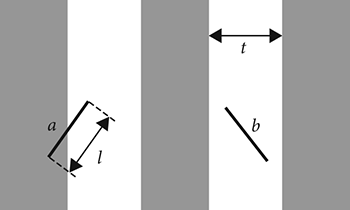
Figure 10.4 Illustration of Buffon’s needle problem
(Source: http://en.m.wikipedia.org/wiki/Buffon%27s_needle)
The problem had vexed others for a long time, but Buffon solved it with geometric probability and integral calculus—the first to do so.
Most pertinent to our discussion, however, is his idea of bringing quantification to the natural sciences, another important first. Closer and closer it comes to the daily lives of ordinary people.