
CHAPTER 8
Up to now, the story of our adopting a quantified worldview has centered on advances in mathematics and probability theory as invented and developed by several extraordinary and brilliant scholars and academicians: Bayes, Bernoulli, Gauss, and others. However, they all were of a type—scholarly and intellectual—and most were associated with academia, often as lecturers or professors at universities. Now, notably, we extend the influence of quantification to a broader populace—namely, to Everyman. Most readers will recognize at least the name “Everyman” which is an allegorical figure who represents all of humanity in the fifteenth-century anonymous morality play Everyman. I use Everyman here purposefully to suggest that during this time, access to this new knowledge—and the concomitant worldview—was transiting from the intellectuals to ordinary people, who were occupied with their daily doings and not with mathematics.
Thus, in our storyline, quantification is finally coming to ordinary folks. Across the social order, quantification is slowly but inexorably seeping into the daily life of Everyman.
Further, my argument for quantification is that the incredible mathematical achievements of these times happened in large part because the unprecedented historical events of the era set the stage for rapid intellectual growth. But, as a theme for the times, it was a reciprocal arrangement. These mathematically inspired ideas themselves contributed to spheres of thought of the Enlightenment, such as the overthrow of absolute monarchs in France, the decline of dominant states such as imperial Great Britain, the emergence of individualism in the new United States, and the soon-to-come industrial revolutions in England, the Continent, and America.
Reciprocally, history supported mathematics, and its development advanced history. The effect on Everyman was to move toward a quantified worldview.
Specific inventions, too, contributed to quantification. One such invention was itself nearly a touchstone in changing people’s worldview. In fact, it alone contributed to a change in how people thought of the world and about their place in it. This important invention was the chronometer, a device for keeping accurate time in all locals and circumstances. The chronometer’s real value was that it worked regardless of whether it was held still or in motion, and whether it was at sea level or high on a mountain.
Of course, timepieces and clocks had been invented long before the chronometer came along, and by the early eighteenth century, they were quite accurate … within limits. But their exactness held only so long as they were on steady ground, and they often did not work in thin mountain air with lower air pressure. On a rolling ship, early clocks simply did not work at all, because their pendulums swung around erratically. With the invention of the chronometer, however, mariners and mountaineers alike could accurately know the time.
Obviously, knowing the time was important to mariners. But the urgency of this need is highlighted by the fact that, with their new knowledge of accurate time, they could now determine their exact location as longitude and latitude. In modern times, since at least the early 1960s, of course, latitude and longitude are both determined by one’s position relative to satellites, and not directly by using time.
Another problem for time was also widely recognized then: the need for a common reference locale. Up to then, time often varied from place to place, and several rulers, like the tsar in Russia, demanded that wherever they were standing be the place from which time should be measured. High noon in Paris was different from high noon in St. Petersburg, for example. This was more than a problem of ego, too, because railways were coming onto the scene and they desperately needed a standardized time system.
While people recognized the problem and knew that the solution was to fix a certain place as the referent for timekeeping, there was debate about where that place should be. Finally, in 1884, an International Meridian Conference was held in Washington, D. C., and the choice was made: the village of Greenwich in England. Politics aside, this was a natural choice to be the center for time keeping because the Royal Observatory—the place from which official time observations were taken—was located there. At exactly noon on November 18, 1884, telegraph operators sent a coordinated signal to major cities across the world as the start of modern time. From that second to today, everywhere across the globe, time is relative to its start in the London suburb of Greenwich—Greenwich Mean Time (GMT). The international dateline, too, is determined from GMT.
For mariners, having GMT meant they could determine their own longitude as the difference between a time interval and the ship’s position relative to the Greenwich meridian. This was a huge advance for many obvious reasons. For us, it signifies that quantification is finding ways into the ordinary necessity of commerce, and thus into the life of Everyman.
Another surprising event in the mid-eighteenth century also advanced the notion of quantification: Europeans suddenly had sugar! Sugar—made cheap and readily available around this time—is more than just symbolic of the rise of a middle class; it is a great leveler in society, a shared experience for the populace, accessible to both Everyman and the nobility. Prior to this time, sugar had been affordable only to persons of means and had been a signpost luxury that signaled belonging to the upper ranks in a well-established societal class system. The same leveling effect was caused by tea, coffee, and chocolate (which were also entering daily commerce about the same time).
If tangible things could be held in common, then certainly intangible thoughts—worldviews—could be shared, too.
In other areas of life, too, there was a plethora of quantifying ideas coming into frequent use by all people, ordinary folks and intellectuals alike. For example, actuarial tables for estimating longevity were commonly used in life insurance plans now; in business, market-planning estimates were growing in sophistication and gaining widespread acceptance as tools for making financial decisions. State-sponsored lotteries (“lotto” in most countries, even then) were up and running (apart from gambling itself, which, of course, has been around forever). These ordinary phenomena rely on mathematics, statistics, and probability theory operating in the background.
Quantification as a worldview had been sown and was growing; its branches were beginning to spread.
* * * * * *
As some daily experiences, like pleasurable cooking with coffee, sugar, and chocolate, were becoming more commonly shared across all social classes, one intellectual intentionally sought to bring the measurement of uncertainty—probability—to the everyday affairs of ordinary folks. This individual was Pierre-Simon Laplace. Unlike most of his predecessors, and even his contemporaries, Laplace did not stay behind the stony walls of academia. He wanted to make the notion of probability public and commonplace.
To Laplace, quantification was something beyond formulas and theory—it could be a part of everyone’s daily experience. He took several specific actions to bring his intention to realization. As one effort, Laplace moved the study of probability theory beyond its then almost-exclusive application to games of chance. He applied it to problems in architecture, engineering, geodesy, and many other areas. This action was imaginative, and although he was not the first scholar to apply probability outside of gaming, he was the most deliberate in pursuing its broader application.
To our modern minds, Laplace’s aim seems very unimaginative, but at the time—in the context of intellectual activities staying generally with peers and inside ivory towers—what he did was almost groundbreaking. Remember, ordinary people of the day had no contact with such intellectual activities. However, to truly appreciate Laplace’s efforts, it is useful to first examine the work of Joseph-Louis Lagrange, a man who influenced him greatly. Examining his work will aid in our understanding of Laplace’s contribution to quantification.
Lagrange, like Laplace, was a solid mathematician, and both men were fairly renowned. Lagrange was only a few years older than Laplace, having been born in Turin, Italy (then, Piedmont-Sardinia) in 1736. His exact birth name is unverified, but it is mostly reported as either Giuseppe Lodovico Lagrangia or Giuseppe Ludovico de la Grange Tournier. We will just call him Lagrange, since he is the only one of that name in our story. A sad fact of his family history is that, of eleven children born to his parents, he was the only one who survived beyond infancy.
As one might imagine, as an influencer of the gifted Laplace, he made substantive contributions to quantification himself. While a member of the French Academy of Sciences, he helped to establish the metric system there during the period of the French Revolution.
Lagrange worked primarily in analytical and celestial mechanics and made important contributions in these areas, principally adding to work originally done by Newton, as was similarly done by Laplace. He is best known, however, for extending the work of Euler (whom we met briefly in Chapter 3) to found a very technical study called the “calculus of variations.”
The calculus of variations seeks to find (read: mathematically define) the shortest distance between two points. On a flat plane, obviously, this is just a straight line, something taught in beginning analytic geometry or algebra courses as a set of points whose coordinates satisfy a given linear equation. We saw this earlier in the description of least squares in Chapter 7. But in geodesic space (as with a sphere, say, Earth or other celestial body), the figuring is not so simple.
Look at the sphere displayed in Figure 8.1, and imagine how to find the best-fitting line between the two end points of the bolded line, A to B. It is a problem of special curvature. In analytic geometry, this is a famous problem known as the “orthodrome problem.” As can be seen, in three-dimensional space, a straight line from the starting point would just extend into infinite space and never reach the second point, so something different is needed.
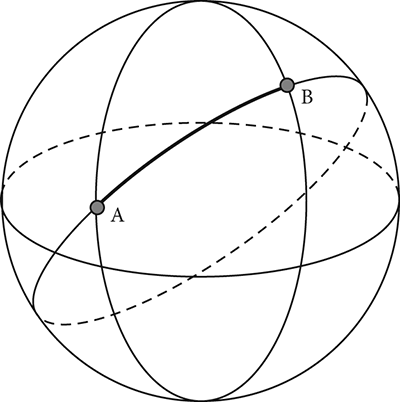
Figure 8.1 Projection for the orthodrome problem
(Source: http://commons.wikimedia.org/wiki/Category:Public_domain)
The solution is to draw a line tangential to the curved surface to create a defined space that can then be measured. Because the arc along this curve is constantly changing, a large number of tangents are needed, each considered a variation. Mathematically defining these spaces leads to a set of what are called “Euler–Lagrange equations.” Lagrange based them upon initial work by Euler. The shortest distance can now be evaluated through repeated estimation by these equations. The entire process is called “Lagrange’s calculus of variations.” Its description can be lengthy; in fact, there are entire books devoted just to explaining Lagrange’s calculus of variations and its application in various fields. We will not go there—thank goodness.
The orthodrome problem, with its solution by Lagrange’s calculus of variations, is given life today in long-distance travel. It is easiest to visualize this in a scenario on an azimuthal projection (viewing the earth from distant space) that considers a “great circle.” A great circle divides a sphere into two equal hemispheres, making it easier to see actual distances. In a given scenario (e.g., see Furuti 2012), suppose an airline flight is scheduled to travel from São Paulo, Brazil, to Tokyo, Japan, with a required refueling stopover. If the route planner used an equidistant cylindrical map and drew a straight line between the cities, it would seem that Hawaii would be the logical stopover point. But this would be a mistake. As seen in the great circle, a stopover somewhere along the northeastern coast of the United States (e.g., Boston, New York, or Philadelphia) would be the preferred choice. Figure 8.2 makes this point clear.
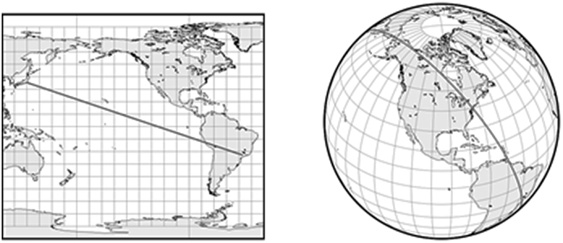
Figure 8.2 Azimuthal orthographic projections illustrating the orthodrome travel problem
(Source: http://commons.wikimedia.org/wiki/Category:Public_domain)
Although Lagrange provided a solution to the orthodrome problem, he was not the first to tackle it. Just a few decades earlier, Galileo, without the benefit of calculus, had also tried to solve it. Actually, at the time, Galileo had not been focusing on this particular problem; rather, he had been trying to figure out what caused the tides to ebb and flow. In trying to solve the surf problem, he realized that the curvature of the earth was somehow involved and that tidal change was related to the distance of any particular spot on the earth’s surface to a given point on the moon. Without being aware of it, he was tackling a version of the orthodrome problem. Although he was on the right track, he was not successful in finding a satisfying solution.
Remember, he did not have the benefit of Newton’s calculus. One famous historian of mathematics noted that since even a genius like Galileo could not solve the orthodrome problem, then you should not feel too bad for not solving it either (Gorroochurn 2016a).
To our benefit, notes from Galileo’s musings have survived, and it is interesting to view them and imagine his thinking, as shown in Figure 8.3. Now, knowing what we do about Lagrange’s mathematical accomplishment with his calculus of variations, it is little wonder, then, that even an accomplished intellectual like Laplace was so heavily influenced by him.
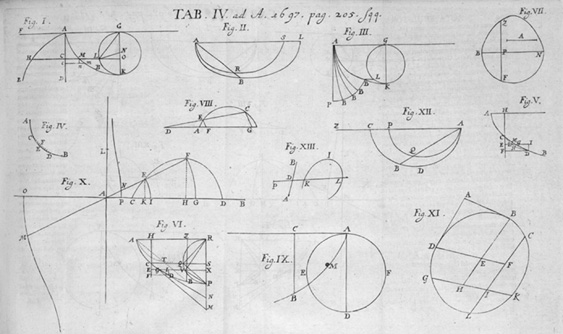
Figure 8.3 Galileo’s notes on attempting a solution to the orthodrome problem
(Source: http://commons.wikimedia.org/wiki/Category:Public_domain)
* * * * * *
By all accounts, Laplace was astonishingly bright. In fact, he is sometimes called the “French Newton”—a high compliment indeed. Laplace lived about three-quarters of a century after Newton and admired him greatly, both in his personal life and for his work. He studied Newton’s calculus creations and realized that they were potentially applicable to a much broader array of disciplines than just astronomy and geodesy, the arenas in which Newton primarily worked. In particular, he understood that although Newton had provided its broad outlines and set an overall structure, many of its parts were still undeveloped. Laplace aimed to finish it, and in doing so, make both differential and integral calculus complete disciplines that could be integrated into other fields of study.
Remember, Laplace had the intention of employing quantifiable activities in areas where it would be influential to benefit ordinary people. The fact that he opened up calculus for application to a much broader range of problems than was heretofore known is some evidence of that. This influence lives on. Today, Laplace’s work is especially well known in mechanical and civil engineering applications, such as for building bridges, dams, or skyscrapers—really, for making almost any large structure. As a result of bringing calculus to such a wide range of new applications, his work is considered a watershed accomplishment.
He described his deeds in a five-volume treatise, titled the Traité de mécanique céleste (Celestial Mechanics; published from 1799 to 1825), a pivotal and inspiring work. In it, he also set out his nebular hypothesis regarding the origin of the solar system. Catching the scientific world by surprise, he postulated the existence of gravitational collapse and the notion of black holes—quite astonishing!—explaining how some stars could have a gravitational pull so strong that even light could not escape, and it would be sucked back into the star. He provided a series of calculus and geometry theorems to prove his claim, which I discuss momentarily.
Figure 8.4 depicts a diagram Laplace drew to explain his theory of black holes. Although the idea of black holes, and even a time–space relationship, had antecedents in incomplete indications by others, many modern astrophysicists credit Laplace as their discoverer. Einstein credited Laplace with having tremendous influence on his own work in developing his theory of relativity. We will revisit this important work in Chapter 15, during our discussion of Einstein.
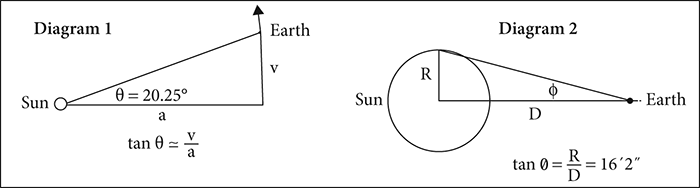
Figure 8.4 Laplace’s diagram used to explain black holes
(Source: from S. Laplace, Traité de mécanique celeste)
Beyond the legitimate black hole explanations to astrophysicists and others, in our time, of course, black holes (and sister notions of wormholes, a tenth dimension, warp drive, etc.) have been great silage for Hollywood moviemakers. Dozens of movies and TV shows have been fashioned around them, although most make no attempt at scientific accuracy. My quick Google search brought up these titles: Interstellar, The Void, The Theory of Everything, even Godzilla vs. Megaguirus, and many more. All stem from Laplace’s original quantification work, attesting to his influence on us today. To think, Laplace could scarcely have imagined his theories showing up (however inaccurately imagined) in movies designed for popular audiences, some even made for preteens! In serious astrophysics work, black holes are very complex, and describing them is difficult. In Chapter 15, we meet a contemporary scholar, Professor Kip Thorne, who proffers a description of them in the context of modern advances in astrophysics.
While explaining his ideas for black holes and the universe, Laplace invented a mathematical process by which a very difficult calculus formula may be solved through the application of a much simpler one. The easier expression, it turns out, applies not only to a single more-complicated formula but a whole family of such expressions. Thus, Laplace has developed a “transform.” In mathematics, a transform is a function that converts numerical information to an equivalent but different form. This is called the “Laplace transform.”
The Laplace transform is very important and useful—perhaps second only to the Fourier transform in its utility for solving differential equations. Individuals today working on engineering problems commonly use Laplace transforms. In fact, there are many Laplace transforms (at least forty common ones), but a precise number is difficult to state because there are various solutions depending upon which mathematical arrangement is employed, and each can be considered a transform application.
Even computing Laplace transforms directly can be fairly complicated; hence, mathematicians usually just use a table of already prepared transforms in their differential calculus work. These tables are commonly reprinted in textbooks on engineering, computing science, and other areas of mathematics. Figure 8.5 shows an example of a table of Laplace transforms.
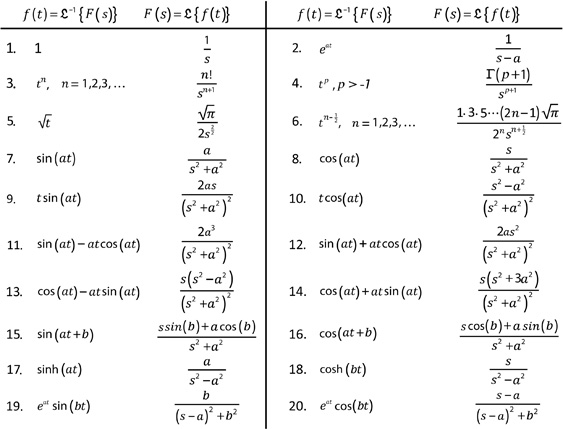
Figure 8.5 Some Laplace transforms
(Source: http://commons.wikimedia.org/wiki/Category:Public_domain)
* * * * * *
Near the end of the eighteenth century, Laplace refocused his energy away from orbital calculus toward general statistical analysis and then on to probability theory. Probability theory absorbed him for most of his productive years, primarily the twenty-year span of the last decade of the 1700s and the first decade of the 1800s. His work in this field was especially significant. In Chapter 6, we saw Bayes’s invention of the logic that became generally known as “Bayesian,” and particularly its application through conditional probabilities in Bayes’s theorem. There, too, we learned that, soon after inventing his now-famous theorem, Bayes mysteriously abandoned further work on it.
Laplace, to our great advantage, recognized its importance and began work to advance it. He reimagined Bayesian statistics to virtually invent the modern Bayesian interpretation of probability, a huge triumph and one that we will look at in some depth, in both this and later chapters. One important writer said: “Laplace’s contributions to probability are perhaps unequaled by any other single investigator” (Newman 1956, 1322).
Laplace shares credit with Bayes for establishing probability theory (and its calculus foundation) as a distinct field of mathematical study. Their work in establishing the discipline is set apart from the correspondence between Fermat and Pascal first suggesting the field, including outlining some preliminary probability concepts.
Especially germane to our interest in quantification is that fact that Laplace resolutely sought to make the main ideas of probability theory accessible to a general audience. For Laplace, probability theory was a whole deterministic philosophy that should be brought to ordinary folks because it went to the heart of “the whole system of human knowledge” (Laplace and Dale 1995, 107). We will return to this quote momentarily because it explains much of Laplace’s thinking. From this initial beginning, we can see plainly that it was also his philosophy of life.
It is the intersection of these two accomplishments—(1) modernizing Bayesian approaches to probability theory and (2) popularizing his philosophy about the theory—where Laplace contributes most to advancing the quantification perspective.
Before moving forward in our story of Laplace, however, we pause to look broadly at his work and life. Even while acknowledging his contributions to the study of probability, readers should not take away the impression that this was Laplace’s single focus for all of his productive life. He worked in several disciplines and was prodigious in his output, especially in astronomy and mathematical physics. To cite his full body of work would require a very long recitation of accomplishments, many of which are not easily understood, much less concisely explained. We will stick to just the portion of his work that advances our interest in bringing quantification to a worldwide outlook: probability theory.
However, know that his reputation as the French Newton is indeed well deserved. In testament to his scholarship, Laplace is among the honored few mathematicians whose name is inscribed on the Eiffel Tower, along with our earlier friend, Adrien-Marie Legendre, the one with the scary caricature as his only surviving picture.
Apparently, Laplace had a natural facility with higher mathematics, grasping complex topics with an ease far beyond that of even most other mathematicians. This talent was noted early on by his teachers and then by others throughout his life. Biographers of Laplace routinely state that his acquaintances and colleagues mentioned him as a quick study. I can report firsthand that Laplace’s natural ease for immediately understanding difficult concepts of higher mathematics is exceedingly rare, having spent much of my professional career in the company of mathematicians, some of whom are (or, sadly, were) exceptionally bright. Laplace, it seems, could grasp a tough concept right away, regardless of how complex, technical, or involved. Ah, to have such a gift of quick understanding!
There is another aspect to Laplace that is worth mentioning at this point. Of all the stunningly brilliant individuals we see throughout our story, Laplace is perhaps the most difficult to read and understand. There are two reasons for this. First, his work was exceedingly complex and technical, accessible to only the few with a deep knowledge of calculus and its theoretical base. Fortunately, over the years, scholars and theoreticians have been able to bring out his findings in more comprehensible forms, making them useful to us today.
We saw earlier that the Laplace transform is one example of this; another instance is his work in astronomy, where he was possibly the first person to have hypothesized the existence of black holes and the notion of gravitational collapse.
The second reason Laplace is tough to follow is his writing style. When he wrote about his numerical inventions, he was positively byzantine in his composition. His official translator to English, Nathaniel Bowditch, described it as follows: “Laplace made no concession to the reader. The style is extremely obscure and great gaps in the argument are bridged only by the infuriating phrase ‘it is easy to see’ ” (quoted in Newman 1956, 1321). Bowditch added that while translating Laplace, whenever he came across the phrase aisé de voir (“it is easy to see”), he knew he had hours of hard work before him. Thank goodness, we will not read Laplace verbatim but only read about him!
Sadly, too, for Laplace scholars who wish to tackle his writings in their first form, many of his original writings were lost in a house fire at the home of his great-great-grandson, the Comte de Colbert-Laplace, in 1925. Nearly all the surviving works of Laplace have been collected in the fourteen-volume edition Oeuvres complètes de Laplace (Complete Works of Laplace) published posthumously between 1878 and 1912 by the French Academy of Sciences.
Laplace and Carl Gauss (already Gauss’s name keeps popping in and out of our story; we finally meet him fully in Chapter 9) are considered contemporaries in their work, despite a twenty-eight-year age difference. Laplace was older. They corresponded regularly, and each made helpful suggestions to the other, given that their worked covered the same domain of scholarship, but they reported their work very differently. Not only did they have dissimilar writing styles, but their approach to explaining things was vastly different.
The reclusive Gauss was careful, thoughtful, and detailed in his explanations. He considered it mandatory to include a proof or two, or three, or even seven, in at least one paper. Sometimes, he even added commentary on why no further proofs were possible! Moreover, Gauss did not typically disseminate his findings until years after he had done the work (as we saw in Chapter 7 on his dispute with Legendre over the method of least squares). Routinely, he put things aside for a while, sometimes years, before returning for further consideration. Only then, after he was fully satisfied, did he publish his findings. We can say he was slow, deliberate, and extremely thorough, but, today, Gauss is widely praised for the thoughtful scholarship in his writings, despite their technical difficulty. His proofs are the standard for exacting scholarly study.
Laplace, on the other hand, was quick to publish his findings, cranking out scholarly papers at an astonishing rate. During his first three years as professor, he published thirteen substantive papers, a rate that is considered to be highly productive (and is the envy of every assistant or associate professor today coming up for promotion or tenure—I can attest to this, having reviewed the publishing record of many dozens of individuals over the years).
But, as we see from the comments of his longanimous (ever-patient) translator, he was haphazard in his writing, often jumping from thought to thought without any transition and leaving great gaps for the reader to fill in. Also, he borrowed liberally from the writings of others, sometimes even employing their phraseology, although he usually acknowledged his source. Today, this practice would be considered sloppy authoring, at best. Be that as it may, we know Laplace’s work was original, even if getting through it is tough.
In terms of personality, too, the two men were quite different. Gauss was reclusive and academic and worked almost unceasingly in his study. We know he did not like traveling away from his hometown. Laplace, by contrast, was gregarious, always seeking contacts with a wide group of people, from academics to politicians. It is ironic that Gauss—the more careful writer and deliberate person—intended his publications for scholars and other mathematicians, whereas Laplace—the more difficult to read and understand—wanted to make his work accessible to a wide audience both inside and outside academia.
Each man contributes to our story of inventing and then spreading the notion of quantification, but in very different ways, obviously. Perhaps, then, Laplace and Gauss were not too different from any two people with distinct personalities.
Laplace was born to good parents of comfortable, but not rich, means. His father worked in agriculture before turning to selling wine in the Normandy region. As a boy, Laplace attended a Benedictine school in a small village in Normandy, where he showed exceptional math talents but did not appear to be a prodigy. His father, also named Pierre, wanted his son to become a priest. At sixteen, Laplace entered the University of Caen to study theology, intending to follow his father’s wishes, but two professors, Cristophe Gadbled and Pierre Le Canu, noticed his talent in mathematics and encouraged him to study that rather than continuing toward the priesthood. They mentored Laplace throughout his higher education. He grew increasingly interested in mathematics, especially astronomy.
At some point, Laplace changed his study from theology to mathematics and announced his intention to become a professional mathematician. Laplace never adopted a formal religion fully, as his father had wished. Instead, he sought a kind of refuge in scientific determinism, something we will explore shortly.
While a university student, he wrote Sur le Calcul integral aux differences infiniment petites et aux differences finies (On the Integral Calculus with Infinitely Small Differences and Finite Differences), a paper confirming Lagrange’s interpretation of Euler’s assumption of a constant difference, a longtime problem of mathematical astronomy (Laplace 1878–1912). Quite astonishing for such a young person who had just been introduced to mathematics! He was given the opportunity to read this paper before the august French Academy of Sciences, which proved fortuitous to his future. Soon after the reading, he left the university (without graduating) to pursue his new interest in mathematics in Paris. But, before his move, he procured a letter of introduction from his university mentor, Le Canu, to the preeminent Paris-based mathematician Jean le Rond d’Alembert.
This d’Alembert was the editor of the first modern encyclopedia, which was published at the same time as Benjamin Franklin was publishing his Poor Richard’s Almanack (as mentioned in Chapter 4). By all accounts, this accomplishment was historic. Earlier encyclopedias are considered nascent in comparison to d’Alembert’s. Its many editions (the 1911 edition is generally thought to be the best) have included original articles by a long list of important persons, including Voltaire, John Muir, Bertrand Russell, Sigmund Freud, James Dewer, Julia Child, and Einstein. When I was very young, a boyhood friend showed me his parent’s copy of their 1911 edition of the Encyclopedia, but it was lost on me at the time. Regardless, it must have impressed me on some level because I still remember him showing me the set of books.
From its inception to today (the last print edition was in 2010, but it remains active online), the Encyclopedia has a reputation of strong scholarship. Much scholarly information given back by Internet search engines references the Encyclopedia as its basis.
For quantification, the Encyclopedia is a veritable gold mine of valuable material for literally hundreds of fields. Perhaps as much as any other single publication, the Encyclopedia has promoted a quantified outlook for people on the whole of information retrieval. Wikipedia, in contrast, is an unsourced offshoot of it to which anyone can contribute, and accuracy is mostly unchecked until challenged by others: a democratic, if not slightly anarchistic, update on the careful scholarship of the original.
Otherwise, d’Alembert made only minor contributions to his primary fields of mathematics and classical mechanics, and none on the scale of our central characters like Bernoulli or de Moivre, and certainly none nearly so important as the achievements of Newton, Gauss, or even Laplace. Thus, I mention him primarily as a person who was important to the life and work of Laplace, advancing his efforts.
In terms of character, d’Alembert was reportedly an opinionated and difficult person, with a reputation for being stubborn and pugnacious in his frequent arguments with other mathematicians. He made outrageous pronouncements and then attacked anyone who disagreed. For example, he declared, “The true system of the World has been recognized … everything has been discussed, analyzed, or at least mentioned” (quoted in Cassirer 1951, 46–7). Such a declaration—whether by d’Alembert or anyone else—certainly would invite disagreement and debate. For d’Alembert, however, it was routine grist for his argument mill. Incidentally, his preposterous assertion closely channels another infamous claim, this one attributed to Charles Duell, the US Patent Office commissioner in 1899, that “Everything that can be invented has been invented.” Talk about inviting debate!
Despite d’Alembert’s unpleasant personality, he was a prominent mathematician of the time, and he both influenced and helped Laplace, especially during the early years after Laplace had left the university.
Laplace, once in Paris and using his letter of introduction, promptly sought out the intractable d’Alembert. True to his reputation, d’Alembert (according to a widely reported but undocumented legend) derisively gave the young man a tough problem to solve. Laplace solved it almost immediately, surprising d’Alembert with how quickly he had grasped the problem’s complexity. Laplace, we know, was a quick study, and here it paid off for him.
Another version of the legend is that d’Alembert gave Laplace a difficult mathematics text to read. Laplace returned in just a few days, ready, willing, and able to carry out a detailed discussion of the book. Regardless of which version of the legend is true (or even if neither), we know enough about both men that the tale is credible.
Regardless, evidently d’Alembert was impressed with Laplace, for soon he helped the young man secure an appointment as a professor of mathematics at École Royale Militaire in 1771, while just twenty-two years of age and sans university degree. Imagine doing that today—unlikely, to say the least.
Laplace, we know, was ambitious both in his career as a professor and in wider spheres, especially in politics. Almost immediately after his appointment to the faculty, he sought membership in the respected French Academy of Sciences, the same society where he had been so impressive as a promising student. Despite being young and inexperienced, he thought he deserved entry into the Academy since his paper had been well received a few years before. Alas, he was unsuccessful—at least on his first two attempts. Finally, in 1773, he was admitted on his third try.
But the ever-ambitious Laplace wanted more. He cultivated numerous acquaintances outside of academia, particularly with those in politics or who had some riches. His ambition was not without risk, for this was just prior to the French Revolution, and the times were highly charged with social unrest. He doggedly infused himself into government circles, seemingly to gain advantage in the contemporary disorder by knowing the right people.
As the French monarchy decayed, things grew even more chaotic. Everyone, it seems, was seeking some kind of refuge from this societal storm. Many fled to England or emigrated to America. Other prominent individuals retreated from public life altogether, seeking safety in anonymity and seclusion. It seemed that everything was in turmoil—it was, in fact, a time of mortal danger for those on the wrong side.
Robespierre came to power in a coup but was soon replaced and eventually executed. (Recall that we saw a famous depiction of this in Chapter 7.) Not long thereafter, Napoleon Bonaparte took over the reins, first as emperor of France (1804–14), then as king of Italy (1805–14) and simultaneously as protector of the Confederation of the Rhine (1806–13). By now, the ambitious Laplace was well known among politicians. He even knew Napoleon personally. It turns out that Laplace had had earlier contact with the emperor. In 1784, when Napoleon had attended the École Royale Militaire, Laplace, as professor, had been Napoleon’s examiner. Of course, Napoleon was then a student, and his future as the emperor (with an aggressive expansionary goal via military means) had not yet been envisioned. Imagine being Laplace examining Napoleon on that day! (I’m guessing Laplace passed the young Napoleon.)
While emperor, Napoleon apparently saw Laplace as someone who had both good connections in governmental circles and a strong academic reputation. Napoleon, it is widely reported, was favorable to scholars and academics, even fancying himself one of them. We will see in the Chapter 9 that Napoleon revered Carl Gauss, even sparing the town of Göttingen because Gauss resided there. Perhaps because of this idolization of scholarly achievement, Napoleon appointed Laplace to be the minister of the interior. However, this was a big mistake.
Almost immediately, other government officials realized Laplace’s insufficiency as minister and complained loudly about it. Laplace, although brilliant in his scholarship, was simply not suited to be an administrator. It is reported that he nitpicked everything in the government, both within his area of responsibility and beyond, apparently driving everyone around him nuts. After only six weeks, Napoleon dismissed Laplace, saying that Laplace had attempted to “carry the spirit of the infinitesimal into administration” (quoted in Gorroochurn 2016a, 3). Napoleon then appointed his brother to succeed Laplace as minister.
But despite his dismissal from his government post (and true to his appetite for politics), Laplace became a count of the empire in 1806. A few years after that, in 1817, after the Bourbon Restoration, he was named a marquis, a title of nobility, permitting him to be addressed formally as Marquis de Laplace. Reportedly, he liked the title very much and asked people to use this address for him whenever it was even remotely within protocol.
Laplace’s role in government service did not end with his earlier dismissal, though. He was appointed to head a commission to standardize weights and measures. This position alone (apart from his prodigious achievements in calculus, mechanics, and especially probability theory) places him as a central character in the saga of bringing quantification to Everyman.
There is a widely reported story of an interaction between Laplace and Napoleon that needs telling. Napoleon, we have seen, had an inclination to be around academicians, especially the great mathematicians of the day. At one meeting of state, Laplace presented Napoleon with a copy of his famous work on the solar system (recall, it is Traité de mécanique céleste). Napoleon must have been briefed on the book beforehand, and particularly that it did not mention God, for at the presentation he said to Laplace, “They tell me you have written this large book on the system of the universe, and have never even mentioned its Creator.” Laplace gave a quick reply that has become famous: “I had no need of that hypothesis.” Later, Napoleon amusedly told Lagrange about the encounter, including Laplace’s reply. Lagrange exclaimed to Napoleon: “Ah, it is a fine hypothesis; it explains many things!” Napoleon retold the story many times, citing it as one of his favorite encounters with the great mathematicians (Bell 1986).
* * * * * *
Laplace lived and worked in tumultuous times: through the French Revolution (1789–99) and the Napoleonic Wars (from 1803–15). We have already seen that he didn’t simply seek to survive (the norm for many others during this time) but tried to prosper, mostly though making political contacts. Yet, another world event was happening during this time, and it, too, came into his life. This event was the drafting of the United States Constitution in 1787 and its subsequent submission to the states for their ratification. These happenings were followed widely throughout the Continent and, it is highly probable, by Laplace, given his penchant for contemporary politics.
Despite the uncertain outlook across Europe, the success of the American Revolution gave people on both sides of the Atlantic a sense of self-determination; this was, arguably, something that had been unknown in all of the preceding history. The new Americans, as colonists in pre-revolutionary times, were viewed by Continentals as a group of rebels who were either zealously religious or sundry misfits.
Now, however, with America gaining stability amid the European tumult, the colonists did not seem so radical after all. In fact, they were suddenly folk heroes of a sort. In a shift of attitude for many, going to America meant a kind of release from centuries-old social and cultural constraints—a paramount desire for people caught up in the French Revolution, which in no slight manner seem designed to keep a noble class dominant, albeit with different rulers, again and again. America was a new and welcome respite from all that. It was, after all, the land of opportunity. It soon came to mind that going there was a sensible choice.
It was also a chance to escape from the oppressive guild system, wherein merchants and crafts persons could not advance by their own talents and energy but only by union-controlled channels. America represented a chance to start anew, with personal responsibility and freedom of self-reliance as strong inducement. Almost everyone knew someone, and often a whole family, who joined in this new attitude by either wanting to go to America themselves or supporting relatives and friends who actually made the journey.
This spirit of self-determination, embodied in the American experience, came to dominate Laplace’s thinking and soon showed up in his writings. For Laplace, self-determination was the outgrowth of his adoption of a philosophy of determinism: a belief wherein all events are the result of human choices and decisions with sufficient causes. He was passionate about his determinism, and he sought to share his viewpoint. Even more, he wanted others to adopt determinism as a philosophy of life as he had. Accordingly, he used his writings as his most effective means for bringing this about. Thus, his publications had a twofold intent: first to communicate his very important and genuine mathematical inventions; and, second, to influence others toward his philosophy. With this in mind, we examine his probability writings toward these ends.
In 1814, Laplace published his seminal work on probability, Théorie analytique des probabilités (Analytic Theory of Probability) (Laplace 1878–1912). In it, he presents an immense number of new ideas. He describes his creation of inverse probabilities, defines his idea of using both prior and posterior information in predicting future events (thereby evolving ideas by Bayes into a form now called Bayesian approaches to probability), and develops a special case for using such posterior information in forecasting. Although each invention is substantial in and of itself, they are conceptually interrelated.
Further, in a break from his forerunners’ studies of probability, Laplace describes his new concepts using applications outside the usual venue of games of chance, in areas such as vital statistics. No other collection of ideas has advanced probability theory so far, so fast. As the leading mathematician of his day, he thrust probability theory to the center of intellectual activity. Through Laplace’s work, previous developments in probability by Bayes, Bernoulli, Legendre, and Gauss were highlighted anew. With probability finally well established as a distinct study, and with Laplace’s substantive contributions, there was a remarkable spurt of research activity that focused on probability theory.
There is yet another far-reaching aspect to this work, apart from its mathematical developments. In the treatise, Laplace articulates his ideas on scientific determinism. He does this by adding to the book a defining essay as a sort of stand-alone introduction. He even gives the introduction its own title, Essai philosophique sur les probabilités (A Philosophical Essay on Probabilities), in the second edition of his Théorie. The essay was itself was accessible in language and tone to lay persons and hence immediately popular with general audiences. It helped to make the whole book more widely read and known.
Laplace’s essay on probability theory is noteworthy because it is not the typical introduction to a scholarly book. It is not technical and does not specifically presage the book’s contents, as is done in most introductions. Rather, in it, Laplace sets a philosophical context for the mathematical tome to follow. He explains his views on probability to the general reader and grounds them as a part of his philosophy of determinism. In particular, Laplace aims to tell the general reader why probability is important in everyday life and does so with a perspective integral to his ideas on determinism. In other words, for Laplace, probability is reified determinism. It has a life all its own. The historian of statistics Stephen Stigler translated the introductory essay into English and described its influence as “immense.”
Laplace kept revising this essay again and again until the sixth edition of his main Théorie, adding to it new concepts and revising earlier ones. Later, he published it separately.
One phrase in the introduction has become especially famous. He said, “Probability theory is nothing but common sense reduced to calculation” (Laplace and Dale 1995, 79). This is pure Laplace, popularizing probability. Acting on his belief that probability is fundamental to the lives of ordinary people, he continues, “It is remarkable that a science which began with the consideration of games of chance should have become the most important object of human knowledge” (Laplace and Dale 1995, 123). Presented this way, it represents a wholly new notion of the study of probability theory, suggesting we view it as accessible to everyone and as “the most important object of human knowledge.”
Such thinking was revolutionary at the time: the most famous mathematician of his day was espousing something completely different and new to popular readers. The academic subject of probability theory is being espoused by an important scholar as central to the lives of ordinary people! To think that he said that while knowing, feeling, believing that this most important object of human knowledge came from scholarly work (“a science,” as he calls probability) yet stemmed from a nonscientific source, namely, games of chance, is truly astounding.
Further, expressing his belief that probability encompasses the most important questions of life, he elaborates his opinion by proclaiming that people have a “sort of instinct” to know an “exactness” for their lives, by describing his book on probability theory as follows:
Here I shall present, without using Analysis [mathematics], the principles and general results of the Théorie, applying them to the most important questions of life, which are indeed, for the most part, only problems in probability. One may even say, strictly speaking, that almost all our knowledge is only probable; and in the small number of things that we are able to know with certainty, in the mathematical sciences themselves, the principal means of arriving at the truth—induction and analogy—are based on probabilities, so that the whole system of human knowledge is tied up with the theory set out in this essay. (Laplace and Dale 1995, 1)
In recognizing this innate aspect of people’s experience, Laplace put his finger precisely on their pulse by identifying the concept as central to their existence: “the whole system of human knowledge.” For the first time, Laplace brings to the study of uncertainty an epistemological perspective (i.e., the way we know things) that may be taken up by ordinary folks.
His argument now moves to describing his scientific determinism. He says that all persons have within them an “infinite intelligence” (his words) that enabled them to have full knowledge of past and future events with complete certainty. To achieve such full knowledge, however, one needed to know everything that there was (and is) possible to know about a given event, something Laplace thought was perfectly reasonable to expect from human beings. He reasoned that, with complete knowledge of an event, people could deduce patterns of thought, making sense of the event’s manifold causes.
Laplace extended his logic to say that if someone had the advantage of complete knowledge (referred to in some writings as “infinite intelligence”) for making such deductions, then the science of probability theory—indeed, all of statistics—would be unnecessary.
This approach to empirical questions is now referred to as “scientific determinism.” Laplace was the first—and probably the most famous—proponent of scientific determinism. But he did not invent determinism; indeed, the idea can be traced back to Socrates.
Still, the notion of infinite intelligence was a deep-seated truth for Laplace. It was his philosophical determinism, his epistemology. To Laplace, infinite intelligence was innate to all humans, and so complete that a given individual would know every atom and force in the universe for each event in his life. With this complete knowledge, one could subsequently use the laws of Newtonian mechanics to calculate the past and future location and momentum of everything else in the entire universe. It is the ultimate free will. Every speck of knowledge is knowable and can be acted upon by laws of mathematical mechanics to make perfect and complete predictions of what is to come.
He referred to this innate capacity as a “demon.” And, throughout the ensuing years, this deterministic perspective has come to be called “Laplace’s demon.” In what is now his most famous quote on his demon, he remarked:
We ought then to consider the present state of the universe as the effect of its previous state and as the cause of that which is to follow. An intelligence that, at a given instant, could comprehend all the forces by which nature is animated and the respective situation of the beings that make it up, if moreover it were vast enough to submit these data to analysis, would encompass in the same formula the movements of the greatest bodies of the universe and those of the lightest atoms. For such an intelligence nothing would be uncertain, and the future, like the past, would be open to its eyes. (Laplace and Dale 1995, 2)
For Laplace, with such infinite knowledge—that is, knowing everything there is to know of one’s past—one could accurately and fully fathom the future. Consequently, and by definition, then, Laplace obviates all of statistics or probability. There is no need for regression equations or Newtonian mechanics to make predictions, since it all lives within the individual’s infinite knowledge. For Laplace, there is no uncertainty, no indeterminacy—even no choice. Everything is predetermined.
One writer, commenting on the ascent of science during this same period, contextualized Laplace’s demon this way: “Laplace had taken Newton’s science and turned it into philosophy. The universe was a piece of machinery, its history was predetermined, there was no room for chance or for free will. The cosmos was indeed an ice-cold clock” (Silver 1998, 234). Laplace was certain of it.
This is reinforced in his famous six principles of inductive reasoning for probability, which he labeled General Principles for the Calculus of Probabilities. True to Laplace’s writing style, in his original wording, they are difficult to make sense of. Here, these principles are rephrased so as to capture their essence:
1.Probability is the ratio of the “favored events” to the total possible events.
2.The first principle assumes equal probabilities for all events. When this is not true, we must first determine the probabilities of each event. Then, the probability is the sum of the probabilities of all possible favored events.
3.For independent events, the probability of the occurrence of all is the probability of each multiplied together.
4.For events not independent, the probability of Event B following Event A (or Event A causing Event B) is the probability of Event A multiplied by the probability that both Event A and Event B will occur.
5.The probability that Event A will occur, given that Event B has occurred, is the probability of both Event A and Event B occurring, divided by the probability of Event B.
6.Three corollaries are given for the sixth principle, which amount to Bayesian probability.
As one can imagine, by sheer force of his reputation and obstinacy, Laplace influenced others to adopt scientific determinism. For the next generation of scientists, scientific determinism was firm and entrenched.
But, by the mid-1800s, thinking began to change. A more reasoned approach considered the impossibility of an infinite knowledge. And Laplace’s demon began to crumble. Obviously, to some degree, past events influence future ones, but the true extent of human comprehension to know all and, from that, infer the future does not match Laplace’s imaginings for it. One simply cannot know the full extent of every breath of a being and realize the movement for all of its atoms. Nor are such things static in time and place. There is a dynamism in the world that is inherently uncertain and thus unknown, or unknowable.
Scientific determinism has a theoretical appeal in that every aspect of life and experience is controlled. But, as understood today, it does not follow absolutes in nature. Simply, scientific determinism does not comport with reality.
Rejecting Laplace’s determinism, by most accounts, is best done by citing the physics of thermodynamics. Quite simply, the laws of thermodynamics refute scientific determinism. There are three basic laws of thermodynamics. Later on, a fourth law was added. Interestingly, since the initial three laws were so well known before the fourth was added and it comes logically before the others, it is teasingly referred to as the “Zeroth Law.” These complex laws describe how atoms, and even subatomic particles, act in nature.
The first law states that energy (the basic stuff of the universe) can neither be created nor destroyed, although it can change form. This leads to the second law, which is relevant to rejecting scientific determinism. It states that when energy changes form (something that requires heat), some of it is thrown off as waste, and this waste cannot be recreated. This fact of thermodynamics is considered by physicists to show the probabilistic nature of quantum mechanics, because Laplace stated he needed to know the position and momentum of every atom; but this cannot be possible because waste energy is lost to us forever. By this reasoning, then, Laplace’s determinism does not stand up to empirical inquiry, at least as evaluated by the laws of thermodynamics. It shows that Laplace’s demon is not a demon after all. To further this end, most people incorporate some degree of religiosity in their worldview. God plays a role, too, in determining one’s life. My reason for rejecting determinism is more modest in thought. I assert that a worldview is human and not calculable in other terms, even when those terms are Newtonian mechanics. Hence, one’s worldview cannot be deterministic.
Regardless, Laplace remains one of the most influential thinkers, philosophers, and mathematicians of all time. He died in 1827. He was seventy-seven years old.