
The ‘old’ world and the ‘older’ world
Even before the birth of Christendom, some of the peoples living in ‘Europe’ had been aware of their debts to ‘Asia’. The Greeks revered the wisdom of Egypt and Mesopotamia and, indeed, for a considerable part of their culture they were indebted to the civilizations of the Near East, of Persia and of India, although they might not always acknowledge this debt. From the age of Alexander the Great onwards, the links with central Asia, with China and the Indian subcontinent remained consistently strong, even though contacts were almost always indirect, by means of intermediaries, such as, for example, the merchants who travelled along the so-called ‘Silk Road’, the chain of trading routes connecting the Chinese and the Mediterranean economies through the plains and deserts of central Asia.1 Rome, too, continued to be aware of the powers and the products of the east if only because of its very extensive trade links which, according to some Romans, sapped the Roman treasury. Admittedly, in the centuries following the decline of the Roman Empire, the ties grew weaker, and Asia became more of a fantasy land, for the role of its silver in the resurgence of the European economy under the Carolingians was understood only dimly, if at all, by even the most knowledgeable of politicians and traders in the eighth and ninth centuries.
The connotation of riches and wonder that came to be attached to Asia undoubtedly grew stronger because of Christianity’s roots in the Near East, which brought many a pilgrim to the Holy Land, where they were told stories about the fabulous wealth of the world beyond the Arabian desert. The very fact that the Bible told the Christians that God had created the world in its original, sublime form in a garden ‘in Eden’, and that this garden still existed somewhere in the east, greatly contributed to the magic of Asia. Thus, the lands beyond the Levant continued to attract many Europeans, even though few ever reached them.2 At one time, the popes even wondered whether they should not conclude an alliance with the Mongol emperors to combat Islam together, and monks were sent to the Great Khan’s court at Karakoroum – an incredible journey, given the lack of proper roads and the many perils that threatened them on the way. Although nothing came of their efforts, they returned with wondrous tales that did not fail to fire the imagination. The travels undertaken by the members of the Venetian merchant family of Polo at the end of the thirteenth century were certainly inspired by them.
Although the fact of Marco Polo’s presence in China has been doubted from the moment he returned to tell his story to an attentive but disbelieving audience – his tale became one of the greatest bestsellers both of the last century of manuscript books and of the first age of printing – it seems that he definitely was where he told his amazed and unbelieving friends he had been: in Cathay.3 There, paper money was used, because one could trust the state that issued the bills. There, the streets of the big cities were paved and lit. There, people travelled in safety. There, an emperor ruled with a might as great as the Roman rulers of old. There, in short, a civilization existed that in all respects was equal to Europe, if not superior to it. For indeed, even without the benefit of Christianity, it was a humane society that held values which in Europe, too, were deemed sacred.
Soon, Asia, India, China or the East – Europeans used all these terms indiscriminately to denote the world beyond the world of Islam – was not only coveted for its wealth but also admired for a culture that, when it became better known, sometimes made even Europeans wonder about the superior value and, indeed, uniqueness of their own achievements. Inevitably, despite all developments in scientific and technical culture that characterized Europe from the sixteenth century onwards, it continued to learn from the East. However, while the process definitely became less one-sided in the field of technology, it was rather more marked in a general, perhaps even philosophical sense. Gradually, Europeans began to wonder whether, perhaps, Asia was the land of origins: the origin of knowledge – for, after all, man had had amazing knowledge in the ‘garden of Eden’ until, desiring to know ‘all’, he overstepped the restrictions set him by God – but also the origin of language. And, perhaps, even the origin of religion.
Of course, travel, the possibility of broadening one’s horizons, always had been part of European culture in a variety of ways. Undeniably, however, from the fifteenth and sixteenth centuries onwards, an increasing amount of Europeans dared leave their own, trusted world, if only because Arab tracts about seamanship and cosmography and maps drawn by Jewish cartographers had shown them the way both in the Mediterranean and beyond. Partly through a growing self-awareness, partly through the promises of wealth and power the many new ideas suggested, Europeans became more independent-minded, confronting the challenge that the unknown always presents. Undeniably, the genesis of the ‘modern’ state is an additional explanation for the expansion that would bring Europe increased economic and political mastery over large parts of the world, from the late fifteenth to the early twentieth centuries. For it was these states that had to vie with each other for what was, after all, a limited territory, which, by the sixteenth century,could simply no longer sustain a growing population; using all their resources, both material and human, as inventively as possible, these states, or rather the people who served them, set out to explore new possibilities.
During the fourteenth and fifteenth centuries, traders, discoverers, adventurers and missionaries – two or even all of these roles sometimes combined in one and the same person – already increasingly crossed the Mediterranean to travel to the worlds beyond the Levant, the Middle and Far East, and to the coasts of North Africa. However, from the late fifteenth century onwards, the balance of power in the Mediterranean area, especially in the eastern part, started to change. The struggle between the two regional superpowers, the Ottoman Empire and the Persian kingdom, severely decreased the profitability of the caravan and shipping routes which, through the deserts of the Near East and across the Mediterranean, linked the European markets with the Indian Ocean and the production centres in Asia. Europeans now needed to find their own routes to the East. Thus, when the Portuguese started to sail the Atlantic Ocean, searching for gold and slaves in the interior of West Africa, they were also searching for a route to the wealth of Asia, and, at the same time, for allies in the fight against Islam and a strategic southern detour to the Holy Land. During the last decades of the fifteenth century, their small ships still somewhat anxiously hugging the African coastline, they discovered a new route to the fabulous Orient: via the Cape of Good Hope and the Indian Ocean.
Both the development of shipbuilding and of the entire array of nautical instruments, such as the magnetic compass, originated in the body of knowledge that had reached the Christian west in the previous centuries via the Islamic Mediterranean. Therefore, it is one of the ironies of history not only that some of the most important technical phenomena instrumental in Europe’s ‘take-off’ in the fifteenth century had been part of the technology transfer from Asia to Europe via the Islamic world, but also that these phenomena enabled Europe eventually to bypass the Islamic world in its search for the riches of the East where much of this technology originated in the first place.
Specifically, the vicissitudes of the compass present us with a problematic case of technology transfer. We know that it originated in ancient Chinese religious divination techniques as a board with a magnetite pointer and the representations of earth and heaven. Well before the year AD 1000, it had spawned a variety of measuring instruments. Yet we do not know how it reached Europe, where it was first mentioned in 1198. It may have travelled over land, through central Asia and the Islamic world, where it was used as a surveying instrument but, even more important, as a ‘Mecca-finding’ instrument – highly useful to the hundreds of thousands who on their annual sacred journey to the holy city had to navigate the seas of the deserts to do so; a compass of sorts was, of course, of great help there. It may also have reached Europe via the Indian Ocean, through Chinese and Arab mariners who also already used it in its compass form.4
As for shipbuilding, it is obvious that during the fourteenth and fifteenth centuries construction techniques, for example on the Iberian peninsula, reached a level of sophistication that explains, at least partly, the success of Portugal’s subsequent enterprises in the Indian Ocean. Yet the building of the light, three-masted Iberian ships may well have been influenced by illustrations of the huge multiple-masted Chinese junks that braved the Indian Ocean; they were depicted on late-fourteenth- and early fifteenth-century European world maps and described in the tales of Marco Polo. Once again, the process of transfer may have taken place at the meeting point of east and west in the eastern Mediterranean. As early as the 1420s, the Jewish and Arab sailors and savants at Sagres, the base of the group of scientists, mariners and technicians stimulated by Prince Henry the Navigator of Portugal, combined the Douro caravela with the Arab caravo to construct a ship that could confidently expect to return home even sailing against the wind, now it was rigged with its lateen sails common on the Egypt coast and in the Indian Ocean.
Once the first Europeans had arrived in Asian waters, new, direct technological transfer between Europe and Asia could develop. After rounding the Cape in the 1490s, Vasco da Gama had already learned new navigational techniques from his Arab pilot, the famous Ibn Majid, author of the monumental encyclopedia of navigation and nautical technology Kitab al-Fawa’id (1490).
After their arrival on the Indian coasts, the Portuguese and later the British soon learned how to use local shipbuilding techniques, employing local materials, a process that continued until the eighteenth century. At that time, for example, the English East India Company adopted the ‘rabet’ work of the shipbuilders of the great Indian port of Surat, who sealed the joints with cotton and tar, finding that it produced more durable ships and reduced construction costs by almost a half.
Another irony of history was that the use of guns and cannon helped to underpin the Europeans’ bid for power in the East. Although in both India and China, to name but two of the regions targeted by the Europeans, the armaments industry had continued to flourish since the period when the earliest technology in this field had started on its slow road to Europe, by the late fifteenth century developments in Europe had taken on a momentum that was lacking in Asia. Consequently, in the sixteenth and early seventeenth centuries, the Portuguese, on arriving in China, could profit from their ability to help the warring factions in the Chinese empire with their by now superior technology. In Japan, the shogunal authorities who gained power after the great civil wars of the sixteenth century retained the knowledge of gunpowder and cannon. Yet, they relied on the weapons of the Dutch, who arrived in the early years of the seventeenth century, to help them suppress the revolt of the Christian-Japanese peasants of Shimabara in 1638. In subsequent years, Japanese governments enforced an almost complete return to sword and bow, hallowed by ancient samurai tradition. Only with the arrival of westerners in the nineteenth century did Japan once more return to a gunpowder concept of warfare which, as in sixteenth-century Europe, considerably altered Japanese culture and society in a variety of ways, if only because the ‘way of the samurai’ and all it entailed became increasingly obsolete.5
Meanwhile, one may wonder what happened to the world of Islam, which for centuries had been the essential intermediary between Asia and Europe. Admittedly, many scholars argue that culturally, and more specifically intellectually, the world of Islam belonged to the Mediterranean-European oikoumene rather than to the civilizations of Asia, if only because of its great indebtedness to ancient Greek science and philosophy. Hence, it would seem that the Islamic cultural sphere could not but have participated in and made use of the numerous highly important inventions which it transferred to the Christian world and which enabled Europe to start upon its road to global economic, technological and political power.

Map 9.1 European expansion at the end of the Middle Ages to c.1540
However, by the late fifteenth century, the Islamic world had entered into a period of stagnation, especially in the field of technology, while Europe continued to develop. Here is not the place to explore in detail the reasons for this process – they are manifold, and the debate on their relative importance in this process is still ongoing. Most of the reasons belong to the same complex set of causes that also changed the technological, and consequently the economic, political and cultural balance between Europe and Asia, as outlined above. Some factors, however, can be singled out.
The challenging and, therefore, fruitful competition between states disappeared in the wake of the rise to hegemony of the Ottoman Empire, which tended to become ever more conservative. Also, one should stress the failure to develop in the world of Islam such a major technology as the art of printing. In Europe, it created a cultural revolution of enormous magnitude, contributing to the development of learning in general, and of education, scholarship and intellectual debate and exchange in particular, stimulating both further technological and material progress and, if slowly, altering civic society. Yet for various reasons, mainly of a religious and more broadly cultural nature, printing was not introduced in the Islamic world until the end of the eighteenth century, with lasting and, indeed, negative results if judged from an economic and social perspective.
Europe’s discovery and subsequent domination of the ocean route to Asia, undeniably led to a decline in the importance of the Islamic world and the Mediterranean as the main route to the riches of Asia; and subsequently, its role as a receiver and transmitter of technology. Also, because of political strife in the Islamic Middle East, the costs of trans-Asian trade and hence of trade in Asian wares in the Levant rose considerably, which negatively influenced European willingness to go there. Therefore, it is difficult to determine whether the decline of the Mediterranean as a region of commercial and hence cultural exchange was a consequence of the general cultural, political and economic decline of the Islamic world, or one of its causes, robbing the Islamic world of its function as an intermediary and thereby reducing its vitality. Undeniably, however, as most cultures benefit from interaction rather than from seclusion, the long-term consequences were negative.
In the course of the fifteenth and sixteenth centuries, as commercial and industrial activity in Europe became concentrated in new centres – Seville and Lisbon, the French ports on the Atlantic coast, Antwerp, Amsterdam and London, mostly – the European trading economy shifted away from the Mediterranean to the Atlantic, increasingly so as other Europeans besides the Portuguese discovered their own routes to Asia. The cultural exchange that, from time immemorial, had developed along the maritime and overland routes through the Near East and central Asia now mainly, though not exclusively, took place on the ocean routes via the Cape. Inevitably, the organizations that dominated these routes became the main agents of cultural exchange, including the transfer of technologies from Asia to Europe. These, of course, were the great maritime-commercial companies of the northern European states, and the spiritual organizations of the Church of Rome, more specifically the Society of Jesus: merchants and missionaries became the main contacts between the old world and the older world. When a Swedish East India trader brought news of technical innovations in Chinese agriculture, his text was soon translated all over Europe;6 and when a Jesuit priest first told Europe about the secret of porcelain manufacture, Europe was quick to take up the practice. But precisely because these organizations were forever looking for new and easier roads towards this older world, they also came to play an important role when Europe discovered an entirely new world.
For while the Portuguese were trying to find their way to India, succeeding when Vasco da Gama reached Calicut in 1498, the Spanish were navigating the dangerous western seas in Columbus’s wake, sailing to the most distant corners of the earth. In doing so they discovered a new world. Subsequently, finding itself profitably placed between Asia and America, Europe definitely did well. International trade, which now became a permanent element of European commerce, acted as the pre-eminent booster for the European economy: commercial capitalism first really peaked in the late fifteenth and sixteenth centuries.
The ‘old’ world and the ‘new’
It is important to stress that European culture is also, of course, very much about such deceptively simple things as daily consumption, which always express a culture’s identity. Take, for example, the tomato, the potato, the coffee bean and tobacco that most Europeans take for granted. Tomatoes, of course, are supposed to be among the most essential elements of the daily diet. While more disputed in health terms, potato consumption and the daily cup of coffee are still essential elements of the overall European food-and-drink pattern. Tobacco, however, is easily the most controversial issue – since so many people still feel they cannot survive without it, while equally many argue that it is one of the major dangers threatening the health of the European population at large.
It is precisely these four items of Europe’s daily consumption that show that Europe’s culture was forever altered by what happened in 1492 and during the following century: the Spanish conquest of the Caribbean area, of Mexico and Peru, and the Portuguese colonization of Brazil during the sixteenth century. For these, of course, were the regions where these foodstuffs and drugs originated, just like the cocoa bean which produces the chocolate to which many people in the western world are as addicted as they are to alcohol. In short, the discovery of the ‘new world’ substantially changed some of the basics of European culture.7
Why did Europeans actually brave the westward ocean which most people felt held only the promise of death, since losing sight of the safe coast and sailing towards the horizon they would end up at the confines of the earth, where no man should dare go?8 Did they long for adventure or hanker after fame? Were they driven by religious fervour or fanaticism, or did they simply seek profit and the power it might bring? For some, it was a dream in which all these elements coincided, the dream of a paradise offering both the promise of innocence regained and the desire for material plenty fulfilled; one should not forget that for Europeans in the fifteenth and sixteenth centuries, the prospect of starvation was terribly real and any notion of paradise had to be material as well, including an abundance of food.
The Genoese Cristóbal Colón or Christopher Columbus was one such European,9 as is shown by the quite revealing log he kept on his first westward journey in 1492. While the original was lost in the sixteenth century, much of its substance was preserved in a transcription and re-arrangement of the original text by the monk Bartolomé de las Casas. Columbus regularly writes about gold and pearls and about the lucrative commercial contacts with China and Japan, the countries in the East he thinks he is going to reach by sailing westwards. Hopping from island to island in the Caribbean, he repeatedly notes that he will soon arrive in Cipangu or Cathay – Japan and China – and thus be able to hand to the Great Khan,10 the fabled ruler of the East, his credential letters from the Spanish king Ferdinand of Aragon and his wife queen Isabella of Castille.
Europe only knew about the ruler of China from the garbled stories brought back by thirteenth-century monks and by Marco Polo. Columbus had read Marco Polo’s travel story, using its first printed version, published in 1492 by a Dutchman, the Gouda printer Gerard Leeu. In his copy, the Genoese mariner had noted precisely the passages where the Venetian merchant wrote about a sea east of China that was said to beat the shore of mythical, hurricane-swept islands.
Yet the most striking observation in the many pages Columbus devoted to the Caribbean islands which he finally discovered is his continuous amazement at a country and people more beautiful than he has ever seen, at a climate so mild, a harvest so abundant, the likes of which cannot be found in Europe. Of course, these eulogies hid a propagandist purpose, as Columbus needed to stimulate the home front to further support for his enterprises. Yet, his rapturous descriptions sound genuine. In this world, peace reigns, while arms and laws are unknown; everyone understands each other, and belief in God, although not formalized in religion, prevails. Only at the end of his story does Columbus actually use the word ‘paradise’, yet his descriptions clearly show that he felt he had discovered a paradise. As Las Casas writes: ‘He told that he felt like wanting to stay there forever’.11He had found a land that had retained the state of grace that had governed the earth before the Fall and the confusion of languages, with a landscape as glorious as that in the garden of Eden.
Others were moved by different emotions. Bernal Díaz del Castillo, companion of the Spaniard Hernán Cortés who, in 1519, was the first European to set foot in Aztec Mexico, voiced his feelings briefly but forcefully when, on dropping anchor at the place they christened ‘Vera Cruz’ (the True Cross), he noted that ‘we came here to serve God and the King, and to become rich’.
The first generation of Europeans who crossed the Atlantic Ocean actually thought they had reached ‘India’, by which name they used to refer to Asia beyond the Indus river: a world where they expected to find the fabulous wealth that had fascinated them in the stories about the Orient they had read or been told for so many centuries. Convinced by Columbus, they thought that they had reached the coasts of Asia. They now hoped to obtain part of the mythical riches of an old continent: silk, spices, pearls and gems, the things that had for millennia reached them only via the complicated trade routes of the Mediterranean and the Near and Middle East.
However, it soon transpired that the supposed riches of ‘India’ were not to be found in these western lands. The explanation only dawned on them when they realized that the first Spaniards to cross the Atlantic had not landed in ‘India’, in Asia, at all, but in a new world that, as yet, had not figured on any of their maps – real or mental. Inevitably, the conquerors and the first colonists were disappointed, a feeling which remained until they discovered this new world offered its own, unexpected treasures: new stimulants and nourishing plants as well as gold and silver in seeming abundance.
The culture of the Americas that the Europeans now started exploring in the wake of Columbus was surprising indeed. Thus Hernán Colón, son of the discoverer, writes in his report of his father’s arrival in Cuba:
On the way they met many people who had a fire with them to light a certain herb of which they inhaled the smoke; they also used it to light the fire on which they roasted the roots, which they gave to the Christians to eat and which were their main nourishment.12
Men like Cortés and Pizarro, who conquered the empires of the Aztecs and the Incas were in for other surprises as well. Bernal Díaz, in his account of the first meeting between Cortés and the Aztec ruler Moctezuma, relates what the Spaniards noticed when they were invited to attend the emperor while he ate: ‘Sometimes they brought him, in cups of pure gold, a drink made of the cocoa plant which, according to them, he always drank before he went to visit his wives’.13 He also noted that
they (…) put three pipes on his table, painted and gilded, into which they poured fluid amber mixed with herbs called tobacco. After eating, Montezuma inhaled the smoke from the pipes. He only had a little, and then fell asleep.14
Soon, many items of native America’s material culture were introduced in Europe. By about 1520, the first tobacco seeds had already arrived in Portugal from Brazil. The French ambassador in Lisbon then took them to France. As his name was Jean Nicot de Villemain,15 ‘Nicotine’ began its conquest of the world. Some would argue that lung cancer was Moctezuma’s belated revenge on Europe’s American imperialism.
In the 1550s, the potato was first introduced into Spain from Peru, which after Spain’s defeat of the Incas, was now governed through a Madrid-appointed viceroy and a huge bureaucracy of Spanish officials.16 The new potato plant was not a success, as the berries were poisonous as, at first, the tubers were thought to be, too. However, it went from Habsburg Spain to Habsburg Austria where, in Vienna, people learnt how to prepare the potato for human consumption. Gradually, it became popular, although not widely so until the seventeenth and eighteenth centuries. Only then did people grasp the value of the potato tuber as a cheap, stable and healthy staple food for the population of Europe, whose diet had been solely based on grain during the previous millennia. What with failed harvests a recurring problem of Europe-wide magnitude, it was always an endangered diet, and not a very healthy one at that. As the story goes, King Frederick the Great of Prussia desired that his army, on whose physical strength his power both at home and abroad was based, should adopt a diet of these nourishing and cheap potatoes. However, the soldiers, often farmers’ sons, stubbornly refused. The king then decided to assemble his troops at Breslau, where he had a splendidly laid table placed on the balcony of the palace, with only one dish on it: a bowl of steaming potatoes. Making certain to visibly enjoy his meal, he set an example to his men.
In the course of the seventeenth and eighteenth centuries, the cultivation and consumption of the potato spread across Europe. Specifically in poorer regions, the tuber became the main part of the popular diet. As a result, some parts of Europe stopped farming grain altogether. This happened in, for example, seventeenth-century Ireland, where the potato first served as cheap rations for the British occupying army and where, subsequently, the local population became completely dependent on it.
Unfortunately, the contemporary state of botany was such that it could not prevent such devastating plant diseases as potato blight. Whenever these occurred, the harvest of one or even several successive years failed completely, as they did in Ireland. The failed harvests of 1847 and 1848 in particular are remembered there even today. A terrible famine followed in which hundreds of thousands of Irish died, and hundreds of thousands left hearth and home. Ironically, they turned towards America, from where the cause of their misery had arrived in Europe three centuries earlier. The Irish were followed by thousands of Dutch, and by much larger groups from the German states, from central Europe and from Scandinavia, when there, too, devastating potato epidemics occurred during the second half of the nineteenth century. Meanwhile, the massive depopulation that had taken place among the native Americans in the first decades of the sixteenth century, though often blamed on the Europeans, unbeknownst to any of the parties involved was largely the result of such diseases as influenza, measles, mumps, smallpox and tuberculosis, carried by the Europeans. They wrought havoc among the Indians, since the native Americans, who for many thousands of years had lived in their own, insulated biological world, had no resistance to them. Unwittingly, the increasing number of emigrants who settled in the new world from the sixteenth century onwards – reaching many millions during the nineteenth and twentieth centuries – corrected the balance.
As indicated above, the importation of food from the new world was not limited to tobacco and potatoes.17 Cocoa and coffee soon became popular as luxury drinks among more prosperous Europeans. Moreover, Europe’s ‘sweet tooth’ was stimulated by theimport of cane sugar from Brazil and the Caribbean area, replacing the honey used for so long.18 Also, the first ‘peppers’ arrived from the Americas, greatly valued in the fairly uninteresting European cuisine because of their piquant, even sharp taste. Being first imported by Spain, they were called ‘Spanish peppers’. However, Europeans, in their turn, transported these plants to Asia, where they had a very real influence on culinary habits in the East Indies and China. From there, they returned to the west in the twentieth century as part of a food culture wrongly seen as ‘typically oriental’.
Another delicacy also caught the attention of Europeans. When the tomato was introduced in Italian cuisine, it was called pomo d’oro (golden apple). Long before the arrival of the Europeans, the Aztecs had discovered that the weed which grew between their corncobs and which was calledtomat in Nahuatl, could be improved into a food crop. When the Spanish came, the Aztecs had already succeeded in creating many varieties, and had even written instructions on how to grow them. In Europe the tomato was first used as a ‘love apple’ or aphrodisiac. Only in relatively recent years has it become a colourful part of Europe’s vitamin-obsessed diet.
The ‘Columbian exchange’
In the wake of Columbus, thousands and, later on, hundreds of thousands and even millions of Europeans migrated to America. First, Spaniards and Portuguese went there to escape poverty and hunger in their own countries, dreaming of the untold riches the new world seemed to hold in store for anyone willing to take the risk. Consequently, Central and South America were colonized by the Iberians.
Undeniably, the experience was a brutal one for the native Americans. Millions of them died. While a minority were killed in the bloody wars that were waged between the conquerors and the continent’s original inhabitants, the great majority perished because of the above-mentioned diseases the Europeans, unwittingly, introduced. In the process, most native cultures were profoundly changed and some totally destroyed. Certainly, the process was influenced by the policy of the new, colonial authorities, both the secular and the religious ones; they wanted to create a political-administrative system and a society along European lines, with the true, Christian religion as the main instrument of cultural cohesion. In particular, the material remains of Indian culture disappeared: for example, most indigenous texts, seen as dangerous embodiments of a pagan culture and identity, were burnt, and precious architecture and artifacts were destroyed, especially if they held religious meaning. Meanwhile, the slow imposition of new languages – both Latin and Spanish – contributed to a gradual erosion and, sometimes, a total loss of collective memory, and to the parallel genesis of a new, hybrid culture, a fusion of both native American and European.19
To the Caribbean and to North America came a mixture of immigrants – both Iberian and non-Iberian – whose decision to migrate was based on a variety of motives. At the end of the sixteenth century, Jews settled there after their forceful expulsion from theIberian kingdom of Philip II of Spain. By the beginning of the seventeenth century, Englishmen started crossing the sea to the east coast of North America, in search of the gold and silver that reportedly had brought fabulous wealth to Spain. They did not find these precious metals. However, they found fertile soil, suitable for all kinds of highly profitable agricultural ventures; soon, they had established plantations where black slaves, bought in and brought from Africa, toiled to produce another kind of wealth, based on tobacco, cotton and sugar. Other Englishmen – as well as Scotsmen – fled their countries because they felt they could not freely express their religious and political opinions. Along America’s east coast, both ‘puritan’ Protestants and Roman Catholics, repressed at home, founded colonies to create their own ‘promised land’. Meanwhile, Dutch and Swedes, as well as Germans and French established settlements, too, sometimes to escape poverty or political and religious persecution at home, sometimes because their governments encouraged them to create overseas bases for profitable expansion.
To this ‘new world’ each group brought its own customs and ideas. Each group also brought back or sent back some of the products of the new world, thus establishing an exchange that, however unequal in many ways, has been of prime importance to the cultural history of Europe and, indeed, of the world. Yet it was not only precious metals and foodstuffs that the Spanish, the first to return from America, imported into Europe. Without people knowing it, the first phase of the ‘Columbian exchange’ also brought death. In 1493, the Indians participating in the victory parade to welcome Columbus to Barcelona did not only carry gold and colourful parrots. They also carried a latent disease they themselves were immune to. Thus, after the first sexual contacts between Indians and Europeans, syphilis was introduced into the old world.20 For about 100 years, until late in the sixteenth century, it devastated Europe as it was spread, mostly, by the armies which during the sixteenth century were continually on the move. They brought syphilis to the remotest parts of the continent where, soon, people blamed it on each other, with the French calling it the ‘Italian sickness’ and the English defaming it as the ‘French malady’. Worse still, in their turn, European mariners, traders and soldiers brought this venereal disease – after Venus, the goddess of love and sex – to Asia and Africa. In 1498, only six years after the discovery of America, the first Portuguese to set foot in India introduced syphilis there.
However, there are scholars, mainly biologists, who hold another theory. They propose that forms of syphilis had always been present across the globe and that Columbus therefore did not bring anything new and terrible back from America. There is little evidence to support that proposition. For the present, the Columbian theory seems the more convincing, if only because the first great syphilis epidemics in Europe did not break out until after 1492.
Meanwhile, whatever its origin, the cultural consequences of syphilis were widespread.21 From the early sixteenth century onwards, prostitution, until then a more or less accepted practice, came to be severely frowned upon. Partly as a result, the habit of bathing in public bathhouses quickly disappeared from European culture. Authorities started to close the ‘stews’, as these places were called, rightly assuming that most of them were brothels. But the kiss, too, until then such a normal sign of friendship and emotion, suddenly became suspect. Shakespeare indicates as much in his play Henry V (1600), in which he describes a soldier’s departure, implicitly warning those who want to say goodbye to him in this way.
Also all manner of medical treatments involving direct contrast with potentially contaminated persons were now eyed askance both by the common people and by the practitioners. Erasmus, always a reliable and astute chronicler of his times, sums up the dominant hysteria in one of the dialogues in his Colloquia: even the barber, wielding his knife as well as being in constant touch with the fumes coming from the open mouths and noses of his customers, is now advised to cover his face with a cloth and protect himself in other ways as well. The obvious parallel with the great fear that followed the first Aids epidemic in the 1980s and 1990s is both striking and disconcerting as public reaction in those decades seems to have been both as unpredictable and as cruel as it was five centuries earlier. Inevitably, some people pondered whether European civilization had progressed at all during those 500 years.
In addition to all sorts of fascinating foodstuffs, which lessened the initial disappointment about the absence of the highly prized spices, Central and South America provided the Spanish and later the Portuguese with an apparently inexhaustible supply of Europe’s two precious metals: gold and silver. In retrospect, this discovery has been decisive not only for the further development of European culture, but also for its economic and political position in the world between the fifteenth and twentieth centuries.
As nature had not blessed Europe with sizeable deposits of precious metals of its own,22 gold and silver, the basis of the economy, had always had to be imported from abroad, at, obviously, great cost. Especially since the recovery of trade in Carolingian Europe during the eighth century, bullion metals had become indispensable to pay for all sorts of interregional trade. When, in later centuries, trade with North Africa and the Near East was re-established, it soon appeared that only large amounts of gold and silver would support the slowly developing capitalist economy of the twelfth and thirteenth centuries. To enable Europe to engage in the kind of trade on which its growing prosperity and, of course, its cultural flowering, rested, access to ‘cheap’ precious metals was necessary. This became the more obvious as, in the fourteenth and fifteenth centuries, Europeans started travelling and trading beyond the Mediterranean Sea themselves, rather than through intermediaries. The Middle East and East Asia, the main suppliers of highly lucrative luxury items such as spices, silk and porcelain, did not care to be paid in kind, if this meant being paid with the, to them, inferior European products. Rather than barter, they demanded cash: gold and silver.
During the fifteenth century, this caused serious financial and economic problems. European merchants were simply unable to acquire or buy enough bullion to pay for their imports and keep the economy growing. Therefore, the discovery of large quantities of gold and silver in the new world at the beginning of the sixteenth century was nothing short of a godsend. It saved the European economy from threatening stagnation and from a subsequent slow but certain decline. In retrospect, we can see that the discovery gave economic life in Europe a stimulus which allowed it to expand and, thus, to become the strongest in the world, for many centuries to come – indeed, until the middle of the twentieth century.23
The gold and silver mines in Mexico and Peru that were now opened by the Spanish, were worked very energetically from the 1520s and 1530s onwards, even though it was soon painfully obvious that the native Americans were physically unfit for this kind of hard labour. Therefore, black people from Africa were now imported, not as free labourers, as the Indian at least theoretically had been, but as slaves. Admittedly, the phenomenon of slavery had been endemic for, probably, more than 1,000 years already. Inter-tribal warfare was one of the main providers. Moreover, even after a major part of sub-Saharan Africa had converted to Islam in the ninth and tenth centuries, slave traders from the Maghrebine north used to come and capture their brethren in faith to sell them to the highest bidder. But now Christian Europeans became the main buyers on the African slave markets, trading their acquisitions to the markets across the ocean. Mostly, they used religious, even biblical arguments to justify their trade.
In short, to mine American ore, increasingly necessary to fuel Europe’s trade with Asia, sub-Saharan Africa was now included in the ever more complex network of ‘the European world economy’. Until the end of the sixteenth century, when the approaching exhaustion of the deposits first became manifest, an enormous quantity of bullion flowed from America to Europe. Until 1540, it was mainly gold. From then on, silver took over.
The annual bullion fleet, heavily protected by naval convoys, brought the precious metal into the Spanish economy by way of the Spanish monopoly port of Seville. However, the Iberian economy was no longer a specifically Spanish affair, since the kings of Spain, Charles V and Philip II, who were members of the Austrian Habsburg family, also ruled other vast parts of Europe, both in Italy and to the north of the Pyrenees and the Alps. Thus, gold and silver poured into Europe. It enabled Spanish nobles, prelates and private citizens to pay for the services of the hundreds of Dutch artists and artisans who flocked to Spain in the early decades of the sixteenth century, to build and decorate cathedrals, monasteries and palaces; they soon integrated into Spanish society. It also enabled the Spanish government to pay the soldiers who protected the Habsburgs’ wide-ranging political interests. In the Dutch rebellion against Philip II, which became increasingly violent in the late 1560s, the thousands of mercenaries who fought for the Spanish against the rebels in the Netherlands were paid with American silver. Many of these soldiers stayed on, marrying local girls. Thus, the American bullion indirectly stimulated European migration.
In short, it is safe to say that the Spanish kings could not have engaged in international politics and in expensive wars if their American colonies had not contributed to the royal fisc in this way. Indeed, if a gold or silver fleet failed to arrive in Seville at the end of summer, because of head winds or because of piracy – the Dutch like to recall Piet Heyn, while the English think of Francis Drake and Walter Raleigh as national heroes who robbed the Spaniards of their ill-gotten wealth – the paymasters of the Spanish army faced empty coffers and the hirelings engaged to fight in Flanders’ fields or in the German states stopped their fighting without further ado; often, they would take to plundering the countryside or rise in mutiny.
But bullion and the money coined from it did not only benefit Spain and Spanish power politics. Waiting for the annual fleet to arrive, the Spanish government had to negotiate gigantic loans to finance their current commitments. They did so with Portuguese, Italian and Flemish financiers and with the Fugger banking family of Augsburg; later, American gold would then pay off their debts. As a result, these financial companies invested their share of the new world’s precious metal in their other ventures that, given their widespread economic interests, affected life in the whole of Europe. This influenced European society in three essential ways.
First, as American bullion and its economic consequences substantially contributed to the further extension of European trade with Asia – which started to grow from the second half of the sixteenth century – an old commercial and cultural link was now revived and strengthened. This proved fundamentally significant to Europe’s budding self-image, as it now had to measure itself against the great civilizations of the East.
Second, it influenced government finance in the European states through its wide-ranging economic effects. Soon, the many new enterprises that were now founded started generating a larger tax volume, especially in Spain, France, England and the Netherlands. This tax income paid for the government bureaucracies that were expanding enormously in the sixteenth century. Thus, the basis was laid for the great power that, at least in Europe, the state came to hold over society – a power that has not decreased ever since.
A third result of the tidal wave of precious metal that flooded Europe for approximately 80 years was certainly negative for the average European. Galloping inflation affected all but the most wealthy24 as the sudden and uncontrollable increase in the money supply was not immediately absorbed by a simultaneous growth in production. As a result, prices rose sharply everywhere. Those who had a fixed income experienced the greatest difficulties. Nor did this situation affect only the lower income groups. Biglandowners, for instance, suffered as well. As many of them had let their lands on long-term leases, rising prices that could not be translated in new contracts reduced their purchasing power. These nobles often became discontented and did not hesitate to show it, certainly when their power was threatened in other ways as well. This was the case in this very period. All over Europe princely governments had long been trying to reduce the competition from the old aristocracy and to strip it of its traditional military and administrative functions. Now, the changing economic climate, which slowly brought central governments more income from taxation, gave them the opportunity to free themselves of noble interference by replacing nobles with paid bureaucrats and mercenary soldiers. Most of the local and even national noble revolts which occurred in European countries during the second half of the sixteenth century and in the early seventeenth century, originated in this situation.
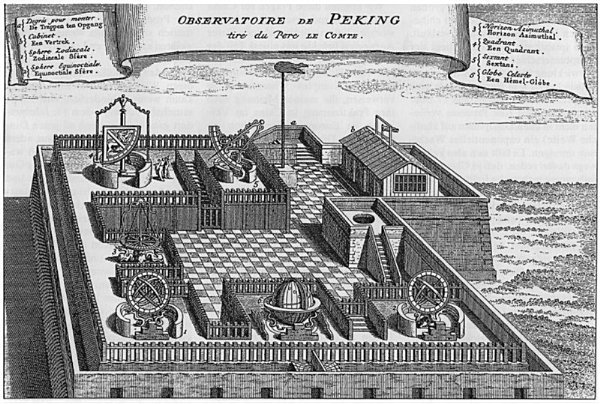
Plate 9.1 Across the world, Europeans tried to introduce Christianity. Travelling to Asia, they were especially fascinated by China. Though trading with the Celestial Empire was not made easy for European merchants, the Chinese authorities did allow the Jesuits to establish a mission in Peking, mainly, however, to allow them to teach China their technological skills, especially in the field of astronomical research, which they pursued in their observatory, here shown with all its measuring instruments in an eighteenth-century engraving.
Source: Centre for Art Historical Documentation, Nijmegen, the Netherlands
In France, during the co-called frondes, dissatisfied nobles, sometimes seeking an alliance with disgruntled urban elites, warred against an increasingly oppressive central authority that they blamed for everything. In sixteenth- and early seventeenth-century England, struggles continually flared up between sections of the aristocracy, many of whom felt restricted in their power and status by the changing economic and political situation. The protestant ‘Beggars’, the representatives of the minor nobility who, in 1566, presented the Spanish governor of the Netherlands with a petition in which they expressed their grievances and requested an adjustment of royal policy on, among other things, religious freedom, included many who had been adversely affected by the prevailing economic situation. It was one of the crises that led to the Dutch Revolt and the subsequent independence of the Netherlands.
In short, the influx of American precious metal was definitely no blessing for all Europeans. On the contrary, for many it felt more like a malediction, just as, in another context, syphilis and, later, the ill-fated dependence on the potato were seen as God’s curse on his sinful people.

EUROPE, THE EARLY SIXTEENTH CENTURY: OPINIONS ON THE CONQUEST OF AMERICA AND ITS CONSEQUENCES
Contemporaries had a clear view of the consequences of America’s inclusion in the European world. Spanish American bullion increased the credit of the House of Habsburg, enabling Charles V to purchase the imperial crown as, with the aid of loans provided by the Fugger banking firm, he managed to outbid his rival, King François I of France. In 1523, old Jacob Fugger did not hesitate to remind the new emperor of his obligations, with a frankness indicating the position of powerbroker he now enjoyed:
Your Imperial Majesty doubtless knows how I and my kinsmen have ever hitherto been disposed to serve the House of Austria in all loyalty to the furtherance of its well-being and prosperity; wherefore, in order to be pleasing to Your Majesty’s Grandsire, the late Emperor Maximilian, and to gain for Your Majesty the Roman Crown, we have held ourselves bounded to engage ourselves towards divers princes who placed their trust and reliance upon myself and perchance on no man besides. We have, moreover, advanced to Your Majesty’s agents for the same end a great sum of money, of which we ourselves had to raise a large part from our friends. It is well known that Your Imperial Majesty could not have gained the Roman Crown save with mine aid, and I can prove the same by the writings of Your Majesty’s agents given by their own hands. In this matter I have not studied mine own profit. For had I left the House of Austria and had been minded to further France, I had obtained much money and property, such as was then offered to me.25
Old Jacob’s words did not go unheeded. Among the ways Charles V chose to pay back his loans were lucrative mining concessions in Peru and a number of hugely profitable monopolies in the various states of the far-flung Habsburg Empire. The Fugger family prospered as never before. For a few decades, American precious metals flowed into Europe, until the first deposits had been exhausted. European politicians had been carefully watching the situation. In 1559, the Venetian envoy to the Spanish court, Michele Soriano, sent a cool and revealing assessment of the entire colonial situation to his masters, the aristocratic merchant rulers of the Republic of St Mark:
From New Spain are obtained gold and silver, cochineal – little insects like flies from which crimson dye is made – leather, cotton, sugar and other things; but from Peru nothing is obtained except minerals. The fifth part of all that is produced goes to the king, but since the gold and silver is brought to Spain and he has a tenth part of that which goes to the mint and is refined and coined, he eventually gets one-fourth of the whole sum, which fourth does not exceed in all four or five hundred thousand ducats…. Nor is it likely that it will long remain at this figure, because great quantities of gold and silver are no longer found upon the surface of the earth, as they have been in past years; and to penetrate into the bowels of the earth requires greater effort, skill and outlay, and the Spaniards are not willing to do the work themselves, and the natives cannot be forced to do so, because the Emperor has freed them from all obligation of service as soon as they accept the Christian religion. Wherefore it is necessary to acquire negro slaves, who are brought from the coasts of Africa, both within and without the Straits, and these are selling dearer every day, because on account of their natural lack of strength and the change of climate, added to the lack of discretion upon the part of their masters in making them work too hard and giving them too little to eat, they fall sick and the greater part of them die.26
The Frenchman Jean Bodin (1530–96), one of the sharpest political analysts of his day, theorized about the consequences of the new situation, arguing from solid historical and statistical research, which, incidentally, shows the pervasiveness of the new scientific spirit. In 1568 he wrote:
I find that the dearness we observe comes from four or five causes. The principal and almost the only one (to which no one has heretofore referred) is the abundance of gold and silver, which is much greater in this kingdom today than it was four hundred years ago. I do not go further back since the extracts of the registers of the court and of the chamber which I have do not go beyond four hundred years. The rest has to be drawn from old histories with little certainty.
The second cause of dearness comes in part from monopolies. The third is scarcity, which is caused as much by exports as by waste. The fourth is the pleasure of kings and great nobles, who raise the prices of the things they like. The fifth is the price of money, debased from its old valuation.27
Images of America and mirrors of Europe
Though my analysis of Europe’s relationship with America may seem rather materialistic so far, it needs to be stressed that an empty stomach is but rarely conducive to great thoughts of a philosophical or religious nature. Moreover, without money no churches or palaces are built, no splendid paintings painted, no magnificent operas composed or produced. A healthy financial basis is necessary for every form of artistry or science.
Thus, almost inevitably, the discovery of America and the influx of bullion greatly strengthened the material basis of European culture. Indeed, from the sixteenth century onwards, European culture showed a new blossoming in many areas. Also, the very ‘experience of America’ became an intrinsic element in European culture, too, a source of continuous inspiration. To start with, both the prevailing world-view and Europe’s concept of man had to be adjusted as existing geographical notions had to be adjusted almost daily and ‘new’ people integrated into the Christian view of creation.28
Until late in the sixteenth century, far and away the majority of Europeans still adhered to Kosmas’s notion of the earth as flat, surrounded by a finite stretch of water that somehow ended in a bleak nothingness, where death awaited those who had dared so far. It had been that very image that made many simple sailors quail before the journeys their masters ordered them to undertake. Once on their way, these men had no idea of the actual vastness of the earth’s seas and of the contours of its lands. Even after the discoveries were well under way, the great majority failed to be interested. Being land-bound, they could not care less about the wider world.
Only a tiny minority of Europeans, the ones influenced by the new knowledge gained by the contacts with Islam and, through these, ancient Greek science, had a completely different world-view; this was based on the spherical conception of the classical geographer Ptolemy. One of these was, of course, Columbus. But his dream of reaching ‘India’ – that is to say, East Asia – also indicates he was not completely aware of the actual dimensions of the globe.29
In 1492, the same year he set sail, one Martin Behaim of Nuremberg constructed a globe, according to many the first of its kind. Coincidence? Not really. Behaim came from the same Portuguese-Spanish maritime milieu as Columbus. He had lived in the Flemish merchant colony on the recently discovered archipelago of the Azores. This Bavarian scholar was therefore acquainted with the geographical data that the expeditions of the Portuguese along the west coast of Africa had produced. He also knew the Florentine scholar Paolo Toscanelli (1397–1492), whose world map and theories had indicated the possibility of reaching the east coast of ‘India’ by travelling westwards from Europe. In fact, Columbus had also corresponded with Toscanelli.
Behaim’s globe does not show a ‘new world’. He positioned an enormous ocean between Europe and Asia, within it only one small island, the mythical land of St Brendan, the Irish monk who was said to have ventured out long ago in search of a new world. But Behaim was the first to indicate the position of China and Japan. Yet from a present-day perspective almost everything else on his globe is as wrong as it could be. One must therefore conclude that, although for Europe the world now started opening up, most Europeans barely knew what it looked like. However, that the world was a globe slowly became clear to more people, if only because of the material globes now being manufactured in increasing numbers, although they were very expensive. But maps could also convey this new notion and even though their reliability, too, was as yet poor, they were now produced on a far larger scale through the new medium of printing, allowing an increased readership to acquaint themselves with the wonder that was the world.
Meanwhile, ever more energy was expended on improving cartographic reliability. The European economy, boosted by the discoveries, demanded scientifically based knowledge that could also be applied to its everyday needs. Map making soon became a valued craft and something of an industry, too; it was less fuelled by the disinterested intellectual pursuit of scientific accuracy and objectivity than by the awareness that progress and the success of Europe’s international trade and politics depended on it. Indeed, maps sooncame to determine and to show the economic and political agenda both of European rulers and governments as well as of all those who now ventured on an as yet often perilous path to riches and dominion in the world at large.30
During the first decades of the sixteenth century, following Columbus’s expeditions, new data came pouring in almost every day. In 1513, Spaniards crossing the Isthmus of Panama in Central America, discovered that on the other side another great ocean stretched out: astonished at first, they soon realized what some had argued already, namely that Columbus had been mistaken in his conviction that he had reached the east coast of Asia. Incidentally, the situation created a new challenge: in the years 1519–21, the Portuguese Ferdinand Magellan (c.1480–1521), rounding the stormy capes of South America, was the first ever to circumnavigate the world, at least as far as can be established from research. Once more, one should again realize what such journeys meant to the people who undertook them. If not Magellan himself, at least his men, like the men sailing with Columbus before him, must have thought that they were going to and indeed ‘over the edge of the world’.31
Inevitably, when the significance of the new discoveries of 1513 and 1519 dawned on Europe, a ‘new world’ was born, for no longer could the ‘West Indies’ be considered part of India, Asia, as the original name indicated. This new world had to be given its geographical place. To accommodate ‘America’, the image on European globes had to be reconsidered as well. In 1507, Martin Waldseemüller had already provisionally charted the east coast of the new continent, naming it after the Florentine navigator Amerigo Vespucci (1451–1512), accepting his claim to have been the first to reach the American mainland, on his voyage of 1497 or 1499. Whether Vespucci was indeed the first is not certain even now; and, of course, we now know that Norsemen from Iceland had reached Newfoundland, by way of Greenland, five centuries earlier. Meanwhile, the American west coast was to remain a sketchy line for many years to come.
Summing up Europe’s increased understanding and knowledge of the world, 1,000 years after Kosmas’s Kosmographia, Waldseemüller could write:
It is clear from astronomical demonstrations that the whole earth is a point in comparison with the entire extent of the heavens…. There is about a fourth part of … the world … inhabited by living beings like ourselves. Hitherto it has been divided into three parts, Europe, Africa and Asia.
Europe is bounded on the west by the Atlantic Ocean, on the north by the British Ocean, on the east by the River Tanais [i.e. the Don], Lake Maeotis [i.e. the Sea of Azov], and the Black Sea, and on the south by the Mediterranean Sea. Europe is so called after Europa, the daughter of King Agenor [i.e. the king of Phoenicia, in the Near East]. While with a girl’s enthusiasm she was playing on the sea-shore accompanied by her Tyrian maidens and was gathering flowers in baskets, she is believed to have been carried off by Jupiter, who assumed the form of a snow-white bull, and after being brought over the seas to Crete seated upon his back to have given her name to the land lying opposite….
Africa is bounded on the west by the Atlantic Ocean, on the south by the Ethiopian Ocean, on the north by the Mediterranean Sea, and on the east by the River Nile…. It is called Africa because it is free from the severity of the cold….
Asia … far surpasses the other divisions in size and in resources…. Asia is so called after a queen of that name….
Now … a fourth part has been discovered by Amerigo Vespucci. Inasmuch as both Europe and Asia received their names from women, I see no reason why any one should justly object to calling this part Amerige, i.e. the land of Amerigo, or America, after Amerigo, its discoverer, a man of great ability.32
The honour of giving America its proper place on the map should, according to many, be given to Gerard Mercator (1512–94). Having studied the humanities at Louvain, he continued his education there with the famous mathematician Gemma Frisius, to prepare for a career as a constructor of mathematical instruments. In 1536, with his master, he made the first celestial globe and, with a Louvain goldsmith, the second ever terrestrial globe. In the following years, Mercator, using all available data, drew and published maps of the Holy Land – a cultural ‘must’ in a Christian society and, moreover, of commercial interest for the pilgrim industry. He quickly gained a wide reputation. Even Charles V ordered him to manufacture astronomical instruments.
In 1579, roughly three-quarters of a century after Behaim, Mercator published a world map ad usum navigatorum (for the use of navigators). With it, he established his interpretation of the earth’s outlines, having used a cylinder projection based upon straight lines of longitude and latitude intersecting at right angles. For the map’s details, he combined Ptolemy’s data and ideas with those of more recent vintage – Marco Polo’s, regardless of their continued controversiality – and with the newest discoveries of Portuguese and Spanish navigators. The map also incorporated America. However, Mercator’s image of South America was overlarge while North America, of which so little was yet known, appears far too small. Moreover, reflecting ancient beliefs, he also added two large polar continents. Still, even now the so-called ‘Mercator Projection’ is the one most humans envisage when they think of a map of the globe.33
The large number of maps produced by Mercator after he had published his map of the world show that cartography had become a field of evident scientific and economic importance. Indeed, however magnificent and costly the Mercator editions, they were all commercially successful.
Interestingly, Mercator still saw the world from one, in a sense metaphysical, point of view. He applied both his theoretical notions and his practical research to an integral, essentially Christian cosmological view that encompassed the earth and the heavens. This became more apparent after his death when, in 1596, the first part was published of what he himself considered the synthesis of his work, his own Cosmographia. Edited by his son, it consisted of five parts. The first part was called Atlas. In his ‘Foreword to the Atlas’, Mercator clearly suggests that the really wise person attempts to harmonize his knowledge of heaven and earth. The engraved print on the title page shows the mythical Atlas with the celestial globe on his knee and, at his feet, the terrestrial globe, now including the Americas. In this first so-called ‘atlas’, Mercator also discusses creation. He analyses the book of Genesis and the four Gospels. This section is followed by a new edition in four parts of map collections of various parts of Europe and the other known continents that he had published before.
The complete ‘Cosmography’ was published in Amsterdam. As the centre of the European economy had shifted from the Mediterranean to the coasts of the Atlantic in the early decades of the sixteenth century, by the end of the century it moved from the main commercial metropolis, Antwerp, to the harbours of Holland, partly because the Dutch, in their revolt against Spain, had chosen to permanently blockade the River Scheldt. Map and instrument makers now established themselves in the Dutch port towns, applying the results of empirical research to produce new technology and thus contributing greatly to the success and growth of international trade. Holland was also the place where Europe’s most important printers and publishers settled, trying to market their knowledge of new worlds. Pouring out travel stories and novels, encyclopedias and atlases, they acquainted their readers with the rediscovered older world of Asia and the new world of America. For a long time, a disbelieving astonishment and an insatiable curiosity continued to ensure a lively demand for new texts and pictures.
Money is power. As Europe became richer, the size of armies which rulers sent into battle and the fleets that sailed the seas increased as well. Ever more parts of the non-European world submitted to the economic and, increasingly, political and cultural power of European states. Power induces a sense of superiority. Travelling the world, Europeans observed that, often, they were stronger than others, soon feeling ‘better’ than Asians, Africans and native Americans. First and foremost, they often proved themselves superior militarily, with their use of gunpowder. Inevitably, they wondered why this would be so. Their answer was, in fact, the simple answer of those who have an inscrutable faith: they were victorious, superior because, being Europeans, they were Christians, always supported by the one God who was true to his biblical promise. Admittedly, the more educated often followed a rather more complex argument. To Jean Bodin, it was clear that Europe dominated the world precisely because European culture, after first having based itself on the great achievements of Greek civilization, had now managed to surpass even many of these.34
This growing self-awareness was reflected in geographical representations as well. Maps now showed Europe as a region that dominated the world rather than as the remote corner of the great Eurasian land mass. Sometimes, Europe’s geographical contours were so transformed that it represented a triumphant queen, as on the famous map in Sebastian Münster’s Cosmographia universalis, published in Basle in 1588. Soon, this sense of superiority turned actual expansion into a ‘mission’, which, in creating its own legitimacy, then provided the arguments for further expansion, for new conquests.
A world-view, however, is not restricted only to a globe or map – indeed, one might argue these are rather translations of a pre-existing vision. Certainly, a world-view is a way of thinking, as can be shown in the complex process whereby the new world was fitted into the European mind. As America was, according to the stories, a world inhabited by people with totally different physical features and habits, a world where animals and plants existed that were not described in the traditional textbooks, Europeans experienced the discovery of America as a grave culture shock.35
Especially during the first decades after Columbus’s voyages, many were so astonished by the reports about the new world that they thought that, after centuries of searching, the ‘garden of Eden’, the ‘earthly paradise’ had at last been discovered: surely, the Americas were the place where people still lived as God had created them, not corrupted by the Fall.36 This belief was strong among the Franciscans – 12 of them, to symbolically represent the first Apostles, were the first missionaries to depart for Mexico in 1524. In trying to convert the Mexican Indians, they felt they had to protect them from the evil influences of godless Spanish colonists. Besides thus keeping power over the new Christians to themselves, in pursuing this policy they also hoped to realize God’s kingdom on earth with these Indians, His as yet innocent children.
The same belief in the continued existence of a terrestrial paradise or, conversely, in the possibility of its recreation somewhere on earth can be found in many literary texts inspired by the Americas. The well-known English poet Andrew Marvell (1621–78), in a poem called Bermudas, praised God who had brought the English to:
… an isle so long unknown,
And yet far kinder than our own.
He lands us on a grassy stage,
Safe from the storms, and prelate’s rage
He gave us this eternal spring
Which here enamels everything.37
He represents an island, therefore, where the English could live as they no longer could at home: in a world of freedom – freedom of religion, among other things – in a paradisical context. A few decades later, George Berkeley (1685–1753) wrote his Verses on the Prospect of Planting Arts and Learning in America:
The Muse, disgusted at an age and clime,
Barren of every glorious theme,
In distant lands now waits a better time,
Producing subjects worthy of fame …
There shall be sung another golden age,
The rise of empire and of arts …
Not such as Europe breeds in her decay:
Such as she bred when fresh and young.38
The poem voices another theme that would recur for several centuries: the old world, Europe, is decaying. In the new world, Europeans can realize what is no longer nourished in the old. Indeed, Berkeley actually wanted to transplant what most eighteenth-century Europeans considered the essence of Europe: its arts and learning, thus showing that Europe’s self-definition had not changed since the same notions had been expressed in the fourteenth and fifteenth centuries, or even earlier.
A comparable, in some ways even more idyllic vision of the new world as the garden of Eden, and of the Indian as the ‘Noble Savage’, a man living, uncorrupted, in the natural state given him by God and in a nature still as pristine as created by God, can be found in many sixteenth- and seventeenth-century prints and paintings such as those created by Albrecht Dürer and Jan Mostaert.39 However, many other Europeans were convinced that Indian societies were not civilized societies at all. Judged by humanist norms of civilization, wherein communication developed along the lines of public oratory and eloquence, denoting an ordered, regulated polity, or by Christian norms of civilization, wherein the belief in the one, true, unseen God denoted the same, the Indians had to be educated, to be raised to the level of Europe. Nor was actual contact with the Indians as peaceful as the more idealistic images would have us believe. On the contrary, European connections with America were, if anything, often calculating and equally often cruel, even by contemporary standards.
The traces of this contact turned conflict can be found in one of Shakespeare’s plays, The Tempest (1611), that tells of a group of Europeans who, lured there by the exiled Prospero, find themselves stranded on a strange island. The playwright is known to have been inspired by the sizeable number of stories of Europeans who were shipwrecked in foreign parts. Yet his play is more than a poetic fabrication of such travel stories. It is an allegory of the way Europeans behaved towards their new fellow men. The Tempest can therefore be read as follows. At first, the natives, represented by the wild man Caliban, are friendly and share their treasures and secrets with the foreigners if only because in return they are taught some of Europe’s arts:
When thou camest first,
Thou strokedst me and made much of me; wouldst give me
Water with berries in’t; and teach me how
To name the bigger light, and how the less,
That burn by day, and night; and then I loved thee
And showed thee all the qualities o’ the isle,
The fresh springs, brine-pits, barren place and fertile.40
Then the foreigners, obviously Europeans, turn their back on the natives because they find them uncivilized. The Indians react in kind. Now, the Europeans, to enslave the natives and make them work for them, begin to use their superior technology, symbolized in the play by Prospero’s magic. The natives try to defend themselves by combining forces with newly arrived foreigners. Caliban calls out:
I’ll show thee the best springs; I’ll pluck thee berries …
A plague upon the tyrant that I serve!
I’ll bear him no more sticks but follow thee,
Thou wondrous man.41
But their fate is sealed: they become only more dependent. Moreover, they are now branded as bloodthirsty monsters.42
In the first decades of the seventeenth century, when in North America, too, Europeans and Indians entered into more frequent contact, the fight for land began. Many colonists, born and raised in the strict traditions of Protestantism, strengthened their moral position and defended their land-taking actions by using biblical arguments. Dozens of sermons and tracts use the image of an elite corps of believers whom God has placed in this ‘wildernesse’ as a test, just as He had once done with the people of Israel, leading them into the desert. But as in the past, the promised land is around the corner, ‘a garden enclosed, a fountain sealed’, and with God’s help ‘Jerusalem shall be inhabitable without walls’, just as the Bible says.43
Yet this could not be attained without a struggle. Outright strife between the European settlers and the natives soon followed. In 1637, the first large-scale war was declared by a group of English colonists, and the tribe of the Pequot was exterminated completely. Admittedly, some colonists questioned whether all this bloodshed could be justified. An anonymous minister had no such qualms, answering ‘I would refer you to David’s war. When a People is grown to such a height of blood and sin against God and man … sometimes the Scripture declareth women and children must perish with their parents’.44 Among the many texts that tell their readers to conquer the new world as the Jews had once conquered their promised land, that is with Old Testament violence, one is relieved to find sometimes a somewhat more nuanced judgement, like that of Robert Beverly, who concluded his 1703 outline of Indian society with the words:
Thus I think I have given a succinct account of the Indians; happy, I think, in their simple State of Nature, and in their enjoyment of Plenty without the Curse of Labour. They have on several counts reasons to lament the arrival of the Europeans, by whose means they seem to have lost their Felicity, as well as their Innocence.45
Another colonist went one step further when, in 1708, he admitted that:
We neither give Allowance for their Natural Disposition, nor the Sylvan Education and strange Customs (uncouth to us) they lie under and have ever been trained up to; these are false Measures for Christians to take, and indeed no man can be reckoned a Moralist only, who will not make choice and use better Rules to walk and act by.46
Until well into the eighteenth century, some European Americans and many more Europeans indulged in an uncritical idealization of the ‘Noble Savage’. Yet careful analysis of most of their writings shows that they are always addressing the European who must improve himself, if necessary by recognizing his own failings, by judging his actions against the original, still uncorrupted worlds and beings. Only rarely does one find a plea for accepting ‘the Other’ as intrinsically different, and thus as his own self. Indeed, as far as the problem of the relationship is addressed at all, the predominating view presents non-European man as dependent on European man. In the early eighteenth century it was codified in Daniel Defoe’s famous story Robinson Crusoe (1719) which created a stereotype of the relation between the European and ‘the Other’ – in this case black rather than red. It shows that the discovery of America or, in general, of new worlds, and the meeting with ‘the Other’ substantially influenced the way Europeans viewed themselves: as superior, as natural-born leaders.
Further cultural consequences of European expansion
Undeniably, the process of contact and conquest by which Europe came to dominate a large part of the world has caused great suffering all over the globe.47 Obviously, history writing is not the forum to make moral judgements on those periods and people of the past who held values so different from our own. Yet one may conclude that colonialism and imperialism, though practised by many civilizations all over the world during known history, in their European form and by Europe’s very technological possibilities, often transgressed even the norms of the time itself.
However, in surveying European history, one cannot fail to note also that the rediscovery of Asia and the discovery of America have been decisive factors in the creation of numerous and lasting forms of culture: of artistic masterpieces still to be seen all over Europe and now eagerly visited by many non-Europeans as well; of lifestyles and luxuries that, while a European prerogative for a long time, are now emulated and often enjoyed by non-European peoples, too; and, perhaps more important, of ideas and attitudes which shaped the European mind for centuries to come and, in their turn, have influenced the hopes and aspirations of the wider world, as is shown in the process of globalization.
To give but a few examples, one may think of the Florentine banking family of Medici, in whose coffers large amounts of Asian and American gold and silver ended up: they were Michelangelo’s first patrons.48 The new St Peter’s which rose in Rome in the course of the sixteenth century – it took more than a century to build – was constructed in part from the ecclesiastical taxes which flowed in from Spain and Portugal and, hence, from the gold and silver mines in Iberian colonial America. In the seventeenth century, in that same Rome, on the Piazza Navona, Gianlorenzo Bernini created the dream-like ‘Fountain of the Four Rivers’, one of which symbolized the Rio de la Plata, the ‘River of Silver’, while all four rivers supported an obelisk, seen as the representation of the oldest culture of the world, Egypt, but that one, in its turn, is topped by the Christian cross.
On the Iberian peninsula itself, the bullion that came from the Americas not only helped to create sumptuous buildings, among them Philip II’s church-monastery-palace of the Escorial, in the mountains above Madrid, but also resulted in commissions for music to be played and sung in churches, monasteries and palaces alike, and in a wide demand for emotionally evocative baroque paintings and sculpture to adorn these buildings.
In the far north, in Amsterdam, Jacob van Campen’s palatial town hall with its statues by Flemish sculptors, the proud symbol of the foremost mercantile city of the seventeenth century glorified the Dutch trading metropolis as ‘mistress of the world’. Significantly, the façade of the building was crowned with a gigantic Atlas figure shouldering the globe. For good reason, two enormous world maps were represented in the multi-coloured marble pavement of the great hall. That globe and those maps certainly served to remind visitors and passers-by of the colonies the Dutch had conquered from the Portuguese in Brazil, as well as of the ‘New Amsterdam’ which Dutch traders and settlers had founded on Manhattan island in the Hudson river, later to become New York, and of the even vaster colonial empire they had built in the east.
The same satisfaction surfaced in a poem in which the Dutch poet Joost van den Vondel referred to Amsterdam’s position of power in the old and in the new world. In more than 1,000 lines he gave the inauguration of the new town hall an allegorical-ideological context. It argues that Amsterdam, which knows all ‘shores’, including gold-filled America’s, is, by right, the ruler of the earth. By Vondel’s time, the Dutch East India Company, founded in 1602 to become the world’s first multinational, had firmly established its hold over South Africa, over parts of the coasts of India, Ceylon and present-day Indonesia, while they were the only Europeans allowed to enter the magic island empire of Japan.
In France, at the end of the seventeenth century, sumptuous tapestries were woven to adorn the pompous palace of Versailles. Some show scenes derived from paintings made by Dutch artists in Dutch Brazil.49 Other paintings were used as the basis for the engraved illustrations of several successful travel stories published in the Netherlands in the seventeenth century: Caspar Barlaeus’s 1647 history of the Dutch conquest of Brazil, and the still more famous Brasiliaensche Land- en Zee-reize (Brazilian Land and Sea Journey), written in 1672 by Johan Nieuhof, servant of the Dutch West Indies Company, the global trade organization which focused, in particular, on the Americas.50 But France, of course, longed to dominate the world all by itself. In 1662, young Louis XIV, for whom his first minister had even sought the imperial crown, entered the Place du Carroussel in a festive procession to mark the birth of the Dauphin. Of course, he himself appeared in the guise of a Roman emperor. However, his brother and his first nobles had dressed as Persians, Turks and men from India and the Americas; they all made their obeisance to him, as the ‘ruler of the world’. During the reign of the man who, if not actually gaining the dominion he sought, yet managed to have himself styled the ‘Sun King’ as another indication of his ambition, such acts of political propaganda were to recur regularly, always showing not only his own pretensions but also those of his state, of the French nation.51
All over Europe, comparable references to Europe’s position in the world show the prevalence of such notions of superiority. In the first decades of the eighteenth century, Giovanni Battista Tiepolo painted the magnificent ceiling frescos for the immense vaulted staircase of the prince-bishop’s baroque residence in Würzburg and at the prince-bishop’s new summer palace Weissenstein, in nearby Pommersfelden. Representing the different parts of the world in colourful allegories, they depict Europe as ‘queen of the continents’, implying that she ruled the earth.52 The palaces of the Habsburg emperors and their noble courtiers, as well as of other German courts in the eighteenth century, were adorned with pictures of America, too.53 At those courts, one might also hear an opera by the composer Karl-Heinrich Graun whose theme was the tragic fate suffered by the Aztec Emperor Moctezuma at the hands of the Spanish conquerors. The same story was also set to music by the Venetian composer Antonio Vivaldi, and a host of others. Indeed, these were only a few of the many operas and ballets in which the Indies, America, formed the location of the action, and the Indians were the characters. By this time, in a more ‘enlightened’ Europe the ‘wild’ Indian had become ‘noble’ again and it was possible to take a more nuanced view of his destiny at the hands of rapacious Europeans.
In England, the nobility’s craze for gardening, or rather for having others lay out their gardens for them, received a new impulse when, at the beginning of the eighteenth century, engravings depicting the huge gardens at Jehol, the Chinese emperor’s summer palace, were published by a Jesuit returning from the Far East. He had been part of a group of Christian missionaries staying at the imperial court, the fourth generation to do so since the beginning of Europe’s new contacts with China in the sixteenth century. Now, in the early eighteenth century, Chinese pagodas began to appear in English gardens while Chinese-style furniture started to fill the country houses. Indeed, a wave of ‘chinoiserie’ swept over Europe, not only to satisfy the need for a new fashion, but also because the Jesuits in their travel tales had succeeded in portraying China as a powerful state with a civilization that did actually match that of Europe.
In short, many of Europe’s works of art would not have been created without the material contribution that the peoples of Asia and America were forced to give, nor, for that matter, without the inspiration which the wonders of this new, foreign and to many dreamlike world had given to the European mind.
At an early stage, Europe had first become an independent world when the Greeks defined it as their world, in opposition to Asia. The concept of Europe had been further articulated when the peoples of Europe had felt the need to form a common front against Islam, to actually cooperate in the Crusades. Now, in the fifteenth, sixteenth and seventeenth centuries, the idea of Europe was elaborated once more in the often hostile contact with other cultures, not only those of Asia, the older world, but also those of America, the new world.
For Vondel’s poem cited above was a glorification not only of Amsterdam. It also described Europe as the world where the ‘burgher’, the citizen, was the centre of society: he was the politically free individual, who continues the tradition of the ancient Greek city-states. Yet, these burghers now drank coffee and tea imported from Asia, and sat down to dinner at tables laden with porcelain, china-ware, sometimes decorated in patterns specifically requested by them, and ended a pleasant evening smoking a cigar made of American tobacco – undoubtedly unaware of or comfortably ignoring the fact that the tobacco was grown on plantations worked by black slaves from Africa, that the china was produced in ever more complex factories on the Chinese mainland, that the cultivation of tea and coffee was slowly disrupting traditional Asian economies and that many of their luxuries were bought with the profits they themselves made from the opium trade in India.
In their gardens they often grew plants from seedlings brought all the way from India or Indonesia by the ships of the Dutch East India Company. Some of the wealthiest Amsterdam burghers owned private zoos, where privileged visitors were allowed to gape at exotic animals collected from all over the globe. Such visitors were also invited to enter the luxurious townhouses that lined the Amsterdam canals, in order to view, or even to study the inanimate collections, the curio-cupboards stacked with strange objects brought from overseas: minerals and manuscripts, but also dodo eggs and unicorn horns. Indeed, all over Europe such collections were being formed by the curious and wealthy, to indicate culture and status, or for reasons of genuine learning and scholarship. In England, the German-born court physician Sir Hans Sloane bequeathed his own extensive collection of artefacts, books and manuscripts to the nation of his adoptive country on condition that it be publicly displayed, thus laying the foundation for the British Museum and its library.
These objects, as well as the animals and the plants, documented a world that, though new discoveries continued to fill in the blanks on its map, yet grew ever more complex, and hence asked to be interpreted, to be understood. The new and the strange could either be explained as being superficially different, but essentially the same as European things, and thus they were controllable, not dangerous; or they were seen as radically different and consequently dangerous, a challenge to be met, a world to be conquered in order to remove the threat of its uncontrolled otherness.
The fact that some of these cultures, like the Chinese and the Japanese, appeared to be highly developed themselves, even according to the criteria posed by Europe, only increased the necessity to underline Europe’s own identity as a Christian and hence superior civilization. How else could one justify the use of guns and cannon in the many attempts to conquer other cultures for the purpose of expanding Europe’s economic and military power?
Only by maintaining that in their very essence every other civilization lagged behind that of Europe, which rejoiced in its superiority founded on Christianity and the classical world, only by believing and proclaiming that for that very reason every other culture contentedly had to accept European supremacy and its resulting economic and political dominance, could Europeans legitimize their efforts to establish the overseas colonies and empires that now became the first manifestations of the globalization process. Economically, politically, religiously and culturally, large parts of the non-European world were gradually incorporated into what slowly became a ‘European world system’.
From this time on those Europeans who consciously thought about their own world, about Europe, would always be influenced by dreams of other worlds. For the first time, leaving the security of home in large numbers, Europeans were also forced to account for their deepest fears and desires, emotions which could not so easily be given free rein at home, if only because they had to preserve the relative stability of their own environment. What forms of culture did Europe want to preserve, defend and even disseminate, and at what cost? What new, ‘foreign’ things should Europeans try to understand and accept?
Those who had made the journey to the distant worlds, which now began to form Europe’s horizon, developed an altered understanding of what was ‘own’ and what was ‘other’ and thus contributed to the development of European self-awareness. For example, in 1544, the cartographer Sebastian Münster proclaimed that Europe, although the smallest of the known continents – a fact which now could and had to be recognized – was the most fertile, the most densely populated and consequently the strongest.54 The English divine Samuel Purchas, who took great pleasure in listening to the tales that seamen told on returning from their trips, was rather more articulate in the collection of travel stories he published in 1625. He wrote that ‘The Qualitie of Europe exceeds her Quantitie, in this the least, in that the Best of the world’. After all:
If I speake of Arts and Inventions (which are Man’s properest goods, immortall Inheritance to our mortalitie) what have the rest of the world comparable? First the Liberall Arts are most liberall to us, having long since forsaken their Seminaries in Asia and Afrike, and here erected Colleges and Universities. And if one Athens in the east (the antient Europaean glory) now by Turkish Barbarisme be infected, how many Christian Athenses have wee in the west for it. As for Mechanicall Sciences, I could reckon … the many artificiall Mazes and Labyrinths in our watches, the great heavenly Orbes and motions installed in so small a model. What eares but European have heard so many Musical Inventions for the Chamber, the Field, the Church?
This very revealing panegyric, which enumerates many phenomena even now considered by many to constitute Europe’s unique cultural heritage, continues for several paragraphs, until Purchas poses the question:
And is this all? Is Europe onely a fruitfull Field, a well watered garden, a pleasant Paradise in Nature? A continued Citie for habitation? Queene of the World for power? A Schoole of Arts Liberall, Shop of Mechanicall, Tents of Military, Arsenal of Weapons and Shipping?
Garden, paradise, city, the very locations of civilization, archetypal images that had been grafted onto Christian thought by the tales in the first books of the Old Testament. What kind of culture blossomed there? Besides music and instrument making there were art, technology and commerce, all of them empowering elements in the widest sense. It is fascinating to see Purchas creating an almost essentialistic relationship between them. For him not only the arts and sciences, but also the nascent commercial-industrial society of Europe itself is a cultural phenomenon. It was a notion that slowly gained wider acceptance until, in the nineteenth century, it had become the very basis of Europe’s self-esteem, in all cultural and scholarly circles.55
Purchas’s question naturally required an answer, and he himself provided it, in equally enthusiastic prose:
Nay, these are the least of Her praises, or His rather, who hath given Europe more than Eagle’s wings, and lifted her up above the Starres … Europe is taught the way to scale Heaven, not by Mathematicall principles, but by Divine veritie. Jesus Christ is their way, their truth, their life; who hath long since given a Bill of Divorce to ingrateful Asia where hee was borne, and Africa the place of his flight and refuge, and is become almost wholly and onely Europaean.56
Once more, the Bible provided the historical arguments that served to belittle the significance of the other old continents. However, Purchas also explicitly noted that Europe had discovered and conquered the world: its cultural qualities are not restricted to its religion, political structures and military might, to its arts and sciences, but include its capacity for expansion. After all:
Who ever tooke possession of the huge Ocean, and made procession round about the vast Earth? Who ever discovered new Constellations, saluted the Frozen Poles, subjected the Burning Zones?57
Here, indeed, Purchas touches upon an important point. For it has to be admitted that no civilization but that of Europe had ever undertaken such large-scale travel. The spirit of adventure and discovery and, consequently, the will to expand one’s horizons and one’s power, if not specifically European, yet seem to be characteristics that Europe, more than any other culture, could claim to have translated into real, and indeed, world-wide action. Or should one term them Christian characteristics? After all, Christianity was a religion that, as Purchas himself indicated, was conscious of the fact that its roots lay outside the region where it had gained dominion. Consequently, this religion almost forced its believers to travel, the more so as the Christian belief in a paradise on earth as well as in a promised land proved an additional, perhaps even more powerful stimulus to engage in travel, however perilous.
Not only did Europe’s often discordant contacts with other parts of the world, and the resulting reflection, result in a broadening of the definition of that which was considered to constitute its essence, but many Europeans now began to contemplate Europe’s failings and to consider how to remedy these. Significantly, from the late fifteenth century onwards, time and again plans were devised for the establishment of a better society. These plans offered an intriguing insight both into the reality and into the ideals of the period in which they were formulated. Mostly, they stressed four topics.
A happy society was nearly always presented as a city, an idea for which the Europeans certainly were indebted to the Greeks. It also implied the notion that nature, essentially uncontrollable, had to be tamed. In this city, healthcare was optimal: obviously, the fear of death played a crucial role in the European, Christian view of man. Also, education – of the middle class, the ruler and the learned – is given high priority. Last but not least, prosperity is divided according to principles of justice. The fact that the opportunity to publish and distribute one’s collected works is sometimes named as the fifth characteristic of these ideal societies betrays their origin in the minds of intellectuals and scholars who were concerned about their future reputation.58
Even though, of course, none of these ideal societies were ever realized, they did influence the European self-image. In consequence, reality, both in Europe but more often abroad, in regions that could still be dreamt of as unspoiled by the negative characteristics of society at home, was frequently envisaged and depicted as if it were already the ideal situation. Also, such ideals often influenced the political and social demands that individuals or groups made of reality, showing their dissatisfaction with it. Inevitably, these demands, if reiterated and forcefully voiced, did help to slowly change that reality.
The above process can be traced from the visions of man and society in Thomas More’s Utopia (London 1516) and Tommaso Campanella’s (1568–1639) Città del Sole, ‘Sun City’ (1603), via Johann Valentin Andreae and his ‘Description of a Christian Republic’ (Nuremberg 1619), to the German philosophers Leibniz and Herder in the eighteenth century, and to the ‘utopian’ socialists of England and France in the nineteenth century. One aspect is particularly striking. A utopia really needs a virgin land. Many of the early utopian thinkers did not locate the world of their dreams in their own world, or in the older world of fabulous Asia but in the newly discovered America, as yet untainted by civilization.
In retrospect, one can see the fifteenth and sixteenth centuries as a period of change. In many fields of culture, old values and systems slowly disappeared while, mainly because of the communications revolution in Europe itself, new norms and institutions were born. At the same time, improved education and the increasing dissemination of texts ensured that the notion of a wider world – Europe itself, but also the worlds beyond, both of them expressed both in the mind and on the map – filtered down to an ever larger readership. Through their contacts with these worlds, a more complete, and also more secular vision of the European self took shape.
The poet Philip Freneau fed on the often superficial, for largely uninformed, cultural relativism that took root in intellectual circles in the Atlantic world in the latter decades of the eighteenth century, in his poem The American Village of 1772, described the world of North America as the place where:
Renowned sachems once their empire rais’d
On wholesome laws; and sacrifices blaz’d.
The gen’rous soul inspir’d the honest breast
And to be free, was doubly to be blest.
Obviously, this was too idealistic a representation of Indian society as a community of noble, free, self-governing men, reflecting a yearning for a life no longer possible in the civilized colonies of the east coast. However, in another poem called The Rising Glory of America, Freneau observed:
How much obscur’d is human nature here!
Shut from the light of science and of truth.59
Unavoidably, and despite his dream of a romantically simple society, he shows himself to be rooted in European values that, precisely in the eighteenth century, increasingly considered science to be the basic norm of truth and progress.
Dossier: Europe’s wider world
Today, Belém is a suburb of Lisbon one reaches if one takes the road westward along the river Tagus towards the Atlantic Ocean. In the early years of the sixteenth century it was an empty site, remarkable only for an old tower from which the capital of Portugal, a state regarded by many as peripheral to Europe, guarded itself against pirates and, in earlier times, even older enemies who came from the sea: the Islamic war bands of the Maghreb who once had ruled the better part of Lusitania but had been driven from it in the thirteenth and fourteenth centuries.60
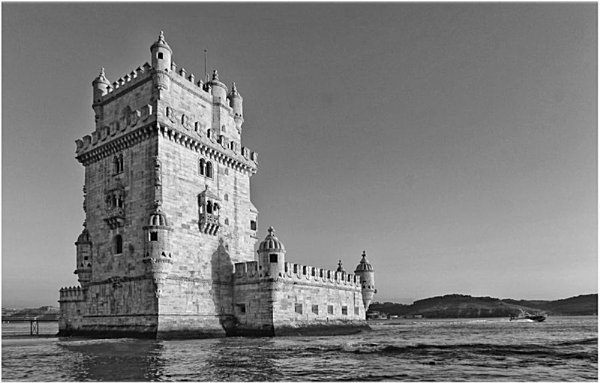
Plate 9.2 The Belém Tower, symbol of Portugal’s maritime expansion in the fifteenth and sixteenth centuries.
Source: Ken Welsh / Bridgeman Images
By the early sixteenth century, Belém gained greater significance. These were the years of King Manuel (r. 1495–1521). He was nick-named ‘The Fortunate’ because these were also the years in which Portugal, after having been one of Europe’s poorest countries for many centuries, became one of its wealthiest states, though not for longer than another two centuries.
Through the dynamics of overseas expansion, Portugal’s riches now came from far beyond its own lands. Almost symbolically, in 1513 Dom Manuel was given the first rhinoceros ever seen in Europe, captured by Portuguese seafarers who had penetrated Africa in search of gold. In 1514, the king decided to gift the animal to the pope. Though the ship that brought it to Rome was wrecked, and the beast drowned, its corpse was rescued, stuffed with straw and still presented to the supreme pontiff as an undeniable example of the greatness and wondrous diversity of God’s creation. Meanwhile, a Portuguese erudite had made an accurate drawing of it. In 1515, the German artist Albrecht Dürer acquainted Europe’s cultural elite with the marvellous creature, through the publication of one of his most famous engravings.
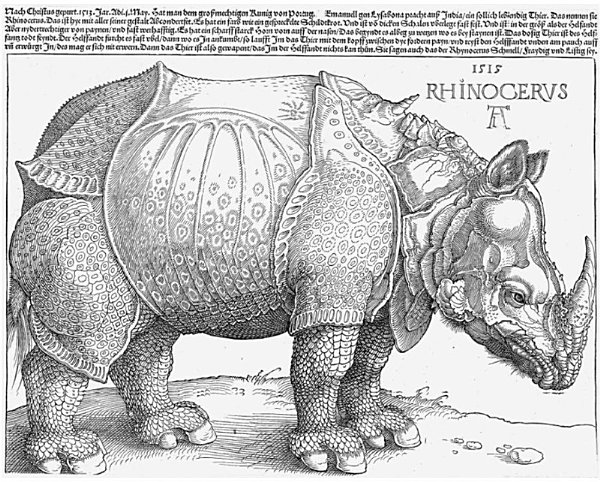
Plate 9.3 The first European image of a rhinoceros, as drawn and engraved/printed by Albrecht Dürer.
In 1516–17, a stone-carved rhino became one of the corbels carrying the elegant balcony of the new tower erected by Manuel at Belém to commemorate the fact that, for almost 100 years, from this precise location the Portuguese had been leaving the relative safety of their country on their perilous voyages along the African coasts, to find regions where, according to the tales of Mediterranean merchants, untold riches were to be had, though monsters might also be found there. The expeditions, first organized in the 1420s by Prince Henry ‘the Navigator’, had proven the tales to be true.
But they had proved other things as well. The world that could be reached by sea was much larger than Africa. In 1497, the Portuguese nobleman Vasco da Gama had departed from Belém to sail south along the newly mapped coasts where gold and, as had become clear, slaves could be bought in abundance. After several months his fleet entered what the Europeans later named the ‘Indian Ocean’. Crossing it, in 1498 he ‘discovered’ India. Departing from Belém in 1500, but this time sailing westward across theAtlantic, Pedro Cabral reached the shores of the country subsequently named Brazil and claimed by the Portuguese as well. The production of hardwood and sugar then began to contribute to the wealth of the small kingdom, too.
Thus, the tower of Belém became the prime symbol of the empire the Portuguese were creating, the first overseas empire in the history of Europe. Significantly, the building seems to be held together by roped cables, carved in stone. They became the most visible element in the style of architectural decoration now called ‘Manuelino’, reminding everyone of the fact that Portugal’s power rested on its mastery of the seas. To additionally remind both Portuguese and foreigners that it was the king who, with the help of the Church, ruled Lusitania and its provinces in Africa, South America and Asia, another element in the Manuelino style was the ever-present combination of the armillary sphere, representing temporal rule, and the cross, the sign of the spiritual ‘imperium’.
All these symbols return in the grand monastery which Manuel, levying a tax on the Asian spices that were brought to his capital to be sold all over Europe, ordered to be built a few hundred metres from the tower, and which he gave to the monks of the Hieronymite Order. Their prayers were required to accompany the fleets annually leaving Lisbon for the ‘Gold Coast’ and – another source of wealth – the ‘Slave Coast’, both in Africa, and for Bahía de Todos os Santos and for Goa, in the Americas and Asia, respectively. These prayers would also accompany the king and his descendants into eternity, where, the king must have hoped, his House would be all the more welcome since the Portuguese monarch had promised the pope to convert the heathen in his newly conquered territories.
The church of the convent was to be the new royal mausoleum, both the chancel and the transepts holding the tombs of the king, his queen and their numerous offspring. Significantly and, surely, for the first time in European history, most of the tombs rest on marble elephants. Fittingly, both Vasco da Gama and Luis de Camoes – the latter, travelling to the Orient in his wake, in 1572 had published what soon became Portugal’s national epic, Os Lusiadas, glorifying as it did the country’s conquest of the world – were symbolically interred in the church in the nineteenth century. Their commemorative tombs recapture the style of that splendid sixteenth century which Portugal wanted to remember as its ‘Golden Age’, during which it had been the master of a seaborne empire.
Beyond the church, the cloisters erupt in a riot of Manueline carving, with rope cables everywhere. On closer inspection, one can discern Moorish influences. The overall impression, however, is of sculpture-decked Hindu temples, like the ones the Portuguese had seen in India and which, inevitably, had become part of their culture as well.
Dom Manuel and his successors definitely wanted all their subjects to know about their country’s and, of course, their own greatness. It shows in the inland city of Tomar, in the huge convent-palace of the erstwhile crusading Order of Christ whose great wealth had enabled Henry the Navigator to undertake his maritime enterprises in the first place. There, Manuel ordered one of his architects to create a window that was the centre of a gigantic, sculpted ‘family-tree’ covering the outer wall of the church’s apse. Though it shows the Biblical descent of the kings of Portugal, the major parts of its now world-famous marble ornamentation were, again, roped cables, as well as plants and animals from Portugal’s overseas provinces.
A few decades later, in the old royal town of Evora, King Joao III built a church whose portico was crowned by no fewer than four globes. Carried by two titans each, they represented the four known continents over which Portugal now proudly held sway.
Whereas all this splendour was made financially possible by, mainly, Portugal’s monopoly of the spice trade with the East Indies, by the 1580s fierce competition from, specifically, England and the United Provinces greatly reduced the country’s erstwhile power and wealth. Soon, the sixteenth century became an almost mythical past.
However, in the early eighteenth century, a new windfall, indeed a bonanza, once more enabled the Portuguese kings to manifest monarchical magnificence on a grand scale. The discovery of gold in northern Brazil gave King Joao V the means not only to construct the enormous convent-palace of Mafra but also to endow the country’s one university, at Coimbra, with a splendid new library building. Entering it, the visitor first needs to adjust to the profusion of green and red lacquer and of burnished gold. Only then does he become aware that here, too, Portugal proclaimed its ties with the wider world, for the two-tiered, beautifully sculpted bookcases that cover the walls are all decorated with Chinese motifs, as if to stress that, of course, Portugal had been the first European nation to establish a foothold in the ‘Forbidden Empire’. Only in 1999 did the country relinquish the Chinese town of Macao, where the Portuguese had formally settled in 1553.
In short, the Tower of Belém and a number of related sites in Portugal help the visitor see how the Portuguese incorporated the non-European world into their Europe. But of course, the tales these triumphant locations tell are slanted; the memories they evoke biased. In 1960, to commemorate the quincentenary of the death of Henry the Navigator, the Portuguese regime decided to erect a huge monument, ‘dos Descobrimentos’, adjacent to the tower of Belém. Built in the form of a caravel, and peopled with some 30 life-size, stone-carved heroes of the age of discovery – kings, cartographers, navigators – it triumphantly hid, as had done the earlier monuments, what the people who created them wanted to forget: tales of brutal conquest, of slavery, of incipient racism – in short of human, in this case European, imperialism.