
Migration, travel and culture
People sometimes wonder whether travel and the ensuing encounter with other cultures is, indeed, a factor of cultural integration. It is true that someone who travels does move to locations where people live and behave according to different norms, creating a different culture. But do not most travellers carry only themselves, namely their own identity and their own prejudices which are, consequently and sometimes even agreeably, confirmed by confrontation with ‘the Other’? Often, travel does not seem to lead to positive interaction at all, let alone integration.
Yet this chapter will try to establish that travelling outside Europe but, increasingly and perhaps more importantly, also within Europe itself, did in fact lead to cultural change. Not considering long periods of actual domination of one language over another, it was precisely travel, especially commercial travel, that continued to result in linguistic interchange, contributing words and ideas to Europe’s various languages. Spanish, of course, had its hundreds of Arabic words after 700 years of Islamic domination, and likewise English had even more French words, even though its contact with France had been much shorter. Italian absorbed a fair amount of Turkish words through trade and, in the golden age of Dutch commercial and technical superiority, Dutch shipping terms entered many languages, including Russian.
Travel also resulted in greater knowledge about such fields as the geography, economics, politics and the morals and customs of other regions, both for the individual traveller but also, as a result of a cumulative process, within the groups who were the main culture makers in the regional cultures of which Europe was, in fact, composed. Finally, travel was an important element in the formation of a cosmopolitan culture which increasingly tied together the elites of the various countries at a European level.
This process was, of course, not exclusively determined by the phenomenon of travel. Other factors were the invention of printing and subsequent developments in education, which resulted in a slow but nevertheless important diffusion of culture during the sixteenth century, as well as the new phenomenon of correspondence networks and cultural periodicals that further promoted this movement. After all, only knowledge and information enabled people to write the books that, from the sixteenth century onwards, brought new ideas to an expanding readership. But without travel and epistolary contacts, that knowledge and information would certainly not have been amassed on such a scale that would allow us to characterize the period from the early sixteenth century onwards as one of growing cultural complexity. Precisely through the interaction of partly traditional, partly new elements that now started functioning together, did cultural life in the centuries between c.1500 and 1800 acquire a peculiarly ‘European’ character.
Non-voluntary travel: the cultural significance of migrations
In view of the land-bound lives of the majority of Europeans, until the early nineteenth century most people travelled rarely, if at all. The few who did, certainly did not do so for motives of cultural communication. While considerable numbers of people from all kinds of social groups have always been forced to travel either professionally or, even, to migrate because of life-threatening circumstances, these two types of travel, though of unmistakable cultural significance for Europe, did not lead to conscious communication, to a growing feeling of solidarity, to a concept of ‘Europe’. Moreover, we know little about the collective or individual experiences of the vast majority of the people who travelled, especially those who did so involuntarily, mainly because they rarely recorded their experiences. Thus, the lack of important sources for the study of past travel experiences and of the ensuing reflections – letters and travel reports1 – inevitably impairs the picture.
Only one of the numerically large groups who travelled was not forced to do so: the groups of pilgrims, who seasonally or annually visited the innumerable locally venerated shrines and the few universally revered holy sites of the Christian world, among which Rome and Santiago de Compostela were the two outstanding destinations – Jerusalem being too far and too expensive for most. Mostly on foot, and recognizable by staff and scarf, the pilgrims travelled to the holy places. Both the pilgrims’ manuals and such literary texts as Chaucer’s Canterbury Tales, which was successful precisely because of its recognizable stories, give an often vivid picture of what pilgrim life was like.2 People did not just go on pilgrimage whenever they felt the urge to do so, not least because the major pilgrimages were bound to the seasons, undertaken only after the cold of winter had disappeared and before the new snow made the passes in the Alps and the Pyrenees impassable again. But even within England, the weather determined pilgrimage. Famously, Chaucer begins his story with the words:
Whan that Aprille with his shoures soote
The droghte of March hat perced to the roote
… Thanne longen folke to goon on pilgrimages
And palmeres for to seken straunge strondes.3
The number of people who went on pilgrimage was huge. The figures for the period before the sixteenth century are frequently unreliable but, fortunately, in Rome, careful counting took place. Thus, in the Holy Year 1600, according to estimates, at least half a million pilgrims from all over Europe invaded a city that at that time had only 100,000 inhabitants itself. The atmosphere on these trips was less pious than one might perhaps expect: it was the atmosphere of an outing. For most pilgrims – except penitents sent on a punitive pilgrimage by secular or religious judges – experienced it as a unique moment in their life, the only sanctioned, long-lasting interruption of a routine which was, for the most part, determined by work and sleep.
We know little about the individual experiences of pilgrims. Most of them were illiterate, unable to put their impressions and emotions on paper. Thus, we do not know how they reacted to the people they met on the road, or to the villages and cities they walked through, to the different languages, eating habits and other forms of behaviour they experienced on the way. Yet, returning home, they must have been full of stories, some obviously even wild ones, for such is the traveller’s condition. Quite likely these stories did influence those who had stayed home and, consequently, unconsciously altered their view of the world beyond the horizon. Quite likely they also confirmed existing prejudices.
It is difficult to determine what was the impact of the phenomenon of involuntary travel, of the wanderings of the many poor wretches who, compelled by all manner of economic and social misery, left hearth and home often for long periods of time, signing up as mercenaries in the new states’ armies or swelling the crews of the big trading fleets.
From the sixteenth century onwards, in most European states both the military themselves and their lifestyle became distinctly international. Between the late sixteenth and the early nineteenth centuries, Spanish soldiers’ letters from the period of the Eighty Years’ War4 and Dutch soldiers’ letters written at the time of the Napoleonic campaigns5 tell us a little about the harsh life of the army experienced by those who had been forced to leave their native soil, often never to return. Huge numbers were killed in battlefields where, as a result of their actions, the map of Europe was continually redrawn. Yet their records support the idea that while all this ‘travelling’ may have led to a growth of knowledge, it certainly did not result in large-scale mutual understanding, in any form of ‘European thinking’ avant la lettre.
It is equally difficult really to gauge the effects on the dissemination and integration of culture of the economically and socially vital group of itinerant workers, the fascinating phenomenon of the fahrende Leute (the travelling people), often large groups of tramps who frequently crossed state borders.6 Also, although they did not travel in the strict sense of the word, it is certainly worth noting the large group of migrants who left their homes and moved around until, sometimes after long periods, they settled down again, either at home or, frequently, elsewhere. First and foremost among these were, of course, religious refugees, who were exiled or, for fear of persecution, ‘voluntarily’ abandoned their native soil to settle in more liberal climes. They brought their own culture, their own world of ideas and lifestyles. Often adapting themselves with difficulty, they still had to find a place in the new world of the receiving culture.
Of this kind of life, of course, the Jews have both the longest and easily the most painful story to tell. After the Romans had conquered Israel at the beginning of the Christian era, they had subdued various Jewish rebellions. In AD 69, during one such revolt, they destroyed Jerusalem. Many Jews then fled and settled around the Mediterranean as well as in central Europe. For centuries, they were forced to live marginal lives on the border of an increasingly Christian and, to them, increasingly hostile world. Whenever local or regional problems occurred, they were often treated as scapegoats, branded as magicians, murderers of Christ, and so on. Obviously, one of the underlying reasons for this attitude was jealousy of the prosperity of many Jews: Jewish bankers and merchants were often very visible in European economic life, to which they contributed greatly. Additional reasons were, precisely, their otherness in such forms of culture as religion and language.
For a long time, in the Islamic world of the Iberian peninsula their lot had been relatively easy. However, after the Christians reconquered Spain, and the Spanish kings started to create a unified, homogeneous state, also in the religious-cultural sense, hundreds of thousands of Jews were expelled in the late sixteenth century.7 Later, large groups felt forced to migrate from the states of eastern Europe to safer areas because of the bloody persecutions or pogroms that they faced there – a phenomenon that went on for several centuries until well into the nineteenth century. Moving, and moving again, or being moved, in their new worlds the Jews often lived in more or less official ghettos, which, if anything, limited their cultural influence. Yet there was a certain dialogue with the mainstream Christian culture, especially in the scholarly world.8 The mysticism of the Jewish Kabbala as well as Jewish theological speculation within the rabbinical tradition inspired many Christian scientists and scholars until the nineteenth century. Moreover, discussing Hebrew and the other languages relating to the Bible contributed to the revival of European interest in the cultures of the Near East since the sixteenth century.
Another example of religious refugees are the Protestant Waldensians and Huguenots, who, as a result of the centralizing religious policy of Louis XIV as well as of their obvious economic power, were forced to flee France and north-west Italy in the last decades of the seventeenth century and to settle elsewhere. The French Protestants mainly sought refuge in the German states, the Dutch Republic and in England.9 They gave an economic and technological boost to the budding manufacturing industry in all these countries, as had the Jews;10 specifically the Huguenot intellectuals contributed to the growing influence of ‘French’ culture in many European cities, despite the fact that the horrific stories about the tragic lot of the Huguenots and Waldensians frequently fed the hostile vision of France that already existed all over western Europe because of Louis XIV’s aggressive foreign policy.
Three types of cultural travel
Though the majority of Europeans who moved around, who travelled, even, did not do so from any conscious wish to broaden their cultural horizon, there were groups who did have this aim. Mostly, they came from Europe’s literate population, who were in a position to actually communicate with their foreign surroundings. The question is, which group’s cultures thus gained a more international character and gave Europe a more marked cultural unity?
Given the need for a certain economic background and the social and cultural preconditions of education, such travel by and large was limited to the landowning aristocracy, the urban patriciate and the affluent upper-middle class. Consequently, travel in these centuries was principally, although not exclusively, an elite phenomenon which, if only for that reason, cannot be compared with the mass tourism that only started with the creation of mass transport in the late nineteenth century. Because of the elite background of most travellers, their experience initially contributed to the formation, consolidation and change of culture only within the elite.
The business trip: merchants and bankers
From days of old, business trips by merchants who operated on a European scale had been important. Even before Roman times, there had been trans-European trade contacts. In the period from the fourth to the seventh centuries of the Christian era – tumultuous centuries which saw mass migration, population decline, economic malaise and political crisis – commercial travel decreased considerably. However, as a result of the economic policies of the Carolingian rulers, from the eighth century onwards a revival set in which, with interruptions, lasted until the demographic-economic crisis of the fourteenth century.
In the fifteenth century, Europe’s economic activity substantially intensified. Until then, leaving aside exceptions such as the Hanseatic network and transalpine and Mediterranean commerce, trade and industry had often been orientated locally. Now national and even international trade began to develop, soon stimulated by increased contacts with Asia, America and, finally, Africa. However, as had been the case for thousands of years, even now such contacts were often maintained not by a single person travelling over long distances but through a chain of merchants, each of whom travelled only regionally.
Yet the extent to which merchants contributed to a change in European culture is shown by the large number of travel guides published specifically to cater for the new needs of this group by printers keen to serve this market; one study counted almost 1,000 different titles for the period between 1500 and 1600.11 These guides were mainly of a very practical nature. They outlined the most accessible and safest travel routes, but also gave information about local and regional currencies, which, because of their huge variety, necessitated conversion tables. Useful advice concerning market times and reasonable hotels was given as well. Some guides even contained short vocabularies to help people make themselves understood in the various European languages.12 Yet even though these guides greatly facilitated travel and communication, they also emphasized that elsewhere everything was different.

Map 10.1 Agencies and commercial interests of the Fugger trading and banking house, c.1500
In this commercial world, so much larger than the agrarian world of the farming population, one meets the agents of the international trade and banking house of the Fugger family, the backers of the Emperor Charles V (1500–57), the first ruler since Charlemagne to operate on a really supranational scale. In their turn, the Fuggers and their clerks operated supra-nationally as well, using a network of offices that stretched from Warsaw to Lisbon, from Rome to Antwerp. Their outlook too became international. In their letters, national borders seem to fade and an awareness emerges of, at least, common economic problems, of factors that determined the growing global trade.13 The big entrepreneurs and their travelling staff certainly operated and, hence, thought in ‘European’ terms.
Yet the question remains to what extent this sense of growing economic interdependence and unity also influenced other aspects of their world-view? Once more, their letters give us a clue. Besides the ‘German’ Fuggers and Welsers, there were other merchants and financiers working on a European scale, such as the Portinari and Della Faille, who hailed from Italy but soon established themselves in the new economic centre of Europe, the southern Netherlands, as well as the Burlamacchi, who came from Lucca to Amsterdam, but also Portuguese Jews like the Suassos. In their correspondence, these entrepreneurs show that they were thoroughly abreast of the cultural peculiarities of Europe’s different trading regions. This certainly helped them to put the interests of states and their small political problems in their proper perspective.

Plate 10.1 Trade and travel: Jacob Fugger, the Augsburg banker, and his chief accountant, Matthäus Schwarz, depicted in the Fuggers’ headquarters with the filing cupboard labelled with the various branch offices that formed the Fugger empire, and between which the Fugger ‘factors’ journeyed to conduct their variegated business. From a coloured drawing dated 1516.
Source: Centre for Art Historical Documentation, Nijmegen, the Netherlands
Obviously, the growth of a more cosmopolitan, ‘European’ vision in these circles also depended on their level of education. Also, it was certainly stimulated by the frequent practice of sending abroad the younger members of the family firm, which remained the basic organizational unit. By staying with foreign business relations, they not only learnt the basics of their trade, they also acquired a sense of what was different in the international economy. In his youth, Heinrich Floris Schopenhauer (1747–1805), father of the famous philosopher Arthur Schopenhauer and himself descended from a dynasty of Danzig wholesalers as well as the son of a Dutch merchant’s daughter, spent several years in France and England. On his return, he accustomed himself to reading The Times every day. His library contained the works of French writers like Rousseau and Voltaire. Schopenhauer’s wife, Johanna Trosiener – whom, 19 years his junior, he had married in 1758 – had grown up in the same culture and spoke both English and French. Her most trusted friend was a Scottish doctor practising in Danzig.14 In such cosmopolitan mercantile circles, which existed from Gothenburg to Seville, from Amsterdam to Narva, some sort of ‘European’ thinking was indeed normal.
The diplomatic trip: ambassadors and politicians
Of course, another group who travelled extensively were diplomats. They were a fairly new group, for ambassadorial diplomacy was developed as a system in the fifteenth and sixteenth centuries, in consequence of the rise of national states which, to retain their independence, had to constantly negotiate with one another. Diplomats were also a much larger group than nowadays, mainly because to uphold the honour of their nation, the ambassadors in the various European capitals usually kept a retinue of dozens, and on special occasions even hundreds of people, ranging from a suite of noblemen to a host of servants. Consequently, their significance for the ‘Europeanization’ of Europe certainly was as great as that of the merchants.
Moreover, the European royal courts, where these diplomats were accredited, were by their very nature the pre-eminent locations where culture was expressed in many ways. As a result of alliances between the various royal houses, courts were, by definition, the milieu where at least two, and often more, ‘national’ cultures continually mixed; perhaps it would be more appropriate to speak of ‘regional’ cultures in this period, during which nations were only slowly starting to take shape.
At first, contacts between ‘Italy’ – or rather, the many Italian states – and France became frequent. Partly as a result of the struggle for power over the Italian peninsula between the French kings and the Habsburg rulers of Spain and Austria, in the sixteenth century people from France often travelled there. In the process, the diplomatic relations with the Italian courts became cultural relations, too, and resulted in a perceptible change of, specifically, French court culture. In the wake of, among others, Maria de Medici, daughter of the Florentine banking family turned dukes who, decked with gold, was married to the heir of France, Italian customs reached the French court at the end of the century. Many Frenchmen quickly found fault with this preposterous foreign culture, if only because it presented itself as superior. At the same time, however, they adjusted to it, in the visual arts, in science, in music, in food, in table manners; in short, in all expressions of elite culture.
Several decades later, in the retinue of Henrietta Maria of Bourbon, ‘daughter of France’, who had been given in marriage to Charles I of England, French culture travelled to the capital of the island kingdom. The famous diarist and chronicler of London life, Samuel Pepys (1633–1703), noted both its pleasant and to some, though not to him, its less attractive aspects: French influences on drama and music and even on food, but also on sexual mores.15
The presence of large contingents of diplomatic actors and spectators on these royal stages further increased the international and cosmopolitan character of these courts. In most European countries, the elite began to feel their education was not complete unless they had travelled on a diplomatic mission at least once in their life, preferably at an early age. The instructions set up for the education of royal children and young members of the aristocracy soon described such journeys as a necessity.16
Through this type of travel, a relatively large part of each nation’s future leadership came into contact with various aspects of a number of foreign court cultures. Norms, ways of behaving and other cultural expressions were observed abroad and subsequently, consciously or unconsciously, adopted, if, that is, they were sufficiently attractive and dominant. In the late sixteenth and early seventeenth centuries this meant a growing ascendancy of what one might term the ‘soft power’ of, first, Italian and, later, Spanish culture in Europe’s higher circles. In 1637, the imperial ambassador Johann Fürst Eggenbergh, who travelled from Vienna to Rome to offer Pope Urban VIII the obedience of his master, the newly elected ‘King of the Romans’ Ferdinand III, was received in regal fashion. The city and the papal court still considered themselves the trend-setters and arbiters of culture which, it went without saying – and thus usually remained unsaid – was to be understood as both Christian and European.
We do not know which of his Roman experiences impressed Eggenbergh most. However, undeniably the banquets that Francesco Cardinal Barberini, secretary of state and cardinal-nephew to the reigning pope, and many other high-placed inhabitants of Rome offered their guest were in the most luxurious and fashionable taste. Table culture at Italian courts was an important cultural element tout court. The ‘ingredients’ of this culinary culture – presentation, table etiquette and the food itself – were both native, Spanish and international.17
Soon, north of the Alps, civilized people felt that they had not yet reached the same degree of refinement. In a process comparable to what had happened through the Italo-French connection, in the wake of ambassadors like Eggenbergh the Italian norm, naturally experienced as Roman by the Romans, was slowly imposed on northern Europe. Continuing the influence of the Renaissance, dance and diet, fashion and music, literary and artistic conventions, all these cultural forms ‘travelled’ in the wake of diplomats. Consequently, during the sixteenth century the Italian example remained the European norm in many areas of culture.
However, in the second half of the seventeenth century, French court culture became the dominant one in Europe, and remained so until the end of the eighteenth century, for the simple reason that France had developed into Europe’s most powerful state, both economically and politically. The French king was the embodiment of this power. In particular, Louis XIV, who ruled during the greater part of the century’s second half, tried to emphasize and enhance his prestige through a sophisticated propaganda policy. Its central instrument was his court, which became a ‘theatre of power’, where everything was ‘conspicuous consumption’ in the prince’s service.18
To realize his goal, Louis built the palace of Versailles, a new creation, far from Paris, the cramped and politically troublesome capital.19 The finished building was a veritable little town, containing hundreds of rooms and galleries and vestibules, where some 5,000–6,000 persons lived, from servants to France’s most exalted nobles. In the state rooms, the curtains and the tapestries covering walls and furniture were changed twice a year: in winter, green and red velvet were used; in summer, silk embroidered with gold and silver.
The palace had two nuclei. First, the great Gallerie des Glaces, where 17 huge mirrors covered the walls, each of them worked on by several artisans for many years. On the ceiling, the frescos represented Louis’s military triumphs and the glory of France: it was the room where the king received the representatives of his foreign rivals, and where he fêted his court. The second centre was the royal bedroom. There, on a dais, stood the splendidly canopied royal bed where each royal day began and ended with the elaborate ritual of the lever and the coucher du roi. Each morning, France’s most illustrious nobles assembled around Louis’s bed to watch His Majesty rise. A happy few of the princes and dukes were chosen to help the king take off his night shirt and then some hundred people were allowed in to watch while another select group assisted the royal dressing. One by one they reverently handed the king his clothes: shirt, breeches, socks, shoes, rapier, mantle, feathered hat and so on. These ceremonies were called the ‘little’ and the ‘grand’ lever. People fought for the honour to be present. Huge bribes were given to be included in the group who handled the royal garments. At night, the entire ritual was repeated in reverse order. Between these two moments, the king’s day ran according to an iron routine, described by the Duke of St Simon, one of the inner circle of court nobles, as ‘the machine of Versailles’, referring to the world of the theatre where increasingly clever stage machinery produced the effects desired by contemporary playwrights to bring the wonders of the world to the stage!20
At each and every daily act of the king, tens or even hundreds of nobles and commoners were present: as he went to chapel, walked in the gardens that extended the architecture of the palace into the countryside, took his dinner, played at cards, or, to round of evening entertainments, danced – Louis was often the centre of great ballets and operas set to stately music by such composers as Jean-Baptiste Lully, which celebrated him as the ‘Sun King’.21 On the splendid stage of his palace, the king acted as a demi-god, whose most simple action was presented as of extraordinary significance. That, of course, was the very aim of this ‘theatre of the state’: the noble courtiers, the humble servants, the haughty foreign diplomats, all of them had to be impressed, to be persuaded that this king’s power was absolute, that everything depended on him. To the untrained eye this was, indeed, the case: the king dispensed the most influential functions in government, the top military posts, the most lucrative bishoprics. Through royal favour, a person could reach the peaks of power. Incurring royal disgrace meant, to many, that life became lacklustre, not to say useless.
The French example was followed all over Europe. Every prince wanted a palace as splendid as Versailles, a court as magnificent as the one that displayed itself there; the cities and countryside of Germany which, at that time, was still divided into tens of dozens of small states, even now afford many examples of the beautiful but, of course, costly results of this desire for emulation. Indeed, below the level of European royals, in one way or another, all European nobles strove to emulate this French culture, too: in England and Poland, in Sweden and Spain they started building country palaces and town mansions after the French manner, filled them with treasures after the French example, dressed according to the fashions dictated by France, ate what and as was prescribed in the manuals produced by the French cuisiniers.22 They even behaved as the French nobles did, aping the intricate court manners of Versailles, in the way they walked, waved their hands, bowed their heads, and so on. French was the fashion in everything, even in pornography and whoring.
Consequently, whether people visited the palaces of the rulers in the German states or the luxurious residences of the nobility in Swedish Skane or in Austrian Styria, the signs of French culture were everywhere, partly as a result of the owners’ experience while on diplomatic missions. However, even in an essentially non-noble, middle-class society like that of The Hague in the seventeenth century, Dutch culture was also heavily influenced by French examples, if only because of the influence of the diplomatic, largely aristocratic milieu on the local bourgeois elite.23
In short, during these centuries, elite culture slowly changed. First, interaction between the Christian values which the Church had proclaimed as universal since the eighth century, and the even older regional or popular cultures of Europe had resulted in the birth of ‘national’ elite cultures from the ninth and tenth centuries onwards. Since the fifteenth century, as a result of contacts with the courts in Italy and with French culture – that is, the culture of the French kings – these national cultures, while retaining their own character, yet acquired a more ‘European’ aspect as well. Reading the travel notes of that fascinating eighteenth-century Englishwoman, Lady Mary Wortley Montagu, it is obvious how easily this diplomat’s wife moved among her class and kind when travelling around Italy and France.24 In short, travellers, though always belonging to a specific national elite, quickly felt at home in their own circle elsewhere in Europe.
Yet another factor played an important role in the development of this cosmopolitan court culture. Due to the invention of printing, those who travelled only through the pages of their books could read all manner of reports about court life, first oriented mainly towards Italy and Spain and subsequently towards France. Particularly influential was the idealized picture of court culture given in novels such as Honoré d’Urfé’s L’Astrée (1627) or Madame de la Fayette’s La Princesse de Clèves (1678), the latter a moving and, to many aristocrats – especially aristocratic women – a recognizable psychological sketch of a woman’s struggle between passion and reason that resulted from the stifling norms imposed by court society on its members. Indeed, in the seventeenth century, a flourishing and intriguing genre of what can be called ‘court novels’ developed, often of as little literary value as the sentimental novelettes of our own time yet certainly of great significance for the development of new norms, behaviour and expectations among their aristocratic and other readers.
The educational trip: students, scholars and artists
Undoubtedly, the contribution by the third group of cultural travellers, consisting of students, scholars and artists was the most important to the formation and transmission of a culture that, in the process, transcended its regional or national origins and became European. In so far as this group embodied culture in the written and printed word or in visual representation, their work had an important communicative function, far more penetrating than can be imagined now that electronic mass communication creates so many images that their impact is sometimes negligible.
Obviously, it would be a mistake to think the travels of this group had a less directly professional character than those of merchants and diplomats, assuming that their travel was anchored in the ideal world of ‘culture’. For many – a considerable number of the students and besides them the scholars and the artists – the world of high culture was also or would be their professional world. Theirs was the world of printed texts that would bring them jobs in education, in bookselling or with publishing firms, or in the world of art, in which the printed word, the ‘theory’ and the ‘explanation’ of the artistic product, played an increasingly important role in the reception and understanding of its visual message.
More than any of the above-mentioned groups, this group was the product of systems of education, as well as of a scholarship and a science whose basic characteristics were ‘European’. These systems had their centres of excellence: certain universities, for example, Bologna, Heidelberg, Leiden, Orleans, Oxford, Paris and Salamanca enjoyed European fame, while others had a more limited but still respectable supraregional attraction.
Depending on their place of origin and their financial possibilities, students for whom a good education was a career necessity or a sociocultural requirement, travelled to the nearest or to the most famous academies. Thus, Swedes went to Heidelberg, Leiden or Utrecht if they were not happy with Abo, Lund or Uppsala. The Dutch, depending on their religious background, travelled either to the Catholic universities of Louvain or Orleans, or to Protestant Heidelberg, Geneva or Saumur.25 The French travelled to Pisa or Bologna. Young Greeks from the Orthodox east flocked to the famous academy at Padua, the university of Venice, before taking up positions in the formerly Christian parts of the Ottoman Empire, or even in the Ottoman imperial bureaucracy. Thus, Padua, from the sixteenth to the eighteenth centuries, became the gateway to western learning for the south-eastern periphery of Europe. Bohemian students, 90 per cent of whom came from the urban middle class, sought places at academies all over the German ‘Reich’ as well as in Switzerland. Of the latter, we also know how old they were the moment they set off on their international journeys: usually 12 or 13 years of age.26 This serves to remind us that the notions of ‘child’ and ‘adolescent’, in so far as they existed at the time, were interpreted quite differently and, inevitably, were experienced differently as well, both emotionally and even physically and biologically. Not until the eighteenth century did the age at which most people in Europe started their university study reach the present-day ‘norm’ of 18.27
Established scholars travelled the same roads as their students. Then, as now, state borders were of less importance to them, although religious differences sometimes imposed limits on their choice of destination. Basically, they would follow the call of lucrative salaries, accept prestigious professorships at famous universities or take up promises of challenging research possibilities.
In this way, the so-called peregrinatio academica (academic pilgrimage) became a permanent part of university education, at least for those students who could afford it. Many Dutch students – future government servants, doctors, lawyers, church ministers and university professors – followed a ‘German route’ or a ‘French route’, respectively, to study abroad for a shorter or longer period, while, conversely, between 1575 and 1814 some 5,000 foreigners from all over Europe flocked to the Dutch Republic, usually opting to study medicine or law.28
The value of studying abroad was impressed on everyone as early as the first decades of the sixteenth century, when Erasmus wrote about it. However, the most influential text in this field was a much-read and translated one by the Flemish humanist Justus Lipsius (1547–1606). In hisEpistolarum … centuria prima, a ‘collection of a hundred letters’ published in Antwerp in 1586, he made an impassioned as well as a practical plea for the academic journey. Lipsius’s text, which went through many editions until well into the eighteenth century, greatly influenced educated Europeans through the way it stressed travel as one of the most important elements in the development of human knowledge and understanding, the way to a truly civilized life and behaviour – incidentally, this was the very reason why Lipsius’s contemporary, King Philip II of Spain, fearing his subjects might get the wrong ideas, forbade Spanish students to travel abroad at all. It also emphasized the significance of Italy as the cradle of civilization. Lipsius did, of course, refer only to men. Girls, if they travelled at all, did so only to accompany their husband or father as his wife or daughter.
Besides Lipsius’s treatise, other manuals soon appeared which gave more detailed information about academic travel for specific career preparations. Thus, there were travel guides specifically for lawyers and doctors, both for those who were still studying and for who were already established.29
Artists had comparable reasons for travelling though: for the completion of their training, they did not attend university but rather sought out the studios of famous colleagues or enrolled in professional academies. Mostly, they combined this with a visit to old and new monuments, sketchbook in hand. Just like the students, their travels almost always brought them to Italy, which, until late in the eighteenth century, was seen as Europe’s most authoritative artistic centre. After they had finally succeeded in making a name for themselves, many artists would have acquired the same attitude as many scholars: they did not necessarily feel deeply about their ‘national’ culture anymore. They took up home where their clients lived, at the royal courts in the capital cities of the various European states or at the mansions of the great aristocrats who wanted to express their power and status through artistic patronage.
Thus, from the early sixteenth century onwards, painters travelled from Antwerp and Bruges, from Haarlem and Utrecht, to Italy, to Rome, where they sold their work to cardinals and curia officials – incidentally introducing perspective into the budding realism of Renaissance Italian landscape painting. On the other hand, they learned from Italy as well, especially from its by now long tradition of anatomically correct representations of the human body: in this respect, the quality of Albrecht Dürer’s painting differed considerably before and after his stay in Italy. For some artists, travelling became a cultural must, for others a professional necessity. In 1521, the famous Dutch master Jan van Scorel even travelled to Jerusalem, afterwards representing his idealized impressions of the Holy Land in his paintings. In the same century, choristers and other musicians travelled from Burgundy and Flanders to the courts in Munich and Burgos, in Venice and Krakow, in Mantua, Florence and Rome, to sing in royal or papal chapels for which they composed their masses and madrigals. Some would stay for only a year, others for the rest of their lives, as can be shown from the example of Roland de Lattre (1532–94).
As a 12-year-old chorister, the young Roland, born in Bergen, or Mons in the Low Countries, accompanied the newly appointed viceroy of Spanish Sicily to his court at Naples and Palermo. Soon, he was known as Orlando di Lasso. At the age of 20, he became the choirmaster of the cathedral of St John Lateran in Rome. Subsequently, he worked in Antwerp where the publisher Tilman Susato saw that money could be made from his music. Its publication made Lasso famous all over Europe. In 1556, he left for the ducal court of Bavaria at Munich, where he first became a singer and, after eight years, Master of the Duke’s Music. To hire other singers he travelled to the Netherlands again, and also visited Italy once more. The pope knighted him and the Bavarian duke raised him to the nobility.
In their turn, painters and other artists from Italy travelled northwards. In the sixteenth century, the Florentines Leonardo da Vinci and Benvenuto Cellini went to the court of François I of France at Fontainebleau, the one to paint, the other to make his astonishing pieces of silverwork. In the seventeenth century, the Roman architect-sculptor Gianlorenzo Bernini temporarily established himself in Paris in order to design palaces and statues that tickled the vanity of Louis XIV. In the eighteenth century, the Venetian Giovanni Battista Tiepolo worked for the prince-bishop of Würzburg’s ‘Residenz’. Many of his compatriots found employment in the creation and decoration of the sumptuous churches and monasteries which, to spread the message of Counter Reformation Catholicism, began to adorn the towns and the countryside of southern Germany. However, they were soon supplanted by immensely talented – but often Italian-trained – native artists, such as the painter-sculptor Assam brothers and the five architects from the Dientzenhofer family, who built cathedrals, abbeys and palaces all over Franconia and Moravia.30
In the same period, generations of Italian architects erected the golden towers that rose against the steely blue sky of the new tsarist capital, St Petersburg. Meanwhile, in the London opera houses Italian sopranos, tenors and castratos sang the virtuoso arias of Georg Friedrich Handel (1685–1759), English court composer of German origin. They were arias written in a style Handel had made his own during his stay in Italy where, for several years, he had been employed by Italian aristocrats. In the same years, two of Handel’s colleagues and contemporaries, the Italian composers Domenico and Giovanni Locatelli (who were unrelated) crisscrossed central Europe, seeking and finding employment at various German courts, both Catholic and Protestant, and even in Russia. The former ended his career in Kassel, the latter in Moscow. The great Johann Sebastian Bach (1685–1750) moved around, too, composing his cantatas for the services in Leipzig’s St Thomas Church, but producing his six ‘Brandenburg Concertos’ for the electoral court at Ansbach. His numerous musical sons and other relatives found employment all over Germany.
And, finally, Mozart (1756–91): as a boy, Wolfgang Amadeus was toured all around Europe by a proud but also money-conscious father, performing in Paris, London and The Hague. While he began his career as court composer to the prince-archbishop of Salzburg, he went on to Vienna to make a name for himself in the imperial service as well as providing compositions to the great aristocrats of the Habsburg states. For the coronation of Leopold II in 1791, he travelled to Prague, where his beautiful opera La Clemenza di Tito, praising the new emperor’s forgiveness of his enemies, paid witness to the influence not only of Italian musical style but also to the impact of classical themes on contemporary political propaganda-through-music.
A particularly good example of the phenomenon of the growing exchange of cultural forms and ideas is seventeenth-century Sweden. In the 1640s, Magnus Gabriel de la Gardie, favourite of Queen Christina and later chancellor of the realm, undertook several ambassadorial trips to the Dutch Republic and France. He subsequently arranged for Swedish nobles and artists to study there. Thus, David Klocker Ehrenstrahl, after having studied in the Netherlands and having married a Dutch woman, became the foremost painter of the Swedish baroque, decorating, for example, the ceiling of the new-built, classically styled Riddarhus in Stockholm with a painting of Svea, the goddess allegorically representing this proud nation. Foreign artists and scholars, too, were offered attractive conditions by De la Gardie to establish themselves in Sweden, at court or at the universities of Uppsala and Lund, which he patronized generously, also enriching their libraries with foreign acquisitions.
His colleague and competitor in the kingdom’s government, Carl-Gustav Wrangel, a war commander who had become immensely wealthy as a result of the Swedish conquests on the eastern shores of the Baltic, tried to outdo him in building sumptuous dwellings, which he then filled with works of art confiscated on his military campaigns in imperial Germany – or buying them from all over Europe through a network of specialized agents. His Renaissance dream palace of Skokloster, a classically symmetrical structure in glistening white stone, was the jewel box for his magnificent collection. He also formed a splendid library there. In consequence of the patronage of such magnates, in a few decades Swedish culture began to show a humanist Renaissance face, with obvious Dutch and French features especially in architecture and interior decoration.31
Business trips, diplomatic trips, educational trips – were three types of travel which not infrequently occurred in complicated combinations.32 Businessmen were often asked to carry out diplomatic missions as did, occasionally, artists like the famous Flemish painter Peter-Paul Rubens (1577–1640) who was sent to England by his Spanish masters. Young members of the nobility or the sons of wealthy middle-class citizens regularly combined a trip as a member of an ambassador’s retinue with a period of study at one or more universities and a visit to the most important sights.33
During the seventeenth and eighteenth centuries, the combination of the diplomatic and educational trip developed into a phenomenon that from then on became something of a European cultural constant: the so-called ‘Grand Tour’.34 This was understood as a grand trip if only because it was meant to influence the education of the European elite in a cosmopolitan-cultural sense. But it was also a trip that, certainly when seen from a north-west European perspective, was grand because it had to include Italy and in the seventeenth and eighteenth centuries often France as well. Indeed, for most Europeans, the ‘Grand Tour’ was characterized by a clear southerly gravitation. It was based on an ‘Italy feeling’35 that, until the eighteenth century, seems to have existed among most cultured Europeans, including the French, despite their growing cultural chauvinism.36 This emotion, a Drang nach dem Süden, and soon a ‘Mediterranean passion’,37 has in different guises continued to direct European travel until our own times.
Significantly, travel in the northern direction was far less frequent. Admittedly, the Italians and French journeyed to those bleak regions when the occasion arose, with the Dutch Republic being among their principal destinations.38 In the seventeenth century, its policy of tolerance, driven by financial pragmatism and fundamental principle, had made the country a European centre of education, science and publishing. For the same reasons the northern Netherlands held an irresistible attraction for people in central and eastern Europe. After the Dutch Republic, England and the German states were good second choices for those who came from the south and east. And yet, though sufficient quantitative data are lacking, the impression remains that, generally, the south–north movement was far less important than the north–south movement.
Of course, this is not really surprising. After all, the roots of both classical civilization and Christianity, the two components of the cultural tradition that Europe’s elite cherished most, were found in Italy. Moreover, while the material manifestations of that glorious past could be admired in Rome’s ruins, the more recent cultural products inspired by it could be seen in the contemporary city. Soon, both the classical and the modern monuments and Rome’s, or Italy’s, other artistic expressions were considered a collective heritage that people, after having partaken of it, wanted to recreate at home in order to continue that tradition.

ROME, WINTER 1644–5: JOHN EVELYN VISITS THE ETERNAL CITY
In May 1641, John Evelyn (1620–1706), a young Englishman from a comfortable background and with a somewhat lazy, pleasure-loving and yet inquisitive disposition, set out on a journey through Europe that was to last for nearly nine years, bringing him to the Netherlands, Germany, Italy, Spain and France, before he returned to England and settled down to a long life mainly devoted to leisure and amateur scholarship as well as to gardening. He has left an extensive and delightful diary covering the larger part of his life and affording precious insights both into his way of thinking and into the culture of his time.
The following selections tell of his visit to Rome and illustrate some of the characteristics of travel, of daily life in an urban context, of the position of Jews, besides the extent of a cultured visitor’s interest in what to most Europeans was still the ‘Eternal City’.
I came to Rome on the fourth of November 1644, about five at night … November 6, I began to be very pragmatic. In the first place, our sights-man (for so they name certain persons here who get their living by leading strangers around to see the city) went to the Palace Farnese, a magnificent square structure, built by Michel Angelo, of the three orders of columns after the ancient manner, and when architecture was but newly recovered from the Gothic barbarity.
[… eighth November] We visited the Jesuits’ church, the front whereof is esteemed a noble piece of architecture, the design of Jacomo della Porta and the famous Vignola. In this church lies the body of their renowned Ignatius Loyola, an arm of Xaverius, their other Apostle; and, at the right end of their high altar, their champion, Cardinal Bellarmine. Here Father Kircher (professor of Mathematics and the oriental tongues) showed us many singular courtesies, leading us into their refectory, dispensatory, laboratory, gardens, and, finally (through a hall hung round with pictures of such of their order as had been executed for their pragmatical and busy adventures) into his own study, where, with Dutch patience [to Englishmen, Dutch and German were and often still are the same], he showed us his perpetual motions, catoptrics, magnetical experiments, models, and a thousand other crotchets and devices, most of them since published by himself.
[… nineteenth November] I visited St. Peter’s, that most stupendous and incomparable Basilica, far surpassing anything now extant in the world, and perhaps, Solomon’s Temple excepted, any that was ever built.
[… 21st November] I was carried to see a great virtuoso, Cavaliere Pozzo, who showed us a rare collection of all kind of antiquities, and a choice library, over which are the effigies of most of our late men of polite literature. He had a great collection of the antique basso-relievos about Rome, which this curious man had caused to be designed in several folios.
[… fifteenth January] The zitelle, or young wenches, which are to have portions given to them by the Pope, being poor, and to marry them, walked in procession to St. Peter’s, where the Veronica [i.e. the cloth with the imprint of Christ’s face] was showed.
I went to the Ghetto, where the Jews dwell as in a suburb by themselves; being invited by a Jew of my acquaintance to see a circumcision. I passed by the Piazza Judea, where their seraglio begins; for, being environed with walls, they are locked up every night.
[… eighteenth January] From thence, through a very long gallery (longer, I think, than the French Kings’ at the Louvre), but only of bare walls, we were brought into the Vatican Library. This passage now was full of poor people, to each of whom, in his passage to St. Peter’s, the Pope gave a mezzo grosso. I believe they were in number near 1500 or 2000 persons. This library is the most nobly built, furnished, and beautified of any in the world; ample, stately, light and cheerful, looking into a most pleasant garden…. The largest room is 100 paces long; at the end is the gallery of printed books; then the gallery of the Duke of Urbino’s library, in which are MSS. of remarkable miniature, and divers China, Mexican, Samaritan, Abyssinian, and other oriental books.
[… After a trip to Naples] Thus, about the seventh of February, we set out on our return to Rome by the same way we came, not daring to adventure by sea, as some of our company were inclined to do, for fear of Turkish pirates hovering on that coast.
[…] On the thirteenth of February, we were again invited to Signor Angeloni’s study, where with greater leisure we surveyed the rarities, as his cabinet and medals especially, esteemed one of the best collections of them in Europe. He showed us two antique lamps, one of them dedicated to Pallas, the other Laribus Sacrum, as appeared by their inscriptions; some old Roman rings and keys; the Egyptian Isis, cast in iron; sundry rare basso-relievos; good pieces of painting, principally the Christ of Correggio, with the painter’s own face admirably done by himself, divers of both the Bassanos; a great number of pieces by Titian.
[…] The next day, we went to the once famous Circus Caracalla, in the midst of which there now lay prostrate one of the most stately and ancient obelisks, full of Egyptian hieroglyphics. It was broken into four pieces, when overthrown by the Barbarians, and would have been purchased and transported into England by the magnificent Thomas Earl of Arundel, could it have been well removed to the sea. This is since set together and placed on the stupendous artificial rock made by Innocent X, and serving for a fountain in Piazza Navona, the work of Bernini, the Pope’s architect … Hence, to a small oratory, named Domine, quo vadis?, where the tradition is, that our Blessed Saviour met St. Peter as he fled, and turned him back again.39
All over Europe, the impressions gained on the Grand Tour led to a creative interaction between well-travelled clients and well-travelled or travelling artists, so that churches, palaces, country and town houses were built and paintings and sculptures were created according to aesthetic principles accepted in the whole of Europe. All this culture – paintings and buildings, but also literary and scientific works and music – referred to the ‘universal’, classical and Christian values, yet they increasingly contained a double reference: they also sang the praises of the excellence of their own state and nation, of the men who commissioned and the men who executed them. Consequently, while a general ‘style’ now developed that was immediately recognizable everywhere in Europe, it also showed national varieties.
In addition to business trips, diplomatic trips and educational trips, was there also a fourth type that we could simply call ‘tourism’, travel for the sake of travelling and sightseeing, for the sake of experiences without an ulterior, ‘higher’ motive? There certainly was. Beginning in the seventeenth century but especially during the eighteenth century, people influenced by a new, more positive, perhaps even ‘romantic’ perception of nature, started going on pleasure trips. However, as opposed to the trips mentioned earlier,these rarely went far; they were usually short and, finally, contributed little to the cultural integration of Europe.
The practice of travel
For present-day travellers, accustomed to the comfort of travel agencies and fast transport, it is difficult to imagine how laborious travel was until the beginning of the nineteenth century. How did European travellers tackle the limitations associated with it and the difficulties that accompanied it?40 First, of course, they thoroughly prepared themselves for their trips, certainly when these were to last many months or even several years, as was often the case with the ‘Grand Tour’. Their expectations were shaped by their upbringing and education; for many, intensive reading formed a basis on which their actual experiences would grow. Published travel stories and travel guides were important not only because they would briefly inform their readers about what should be seen but also because they contained many useful tips about, for instance, where and what to eat.
Many people embarking on travel were instructed by family, friends, acquaintances, teachers or colleagues, telling them, first of all, who was to be to visited: local dignitaries, famous scholars or collectors with interesting collections of antiquities or curios, artists whose ateliers were open to visitors, and so on.
In his youth, the famous French bibliophile, researcher and collector Nicholas Fabri de Peiresc (1580–1637) travelled and studied in Italy for more than a year. He also crossed the Channel to England in the retinue of a French ambassador and, subsequently, went to the Netherlands on his own in order to talk to the leading scholars there. At the beginning of the seventeenth century, he enjoyed an international reputation because of his extensive correspondence with men of letters all over Europe. He regularly sent his younger friends and acquaintances memoranda indicating how they could make the most of a trip to England or Italy;41 what to see, who to talk to, which things to buy – Peiresc was able to indicate all this on the basis of his own rich, much-travelled experience.
People did well to arm themselves with letters of recommendation to this and that person, so as not to turn up unintroduced and thus unexpected and, perhaps, unwelcome. Passports and escorts were also very important in view of the fact that there was always a war going on somewhere in Europe. And people’s financial affairs naturally had to be settled as well. Carrying cash was, of course, dangerous. Bills of exchange – the new medium of European finance, popular since the fourteenth century – could be cashed with bankers or merchants en route.
Many travellers embarked on long journeys, but only for the very rich can the experience have been a really comfortable one, although even they probably suffered from the jolting of carriages which, without adequate suspension, had to negotiate Europe’s mostly unpaved roads. However, many had to make do without their own carriage and travelled by stage coach,42 by horse or, if the opportunity arose, by barge or sailing boat. For poor students or artists, as well as for pilgrims, walking was normal, as appears from the useful guide that G. Grutarolus had published in Basle as early as 1561, called De Regimine iter agentium vel equitum, vel peditum, vel navi, vel carru, seu rheda … utilissimi libri duo (two very useful books including a guideline for those who travel by horse, by foot, by ship, or with a two- or four-wheeled carriage). Many simply had to use whatever means of transport were available and affordable at a given place and time.
As streets were not normally lit and sailing vessels and carriages often did not carry lanterns, as well as for reasons of safety, it was wise to travel only during daytime. Hence one had to get up very early and end the day’s travel in time to start searching for a place to stay the night. Travellers were, therefore, waylaid by cheeky youths who, representing rival innkeepers, loudly praised the qualities of their accommodation, qualities which not infrequently turned out to be complete fantasies. Inns where a night’s rest was not spoilt by lice in a bed that, moreover, had to be shared with two or three other guests, were expensive and thus, for many, such as travelling students and artists, an unaffordable luxury. In short, the hostelry offered most travellers little rest. In his Colloquia, Erasmus, an experienced traveller, too – he had lived in Basle, Rome and England, among other places – fulminated against the poor quality of inns, mainly the German ones.43 Yet, frequent stops were unavoidable, for the tempo of travel was slow. Travelling by coach, it might be possible to cover 50 kilometres a day, but on foot this was obviously unthinkable.
Travellers looked around. The obvious and important question is what directed their gaze and what did they actually see? Admittedly, we know little about the process. As already indicated, to a certain extent people were prepared for their ‘Grand Tour’ or for other types of travel not only by the expectations created by their Christian-Humanist education but also by reading works of a general historical and cultural nature as well as special travel guides. However, once having reached their destination, most travellers frequently showed themselves very dependent on and mostly following, unquestioningly, the directions of professional guides who were either employed for the occasion or travelled as permanent escorts – by the seventeenth century, there were people who made a career of accompanying young members of the aristocracy on their tours.44 Others decided on a route and a sightseeing schedule themselves but in doing so often used a printed guide as well.
Much of what we know about travel experiences in this period stems from the diaries people kept, mindful of the adage of, among others, Francis Bacon, one of England’s leading scholars and intellectuals. In his essay ‘On Travel’, he wrote: ‘Let diaries therefore be brought into use’,45 since any experience gained and any knowledge acquired had to be set down systematically in order to be profitable. A comparative study of the printed guides with the experiences that travellers chronicled in their letters and diaries results in striking although perhaps not unexpected conclusions. Many travellers only ‘saw’ what their travel guides told them to see. Indeed, describing their impressions, whether on the spot or later, as they sat down to recall their memories, they frequently recorded not so much their own views as the ones the book, which they often had at hand, had taught them to see. And as far as their emotions were concerned, a sometimes suspicious similarity is evident between the admiring commentaries, programmed, as it were, by the printed travel guides, and the feelings expressed by travellers in their own writings with, often, an ostensible air of originality.
Travellers met people. Or at least, they should have done so if they remembered another piece of advice in Bacon’s essay: ‘Let him [i.e. the traveller] sequester himself from the company of his countrymen and diet in such places where there is good company of the nation where he travelleth’.46Of course one may ask whether most travellers really were inquisitive and, if so, what were their opportunities to make actual contact with other people? Francis Bacon also wrote: ‘He that travelleth into a country before he hath some entrance into the language, goeth to school and not to travel’.47 Indeed, language was an essential means of communication, but in those days it was often an insurmountable barrier as well. Those who, numerically, were the most important group of travellers, the pilgrims, often spoke only their own language, relying on a small group of leaders to arrange everything for them. They travelled in and with their own world, outside of which another world was visible but basically incomprehensible – not unlike the majority of modern tourists who travel within the semi-closed context of their operated tour.
However, for the elite, language was far less of a problem. They had been taught Latin at an early age. Moreover, in the sixteenth and early seventeenth centuries, Italian had become a ‘European’ language, a function that French then took over in the seventeenth and eighteenth centuries. Thus, it was possible to communicate in one of these three languages with those who moved in the same privileged circle, who shared the same social and educational background. Reading contemporary travel letters and diaries, German and English aristocrats seem to have felt rather more at ease with Frenchmen or Italians of their own social class than with the labourers in their native country. They simply ‘understood’ each other better, culturally, down to the basic level of language.
To travel or not to travel?
Clearly, travel in Europe acquired a wider scope and frequency from the sixteenth century onwards. That much is obvious from the enormous increase in publications which were aimed specifically at the travel market and which, either by presenting practical information or by emphasizing the moral and educational aspects, intended to serve an apparently growing public. The boom in this sector occurred in the last decades of the sixteenth and in the early years of the seventeenth century and, again, in the last years of the seventeenth and the first decades of the eighteenth century.48
Many apparently shared the opinion articulated by the Englishman William Bourne. In his A Booke called the Treasure for Travailers … contaynyng very necessary matters, for all sortes of Travailers, eyther by Sea or by Lande, published in London in 1578, he writes: ‘it is a playne case, that Travailers into other Countreies doo much profyte the common weale’. He underlines the need for contact with other countries, and, although he does not say this explicitly, with other cultures, arguing that if people do not travel, ‘in process of time wee should become barbarous and savage’. As seen above, it was precisely for fear of such outside influences that Spaniards in the sixteenth and seventeenth centuries were forbidden to embark on educational travel. However, elsewhere, too, there were those who were less than certain that travelling was indeed a worthwhile experience. On the contrary, early in the seventeenth century one already finds commentators who judged the phenomenon negatively. By no means all parents and educators were convinced of the value of a southward trip, heading for Italy. All too often, young travellers passed the time eating and drinking, playing cards and roulette and, not infrequently, indulging in sex which, if things went wrong, affected one’s purse as well as one’s health.
Other objections were raised as well. In his tract Quo Vadis? A Just Censure of Travell, published in London in 1671, the Englishman John Hall wondered whether all those young members of the English nobility who said they simply ‘had’ to travel to the continent and, especially, to France and Italy, would not get bad ideas, whether, in short, travel would not lead to ‘private and publicke mischiefe’? And the German Johannes Thomasius, in his tract called Programma XLII de peregrinationis usu et abusu, ‘a programme of 42 points on the sense and nonsense of travelling’, published in Halle in 1693, argued that travel had actually become unnecessary now that books could be obtained so easily. He added that one of the dangers lurked in people’s uncritical acceptance of what they encountered abroad, pointing out, particularly, the risk that travelling might ‘dilute’ the purity of proper Protestantism – Being a Protestant pietist, Thomasius was clearly referring to the dangers of popery.
Such statements give cause for reflection. Other morals and customs, even if people encountered them within Europe, within the Christian world, apparently did not by definition evoke feelings of cultural solidarity. If anything, such men as Thomasius and Hall feared the propagandistic, even corrupting power of Catholicism which, after all, was now showing all its post-Tridentine, baroque splendour to the many travellers who visited southern Germany, France and especially Italy. It is a fear that for centuries continued to characterize European anti-popery, stemming from the opposition between Catholicism and Protestantism that had created such a fundamental schism in Christian unity.
For different reasons, the English philosopher and pedagogue John Locke (1632–1704) was not completely convinced of the usefulness of the ‘Grand Tour’ either. He wondered whether a person would not benefit more from a foreign trip when he had grown to manhood as he would, then, be less easily influenced.49 The famous Swedish biologist Carl Linnaeus (1707–78)50 used another argument when, in 1741, he gave his inaugural address as professor at the university of Uppsala. He regretted the ‘wanderlust’ of many young Swedes who travelled to distant lands yet hardly knew their own country at all. With some pride he pointed to his own past. After all, as a young man he had joined one of the first scientific expeditions to Swedish Lapland. He now felt that some experience of the unknown regions and cultures of a person’s own country could be far more salutary.51However, in later years this opinion did not prevent Linnaeus from sending his students on overseas expeditions which explored even the remotest corners of the earth.
Those who did not heed such warnings, but yet were seldom, if ever, able to actually travel themselves, could, of course, indulge in ‘armchair tourism’. Sitting by the hearth or at their desk, they enjoyed the products of what was quickly becoming one of the more successful genres in European book production, travel literature. Special books were even written for them. In 1600, the Englishman Samuel Lewkenor published a work in London with the telling title, A Discourse not altogether unprofitable, nor unpleasant for such as are desirous to know the situation and customs of forraine cities without travelling to see them.
Clearly, the craving for the exotic, the need to escape from everyday routine, greatly popularized precisely those travel stories in which a completely different and, therefore, preferably non-European world was described, a world where Europeans could still project their dreams of an earthly paradise or a promised land. Yet travel stories of journeys in Europe also enjoyed considerable success. After having completed his studies, the Guelders country squire Thomas Walraven van Arkel, who in the seventeenth century led a quiet life at his castle of Ammerzoden in the Betuwe area, rarely travelled. However, the inventory of his rich library – he owned approximately 2,000 titles – seems to prove that he read a great deal, especially travel stories, as well as, not surprisingly in view of his origins and status, many court novels of the genre described above. In this way, he and, as is shown by numerous other inventories, many members of his class in the rural backwaters of Europe kept up with the latest developments in a lifestyle which they considered theirs; which, perhaps in their youth, they had ‘sniffed’ during a diplomatic or educational trip, and which they still experienced as normative, even if they could only partly live it out in their own lives.52
Travel as an element in growing cosmopolitanism and cultural integration
Travel letters, travel diaries, published travel reports – do they allow us to conclude that besides growing cosmopolitanism, travel in the period from the late fifteenth century onwards caused or promoted some form of supraregional or even supranational solidarity, a concept of ‘Europe’? The answer is twofold.
Admittedly, many travellers certainly gained some knowledge about other countries and peoples; yet, most of them but little understood or valued the different, national or regional cultures they met elsewhere in Europe. Reading their recorded experiences reveals the existence of prejudices that were hardly, if at all, removed by travelling. On the contrary, they frequently appear to have been confirmed by it. Maybe this was only to be expected. After all, the manuals that prepared the traveller for his new experience aboundedwith warnings regarding certain habits, certain patterns of behaviour that were deemed characteristic of specific European nations. Even the largely impartial Lipsius could not help enumerating them: French vanity, Italian degeneracy, German gluttony and, nota bene, Spanish ‘Africanness’ – many Europeans saw Spain as non-European, for the very reasons that made it so recognizable to the Moroccan ambassadors who, to visit Madrid, travelled through Andalusia and were proud to note that in this otherwise dismal country Islamic culture had survived, now being one of its few redeeming points.53
Thus, there were definite limits to the acceptance of the otherness of the various parts of Europe travellers got to know. Particularly in their appreciation of the various aspects of daily life – the ‘low’ culture of the ‘small’ tradition – travellers frequently showed their irritation. Without batting an eyelid, a mainly tolerant, relatively cosmopolitan traveller like John Evelyn still describes an incident as being ‘after a true trecherous Italian guise’.54
Indeed, for many, the contemporary society of the countries they travelled in held little or no fascination. On the contrary, most travellers seem annoyed by foreign customs, by codes of behaviour they often considered bizarre and sometimes ill-mannered. Remarkably, central and north Europeans expressed this negative appreciation precisely about the countries of the south: for them, the vision of a glorious, all too idealized past, hoped for but certainly not always found, that was the basis of ‘high’ culture, of the ‘great’ tradition, inevitably clashed with the realities of daily life, of contemporary culture in that very region, a reality which, especially for many Protestants, was so evidently Catholic, and, or so they felt, superstitious. Also, growing differences between a northern Protestant culture and a southern Catholic civilization seem to emerge in the often disparaging descriptions of the perceived seediness of southern street life. Does this constitute proof of actual differences? Perhaps not – for if anything, street life in London was as dirty as it was in Rome. But it does constitute proof of a change in, especially, elite values and views of what proper culture, in a civilized world, should be.
Nevertheless, certain forms of culture were profoundly influenced by the phenomenon of travel, becoming characteristic of a larger Europe as a result. Returning home, travellers could not only look back upon their stay abroad as an enjoyable conclusion to their relatively carefree ‘youth’, a chapter they now closed before embarking on a responsible career. For many, the memory also remained a life-enhancing experience that somehow determined their future thoughts and actions. The elite vision of European culture was definitely altered by this increasingly close interaction between travel and other forms of educated communication.
Dossier: The Church of Rome
Even those who have never visited Rome will immediately recognize at least one of its many iconic buildings: the basilica of St Peter’s, and the huge, colonnaded piazza in front of it. Ever since photography, film and its great popularizer, television, have informed people in Europe and, later, all over the world of what was happening to man, in war or peace, they have become familiar with the ‘headquarters’ of the Roman Catholic Church, the group of buildings collectively known as ‘The Vatican’ after the hill on which they were constructed. Indeed, since the fourteenth century pencilled or painted pictures, soon mass produced from wood or copper engravings as printed illustrations, impressed the people of Europe with the power of this, to them, second holiest of places – for the sites of the Holy Land where Jesus of Nazareth and his disciples had lived, though not entirely inaccessible, were very difficult to reach. Rome, on the contrary, was situated in the relative safety of Europe, and was where the pope resided, the spiritual leader of Christendom. Rome was, moreover, the place where the bones of the ‘First of the Apostles’ were buried. In fact, the pope resided in Rome precisely because a tomb constructed in the first century of the Christian era in an underground necropolis under the Vatican Hill legitimized his position not only as bishop of Rome, but also as ‘supreme pontiff’, as Christ’s vicar on earth. The tomb was supposed to hold the bones of St Peter, to whom, according to tradition, Jesus had entrusted his ‘Church’, the community of his followers. Tradition also had it that St Peter had been the first bishop of Rome.55
This tradition was born in the late first or early second century AD, and had given the bishops of Rome great authority as well as, often, power over the Christian inhabitants of Europe. To honour this tradition, the Emperor Constantine first ordered a marble and gold canopy to be erected over the tomb and, in the third decade of the fourth century, a splendid church to house the entire complex. Together, they served to visually venerate and commemorate Christ’s first successor, and the long line of popes said to have been chosen by the Holy Spirit to follow in his footsteps. For 1,000 years, the first St Peter’s, Europe’s largest church, stood as a potent symbol of papal power: how could the Roman pontiff, guarding Peter’s grave, not be the one and only ruler of the entire Christian world? Did he not also live there as a true guardian should, in the palace built next to the basilica, that came to function as the most important papal residence?
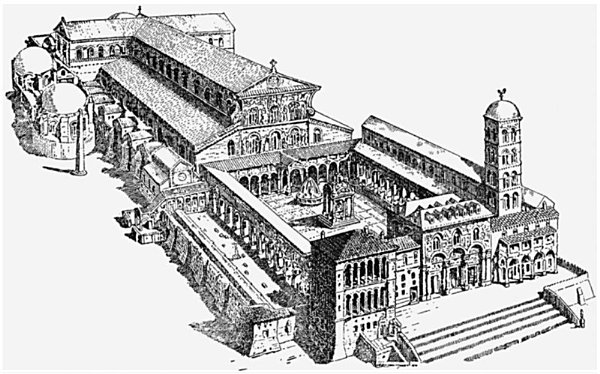
Plate 10.2 A reconstruction of ‘old’ St Peter’s: the basilica built by the Emperor Constantine in the fourth century over the tomb of the ‘first of the Apostles’.
By the late fifteenth century, however, the ancient basilica had become seriously dilapidated. Also, with the revival of ancient Graeco-Roman architecture during the Renaissance, its style had become outdated, no longer impressing pilgrims with the idea that Rome was the leading force in modern European culture. From the 1450s onwards, successive popes asked their architects for plans for a new sanctuary. The actual building process took more than 100 years. Partly resting on a huge terrace built against the slope of the Vatican Hill, the new St Peter’s was constructed both around and over the older church. This effectively meant that it once more became the grandest church in Christendom.
Its fulcrum, under the huge cupola devised by Michelangelo but only finished in the 1590s, was the spot where St Peter had been laid to rest. In the 1630s, Pope Urban VIII ordered his court architect and sculptor Gianlorenzo Bernini to devise a proper monument to enhance that holy site. He created the now famous grand bronze baldachin that stands more than 30 metres over the high altar which, in turn, stands over Constantine’s monument that, in turn, stands over the tomb supposed to be Peter’s. To show the continuity of the papal line in yet another way, and, thus, to stress Rome’s position, the basilica also came to house the tombs and funeral monuments of almost all popes who have ruled since the late fifteenth century.
After the new basilica had been finally completed in the 1630s, and the old palace that had been built beside it had been hugely extended to truly imperial dimensions, papal thoughts were directed – often by ambitious architects! – to the desire to create an impressive piazza to front it. Up till then, the multitudes of pilgrims coming to Rome from all over Europe and – by now – from the Christian parts of the non-European world, after traversing the city would always find themselves on the untidy, sandy slope of the hill which led up to the church’s huge façade. Finally, in the 1650s, Pope Alexander VII, from a number of greatly varying proposals selected the one made by Bernini, whom he had retained as his court architect. The very clever project, which combined a trapezoidal section where steps ascending the slope were contained within a large, almost level oval section surrounded by an open, columned gallery, took more than ten years to build. However, the grandiosity of the design does not lie only in its ingenuity. ‘Piazza San Pietro’, as it is officially known, also, and more importantly, embodies an idea and an ideal. Pope and architect, closely working together – or so Alexander suggests in his diary – strove to create a symbol: of the Christian community, the Church, the papacy and, indeed, of Heaven.
Those who come to Rome and make their way to the Vatican will arrive at or, rather, in the oval, visibly as well as, or so it was hoped, emotionally embraced by the colonnades that, indeed, do not fulfil any practical function but serve only as protecting ‘arms’. They have come ‘home’, if, that is, they think of the Church as their spiritual abode, and if, continuing, they enter the basilica that symbolizes the organization which stated it was the sole bearer of that spirit. Of course, they then proceed to the tomb of the ‘First of the Apostles’, the first pope, whose successors will rule supreme till the end of time, the Last Judgment. If they think along those lines, if they believe – that is, according to the traditions held by the papacy – they will, eventually, enter Heaven as had all those who in faith had preceded them. To point the way, the pilgrims had already been guided by the host of saints who, in more than life-size statues, hover over the colonnades, allowing the people below a glimpse of eternity above.

Plate 10.3 An eighteenth-century engraving showing the colonnades erected in front of ‘new’ St Peter’s in the seventeenth century.
For many centuries, there have been those who feel that the claims of the papacy as outlined above bear no historical or scientific scrutiny. Indeed, it was one of the arguments against Rome’s rule used during the various reform movements of the sixteenth century.Finally, in the early 1950s, a series of excavations undertaken, with papal consent, to study the stability of the huge basilica on its terrace and the sloping subsoil underneath, surprisingly also revealed the existence of a monument that matched the very old textual descriptions of the one erected by Constantine. Even more surprisingly, under it were discovered the remnants of a tomb that could be dated to the late first century. The walls were covered with graffiti suggesting that the pilgrims who had visited it in the years of the early Church had believed it to be Peter’s burial place. But did all this actually prove that the tomb was, indeed, St Peter’s? In the 1960s, a number of bones were produced that, according to the archaeologist in charge, had been found beside the tomb, under the monument. Analysed by a scientist, they were then proclaimed to be the bones of a single person: a man who had died in his seventies, and whose remains had been covered with a purple cloth; all this answered the ancient stories about the burial of St Peter.
Inevitably, since the 1970s the discussion has gone on. Many Christians do not care whether or not the scientific story is ‘beyond any doubt’: they feel that those who need the seal of science are not true believers, anyway. Others are relieved – their belief now has been proven by scholarly research. Yet others argue that the entire story as it has evolved since the early 1950s is one more blatant example of the way the Roman Catholic Church and, indeed, all institutionalized belief-systems constantly try to manipulate their followers. But increasing numbers of people living in Europe do not give the issue a thought at all: either because they are no longer concerned about the roots of their culture in Christian religion and, specifically, the ways this religion has developed to represent man, the world, and the cosmos – of which, of course, St Peter’s and everything connected with it is a prime manifestation – or because they hold other beliefs.
Nevertheless, the magic of St Peter’s continues, not least because now it is enhanced by the possibility of actually descending to the various levels under the basilica to arrive at the place where, along an underground ancient Roman street, the purported tomb is shown.