
The Republic of Letters: a quest for harmony
The political and religious divisions of Europe, which reinforced each other from the sixteenth century onwards because disputes on the one front were often fought out with arguments from the other domain, resulted in almost uninterrupted discord, in a general feeling of insecurity. Not only did all states actually fight each other, they also felt that their own identity, judged increasingly important, would be lost if a single state were to achieve hegemony.
In the sixteenth century, this fear centred around the imperial aspirations of the House of Habsburg, reflected in an ideology and a propaganda policy which linked this family, who had borne the imperial crown for several centuries, to Charlemagne, to the early German and Roman Empires, and even further to Japhet and Adam, while its acquisition, through marriage, of the Spanish crowns of Aragon and Castile and, consequently, of dominion over parts of the Mediterranean, and of America, Africa and Asia was seen as proof positive of their right to rule the entire world. In the seventeenth century, Europe feared the equally megalomaniac concepts of Louis XIV of France which continually threatened the quest for peace and quiet that now determined the foreign policies particularly of smaller states, admittedly rather more from pure necessity than from any idealism. Reactions to this situation, which regularly led to devastating wars, were twofold. Both can be interpreted as attempts to reach a more precise definition of ‘Europe’ and thus limit the results of war and dissension as much as possible.
First of all, one senses that, at least among the European elite, thinking and acting were to a large extent intensified by experiences gained during diplomatic and educational travel. A cosmopolitan culture recognizable all over Europe now developed; though limited to the upper classes, in the long run it did not fail to have a more widespread influence on very diverse areas of European life. Obviously, many lived this culture only as a superficial lifestyle, but specifically the intellectual elite began to embrace the values which appeared to guarantee the more fundamental ideals of unity, civilization and, it was hoped, the resulting peace: the values of Christianity in its original, universal form and classical culture. These values became internalized through common educational norms and practices and therefore were considered Europe’s collective inheritance even if, depending upon the specific philosophy and the world-view of those involved, this was now felt to be Christian-European, European-Christian or perhaps just European, without any clear religious connotation.
Because unity, civilization and peace offered the possibility of escaping from the political and religious differences which so cruelly influenced or even disrupted the everyday lives of many, people made attempts to contact and stay in contact with each other across the very borders of the states that increasingly thought in ‘national’ terms, thus fuelling that very discord. The frequent travels undertaken by the elite to complete their cultural formation by a period of university study elsewhere, by visits to art collections and classical ruins and by contacts with scholars and other famous figures obviously did not create a fundamental sense of solidarity all by themselves. Other means of communication, too, contributed to the genesis of a culture and, finally, a mentality, a way of thinking in which it was possible to believe that the consequences of political and religious conflicts could, as it were, be transcended by emphasizing what was of essential importance, what should bind everyone: the belief in individual freedom and the chances for creative development, the improvement of the human mind – all this, at least for the majority of intellectuals, in relation to the challenges presented by the great miracle of God’s creation. These ideals, which transcended and partly even had to deny the borders of one’s own region and state, were given shape in what was very significantly called the Respublica Literaria – a concept frequently, but as time went by decreasingly, defined by the addition Christiana.1 From the late fifteenth century onwards, the Republic of Letters was felt to be a non-institutionalized community based on commonly experienced norms such as brotherhood and tolerance and on a common aim such as the advancement of knowledge, of learning, in order to become more human. This ideal and its background are strikingly articulated in a poem by the sixteenth-century Englishman Samuel Daniel, who writes:
It be’ing the proportion of a happie Pen,
Not to b’invassal’d to one Monarchie,
But dwell with all the better world of men,
Whose spirits are of one communitie;
Whom neither ocean, Desarts, Rockes nor Sands
Can keepe from th’ Intertraffique of the minde,
But that it vents her treasure in all lands,
And doth a most secure commencement finde.2
The Republic of Letters and the ideal of tolerance: theory and practice
However, this ideal, which implied a view of man and the world, of a tolerant fraternity, remained a dream only, voiced in the conscious and unconscious propaganda of its bearers. Indeed, later historiography that, after all, has often been the product of people who had their roots in this tradition, tended to depict the Respublica Literaria as an achieved European cultural unity rather more than contemporary reality warranted. The expectations people cherished of the humanizing, civilizing influence of a brotherhood of all those who wanted to advance the bonae litteraecontributed to this vision.
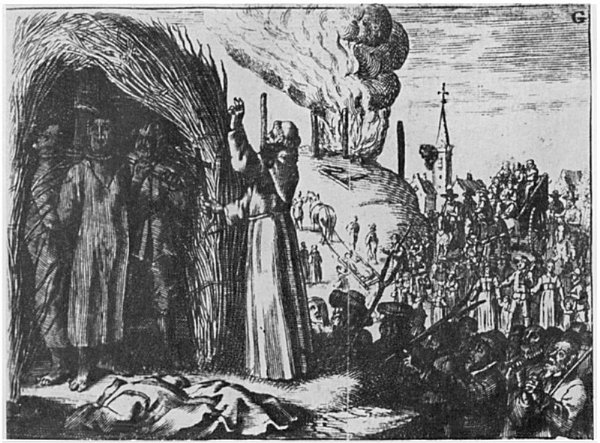
Plate 11.1 Religion and the practice of intolerance: people watching heretics and witches being burnt in a straw hut, depicted in a text on criminal law and procedure, the Cautio Criminalis of 1632.
Source: Centre for Art Historical Documentation, Nijmegen, the Netherlands

CHATEAU MONTAIGNE, NEAR BORDEAUX, AD 1580: MICHEL DE MONTAIGNE ON EUROPE AND ‘THE OTHER’
In 1580, Michel de Montaigne (1533–92), a French intellectual and one of the sharpest minds of his age, published a number of highly perspicacious essays, covering a great many aspects of contemporary culture in a spirit of criticism, not to say scepticism. In theseEssais, he showed himself to be an example par excellence of undogmatic, cosmopolitan thinking, of the Humanism that had grown in the previous centuries. Later thinkers, from the seventeenth, eighteenth and nineteenth centuries, such as Pierre Bayle and John Locke, Jean-Jacques Rousseau and Friedrich Nietzsche, were influenced by him. With his essay ‘On the cannibals’, Montaigne joined one of the most fundamental debates of the Republic of Letters, indeed of Europe: the debate on tolerance. Reflecting on the ‘otherness’ of the newly discovered native Americans, he actually voiced a critique of the situation in contemporary Europe. On the basis of the travel tales he had read he sketches an idealized version of Indian culture and society: not hierarchical, not determined by birth and wealth. In this society, man lives ‘in the wild’, in a state of nature and, therefore, nobly, for as intended by creation:
The discovery of an enormous continent deserves consideration. I do not know that I can be sure that some other may not hereafter be added, seeing that so many great men have been deceived in this….
I find … that there is nothing barbarous or savage about that people, as far as I have been able to learn, except that everybody will call anything barbarous that does not agree with what he is used to. Admittedly, we have no other test of truth and reason except the example and model of the notions and customs of our own country: the perfect religion, the perfect society, the perfect and complete employment of all things are natural here. Those others are savages, just as we call those fruits wild which nature produces unassisted and by its ordinary processes; whereas by rights we ought to apply the term to those which we by our science have changed and perverted from their proper state….
Those people, therefore, seem barbarous to me because they have received very little conditioning by the human mind and are still close to their original simplicity. The laws of nature, but little bastardized by ours, still govern them, and in such pure form that I am sometimes distressed by the thought that the knowledge of all this did not come sooner, at a time when there were men who could have brought greater insight to the matter than we can. I am sorry Lycurgus and Plato knew nothing of this; for it seems to me that what we have learned about those people there exceeds not only all images with which poetry has embellished the golden age and all the fanciful inventions about a happy state for man, but also the arguments and even desires of philosophers. These could not imagine so pure and simple a lack of artificiality as we now see before our eyes; they could not believe that our society could maintain itself with so little contrivance and human sweat.
Those peoples, I would tell Plato, have no knowledge of trade or letters, no science of numbers, not the name even of a magistrate, no superiors to rule them; no use of services, of wealth or poverty; no contracts, no inheritance, no property rights, no occupations except those of leisure; no respect for ancestry except that which they all share, no clothes, no agriculture, no metal, no use of wine or wheat. The very words signifying lies, treason, deceit, avarice, envy, slander, pardon – all unheard of! How far would he find that his imaginary republic differs from such perfection? …
[But they are] ignorant how dear their acquaintance with our corruption will one day cost their peace and happiness, and how this intercourse will bring about their ruin.3
May one interpret Montaigne’s sketch as a form of European self-criticism, as a ‘dream of Europe’? One certainly may. Does it imply a plea for tolerance of ‘the other’? It obviously does. But yet, the Indians whom Montaigne glorifies lived far way. Had he chosen to portray the ‘Moors’, the Muslims, who lived nearby, in the Balkans, and who for many Europeans constituted the real danger, the message would have been rather more poignant, or more difficult to swallow – as is shown by the reality of Europe’s reactions to those neighbours. Thus, Osmin, one of the main characters in Mozart’s opera Die Enführung aus dem Serail (The Escape from the Seraglio) (1782), was ridiculed by the Austrian composer’s librettist. In doing so, he provided his audience with one of the proven possibilities to ward off the danger of the nearby ‘other’, the foreigner who is seen as a threat. Monostatos, too, the ‘Moor’ in Die Zauberflöte (The Magic Flute) (1791), the Mozart opera in which white and black, light and darkness, good and evil are so child-like and yet so profoundly contrasted with each other, is clearly ‘the enemy’. Both operas, based on texts in the vernacular, were very popular: real crowd-pullers, rather than purely elite events. They undoubtedly had the effect of confirming prejudices.
Still, one may maintain that Montaigne had tried to counter precisely such feelings. Nevertheless, his text shows that even he could not avoid explicitly taking the norms and even the terms he used to describe and analyse ‘the Indians’ from Europe’s ideal-type civilization, that of classical Greece. Nevertheless, one cannot simply interpret Montaigne’s argument as ‘cultural imperialism’. Maybe, people can accept ‘the foreigner’ only if they are able to see and experience the potential ‘enemy’ as an ideal self.
For centuries, Europe, like most other cultures on earth, had wrestled with the problem of insiders and outsiders, the problem of tolerance. From the sixteenth century onwards, with religious unity finally broken, it became a central problem in understanding itself as a culture undivided, the more so as, generally speaking, the normative function of Christianity began to lose its force. Tolerance, between religions and, increasingly, different religious cultures, was now a major problem, as was tolerance between the peoples of the various states with their increasingly national, sometimes even nationalistic cultures. Consequently, tolerance remained a problem of European culture both in theory and in practice.
John Locke and Pierre Bayle (1647–1706), two of the many intellectuals who participated in the tolerance debate in the last decades of the seventeenth century, brought about a gradual change in the description of the concept through their writings, moving from a tolerance that resignedly accepted what could not be changed to the peaceful acceptance of other opinions – and behaviour? – that one did not necessarily approve of oneself.
Yet, their grand theories still left the practical problems all but unresolved. Indeed, it was an intellectual debate, mostly, in a context, moreover, in which at least for most participants the actual issues of toleration were not really problematic. Yet the growing conceptual consensus within the intellectual elite in no way guaranteed that people – those who lived in less comfortable positions but also intellectuals themselves, men of letters – now accepted, in everyday practice, those fellow men who were clearly different culturally. It was the more difficult if that acceptance had to be proven in an economic situation that did not favour tolerance.
The situation in seventeenth-century France provides a telling example. In 1589, King Henry IV had proclaimed the Edict of Nantes, according a measure of safety and even liberty to the French Protestants, a religious minority living in an overwhelmingly Catholic world. For a century, they had been able to enjoy this tolerance which, though it did not extend throughout the realm, had resulted in the powerful economic and cultural presence of these so-called Huguenots in French society. This irked Henry’s most famous, or infamous successor, Louis XIV. In 1685, in the same period that the debate on tolerance was waged, the Protestants were given the choice either to convert or to leave their possessions and their native France. As victims of the religious intolerance of the Sun King, in their hundreds of thousands they went into exile, giving up their country and, of course, their culture.
Many European states gave them refuge, either moved by sincere sympathy, or because the host countries saw them as potentially profitable immigrant workers. Yet not all exiles proved easily employable. Many were and remained poor. Appealing to social funds, they were soon seen as a threat to local social stability. Obviously, it was only then that tolerance was – and still is – really tested. Many Huguenots realized that far-reaching assimilation, renouncing their own dreams, was the best, indeed the only protection against the resentment and spite with which many now treated them.
This in no way detracts from the fact that many Europeans genuinely tried to put their high-minded thoughts into actual practice. From the end of the sixteenth century onwards, in learned circles the most grandiose projects for ‘eternal peace’ were devised with increasing regularity. Mostly, they pleaded for some sort of federal political organization which would guarantee that violence and the other miserable consequences of the perverted use of power and intolerance be banished from Europe. Besides the creation of theRespublica Literaria, these projects constituted Europe’s second attempt to realize some unity in a situation that so often threatened to slide into crisis.4 However, even more than the Republic of Letters, these plans remained only paper ideals, though they contained many elements which, from the late nineteenth century onwards, were proposed for the unification of Europe and, indeed, have been realized in more recent years.
In 1693, the Englishman William Penn, leader of a Protestant sect known as the Quakers because its members were encouraged to publicly and sometimes vehemently – quakingly – voice their beliefs, published his Essay towards the present and future Peace of Europe. It is a powerful text in that it successfully avoids the usual long-winded references to the Bible or the classics, and hardly uses baroque or classical figures of speech. It is also a short text. It proposes a ‘European parliament’ in which all participating states are represented by a number of delegates – that number to be determined on the basis of their economic strength! The German Empire holds pride of place, with 12 seats; France and Spain are next, with ten votes each; one is forcefully reminded of the debate over the seats to be given to the various states under the proposed European constitution of 2004. Given his cultural or rather religious background of pacifism and tolerance, Penn argues: ‘And if the Turks and Muscovites are also admitted, which is only just and right, then two times ten representatives will also be added […]’ – incidentally another, even more telling position in view of the decision yet to be taken by the present-day European Union in the coming decades. Thus, according to Penn, a political constellation is created that, admittedly, covers only ‘a quarter, but still the best and richest, part of the known world, where religion and education, civilization and art have their place’.5 Thus, while Penn’s definition of the elements that constitute European civilization unmistakably refers to a long tradition, he also includes the two cultures which, precisely because they were not part of that tradition, most of his contemporaries would have excluded, even emphatically so. Fascinating also, from a present-day perspective, is Penn’s awareness of the tensions that will inevitably develop between sovereign states and a ‘parliament’ of representatives.
However, one of the most significant aspects of Penn’s plan is that while he does not attempt to achieve a traditional Christian world order, his inspiration was in its deepest essence biblical. However, economic and utilitarian considerations play a clear role, too, undoubtedly because the formation of his theory was partly based on the works of such ‘common sense’ thinkers as his contemporary John Locke.
In Penn’s outline of a civilized society, the concept of ‘freedom’ stands explicit and central: not a single person must live in fear. As a result, ‘justice’, or controlled ‘violence’, is the basis of a state, and freedom of conscience is the logical consequence. Penn implicitly proposes that true Christianity lies in the acceptance of others, if only they, too, accept justice and freedom – thus, in a sense, entrusting the State with the protection of these basically religious values. Finally, he stresses the absolute necessity of education to realize these ideals.
Yet, it is characteristic of the problematic nature of Penn’s idealistic vision that ten years earlier he had sought to realize his plans in the new world, on the other side of the ocean, where a century earlier many readers had situated Thomas More’s Utopia (1516) and where, during the following years, so many people had actually attempted to make their dreams come true. ‘Pennsylvania’ and ‘Philadelphia’ – respectively ‘Penn’s colony in the Woods’, in an Eden-like garden, and the ‘City of Brotherly Love’ – were the outcome of William’s ideas on the ideal state and the ideal city. Yet, whereas he advocated equality of Indians and Europeans, on the condition that the latter would do some civilizing work – to be understood as Christian mission – among the former, his followers quickly proved unable to reconcile the requirements of practice with the ideals of theory.6Penn’s utopian society soon became a ‘normal’ European colony using and even exploiting both Indian territory and the Indians themselves.
The Republic of Letters and its enemies: national cultural policies, or the political uses of culture
Plans like Penn’s not only reveal the vision that many intellectuals held of Europe’s ideal self, but also show that people were fully aware of the reality that had emerged from the sixteenth century onwards, the reality of increasingly powerful national states. They now formed the framework in which Europe’s cultural self-awareness was articulated and shaped. The new awareness is fully outlined in a text by the French publicist Louis Le Roy. Viewing the past in his De la vicissitude ou variété des choses de l’univers (Paris 1575), he writes:
We in the west have, during the past 200 years, regained the value of knowledge and learning and have restored to honour the different branches of science which for so long appeared to be extinct. The constant dedication of many scholars led to so many successes that today our time can measure itself with the best that ever was…. The rulers who have done the most for the recovery of culture are Pope Nicholas V and King Alfonso of Naples, who welcomed those who offered them the Latin translations of Greek books with tributes and royal support. The King of France, François I, paid the salaries of professors in Paris and had a splendid library assembled at Fontainebleau. Without the support and generosity of the kings of Castile and Portugal the discovery of new countries and the journey to the Indies would never have taken place. The Medici lords of Florence, Cosimo and Lorenzo, also gained many merits because they received scholars from all over the world and supported their work.
In short, at the end of the sixteenth century and in the early seventeenth century, Europe’s cultural elites were obviously well aware that society and culture had undergone great changes in the preceding 200 years.
While at the beginning of the period Le Roy described the aim of many Europeans had been to revive and relive the culture of the ancient Greeks and Romans, according to him, two centuries later, people no longer considered this the only worthwhile goal. Indeed, the development of knowledge and of the arts in Europe had been such that classical civilization had been superseded already.
Obviously, the state, in the person of the ruler, was now felt to play an important role in the advancement of the arts and sciences, not, of course, because of any innate civilization but rather because they valued the cultural prestige and the propagandist effects of this patronage. Equally important was that many of the products of culture and, especially, science, could be of eminent practical use, for example in the development of education and, thus, in the training of a well-informed bureaucracy, but also for all kinds of technological improvements, not least in military matters.
However, because state governments, growing powerful, began to use all sorts of cultural forms to increase their power further, the freedom to form and exchange ideas slowly became limited precisely because culture was now embedded in official structures. During the seventeenth century, royal academies of science and fine arts had been founded and educational institutions, especially at university level, had been used increasingly to support royal prestige which, of course, was now felt to be the prestige of the State, the nation.7 This is most clearly shown in the writing of history, whether it be in the royal biographies commissioned from well-known authors via the system of ‘gratifications’ in France, or in the so-called Pragmatische Geschichte produced in the German states from the late sixteenth century onwards, or in the descriptions glorifying the past and present cultural and political achievements of a people, for example the Italia Illustrata.8 In Spain, Juan de Mariana, linking his nation’s fame to its military and colonial expansion, wrote:
The name and valor of Spain, known to few and confined within the narrow limits of Spain, was in a short time, and with great glory, spread abroad, not only through Italy and through France and Barbary, but to the very ends of the earth.9
Indeed, until late in the eighteenth century, those expressions of culture principally produced for and dominated by the elite – the visual arts, literature, music – could exist only within the often limiting framework of patron–client relationships. Thereby, the leaders of State or Church, princes, nobles and prelates acted as patrons. For the artists involved, this was not always a pleasant situation. As early as 1508, in a letter to a friend, the painter Raphaello Santo lamented: ‘You yourself have several times experienced what it means to be robbed of one’s freedom and to live under the yoke of a patron’.10
By the seventeenth century, it was only the Catholic Church that still maintained its manifestations of grand culture which actually stemmed from and contributed to a universal cause. Most states had developed distinctly ‘national’ varieties of culture. In France, three powerful ministers – Richelieu, Mazarin and finally Colbert – used culture to enhance the glory of the monarch, the embodiment of the state, harnessing prose writers, playwrights and historians, but also architects, musicians and painters into a ‘bureaucracy of the arts’ hitherto unknown in European history. The creation of scientific academies (the Academie Française was founded in 1635), libraries and museums further strengthened government control over a culture that had to be ‘national’. In the German principalities, too, culture increasingly became a concern of the State, a matter of national prestige. In 1700, the Prussian Academy of Sciences was founded in Berlin, directed by the famous philosopher Gottfried Wilhelm Leibniz (1646–1716).
Cultural nationalism manifested itself in a variety of forms and situations. As all over Europe, in England, too, classical architecture was highly valued. Yet the designs attributed to the famous Roman master builder Vitruvius – actually they were based on sixteenth- and seventeenth-century interpretations of him – were published in London under the telling title Vitruvius Britannicus, adapted to English needs and the English climate. And while Italian and French music may have delighted English ears, yet new melodies were presented in a guise both classical and national, as inOrpheus Britannicus, two volumes of songs published by the widow of the great composer Henry Purcell in 1698 and 1707, and in Amphion Anglus, in which John Blow collected his music in 1700. Indeed, the music itself was by now often unabashedly national(-istic), as demonstrated by Purcell’s delightful tune to the very chauvinistic text ‘Fairest Isle, all isles excelling’, part of the equally chauvinistic masque ‘King Arthur’, written by the poet John Dryden in praise of England as the ideal island, a society where, as worries no longer exist, man only has to indulge in his sensual pleasures.
In Russia – first, the grand-duchy of Muscovy, later, the empire of the tsars – which attempted to come out of its economic, political and cultural isolation in these centuries, the process of interaction between cosmopolitan and national culture was even more complex. The full panoply of Byzantine coronation rituals, which, in a way, had survived in the west through the complex ceremonial of the papal court, was introduced in Russia in the late sixteenth century. Meanwhile, Italian Renaissance forms began to structure the great cathedrals built inside the Moscow Kremlin, the churches of St Michael the Archangel and of the Dormition of the Virgin. Yet the famous cathedral of St Basil, dominating the great square outside the palace, with its multicoloured façade and its bulbous domes, was built to show a visibly different style, that was considered less European, more ‘Russian’.11 From the end of the seventeenth century onwards, Tsar Peter not only ordered a great literacy campaign but also decreed the setting up of an imperial academy and a university – in all this following the European example but principally intended to strengthen Russia’s national fame and prosperity.12 And while Peter’s new capital, St Petersburg – incidentally not named after the emperor but after the Apostle Peter, to stress Russia’s ambitions to be the successor of imperial Rome – might function as a ‘window on the west’, the large-scale scientific expeditions to central and east Asia organized by the Imperial Academy from the 1720s, aimed to help Russia to map, literally, its growing empire in the east. Peter’s successors continued his policy of western-style education and the advancement of modern, i.e. European, learning, but arguably this was successful only among the nobility and the bourgeois elites of a few towns. When, in 1767, Czarina Catharine declared in one of her famous decrees, ‘Russia is a European state’,13 she showed she was by birth a German princess and, moreover, a woman whose will, though it often became law, nevertheless revealed more about her wishes than about Russia’s cultural reality.
The development of national cultures all over Europe is, perhaps, best represented in one characteristic moment. In 1700, at the book fair in Frankfurt, which had become Europe’s largest in the late fifteenth century and has remained so ever since despite a decline in the eighteenth century,14only 4 per cent of the titles available were still in Latin, that once cosmopolitan language. European books were now published largely in the various national languages, as is eloquently shown in the fair’s catalogues.15
The Republic of Letters, or how to communicate in an invisible institution
The community that transcended the State, which is what the Respublica Literaria intended to be, was constantly being formed by travel and the resulting personal contacts, but in everyday practice it mainly continued through the writing and, thus, reading of letters. On this point, too, Bacon had clearly expressed himself in his essay on travel: ‘When a traveller returneth home, let him … maintain a correspondence by letters with those of his acquaintance which are of most worth’.16
Unlike in today’s e-mail society, the hand-written letter was the privileged means not only of personal but also of professional communication. Naturally, the printed word was influential, too. Its role in European culture gained considerable importance during the sixteenth and seventeenth centuries because the need for information in all areas of life and culture grew continually. Yet for daily communication the hand-written letter remained a primary carrier of information until the invention and introduction of the typewriter in the twentieth century.
All over Europe, literate people, while working in their often relatively closed milieus, were inspired by the vision of a larger world, held together by a network of correspondents to which they, along with thousands of others, belonged. Many who regularly corresponded with each other also knew each other, even if only through a few meetings during the academic peregrination or the Grand Tour they had made to round off their education. Yet some who wrote to each other for dozens of years never actually met. In short, for all of them, correspondence was one of the most important methods of keeping up with the latest news, whether personal or political, religious or scientific. The world of learning in particular was largely dependent on contact by letter. Thus, a man like Erasmus relied on more than 100 more or less regular correspondents, mostly in the Netherlands, England, France, Italy and the German countries, while a century later the French érudit Peiresc exchanged letters with more than 200 friends, living in an even wider world that included North Africa and the Levant.17 Of course, their letters were not ‘private’ ones. The addressee would frequently share its scholarly contents with a wide circle of like-minded people who gathered at his house to hear the latest news. Despite the postal delays caused by climatic or political problems, one could circumvent such uncertainties by sending several copies. However, it was less feasible, and far more expensive, to send heavy loads of printed texts, whose postal distribution beyond one’s own region was equally difficult as a result of commercial, financial and political limitations.
Yet printing indisputably caused a momentous increase in the diffusion of knowledge, both in a quantitative and a qualitative sense. After its invention, which in Europe coincided with the beginning of a century of unprecedented economic expansion and increased purchasing power, only some small technical and, in the case of very ambitious publishing enterprises, somewhat bigger financial problems still limited the distribution of the book and, thus, the further expansion of communication and the spread of knowledge. While there had been people trading in manuscript copies of mostly learned and devotional texts in the fourteenth and fifteenth centuries, as well as marketing such bestsellers as Marco Polo’s tale, or the famous knightly romances, the sixteenth and seventeenth centuries really saw the beginning of the mass distribution of texts. The age of the printers and publishers had arrived, of people who saw a market for their products.
Some publishers were actually interested in the promotion of culture, but mostly they were in it only for profit. Besides the few famous ‘scholar-publishers’ – men such as Aldus Manutius in Italy,18 Johann Amerbach and Johann Frobenius, the printer-publishers and friends of Erasmus in Basle, and Christoffel Plantijn and his descendants in Antwerp – there was a host of less scholarly and idealistic entrepreneurs who simply smelled money in the nascent information culture. Counting on improving education, on the growing group of readers and, of course, eagerly exploiting the change from one, universal language, Latin, to the many national languages, they adapted to the market or even took the lead. They introduced cheaper books that were also less awkward to handle than the heavy folio and quarto volumes that had dominated in the sixteenth century. Not only did the supply of titles in the various national languages grow expansively, so did the texts providing general information or entertainment. Gradually, literary prose and poetry, historiography and, especially, travel stories19 became more popular than theological or scientific treatises.
In the first years of printing, book production had concentrated mainly in Italy, the land of many courts, the land of Rome and the papacy, the cradle of Humanism and of the Renaissance. Venice was a major centre, where publishers could use a long-established trade network and where the demand for Greek classical texts could be most easily met. As an important cultural consequence, the Orthodox Christians of the Balkans, who were deprived of the benefits of printing by Ottoman rule, were now educated mainly through the products of Venetian presses, which provided not only classical learning, but also started publishing a religious and popular literature in Greek, later enriched with works of modern science. This contributed considerably to the reintegration into Europe of the Orthodox Christian intelligentsia.
As the focus of trade in general moved north, by the beginning of the sixteenth century book production also moved to the north. There, first Antwerp and subsequently, in the seventeenth century, the cities of the Dutch province of Holland, with Amsterdam and Leiden in the lead, dominated the international book trade.20 The arrival of the Huguenots, mentioned above, certainly contributed to Holland’s increasingly important function as an intellectual trading centre. The Huguenots hoped to make money with books, not least because they rightly reasoned that the country from which they had been banished represented an enormous market which, as a result of French royal censorship, could be served more profitably from abroad. As some of their fellow believers had ended up in the German states and in England, it was easy to establish international contacts as well.21 Thus, the eighteenth-century Leiden printer, publisher and publicist Elie Luzac, a Huguenot, cooperated with the secretary of the Prussian Academy of Sciences in Berlin, Samuel Formey, another Huguenot, on the publication of a periodical whose title, Bibliothèque Impartiale, clearly indicated the contemporary ideal of tolerant yet critical knowledge.22
While travel cost time and money, so did buying books. In the seventeenth and eighteenth centuries it had already become too expensive for many. Nevertheless, information was important to those wanting to keep up professionally or simply interested in new developments in all fields of culture. At the same time, the flow of information had already become uncontrollable. European publishers quickly devised a solution for people who, for whatever reason, could or would not buy new titles by the dozen. Thus, in the 1660s, a new phenomenon appeared on the European cultural scene: the periodical. Within a few years’ time, specialized political, literary and scientific journals gained a central role in the spreading of knowledge and new ideas among people who travelled seldom, if ever, and had little money to buy expensive books. While serious scientific studies continued to be published, their contents were often disseminated in these periodicals which reached an increasingly large readership in the Republic of Letters. They were not primarily directed at specialist scholars who lived with their books and letters, but rather at a broader readership of educated people who wanted to keep up with the latest in a variety of fields: theology, philosophy, political theory and literature.23
Inevitably, those periodicals ‘specializing’ in general information or commenting on recent events satisfied an increasing demand. Still more popular were the periodicals filled with abstracts of new titles, preferably providing extensive, critical excerpts and reviews. Until the late eighteenth century, the market for these journals was mainly supplied by Dutch publishers. They were often written in French, whose role as a lingua franca had already been confirmed by diplomacy and was now reinforced by Europe’s language of culture as well.
Yet, to many, even the regular perusal of periodicals was too much trouble. An even more concise, preferably critically acceptable form of collected knowledge was thought to offer a solution. Publishers soon realized there was a market to be explored and succeeded there as well. The encyclopedia, in itself a very old phenomenon, now appeared on the European market. It is difficult to judge whether stories about the printing of gigantic compendia of knowledge by the Chinese emperors, which became known in seventeenth-century Europe through the reports of the Jesuits and other travellers, contributed to its introduction. The fact is that in the second half of the seventeenth century, the first ‘libraries without walls’ were published: Louis Moreri’s Dictionnaire was brought out in 1674, followed in 1697 by Pierre Bayle’s Dictionnaire Historique et Critique which was talked about and read for decades.24 The latter was an excellent example of the ‘literature of recollection’, a text which was, as it were, to be the memory of that European culture Bayle had become acquainted with in his reading, and which he wanted to understand and interpret as a corpus that had grown historically but which needed to be read and used critically.
The Republic of Letters and the ‘intertraffic of the mind’: three examples
At the end of the seventeenth century, the Dutch envoy in Stockholm, Christian Constantijn Rumph (1633–1706), befriended most of the representatives of Sweden’s political and cultural elite. Also, for 25 years he exchanged letters virtually every month with Gisbert Cuper (1644–1716), a Deventer professor of classical languages but also mayor of his native city and member of the Dutch States-General.25 His contacts with the learned Cuper made Rumph a godsend for his Swedish friends and acquaintances who frequently gathered at his house, among whom were many professors from Uppsala who had studied in the Dutch Republic in their youth and who retained the best memories of those years. With Rumph’s help, these Swedes could obtain the books and periodicals discussed in the Republic of Letters but that could not be easily bought, if at all, in their own country. Between them, Cuper, the insider, living in the Dutch Republic, and Rumph, the outsider, living on the periphery of European culture, were able to supply Sweden with the latest political and cultural news.
Cuper’s, or rather Rumph’s, Swedish contacts also used their friends’ epistolary network to prepare the publication of their scientific work in the Dutch Republic since there were as yet no up-to-date printing facilities in Sweden. Only for the finishing touches did they have to undertake the difficult journey to Amsterdam – difficult because, as a result of the many destructive wars in these decades, the Baltic and North Seas were anything but peaceful waters. When their books were finally published, Swedish knowledge of the geography of northern Europe and central Asia, of the origins of the Goths and so on could be discussed in learned Europe.
In his turn, Cuper corresponded regularly with dozens of men from all parts of Europe, ranging from Cardinal Noris, a powerful member of the Roman curia, and the Florentine librarian and erudite Magliabecchi to the English, Anglican theologian and historian Burnet, and the German, Lutheran philosopher Leibniz. News of all sorts from Italy thus ended up in Amsterdam and the Netherlands and, subsequently, in Berlin and in Prussia, as well as in Sweden.
One of Cuper’s best friends was the Amsterdam merchant and politician Nicolaas Witsen (1641–1717), one of the richest and most powerful men in the Dutch Republic and director of the Dutch East India Company. Both in his palatial canal house and in his country house he kept an enormous library and filled the rooms with collections of the most valuable and exotic rarities. In his gardens grew choice shrubs from the east – he had introduced the coffee plant to the city’s botanic gardens – and his zoo was famous, too. Travellers from all over Europe who visited Amsterdam asked permission to visit him.
Almost every month, Cuper sent Witsen a six- or seven-page letter and duly received a reply.26 A considerable part of the Cuper–Witsen letters concerned questions which they, both fanatical readers of travel stories, asked in the margins of the multifarious information which their reading matter offered. What was the origin of language and was there, still, an ‘original’ language, from which all the others stemmed? Had Asia and America once been linked? Was Chinese Confucianism a pre-Christian form of Christianity? And so on. Witsen supplied Cuper with data from China, Japan and India, but also from Brazil and Canada. Cuper again informed his German and Swedish acquaintances, introducing Witsen to Leibniz, who asked him for material on the globe’s innumerable tongues. Eventually, much of the information spread in this manner found its way into the scientific and other publications or periodicals that were published for the people involved in this learned exchange.
Unlike his correspondent, Witsen had travelled a great deal, even, quite exceptionally – for it was on his own account – as far as Russia. He regularly exchanged letters with a number of distinguished Russians as well as with French Jesuits and with members of the Royal Society in England. Frequently, his letters contained requests for more detailed information concerning the data he obtained from his scientific reading and from the travel stories he devoured. In the discussions which then followed, carried on by letter again, one can see Witsen’s world-view, his concept of culture, gradually change, as he came to view the world as fundamentally one, a single creation under a veneer of cultural diversity which, on closer inspection, revealed surprising similarities.
Such correspondence networks spanning Europe enabled people to exchange ideas. This encouraged intellectual curiosity and resulted in a dynamic cosmopolitanism, especially in educated circles. In the 1720s, following the years in which Rumph, Cuper and Witsen had established their complex but rewarding epistolary north–south axis, the Phanariot Greek Nicholas Mavrocordatos kept up an exchange of letters with the Amsterdam Huguenot scholar and magazine director Jean Le Clerc. Mavrocordatos, scion of an intellectual Greek family, whose father had studied medicine at Padua and had published several books, was appointed by the Ottoman sultan prince of Moldavia and Wallachia, two of the Balkan border regions separating the Christian and the Islamic worlds. Not only did Le Clerc supply his friend with recent maps of central Europe and the eastern Mediterranean; also, answering Mavrocordatos’s incessant requests for information about new developments in the world of arts and letters, he sent him the books of recent western learning which Nicholas asked for. Thus, Mavrocordatos enriched his library with the works of Newton and other scientists, and with John Locke’s Two Treatises of Civil Government (1690), a highly influential tract about a more balanced political system in which royal absolutism was mitigated by representative institutions. Mavrocordatos’s intellectual interests fully appear in his novel Les Loisirs de Philothée, which was the first text to introduce the names of Bacon and Hobbes into Greek culture and to declare that if Aristotle were alive he would gladly become a pupil of ‘the Moderns’27 – those who held that contemporary culture had, indeed, surpassed classical civilization.
At the end of the eighteenth century, the wealthy bibliophile Gerard Meerman (1722–71), former Pensionary of Rotterdam and former Dutch ambassador to England, lived in The Hague. He had travelled extensively, starting with a Grand Tour that lasted for three years and brought him to Germany, France, Switzerland and Italy. His luxurious house was crammed with books, manuscripts, coins and antiquities, all of which he generously showed to people provided with a proper introduction. By letter, Meerman remained incontact with all of Europe, including the erudite Spaniard Gregorio Mayans y Siscar (1691–1781).28
Although Meerman and Mayans never met, their letters, over a period of more than 20 years, totalled several hundred, each often three or four pages long. They helped the two men share a treasure of information in many fields. Mayans, one of the most critical and, hence, important figures in Spanish culture in the eighteenth century, benefited from the situation because it enabled him to write a number of works wherein he pleaded for a more modern view of science and society – less dominated by Church traditions – to achieve the cultural regeneration of Spain. Mayans’s books were partly published abroad, including in the Dutch Republic, where Meerman, following his friend’s instructions, provided essential assistance. In his turn, Mayans acted as intermediary in Meerman’s purchase of Spanish books and manuscripts and supplied him with the details for a number of his own publications, especially concerning the history of the invention of printing, which Meerman considered one of Europe’s central cultural feats and which he desperately wanted to ascribe to a Dutchman, Laurens Janszn Coster. Of course, the Dutch were not immune to cultural nationalism, either.
The Meerman–Mayans letters also reveal how the two friends tried to practise what they felt was their duty as ‘men of letters’: to gather and critically test knowledge. However, equally important, their epistolary exchange shows how much the correspondents – one a Protestant, the other a Catholic – were aware of the political and religious structures and traditions that separated their countries. Consequently, they expressed the need for tolerance and mutual understanding to demolish these barriers and to serve the interests of an ideal they never specifically named but clearly did feel: Europe’s ‘common culture’ and, through it, their own humanity.
Contacts with like-minded people from other nations provided the basis for the very exclusiveness of the members of the Republic of Letters, of Europe’s cosmopolitan elite. During these centuries, these men – the Republic being a predominantly male affair – were not yet heavily pressured to make their country’s rather than their own intellectual and cultural choices. Undeniably, however, many of these people, too, were profoundly prejudiced against representatives of other nations, especially if the latter remained anonymous and did not belong to the same sociocultural group; yet, as soon as people got to know each other personally, or through letters, prejudices would often disappear.
Of course one should ask if the ideal of the Republic of Letters was a limited and elitist one? I feel it was. Undeniably, it was easier to pay lip-service to an abstract concept, in letters, books and periodicals, and to propose tolerance and even understanding on paper, than to be confronted – in one’s daily life or on trips abroad – with other people’s regional or national cultural peculiarities. Yet the indisputable limitations both of the ideal and of the various elite groups who were its bearer did not make the idea behind it less functional or valuable. Despite a growing nationalization of culture, in the Republic of Letters Europe enjoyed a form of communication, a form of culture that, de facto, created a certain unity that was almost completely lacking in other fields. This situation lasted for almost three centuries. Only at the beginning of the nineteenth century did it start to alter.
Dossier: Paradise
Some 100 kilometres west of Poznan lies a monastery bearing the name ‘Paradyz’. It was founded in 1230, and still functions, as a training college for the Polish clergy and as a museum.
It belongs to a fascinating ‘family’ of religious foundations, originating in the abbey of Citeaux in France, founded in 1098, and the birthplace of the Order of the Cistercian monks. In subsequent decades, the ‘family’ spread all over Europe, with one abbey begetting another till, finally, we find a particular group of them starting with the monastery at Lehnin (1181). This and its daughter-monasteries were established to represent the power of eastward-moving German migrants and of the Church in the newly conquered lands of what came to be called Brandenburg, up till then inhabited by pagan Slavs. No wonder these monasteries were given the right to establish villages and towns: both to accommodate German settlers and to better control the remaining indigenous peoples.
The geographically nearest ‘relative’ of Paradyz is another, now ruined, abbey, founded in 1299. It, too, bears a significant name: ‘Coeli Porta’, ‘Himmelpfort’ (‘Heaven’s Gate’). Like its sisters, its name reflects a fundamental way of thinking. Every Christian knew that life on earth was, essentially, imperfect: it could never be paradise. Only those who adhered to the Church’s creed might hope to gain the real paradise, in the afterlife. But where on earth could one learn to live the life that would serve as the gate through which one might enter Heaven? For many centuries, the thousands of monasteries that enmeshed the world of Christendom served as such exemplary locations, their names often bearing testimony to the ultimate goal of the Christian world. Always, within the walls that protected them against a hostile nature, they combined the buildings housing the community with a garden, while the abbey church served as its linchpin, that, moreover, linked earth to heaven.
Of course, everything in Christian Europe was ultimately related to the Bible. According to Genesis, the first book of the Jewish Old Testament, the world as created by God was a ‘garden in Eden’ – not surprisingly since its Jewish authors, writing probably in the sixth or fifth century BC, belonged to a semi-nomadic people eking out a difficult living in the desert and thinking of an oasis as the ideal world. In Eden, God had placed the first man and the first woman, giving them perfection: in their bodies, in the abundance of their food, in the innocence of their thoughts. But their desire to equal God in his all-knowing spoiled it all: paradise was truly lost.
For many centuries, Christians – Europeans – against any rational argument wondered whether, perhaps, somewhere on earth this place of origin might yet be regained. This hope served as a powerful dynamic in their exploration of the globe. Mostly, however, people accepted that, if it ever had existed, the primeval garden was no more. Meanwhile, the Church presented the ultimate world as a city, the ‘heavenly Jerusalem’. This is not surprising either, since the authors of the last book of the Christian New Testament,Revelation, who prophesied its coming, were writing in the first century of the Christian era and modelled it on the urbanized society of the Roman Empire.
In subsequent centuries, Christians, realizing that a return to an earthly paradise was impossible, and yet not content with the promise of a paradisiacal afterlife – both only to be had as a gift from God – began imagining a man-made ideal world, a ‘utopia’. They hankered after perfection, or, at least, after a life that would not force them to toil for their daily bread and live in a society that, increasingly, suffocated them with dos and don’ts, with crime, vice and ruthless power. Many such ideas were formulated during the debates about the improvement of man and his world that characterized intellectual exchange in the ‘Republic of Letters’. Fascinatingly, Europe’s utopias, both the thought-experiments on paper and the ones realized in brick and mortar, have mostly sought to reconcile or, ideally, join the garden and the city. In Roman and post-Roman times, kings, nobles and wealthy burghers constructed palaces and mansions surrounded by gardens or even parks within the city walls, while also building themselves villas in the countryside, amidst gardens – but protected by walls, too, for real nature was seen as untamed, uncivilized, dangerous.
From the sixteenth century onwards, Europe’s princes gained the power and the means to indulge their wildest dreams. Often, they asked their architects to create towns that were gardens as well. Many projects proved too grandiose to be realized. Some, however, were actually built. Thus, within its walls, the ‘ideal’ town of Terra del Sole, newly founded in 1564, combined civic buildings, including a palace, with a large park. The ultimate royal residence, built by Louis XIV of France at Versailles a century later, though usually described as a palace was, really, a fusion of a town that housed the court, and a garden, each inscribed within a half circle. Together, the two formed a perfect unity, with the palace and the king’s rooms as its linchpin. Soon, other monarchs followed suit. In 1715, Charles, margrave of Baden-Durlach ordered the construction of Karlsruhe: half town, half park with, again, a palace at its centre, a place where he could rest.
However, by the seventeenth century Europeans participating in the intellectual exchange that characterized the ‘Republic of Letters’ came to realize that utopias were not meant to only profit the happy few but, in fact, should benefit society at large. At the same time, many felt that their own world, the old world, was too congested and too contaminated by centuries of human iniquity to provide the conditions for a new, better society.

Plate 11.2 Plan of the town of Karlsruhe in the eighteenth century, which shows the integration of the urban constructions in a parklike context.
Thus, in 1681, the founder of the Quakers, William Penn, in repayment of a debt was granted by his sovereign, the king of England, a huge tract of the newly discovered east coast of North America. Significantly named ‘Penn-sylvania’ – ‘Penn’s woods’ – it was to have a capital, ‘Philadelphia–, the city of ‘loving brotherhood’. There, the conditions that made life so obviously imperfect, not to say miserable, in Europe, would be eliminated. Equality and tolerance would be the rule. To help ensure that dream, every home was to be the same, along one of the streets laid out in a grid pattern – a sign of rationality, perfection. Also, unlike in most existing cities, every family was to have a garden.
Though Philadelphia thrived, it definitely did not become the abode of virtue Penn had envisaged. Nor did comparable foundations, whether in the new or in the old world. In fact, in real life conditions for most people – both in Europe and in the Europeanized Americas – deteriorated, especially after the Industrial Revolution forced increasing numbers to move to cities, old and new, because that was where labour was needed, and an albeit meagre income could be earned.
Soon, overpopulation, the lack of any form of public health care and sanitation, as well as pollution made Europe’s towns into the image of Hell rather than of Heaven, as shown in, for example, the gruesome depictions of the London slums by Gustave Doré. Campaigns to bring fresh air, quality water and other elements of nature to the city were heard all over Europe. And, soon, people started asking for the garden to be combined with the town once more. Both to increase their own profits and to humanize living conditions for their work force, enlightened factory owners like Sir Titus Salt ordered towns to be built that had a park as well as basic public sanitation. In 1890, in the newly built factory town of Crespi d’Adda in Italy, every family was given a garden.
During these years, the ‘Garden City Movement’ or equivalents thereof sprang up in many countries of (western) Europe. It became influential, not so much in restructuring existing cities as in creating suburbs conforming to the new ideal, or even in founding new towns altogether. Often, the garden element consisted of the introduction of public parks and of tree-lined streets, but there was also a tendency to allow each family house its own plot of land.
However, in the decades between the two World Wars, the artistic and, in a wider sense, cultural movement called Modernism glorified a ‘rational’ approach to all societal problems, both in the Capitalist West and in the Socialist East. It manifested itself in urban planning, too, filling new cities with massive, concrete, often high-rise public housing. Its designers gave little or no attention to the increasing real and emotional need most people had for some kind of interaction with the outdoors.

Plate 11.3 A city in the throes of industrial pollution: London in 1872, as seen by the French artist Gustave Doré.
Source: akg-images
Regrettably, the Modernist hold on urban development continued till the last decades of the twentieth century. Only then, slowly, did public authorities realize that though not all problems of contemporary society – such as crime, and the negative results ofghettoization – could be blamed on the built environment, providing people living in towns with a less reductionist and more small-scale and organic habitat, including some kind of nature (even if it was sometimes re-created) might be preferable.
Arguably, the developments in urban and social planning sketched above were an entirely European phenomenon. They remained so till the influence of European ways of thinking started to extend to non-European parts of the world through colonialism and imperialism – basically from the early twentieth century onwards. It was then that people also sought somehow to urbanistically humanize the often densely populated cities of the non-European world, albeit with little success.