
The revolutions and their aftermath
As shown in Chapter 13, the industrial and the political revolutions had complex consequences, principally in western Europe, although changes made themselves felt in central and eastern Europe as well. Ideologically, conservatives and liberals in particularbecame the main opposition groups within the newly created constitutional, partly democratic political systems. The former, those who basically rejected the consequences of the revolutions, preferred to see the old power structures maintained or restored as much as possible. They also advocated vigorous government. The latter argued that social progress was best served by as free a play of social forces as could be realized without society degenerating into chaos; in their opinion, liberalism also implied the limited interference of government in economic, social and certainly cultural affairs.
Meanwhile, a third ideology, opposed to both conservatism and liberalism, gained increasing support. It was, of course, socialism, the most visible sociopolitical child born of the great European revolutions, principally the industrial one. But although its birth as a political force would not have occurred without the changes of the late eighteenth and early nineteenth centuries, its roots were much older, composed as they were of such diverse strands as guild solidarity in Europe’s cities of the twelfth and thirteenth centuries, the growing individualism of Renaissance and (Counter) Reformation culture, the organizational structures of the Enlightenment clubs and Romantic notions of the value of labour and the artisan as representative of traditional culture.1
Most socialists did not want to reverse the recent political-economic changes; mainly, they felt that their negative consequences should be remedied. The evident problems facing large parts of the working population required, according to socialist ideology, a steering of society – by the State, through a government that truly cared for all its people – in such a way that economic prosperity and, in a wider sense, sociocultural welfare would be adequately guaranteed to each and everybody.2
In the 1820s, the French author and social critic Henri, count of Saint-Simon, presented an interesting mix of the three political stances when he argued that:
At the outset, I wish to state that the only way to bring sustenance to people is through employment. The government has to be controlled by the heads of industrial enterprises. These men are the true leaders of the people, whom they direct in their daily labour. Therefore, directly and in their own interests, the heads of industrial enterprises will use their authority to expand business as much as possible. From this will result the greatest increase in economic activity, leading to larger employment.
Yet, while one may detect a strongly paternalistic tendency in Saint-Simon’s society, he apparently held high hopes for the mitigating – or rather disciplining? – influence of education, writing:
I now come to another question. What is the best education for people, and in what ways should it be given? The education that people need most, and that will enable them to work best, should be based on the subjects of geometry, physics, chemistry, and hygiene…. incontestably the most useful as a preparation for life work. The scholars in the physical and mathematical sciences are the only ones fit to establish a good system of education.3
Of all the ideologies that were, more or less, the consequence of the new, industrial society, Saint-Simon’s has perhaps been the most prophetic as to the direction actually taken by western capitalism, especially in the late twentieth century.
In the decades during which Saint-Simon contemplated his world, society and culture were already greatly influenced by the success of the ‘modern’ sciences – especially technology which, incorporated into the industrializing process, for the first time in history proved able to offer many people a modicum of prosperity. Due to the need to mechanize industry, the nineteenth century saw an increasingly far-reaching division of labour. This contributed to the genesis of many parallel, but by and large separate sociocultural networks and thus ultimately furthered the process of individualization. At the same time, standardization allowed production both to expand and to become more international. The consumer culture that now developed increasingly crossed the borders of states, nations and their traditions. These decades witnessed the first phase of material ‘globalization’.
However contradictory, the national state yet proved itself the most adequate framework for all these developments, even increasingly so. Nationalism was – and perhaps is – both a component of and a reaction to the ‘processes of modernization’ which the economic and political revolutions expressed, processes which should more appropriately be called ‘processes of change’, since both ‘modernization’ and ‘progress’ are to a large extent immeasurable phenomena, mainly moral and, thus, subjective categories.
On the one hand, old cultural, social and political certainties were now lost. On the other, a strong state was clearly an effective vehicle for safeguarding a country’s economic interests in view of growing international competition. Hence, from the late eighteenth century onwards, cultural notions were increasingly linked with state politics in an attempt to achieve a sense of national identity and thus of unity, which soon acquired rather extreme dimensions. Political and cultural elites, using such emotionally effective elements as a common name, the reference to a shared language and, where possible, a shared religion, the invocation of a common, though often mythical ancestry and of collective historical memories and traditions – though often invented – now succeeded in achieving nationhood for many European states.4 Nationalism now became an ideological instrument used not only to reconcile the disparate and often conflicting sociocultural elements and regional identities that made up each and every one of the European states but also to buttress the expansionist politics of these states.
The development of nationalism in late eighteenth- and early nineteenth-century Europe was greatly strengthened by Europe’s recent experience of a supranational dictatorship. In the wake of the French Revolution of 1789, Napoleon Bonaparte had tried and for a short time succeeded in uniting the whole of Europe, as far as the borders of the tsarist empire, excepting, of course, the British Isles. In order to do so, he had employed not only military means but also the same appeals to hegemony which in earlier centuries so many others had invoked: unity, even if achieved only by force of arms, would prevent division and its destructive consequences. Arguably, Napoleon’s policies introduced or helped speed up a number of reforms that were of vital importance to the creation of a structured, economically free and legally more egalitarian society: legislative unification culminating in the famous Napoleonic Code (1804), the slow admittance, in large parts of continental Europe, of a metric system, of standard weights, of a standard coinage, in short, a number of structures which greatly facilitated the further development of the European economy as well as of sociopolitical change.5 Indeed, judging France’s first emperor dispassionately – which is hard in view of the tens of thousands of lives that his campaigns cost – his grand design prefigured the policies adopted by the European Community and, later, the European Union in the last decades of the twentieth century.
However, Napoleon’s pan-European vision brought about a heightened awareness of problems existing in and even more so between the various European states. Indeed, opposition to Napoleon’s conquests soon emerged. Politically and propagandistically, that opposition left no room for Bonaparte’s more idealistic arguments for European unity, for a culture presented as a European culture; after all, the dictator had used these very arguments. Consequently, Britain, Sweden and, at a later stage, the Netherlands and parts of southern Europe joined against Napoleon. And so did the many states that, since Charlemagne, had been united in the fragile ‘Holy Roman Empire of the German Nation’, an empire Napolean had speedily abolished.
In 1805, the emperor had defeated the Prussians and imposed severe conditions on their country. In 1813, the Prussian king, Friedrich Wilhelm decided to join the alliance against Bonaparte. In an impassioned pamphlet, he admonished his subjects to fight for their country’s independence. His words perfectly illustrate the various cultural elements that make up nationalism, in particular their common history as well as the achievements the Prussians had fought for in the past. However, a closer look reveals that those civilized and civilizing elements on which Europe had prided itself for so long were adduced as well, but, significantly, were now presented as characteristics of a national culture: freedom of conscience, industry and science stand beside honour and independence.
To my people
There is as little need to explain to My loyal people as to the Germans the causes of the war which is now beginning. They are clear for undeluded Europe to see. We succumbed to the superior power of France … The lifeblood of the country was sucked away, the principal fortresses remained occupied by the enemy, agriculture was crippled, as were the once-prosperous industries of our cities. Freedom of commerce was impeded, thus choking off the sources of profit and prosperity … I hoped to make things easier for My people and finally convince the French emperor that it was to his own advantage to leave Prussia its independence. But my wholly innocent intentions were rendered useless by his arrogance and faithlessness … Brandenburgers, Prussians, Silesians, Pomeranians, Lithuanians! You know what you have endured for seven years, you know what tragic fate will be yours if we do not end with honour the fight which now begins. Remember the past, the Great Elector, the great Frederick. Keep in mind the benefits which our forefathers won under them in bloody battle: freedom of conscience, honour, independence, commerce, industry and science. Think of the great example of our mighty allies, the Russians; think of the Spaniards, the Portuguese. Even smaller nations have joined battle with mightier foes for such benefits and have triumphed. Remember the heroic Swiss and Dutch…. No matter what sacrifices may be demanded of individuals, they do not balance the holy boons for which we make them, for the sake of which we struggle and must triumph, if we do not wish to cease to be Prussians and Germans…. You will go forward boldly … because a Prussian and a German cannot live without honour. But we must have complete confidence: God and our firm will shall bring victory to our just cause, and with it a secure and glorious peace and the return of better times.
Friedrich Wilhelm, Breslau, 17 March, 1813
The arguments proffered by the Prussian king essentially repeat the rhetoric used in other states by politicians now posing as national leaders in their opposition to the French dictator. Sometimes, these men were the ideological and even physical heirs of the old rulers, sometimes they were new men trying to cement their newly found power with an appeal to old traditions which were increasingly presented as inalienable and, indeed, almost innate national values.
Elements of nationalism: the political culture of the nineteenth century
Even if the images in which, at the end of the eighteenth century, a ‘Europe of nations’ was revealed represent only a limited selection from Europe’s cultural heritage, as images of earlier, more universal dreams, they constituted an ideology that presented the nation as a unique and essential unity, a living body, which, of course, represented its citizens. This idea was consciously constructed by the State, propagated with all possible means by governments and ruling elites in order to advance solidarity. Indeed, more than ever before, state policy now became a deliberate cultural policy as well.
In all European states, traditions were ‘invented’ to give the citizen the feeling of a centennial solidarity.6 History was rewritten or written anew from the point of view of the State as the natural structure in which the nation and the community expressed itself politically. This new past was glorified by emphasizing the importance and results of commonly fought battles, the role of great men – rarely women – and the glorious feats of history; it was a ‘national’ past, the reflection of the nation’s shared, collective heroism.
Everywhere, the school curriculum was emphatically historicized to contribute to this end. The arts were harnessed to the same end. In all states, splendid monuments arose to celebrate a nation’s greatness. In Rome, itself the outstanding monument to the past and present of a millennial Church with universal pretensions, the very nationalistic and anti-clerical Roman republic, the outcome of the Napoleonic conquest of Italy, decided that secular culture should be remembered as well. In the Pincio Gardens, on a terrace overlooking the old town, dozens and dozens of marble busts were placed, honouring Italy’s great sons and, admittedly, a few of its daughters as well. This tradition was continued when, after a temporary return to political division, Italy was finally united in the 1860s. The guide book to this ‘remembrance park’ was used as a prize gift in nineteenth-century Italian schools.7 Meanwhile, the Bavarian kings built a classical Greek temple on a ridge overlooking the Danube, calling it the Valhalla, after the heavenly house of the ancient gods of the Germans; thus indicating the dual inspiration of contemporary German culture, they filled it with monuments glorifying the great men of Germany, for good measure ‘adopting’ many a genius who was manifestly not German at all. Old buildings and other places of historic interest, too, were now restored, as ‘sites of memory’;8 they were made the object of secular pilgrimages, where the nation’s past could be experienced as a living influence.
Inevitably, as most educated Europeans were increasingly fascinated with their own nation’s past, which was glorified in literature and the visual arts and all remains of which were cherished, the centuries that by and since the Renaissance had been dismissively described as the ‘Middle Ages’, the period between the end of the classical world in the fifth century and its ‘rebirth’ in the fifteenth, were now glorified as well. After all, it was precisely in those ages that most European nations had first set foot on the road towards the formation of the sovereign, territorial states that now, in this blessedly prosperous and progressive nineteenth century, gave them such power and glory. Consequently, all over Europe a ‘medieval’ revival took place, most visibly manifest in architecture that chose the ‘gothic style’ as its preferred vehicle. In Cologne and Milan, the unfinished medieval cathedrals were now completed, but, mainly, hundreds of neo-gothic buildings were erected – churches, but also, as in, for example, such capitals as London and Budapest, the houses of parliament, for what better way to express a nation’s confidence in the historic roots of its newly found democracy than to assemble its representatives in an architectural context harking back to those now hallowed ages.
All over Europe, literature served the national ideal as well: in poetry which evoked a past either distant or recent, but always decidedly romanticized, in plays which re-enacted the great moments of the nation’s history, and in a genre that was relatively new but soon proved both hugely popular and politically particularly effective – the historical novel. Leo Tolstoy’s monumental epic War and Peace (1863–9), referring to Russia’s heroic battle against Napoleon, immeasurably helped to create a sense of the Russian nation’s greatness through establishing its identity and destiny. In the person of the simple farmer-soldier Platon Karatayev, Tolstoy created the embodiment of the uncontaminated pure soul of the Russian people, whose example imbued the novel’s noble protagonist, the aristocrat Pierre Bezuhov, with a sense of individual and collective suffering that helped him gain spiritual freedom.
Of course, people did create literary ‘sites of memory’ as well, if only by cultivating the places where the literary giants who were identified with national culture had lived. The English had been doing so in the Shakespeare cult staged at Stratford-upon-Avon since the middle of the eighteenth century; and in Germany, Goethe’s city of Weimar became a place of pilgrimage, too. Due to improved and, more importantly, cheaper print technology, the nation’s literary heritage could be brought to people’s own homes, as it was when, for example, the publishing house of Macmillan decided to create its very successful English Men of Letters series in the 1870s; it was a veritable exercise in popular, national education,9 as was, in a slightly more elitist way, the creation of the Pleiadeseries, the printed pantheon of the authors who were deemed to form the literary canon of France.
Last, but not least, all over Europe music was instrumental in inciting feelings of national pride, especially in the form of grand opera, both romantic and patriotic. In Brussels, in 1830, such an opera, La Muette de Portici, fuelled the already heated feelings of the ‘Belgians’ who were dissatisfied with Dutch rule. In due course, Belgium gained its independence as a nation from the Netherlands. During the political fragmentation of the Italian peninsula, the very name of the composer Giuseppe Verdi (1813–1901) came to be a rallying cry for those seeking to finally abolish both feudal and clerical authority and create a unified, national state under a new king. For the composer’s name could be read as an acronym of the king of Sardinia’s new title: ‘Vittorio Emmanuele Re d’Italia’. In Germany, still divided into many states, the musical dramas of Richard Wagner, such as the famous Nibelungen cycle, evoked the image of a common, though entirely mythical, Germanic past which soon served as a stimulus for action in the present, too. Wagner hoped that the German people would flock to his new opera house on the green hill at Bayreuth and, like the Greeks of ancient Athens in their theatres, be incited by the message encoded and enacted in the ‘total art’ he had devised and thus become better citizens of the German nation which, emerging out of its political division, soon would be a single state as well.
For in this climate of nationalism, new states were born to give political expression to the expectations and hopes of peoples who, instigated by the rhetoric of political and cultural leaders alike, felt that a state that was a veritable unity, encapsulating all who spoke the same language and shared the same traditions, would be a guarantee for a better life. During the course of the nineteenth century, the numerous German principalities were united under the Hohenzollern kings – soon to be emperors – of Brandenburg-Prussia, as was Italy under the kings of Sardinia of the House of Savoy-Piemonte. On the other hand, existing multicultural states, such as the old, far-flung Habsburg Empire, increasingly felt the centrifugal power of nationalist movements which, in the early twentieth century, led to its final dismemberment.
Frequently, in the process of nationalistic state formation, older, regional cultures were subordinated to and sometimes even violently forced to conform to the new ideal. All over Europe, language became an instrument of power that was used to help create the unity of the state. Consequently, all over Europe, national governments attempted to make the populations within their country’s borders speak the same language, a policy that often evoked outbursts of regional particularism. Regional cultures now becamenationalized. For the time being, such peoples as the Irish, the Balts and the Finns lost their cultural autonomy. Cruel campaigns of Anglification, Russification and Swedification superimposed the languages and frequently also the religions of the ruling elites on, or forcefully put them in the place of those who had not succeeded in retaining their power. Indeed, the terrible policy which came to be called ‘ethnic cleansing’ at the end of the twentieth century, had really started with such campaigns as the ones waged by the English against the Roman Catholics in Ireland from the times of Elizabeth I onwards until the nineteenth century. In consequence, all over Europe groups who were now put in the position of ‘minorities’ tended increasingly to cherish their own traditions. Secretlyor openly they tried to defend their identity, defining it in cultural, including religious, terms, as well as on ethnic and political grounds, but always with linguistic arguments, too.
The ultimate reason for these nationalizing campaigns was that unity was required to secure internal cohesion and peace, necessary to pursue well-founded foreign policies and to maintain a leading position in the increasingly expanding world market. What a state needed was a general feeling of community among the people who would support the ruler’s claims to sovereignty and the pretensions to power of those who led ‘the nation’. Governability requires controllability. It was assumed that controllability was most easily achieved if a single system of norms and values were imposed on society. It was thought to be even more effective if it caused people in such a community to feel that those norms and values really formed their own specific identity, bound them together, making them strong against everyone who presented himself as an enemy – or who was presented to them as such. In the nineteenth century, to a greater or lesser extent, virtually all European states were each other’s enemies, fighting for limited natural resources in order to make their economies as strong as possible and thus buttress their positions of power.
This is one of the reasons why science, especially in its applied, technological forms, interacting with increasing industrialization, was now seen as a pre-eminent manifestation of national culture, proudly presented as an expression of the national ‘genius’. Thus,the great ‘world exhibitions’ such as that in London in 1851, despite their stress on the ‘universality’ of industrial and technological progress, were mainly windows for the display of national entries.10
New elites, new mechanisms of cultural diffusion, new manifestations of culture
The group who mainly articulated the national ideology was described succinctly by the nineteenth-century Hamburg publicist Johann Curio when he wrote:
Wir haben keinen Adel, keine Patrizier, keine Sklaven, ja selbst nicht einmal Untertanen. Alle wirklichen Hamburger kennen und haben nur einen einzigen Stand, den Stand eines Burgers. Burger sind wir alle, nicht mehr und nicht weniger.11
We have no nobility, no patricians, no slaves, no, not even subjects. All real Hamburgers know and have only one class, the class of burghers. Citizens we are, nothing more and nothing less.
As a result of economic and political change, by the 1840s it was mainly people from the affluent industrial and professional classes, partly new, ‘self-made’ men, partly descendants from the old urban notables, who dominated life and culture in Europe. Everywhere, their power grew, not only in the financial-economic world but also in politics, if only because officials who kept the wheels of state running were increasingly recruited from their ranks. Consequently, they began to control cultural life as well. This new elite was formed, intellectually and, in a broader sense, culturally, within and through a complex set of mechanisms of cultural diffusion.
States striving to achieve a heightened sense of national identity were helped in their endeavour by better communication. The construction of roads and railways facilitated the mobility of people who for ages had been tied to their villages. Increased migration as part and consequence of the industrialization process was another factor, and so was the recruitment of soldiers from the remotest corners of the country and from the entire population to serve in a ‘national’ army.12 For to be able to obey orders, they now had to learn the ‘national’ language, rather than their own, local dialect. They also had to learn to read, if only because the new, technologically advanced arms often required a basic ability to understand written instructions.
Yet it was principally the enormous growth of education that contributed to the spreading of all sorts of ideas and traditions. To supply the needs of a growing technical-industrial economy, primary schools were founded on a grand scale and basic education was often made compulsory. Consequently, the literacy rate in Europe quickly rose, although this varied greatly from country to country.13 Between 1870 and 1900, in the industrialized parts of Germany the number of illiterate people – measured among recruits for the army and among people who had to sign a marriage certificate – dropped from the remaining 2 per cent to nil. In a still largely rural Italy, the percentage dropped from a high 59 to 33 per cent, and among women, from 78 to 48 per cent.14
Also, education, especially at the secondary and tertiary levels, was now no longer limited to the old and new elites, but became open to large sections of the moderately well-to-do middle classes as well. Yet, it remained an education whose structure and content were based largely on the practices and concepts developed in the late fifteenth and early sixteenth centuries.
An authoritative ‘educational philosopher’ like the Englishman Matthew Arnold (1822–88) succinctly articulated the problem in his essay Culture and Anarchy (1869).15 Arnold argued that good education is the basis of any society which claims the epithets ‘civilized’ and ‘humane’. He wanted, first of all, to reform the ‘public’ schools – actually, the private boarding schools – where boys from the British aristocracy and the prosperous middle class were mostly educated. However, in his plans he referred explicitly to the situation in the German states.16 There, Wilhelm von Humboldt (1776–1835) had voiced new ideas for reform of secondary and tertiary education as well; however, Humboldt felt such reforms should be realized through deliberate, government-controlled policies, instead of, as was normal in England and nearly the whole of Europe, being left to the Church and other private institutions.
For Arnold, ‘Hebraism’ and ‘Hellenism’ were the two pillars of European culture. The ‘desire for reason’ attributed to the latter combined with ‘the will of God’ inherent in the former produced those forms of culture which were worth propagating: ‘the best that is known and thought in the world’.17 There was every reason to propagate precisely this culture for, as Arnold significantly wrote in 1848: ‘I see a wave of more than American vulgarity, moral, intellectual and social, preparing to break over us’.18
Like Von Humboldt, Arnold noted a growing and dangerous divergence between ‘the strictness of conscience’ that Christianity imposed on European man and ‘the spontaneity of consciousness’ that classical antiquity had fostered. He wrote: ‘neither of them is the law of human development, as their admirers are prone to make them; they are, each of them, contributions to human development’.19 Yet, reading between the lines, his deepest inclination was obviously to Hellenism, or rather to ‘the habit of fixing our mind upon the intelligible law of things … [that] makes us see that the only absolute good … is the progress towards perfection, – our own progress towards it and the progress of humanity’.20
For some of Arnold’s critics, this cultural ideal smacked of paganism. Moreover, many thought it was too elitist. Henry Sidgwick wrote that any culture worth propagating should:
learn ‘to call nothing common or unclean’. It can only propagate itself shedding the light of its sympathy liberally; by learning to love common people and common things, to feel common interests. Make people feel that their own poor life is ever so little beautiful and poetical; then they will begin to turn and seek after the treasures of beauty and poetry outside and above it.21
The influence of education was strongly reinforced by the culture of reading which was transformed by new techniques of printing and illustrating that made mass publishing far cheaper than before.22 Since the end of the eighteenth century, all sizeable Europeancities boasted of reading rooms and lending libraries where newspapers, periodicals and books could be consulted.
Yet, if one were to ask what the visitors of these establishments actually read, the answer, as far as it is possible to give one, is disappointing. Analysis of inventories and loan records shows that in the eighteenth century relatively large numbers of informative, general publications were read but that, partly as a result of the censorship imposed all over Europe on these kinds of institutions in the years during and following the French Revolution, reading patterns changed in the early nineteenth century.23 People still read daily papers and periodicals but their main fare consisted of novels.24 The ‘fiction industry’, already in evidence at the end of the eighteenth century, now saw its first boom, precisely through an interaction between reading clubs and lending libraries.25 When, in the course of the nineteenth century, general primary education became the norm in many European countries, this development continued to an even higher degree, especially when cheap magazines began to serialize the fiction both of hack writers and of more serious authors, influencing audiences hitherto untapped.
Novels, in so nationalistic a culture, were often constructed around a topic from the present or past of their own society. Yet few were the novelists who did not also articulate, albeit in a glorifying national context, the many Christian values that had characterized Europe for so long, though these values had been turned into middle-class shibboleths and, moreover, had often been secularized as well. Nor were novels entirely uncritical of contemporary society and culture. Indeed, they often vented opinions – popularized and ‘filtered’ precisely to suit a mainly middle-class readership – which had been expressed by elite cultural commentators but had not yet been divulged to the general public.
All the while, the continuing disadvantaged and indeed disenfranchised position of women, economically, socially as well as politically, robbed culture and society of many positive influences. That much was obvious even to Alfred, Lord Tennyson (1809–92), Queen Victoria’s ‘best-selling’ Poet Laureate. Admittedly, his very popular poetry, exalting the bourgeois family ideal, contributed to the consolidation of male–female relations in which the woman was denied virtually every right and even feeling. Not allowed to vote or to enrol at university and largely restricted to the roles of wife and mother, and, hence, confined to the house, middle-class women were increasingly dissatisfied. Yet society, and a cultural pattern that, having been shaped over many centuries, held both women and men prisoner, was not easily changed by the protests of a few courageous females, who were widely condemned as radical feminists and unwomanly women. Nevertheless, Tennyson at one time succumbed to the temptation to write a poem which not only made clear which spheres of cultural life women were excluded from but also – in its introduction – showed that he himself experienced the ‘spirit’ of his own time as restrictive and, hence, unproductive:
At last
She rose upon a wind of prophecy
Dilating on the future: everywhere
Two heads in council, two beside the hearth
Two in the tangled business of the world,
Two in the liberal offices of life,
Two plummets dropt for one to sound the abyss
Of science, and the secrets of the mind;
Musician, painter, sculptor, critic, more;
And everywhere the broad and bounteous Earth
Should bear a double growth of those rare souls,
Poets, whose thoughts enrich the blood of the world.26
Indeed, the early decades of the nineteenth century saw the coming of age of a new species, the female novelist. All over Europe, women took the opportunity that mass printing offered. Some of them did so to make a living, rightly assuming that the new market largely consisted of women as well. Others took to writing as an outlet for pent-up creative urges. Combining the two, some also used the novel to voice, either hesitantly or radically, their opinions about the position of women in an oppressively patriarchal society. Thus, the female readership of the majority of popular novels were slowly acquainted with new opinions on the relationship between men and women, which heralded the first step towards the movement that claimed liberty and equality for women. In England, Mary Ann Evans, writing as George Eliot, in her great novel Middlemarch (1872) explored the socio-economic and psychological boundaries that confined and restricted both men and women. Also, increasingly, specialized periodicals for both ‘the family’ and for ‘women’ were printed, which not only offered – mostly serialized – novels suitable for general reading but also acquainted this readership with developments in society and, interestingly, the sciences. If only to facilitate their educational role, women were enabled to take a stance in the often ferocious controversies between materialist scientists and those advocating a more conciliatory position aimed at retaining traditional theological views on the relationship between God and his creation.
Criticism of a society that was still essentially class-ridden also emerged. The German novelist and journalist Theodor Fontane, for example, in the exquisite novel Effie Briest (1895), set in late nineteenth-century Berlin and the surrounding Brandenburg countryside, painted a vivid portrait of the constraints which an aristocratic society imposed on its members, male and female alike. In France and Spain, Gustave Flaubert’s Madame Bovary (1857) and Clarín’s La Regenta (1884) depicted life in provincial towns, where the customary power of the Church and the local notables stifled any expression of individual emotion that threatened the limits of propriety set by tradition.27 Meanwhile, it is worth noting that these three novels – among the most famous texts about thesituation of nineteenth-century women – were still written by men.
Another point of sociocultural criticism effectively expressed in novels concerned the threats posed to the poor by increasing industrialization. It was most eloquently voiced in England by Charles Dickens (1812–70), the more effectively because his stories were usually serialized in periodicals first, thus reaching that part of the public which could not afford to buy his books. Such criticism as, for example, Dickens’s on the appalling conditions of the urban labouring population did not fail to awaken the authorities to the need for actual social reforms.
Yet the danger of potentially more radical cultural changes, such as the growing significance of the machine for man, was taken less seriously. The unknown possibilities that, since the last decades of the eighteenth century, the sciences, especially mechanics and chemistry, had begun to offer had also revived fears about ‘the mechanical human’ in a number of books.28 Mary Shelley’s gripping novel Frankenstein, or The Modern Prometheus (1817) is one of the most important works in the genre precisely because she shows to what extent man, the maker of machines, can always choose to use them for his own purposes, good or evil. Towards the end of the first ‘machine age’, the English novelist Samuel Butler (1835–1902) published his satire Erewhon (1872), in which he contrasted the England of his time with a society which had consciously distanced itself from all sorts of ‘modern’ conveniences precisely out of fear of the machine, noting that:
The largest machines will probably greatly diminish in size…. a day will come when … its language shall have developed from the cry of animals to a speech as intricate as our own … Man’s very soul is due to the machines.29
The characters in Butler’s novel articulate a perennial anxiety – the stronger because at the same time it voiced a desire? – that already had been expressed in the Roman version of the Greek Prometheus story, in which the hero, breathing life into a clay figure and, thus, god-like, creating life out of inane matter, subsequently loses control over it. The central question was, of course, the extent to which man could and should interfere in the process of creation.
Yet, the new ‘bourgeois’ elite, while educated within the culture outlined above, had often been raised in more limited financial circumstances than the aristocratic elite of earlier times. Moreover, they were firmly persuaded that their power and prosperity were principally bound to the destiny of their own national economy. Had they not been prepared to sacrifice money and life for their country, for example in the fight against Napoleon? Had they not subsequently forged a closer bond between nation and state because they had made a case for some form of popular representation? And was this process, which in many western European states had created at least the formal framework for democracy, not proof that they, these nations, Europe, essentially distinguished themselves from the greater part of the world, politically, institutionally, morally even? The German novelist Gustav Freytag depicted the new society, with its civic-national values and aspirations in his famous novel Soll und Haben (Assets and Liabilities) (1855), in which he pitted the bourgeoisie – educated, thrifty, idealistic, moralistic, concerned about both its own prosperity and the nation’s progress – against a self-seeking, decadent aristocracy, and against the financial manipulations of Jewish bankers. For like so many other European novelists, he, too, openly voiced the growing, increasingly virulent anti-Semitism of the age, a sentiment that was certainly not tempered by growing nationalism and even expressed itself in the construction of theories of global Jewish conspiracies. While in Freytag’s novel the latter groups lost out, the former, of course, triumphed.30
This atmosphere of triumphant middle-class nationalism almost seemed to suffocate the previous more cosmopolitan, Europe-centred spirit, precisely because nationalist thinking was so closely intertwined with the radical economic changes that had started to reshape large parts of Europe since the end of the eighteenth century. Now, even among the traditional elites, the old cultural ideal – the dream of Europe – largely disappeared. By now, these elites, too, felt they needed to identify with their own state and nation. Following the expansive growth of the European economy during the Industrial Revolution and in the subsequent phase of Europe’s worldwide imperialism, following the political and social changes that the upheaval of the last decades of the eighteenth century had brought, these elites could no longer act and think as they had done in the past. Indeed, many historians argue that the beginnings of a cosmopolitan culture, felt and experienced all over Europe at royal courts and in the residences of the aristocracy, by the early nineteenth century had slowly disappeared. Or, one should rather say, the new power groups in European society had translated it into forms that could be more nationally experienced.
Of course, artists and scholars continued to read, write and travel, and many individual members of this principally intellectual part of the elite still cherished a sense of community that reached beyond their own country. Yet two phenomena began to undermine this cosmopolitanism. On the one hand, from the end of the eighteenth century, but certainly during the nineteenth century, the study and dissemination of classical culture increasingly became the domain of a professional class of ‘career intellectuals’ who gradually ensconced themselves in the ivory towers of universities and other academic institutions: the ‘demolition’ of the influence of the classical heritage in European society in a broad sense had begun.31 On the other hand, most of those who were now, for the first time, able to look over their own fences and who did so by travelling and reading – the solid, proud bourgeois – were frequently informed by another mentality than the Grand Tour travellers of earlier times.
Admittedly, the new elite continued to look upon Mediterranean Europe as the cradle of classical culture. They travelled to Italy, which became a unified state in 1861. They also travelled to Greece, which in the 1820s had already fought itself free of Ottoman domination – helped by cultural enthusiasts from all over Europe as well as by European governments who wanted to increase their economic and political influence in the Ottoman provinces of the eastern Mediterranean. But Europe’s well-heeled middle class no longer journeyed en masse to German universities or to the French court, with the aim of ending their trip and completing their education in Italy, and of turning themselves into members of a cosmopolitan elite whose representatives, recognizable across state borders by their common behaviour, shared certain norms and values. Increasingly, most of those who now went abroad did so only for pleasure, to enjoy themselves, preferably in an atmosphere in which an exotic landscape and a pleasant climate coincided with an interesting, status-enhancing cultural experience. The ‘Grand Tour’ was giving way to consumer tourism, for which the middle class’s increased prosperity created the economic conditions. Improved means of transport – the steamship, the train – made it technically possible, while the cultural context made it into a mental, psychological imperative. Indeed, travelling or taking a holiday became fashionable and, as a result, a necessity as well, for a much bigger group than ever before – a group whose wishes and expectations also differed from the former Grand Tour-ists.
To reconstruct the new travel culture and the mentality behind it, one should turn to newspaper articles and to the brochures supplied by the first travel organizations – like Thomas Cook and Sons, who had made a fortune out of transporting people to the Great Exhibition of 1851 – as well as to travel guides like the German Baedekers and the English Murray’s, which were written for the incipient mass tourism of the 1830s and 1840s. All these texts were clearly aimed at a group who, despite their classical education, still had a different attitude towards culture and towards Europe. Equally fascinating are the special magazines now created to publish only travel stories – indicative of a huge new market. A good example is the French magazine Le Tour du Monde (A trip around the Earth), which was translated into many languages and eagerly read by the bourgeoisie. Both the travel guides and these often illustrated periodicals not only described the exotic parts of the non-European world but also Europe itself which was now represented as a region made up of different, national cultures rather than as a single cultural world.
As most travellers came from western Europe, their views of central and eastern Europe are particularly revealing. There was a marked increase in people’s interest in Russia. Yet, inasmuch as the world outside the imperial capital, St Petersburg, did not resemble the changed – meaning technologically and politically much improved – conditions ‘at home’, i.e. in western Europe, most travellers tended to comment negatively on and even judge the tsarist empire as part of ‘barbaric’ Asia rather than of ‘civilized’ Europe.
Searching such sources for the prevailing concepts of culture, national or European, one must conclude that the ‘sense of Europe’ was little developed. Indeed, they point to what was perhaps a growing gap between ‘us’ and ‘them’, the ‘others’, even within Europe itself; obviously, this was by and large caused by the nationalism that now constituted most people’s political and cultural context, determining both their thoughts and their actions.
Yet, at the end of the eighteenth century, the German poet Friedrich von Hardenberg (1772–1801), better known as Novalis, had already proclaimed that the ghost of nationalism and the horror of revolution would disappear only if Europe once more drank from the source from which the inspiration for unity and civilization had once come, Christianity. However, though Novalis’s mystic poetry was much admired, he did not find a large audience with his impressive and impassioned essay Die Christenheit oder Europa(Christendom or Europe) (1799). In it, he presented his vision of an all-encompassing humanity, based on democracy and the fruitful interaction between nature – mastered for man’s progress by science and technology – and culture, as a system of values inspiring man’s actions. Thus, he hoped to bridge the fundamentally threatening gap between an all too elitist humanistic vision of culture and an all too populist mechanistic, physical world-view. He also hoped to undo the results of a narrow-minded Eurocentrism. While Novalis certainly did not lapse into shallow cultural relativism and even less into reactionary traditionalism – he was far from preaching a romantic-medieval Christianity – his ideas were misunderstood, wilfully or not, by many,32 and not surprisingly so. After all, the nations of Europe, instead of searching for unity, continued to struggle for hegemony.

BASLE, THE MIDDLE OF THE NINETEENTH CENTURY: JACOB BURCKHARDT (1818–97) CRITICIZES CONTEMPORARY CULTURE
Ever wider grew the gap between those who gloried in the measurability of nature and in the ‘makeability’ of everything that man could ever need, and those who maintained that this should not be the only, and certainly not the ultimate, concern of man. The Swiss historian Jakob Burckhardt gained European fame with his masterly analysis of the culture of the Renaissance. In his Die Kultur der Renaissance in Italien (1860), he virtually created the image of that period for many generations to come. However, his vision of the Renaissance was a highly positive one. Indeed, perhaps it was too positive, not least, one suspects, because in representing the past in a way suited to his feelings about the present this ‘aristocrat of the mind’ tried to find some sort of spiritual refuge from the many unpleasant aspects he discovered in his own society and culture. Some 50 years later, the famous Dutch historian Johan Huizinga obviously succumbed to the same temptation with his powerful but equally one-sided recreation of the ‘Waning of the Middle Ages’.
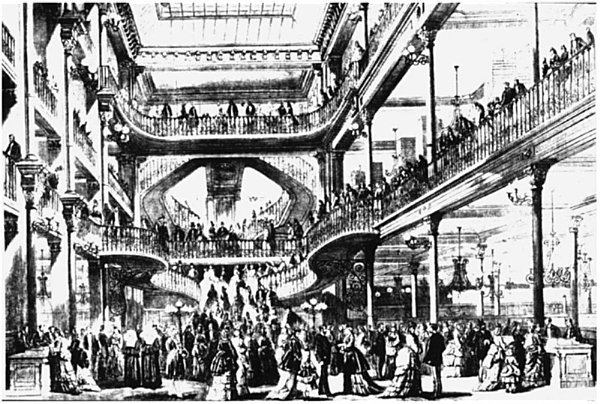
Plate 14.1 While many Europeans eagerly entered the ‘age of consumption’, symbolized by the new phenomenon of the great department stores, such as the Parisian ‘Au Bon Marché’, here shown as it was in c.1870, others preferred to look back to times they thought more ennobling.
Source: Centre for Art Historical Documentation, Nijmegen, the Netherlands
Burckhardt’s private opinions – some of them clearly dated, some of them still relevant, most of them fascinating – can be gleaned from his correspondence. Some of them he expressed in his letters to his friend Hermaun Schauenburg, written in the fateful years 1848 and 1849, when revolutions occurred all over Europe because the new elites wanted more power and asked for more democratic rights – for themselves, only – while the common people simply hoped for improvement of their wretched living conditions in industrial society. These were also the years in which Karl Marx’s Communist Manifesto (1848) was widely read and discussed. Burckhardt, betraying the continued fascination of Europe’s intellectuals with the classical cultures of the Mediterranean, noted:
I think I can detect a look of silent reproach in your eyes, because I am off so light-heartedly in search of southern debauchery, in the form of art and antiquity, while in Poland everything is going to pieces and the messengers of the Socialist Day of Judgement are at the gates. Good heavens, I can’t after all alter things, and before universal barbarism breaks in (and for the moment I can foresee nothing else) I want to debauch myself with a real eyeful of aristocratic culture, so that, when the social revolution has exhausted itself for the moment, I shall be able to take an active part in the inevitable restoration…. Just you wait and you will see the sort of spirits that are going to rise out of the ground during the next twenty years! Those that now hop about in front of the curtain, the communist poets and painters and their like, are mere bajazzi [clowns, PR], just preparing the public. You none of you know as yet what the people are, and how easily they turn into a barbarian horde … We may all perish; but at least I want to discover the interest for which I am to perish, namely, the old culture of Europe …
I hope for nothing from the future … for I am of the opinion that democrats and proletarians, even though they make most furious efforts, will have to yield to an increasingly violent despotism, for our charming century is made for anything rather than for real democracy.
Some 20 years later when, in the 1870s, Europe was, indeed, once more in turmoil as a result of the terrible war between France and Germany – the first ‘industrial war’, waged with weapons of mass destruction never before seen or used – Burckhardt wrote to hisfriend Friedrich von Preen:
The two great intellectual peoples of the continent are in the process of completely sloughing their culture, and a quite enormous amount of all that delighted and interested a man before 1870 will hardly touch the man of 1871…. The worst of all is not the present war, but the era of wars upon which we have entered, and to this the new mentality will have to adapt itself. O, how much the cultured will have to throw overboard as a spiritual luxury that they have come to love! And how very different from us the coming generation will be…. Anything that has to live on must contain a goodly portion of the eternal. And if anything lasting is to be created, it can only be through an overwhelmingly powerful effort of real poetry. To me, as a teacher of history, a very curious phenomenon has become clear: the sudden devaluation of all mere ‘events’ in the past. From now on in my lectures, I shall only emphasize cultural history …
Those who arranged those things [i.e. the Franco-German war] could all read, write and even compose newspaper articles and other literature. And the ones in Germany … are no less educated. But just look at England, bursting with wealth, and secretly kept in a state of siege by analogous elements! Up until now, for two hundred years, people in England have imagined that every problem could be solved through freedom, and that one could let opposites correct one another in the free interplay of argument. But what now? The great harm was begun in the last century, mainly through Rousseau, with his doctrine of the goodness of human nature. Out of this, plebs and educated alike distilled the doctrine of the golden age that was to come quite infallibly, provided people were left alone. The result, as every child knows, was the complete disintegration of the idea of authority in the heads of mortals, whereupon, of course, we periodically fall victim to sheer power. In the meanwhile, the idea of the natural goodness of man had turned, among the intelligent strata of Europe, into the idea of progress, i.e., undisturbed money-making and modern comforts, with philanthropy as a sop to conscience…. The only conceivable salvation would be for this insane optimism, in great and small, to disappear from people’s brains. But then our present-day Christianity is not equal to the task; it has gone in for and it got mixed up with optimism for the last two hundred years….
One of the principal phenomena which you emphasize reveals itself as clearly as can be in Switzerland: a flight from the risks of business into the arms of the salary-paying state is manifest in the fact that the moment farming is in a bad way the numbers who want to enter classes for teachers increases. But where on earth is it to end … Here in Basel we are now faced again with disbursements of two millions for new schools buildings! It’s a single chain of related facts: free instruction, compulsory education, a maximum of thirty per class, a minimum of so and so many cubic metres per child, too many subjects taught, teachers obliged to have a superficial knowledge of too many subjects, etc. And, naturally, as a result: everyone dissatisfied with everything, a scramble for higher positions, which are of course very limited in number. Not to mention the absolutely insane insistence upon scholarship that goes on in girls’ schools…. It may even be that the present educational system has reached its peak, and is approaching its decline.33
Inevitably, all over Europe urban life became more complex, representing an assault on man’s senses: the crowdedness and filth of the smog-infested cities, where proper sewage systems were still often lacking, which meant that such epidemics as cholera claimed huge numbers of victims because human waste entered drinking water; the rampant prostitution and the consequent effects of venereal disease; the insecurity of the job market and the sense of a society constantly changing and on the move.
By the end of the nineteenth century, in the more industrialized regions of Europe, the elite’s well-informed self-interest slowly, indeed, very slowly, resulted in improved working conditions in the factories as well as in better housing. Also, both the hospital and the medical service were now re-organized and extended. Large-scale vaccination campaigns were launched against such epidemic diseases as smallpox; initially, they aroused emotional, political and religious reactions revealing the widespread revulsion against the ways in which government and science increasingly invaded man’s private life; indeed, it must be admitted that such policies did contribute to the growth of the power both of governments and of the medical profession, while, in retrospect, the health effects of the campaigns were debatable. Nevertheless, these developments have contributed to that aspect of European culture that has made medicine part and parcel of both the modern state and of modern society, with the latter, increasingly, relying on the former to deliver the ‘health services’ people now feel are their right.34
Also, some forms of insurance against illness, accident and old age were introduced – in Germany as early as the end of the nineteenth century. This and other, related, developments marked the final transformation of a society based on charity as a voluntary act to a ‘social state’, where the right to a minimal level of material comfort was guaranteed to every citizen. It was, perhaps, the major development that, besides increased overall prosperity and increasing political rights – and, of course, as a consequence thereof – came to distinguish European societies from those in the other worlds.35 Admittedly, the industrial elite did not always adopt these changes of their own volition. Indeed, the ongoing social revolution was markedly influenced by the labour movement.36
One of the results of industrial action was that holidays were introduced for the labouring classes, albeit only a few days a year. Now, people started to save some of their hard-earned money to spend on an outing. They wanted to leave the overcrowded towns for the fresh air, deemed beneficial even if taken only for those few days. Actually, fresh air became they very symbol of escape from real and imagined illnesses, caused not only by the filth of factory towns and the terribly unhygienic living conditions, but also by ‘stress’, although the word had not yet been invented. Hence, people increasingly travelled to the mountains or the seaside.37 Those who were better off could afford to be pampered by doctors and nurses in health resorts, mostly watering places that offered cures for each and every disease. Consequently, Europe is still dotted with spas, the monuments to a bourgeois society’s growing concern with disease, real and imagined.
Within the context of both Romantic notions of nature and the need to escape from urban civilization, a new, far more positive attitude towards the natural environment developed, in which the erstwhile disdain for and fear of the countryside as something wild, untamed and uncontrollable was replaced by the feeling that only here the real life could still be lived, that only here man would find inspiration for really great visions and actions.38 It was a notion visualized, especially, in landscape painting, which now tended to present man in the context of a ‘sublime’, awe-inspiring nature. Among the more daring and artistic, walking holidays, unheard of until that time and still looked upon with amazement by the working classes, became fashionable. Soon, the educated classes began to stress the view that if the labouring class could but experience nature, it would be a much-needed civilizing experience as well, that would keep them from their main, disturbing pastimes: drink and sex. In the process, Europeans also developed their passion for zoos and for pets. For of course, the animals that inhabited this sacred natural world should not be chased and killed, but lovingly protected. Taking a pet also meant bringing something of nature into one’s own city-based existence. Soon, the animal world was highly sentimentalized, especially in children’s stories, where it was presented as a ‘mode’ for the values that should structure the human world.
Even though, for most Europeans, a real vacation was still limited to one or two day-trips a year, the more affluent citizens already took their holidays for two or three weeks. It was the wheel that turned this leisure revolution: both the wheels of the steam train, which permitted mass travel over long distances from the 1840s onwards and, by the end of the nineteenth century, the introduction of a safe and manageable bicycle which gave people greater mobility within their more immediate surroundings and revolutionized their thinking about space and time, immediacy and distance. Indeed, for many, bicycle tours became their first contact with a wider world.
All over the more prosperous parts of Europe, people came to think of leisure as both a symbol of status and a necessity of life: from the end of the eighteenth century onwards, consumer demands and consumption patterns increasingly revolved around free time, a commodity both scarce and expensive. The more leisure one was able to show, the more one moved away from the working poor, the lowest and largest group on the social scale.39
However, leisure time had to be filled and even regulated. If people became bored, they would only be tempted to start drinking or indulge in promiscuous sexuality or in wild games, all of which would lead to social unrest and chaos, specifically among the working classes: the culture of the people meant disorder. That, at least, was the argument of the mainly bourgeois political and social leaders who now controlled Europe’s cities.40 This resulted in a number of new cultural phenomena.
The well-to-do citizens – the men but also their wives, who were considered the natural keepers of civilized life – began to stage all kinds of activities to civilize and discipline the ‘lower classes’. Temperance societies were formed to combat the demon of drink. Cookery classes taught women from these lower classes to be proper housewives according to the bourgeois model; it would help them to provide a welcoming home both for their husbands, who would be less inclined to go from the factory directly to the pub and spend their hard-earned wages on drink, and for their children, who would be reared in more congenial surroundings, and be taught to be proper citizens.
Obviously, all these activities were meant to help keep a tight rein on the large group of underpaid labourers who were suspected of the most shocking behaviour, which made them a potential threat both to the social and the political order. In 1825, the Prefect of the Rhône department in France wrote:
I learned that men and women were sitting around a table in a separate upper room and … said indecent things and sang songs no less obscene. At dessert, everyone undressed completely. Paired off in couples, they proceeded to simulate the ceremony of marriage. One of them dressed in certain derisive garments … and married a couple in a parody of the religious ceremony of the Church. After … a sermon, the couple went into an adjacent room to consummate ‘their marriage’. Afterwards they returned to wipe each other off. These ceremonies, as shocking as they are sacrilegious, continued as many times as there were couples to be joined in this scandalous manner.41
Concern for such and other forms of disorderly and indecent behaviour led civil and ecclesiastical authorities to collaborate in the transformation of all kinds of traditional popular pastimes. Thus, they tackled the phenomenon of the annual fairs and carnivals, which, according to bourgeois observers, always occasioned public drunkenness and, worse, the open manifestation of sexual acts. Precisely these two phenomena were felt to destabilize the family bond, the basic value of order that authorities held in high esteem. Therefore, such manifestations as fairs and ‘kermisses’ were sometimes banned completely, as was the case in many Dutch towns at the end of the nineteenth century. Often, however, the ‘pillars of society’, recognizing the need for popular relaxation, sought to give these festivities another, more controllable slant, focusing on religious processions and on such elevating activities as amateur theatricals, musical contests, flower shows and so on.42
Hence, in the same vein, importance was now attached to organized sports. They, too, could help to keep the ‘mob’ from the streets and out of the pubs where they would only create mischief. Moreover, participating in sports would imbue them with team spirit and, generally, incline them to a healthy way of living and thinking. The nineteenth century being the ‘age of nationalism’, celebrating the glory of ‘King and Country’, of la Patrie or of the Vaterland, in most countries the State, aided by the Churches, demanded the obedience of its subjects, if necessary to the point that they would be willing to give their lives for it. Social discipline was considered a basic civic virtue – and sport an excellent means to that end. Soccer especially soon became popular, not least among factory workers. Yet the game soon turned into an outlet for all kinds of suppressed aggression. Berlin’s most authoritative newspaper around the turn of the century, the Vossische Zeitung, warning against the situation in Britain, reported on 23 April 1895:
The losses of the football season 1894/5 during the past six months already amount to no less than 20 people killed, as well as several hundred badly wounded. However, it seems that only 10 per cent of the actual mishaps has been reported….
Quite deplorable is the custom, increasingly normal, to attack the umpire with bricks and iron bars when his decisions elicit the anger of the competing teams. Often, the public readily joins in, which means that the police, who are present at each match, cannot restore order. I know of English firms whose employees, on being hired, have to promise not to spend their leisure time playing football, as the number of accidents after the matches prevents the regular conduct of business.43
The well-to-do enjoyed sports as well, but not the same ones as those played by the labouring poor. Like all forms of culture, sports, too, have a specific status and a specific cultural value. In the eighteenth century, boxing was, to a certain extent, an elite sport, because aristocrats enjoyed watching it, often employing the contestants and at times even joining in themselves. In the nineteenth century, however, it became one of the ‘common’ sports. In the first decades of the nineteenth century, football was an elite sport, played mainly by the boys of English public, i.e. private, elite schools. At the end of the century, it became another ‘common’ sport. In the first decades of the twentieth century, hockey and tennis were elite sports, but after the Second World War ‘everybody’ entered the fields and the courts.
In short, all forms of culture that filled the free hours of the nineteenth century provided status and showed differences of status. But as the example of sports shows, in this fast-changing industrial society, the status of cultural forms changed equally fast, with the various social groups trying to find new ways of distinguishing themselves as older forms of culture were appropriated by other groups.
Factory and other blue-collar workers flocked to those theatres which, besides offering music hall and vaudeville shows, with bawdy songs and risqué scenes, also provided the highly popular genre of melodrama, packed with simple, recognizable emotional conflicts set in often improbable intrigues; the inevitable, though often equally improbable happy endings were judged sentimental and, worse, even morally corrupting by the bourgeoisie who were highly suspicious of these forms of ‘low brow’ culture.44 They, in their turn, participated in those forms of public entertainment that provided status through their association with upper-class culture. Thus, ‘high-brow’ theatre continued to flourish, as did public reading rooms and the public lectures provided by scientific societies – a phenomenon that significantly contributed to the popularization of science, reinforcing the belief that this was, indeed, an era of progress. Indeed, it was this science that endorsed such physical notions as high brow and low brow in the first place and made them into stigmatizing characteristics – the high forehead being associated with intelligence or culture, because the upper classes were considered to have experienced a different development from the labouring poor with their low, almost animal-like foreheads.
Important developments took place in musical culture, too. Music had been part of European civilization for ages: the ‘popular’ music of the fairs and taverns, and the drawing-room music performed and enjoyed by the bourgeoisie and the aristocracy, besides, of course, the oldest music, that of the Church. The distinction between the three was far less than the present-day cult of classical, or serious, music might lead one to presume. Indeed, aristocratic opera and Church music were often constructed on the basis of popular, profane tunes, and court songs were whistled in the streets. However, although there were public concert halls in most European capitals – the seventeenth-century English diarist Samuel Pepys is forever telling us what he heard and saw in the London playhouses where music was played as well – their size was relatively small.
With the revolutions of the late eighteenth century, many court musicians, used to composing and performing for princes or wealthy private patrons – e.g. Joseph Haydn was employed by successive heads of the Eszterhazy family, one of the Habsburg Empire’s most powerful dynasties – had to find new means of earning a living.45 As the bourgeoisie, growing in number and with cultural aspirations of their own, were keen on good music, too, the step from the court theatre or court opera to the grand concert hall open to an increasingly numerous general public was not a big one. Thus, the first grand concert halls were built around the turn of the eighteenth to the nineteenth century. Not incidentally, they revolutionized European music: the size of the audiences necessitated composing on a grander scale, resulting in an increase both of the size of the orchestra and of the reach and pitch of the various instruments. Thus, Beethoven’s symphonies were composed for and heard by a larger public than, for example, Mozart’s.
It was a public who often enjoyed what it was offered but never forgot that attending these occasions gave status, too, showing that one was a culturally minded person. Audiences started to listen in silence. Having paid for the pleasure – or simply to be publicly seen imbibing ‘culture’ – they thought they should treat it as something special. And, in contrast to the aristocracy, who had considered musicians no better than servants, and music a divertissement, which should not interrupt polite conversation, the bourgeoisie, less secure, were afraid to speak. But the main change was that people increasingly looked upon music as an art, even as a religion, rather than an entertainment.46 Indeed, some cultural historians feel that as the actual power of Christianity, of the Churches, fell, the power of music, romantically conceived as expressing all that was best in nature and man, rose, to become a ‘substitute religion’.
Indeed, music, like reading, provides interesting clues to this development, especially within the context of the bourgeois cult of domesticity. For now the drawing room became the actual as well as the symbolic shrine of a culture whose specific task it was to instil the household and the family with the norms and values of this class. Reading, for example, the hundreds of ‘romantic’ poems set to music mostly for the drawing room by a composer like Franz Schubert (1797–1828), one of the most gifted musicians of the early nineteenth century, one detects the hopes and fears of this bourgeois society: a longing for love and a happy marriage; and a craving for solitude; the need to escape from the bustle of urban life into the fields and mountains, and the joy or melancholy born from a union with nature, with a God sometimes still manifestly present, but at other times unrecognizably hidden in the vastness of the cosmos.47
But besides this inward-looking romanticism, music, especially vocal music, was often the medium for expressing the values of a society not only bourgeois but also nationalistic: satisfied with its economic and political progress, in operas, cantatas and songs it often extolled the nation’s glorious past in rousing melodies or obliquely commented upon Europe’s superiority vis-à-vis the other worlds.48
One of the major questions raised by the changes of the nineteenth century is how the values of an urban middle class came to dominate the majority of the population. Between the early decades of the nineteenth and the early decades of the twentieth centuries, the transformation of parts of Europe from a rural into an industrial society and, moreover, into an urban or rather middle-class culture was inaugurated by the massive move of people from a slowly emptying countryside to fast-growing and even overflowing towns. Inevitably, for several generations, increasing numbers of Europeans were confronted with and bombarded by the norms and notions held by the bourgeoisie, whose affluence was a powerful stimulant for all those who sought to escape from poverty.
Great changes were brought about by the various civilizing, disciplining cultural policies successfully employed by the elite as described above, as well as by the increasing power the consumer economy of the towns came to hold over large sections of urban society. More important, however – for subconsciously, worlds were merging as well, they introduced the predominance of bourgeois morality in European society at large. Undoubtedly, the huge groups of male and, even more, female domestic servants were one of the main channels through which bourgeois family values slowly trickled down into the labouring classes, values epitomized in the ideal image of the non-working, mothering wife. Servants were also confronted with the growing taboo of sexuality in these middle-class households, where everything connected with intercourse and the childbearing process was becoming shrouded in secrecy. Besides the connotation of animal-like and thus non-human, i.e. non-civilized, behaviour, the bourgeoisie assumed that the seductions of sexuality pursued outside the restrictions of the marriage bond were a disruptive force, for men as well as, but perhaps even more so, for women. J.J. Virey, a widely read French medical publicist of the 1860s, revealingly wrote of the ideal coupling as one between:
the most female woman and the most virile man, when a dark, hairy, dry, hot and impetuous male finds the other sex delicate, moist, smooth and white, timid and modest. The one must give in and the other is constituted to receive … to welcome, to absorb, out of a sort of need and feeling of deficit, the overflow of the other.49
Obviously, such representations of ideal sexuality, sanctioned by science – for by now medicine was definitely a science, and one increasingly demanded and, hence, respected as well – could not fail to influence people’s expectations and behaviour. Men were allowed their evenings ‘on the town’, their drinking and smoking societies, and their liaisons, albeit reluctantly, for the notion of the ‘double standard’ was certainly not as universally accepted as has been suggested. Women, however, had no such distractions. The often intensely religious middle classes felt that the only outing becoming a respectable female was the daily walk to church or, perhaps, but then accompanied by a servant, a visit to dispense charity to the poor. Also, women were increasingly desexualized. As the guarantors of procreation and thus of the sacred family, they were idealized as innocent of the ‘ways of the world’ – always meaning, of course, the male world, which they still served as self-effacing wives and mothers, as the natural keepers of the house. Slowly, such notions were introduced to and, moreover, interiorized by the working classes of Europe’s urban, industrial regions.
Money and time, goods and leisure: towards a consumer culture
Besides the need for leisure – which increasingly became both a status symbol and a psychological craving – the ‘culture of things’, the acquisition of highly visible possessions remained a powerful expression of status. Never before had so many European houses been packed with so many useless objects.50
Not surprisingly, this was the century of the department store. These showcases of consumer culture proclaimed that, now, luxury goods were within everybody’s reach, the material expression of the new democracy.51 In 1883, the famous French author Émile Zola (1840–1902) published hisAu Bonheur des Dames, one of a series of novels in which he aimed to provide a sociologically correct picture of the conditions of contemporary life. He had actually carried out research in and among the staff of one of Paris’s grand new shops, the Bon Marché. Surprisingly, the technicalities of retailing he discovered and described seem as pertinent today as they were at the end of the nineteenth century. Probably because its subject matter struck a chord in the people inhabiting the changing townscape of England, too, it was the first of Zola’s novels to be translated into English, asThe Ladies’ Paradise (1883). The novel opens with a scene showing a young girl and her two brothers who have left the country for the big city, Paris. Wandering around, overwhelmed by the bustle of the metropolis, they try to find their uncle’s house. Suddenly, they come upon a palace-like building, all encased in glass, attracting the eye to all kinds of goods that seem to lure people inside. One of the windows shows, artistically presented, dozens of silk umbrellas, another item of luxurious ladies’ wear. The youngsters gape at this unaccustomed spectacle of beautiful apparel. Showering the reader with an avalanche of consumer goods – as did and do, of course, department stores shower their customers – Zola makes plausible that, at this moment, the girl must have decided to try to ‘make’ it in Paris, to be able to enter this mega-store as a customer herself. She had been sold to consumer culture, as her brothers had been:
Denise had walked from the Saint-Lazare railway station, where a Cherbourg train had landed her and her two brothers … all three fatigued after the journey, frightened and lost in this vast Paris.
But on arriving in the Place Gaillon, the young girl stopped short, astonished.
– ‘Oh! look there, Jean,’ said she … ‘that is a shop!’
They were at the corner of the Rue de la Michodière and the Rue Neuve-Saint-Augustin, in front of a department store whose windows shone with bright colours, in the soft October light….
This, to her, enormous place, made her heart swell, and kept her excited, interested and oblivious of everything else. The high plate-glass door, facing the Place Gaillon, reached the first floor, amidst a complication of gilded ornaments. Two allegorical figures, representing two laughing, bare-breasted women, unrolled a scroll bearing the sign ‘The Ladies’ Paradise’…. The establishment comprised, beside the corner house, four others…. It seemed to her an endless extension, with its display on the ground floor, and the plate-glass windows, through which could be seen the whole length of the counters….
Denise was absorbed by the display at the principal entrance. There she saw, in the open street, on the very pavement, a mountain of cheap goods – bargains, placed there to tempt the passers-by, and attract attention … the establishment seemed bursting with goods, blocking up the pavement with the surplus.
… following the shop windows and stopping at each fresh display … they were captivated by a complicated arrangement … an exhibition of silks, satins and velvets, arranged so as to produce, by a skilful artistic management of colours, the most delicious shades imaginable.
… just as she was entering the street, Denise was attracted by a window in which ladies’ dresses were displayed … and the dresses were in this sort of chapel raised to the worship of woman’s beauty and grace …
‘How stunning they are,’ murmured Jean, finding no other words to express his emotion…. All this female luxury turned him rosy with pleasure.
Essentially, since the beginning of industrialization proper at the end of the eighteenth century, cultural critics have discerned two situations, creating two basic problems for European civilization. After more than two centuries, these problems have lost nothing of their topicality.
On the one hand, some theorists reasoned that as the higher wages made possible by increasing employment and production would enable people to meet basic needs, the demand for leisure could increase and, moreover, be fulfilled. However, this posed the moral problem of the anarchy of undisciplined time. On the other hand, the emulative desire that many observers deemed structural in Europe and that was stirred by increasing luxury would spur additional effort. This, though, would lead only to a wholly work-driven society, based largely on false needs.52
At the end of the eighteenth century, Jean-Jacques Rousseau, as always reasoning within the, ultimately false, premises which he set by positing his small-scale république as man’s normal political and social context, had prophesied that the problems would be solved by communal discipline.53The Scottish philosopher David Hume meanwhile had pleaded for individual self-control.54 However, in the mid-nineteenth century, John Stuart Mill argued that the affluence brought by industrialization would lead to a democratic culture of leisure.55 Many other thinkers, both liberal and socialist, followed him, differing only in their selection of the agency that would help achieve this goal: the State or the individual himself. The polarity between these two posed problems of balance that became manifest in other fields of culture as well. It has been worrying both politicians and social and cultural critics up to the present day.
Dossier: War and Peace
Travelling some 200 kilometres south of Moscow one might come upon the sleepy village of Jasnaja Poljana, remarkable only for a country house that, though of modest size and pretentions, still attracts many visitors. A state museum since 1921, it is a site of pilgrimage for all those who, Russian or non-Russian, want to feel the presence of one of Europe’s greatest writers ever. For here, Count Lev, or Leo, Nikolajevitsj Tolstoy (1828–1910) was born, and buried. Here he researched, wrote and rewrote what, by any standards, must be considered one of the masterpieces of world literature, the monumental novel ‘Voyna i Mir’, War and Peace.56
The first of two themes specifically referred to the terrible reality that the people living in the space called Europe had experienced since time immemorial. Perhaps more than anything else, war has been a constant in their existence till as recently as, in north-western Europe, the 1940s and, in south-eastern Europe, the 1990s. Caused by power-seeking leaders, or by economic and demographic constraints, or a combination of the two, and aggravated by religious and/or nationalistic ideologies, wars ravaged the countryside where, till the end of the nineteenth century, most Europeans lived, unprotected by the walls that gave a modicum of safety to the towns and their burghers. Villages were burned, women and children raped, boys and men killed, harvests plundered, and when the soldiers had moved on, epidemics might begin that, together with the negative consequences of (male) depopulation for agriculture, left entire regions devastated for decades.
Plate 14.2 A page of the manuscript of Tolstoy’s War and Peace, with the author’s many corrections.
Source: The Tolstoy Museum, Moscow
During the entire seventeenth century there was not a single year when parts of Europe did not suffer the depredations of war. The first half of the eighteenth century showed relative quiet, since, by that time, the politicians of Europe’s many states had created a ‘system’ of international treaties, mainly concluded during the peace conferences of Rijswijk (1696) and Utrecht (1713). They realized these would give their peoples some much needed rest. While these governments may not have acted from any humanitarian motives, they certainly did consider fiscal constraints: peace was necessary to ease the heavy financial burden that wars meant for the treasury – especially when expensive loans had to be negotiated – which, in its turn, negatively affected both economic prosperity and social and political stability.
However, by the 1750s the Seven Years’ War, sometimes termed the ‘first world war’ since it spilled over into Europe’s overseas colonies in Asia and the Americas, ended the few decades of peace again. From the early 1790s onwards, revolutionarydevelopments in France erupted into a series of wars that engaged most European states. These wars were continued by the man who took power in 1799, Napoleon Bonaparte, and crowned himself ‘Emperor of the French’ in 1804 – a ruthless and callous dictator on the one hand and, on the other, a man to whose grandiose visions present-day Europe owes many of the ideas that make it function as a ‘community’. In 1812, the ‘grand army’ in which the emperor had assembled soldiers both from France and from the countries he had conquered – estimates range from 450,000 to 600,000 – marched against the incredibly vast empire of the czar, though on the Russian side only some 200,000 men were engaged.
Plate 14.3 The battle at the village of Borodino (1812) that sealed the fate of Napoleon’s Russian campaign and figures prominently in Tolstoy’s novel. Some 70,000 soldiers died.
On finally reaching the old capital, Moscow, Bonaparte realized his campaign was a colossal as well as a terrible mistake, due to, among many other factors, impossible logistics, the winter weather, etc. Perhaps as many as four-fifths of his soldiers died, and uncounted Russians perished as well, both military men and several hundred thousand civilians. The episode marked the beginning of Napoleon’s end which came, three years later, with the battle of Waterloo. Soon, in Russia, the memories of ‘the great war’ took epic proportions. Indeed, the czarist empire now emerged as a major European power, ruled, ever more autocratically, by successive members of the Romanov-dynasty though in fact they descended from German princelings.
Looking back, Leo Tolstoy, who had first-hand experience of a more recent terrible war, the one in the Crimea (1853–6), decided he needed to somehow capture and analyse the essence of his country’s emotions in the years preceding and during the Napoleonic invasion – from 1805 to 1812. Researching all kinds of historical documents, including eye-witness accounts, and also interviewing people who had actually lived through those years, Tolstoy toiled away at his text between 1862/1863 and 1869. The final result amounted to some 1,200 pages in the first published edition.
Though we now think of War and Peace as a novel, in the introduction the author himself described it as ‘not a novel, even less … a poem, and still less a historical chronicle’. Indeed, many readers and critics have seen it as a ‘philosophy of history’. I would argue that it is, also, a critique not only of other philosophies of history – primarily the one propounded by the German philosopher Georg Hegel (1770–1831) – but of history writing itself.
Yet, despite its sometimes very long digressions on all kinds of abstract topics, War and Peace is definitely a novel, too, telling the complex, interwoven tales of a few protagonists, with their loves and hates, from five extended aristocratic families – such as Tolstoy himself belonged to – and of a huge cast of subsidiary characters. One of the main arguments that emerges from the often convoluted descriptions of the vicissitudes of all these people, and of mankind in general, is, that though many people profess to act rationally, in reality they do not. Therefore, Tolstoy argues, we would be wrong in describing their actions as such because, thus, we misinterpret ‘history’. Rather, people follow instincts that are deeply recessed in the human mind, though these may yet turn out to be successful. Through love or through (near-)death, some of Tolstoy’s main characters consciously experience the falsity of life as lived by the dictates of culture and society, and then go on to do the right thing – for Tolstoy is, also, a moralist.
He depicts all his subjects as part of the seemingly ‘grand history’ that, for Russia, evolves during the Napoleonic campaign and that, in a more general sense, is the stuff most history books are filled with. He feels historians are wrong in always attempting to describe and explain events, and their outcome, in terms of the various leaders, in this case Napoleon, his opponent Czar Alexander, and the French and Russian generals. Tolstoy argues that none of them is the grand man favoured by historians as a ‘maker’ of history. Therefore, he tries to show all of them as ordinary people, insecure and yet proud. Almost inevitably, he sets out primarily to unmask Napoleon, the man who had made a myth of himself, and had been mythologized by others, especially by Hegel, who had seen the emperor in 1806, at the height of his power, and considered him the embodiment of God’s presence in history. In the novel, Napoleon is shown as a self-important but not very intelligent person. For Tolstoy, he also epitomizes the French culture that had affected the Russian elite and, thus, altered the country’s true cultural identity, diminishing its innate strength.
Indeed, and here Tolstoy again contradicts Hegel, all these men are not even real leaders, for all their boasting of strategies and goals, of patriotism and benevolence only conceals their real helplessness given the many imponderables that dictate the life of man – in their case specifically the inertia of the masses they need to help them achieve what they say they want to realize.
Actually, Tolstoy feels that history is ‘made’ by these masses – in Russia the peasants serving the nobility on their huge estates; the peasants who were also commandeered for the army. According to him they are people who act at a very basic level of survival. Inevitably, they are preconditioned, if not, perhaps even determined, by primary factors of nature such as the (un-)availability of food, the weather, etc. They are real also because they have no grand ideas about themselves, no self-importance. If ‘great men’ exist at all, they are the ones who ‘listen’ to these people: field marshal Mikhail Kutuzov, the aristocrat Pierre Bezukhov, the visionary Platon Karatejev. At the same time, Tolstoy shows his spiritual side when he stresses that ‘the common people’ are nearest to the workings of the spirit, of ‘God’ – whom he seems to equate with what he strongly believed to be the ‘essence’ or soul of Russianness.
Finally, War and Peace can be read as a plea for the brotherhood of all mankind. Yet, the reader is left with the question of how this ever can be achieved, given Tolstoy’s outspokenly pessimistic views of the role of leaders and, also, of the state, which he held to be ‘a conspiracy designed not only to exploit, but above all to corrupt its citizens’.