
Europe and its expanding world
Although the notion of ‘the Columbian exchange’ seems to suggest that in the wake of Columbus’s ‘discovery’ momentous developments took place only on both sides of the Atlantic Ocean, because of the interaction between Europe and the new world of the Americas, yet the continued and, indeed, increasing interaction with Asia produced important changes in the old Eurasian world as well.1
From the sixteenth century onwards, the European maritime merchants who established trading posts all around the Indian and Chinese seas both satisfied and stimulated a European demand for Asian products such as chinaware, silk and spices. In the process, they slowly began to influence production and, consequently, the way of life of the producers in India, Indonesia and Ceylon. For in order to improve their control of supplies, they tried either to conquer or otherwise to dominate the production areas or, indeed, decided to transfer production to such regions as were under their power already. Thus, from the seventeenth century onwards, one finds the Dutch, English and French colonial companies shipping seeds all over Asia, planting them where they could be profitably grown. An unintentional but sometimes devastating process of ecological change set in; its long-term consequences for the world’s biological and climate situation are even now difficult to determine.
It found its most poignant expression perhaps when, after their discovery in the 1770s, the islands of the Pacific Ocean were colonized. Whereas the first European visitors had described them as the ‘last paradise’, the true ‘garden of Eden’, the next generation turned these delicately balanced ecosystems into plantation societies with the sole function of producing fruit for the western market. Obviously, the introduction of these monocultures had serious social implications as well, changing power relations among the native population and all the values that went with them.
From the early seventeenth century onwards, something comparable happened in a region that had long remained at the margin of Europe’s contacts with the wider world. The Russian tsars and their entrepreneurs, while turning to the west for its culture, started an eastward expansion to provide their realm with an economic base outside agriculture. The vast steppes stretching from the Ural Mountains to the Chinese Sea produced the furs that, as ‘black gold’, gave the rulers of Muscovy the wealth and, thus, power they sought. In a series of colonizing waves, sometimes prepared by the explorations of well-organized scientific expeditions, the Russians extended their power over this region, until in the 1720s they reached the Bering Straits, named after the Dane Vitus Bering, one of the explorers. They then crossed the Straits – as, some 30,000 years earlier, the Asian ancestors of the native Americans had first done – hoping to be able to colonize not only Alaska but also the entire coastal region of the North American Pacific. In this effort they were thwarted by the competition of the British and the Spaniards. Meanwhile, however, by toeing the line which separated their growing empire from the northern borders of China, and by playing off the scattered tribes who inhabited the sparsely populated region of Siberia against each other, using their gunpowder superiority, the Russians succeeded in subjugating the region, politically and economically. To help them do so they convinced themselves, as so many other European nations did, that they had a mission, that civilizing Siberia was their manifest destiny.2 They turned it into a colony which, besides furs, now began to yield its enormous mineral riches as well. In the process, which was often as cruel as any of the European conquests in the south and north Americas, slowly but inexorably, traditional society disappeared.
Still, it would be unhistorical to blame European expansion for all the evil that befell the world, as many environmentalist campaigners would have it. Thus, for example, the great famines which devastated many of the world’s tropical regions from the sixteenth to the end of the eighteenth centuries were caused by the occurrence of a so-called ‘little draught age’, in consequence of the oceanic movements that control fluctuations in the global climate.3
Europe and Latin America: a severed relationship?
For two centuries, the Spanish and Portuguese governments had succeeded in protecting their overseas territories against their European rivals in the colonial market, relatively easily at first, later only at great military expense which, towards the middle of the eighteenth century, no longer balanced the profits. The Iberian governments, moreover, were afraid that the indigenous population, especially in the peripheral areas of the empire, where Spanish and Portuguese power was barely effective, would unite with their European competitors, especially England and France: such crucial areas as Florida and, indeed, the entire Pacific coast could not really be defended without depleting the treasury. Therefore, by the mid-1750s, Spain in particular embarked upon a new phase of expansion.
This time, however, policy-makers in Madrid decided that costly military campaigns and the ensuing need to maintain expensive garrisons would not realize its aims. Looking at the colonial policies of the other European nations, which accomplished great results through commerce rather than conquest, men like the powerful minister Campomanes and the Viceroy Galves hoped for a peaceful incorporation of these territories. Trade with the Indians, to accustom them to all kinds of goods, among which especially alcohol, would soon bring them within the colonial consumer market and ensure their cooperation. Also, in the spirit of the Enlightenment which now pervaded part of Spain’s governing elite, it was thought that it was more humane and, indeed, propagandistically opportune if the Indian nations should ally themselves freely to a civilized, enlightened empire which offered to protect them against possible enemies and which, now almost as an afterthought, would also bring them Christianity. In the ensuing process, many Indian tribes settled down to agriculture and trade, and their territories were eventually incorporated, while, of course, their culture was deeply affected.
All this meant a marked departure from Spain’s earlier colonial policy, but as a new beginning it still came too late. It did not really solve Spain’s grave financial and military problems. Nor did it lessen the pressure European commercial competition, now especially from England, put on the Iberian colonies. Finally, Spain and, though less so, Portugal, also had to counter the growing protests of the descendants of the original settlers of Central and Latin America, the erstwhile emigrants. The latter now considered the colonies their ‘own’ country, theirs to rule and enjoy. Indeed, they began to resent being administered and taxed by Madrid and Lisbon and, like the European-descended elites of Britain’s former 13 North American dependencies, began to voice definite ideas about self-government. In all American colonies, the educated classes had perhaps studied the political notions of the Enlightenment even more eagerly than the reformers in Madrid and Lisbon, or, for that matter, in London. This contributed to a climate in which the long-standing links between European centres and their colonial peripheries seemed decidedly less stable than they had been in the preceding centuries.
Consequently, the ‘Atlantic revolutions’ of the period between the 1770s and the 1830s which, among other things, resulted in the birth of the United States, were also felt in Central and South America. Virtually all former Spanish and Portuguese colonies fought for or were reluctantly given their freedom. During the seventeenth and eighteenth centuries, the protectionist–imperialist policy had considerably weakened the economic and cultural contacts between the Iberian part of the new world and the non-Iberian parts of Europe, with the consequence that Europe had largely lost its interest in the region. Now, the newly independent countries eagerly grasped their chance to open up to economic and cultural influences from non-Iberian Europe. Yet at first there was no marked increase in European emigration on a scale as great as that to North America. The main reason was that the new states soon proved to be no sensational economic success, while the new political structures did not inspire much confidence either.4 The hot and humid climate also failed to attract the many potential emigrants who, after all, mainly came from the somewhat cooler north and west of Europe. Finally, they found the dominant role of the Catholic Church in these areas equally unattractive.
But even Roman Catholics, for instance from the Dutch and Belgian provinces of Brabant and Limburg that began to supply an amazing number of priests, monks and nuns to the worldwide missionary efforts of the Roman Church, felt less than stimulated by the often unexciting reports from the missionaries who had gone to Latin America in the 1820s and 1830s to strengthen the Christian belief among the Indians and black Africans in the Dutch territories, especially when the slave trade was finally abolished. As, in the same period, Dutch and Flemish priests did report with great enthusiasm about the freedom and hope held by the wide prairies of the American north, the choice for prospective missionaries was not a difficult one.5
During the course of the nineteenth century and in the first decades of the twentieth century, emigration to Central and South America did increase, especially from the poor regions of Europe’s Catholic south, now hit by the effects of overpopulation and non-industrialization. Yet, for the time being this did not result in a renewed fascination with and a resulting cultural influence of that part of the new world on the elites of the old. Actually, it was only the new wave of artistic exoticism which swept Europe in the second half of the twentieth century that created a market for, mainly, the literary products of the intriguing cultural blend which had developed in Latin America from the fusion of European-Christian, Indian and African elements into a civilization of blacks, reds and whites; the novels of such authors as the Argentinian Jorge Luis Borges (1899–1986) and the Colombian Gabriel García Márquez (1928–2014) became especially popular. The former often explored the intricate workings of a culture’s memory; the latter, for example in his Cien años de soledad (One Hundred Years of Solitude) (1967, 1970), which became a worldwide bestseller, gave an almost mystical allure to this mixed culture. Thus, these writers, descended from European colonists but actually voicing a new, complex cultural tradition, were creating the new as well as undoing the old mythologies necessary to structure their, and indeed any society, as had their colleagues in the American north.
The ‘old’ world and the ‘new’: North America as a vision of freedom
In 1776, the revolt of Britain’s North American colonies against the government in London and the independence that followed gave the former colonists a new self-awareness. Moreover, they were also liberated from the restrictions posed by a number of rules established by parliament, including those that had been devised to stop their westward expansion into protected Indian territory beyond the demarcation line established in 1763 in the Ohio valley. The endless, still largely unknown interior was now open to European settlers hungry for land, and the ideals which people like Benjamin Franklin had projected onto the pretended empty space now appeared realizable. Echoing the biblically motivated ideology of expansion voiced by the seventeenth-century immigrants, in 1792, General Benjamin Lincoln declared that:
When I take a view of this extensive country … I cannot persuade myself that it will remain long in so uncultivated a state; especially, when I consider that to people fully this earth was in the original plan of the benevolent Deity … if the savages cannot be civilized … the whole race shall become extinct.6
The new nation’s vision of itself became popular in Europe as well. Those who, during the upheavals which drastically changed the political and economic situation in large parts of western Europe between 1790 and 1830, sought an ideology to legitimize the political revolutions, did so also by reflecting, often in a sincere though highly uncritical way, on the admirable actions and ideas that had shaped the foundation of the United States. For the sake of convenience, these people forgot – just like the leading Americans themselves liked to do – that the American form of government of the first decades after the declaration of independence of 1776 was, in fact, aristocratic-oligarchic rather than democratic; some would argue it has continued to be just that, with more than a touch of plutocracy mixed in.
Nevertheless, more and more Europeans were allured by visions of freedom and space, of unlimited possibilities, of escape from the restrictions of the old continent still associated with decadence and rigid structures. For though the wealth of Europe greatly increased as a result of fast-paced industrialization, the process frequently brought great misery to the lowest strata of its growing population.
Many, if not all, of the above elements were described in the Letters from an American Farmer which, first published in London in 1782, soon after its translation into other European languages, became very influential in creating an idealized image of North America. In his dedication, the author, Hector St John, writes: ‘You viewed these provinces of North America in their true light, as the asylum of freedom; as the cradle of future nations, and the refuge of distressed Europeans’.7
Besides containing very realistic analyses, St John’s description of life in the former colonies, which had recently begun their existence as an independent nation, resounds with a clearly Arcadian undertone presenting the dream of Eden, or its re-creation as a new, perfect world, to all those European readers whose enthusiasm made the work into a ‘bestseller’. A few quotations illustrate his vision:
we convert huge forests into pleasing fields, and exhibit through these thirteen provinces so singular a display of easy subsistence and political felicity…. Here nature opens her broad lap to receive the perpetual accession of new corners, and to supply them with food…. Here we have in some measure regained the ancient dignity of our species; our laws are simple and just, we are a race of cultivators, our cultivation is unrestrained, and therefore everything is prosperous and flourishing.8
Elsewhere, St John explains the reasons why most Europeans have made and continue to make their momentous crossing:
The instant I enter on my own land, the bright idea of property, of exclusive right, of independence exalts my mind…. No wonder we should thus cherish its possession, no wonder that so many Europeans who have never been able to say that such portion of land was theirs, cross the Atlantic to realize that happiness.
However, with a prophetic glance, he indicates why the arguments for emigration could well change in the near future, as in the United States, too, the industrial economy will gradually eclipse the agrarian, rustic, noble way of life:
As it is from the surface of the ground which we till that we have gathered the wealth we possess, the surface of that ground is therefore the only thing that has hitherto been known. It will require the industry of subsequent ages, the energy of future generations, ere mankind will have leisure and abilities to penetrate deep, and, in the bowels of this continent, search for the subterranean riches it no doubt contains.
Equally prophetic is another pronouncement:
Many ages will not see the shores of our great lakes replenished with inland nations, nor the unknown bounds of North America entirely peopled. Who can tell how far it extends? Who can tell the millions of men it will feed and contain? For no European foot has as yet travelled half the extent of this mighty continent.
However, the inhabitants of the old continent will always be happier in the new:
In this great American asylum, the poor of Europe have by some means met together…. Everything has tended to regenerate them; new laws, a new mode of living, a new social system; here they are become men: in Europe they were as many useless plants … and were mowed down by want, hunger and war.
In short, America gives man, the European, the intensely longed-for perfection: ‘Americans are the western pilgrims, who are carrying along with them that great mass of arts, sciences, vigour, and industry which began long since in the east; they will finish the great circle’.
In a simpler form, this eloquently articulated message, the verbal depiction of the American or, rather, the European dream of discovery, exploration and conquest occurs in the enthusiastic stories told by many other emigrants. From the late eighteenth century, the dream induced more and more inhabitants from the old world to try their luck in the new. ‘There are always dreamers on the frontier’, wrote the American novelist Willa Cather in O Pioneers! (1904),9 her famous evocation of the life built up by Swedish migrants in the new world. It was these European emigrants who actually gave the United States its present contours. It was they who, in wave after wave, flooded across America, often in conjunction with economic calamities, political unrest or religious disputes in Europe. It was they who slowly shifted the frontier of the United States westwards, until in the 1860s even the Rocky Mountains were no longer a hindrance and the coast of the Pacific Ocean could now be conquered, too, from the Spanish, English and Russian merchants, soldiers and farmers who had settled there in the preceding century.10
In the latter decades of the nineteenth century, the flow of immigrants reached gigantic proportions. For many European countries, emigration to North America was a phenomenon of great economic and cultural significance although this was not appreciated for a long time.11 It is splendidly articulated in Vilhelm Moberg’s four-part epic Romanen om Utvandrarna (The novel about the migrants), in which he sketches, on the basis of extensive research of the sources, the historical and psychological circumstances behind this process as it took shape in late nineteenth-century Sweden. He probes into the tension between the lack of freedom in the old and the very real freedom in the new land – a freedom, however, which also poses existential choices: should one work for individual development or for the welfare of society?12
Capitalism and consumerism: freedom or slavery, progress or decadence?
By about 1870, the United States had reached its present extent and enormous parts of the country, certainly in the mid-west, had indeed been re-created as an agrarian ‘paradise’ that now seemed to reflect the vision of Hector St John and so many others. Some five decades later, however, the dream of Eden, at the hands of the new settlers themselves turned into the nightmare when the over-farmed plains changed into a barren dust bowl.
Meanwhile, on the east coast, industrialization had started at such a rate that the USA quickly became an economic giant on a scale hardly equalled by any European state or even by Europe. Yet, for the ever-increasing flow of emigrants, among whom were a growing number of farmers’ sons from central and eastern Europe, American agriculture no longer had jobs to offer. They had to content themselves with low-paid industrial work: in the iron, steel and meat factories, in the coalmines and in the construction of railways. The same held for the numerous Jewish emigrants, who fled eastern Poland and the Ukraine, the region between Warsaw and Odessa, where they had been ‘parked’ by the Russian empress Catherine in the eighteenth century. Especially since the mid-nineteenth century, when they became the victims of new waves of the still widely prevailing anti-Semitism, in the form of gruesome pogroms, they left the bleakness of life in the old world hoping to find their promised country in the new world as well.
The same factors which contributed to the tempestuous expansion of American industry – a very liberal fiscal system and very liberal legislation – contributed to a situation wherein the labouring poor were hardly protected, if at all. For countless people who, often persuaded to do so under false pretences by unscrupulous ‘dealers in human beings’, boarded the badly equipped ships that would transport them across the ocean, the dream they had cherished quickly turned into a nightmare after their arrival in the ‘Promised Land’.
The reports that the nineteenth-century immigrants sent home to the old world and which, often sentimentalized, began to fill popular magazines as well as the popular drama in which ‘the rich uncle from America’ or glowing stories about the new life of the emigrants quickly became favourite themes, certainly did not always reflect their true feelings about the situation they found themselves in. Indeed, many were ashamed to confess they had not been able to realize their dream, or still clung to the hope they might yet improve their situation.
Often, novelists succeed in vividly depicting the atmosphere of a certain period where other contemporaries fail to do so. The American author Upton Sinclair, after sound research and partly on the basis of interviews, wrote a fierce but to many of his readers entirely convincing indictment of the inhuman conditions in Chicago’s meat-processing industry, where so many who had recently arrived from Europe had accepted a job in order not to die of starvation. In The Jungle, published in 1906, the hero, a farmer’s son from Lithuania called Jurgis, considers ‘that he would go to America and marry, and be a rich man in the bargain. In that country, rich or poor, a man was free, it was said’.13 But the cruel fact soon appeared that:
it was a land of high prices, and that in it the poor man was almost as poor as in any other corner of the earth; and so there vanished in a night all the wonderful dreams of wealth that had been haunting Jurgis.14
Chicago, ‘Packingtown’ in the novel, is a cold, damp and poisonous hell, where some 30,000 people, including children, toil in the meat factories, often for more than ten hours a day, for seven days a week, wading in the blood of the thousands of slaughtered, frequently diseased animals which, in the most horrifyingly unhygienic conditions, are processed into food that will subsequently endanger the health of countless consumers. Hundreds of thousands directly or indirectly depend on this kind of work for their livelihood. They are exploited, just like Jurgis and his family, by unscrupulous landlords, corrupt police officers and cunning tradesmen who tamper with the food they sell for high prices. If people become ill they are dismissed without mercy and, if things become worse, they die of hunger and cold. Consumption, as well as alcohol, claim their victims. When Jurgis, sick of it all, decides to improve his lot by joining a labour union he quickly notices that, rather than deciding his own fate, he has now become a mere tool in the hands of unscrupulous politicians. It is not long before he is among the many who hate the city ‘with an all-inclusive hatred, bitter and fierce’. He also observes how one wave of emigrants after the other only results in mutual intolerance instead of creating solidarity. One evening, returning home after being forced to participate in a successful attempt to deceive a group of factory inspectors, he realizes ‘how those might be right who had laughed at him for his faith in America’.
And yet, despite the often wretched circumstances which many immigrants had to live in, for countless people in Europe ‘America’ remained a magic word, the land par excellence where what definitely could not be reached at home could, apparently, be realized: prosperity and freedom. Thus, continued misery in the old world, as well as continued idealizing reports about the new world, combined with often consciously misleading propaganda on the part both of the American government and private entrepreneurs, went a long way to convince people to embark on the journey of their life.

NEW YORK, 1909: HERBERT CROLY (1869–1930) INTERPRETS ‘THE PROMISE OF AMERICAN LIFE’
In 1909, Herbert Croly, an American journalist and the founder-editor of the influential periodical The New Republic, published a widely read pamphlet entitled ‘The Promise of American Life’. In this tract, he voiced both his criticism of the state of contemporary culture and society in the United States and the hopes he yet held for the future if the dangers of excessive individualism, consumerism and, yes, even democracy were adequately met. Precisely because comparable developments took place in Europe, too, the text has a significance that transcends the American experience.
All the conditions of American life have tended to encourage an easy, generous, and irresponsible optimism. As compared to Europeans, Americans have been very much favoured by circumstances. Had it not been for the Atlantic Ocean and the virgin wilderness, the United States would never have been the Land of Promise. The European Powers have been obliged from the very conditions of their existence to be more circumspect and less confident of the future. They are always by way of fighting for their national security and integrity. With possible or actual enemies on their several frontiers, and with their land fully occupied by their own population, they need above all to be strong, to be cautious, to be united, and to be opportune in their policy and behaviour.
… We were for the most part freed from alien interference, and could, so far as we dared, experiment with political and social ideals. The land was unoccupied, and its settlement offered an unprecedented area and abundance of economic opportunity….
The moral and social aspiration proper to American life is, of course, the aspiration vaguely described by the word democratic; and the actual achievement of the American nation points towards an adequate and fruitful definition of the democratic ideal. Americans are usually satisfied by a most inadequate verbal description of democracy, but their national achievement implies one which is much more comprehensive and formative. In order to be true to their past, the increasing comfort and economic independence of an ever increasing proportion of the population must be secured, and it must be secured by a combination of individual effort and proper political organization. Above all, however, this economic and political system must be made to secure results of moral and social value. It is the seeking of such results which converts democracy from a political system into a constructive social ideal; and the more the ideal significance of the American national promise is asserted and emphasized, the greater will become the importance of securing these moral and social benefits. The fault in the vision of our national future … consists in the expectation that the familiar benefits will continue to accumulate automatically…. But this is no longer the case. Economic conditions have been profoundly modified, and the American political and social problems have been modified with them. The promise of American life must depend less than it did upon the virgin wilderness and the Atlantic Ocean, for the virgin wilderness has disappeared, and the Atlantic Ocean has become merely a big channel. The same results can no longer be achieved by the same easy methods….
If the fulfillment of our national promise can no longer be considered inevitable, if it must be considered as equivalent to a conscious national purpose instead of an inexorable national destiny, the implication necessarily is that the trust exposed in individual self-interest has been in some measure betrayed. No pre-established harmony can then exist between the free and abundant satisfaction of private needs and the accomplishment of a morally and socially desirable result. The promise of American life is to be fulfilled – not merely by a maximum amount of economic freedom, but by a certain measure of discipline; not merely by the abundant satisfaction of individual desires, but by a large measure of individual subordination and self-denial…. The traditional American confidence in individual freedom has resulted in a morally and socially undesirable distribution of wealth…. The existing concentration of wealth and financial power in the hands of a few irresponsible men is the inevitable outcome of the chaotic individualism of our political and economic organization, while at the same time it is inimical to democracy…. A more highly socialized democracy is the only practical substitute on the part of convinced democrats for an excessively individualized democracy…. Democracy may prove to be the most important moral and social enterprise as yet undertaken by mankind; but it is still a very young enterprise, whose meaning and promise is by no means clearly understood.15
Europe and ‘America’: a cultural symbiosis, or the growth of the ‘western world’
Even during the colonial period, the more prosperous colonists and their descendants periodically returned to the old world, i.e. mainly to England, frequently to complete their schooling there. However, at the end of the eighteenth century, besides England – which, in the meantime, had become greatly mistrusted – France was the new place to go to: particularly Paris, the city of the ‘enlightened’ intellectuals, the centre of European civilization, a town not to be missed if one wanted to return to one’s colonial world as a person of culture.
But whereas such trips were the perks of the colonial elite, during the course of the nineteenth century, in the United States, too, a prosperous middle class developed in this successfully industrializing economy. Now, this group also sought the benefit of a cultural formation in the same tradition that for centuries had formed the European elite; a journey to Europe, now including Italy as well, became a sort of ‘Grand Tour’ for many Americans, the rounding-off of their education. In the tale of his travels, the well-known writer Washington Irving (1783–1859) sighs:
Europe held forth the charms of storied and poetical association. There were to be seen the masterpieces of art, the refinements of highly cultivated society, the quaint peculiarities of ancient and local custom. My native country was full of youthful promise: Europe was rich in the accumulated treasures of age. Her very ruins told the history of times gone by, and every mouldering stone was a chronicle.16
Irving was not the first and certainly not the last to enthuse thus over the old world. As emigration from Europe increased, more and more emigrants and especially their descendants thought about Europe as the land of the past; despite the often unhappy memories attached to it for the first generation, the second- and third-generation immigrants often wanted to visit the land where their roots lay. Moreover, American intellectuals in particular developed a vision of a Europe that was the embodiment of a millennial tradition of culture as a challenge to their creativity. Often feeling their own society to be constricted by Puritan norms, they also saw Europe as the land of freedom – a notion that is, of course, fascinatingly complementary to the reasoning that for centuries had caused so many European emigrants to make the crossing.
Many American artists and writers began to seek their inspiration in the old world. Henry James, for example, painstakingly chronicled in most of his novels the mutual fascination and antagonism of cultured Europeans and Americans. Still, both these intellectuals and the self-made billionaires who, like the Carnegies, the Morgans and the Rockefellers, spent fortunes buying European art and antiques, were criticized or even ridiculed by many on both sides of the ocean, albeit for different reasons: the majority of Americans rebuked their Europhile compatriots for failing to make an effort to create a true, indigenous culture rather than ape the old world, whereas Europeans mocked them for their manners and their crass belief in the power of money. And yet the phenomenon did contribute to a growing cultural rapprochement between the two worlds. The numerous affluent and educated Americans who, since the second half of the nineteenth century, made a long or short trip to Europe, did contribute to the formation of a positive image of the United States as well.
This context as well as the wealth shown by a number of sometimes only recently arrived immigrants and the position of power which the new state quickly achieved, by the end of the nineteenth century, explains both why and how the USA came to present a challenge to Europe more than ever before.
For those in the old world for whom progress in particular was measured in economic terms, America was the pre-eminent example of a ‘modern’, i.e. also a progressive, country; indeed, in European public opinion, especially in many (pseudo-)scientific and popular publications, the new nation was presented as a society both enviable and worthy of emulation. Thus, for many, America mirrored a very positive idea: it was the perfect state, pairing regulated spiritual freedom with high material development and thus also with civilization.
This admiration and the increasing economic interaction between North America and (western) Europe slowly led to a situation in which, in a number of fields, both cultures began to show marked similarities and looked upon each other as being closely related, democratic societies which, essentially, strove for the same values. To man in Europe, the coastal regions of the North Atlantic continued their own culture and economy: a new unity had been created which, in common parlance, soon became known as the ‘western world’.
To the ‘heart of darkness’: Europe and Africa
Well into the seventeenth century, Europe’s knowledge of sub-Saharan Africa had been restricted to the scant information it could obtain from the coastal forts built to enable slave-traders, merchants looking for gold and missionaries to do their work; indeed, few Europeans dared venture into the unknown, unhealthy interior. The slaves, mostly procured by indigenous rulers specializing in this ‘commodity’, and then sold to European companies, were sent to the Americas;17 the gold went into financing Europe’s increasing trade with Asia; and according to the missionaries, the souls of those who converted to Christianity went to heaven. Otherwise, European ships hopping from Portuguese fort to Dutch port on the so-called Gold and Slave coasts of Africa’s western half, and then proceeding to the Dutch colony at the Cape of Good Hope and the Portuguese towns on the east coast of Mozambique, only saw Africa as an inhospitable continent they passed on their way to the riches of Asia.
By the end of the eighteenth century, this situation changed. On the one hand, the leaders of the European economy became aware of the possibilities of Africa both as a producer of raw material to be used by and as a market for the finished products of their industry. At the same time, the slave trade, which had uprooted many millions of black Africans, transporting them to the plantations of the Caribbean as well as of the American continent, came under increasing attack. Both ‘enlightened’ humanists and Church-related groups, especially in Protestant Europe, now started condemning a practice that caused such indescribable misery. Soon, campaigns were staged to provide public support for a Europe-wide effort to root out the problem. This, however, meant that the situation in Africa’s interior would have to be explored, to provide the data which the so-called ‘abolitionists’ needed to convince their governments that action should be taken. Many governments eagerly assented to officially support fact-finding expeditions, partly for humanitarian reasons, partly however because they saw this as a marvellous opportunity to get to know the continent better and thus create possibilities for extending their economic power.
The slave trade and, later, slavery itself, were only abolished in the course of the nineteenth century. In the process, mission and trading posts had been established along Africa’s rivers; the two were often complementary, for, as in South America two centuries earlier, many missionaries realized that the ways of Christ did not necessarily run parallel to the ways of the Mammon, and, therefore, started protecting ‘their’ negroes from the corruptive influences of soldiers and traders. It was not long before, in an outright ‘scramble for Africa’, fully fledged colonies were staked out by the major European powers. These now included imperial Germany which, after its political unification in 1870, decided it should be a colonial player as well; indeed, like the other industrializing nations, it increasingly needed the African markets as much as the German missionaries, both Protestant and Catholic, needed the African souls.18
Yet, it would be altogether too simple to present Africa as the silent victim of Europe’s predatory politics. Much like in those regions of Asia and the Americas where Europeans had succeeded in establishing colonial rule in the seventeenth and eighteenth centuries, in Africa, too, they were successful only because local rulers often used the colonizing agencies as much as the latter used them, trying to implicate them and their superior weapons in their age-old power games. The small group of Europeans who for barely more than a century ruled large parts of Africa were able to survive only because local elites, for manifold reasons of their own, cooperated.
Nevertheless, the upheaval caused by European colonial rule – certainly in Africa but, indeed, all over the world – was enormous. In economic terms, it sometimes created ecological change, which then led to famine and disease. In social life, it caused the disruption of traditional communities and societies. And, of course, there was upheaval in the cultural sphere. Thus, for example, European notions of clock-regulated time, of decent behaviour, beginning with decent clothes, and of work discipline were introduced to make Africans into willing workers and subjects, as well as Christians. However, one might also argue that the intrusion of Europe in Africa, and elsewhere, opened up roads for local elites to empower themselves, if only by appropriating the ideological and political tools of Europe. Definitely, in many areas – though, perhaps, least so in Africa – larger groups now gained some prosperity, more than ever before.
Meanwhile, in Europe, many who would never visit Africa nor, perhaps, knew that many of the things they ate or wore were made of the materials produced by Africans, once more had to adapt their view of the world to include yet another world. They were informed, first, by the tales told by missionaries and widely published – certainly also in the popular press – to serve as propaganda for the conversion policy of the Churches. Soon, scientific studies, especially in the newly defined branch of anthropology, were popularized, too, catering for Europe’s desire for the exotic. They described a world full of creatures who might or might not be entirely human – were they not, perhaps, the embodiment of some stage between ape and man? As many missionaries, in their eagerness to get to know the region and its cultures, acquired a vast amount of information, in a way that made them proto-ethnographers or anthropologists, the resulting images were often mixed, creating a complex vision of the so-called Dark Continent and of its inhabitants.19
For a long time, many Europeans continued to hold extreme views. As early as 1864, the Anthropological Society of London debated the desirability of the extermination of the lower races, especially the African ones. When, in 1897, the German anthropologist Friedrich Ratzel published hisPolitische Geographie, it contained the same ideas, which were later eagerly adopted by the leaders of Nazi Germany.20 Indeed, from the 1860s onwards, the advance of evolutionist theories in the wake of Darwin’s epochal study inevitably helped to strengthen such views.
Finally, by the end of the nineteenth century, the notion that black Africans were some sort of wild animals was discarded by more enlightened Europeans. Nevertheless, native cultures were still depicted as ‘primitive’, sometimes with the same connotation of innocence that had once been applied to native America. During the late nineteenth and early twentieth centuries it was debated whether the process of evolution, instead of being interpreted negatively as if proving the backward species had no place in progressive society, should be positively advanced by education which, of course, meant Christianization. Others, for various reasons, did not want to embark upon such schemes, if only because educated Africans might come to resent European colonial rule as, of course, they eventually did. Often, those cultures of Africa that had been Islamicized were judged rather more harshly than the regions where animism reigned, the latter being seen as more receptive to the preaching of the Christian Gospel. Inevitably, in some regions the very introduction of that Gospel did increase the problems between native Islamic and native Christian groups.
Despite the many instances of individual Europeans working to their heart’s content among their ‘chosen’ Africans, European public opinion often continued to stigmatize the people of Africa as stupid, lazy, addicted to alcohol and indulging in open sexuality. Perhaps even more than had been the case in Europe’s perception of the other worlds it had encountered, the peoples of sub-Saharan Africa came to embody the emotions and actions which Europeans, precisely because they were now entering upon the ‘bourgeois’ phase of their culture, increasingly considered socially unacceptable and, therefore, morally evil. Consequently, they felt they had to combat these vices, if only to be able to continue believing that their own culture was, indeed, superior.
Meanwhile, the fact that, at the turn from the nineteenth to the twentieth century, many who belonged to Europe’s artistic and musical ‘avant garde’ developed a decided penchant for the very ‘primitivism’ of African culture, for its emotionality which they saw as so much more in tune with the essence of being human than the over-refined, restrictive civilization of contemporary Europe, did little to alter the perception of the masses, who mostly thought these expressions of high culture an aberration or, even, a betrayal of European artistic values.
The ‘old’ world and the ‘older’ world
During the sixteenth and seventeenth centuries, the ‘new’ world, due mainly to the lack of effective resistance of indigenous societies and the demographic catastrophe that followed the first contacts, had been conquered and had become the embodiment of Europe’s hope that paradise on earth might yet be found, or that at least the promised land could be built there. Africa was conquered too, in the nineteenth century, but was barely used for the large-scale resettlement of Europeans. Asia, however, sharing Europe’s biologicaland bacteriological makeup and, moreover, ruled by powerful empires, for a long time resisted any easy conquest.
True, the Dutch had built their commercial rather than colonial empire in the East Indies, replacing the Portuguese, and the Spaniards retained their hold over the Philippines. Further expansion, however, did not prove easy. Japan, still traumatized by the Mongols’ efforts at invasion in the twelfth century, had become afraid not only of firearms but also of Christianity as an ideological weapon which might be used by indigenous rebellious magnates – as had actually been the case after their introduction by the Portuguese in the latter half of the sixteenth century. Consequently, from the 1640s onwards, the shogunal government of the Tokugawa family closed its islands completely to all foreigners except the Chinese and the Dutch who were, however, allowed to live only in close confinement on two tiny artificial islands in Nagasaki Bay.21 Nevertheless, the Dutch managed to see quite a bit of the country and, in a series of important books published in the seventeenth and eighteenth centuries, presented its history and culture to a highly appreciative European audience;22 at the same time, the Japanese used the Dutch to become acquainted with those aspects of European culture they considered useful, such as medicine and some of the new sciences.23
China, too, successfully rebuffed any efforts made by European powers to enter the Middle Kingdom beyond the great port of Canton, where porcelain, silk and tea were traded.24 Only the Christian missionaries, and especially the Jesuits, were allowed to try to convert the Chinese. Their impact was minimal, but in order to gain material and moral support for their policies among the faithful in Europe, they spread highly one-sided, euphoric accounts of China as a society and a civilization uniquely worthy of Europe’s attention. Indeed, it lacked only Christianity to be truly admirable, but the conditions to impose the Gospel were favourable, for the Christian priests felt that in the Confucian system of reverence for the gods – perhaps even the one God – and for the well-ordered family and the all-powerful state, China did have its share of proto-Christian ideas and values.25
If only for the relative mystery surrounding these two civilizations, Europeans, little aware of the actual state of affairs there, tended to idealize Chinese and, to a lesser extent, Japanese culture. Enlightenment intellectuals like Voltaire, highly critical of political and social conditions at home, and not hindered by profound knowledge of the realities of the Chinese political and social system, held it up as an example to the, in their opinion, backward monarchies of Europe.
The British, too, desiring to dominate the huge market of China from their Bengal commercial base, began to force their way into the Heavenly Empire by, among other means, the illegal import of huge quantities of debilitating opium. In the early decades of the nineteenth century, this resulted in violent controversy and, soon, in outright wars. Due to the military and technological superiority of the UK, the Chinese came out the losers, being forced to accept a series of highly humiliating treaties. From the 1840s onwards, the British and, in their wake, other western powers began their systematic economic exploitation of China. In the process, many in the western world lost their erstwhile admiration for Chinese civilization.
After being, as American historians like to claim, forcefully opened up to the western world, and thus to modernity, in 1854 Japan, in order to escape a similar fate to China, embarked upon a remarkable policy of agricultural renewal as well as of industrial and technological ‘westernization’. Y. Fukuzawa, one of the participants in the investigative missions sent out to explore and understand the factors that contributed to the success of the ‘West’, in his Conditions in the West (Tokyo 1866) concluded that the westerners were not intrinsically cleverer than the peoples of the ‘East’ but were definitely more rational and, because of that, valued ‘clever people’ more, people who then tended to work for progress and power. Emulating what they saw and applying what they learned, the Japanese succeeded in keeping their economic and political independence as well as, in a way, earning the reluctant admiration of the western world, precisely because they so successfully aped its material achievements. Moreover, many artists of fin-de-siècle (turn-of-the-century) Europe, looking for new concepts and ever willing to be lured by the exotic, were inspired especially by Japan’s woodblock art and its painting, as can be witnessed from the works of some of the impressionists and expressionists, such as Paul Gauguin (1848–1903) and Vincent van Gogh (1853–90);26 more specifically it was the ‘essentialist’ tendency which came from the Zen variety of Buddhist philosophy that now captured the western imagination. Soon, many Europeans who sought spiritual renewal in a world they felt increasingly devoid of any of the higher ideals turned to precisely these ‘Eastern’ philosophies, though they might only partly understand them.27
Perhaps the most amazing phenomenon in the continued interaction between Europe and Asia was the way Europe and, at a later date, the United States reacted to India. Until the eighteenth century, the vast subcontinent, too, remained largely outside European influence. By then, however, the French and, more successfully, the English had begun to encroach upon the crumbling Mogul Empire. Meanwhile, ever since the late sixteenth century, Roman Catholic missionaries had tried to convert the Hindus. Confronted with a stubbornly resistant culture, they had found out about the existence and power of India’s sacred writings, the Vedas. As these were written in Sanskrit, a language kept secret by the caste of priests, the Brahmins, many missionaries tried to master it one way or another. Though they partly succeeded in doing so, their results were not widely publicized in northern Europe. At the end of the eighteenth century, the servants of the English and French colonial companies, also confronted with indigenous culture and society, experienced the same desire. Finally, a few managed to learn the language. From the 1780s onwards, the Vedas, theUpanishads and such ancient Indian epics as the Mahabharata were translated into French, English and German, and created a veritable craze.

Map 15.1 Major spheres of European cultural influence, c.1800
Also at the end of the eighteenth century, Sir William Jones, himself a senior civil servant in the British colony of Bengal, though certainly not the first to formulate the idea, was the first to publicize the notion of Sanskrit being the oldest language on earth, the mother of all major languages of Eurasia, including Greek, Latin and all the Germanic ones. Written in the ‘oldest’ language, the Sanskrit texts were also considered to contain the oldest knowledge of things material and spiritual. Consequently, at many European universities professorships of Indology were established, studying the philology and the literature of India, as well as its religion and philosophy. Soon, the idea of a common linguistic origin was further elaborated in the scientific systematization of the now so-called Indo-European languages – including Persian and Sanskrit – which assumed them to be the offspring of one ‘proto’ Indo-European language. Therefore, Indian and European culture shared the same roots. As, however, Indian civilization had retained many of its pristine forms, indeed, had kept its childlike innocence – surely another sign of its great antiquity – many felt it to be a source to return to, to be drunk from in an effort to revivify European civilization as well.
Many of the theories supporting this view, from the late nineteenth century onwards were at least partly confirmed by archaeological research indicating the diffusion of culture into Europe and western Asia from a region covering parts of present-day Iran, Afghanistan, northern India and Asian Russia. It was not long before the notion of an ancient ‘Aryan’ people who had been the creators of all the major civilizations of the world – emphatically excluding the world of Islam – entered the European conscience. The idea was highly popular in England as well as in Germany, but also found adherents in other countries. In retrospect, one must conclude that the ensuing ‘Indian Renaissance’ was, in large part, an enchantment with origins, European society’s romantic and revealing search for secure roots.
The second part of the nineteenth century shows elements of Indian culture being introduced into western literature and music, often shallowly but sometimes creatively. More important was the way in which Hinduist Indian philosophical notions – and in their wake also Buddhist ideas – about the essentials of man’s self and his relation to the cosmos crept into European philosophy. Thus, for example, Arthur Schopenhauer, using Indian philosophical concepts, came to maintain that all human reality was maya (illusion) only, the projection of man’s mind, the one reality, brahman; yet he also reasoned that this individual essence was part of the world-soul, atman.
To many, the culture of India, sometimes indiscriminately mixed with other oriental civilizations – Japan being perhaps the favourite one – was seen as less one-sidedly rationalistic than ‘the European mind’. It fed their craving for a new spiritual dimension, which in their opinion Christianity could provide no longer. The foundation, in 1875, of the Theosophical Society, which tried to reconcile western scientific thought and eastern holistic visions is but one of its many manifestations. In their own way, the ‘hippy movement’ of the 1960s and the New Age ideas of the 1980s showed the continued attraction other cultures held for Europe. Interestingly, by now, the culture of the native Americans, too, was felt to have retained man’s essential earth-bound force as well as being hailed as an example of an ecologically viable way of life.
Meanwhile, by the early nineteenth century, the Islamic Near East had become an area of actual European expansion as well, for the first time since the Crusades. Though ‘God’s Shadow on Earth’, the sultan at Istanbul, who still claimed to rule it as the Prophet’s heir, held only nominal authority, as his power had been steadily eroded by regional potentates since the seventeenth century. Internal weakness had come along with external pressure. For in the same period, the Ottoman Empire had grown important to European trade. Indeed, by the eighteenth century, its economy was partly run by Dutch, English and French firms, aided by Greek Christian middlemen. The reason the Ottoman world started acquiring even greater importance in the early nineteenth century was, of course, because through it ran a number of the vital overland routes linking Europe to its Asian colonies. Moreover, its Balkan provinces were becoming the battleground of two major expansionist European powers, the Austro-Hungarian monarchy and tsarist Russia; the latter was not only creating its eastern empire, but also strove for ice-free harbours in the Mediterranean. Consequently, all European powers which had a stake in south-eastern Europe, the Levant or central Asia were now interested in further weakening the sultan’s power.
This economic and political interest ran parallel to and was often reinforced by a two-fold cultural factor. On the one hand, the Christian Churches from the early nineteenth century onwards experienced a revived interest in the Holy Land as the region where their religion had originated and, perhaps, would reach its fulfilment – might not Christ return there on Judgement Day? Partly connected with this movement, biblical scholarship, increasingly influenced by positivistic scientific thinking, sought to prove the holy book’s literal truth by engaging in extensive archaeological research.28 On the other hand, parallel to the discovery of India, the notion that perhaps Europe’s culture was not based only on Graeco-Roman antecedents created a new fascination with the world of the ancient Near East. Its languages and its literature now became widely studied, often in combination with the newly discovered languages of central and eastern Asia. The first scholarly periodical devoted to oriental studies was founded in Vienna, in 1808, by the ‘father’ of Ottoman studies, Joseph von Hammer-Purgstall.
While, undeniably, many scholars were deeply fascinated by the new worlds that opened up for them, such learned journals as Hammer’s Fundgruben des Orients as well as the slightly later French venture, Journal Asiatique, also show the growing interrelationship between oriental studies and the colonial policies of the European states: not surprisingly, Russia concentrated on the languages and cultures of central Asia, while England almost exclusively studied those of India. French scholars developed a specialism in Near Eastern and Indo-Chinese studies, still hoping to create an oriental empire there, after having lost their Indian possessions to Britain.
The knowledge about the cultures of Asia and the other continents was not gathered only by scientific explorers and other scholars. It was helped considerably by the greatly increased number of travellers who, sometimes with the aid of modern technology but often braving regions where conditions were still very primitive, reached the far corners of the earth. By the end of the nineteenth century and in the first decades of the twentieth century, for the first time in history Europeans could boast that they had ‘discovered’ the entire earth. From the impenetrable rain forests of the Amazon to the unscalable heights of the Himalayas, Europeans, whether economic adventurers, empire builders, expedition leaders, journalists or just more than normally enterprising tourists brought home their tales.
Also for the first time in history, a sizeable group of these travellers were women. Often they went to escape the restrictions of genteel life as an unmarried ‘maid’ or, worse, a divorced wife in Europe, travelling either on the basis of some slender private means or even trying to finance their expeditions by writing up and publishing the stories of their experiences, catering to the ever-growing market for exotic tales. Whatever their background or motives, they, too, contributed to Europe’s growing knowledge of the world while at the same time creating an alternative vision of European womanhood, suggesting that a woman could, after all, do the things only men were supposed to do.29
Thus, it was not only Henry Stanley who travelled to the heart of Africa, or the Swede Sven Hedin who crossed the Gobi Desert. The equally intrepid Scotswoman Isabella Bird journeyed along ‘unbeaten tracks’ to the northernmost parts of Japan and became one of the first Europeans ever to live among the Ainu tribes. The Dutch noblewoman Alexandrine Tinne first ventured into the Sudan and then moved among the Tuaregs. And French-Danish Alexandra David-Néel claimed to be the first woman to have entered Lhasa, Tibet’s forbidden city on the ‘Roof of the World’, where no Europeans had set foot after a handful of Jesuit and Capuchin missionaries who, without much success, had tried to bring Christianity there in the eighteenth century.
Irrespective of the gender of their authors, the majority of travel tales, both literary and scholarly, reflected European attitudes and values and stressed the superiority of European culture in all its respects, often sketching the world of the ‘others’ as timeless, or even stagnant and backward.30The ‘sketching’ should be taken literally as well, for the nineteenth century was the first period in European history in which considerable numbers of artists left their own world to travel. The few painters who had gone to Dutch Brazil in the seventeenth century, and who had accompanied Captain James Cook on his epochal voyages of discovery in the Pacific Ocean in the 1770s, had been the exception rather than the rule; moreover, in these early ventures artistic and scientific observations were clearly mixed.31 Now, many artists left on extended trips, concentrating, however, on the Near and Far East. A wave of orientalist painting showed the new fascination for the brilliant light and, consequently, the equally brilliant colours created by the Orient’s glaring sun. In the themes they chose, these painters also showed the dreams that they as well as their buyers had, and which Europe’s increasingly industrialized, regulated society could no longer satisfy: dreams of a lost world, of a simpler life, of greater passions and of unrestricted sexuality.
Undeniably, such texts and, also, such paintings, idealizing and objectifying the Orient and all of Europe’s ‘other’ worlds gave further argument to all those who were of the opinion that the East was neither modern nor progressive, and that Europe had a civilizing mission towards the rest of mankind. Yet a minority showed not only an increased interest in but also a growing awareness of the fact that these cultures, though they might be superficially different, were still somehow equal and even fundamentally the same. Friedrich Schlegel, for a few years the driving force behind a journal called Europa, in his Ueber die Sprache und Weisheit der Indier (On the Language and Wisdom of India) (1808), was one of the first scholars to alert Europe to the culture of India. He wrote:
Now that in the history of peoples Europeans and Asians form one big family, Asia and Europe one inseparable area, we should try to see the literatures of all civilized peoples as a continuing cultural development, one tightly constructed building; this will allow us to view everything in its unity; many one-sided, restricted views will disappear, and, acknowledging the many interdependencies, we will come to understand things and see them in a new light.
And yet, Europe was forever creating new boundaries, in order to be able to define itself. One of the most fateful was also the nearest. For in the eighteenth century, notions about the ‘difference’ of the central and eastern part of Europe were ever more strongly voiced. True, as early as 1647, a book published by the German traveller Abraham Olearius on the culture of Muscovy had given Europe damning proof of its barbarism:
If one were to judge the Russians by their character, customs and life-styles, it would be just to number them among the barbarians…. For the Russians do not love the arts and the sciences, nor have they any desire to get acquainted with them … Consequently, they remain unlearned and rude.32
Once more, Europe expressed itself as the embodiment of civilization, through its cultural accomplishments, especially in the arts and sciences. Translated into almost all western languages, Olearius’s text was used by other travellers to Russia in the late seventeenth and early eighteenth centuries, who always wrote in confirmation of his views.33 Since the mid-eighteenth century, these were being expressed rather more forcefully, and even began to include the whole of central and eastern Europe, from Russia to the Balkans.
Now, the entire region was described as ‘oriental’, being part of the strange world of Asia rather than of Europe. European public opinion began to deliberately cultivate the region’s backwardness, if only to enable Enlightenment thinkers – Voltaire being one among many to air these views, despite his profitable relationship with the Russian empress Catherine – to more effectively present their own vision of Europe as the model of civilization. When Mozart, not normally given to reflection on such issues, went from Vienna to Prague, he felt that he entered another world, a Slav world, an oriental world.34
Of course, the fact that parts of central and eastern Europe were only marginally involved in the feverish economic development of the western European states, and that Russia was hardly involved in it at all, made the differences seem all the more glaring.35Even Poland, whose contribution to Humanism and the Renaissance had long been recognized, and which, being Roman Catholic rather than Orthodox, strongly felt part of the western, Christian world, now fell victim to the new view – not least, one suspects, because of the ease with which, at the end of the eighteenth century, the Polish kingdom was divided between contending neighbours. Thus, it lost a characteristic which ‘Europe’ had come to think of as vital to any civilization, namely its independence and its sovereignty.
Yet, the German philosopher Johann Gottfried Herder, reflecting on the course of world history in 1791, did ask himself whether eastern Europe and, more specifically, Russia, might not eventually emerge from this backwardness. Though according to him the Slav peoples might seem born to servitude, no doubt because they had been subjected to absolutist regimes for so many centuries, they did have the potential to imbibe the best elements of European culture. In doing so, might they not, at one time, follow the course of the United States, which had thrown off its colonial shackles to become a major power?36
Dossier: Europe and humankind
Sometime in 1593, the town hall of the free German city of Nuremberg was adorned with an astonishing new exhibit: a terrestrial globe made by a team of artisans led by one of Nuremberg’s citizens, Martin Behaim. In his youth, he had sailed with Portuguese ships along the west coast of Africa. Back home, he combined all he had learned about geography, cartography and manufacturing nautical instruments into the making of what was called the ‘Erdapfel’ (‘Earth apple’). It was certainly not the world’s first globe; we know that such representations of the spherical earth existed in Greek and Hellenist times, the most famous being that of Ptolemaios. Behaim’s is, however, the oldest surviving one. Moreover, it is, in a certain sense, historically more important since it visualizes the idea that it was actually possible to circumnavigate the globe. In the very year Columbus was making his way to the east, to ‘India major’, or Asia, by taking a westward course, Behaim incorporated that possibility in his world-view. Like Columbus, he relied, amongst other data, on the tales of Marco Polo, who, standing on China’s east coast, had been shown the ocean that bordered it, and had been told the tale of the island empire that lay beyond the storms: Japan. Behaim, again like Columbus, wanted to believe that the actual distance between western Europe and eastern Asia could be covered easily – we know that Columbus’s computations, based on Poseidonios’s notions about the earth’s circumference, were only half right. In that sense, Behaim’s globe, now one of the treasures of the ‘Germanische Nationalmuseum’ in Nuremberg, is wrong, too: the sea between Europe and Asia is deceptively narrow. Nor does it show the lands Columbus actually discovered, his ‘West Indies’ – that only later generations would accept as parts of a new, unforeseen continent.
But while Behaim’s globe was soon to be outdated, it still paved the way for an ever-increasing production of globes that document each stage of Europe’s continuing discovery of the world, from the sixteenth till the nineteenth century.37
Europe’s quest for information about the unknown outer world, coupled with the ever more complex maps and texts divulging it, resulted in a new, decidedly European world view. Though maps and globes were made in the Ottoman world and in Mughal India, since the sixteenth century the data used to substantiate them were always gathered by Europeans, only; the cultures of native America, the Islamic world(s), India and China either never travelled, or did not do so any more. More importantly, the discourse interpreting them was European, too. In the discussions about globalization that now dominate almost every field of human thinking and action, the key concepts are ‘world’, and, moreover, ‘humanity’, and ‘(hu)mankind’. Many of these words are relatively new, certainly as they are interpreted nowadays. Yet, it is not commonly understood how fundamentally European these concepts are. When confronted with this fact, people are often offended, taking it as yet more proof of Europe’s continued pretence to cultural hegemony. The true historian, however, is not concerned with political correctness.
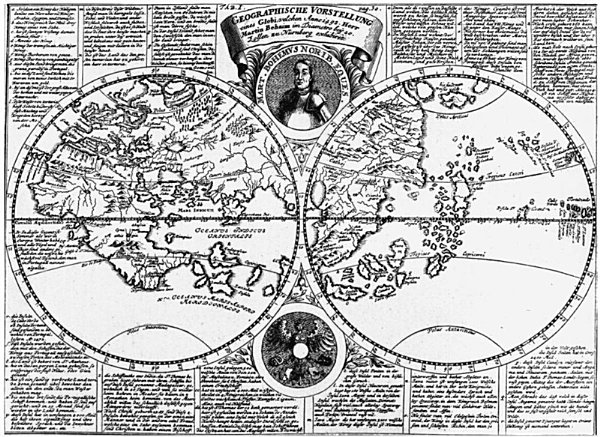
Plate 15.1 An early representation of the earth on Martin Behaim’s famous 1491–3 ‘earth apple’, or globe.
Source: akg-images
While acknowledging that for most of human existence both in Europe and elsewhere, people have not identified themselves within the physical/spatial and cultural/mental parameters of a global world, we will have to accept that Europe’s discovery and representations of the world, and, even more so, the albeit temporary global dominance of a European discourse about it, have resulted in our thinking in terms of globalization. Without knowing how this knowledge came about, how it was structured, and spread, it is not possible to make sense of our understanding of the world.
To analyse the development of a world view that both induced and enabled (Christian) Europe to go beyond the spatial limits – which also determined the intellectual and psychological, as well as historically temporal ones – of its self-defined oikoumene, one needs to go back to the sixth century. Slowly, the Church of Rome and Europe’s secular powers had begun to lose control over the Holy Land, the cradle of Christianity, blaming the process on the advance of Islam. This decisively influenced the cultural make-up of Europeans. The situation allowed, even forced, them to regain that sacred place, and, thus, in the crusading movement, to go collectively beyond the safe frontiers of their own world. A comparable situation did not occur for Hindus, Chinese/Confucians or Muslims, who always have held control over their own holy centres, nor indeed for the cultures of sub-Sahelian Africa and the Americas.
However, the biblical notion of Eden suggested yet another place the European Christians might want to regain: the place of Genesis, the ‘somewhere’ on earth where everything had originated. This led them to think of themselves as part of a larger, unknown world that might still contain this place and, perhaps also those people who had not succumbed to civilization but had retained their pristine, perfect, paradisiacal state. In part to discover their own roots, Europeans set out to discover the wider world.
As an element of the complex process of European expansion that, effectively, started in the thirteenth and fourteenth century, these religious, intellectual and psychological needs played a role alongside other factors. Inevitably, the process of bringing the wider world to Europe influenced scholarship and science. The constantly altering view of the world and of the variety of mankind was one of the godmothers of the Enlightenment of the seventeenth and eighteenth centuries. Increasingly, knowledge of the actual world also resulted in a comparative view that now characterized Europe’s approach to other humans. Together, the scholarly disciplines dealing with the many issues involved came to constitute the Humanities.
In the process, Europeans increasingly tried to relate their own culture(s) to the many other civilizations they encountered, especially to the ones that, somehow, were deemed to be part of a millennial civilizing process of which Europe itself felt to be the epitome. By the early nineteenth century, a cultural/psychological chain-of-being was established, and often demonstrated in the many ‘world histories’ written then, that linked contemporary Europe first to its Renaissance forebears and, through them, to their ancestors in the world of antiquity.
This created a cultural and scholarly focus on the Mediterranean and, almost inevitably, an interest in the ancient Near and Middle East. Yet, at the same time, the Indo-European or Eurasian link had been discovered. Some even would argue it was created precisely because Europeans wanted to sever their cultural links with or indebtedness to a ‘Semitic’ Near East and a ‘black’ Africa. Indeed, the construction of the Indo-Germanic, and later Indo-European continuum in west-Eurasia (slowly, from the sixteenth century onwards, but, basically, since the discovery of Sanskrit in the eighteenth century) demonstrates the essential Europeanness of the scholarly-scientific debates of the eighteenth and nineteenth centuries.
Yet, in a Europe increasingly fragmented by the contest between opposing nation-states, the appropriation of this new ‘world of origin’ developed along national-cultural lines. Often, Europe’s Germanic-speaking cultures pitted themselves against the Romanized ones, the more so since the latter had to accommodate the new Eurasian notion into their erstwhile antiquity, i.e. Mediterranean-based claims to cultural pre-eminence in Europe.
Meanwhile, in scholarship, the need to establish the pre-Christian connections between what still seemed to be separate regions/civilizations stimulated research in, or even led to the establishment of new fields such as comparative linguistics, Eurasian archaeology and mythology, and world religions. New intellectual/historical paradigms had to be devised as well, which, paradoxically, sometimes brought people back to Biblical and other historical/mythical visions of human/cultural origin and diffusion: was man created in Asia, and had his species spread from there over the entire globe, or should one consider the possibility of polygenesis? Whether fictional or not, these visions in their turn resulted in research that was then integrated in a changing but, at least in Europe, increasingly consensual view of the processes that had resulted in the world’s different civilizations on the one hand, and the elements that linked them on the other.
By the mid-nineteenth century, those parts of the world that could not be readily accommodated into a basically Eurocentric cultural genealogy nonetheless were incorporated into a larger but still European-Christian notion of creation and humanity that increasingly developed along biological-evolutionist and, also, diffusionist lines. Admittedly, acceptance of the idea that humanoids and humans all came ‘out of Africa’ has been, and for many cultures still is, problematic, despite the fact that the huge advances recently made in DNA-research have made this model the most probable. Nevertheless, as part of European economic and cultural dominance between the mid-nineteenth and mid-twentieth century, concepts such as the world and mankind have come to structure thinking all over the globe, and now dominate the discourse of globality/globalization as well.