
8
The role of the emotions
Emotions enter human life in three ways. At their most intense they are the most important sources of happiness and misery, far overshadowing hedonic pleasures and physical pain. The radiant love of Anne Elliott at the end of Persuasion is unsurpassable happiness. A more reproducible if less exalted effect is that of watching Fred Astaire dancing. Conversely, the emotion of shame can be utterly devastating. Voltaire wrote, “To be an object of contempt to those with whom one lives is a thing that none has ever been, or ever will be, able to endure.”
Shame also illustrates the second way in which emotions matter, namely, in their impact on behavior. In Chapter 4, I cited several cases in which people killed themselves because of the overpowering emotion of shame. In this chapter I shall mainly discuss the action tendencies that are associated with the emotions. The extent to which these tendencies are translated into actual behavior will concern us in later chapters.
Third, emotions can matter because of their impact on other mental states – on motivations as well as on beliefs. When a desire for a certain state to obtain is supported by a strong emotion, the tendency to believe that it does obtain can be irresistible. As Stendhal says in On Love, “From the moment he falls in love even the wisest man no longer sees anything as it really is … He no longer admits an element of chance in things and loses his sense of the probable; judging by its effect on his happiness, whatever he imagines becomes reality.” In À la recherche du temps perdu Proust pursues the same theme over hundreds of pages, with more variations and twists than one might have thought possible.
Also, when an emotion triggers a negative meta-emotion, such as shame, the pressure to transmute it into a more acceptable emotion may be irresistible (see next chapter). This mechanism presupposes, of course, that the agent is aware of the emotion and identifies it correctly. Anger and love sometime creep up on us, without our being aware of them until they suddenly erupt into consciousness. In Emma, Jane Austen offers a hilarious description of a young woman who mistakes her state of boredom for love. “This sensation of listlessness, weariness, stupidity, this disinclination to sit down and employ myself, this feeling of every thing's being dull and insipid about the house! – I must be in love.”
What are the emotions?
Before considering each of these aspects of emotion in more detail, I need to say something about what emotions are and what emotions there are. There is no agreed-upon definition of what counts as an emotion, that is, no agreed-upon list of sufficient and necessary conditions. There is not even an agreed-upon list of necessary conditions. Although I shall discuss a large number of common features of the states that we understand, preanalytically, as emotions, there are counterexamples to all of them. For any such feature, that is, there are some emotions or emotional occurrences in which it is lacking. We may think that action tendencies are crucial to emotion, but the aesthetic emotions provide a counterexample. We may think that a “short half-life,” that is, a tendency to decay quickly, is an essential feature of emotion, but in some instances unrequited romantic love (such as that of Cyrano de Bergerac) or the passionate desire for revenge can persist for years or decades.1 We may think that emotions are triggered by beliefs, but how do we then explain that people can get emotionally upset by reading stories or watching movies that are clearly fictitious? Many other examples could be given of allegedly universal features that turn out to be lacking in some cases.
In light of this problem, the natural response is to deny that “emotion” is a useful scientific category. In the language of philosophers, emotions do not seem to form a natural kind. In spite of their difference, whales and bats, qua mammals, belong to the same natural kind. Whales and sharks, in spite of their similarity, do not; nor do bats and birds. Anger and love have in common the capacity for clouding and biasing the mind, but this similarity does not make them into a natural kind. To see how such reasoning by analogy can go astray, we may notice that the intake of amphetamines and romantic love produce many of the same effects: acute awareness, heightened energy, reduced need for sleep and food, and feelings of euphoria. In fact, the states of hypomania, intense creative activity, and enthusiasm partake of the same features. Yet nobody would claim, I assume, that these five states belong to the same natural kind.2
For the purpose of social-scientific explanation, this conundrum can be left unresolved. We can focus on occurrences of emotions in which a certain number of features are regularly observed and ask how these can help us to explain behavior or other mental states. The fact that in other occurrences that intuitively count as emotions some of these features are lacking is interesting from a conceptual point of view but does not detract from their explanatory efficacy in cases where they are present. I shall list and comment on the features to which I want to draw attention:
Cognitive antecedents. Most emotions are triggered by beliefs, often by the agent's acquisition of a new belief. Emotions may also have other causal conditions (we are more readily irritated when we are tired), but the presence of these will not by themselves cause the emotion to occur, any more than a slippery road will cause a car accident. As explained later, these beliefs may fall short of full certainty.
Perceptual antecedents. Some emotions, such as disgust and fear, can be triggered by mere perceptions, prior to belief formation. Emotions that are triggered by cognition may be strengthened if there is also a perceptual element present, as when the fear triggered by warnings on cigarette packs is enhanced by graphic color pictures of cancer lungs.3
Neurophysiological work on fear (in rats) confirms this idea. There are two different pathways from the sensory apparatus in the thalamus to the amygdala (the part of the brain that causes visceral as well as behavioral emotional responses). Confirming the traditional view that emotions are always preceded and triggered by a cognition, one pathway goes from the thalamus to the neocortex, the thinking part of the brain, and from the neocortex onward to the amygdala. The organism receives a signal, forms a belief about what it means, and then reacts emotionally. There is also, however, a direct pathway from the thalamus to the amygdala that bypasses the thinking part of the brain entirely. Compared to the first pathway, the second is “quick and dirty.” On the one hand, it is faster. In a rat it takes about twelve milliseconds (twelve one-thousandths of a second) for an acoustic stimulus to reach the amygdala through the thalamic pathway, and almost twice as long through the cortical pathway. On the other hand, the second pathway differentiates less finely among incoming signals. Whereas the cortex can figure out that a slender curved shape on a path through the wood is a curved stick rather than a snake, the amygdala cannot make this distinction. Yet from the point of view of survival, the cost of reacting to a stick as if it were a snake must have been much smaller than the cost of the opposite mistake.
I do not know whether these findings from the study of fear generalize to other emotions. Conjecturally, something of the sort might also be true of anger. When exposed to something that could be an attack, the opportunity cost of waiting to find out whether it is one might be very high. Natural selection might well have hardwired a tendency to “shoot first; ask later.” If I do lash out and later find out that I was in fact not the victim of an attack, I might nevertheless invent a story to justify my behavior. This rather subtle mechanism, linked to our amour-propre (Chapter 9), would interact with a neurophysiological mechanism that we share with animals that lack the need for self-esteem. This is likely to be the pattern of many findings from physiology and neuroscience. Near-automatic reactions that we share with other species may be subject to the self-serving interpretations and elaborations that are unique to human beings. These rationalizations are not trivial, since they may cause us to persist in aggression rather than admit that we were at fault.
The importance of perception in generating emotions can be illustrated by the attitude of White House officials toward the loss of American soldiers in Vietnam. In 1964, McGeorge Bundy and his staff compared casualties in Vietnam to traffic-related injuries in Washington DC and found them insignificant. In early 1965, the Chairman of the Joint Chiefs of Staff, Maxwell Taylor, recommended that Bundy be sent on a mission to Vietnam because of “the fact that he has been physically detached from the local scene and hence would have an objectivity which an old Vietnam hand would lack.” When he witnessed the effects of an attack at Pleiku, in the central highlands of South Vietnam, Bundy lost his detachment. The “sight of gravely wounded American servicemen evoked in Bundy uncharacteristically strong and visible emotion.”
Physiological arousal. Emotions go together with changes in heart rate, electrical skin conductance, bodily temperature, blood pressure, respiration, and numerous other variables.
Physiological expressions. Emotions go together with characteristic observable signs, such as bodily posture, voice pitch, flushing and reddening (from embarrassment), smiling or baring the teeth, laughing and frowning, weeping and crying, and white or red anger (as manifested in pallor and blushing, respectively).
Action tendencies. Emotions are accompanied by tendencies or urges to perform specific actions. Although these tendencies may not lead to actual behavior, they are more than dispositions – they are forms of incipient behavior rather than mere potential for behavior. I discuss some of these tendencies at greater length later.
Intentional objects. Unlike other visceral phenomena such as pain or hunger, emotions are about something. They may have “propositional objects” (“I am indignant that …”) or non-propositional objects (“I am indignant with …”). As we shall see, the lack of a clearly defined object may prevent the emotion from being triggered.
Valence. This is a technical term for the pain-pleasure dimension of the emotions as we experience them. As noted, the valence might range from the glowing happiness of Anne Elliott to the crushing shame of the exposed consumers of pedophiliac material.
Do not emotions, like colors, also have specific qualitative feelings? Shame and guilt, for example, seem to feel different in a way that cannot be reduced to the fact that shame is more intensely unpleasant. There is evidence that one could insert an electrode into my brain and make me feel sad, embarrassed, or afraid even though I would not be able to identify either a cause or an object of the feeling. Important as this aspect may turn out to be for our understanding of emotion, it is not yet well enough understood to suggest specific causal hypotheses.
What emotions are there?
I shall list and briefly describe some two dozen emotions, without claiming that this classification is superior to the many others that have been proposed. My aim is to provide some understanding of the emotions that have either intrinsic or causal importance in social life, not to try to satisfy the (legitimate) concerns of emotion theorists. In particular, I shall have nothing to say about which emotions are “basic” or “non-basic.”
One important group of emotions are the evaluative emotions. They involve a positive or a negative assessment of one's own or someone else's behavior or character.4 If an emotion is triggered by the behavior of another person, that behavior may be directed either toward oneself or toward a third party. These distinctions yield ten (or eleven) emotions altogether:
Shame is triggered by another person's negative belief about the agent's character.
Contempt and hatred are triggered by the agent's negative beliefs about another's character. Contempt is induced by the thought that another is inferior, hatred by the thought that he is evil. Hitler thought Jews were evil, and Slavs inferior.
Guilt is triggered by a negative belief about one's own action.
Anger is triggered by a negative belief about another's action toward oneself.5
Cartesian indignation6 is triggered by a negative belief about another's action toward a third party.
Pridefulness is triggered by a positive belief about one's own character.
Liking is triggered by a positive belief about another's character.
Pride is triggered by a positive belief about one's own action.
Gratitude is triggered by a positive belief about another's action toward oneself.
Admiration is triggered by a positive belief about another's action toward a third party.
Second, there is a set of emotions generated by the thought that someone else is in the deserved or undeserved possession of some good or bad.7 The target of these emotions is neither individual action nor individual character, but a state of affairs. Following Aristotle's discussion in the Rhetoric, we may distinguish six (or seven) cases.
Envy is caused by the deserved good of someone else.
Aristotelian indignation is caused by the undeserved good of someone else.8 The closely related emotion of resentment is caused by the reversal of a prestige hierarchy, when a formerly inferior group or individual emerges as dominant.
Sympathy is caused by the deserved good of someone else.
Pity is caused by the undeserved bad of someone else.
Malice is caused by the undeserved bad of someone else.
Gloating is caused by the deserved bad of someone else.
Third, there are positive or negative emotions generated by the thought of good or bad things that have happened or will happen – joy and grief, with their several varieties and cognates. The emotion of enthusiasm – neglected by emotion theorists but observed in many revolutionary moments – also belongs here. As many have observed, bad events in the past may also generate positive emotions in the present, and good events negative emotions. Thus in the main collection of proverbial sayings from antiquity, the Sentences of Publilius Syrus, we find both “The remembrance of past perils is pleasant” and “Past happiness augments present misery.”
All the emotions discussed so far are induced by beliefs that are (or may be) held in the mode of certainty. There are also emotions – hope, fear, love, and jealousy – that essentially involve beliefs held in the modes of probability or possibility. These emotions are generated by the thought of good or bad things that may or may not happen in the future, and of good or bad states of affairs that may or may not obtain in the present. By and large, these emotions require that the event or state in question be seen as more than merely conceivable; that is, there must be a non-negligible chance or a “downhill causal story” that it might actually occur or obtain. The thought of winning the big prize in the lottery may generate hope, but not the “uphill” thought of receiving a large gift out of the blue from an unknown millionaire. These emotions also seem to require that the event or state fall short of being thought to be certain. If I know that I am about to be executed, I may feel despair rather than fear. According to Stendhal, love withers away both when one is certain that it is reciprocated and when one is certain that it is not. According to La Rochefoucauld, jealousy may disappear the moment one knows that the person one loves is in love with somebody else.
Some emotions are generated by counterfactual thoughts about what might have happened or what one might have done. Disappointment is the emotion that occurs when a hoped-for positive event fails to materialize.9 Regret is the emotion that occurs when we realize we could have made a hoped-for positive event occur if we had made a different choice. The positive counterparts of these emotions (caused by the non-occurrence of negative events) are sometimes referred to as elation and rejoicing, respectively. (In everyday language, the two are usually blurred under the heading of relief.) Whereas disappointment and elation involve comparisons of different outcomes caused by different states of the world for a given choice, regret and rejoicing involve comparisons caused by different choices within a single state. In some cases, negative events can be imputed to either source. If I get wet on my way to work I may either ascribe it to a chance meteorological event or to the fact that I did not take an umbrella. Although I might prefer the first framing, this piece of wishful thinking might be subject to reality constraints (Chapter 7) if I had just heard a forecast of rain before leaving the house.
Some emotions, finally, are generated by other emotions. I shall have more to say about such meta-emotions in Chapter 9. Here I shall only mention shame at feeling envy or guilt at loving an inappropriate person.
Emotions and happiness
The role of emotions in generating happiness (or misery) suggests the idea of a “gross national happiness product.” The usual measures of economic performance are, of course, more objective. Yet objectivity in the sense of physical measurability is not what we ultimately care about. The reason we want to know about economic output is that it contributes to subjective welfare or happiness. Moreover, happiness can stem from sources that do not lend themselves to any kind of objective quantitative measurement. In 1994, when Norway hosted the Olympic Winter Games, the country had to build new arenas for the events and housing for the participants, at considerable cost. On the revenue side one could include the money spent by visitors to the country and by spectators of the events, as well as the income generated by these constructions in the future. Economists who have carried out these calculations do not believe that the games broke even. I feel utterly certain, however (but of course cannot prove), that if we include the emotional benefits to the Norwegian population, the games ran a huge surplus. The unexpectedly large number of Norwegian gold medalists created a mood of collective euphoria, which was all the greater because the victories were so unexpected. The “objective” number of victories owed a great deal of its impact to the element of subjective surprise.10 More recently, the victory of the French soccer team in the 1998 World Cup as well as its defeat in 2002 generated feelings of euphoria and dejectedness that owed much of their intensity to the fact of surprise.
In general, it is difficult to compare the emotional components of welfare or well-being with other components. That positive emotions at their most intense contribute more to happiness than does simple hedonic welfare proves nothing, unless we know how often the intense episodes occur. Also, we do not understand whether and to what extent the propensity for emotional highs goes together with the propensity for emotional lows. If it does, is a life in steady contentment happier overall than one that alternates between euphoria and dysphoria? As Montaigne noted, the answer depends on the occasions offered by the environment. “If you say that the convenience of having our senses chilled and blunted when tasting evil pains must entail the consequential inconvenience of rendering us less keenly appreciative of the joys of good pleasures, I agree. But the wretchedness of our human condition means that we have less to relish than to banish.” The ideal of extinguishing the emotions that one finds in many ancient philosophies, notably Stoicism and Buddhism, emerged in societies where the environment may have offered more occasions for emotions with negative valence. Writing during the wars of religion that were devastating France, Montaigne may have been in the same situation.
Emotion and action
The mediating link between emotion and action is that of an action tendency (or action readiness). We may also think of an action tendency as a temporary preference. Each of the major emotions seems to have associated with it one (or a few) such tendencies (see Table 8.1).
Table 8.1
|
Emotion |
Action tendency |
|
Anger or Cartesian indignation |
Cause the object of the emotion to suffer |
|
Hatred |
Cause the object of hatred to cease to exist |
|
Contempt |
Ostracize; avoid |
|
Shame |
“Sink through the floor”; run away; commit suicide |
|
Guilt |
Confess; make repairs; hurt oneself |
|
Envy |
Destroy the envied object or its possessor |
|
Fear |
Flight; fight |
|
Love |
Approach and touch the other; help the other; please the other |
|
Pity |
Console or alleviate the distress of the other |
|
Gratitude |
Help the other |
Although anger and Cartesian indignation induce the same action tendency, that of anger is stronger. Experiments show that subjects are willing to incur a larger cost to punish somebody who hurt them than to punish somebody who hurt a third party. After the end of World War II, Americans were often more eager to punish Nazis who had mistreated American prisoners of war than those who were responsible for the Holocaust. An exception, which confirms the principle, were the Jewish members of the Roosevelt administration.
The emotions of anger, guilt, contempt, and shame have close relations to moral and social norms. Norm violators may suffer guilt or shame, whereas those who observe the violation feel anger or contempt. The structures of these relations differ as shown in Figure 8.1. Social norms, further discussed in Chapter 21, are mediated by exposure to others. That is why the suicides mentioned in Chapter 5 occurred only when the shameful actions became public knowledge. As I argued in Chapter 5, moral norms differ in this respect.11
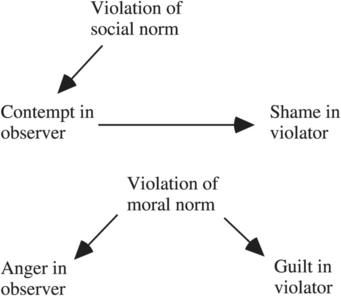 Figure 8.1
Some action tendencies appear to aim at “restoring the moral balance of the universe.” Hurting those who hurt you and helping those who help you are, seemingly, ways of getting even. This may be true in some cases. The moral-balance view is compelling in the case of guilt, where the action tendency of making repairs is explicitly restorative. Moreover, when the agent cannot undo the harm she has done, she can restore the balance by harming herself to an equal extent. If I have cheated on my income taxes and discover that the IRS does not accept an anonymous money order for the amount I owe, I can restore the balance by burning the money instead. As Montaigne noted, the act of repentance has to cost the agent something: “I have seen many in my time smitten in conscience for having withheld other men's goods who arrange in their testament to put things right after they are dead. But it is valueless to fix a date for so urgent a matter or to wish to right wrongs without feeling or cost.” Earlier, I cited Oscar Wilde's observation to the same effect.
The action tendency of anger, to take revenge, is more complex. In particular, it is probably not expressed by the maxim “an eye for an eye.” The Lex talionis served to limit the extent of revenge rather than to create an obligation to take revenge. It forbids the taking of two eyes for one or an eye for a tooth. The Koran, too, says that “If you want to take revenge, the action should not exceed the offense” (Sura XVI). In this perspective, the Lex talionis would serve to counteract a spontaneous tendency to excessive revenge. That tendency may, instead, be “Two eyes for an eye.”12 A character in one of Seneca's plays asserted that “a wrong not exceeded is not revenged.” In response to the killing of 365 Lebanese Muslims a Lebanese woman said that “at this moment I want the [Moslem militia] … to go into offices and kill the first seven hundred and thirty defenseless Christians they can lay their hands on.” In Greece in 1944, after an attack by left-wing groups on the right-wing leader Nikolaos Papageorgiou, “two young men were found dead in the road where the original attack had taken place; placards around their necks read ‘Papageorgiou – 2 for 1.’”13
The asymmetry might also be due to loss aversion (see Chapter 13), that is, the tendency to value losses roughly twice as heavily as gains. In the following passage, I have transposed an application of the theory of loss aversion to negotiated disarmament to the case of revenge. Italicized statements in parenthesis indicate the transpositions.
Loss aversion, we argue, could have a significant impact on conflict resolution. Imagine two countries negotiating the number of missiles that they will keep and aim at each other (two clans involved in a long-standing conflict). Each country derives security from its own missiles and is threatened by those of the other side. (Each clan finds security in numbers and is threatened by numbers on the other side.) Thus, missiles (persons) eliminated by (on) the other side are evaluated as gains, and missiles (persons) one must give up (killed on one's own side) are evaluated as losses, relative to the status quo. If losses have twice the impact of gains, then each side will require its opponent to eliminate (lose) twice as many missiles (persons) as it eliminates (loses).
To further complicate matters, excessive retaliation might aim at deterrence rather than at revenge. In a draft of The Civil War in France, Marx cites an official statement by the Commune that “Every day the banditti of Versailles slaughter or shoot our prisoners, and every hour we learn that another murder has been committed … The people, even in its anger, detests bloodshed, as it detests civil war, but it is its duty to protect itself against the savage attempts of its enemies, and whatever it may cost, it shall be an eye for an eye, a tooth for a tooth.” He also cites, however, a letter from a priest taken hostage by the communards which asserts that “a decision has been taken to execute two of the numerous hostages they hold for every new execution” by the government forces. In German-occupied countries during World War II, the ratio was often much higher, up to a hundred to one. These reprisals were often very effective. In actual situations, revenge, loss aversion, and deterrence may interact and reinforce each other to produce a “two for one” or “many for one” pattern, making it hard to identify the pure action tendency.
Emotional action tendencies do not merely induce a desire to act. They also induce a desire to act sooner rather than later. To put this idea in context, let me distinguish between impatience and urgency. I define impatience as a preference for early reward over later reward, that is, some degree of time discounting. As I noted in Chapter 6, emotions may cause an agent to attach less importance to temporally remote consequences of present action. I define urgency, another effect of emotion, as a preference for early action over later action.
To introduce and illustrate the distinction between urgency and impatience, I shall use examples involving money, even though urgency is not likely to be an important factor in monetary decisions. Strictly speaking, therefore, I ought to refer to units of utility rather than to dollars. As the purpose of the examples is merely illustrative, this does not really matter.
In the following statements, all preferences are Monday preferences, i.e. the preferences I hold on Monday:
Urgency: I prefer acting on Monday to get $100 on Wednesday to acting on Tuesday to get $150 on Wednesday.
Impatience: I prefer acting on Monday to get $100 on Tuesday to acting on Monday to get $150 on Wednesday.
Impatience is the familiar difficulty of deferring gratification. There is a two-way trade-off between the size of the reward and the time of delivery of the reward. In urgency, there is a three-way trade-off: the urge to act immediately may be neutralized if the size of the reward from acting later is sufficiently large or if that reward is delivered sufficiently early. In other words, the following statements may all be true:
I prefer acting on Monday to get $100 on Wednesday to acting on Tuesday to get $150 on Wednesday.
I prefer acting on Tuesday to get $300 on Wednesday to acting on Monday to get $100 on Wednesday.
I prefer acting on Tuesday to get $150 on Tuesday to acting on Monday to get $100 on Wednesday.
Since early action and early reward often go together, the choice of the early action may simply be due to the fact that it promises the early reward. In principle, however, it should be possible to tease the two apart.
It is perhaps more intuitive to explain the idea of urgency as a form of inaction aversion.14 In a book on How Doctors Think, the author refers to a “tendency toward action rather than inaction. Such an error is more likely to happen with a doctor who is overconfident, whose ego is inflated, but it can also occur when a physician is desperate and gives in to the urge to ‘do something’. The error, not infrequently, is sparked by pressure from a patient, and it takes considerable effort for a doctor to resist. ‘Don't just do something, stand there’ … one of my mentors once said when I was unsure of a diagnosis.”
The behavior of terrorists and suicide attackers may also be illuminated by the notion of urgency. Before they kill themselves, suicide attackers are presumably in a state of high emotional tension. According to one Kamikaze pilot, the stress of waiting was unbearable. To counteract the urge to take immediate and premature action, the first rule of the Kamikaze was that they should not be too hasty to die. If they could not select an adequate target, they should return to try again later. In Afghanistan, organizers sometimes prefer the technique of remote detonation, which reduces mistakes caused by attacker stress, such as premature detonation.
The urgency of the emotions provides one of the mechanisms by which they may affect belief formation. As we shall see in Chapter 13, rational belief formation requires an optimal gathering of information. Rather than going by the evidence already at hand, a rational agent will gather additional evidence before acting if the decision to be made is sufficiently important and the cost of waiting sufficiently small. Urgent emotions are often triggered in situations in which the cost of waiting is high, that is, in the face of acute physical danger. In such cases, acting quickly without pausing to find out more is of the essence. But when an important decision could be improved by waiting, an emotion-induced desire for immediate action can be harmful. As Seneca said, “Reason grants a hearing to both sides, then seeks to postpone action, even its own, in order that it may gain time to sift out the truth; but anger is precipitate.”15 The proverb “Marry in haste, repent at leisure” suggests both the impetus of emotion and the unfortunate consequences of the inability to resist it.
When the emotion cools down, it may not be possible to undo the actions it triggered. Gibbon writes about the Emperor Theodosius that after his “passion was inflamed” by a minister and he dispatched “the messengers of death, he attempted, when it was too late, to prevent the execution of his orders.” In the trials of agents and collaborators of the Germans after 1945, prison sentences were reduced when emotions faded, but executions were irreversible. When young men and women join the Armed Revolutionary Forces of Colombia (FARC) in a moment of enthusiasm and are subsequently disillusioned by the extreme harshness of the organization, they are not allowed to leave it (a “lobster-trap” situation). In 2014, Western recruits to the Islamic State had to hand in their passports when they joined the organization, or their passports were burned.
Urgency is not the only cause of premature belief formation. The need to achieve cognitive closure – to form some opinion or other, rather than a specific opinion – can have the same effect. This mechanism, too, is related to emotions, but not in the same way as urgency. Some individuals may be characterized by what Otto Neurath called “an emotional disposition for which the elimination of doubt means a release from a feeling of displeasure.” The disposition is also sometimes referred to intolerance of ambiguity or of uncertainty. Whereas urgency is directly induced by the desire to act, the need for cognitive closure may exist even when there is no occasion to act.
Earlier, I mentioned that not all emotions have a short half-life. Usually, nevertheless, emotions do decay quite rapidly with time. In some cases, this is simply due to the fact that the situation that triggered them ceases to exist. When I have gotten safely away from the bear that was threatening me, fear is no longer warranted. More often, though, emotion wanes as memory fades, by the sheer passage of time. Anger, shame, guilt, and love rarely persist with the intensity they had at the onset of emotion. Although McGeorge Bundy's strong emotions at Pleiku caused him to recommend a policy of “sustained reprisal” rather that a punctual tit-for-tat response, “once [his field-marshal] psychosis subsided … Bundy's belief in the potency of bombing was short-lived.” After September 11, 2001, the number of young American men who expressed an interest in serving in the army increased by 50 percent, but there was no marked increase in actual enlistment. These facts are consistent with the hypothesis that the initial surge of interest was due to emotion, which then abated during the several months required for the enrollment process. There was almost no increase in the interest in serving among young women, a fact that has no obvious explanation.
This being said, people are often unable to anticipate the decay of their emotions (see later discussion). When in the grip of a strong emotion, they may believe, wrongly, that it will last forever and may even lose any sense of the future. If the suicidal individuals I have referred to had known that their shame (and the contempt of the observers) would abate, they might not have killed themselves. If young couples knew that their love for each other might not last forever, they would be less willing to make binding commitments and in particular to enter into a “covenant marriage” from which it is more difficult to exit.
Let me conclude on this point by pointing to an interaction between two emotion-induced phenomena: preference reversal and clouded belief formation. On a rosy view, these two might cancel one another: because of the preference reversal one wants to act contrary to one's calm and reflective judgment, but because of the clouded belief one is unable to carry out the intention. More frequently, perhaps, the two will reinforce each other. Vengeance is an example. The risk is minimal if I do not take revenge for an affront (disregarding the contempt I might incur from third parties), greater if I take revenge but bide my time; and maximal if I take revenge immediately without any concern for the risks. Montaigne made a similar observation: “When we punish any injuries we have received, philosophy wants us to avoid choler, not so as to diminish our revenge but (on the contrary) so that its blow may be weightier and better aimed; philosophy considers violent emotion to be an impediment to that.” Yet that is to ignore the paradox that if we do not feel emotion, we may not want revenge, and if we do feel it, we may not be able to carry out the revenge effectively.
Emotions and politics
Emotions matter in politics, sometimes in systematic ways. The emotions that affect political decisions and outcomes are mostly negative: anger, Cartesian indignation, hatred, fear, resentment, envy, guilt, and shame. Only one positive emotion, enthusiasm, seems capable of affecting political behavior. I shall consider two examples: an important episode in the French Revolution and transitional justice after the end of World War II.
Historians have coined the term “the Great Fear” for the emotion that swept the French countryside in the spring and summer of 1789. In fact, that summer saw not one but two “great fears,” the second triggering the decisions made by the deputies in Versailles when they learned about the first. I return to the fear in the countryside in Chapter 22; here I discuss its repercussions on the assembly.
In 1789, “the Great Fear” peaked in late July, leading to numerous “anti-seigneurial actions” such as the sacking of castles, the burning of tenancy records, and occasionally physical attacks on the nobles. When news about these events reached the constituent assembly in early August, many deputies feared for their properties and their families. After an initial urge to crack down on the uprisings, on August 4 the assembly went to the other extreme and abolished feudalism overnight. Many of the deputies gave up their personal privileges or those of their city or province. It is not easy to determine the exact motivational mix behind this “self-denying ordinance,” to use a phrase coined about Cromwell's decision in 1645 that members of parliament should exclude themselves from military office.16 Tocqueville was probably right when he asserted that the decisions were “the combined result, in doses that are impossible to determine, of fear and enthusiasm.”17 Some illustrations and testimonies follow.
Considering the role of fear, the emotion is manifest in several letters from August 7 onward by the Comte de Ferrières, a deputy for the nobility, to his wife. The first letter contains very detailed instructions to sell his sheep and his oxen for cash, at any price; to gather all the money and documents in his castle in Mirebeau and transfer them to their house in Poitiers, making sure nobody observes her doing so; to ship their mattresses, bed covers and sheets to Poitiers (“in case of an event, at least something will be saved”). Three days later, he tells her to go with their daughters to Poitiers, even if the harvest should suffer: “do not consider the costs and do not ask to be protected by soldiers, since this would cause alarm in the countryside.” He does not care if after these precautions his castle is burned, as he is never going to live there again. His comments on why he is reluctant to cast his votes sincerely in the assembly reflect the same visceral fear.18
Considering the role of enthusiasm,19 the Courrier de Provence, the organ of the Comte de Mirabeau, referred to “reciprocal challenge and combat in generosity” and to “the seduction of applause, the emulation of outdoing one's colleagues, the honor of personal disinterestedness, and the kind of noble intoxication which accompanies the effervescence of generosity.” Another contemporary document refers to “the heat of the moment that electrified each individual and made him fear being left behind” in the competition to be generous. To be sure, these statements do not exactly describe a disinterested motivation, but rather an egocentric desire to be seen as disinterested. This desire is perhaps an intrinsic or at least inevitable feature of enthusiasm, which tends to arise in crowds and assemblies.20
Soon after the capitulation of Germany on May 8, 1945, in some cases even earlier, the countries that had been under German occupation began preparing the prosecution of agents and collaborators of the various regimes. Eventually a proportion of the population ranging from 0.2 percent (Austria) to 2 percent (Norway) suffered some kind of punishment, including the loss of civil and political rights. The number of executions ranged from four per million of population (Austria, Holland) to thirty-nine (France). In most of the countries, the authorities stated that the trials were to be strictly constrained by the rule of law, excluding notably retroactive laws and collective guilt. Justice, not revenge, was the goal. The temporal pattern of the trials suggests, however, that strong emotions were at work. There were clear indications of urgency.21 Maurice Rolland, the official in charge of the early stages of transitional justice in France, asserted that “the government should establish justice before railroads.” Also, the fact that identical acts of collaboration, such as joining the Waffen SS, received more lenient sentences as time went on strongly suggests that judges and jurors were motivated by emotions with a short-half life.22 There is also evidence that a small recent crime was punished more severely than a grave crime committed earlier.23
Even more tellingly, the sentences that were meted out fitted the crimes very closely, in the sense that they reflected the action tendencies of emotions that were triggered by different crimes. The acts of informants and torturers induced hatred. According to Aristotle, the action tendency of this emotion is not (as in anger) to make the wrongdoer suffer, but to make him or her disappear from the face of the earth. These persons were in fact heavily represented among those who received the death penalty. Everyday acts of collaboration, such as joining the Nazi Party to keep one's job, were more likely to trigger anger. The legal expression of this emotion would be an ordinary prison sentence. When the wrongdoing was directed against a third party, as when Americans reacted to German atrocities against Soviet citizens, the emotion was one of (Cartesian) indignation rather than anger. The tendency for indignation to trigger weaker retribution than anger is reflected in the patterns of prosecution and sentencing. In the trials of German officers organized by the British and American occupational forces, high-level German war criminals, connected to mass murder, but who had not been involved in atrocities against British or American personnel, escaped prosecution, while the lowliest perpetrators who participated in beating, mistreating, or executing even a single prisoner of war were relentlessly pursued.
Finally, individuals whose collaboration took the form of diffusing pro-Nazi propaganda or being passive members of Nazi organizations were the objects of contempt. The action tendency of this emotion, ostracism, closely matched the legal reaction of imposing the loss of civil and political liberties, that is, a form of civic death. I find it hard to believe that these tight links between emotion-triggered action tendencies and forms of punishments could be accidental.
After the end of the war, many of those who remained neutral were blamed for their passivity, and were at the receiving end of angry or contemptuous reactions. Even if they were not harassed in any way, the guilt they felt for having done nothing may have strengthened their demand for retribution, as if post-transition aggression toward the wrongdoers could magically undo pre-transition passivity. This tendency for the neutrals, those in the “gray zone” between collaboration and resistance, to be especially vindictive, is an instance of transmutation (Chapter 9).
Emotion and belief
Not only are most emotions triggered by beliefs; they can also affect belief formation directly as well as indirectly. The direct effect produces biased beliefs, the indirect effect low-quality beliefs. One form of bias is illustrated in Stendhal's theory of crystallization. The origin of the term is as follows: “At the salt mines of Hallein near Salzburg the miners throw a leafless wintry bough into one of the abandoned workings. Two or three months later, through the effect of the waters saturated with salt which soak the bough and then let it dry as they recede, the miners find it covered with a shining deposit of crystal. The tiniest twigs no bigger than a tom-tit's claw are encrusted with an infinity of crystals, scintillating and dazzling.” The analogy with love is clear: “From the moment you begin to be really interested in a woman, you no longer see her as she really is, but as it suits you to see her. You're comparing the flattering illusions created by this nascent interest with the pretty diamonds which hide this leafless branch of hornbeam – and which are only perceived, mark you, by the eyes of this young man falling in love.”
In the saying by La Fontaine that I cited earlier and shall cite again, we easily believe what we fear. This, too, is a form of bias. In addition to the fact that we naturally (even in non-emotional states) may give excessive importance to low-probability risks, feelings of visceral fear may also cause us to believe that dangers are greater than they actually are. When we walk in a forest at night, a sound or a movement may trigger fear, which then causes us to interpret as fearsome other sounds or movements that we had previously ignored. The fear “feeds on itself.”
The urgency of emotion acts on the gathering of information prior to belief formation rather than on the belief itself. The result is a low-quality belief, based on a less than optimal amount of information, but not a belief that is biased for or against any particular conclusion that the agent would like to be true. In practice, though, the two mechanisms often go together and reinforce each other. The agent initially forms an emotion-induced bias, and the urgency of emotion then prevents her from gathering the information that might have corrected the bias. As we saw in the previous chapter, wishful thinking is to some extent subject to reality constraints. Hence if the agent had gathered more information, it might have been difficult to persist in the biased belief.
A further cognitive effect of the emotions is that, while we are in their grip, it may be difficult to realize that they will subside (the “hot–cold empathy gap.”) The shame-induced suicides I referred to earlier might not have occurred if the individuals had been able to anticipate that the contempt of others, and their own shame, would subside. People may also suffer from a “cold–hot empathy gap,” which is the difficulty in anticipating, when in a calm state, the pains of a future experience such as being caught cheating on an exam or giving birth without anesthesia. The same persons might not have engaged in the behaviors that, when exposed, triggered the contempt of observers had they anticipated how horribly bad the shame would feel.
Culture and emotions
Are all emotions universal? If not, are there some universal emotions? I answer a firm yes to the second question, and a tentative yes to the first.
It seems clear that some emotions are universal. It is commonly claimed that there exist half a dozen emotions – happiness, surprise, fear, sadness, disgust, and anger – that have facial expressions people recognize across cultures. Although the claim has been challenged, historians and anthropologists offer persuasive behavioral evidence. If one believes, as I do, that social norms exist in all societies, the emotions that sustain them – contempt and shame – must also be universal. One might imagine a society in which people felt anger when offended, but no (Cartesian) indignation when they observed offenses toward a third party. I find it hard to believe that such a society could exist, but I may be wrong. If love is universal, would not jealousy be too?
It is said that the Japanese have an emotion, amae (roughly rendered as helplessness and a desire to be loved), which does not exist in other societies. It has also been argued that ancient Greece was a “shame culture” that differed from modern “guilt cultures,” that romantic love is a modern invention, and that the feeling of boredom (if that is an emotion) is of recent origin. One cannot exclude, however, that the allegedly absent emotions may have existed but not been conceptualized by members of the society in question. An emotion may be recognized as such by an external observer, but not acknowledged by the members of that society. In Tahiti, a man whose woman friend has left him will show the behavioral symptoms of sadness but will state only that he is “tired.” In the West, the concept of romantic love is a relatively recent one, dating from the age of the troubadours. Prior to that time, there was only “merry sensuality or madness.” Yet it is possible, and in my opinion likely, that the experience of romantic love occurred even when the society did not have the concept of that emotion. Individuals can be in love without noticing it, and at the same time their emotion may be obvious to observers, whether from their own society or from another. The ancient Greeks displayed a cluster of guilt-related reactions – anger, forgiveness, and reparations – that point to the presence of the emotion even if they did not have a word for it. The way people think about emotions may be culture specific, even if the emotions themselves are not.
One should add, though, that when a certain emotion is not explicitly conceptualized, it may also have fewer behavioral manifestations. La Rochefoucauld wrote that “some people would never have fallen in love if they had never heard of love.” Guilt, too, may be more common in societies where people are told from an early age that they ought to feel guilty on this or that occasion.
Bibliographical note
The best book on emotion is N. Frijda, The Emotions (Cambridge University Press, 1986). Aristotle's Rhetoric also provides invaluable insights into the causes and consequences of emotions. Seneca's On Anger goes beyond Aristotle in ways that prefigure the French moralists. I draw heavily on these writings in Alchemies of the Mind (subtitled Rationality and the Emotions) (Cambridge University Press, 1999), where the reader can find further references to the ideas discussed here. The idea of urgency, as distinct from impatience, is an addition to the framework of that book. I discuss it in more detail in “Urgency,” Inquiry 52 (2009), 399–411. The book on How Doctors Think is by J. Groopman (New York: Houghton Mifflin, 2007). The references to McGeorge Bundy are from H. MacMaster, Dereliction of Duty (New York: Harper, 1997), p. 215, A. Preston, The War Council: McGeorge Bundy, the ASC, and Vietnam (Cambridge MA: Harvard University Press, 2006), p. 167, and D. Milne, America's Rasputin: Walt Rostow and the Vietnam War (New York: Hill and Wang, 2008), p. 149. For the role of surprise in emotional life, see B. Mellers, “Decision affect theory: emotional reactions to the outcomes of risky options,” Psychological Science 6 (1997), 423–9. The experiment on escalation is in S. Shergill et al., “Two eyes for an eye: the neuroscience of force escalation,” Science 301 (2003), 187. The loss-aversion theory of “two eyes for an eye” is transposed from D. Kahneman and A. Tversky, “Conflict resolution: a cognitive perspective,” in K. Arrow et al. (eds.), Barriers to Conflict Resolution (New York: Norton, 1995), pp. 44–60. I discuss the issue in “Two for one? Reciprocity in Seneca and Adam Smith,” The Adam Smith Review 6 (2011), 153–71. Sustained discussions of the role of emotions in explaining political behavior include P. Walcott, Envy and the Greeks (London: Aris and Phillips, 1978), R. Petersen, Understanding Ethnic Violence: Fear, Hatred, and Resentment in Twentieth-Century Eastern Europe (Cambridge University Press, 2002), and Chapter 8 of my Closing the Books: Transitional Justice in Historical Perspective (Cambridge University Press, 2004). I consider the Great Fear of 1789 and its effects on the constituent assembly in “The two great fears of 1789,” Social Science Information 50 (2011), 317–29, and in “The night of August 4, 1789: a study of social interaction in collective decision-making,” Revue Européenne des Sciences Sociales 45 (2007), 71–94. The ideas of “hot–cold” and “cold–hot” empathy gaps are due to George Loewenstein: see, for instance, “Emotions in economic theory and economic behavior,” American Economic Review: Papers and Proceedings 90 (2000), 426–32. The claim that there are universal facial expressions of emotion is made by P. Ekman, “Facial expression and emotion,” American Psychologist 48 (1993), 384–52, and criticized by L. Barrett, “Are emotions natural kinds?” Perspectives on Psychological Science 1 (2006), 28–58.
1 Thus Seneca was wrong, for once, when he asserted that if a delay makes no difference for the intention to act, we can infer that the agent was not under the sway of anger.
2 They may, however, recruit some of the same neural circuitry.
3 Research indicates that the larger graphic Canadian health warnings has a greater impact than the smaller US text warnings and the small text warnings in Mexico. Similarly, graphic warnings in Thailand have greater impact than text-based Malaysian warnings.
4 Emotions triggered by negative assessments of oneself always have negative valence. Those caused by negative assessments of others are more ambiguous in this respect. Some people enjoy being angry or indignant, and even seem to seek out occasion to trigger these emotions. If they do, the mechanism is probably reinforcement (Chapter 11) rather than intentional choice.
5 Anger can also be triggered by the sheer frustration of a desire. Seneca cites the example of the Romans who showed their anger at gladiators when they were unwilling to die. Closer to us, many drivers are angry at cyclists who force them to slow down. The anger can induce a rewriting of the script (Chapter 9), to make drivers believe that the cyclists are deliberately slowing them down. If the latter are subject to reactance and refuse to be crowded (Chapter 9), the belief may actually be justified.
6 The emotion was first identified by Descartes, who added the important qualification that when the agent loves the third party the reaction is anger rather than indignation.
7 I include “non-undeserved” under the heading of “deserved.” Thus when someone wins the big prize in the lottery I shall say that it is deserved, contrary to ordinary usage.
8 Although Aristotle's term for this emotion is usually translated by “indignation,” it should be clear how it differs from Cartesian indignation.
9 Near-misses generate stronger emotions; thus silver medalists in Olympic competitions report less happiness than do bronze medalists.
10 Suppose that the prior probability of a victory is p and that the satisfaction derived from a victory is proportional to 1/p (because the surprise is greater when p is low). In this special model of surprise, the expected satisfaction of victory is independent of the probability of victory. In general, the impact of surprise is going to be more complex.
11 I suspect that violations of quasi-moral norms trigger the same emotions as do violations of moral norms, but my intuition is not robust.
12 There is some experimental evidence for this mechanism. When instructed to apply the same force on another participant as the latter had applied to them, subjects escalated on average 38 percent in each round. The explanation is that the perception of force is attenuated when the force is self-generated. Although this mechanism may explain escalation in fighting among children, it would not apply to less direct forms of interaction. In some trust games with punishment (see Chapter 20), the punishment that investors imposed on the trustee who did not return part of the profit on their investment was substantially larger than the loss he inflicted on them.
13 Both Seneca and Adam Smith affirm that a similar asymmetry exists in gratitude. You must return more than you received, since returning the equivalent would just be like repaying a loan. Actually, however, because of loss aversion (Chapter 14), repaying the equivalent would be experienced as returning more than you received.
14 It is not the only form. Pascal said that “all of humanity's problem stems from man's inability to sit quietly in a room alone.” Hume, commenting on a peaceful period in the reign of Henry VII, said that the king and his ministers “might even have dispensed with giving any strict attention to foreign affairs, were it possible for men to enjoy any situation in absolute tranquility or abstain from projects and enterprises, however, fruitless and unnecessary.” Keynes wrote that “Most, probably, of our decisions to do something positive, the full consequences of which will be drawn out over many days to come, can only be taken as a result of animal spirits – of a spontaneous urge to action rather than inaction.” It is not clear whether these observations refer to the same phenomenon, but they are all distinct from emotional urgency.
15 The curtailments of civil liberties enacted by several Western governments in the wake of September 11, 2001, are a good test case. Did they illustrate the need to act rapidly in the presence of an imminent danger, or were they a panicky reaction that, by making these governments appear even more odious in the eyes of their enemies, made further attacks more rather than less probable? Compare also the remarks on the “psychology of tyranny” in earlier chapters.
16 Another such ordinance was the decision of the assembly on May 16, 1791 that its members should be ineligible for the first ordinary legislature. As in the case of the decision on August 4, 1789, the real motivations of many deputies who voted for this measure were very different from the pure disinterestedness (falsely) professed by its proposer, Robespierre.
17 In his Recollections, Tocqueville makes a similar comment on the motivations of the French constituent assembly of 1848 – “fear of outside events and the enthusiasm of the moment.”
18 How do I know that his fear was visceral rater than prudential? The best evidence for my interpretation is the urgency of his reaction and the later reversal of his policy in letters to his wife a few days later, suggesting that an initial emotion had cooled off. Also, the insistent tone of the letters suggests panic.
19 Apart from some brief and penetrating remarks by Kant, the emotion of enthusiasm has been little studied. While generally praising it, and distinguishing it from sentimentality (Schwärmerei), Kant observed that enthusiasm tends to produce good ends but a bad choice of means: the best becomes the enemy of the good.
20 A more complex catalogue of the motives in play on August 4, 1789, also offered by a contemporary, is the following: “Some were motivated by the general utility, but many made a virtue of necessity. Some thought they would trap their adversaries, others aspired to praise by newspapers or a group without concern for the consequences; a third was swept up in the general intoxication; and a fourth tried to spoil things by pushing them into extravagance.”
21 In some cases, the urge to act immediately may also be due to an anticipation that emotions will decay over time: “Let's act now, while we are still angry!” This attitude may explain the urgent desire to act of some agents of transitional justice in Belgium in 1944–45, who remembered the slowness of the punishment of collaborators with the Germans after 1918. In general, however, the hot–cold empathy gap (Chapter 7) renders such anticipations unlikely. Also, when they do occur, the effect may be the opposite one: “Let's not act now, while we are angry!” Plato is said to have asked another person to punish a slave who had misbehaved. According to Seneca, “His reason for not striking was the very reason that would have caused another to strike. ‘I am angry,’ said he, ‘I should do more than I ought to and with too much satisfaction; this slave should not be in power of a master who is not master of himself.’” After 1945, some agents of transitional justice in Holland urged slowness, to avoid irreversible death sentences.
22 In note 1, p. 139 I asserted that Seneca was mistaken when he claimed that invariance of intention over time was a proof that the agent was not governed by emotion. The converse statement seems correct, however.
23 This fact might seem to go against the theory of the peak-end heuristic (Chapter 6).