
CHAPTER 14
Every body loves trees, and every one feels a thrill of gratitude toward the man whom they see planting one. A tree is unlike any other ornament. Though set on private property, it is a public blessing.—Farnham 1846
Few phenomena have attracted as much attention from layman, amateur and scientific observer alike as the absence of trees from the prairies of the Mississippi valley.—Shimek 1911
To the dweller of forests, the prairie pioneer, the landscape of the treeless grassland seemed extremely monotonous. There was an innate longing for the companionship of trees.—Albertson and Weaver 1945
Even the sky was shrinking, for the settlers were eager to close it out and have shade trees as quickly as possible. . . . A shade tree in the dooryard of a prairie homestead was a delicious luxury.—Madson 1982
Americans love trees. We hug them, we decorate them at holidays, and chain ourselves to them to prevent their destruction. We plant them for shade, for windbreaks, for their fruit, to memorialize loved ones and important events. But mostly, we just like to have them around. Many trees are nurtured and cared for as if they are members of our families. Every child in every school in the nation learns about the importance of trees to our culture, our industry, and our lives.—Helzer 1999
Thus, the loss of native grassland bird communities is the currency in which we pay the ecological costs of planting trees in prairie landscapes.—Kelsey et al. 2006
IF YOU ARE OF CERTAIN AGE and hear the phrase “Plant a tree for tomorrow” you instantly hear John Denver’s voice. Planting trees is a good thing. Good people plant trees. If you want to protect a tree, you can embrace it in a hug, chain yourself and a few friends to the trunk, or sit in the leafy branches high overhead. You can’t hug leadplant. Neither can you sit in a compass plant or chain yourself to big bluestem.
In an earlier career, a friend stopped by my office. He had some questions about some land he just purchased that he wanted to manage for prairie-chickens. He is one of the most educated, well-read, thoughtful, intelligent people I’ve ever met. I asked him what he had been doing since he purchased the land. He and his family had been planting several hundred Russian olive trees each year. He was a conservationist and good conservationists plant trees. His quick question turned into a lengthy conversation.
The Homestead Act of 1862 motivated a lot of people to move into the western parts of the tallgrass region and the Great Plains. Eleven years later Congress passed the Timber Culture Act. Planting a grove of trees became part of improving a land claim.
Historically, and still sometimes today, two commonly planted trees were Russian olive and Siberian elm. From the names it’s not hard to tell that these trees are not native to the Midwest, or even North America. These, and a few other trees, are clearly non-native species. Almost every conservationist will agree that they are invasive species and should be eliminated wherever possible.
However, many of the most problematic trees in the prairie are native to the Midwest: cottonwood, boxelder, green ash, red cedar, aspen, and a few others. These species fundamentally change the structure and function of grasslands and habitat for grassland wildlife. By changing these functions and structures, they act as many true invasive species act in other habitats. Yet they are native to the prairie region.
There’s a visceral satisfaction in planting a tree or a row of trees. Planting can involve a large hole and heavy, burlap-covered root ball. In other cases, we make a simple slit in the soil, stick in the roots of a twelve-inch-tall sapling, and tamp the slit closed with the heel of our boot. Either way, you’ll have dirt under your fingernails, maybe a blister on your thumb, and dirt-stains on the knees of your jeans. Your back and arms will be sore, but it’s a good sore. It’s an honest sore.
We can even move into the realm of cultural views where those who cut down trees are often labeled with less than flattering names. For many, those with a chainsaw in their hands have a black hat on their heads. And indeed, some forestry practices have historically been devastating to certain parts of this country. However, that has somehow morphed into the idea that every tree is sacred and every tree is good. Helzer (1999) describes the “seriousness of the tree hugger mentality as a threat to prairie conservation efforts.”
It’s okay. You can not like trees and still be a good person. Actually, there’s nothing wrong with liking trees. They have their place; their place just doesn’t happen to be in an area where the focus is prairies and grassland wildlife. The conservation question thus becomes, where are grasslands most appropriate and where are forests most appropriate?
Then we can get into the psychology of those earliest pioneers, huddling at the edge of the forest, afraid to move out into the prairie. Trees cover our heads from sun and heat as well as from rain and hail. There were several ways we tried, and we eventually did conquer the prairie. First, we removed the original inhabitants of these lands. We hunted much of the wildlife nearly to the point of extinction. We plowed under the grass. Even after that, the prairie region still didn’t feel like home, whether home was New England, Virginia, Norway, or Germany. To make it feel like home, we needed to plant trees.
During the 1930s and 1940s, there was much handwringing among conservationists because the Dust Bowl droughts of the 1930s were killing off planted tree rows and woodlots. Even some natural forests along streams and creeks were dying (Weaver 1968). In the wet period that has settled in over the Midwest since the early 1990s, managers are doing the same handwringing, but this time about not being able to keep trees under control. In many areas today, trees are encroaching into grasslands at a far greater rate than managers can control with fire.
One of the more interesting conservation programs of the 1930s was planting a massive hundred-mile-wide shelterbelt stretching from Canada down to Texas. Actually, it was a hundred-mile-wide zone where shelter-belts would be clustered. The idea was to break up the drying effects of the winds on both crops and soils.
In the book Trees, Prairies, and People (1977), Wilmon Droze covers the biology, economics, and politics of this program. He also places the Shelterbelt Project into cultural context. He refers to one newspaper editorial describing the “gospel of tree planting.” Droze goes on to describe “a crusade of tree planting,” the “morality of tree planting,” and a crusade “clothed in all the virtues of a mid-west Protestantism.” He quotes an 1872 report stating that orchards were “missionaries of culture and refinement.” It’s hard to be against trees when put into that context.
Once trees become established in prairies, fire often isn’t enough to keep them under control. Managers must bring in bulldozers, backhoes, and other heavy equipment to get rid of the trees. It takes a lot more than a couple of people with chainsaws to keep ahead of the trees these days. It also takes repeated treatments, which can get expensive. Trees need to be cut and then hauled away. Stumps need to be chemically treated or grubbed out. Burning alone just isn’t enough in many situations.
While tree management creates a workload issue for managers, it also creates a public perception issue. The conservation community has promoted tree planting for decades. Now, similar to changing views of grazing covered earlier, conservationists are telling the general public that not all trees are always good everywhere. In fact, we should be cutting many of those trees down.
Almost any manager with state or federal agencies or organizations like The Nature Conservancy who has done tree removal projects has had concerned citizens question their actions, often quite emotionally. How can an environmentalist or conservationist or anyone who claims to love wildlife cut down a tree?! Often passions can run high and it takes a significant effort to explain what managers are doing and why they are doing it. Even then, many aren’t convinced. Every tree is sacred, and people become emotionally attached to them.
When leading trips at a local birding festival, we always tour some high-quality prairie sites first to get the few grassland specialist birds that people want to add to their life lists. We then visit the local woodlot or riparian area where we rack up the number of mostly generalist species. One year the big attraction for the festival was a magpie nest on some public land. Everyone wanted to see the magpies. No one had the heart to tell those on the field trip that this coming winter managers would cut down all those trees and shrubs.
These are the decisions managers have to make every day. Managers need to focus on the rarer species or species of concern that have limited amounts of habitat, prairie, on the landscape. If any habitat, forest or brush, for generalist species is destroyed, those species will find other habitats nearby. These actions don’t destroy trees or brush, they create prairie. However, that’s not always how people see it.
There are several types of tree invasion in the prairie. In some cases, gallery or riparian forests along streams and rivers become wider or extend farther up toward the headwaters of the stream (Knight et al. 1994). In other cases, trees and shrubs colonize out into the prairie itself well away from riparian areas.
Once established and able to rain seeds into the surrounding prairie, trees can take over an area very quickly. Native prairie can turn into closed canopy red cedar forest in as little as thirty years without fire (Hoch et al. 2002). The shifts in the prairie-forest border described in earlier chapters didn’t occur over geologic time. They often happened over the course of a few years, a period of time when a single person could recognize those changes. In historic times, when there were few trees, there weren’t any trees to rain seed into the prairie. A prairie probably could have gone for a significant period of time without fire and without tree encroachment with no tree seeds around.
[A] distance of forty or fifty miles, there was not a tree or bush to be seen in any direction. (Catlin 1844)
Trees can in a way fireproof their immediate surroundings. Even isolated trees can create enough shade to reduce grass growth next to the tree trunk. This leads to reduced fuel loads and less intense fire next to the trunk when the prairie does burn.
In theory, fire was one of the chief factors that kept the prairie a prairie by controlling woody vegetation. However, it’s not quite that easy. There isn’t a direct relationship between more fires and fewer trees and shrubs. A lot of the recent research on woody vegetation comes from the Flint Hills of Kansas. This is the westernmost and driest part of the tallgrass prairie region. Any changes in woody cover in Kansas would surely be much stronger and more rapid in the wetter parts of the tallgrass prairie to the east.
At Konza Prairie, shrubs expanded by 24 percent in unburned prairie and 4 percent in annually burned prairie over a nearly two-decade period (Heisler et al. 2003). Even annual fires are not enough to completely eliminate shrubs once established. What is perhaps most interesting is that in prairie burned every four years, shrubs expanded by 28.6 percent. In other words, four-year burn frequencies can cause shrubs to expand more than unburned prairie. Post-fire there was a 600 percent increase in stem density in some shrubs (Heisler et al. 2004). I have seen the same pattern in many parts of Minnesota. There are similar patterns across entire watersheds when comparing the same three fire treatments (Briggs et al. 2005).
How can we explain this? Fire top kills the shrubs, which is different than killing the entire shrub, roots and all. Fire prunes the shrubs. Then fertilizer in the form of ash is added. Last, fire removes all the thatch at the base of the shrub. Instead of the base of the plant being in darkness from the thatch, there is full sunlight at the soil surface. Pruning, fertilizing, and more sunlight all lead to increased growth. The plants are then left alone for three years. In this context it makes perfect sense that periodic fires can stimulate shrub growth. This is analogous to the Transient Maxima Hypothesis for grass productivity (McCarron and Knapp 2003).
Modern fires are conducted under moderate winds and high humidity. Drought periods and high wind days are generally red flag days when burning is banned. The conditions in which fires might do the most to set back trees are the same conditions when we can’t and don’t burn, for obvious reasons. Legally, and in most cases ethically, managers can’t light fires if there is a reasonable risk of those fires escaping and causing property damage or personal injury.
Seasonality might also be an issue. Most prescribed fires today are conducted in the spring months. The spring season has cool temperatures, snowmelt, and spring rains. It’s a wet time of the year. A person can simply grab a twig in their bare hand to feel how moist and cool it is. Historically, most fires were in October. Fall is often a much drier season. Are fall fires more damaging to woody vegetation? Some have started experimenting with summer fires for habitat management. These prescribed fires are set in late summer once the grasses have started to dry out and young birds are able to fly.
One area where woody management practices interact in the prairie is fire and grazing. Grazing increases plant diversity because the grazers remove the dominant plants, providing resources, especially light, for other species. Grazing also alters the pattern and intensity of fire. For the same reasons grazing increases plant diversity, grazing can and almost always does, increase woody encroachment if there is some woody vegetation established in the area.
There can be a forty-fold increase in woody vegetation in annually burned and grazed prairie compared to annually burned and ungrazed (Briggs et al. 2002). There is nearly 100 percent fire mortality in red cedars up to five feet tall in the ungrazed prairie. In the grazed prairie, fire killed only 50 percent of the shorter trees and killed only 20 percent of the trees over six feet tall (Hoch et al. 2002). Fires in grazed prairies have less fuel, are less intense, and incomplete so that not every tree would be exposed to flames.
As noted in Chapter 10, people still use phrases such as “we can’t burn it, so we’ll graze it instead” or “we’ll graze to control woody vegetation.” Cattle are grazers, grasses, not browsers, twigs. Except in a few specific circumstances, cattle grazing will almost always increase woody vegetation because it reduces competition for seeds and seedlings and reduces fire intensity. In some cases, cattle can control young woody vegetation, but this is usually when the stocking rate is very high and it’s often more hoof action than grazing that damages the plants. Those high stocking rates are often well past what most conservationists are trying to do with grazing.
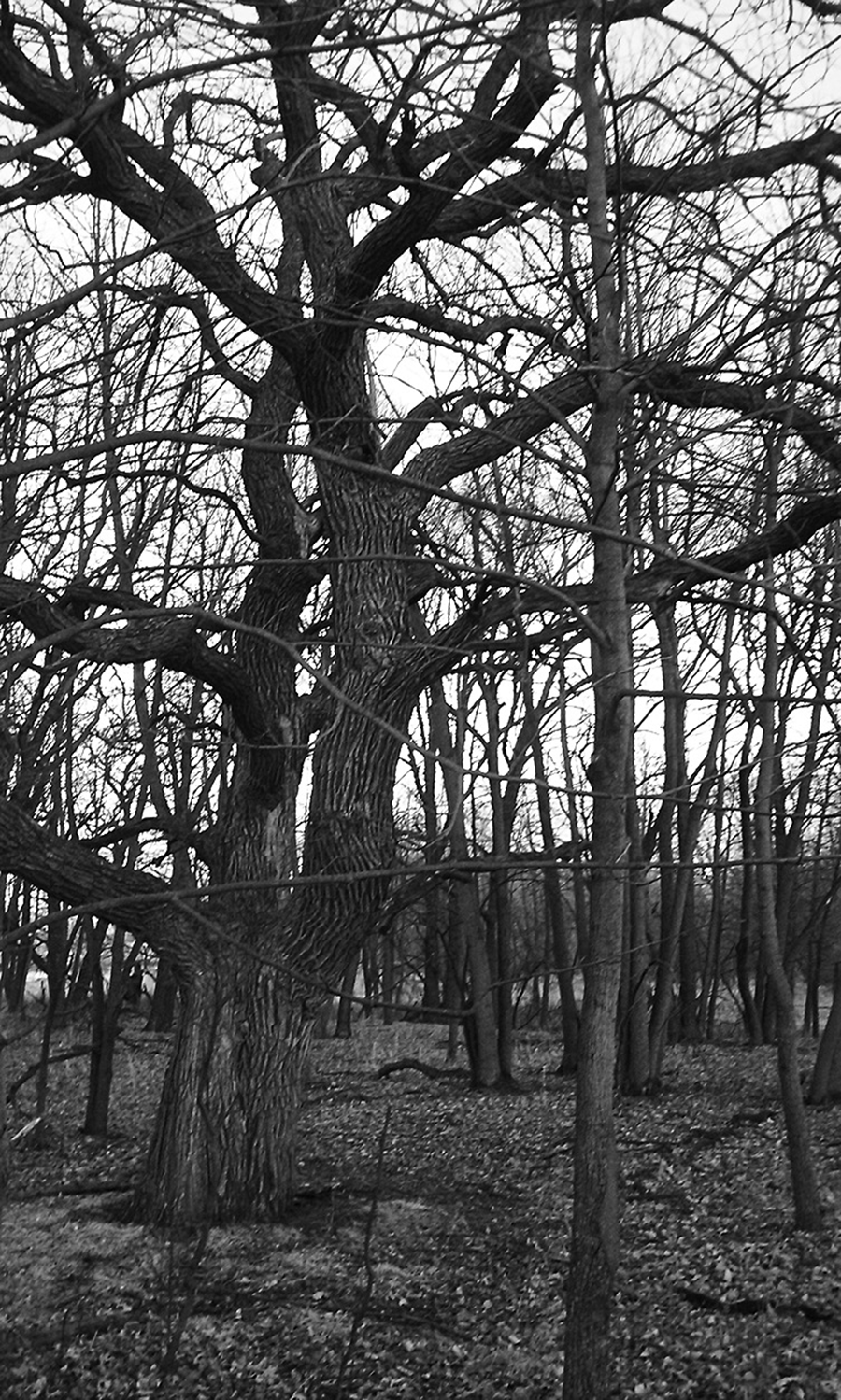
FIGURE 10. The large trunk testifies to the age of the tree. The large horizontal limbs tell us this was once an open prairie. Today, the tree is surrounded by a dense stand of young trees, primarily basswood. The basswood have shaded out all the grass and essentially fire-proofed this area. Photo courtesy of the author.
There were trees, especially oaks, on the prairie, as described in Chapter 3. These old oaks are characterized by their wide-spreading horizontal limbs. Even as a prairie lover, a lone bur oak with its massive limbs on a hilltop is an impressive sight. However, with fewer fires today, these former open savannas or single trees are now engulfed in a thick forest (Figure 10). Once the tree canopy closes, almost no grasses or other fine fuels will grow. These areas are effectively fire-proofed until the trees are cut down and there’s enough light to encourage the grasses and forbs to grow.
What’s the best tree in the prairie? A stump. Just remember the immortal words of Smokey the Bore: Only you can prevent forests.
Lawns of God
JOHN MUIR famously called forests “god’s first temples.” Temples are sacred and are not to be touched. In his classic Where the Sky Began, John Madson titled his third chapter “The Lawns of God.” This brings up another issue in the prairies related to the previous chapter on trees. Midwesterners do like grass, just as long as it’s short, shorn, and monotypic. We will spend large sums of money on fertilizers to make it grow tall, equipment to cut it short, gas to run that equipment, and chemicals to reduce the diversity to a single species. We will invest countless hours on weekends and evenings generating air and noise pollution.
Some rural midwestern home lawns are enormous. And they are small in comparison to the lawns around some office buildings, churches, and in industrial parks. Some rural residents mow wide ditches past their lawn along the front of corn and soybean fields. Municipalities mow roadsides all summer long.
I remember asking a neighbor when I lived in Kansas why he spent so much time mowing ditches. I pointed out the time, fuel, and wear and tear on his tractor. His response was that he could either spend the afternoon with his tractor or his wife. That was twenty-five years ago, and I still haven’t figured out a response.
Another homeowner told me last year that he tries to spend two hours on his mower every evening after work. He finds it relaxing and it is how he decompresses at the end of the day. He was very proud of how his property looked, and rightly so. It would have been hard to say I’d like him to stop mowing and have his anxiety level increase.
To others, native or restored prairies just look weedy, untidy, and unkempt. Anything that isn’t carefully manicured bluegrass, not bluestem, is a weed. Prairies make the news every couple years when a suburban homeowner converts their chemically soaked, maintenance-intensive, monoculture to prairie grasses and wildflowers. Neighbors complain and local politicians invoke ordinances. It often doesn’t end well for the homeowner. That said, with the recent focus on pollinators, people are taking a greater interest in native plants.
It’s always frustrating to go to garden centers and see what they advertise as “native plants.” Most are monstrous cultivars while others are plants such as Korean so-and-so grass. Nothing against the country, the people who call it home, or who came from there, but doesn’t the name imply the species may not be native to the American Midwest?
One of the prairies I used to visit frequently as a college student has for the last two decades or more been mown to putting green height once a week. Families of the people buried in that cemetery didn’t like the “weeds” growing on their ancestors. While I want to cry every time I think about how beautiful this remnant prairie once was, I can’t say that these are terrible people for wanting this cemetery to look like every other well-kept and nearly shorn cemetery.
These situations take conservation out of the realm of ecology into psychology and sociology. People just like a golf course–looking landscape because that’s what they are used to. No one can fault anyone else for that. It’s part of our cultural esthetic. There’s an entire industry and advertising campaign to convince people they’ve done a good thing and need to keep doing it. And of course buy more chemicals and equipment to achieve that look.
People who mow grass aren’t bad or wrong. I wish they’d leave it alone and plant native grasses and forbs, but then I’d be forcing my cultural values on them. They probably wish I’d mow more and keep the weeds under control. This is where the conservation message gets tricky and where bad feelings develop if words aren’t chosen carefully. These are hard conversations to have.
However, the prairie lover in me thinks about the hundreds of thousands of acres of mown grass across the Midwest. What if we wanted all those lawns and ditches and other places to look like meadows of native wild flowers? How much pollinator habitat could we create in a very short time? How much time, fuel, and money could homeowners and businesses save? How much carbon could we sequester and erosion could we prevent? Then again, perhaps some questions are better left unasked.