
CHAPTER 15
All the charm and mystery of that prairie world comes back to me, and I ache with an illogical desire to recover it and hold it, and preserve it in some form for my children. It seems an injustice that they should miss it.—Garland 1917
[A] memory of what was gone before I came.—Peattie 1938
To those who wish to bring together the multitude of species represented in a prairie—or any other natural community for that matter—would seem to have a task exceeding that allotted to Noah.—Kline 1997
Consideration of evolutionary history rather than anecdotes from European travelers presents a dilemma for nostalgists fixated on a particular image of pre-contact nature. . . . [T]he best course is probably to define restoration objectives in terms of ecological or biocultural processes, rather than as arbitrarily chosen or illusory static communities. One may wish to preserve diversity as a key to the past and an offering to the future, but the particular composition of plant communities in any single place or time, as far as anyone can determine, is ephemeral.—Howe 1999b
However, our efforts at prairie restoration are usually limited to establishing prairie plants with little attention given to other prairie organisms.—R. C. Anderson 2006
MOTHER NATURE IS PRETTY SMART. Surely if we just leave things alone, take a hands-off approach, nature will heal itself? In the words of Paul McCartney, just “Let It Be.” One of the themes of this book is the role people played in maintaining and expanding, and possibly creating, the tallgrass prairie. Researchers at Cedar Creek in Minnesota studied fields that had been plowed but abandoned for more than nine decades. Even after all that time, plant diversity and productivity were only 73 and 53 percent, respectively, of adjacent native prairie (Isbell et al. 2019). They state that bringing back the prairie will require “active restoration efforts.”
This chapter will not provide a how-to for reconstructing prairie from the ground up or restoring the health of an existing prairie. There are a number of books that cover this topic well. The goal of this chapter is to take a step back and provide food for thought before the restoration begins. Restoration can be as philosophical as practical. Restoration requires that the practitioner be up on the latest science. However, that isn’t enough. Restoration is both an art and a science, and it needs to be viewed from both perspectives.
Prairie restoration may be one of the best places for an individual or group to leave a legacy on the land. My own research and the research of others clearly shows that each native prairie is a unique assemblage of plant species. After the pup and I had surveyed numerous restorations over a couple summers, I could almost tell who was in charge of the restoration just by looking at the results. That’s an exaggeration, but not by much. My fear was that people were using a standard seed mix and all the restorations would be essentially the same. I was pleasantly surprised to find that, while not nearly as diverse and distinct as each individual native prairie, each restoration was somewhat distinct from every other one.
One reason for this is the role weather may play, especially in the summer after the site is seeded. Imagine using the same seed mix on two restorations two years apart. In the first restoration, the summer is cool and rainy, ideal for germination and seedling survival. In the second restoration, there are some timely spring rains promoting good seed germination. The rest of the summer is hot, windy, and dry, shriveling up and killing all those seedlings. Three years later, those two restorations will look very different, even with the same starting point (Middleton and Bever 2012; Stuble et al. 2017; Groves et al. 2020). This again shows the role that weather can play as a major factor in prairies.
Much of the restoration activities today are about trying to capture something that we, individually and as a society, have lost.
The stranger ignorant of the history of the country is struck with the sense of some difference; but there is nothing to admonish him that here was once a land of unbroken sky-line with no object in sight taller than the yellow blossoms of the compass plant or rosinweed. A thing of great beauty has passed away forever. (Quick 1925)
Today, I think of my great-grandad’s quarter-section of old Iowa. He saw prairie as something to be broken for his children; I see it as something to be saved for mine. (Madson 1993)
Some who participated in the death of the prairie lived to regret their actions.
I felt for the first time the poetry of unplowed spaces. (Garland 1917)
The seed is in, fateful and indomitable; we have populated where we have slain. Still sometimes when in fall or spring the wind turns, coming from a fresh place, we smell wilderness on it, and this is heartbreak and delight. (Peattie 1938)
Many people like to restore old houses or old cars. Someone restoring a car can look at old photos and blueprints and restore the car to what it looked like when it rolled off the assembly line. A person can look at architectural styles, paint colors, wallpaper patterns, and restore a house to exactly what it looked like when it was first built. If a famous individual was born in that house, the goal may be to restore the house to that date as opposed to what the house looked like when it was first built.
We can say that there is a time we can call age zero, when construction is done on the house or the car rolls out of the factory. What is the starting point for the prairie, or any other ecosystem someone is trying to restore?
The following quotes were taken from Leopold’s dedication of the University of Wisconsin’s Arboretum.
This Arboretum may be regarded as a place where, in the course of time, we will build up an exhibit of what was, as well as an exhibit of what ought to be.
The first step is to reconstruct a sample of what we had to start with. (Leopold 1934)
These quotes bring up some interesting points. The words “start with” imply that there was some point in time that we can say things started, a time zero. The phrase “what ought to be” implies a judgment call and perhaps that judgment is open to interpretation. There are many who think natural areas ought to be fields of corn or subdivisions of trophy homes.
The “re-” part of re-storing implies that we are going backward in time, re-turning to an earlier period. So that invites the question of what time are we going back to? Are we going back to the year the first European explorer entered the area? The year the General Land Office Survey mapped the area? The year the site was plowed under? Are we going back to 1492? (Notice how all of these arbitrary dates have a Euro-American or European perspective?) Are there specific times before this we should aim for? Or should we try to return the area to what it looked like right after the last glacier retreated?
Should managers maintain or re-create a particular image of presettlement prairie climax determined by soil, hydrology, and climate? Or should their goals include several historically plausible images of grassland communities? Or should the objective be to maximize grassland species diversity for its own sake? (Howe 1994b)
These discussions can get silly, but they are serious. I don’t know if anyone could really argue that we should restore the landscape to the years immediately following the glacier’s retreat. That’s ridiculous. However, we can get serious about this topic also. Let’s go back to the end of Chapter 3 and the descriptions of the Driftless Area of southwestern Wisconsin. Should the aim be to restore the open grassy landscape that Jonathon Carver and George Catlin described or the Big Woods Laura Ingalls Wilder described? Which landscape is “correct” and what is the justification for that answer?
Pick any spot or plot of land in the eastern tallgrass region, especially east of the Mississippi River. At some point in time over the last several thousand years that acre has probably been a forest, savanna, and prairie as the prairie-forest boundary shifted east and west. In fact, the acre may have been several forest or grassland types over that time.
Right now, the land is currently an agricultural field. What condition or plant community should we restore it to? In some cases, there may be a landscape context. If there is an oak-hickory forest on two sides of the land, maybe we should restore it to this forest type. If there is native prairie on either side of the land, then planting trees would obviously be detrimental to grassland nesting birds in these areas.
There are also some practical considerations to restoration. Imagine an eighty-acre parcel in a floodplain along a river. We want to restore this to prairie, which at one time it was. Every few years those acres will be inundated by floodwaters and most falls the acres will be carpeted with seeds from cottonwood, silver maple, boxelder, and green ash trees.
It may require almost annual burning to keep these acres a grassland, and even then, the area would probably need some mechanical tree removal every few years. Does the agency or private landowner have the time, resources, equipment, and staff to devote to keeping those acres an open grassland? If the answer is no, then it may be best to restore those acres to floodplain forest even if the General Land Office Survey said those acres were in prairie at the time of the survey.
What are we trying to restore? Are we simply trying to replicate the plant community in the nearby pioneer cemetery? Have those plant communities changed in the last 100, 200, 500 years and how have they changed? When it comes to plant diversity is more always better? Why? Although there are scores of prairie plants, no one prairie has them all.
Restoration can invite as much philosophy as it does pragmatism. What is the purpose of the restoration? Why does someone want to restore these specific acres? Is it possible to restore something that is constantly changing? Are we trying to restore a plant or animal community, an elaborate garden or zoo, or are we trying to grow some quail to hunt in the fall? Or are we trying to restore or replicate large-scale ecological patterns and processes?
Patterns and assemblages of taxa are clearly transitory. Perhaps conservation would be more constructive if efforts focused on preserving the processes and opportunities of change. (Brown 1993)
Should restorations only look backward in time or should they also consider the future? Does it make sense to restore a particular plant community to an area if we know we can’t maintain it or if it may not match existing or future climates? What role does future climate change play in restorations?
Because restoration often seeks to undo the last several centuries of human influence, restoration ecologists often focus on the past. However, this focus obscures a goal that is more important than simply recreating past conditions: the restoration of ecosystems that will be self-sustaining and resilient. (White and Walker 1997)
One theme of this book is the large role people played historically in maintaining and possibly expanding the prairie, primarily by the use of fire. People are also responsible for the destruction of the prairie. Today people need to play a strong role in bringing the prairie back. Prairie is not a hands-off ecosystem. In most deserts and forests, people can largely leave the land alone, or apply management actions only periodically. Prairie needs a human touch, if not annually, then fairly frequently. A hands-off prairie is a forest.
Well-meaning conservationists continue today to argue against ill-conceived assaults on ecosystems as interfering with the balance of nature. Arguments are occasionally heard in which it is said that “nature knows best,” and should be left to its own devices. Such a view is obviously based on the presumption of a natural balance. (Kricher 1998)
As late as the early 1960s, prairie managers thought that the best way to preserve the remaining fragments was to put fences around them and keep people out. People had done enough harm, and nature would know how to heal itself. The fatal flaw in this approach is that one key species is missing, but is critical to the survival of even small prairies and savanna remnants. That species is us. Show me a black-soil prairie remnant in good condition, and I’ll show you an attentive prairie steward. (Drobney 1999)
Restoration has undergone a number of positive changes over the years and decades. Many early grassland restorations were done with brome and sweetclover. The seed was cheap. Farmers knew they would get good germination and a quick establishment. Today, these and similar species are some of the worst invasives we battle in the name of grassland conservation and biodiversity.
Next, we moved to native species, but often with little regard for where the seed came from. These restorations were frequently heavy on grasses and light on forbs. Often, we planted grasses from western areas into eastern restorations. Given more rainfall than they were used to, the grasses grew so well they crowded out all the forbs, creating almost a monoculture (Figure 11). Not surprisingly, plant richness is often negatively correlated to the amount of the dominant grasses in restorations (McCain et al. 2010).
Today’s restorations often use much more diverse mixes of locally harvested seeds. Instead of using one seed mix over an entire area, managers may be able to customize seed mixes to different soil types and topographies within the restoration.
One of the key features of native prairie is that there is always something in bloom, and each week or two there is a different set of species in full bloom.
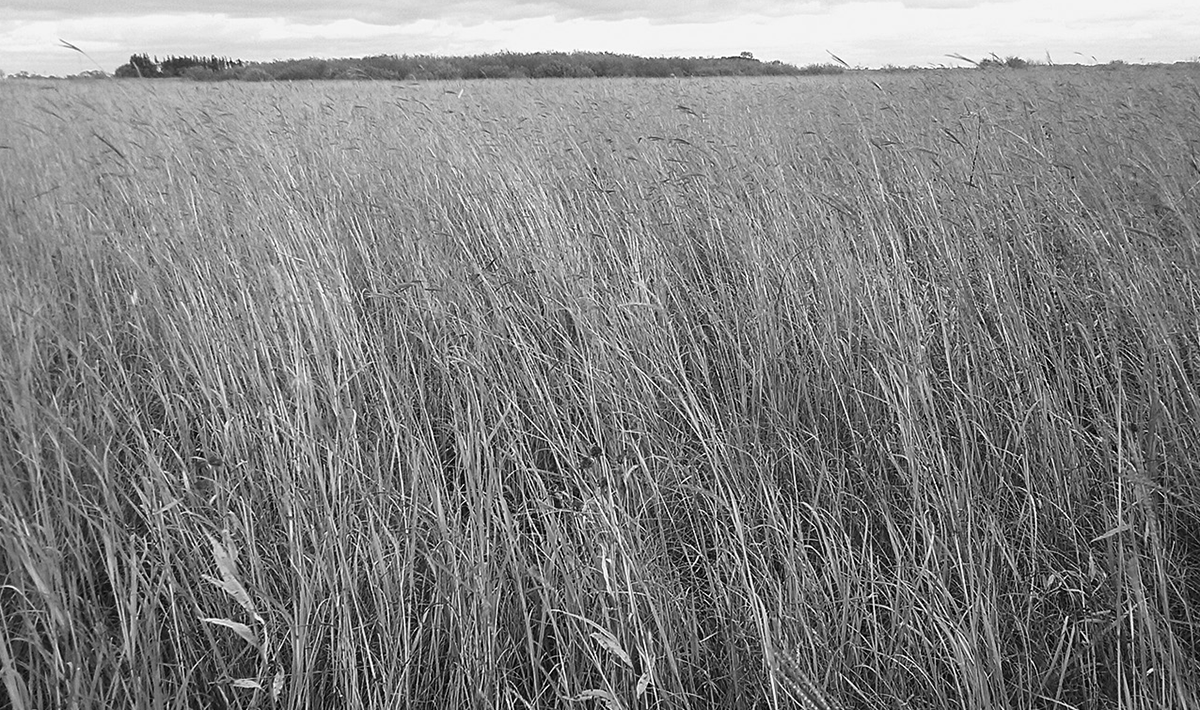
FIGURE 11. In this image, there’s a ninety-pound Labrador retriever fifteen feet in front of me hidden in the tall dense grass. Photo courtesy of the author.
This [late spring] was the surface of the prairie, a soft fragrant cheek turned to the sun; this was the most passing and innocent vernal aspect, before the coming to full stature, to the war paint colors of final bloom. (Peattie 1938)
One glories in its beauty, its diversity, and the ever changing patterns of its floral arrangements. (Weaver 1954)
From the first pasqueflowers of March to the towering sunflowers of October, the tallgrass prairie will never be without flowers. (Madson 1993)
However, still today most restorations are often missing most or all of the spring and early summer flowering species. This is usually related to seed availability and price. Aster and sunflower seed is easy to produce and harvest. There’s a lot of seed commercially available and it’s relatively inexpensive. Pasqueflower, prairie smoke, blue-eyed grass, birds-foot and prairie violet, and other spring blooming species are more difficult to harvest, not as available in the commercial trade, and often much more expensive. For instance, one commercial seed dealer sells a quarter ounce of early blooming prairie violet for twenty-five dollars. Late blooming long-headed coneflower sells for five dollars an ounce.
When it comes to diversity in seed mixes for restorations, all species aren’t necessarily equal. Diversity of blooming times, plant families, sizes, shapes, and colors of flowers are just as important as species diversity. If there are already five species of fall asters in a seed mix, adding one more fall aster may not add that much. If there aren’t any penstemons in the mix, adding a penstemon may be far more beneficial to pollinators than one more aster. It makes the process of developing the seed mix longer and more complicated, but, picking what seed to use in a restoration is usually a pretty fun part of the job. And this is often where the art comes into the restoration.
It makes sense that if someone is restoring a prairie in Illinois, they should use seed from Illinois instead of from Kansas. Local seed, or local ecotype seed, will be better adapted to local soils and climate. However, that can be easier said than done.
The titles of some of the research published on the topic of local ecotype seed in restorations is revealing. Edmands (2007) titled her paper “Between a rock and a hard place,” while Millar and Libby (1989) use “Restoration: Disneyland or a native ecosystem?” McKay et al. (2005) used “How local is local?” Schaal and Leverich (2005) title their paper “Conservation Genetics: Theory and Practice.” “Ecological genetics and the restoration of plant communities: Mix or match?” is the title Lesica and Allendorf (1999) chose. Mortlock (2000) titled his study “Local seed for revegetation: where will all that seed come from?” Finally, Miller and Hobbs (2007) used the title “Habitat restoration—do we know what we’re doing?” It is interesting to see how many studies in this area have question marks in the title of the research paper. It’s also clear that restoration ecologists don’t operate in a perfect world.
In a perfect world, there would be a large native prairie of the same soil types near the restoration where managers could harvest seed. Obviously, that doesn’t characterize most of the Midwest today. Without the option of a nearby native prairie to harvest, the manager has to determine where they are going to get their seed. How far away is too far away for me to get seed? A manager may be able to get thirty species nearby but really wants ten more species. Is it better to have a lower diversity planting of local seeds or a higher diversity planting using seeds from farther away? There may be a nearby native wet prairie. If you’re trying to restore a dry hilltop, you’ll want to look farther away than the closest prairie.
And then there is climate change. The Midwest is expected to get warmer and drier. Species may shift from the southwest to the northeast. Should managers try to get seed from southwest of the restoration and move it northeast to the restoration? We can look at this in two ways. Instead of using “local” big bluestem seed in our mix, should we look for seed from southwest of the restoration to better match future climates? The next question is whether we should select entirely new species from southwest of our restoration and use them even though the restoration site is technically outside of the “currently” designated range for that species but may be in the “future” range. This is sometimes called assisted migration. These are hard questions, and few of them have absolute right or wrong answers.
So how far should you go? Seed should come from a “reasonable distance” (Millar and Libby 1989). However, reasonable may be in the eye of the beholder and it’s difficult to come up with “unambiguous recommendations” for seed collection relative to distance between local and restoration sites (Moncada et al. 2007).
What does local even mean to a plant? Big bluestem is almost everywhere and wind-pollinated. We can imagine that through pollen the genes of big bluestem moved around quite a bit. Another species may be limited primarily to small hilltops and pollinated by an insect that doesn’t travel very far. Other plants may naturally self-pollinate and be genetically adapted to this reproductive strategy.
There’s one area of research that so far has had little attention. We bring plant seeds to an area to restore grasses and forbs. We assume the birds will find the site, as will the most mobile insects. But what about soil bacteria, fungi, and other microorganisms? What about the insects that can’t disperse or travel over long distances? Do we need to cultivate and then “seed” these organisms into the site? How do we do that? For the most part, we just don’t know. But it’s interesting to think about and researchers are starting to investigate these questions (Fierer et al. 2013; Klopf et al. 2017).
For most restorations, managers are literally starting with a blank slate. They plant seed into or onto bare soil, often soybean stubble. In other cases, managers want to either: 1) convert a (near) monotypic field of brome or similar non-native grass to a diverse stand of native grasses and forbs, or 2) convert a low diversity native planting dominated by native grasses to a more forb-rich plant community.
When seeding into bare dirt, managers are putting seed into what is at least initially a relatively competition free environment. Interseeding into an established plant community is a very competitive environment.
Clipping or mowing can remove enough of the canopy of the dominant grasses to aid seedling establishment (Williams et al. 2007; Dickson and Foster 2008). Grazing can also help seedlings become established when seeds are added to established grasslands (Martin and Wilsey 2006; Doll et al. 2011; Wilsey and Martin 2015). Put another way, interseeding probably only works when followed by a significant amount of disturbance to remove or weaken the existing vegetation and reduce competition. Throwing seed out and just hoping for the best will rarely if ever increase species richness. It will waste seed, effort, and money.
One method that can cause significant heartburn in some people is seeding into native prairie, even highly degraded native prairie. There are several reasons for this. First, if some of the seed does germinate and plants get established, they could introduce new genes into an existing population of a species that could be detrimental to future generations. Second, it may damage the site for future research into plant community composition. Future researchers would have to ask whether that species was part of the original or historic plant community or a species someone planted recently.
Everyone who has been around prairie for a reasonable period of time has a story of burning a prairie that is in poor condition and being amazed at what pops up the following summer. A little more tender loving care may reveal an incredibly diverse plant community that just needed a little help to be “released.”
I look for several species when investigating a new site, and if I find them, I’m pretty sure I’m standing on prairie that has never been plowed. If I’m on a hilltop, and I find some combination of pasqueflower, prairie smoke, ground plum, violets, puccoons, and similar species, I’m pretty sure I’m on unplowed soil. These are species that rarely show up in restorations. If I find them, they’ve probably been there for a long time. The site may have been heavily grazed in the past and dominated by brome. However, if there are some high-quality plants poking through, there are almost always more hiding in the soil. It’s probably best to do a few years of management. If there are still very few native species at very low densities, then some sort of additional seeding may be in order.
In a way, restoration implies a fair amount of hubris and arrogance. It took Mother Nature, with a lot of help from human hands, thousands of years to put together the prairie. Do we really think we can recreate the prairie in her image in a few years?
Of course, prairie restorations are not the genuine article. For a long time they can be only reasonable facsimiles at best. If we knew everything we needed to know, and had exactly the right equipment and seed sources, we might be able to re-create a fairly authentic prairie in as little as a century—although it may take from 300 to 500 years. (Madson 1982)
Restoration is an “acid test” for ecologists (Bradshaw 1987) and the “ultimate test of ecological theory” (Ewel 1987). If we really know all the pieces and parts of a prairie and how they all fit together, it shouldn’t be any problem to put them together. Watchmakers with a fully stocked workshop should be able to build a functioning watch that accurately keeps time. Prairie restorationists can’t say the same thing.
Ecosystem restoration is an activity at which everyone wins: when successful, we are rewarded with having returned a fragment of the earth’s surface to its former state; when we fail, we learn an immense amount about how ecosystems work, provided we are able to determine why the failure occurred. (Ewel 1987)
Prairie restoration is an exciting and rewarding enterprise. It is full of surprises, fantastic successes, and abysmal failures. You learn a lot—usually more about what not to do than what to do. Success is seldom high, but prairie plants are resilient, and even a poor beginning will in time result in a beautiful prairie.
Prairie restoration is also a humbling experience. You find out how little you really know and how intricately interrelated the species and their physical environments really are. (Cottam 1987)
However, none of that is a reason to slow down or stop our conservation efforts. If we don’t know certain answers, like how to restore soil microorganisms, we shouldn’t stop. That’s a good reason to accelerate our restorations, monitoring, and research so that we learn from what we’re doing today so that tomorrow’s restorations are better. No time like the present to get started.
In a letter to his friend Bill Vogt on January 25, 1946, Aldo Leopold wrote that “the situation is hopeless should not prevent us from doing our best.” First, the prairies aren’t hopeless, even if it sometimes seems that way. Yes, we’ve lost a lot of prairie. Yes, our restorations aren’t quite as diverse as native prairie. We just always need to do our best, even if that best isn’t perfect, with every management action and every restoration. The important thing is to learn from every restoration, every burn, every grazing event. If something didn’t work, study it, understand it, learn from it, and try again.
Keeping the Cogs and Wheels
IT’S EARLY SUMMER. The prairie-chickens and sharp-tails are done displaying. Roosters no longer crow from the ditches. Bobolinks don’t circle overhead and meadowlarks don’t sing. It’s quiet . . . as it should be in this season when hens sit silently and cryptically on nests.
Today we carry only paper bags as my best friend and I walk slowly across the prairie. He is close at heel so as not to disturb any nests. I am stooped over, looking closely at the ground in front of me. We are here to hand-harvest wildflower seeds from a native prairie.
Formally and informally, we’ve been surveying plant diversity in native prairie and restored grasslands on public lands near home. Although restorations are more diverse than they were just a few years ago, they still have only a fraction of the plants in a native prairie. As importantly, there are a number of species that almost never show up in restorations. These are usually species that are short, or bloom early, or grow on hilltops or wetland margins where the big harvest equipment can’t go. Our efforts focus on these species, one handful of seed at a time.
With full bags, we get in the truck and start to drive away. A prairie-chicken hen and her brood sneak out of the grass, dart across the sandy two-track, and just as quickly disappear. Those young chicks are the reason we’re out here.
After we get home, we pour the seeds into cardboard boxes and spread them out to dry. The seed pile starts to squirm and wiggle with all the insects we inadvertently collected. This may be the most important reason to consider plant diversity when restoring grassland bird habitat.
At this time of year I keep each species of seed separate, everything dried and in carefully labeled paper bags. But there’s always that one bag I forget to label. Then I get the fun of trying to identify seed and chaff at the end of the summer.
Late summer finds massive gleaners noisily marching back and forth across the prairie, harvesting wide swaths of grass and wildflower seed. This time of year we harvest the sunflowers, asters, blazingstars, legumes, mints, and warm-season grasses in bulk. The gleaners will harvest tens of thousands of pounds of seed in a few days. We’ll add our seed to this mix.
We spread the seed from the gleaners out in long three-foot tall windrows on top of perforated PVC pipes. Once we turn the blowers on, we need ear protection, and any communication is done by yelling or hand signals. After the seed is dry, a large group will come together to bag the seed and store those bags in rodent-proof cages for the winter. We store tens of thousands of pounds of seed, forty-pound bags at a time.
As fall progresses, it’s just the two of us again on the quiet prairie. We have plenty of seed for the year. Now it’s just an excuse to be outside, alone together.
Next March we will scatter the seed over snow-covered soybean stubble. The snow will melt, and the daily freeze and thaw will pull the seed down into the soil. In another couple years, a former monoculture agricultural field will be turned into habitat with a diversity of native grasses and wildflowers and an abundance of gamebirds, waterfowl, songbirds, and pollinators. There are few rewards in the field of conservation, and most gratification is delayed. Finding wildflowers in a restoration that you know wouldn’t be there without your efforts is very gratifying.
Hand-harvesting seed is just one more excuse to be outside, to walk more miles, to explore new habitats, and spend time alone with my best friend. It’s about walking slowly, observing closely, and listening carefully.
Aldo Leopold tells us “that the first part of intelligent tinkering is keeping all the cogs and wheels.” Hand-harvesting seed is one way to ensure that our habitat restorations, our tinkerings with nature, have as many cogs, wheels, grasses, wildflowers, insects, and birds as possible.