
Once upon a time, there was a comedian who got his start with Fred Karno, came to Hollywood to work for Mack Sennett, made the transition from short films to features, was one of Hollywood’s highest paid comedians, and left his mark in some of the most important and beloved classics of silent cinema. And did I mention his name was Chaplin?
Syd Chaplin, that is.
To the extent he is remembered today outside of nutjobs like myself, he’s thought of mostly as a supporting player in Charlie’s films. He was certainly a tremendous asset to his famous brother, in films such as A Dog’s Life. But to focus on stuff like this devalues Syd, and reduces him to an also-ran, when he was a full-fledged top-billed comedy star in his own right.
During the 1910s, when Charlie was making his seminal short comedies at Essanay and Mutual, Syd was working with Mack Sennett on a series of shorts in which he played a character called “Gussle.” Gussle, for want of a better description, was a self-conscious Chaplin-alike. Syd made the necessary tweaks to accommodate his heavier girth, and didn’t attempt to copy Charlie’s costume and mannerisms in the slavish way that professional Chaplin mimics did—he just took the general idea and adapted it to his own idiom.
In the end, Gussle looks like the unholy love child of Charlie Chaplin and Shemp Howard—he combines Shemp’s appearance with Charlie’s physical grace, and fuses both of their more violent traits. Charlie’s early shorts at Keystone were often startlingly violent—and Syd’s Gussle shorts leaned heavily on the knockabout form of slapstick havoc.
Reggie Gussle—with his oil-slicked hair parted in the middle, a mustache apparently swiped off Snub Pollard’s face and stuck on upside down, a drunkard’s swagger—was consistent with the character he’d started playing on the Music Hall stage for Fred Karno, and simply ported over to films when he joined Sennett.
Now as any decently informed Chaplin buff can tell you, Charlie started his career in the English Music Halls with the Fred Karno Company. But, and here’s the secret history that isn’t often mentioned, he was there thanks to his older brother Syd. Actually, half brother, if we want to be technical. But Charlie considered Syd a full and true brother, so who are we to split hairs?
To trace the proper history of Charlie and Karno, we start with Syd—although exactly how to start with Syd is a bit of a mystery.
As it happens, where on the planet Syd was born is a question mark for historians and genealogists, who think but are not sure that he was born Sydney Hawkes, in 1885, in South Africa to a pair of traveling British actors. A year later, mama Lily Harley divorced her husband to pair off with Charles Chaplin. In 1889, they had a boy named Charlie. Papa Chaplin died, Mama Chaplin underwent a nervous breakdown and suddenly Syd and Charlie were on the streets, bereft and alone. They were shipped off to an orphanage, and Syd had no choice but to step into the surrogate father role.
Syd was a natural entertainer, and he made pocket change as a street performer. In 1905, this landed him a better paying gig (yup, better paying than pocket change) as a comedian with Fred Karno’s troupe. And it was then and there that Syd started lobbying Karno to open up a slot in the cast for Syd’s younger brother Charlie.
If Syd stopped there and did nothing else, he’d have already earned a place in film history for the momentous act of introducing Charlie to the stage.
In 1914, Charlie made the leap away from Karno to join Mack Sennett’s Keystone Pictures—and within a year he was on his way to being the biggest movie star in the world. By August 1914, Charlie wrote letters back to Syd in England urging him to come to America and get a job at Keystone—and furthermore, recommending that his brother play hardball with Sennett in his salary negotiations.
You could say one good turn deserves another—Syd got Charlie a job at Karno, Charlie got Syd a job at Keystone. But there’s more to it than that: Charlie was at that point already scheming to leave Keystone—he needed greater creative freedom than the omnipresent Sennett would ever give him. Charlie knew that his leverage with Sennett was as great as it would ever be, and if he was ever going to do anything with it, now’s the time, so why not use that power to maneuver his brother into a plum job?
This is indeed how it played out. Sennett hired Syd, gave him a one-year contract for his own run of top-billed solo shorts, with a better than average starting salary. At which point Charlie quit to join Essanay. Sennett was obliged to keep Syd and treat him well as a bargaining chip in his efforts to woo Charlie back.
Sennett had forged a secret alliance with D.W. Griffith and Thomas Ince. Between them they were the three most powerful and significant figures of American film in 1914. This triangle of talent (nudge nudge) also roped in some bankers and movie financing types to create a megalithic media conglomerate called Triangle. Their plan was to lock all of the major Hollywood stars into exclusive contracts with Triangle, and then go to theater chains and say, look, if you want any movies with these top marquee names in them, you have to agree to our distribution terms: namely, if you buy one you buy all. If you want to screen any Triangle films, you have to agree to be an exclusive Triangle outlet and buy everything we send you.
It’s called “block-booking” and it’s such a controversial practice that today various governing bodies have created strictures to prevent it, but in 1915 it was a legal, if unpopular, strategy.
It was also potentially a self-destructive strategy, because it only works if you have something so attractive on offer that exhibitors will agree to accept these terms. If you don’t have enough things that the exhibitors want, then you’ve just locked your own self out of competition altogether and put yourself out of business, because block-booking also means, if you don’t take one, you don’t take any.
Which meant in simple practical terms, Mack Sennett was under extraordinary pressure to get Charlie Chaplin back. He’d hire Syd and give Syd just about anything he asked for if it gave him any better odds of getting Charlie back.
Of course, it didn’t actually change his odds of getting Charlie back, but Sennett didn’t really understand that. He, and moreso the money men at Triangle, believed Charlie’s departure was all about money. Offer Chaplin enough cash and he’ll come back. The fact was, Charlie was seeking something Mack Sennett could never give him: creative autonomy, but Sennett selectively remembered only Charlie’s salary demands.
Charlie did leave Essanay, but not to return to Sennett. Instead, he went to Mutual where he was paid exponentially more than Sennett and Triangle could afford.
Mack Sennett still had Syd, though—and a Chaplin is better than no Chaplin. Keystone had been swallowed by Triangle, but Sennett wisely retained his own studio, Mack Sennett Productions, as a separate entity whose product would be distributed by Triangle. Sennett could see where this was headed: without Charlie Chaplin, Triangle’s monopoly would fail, and Sennett made sure he’d ride it out safely, capable of distributing his comedies through other chains when and if the need arose.
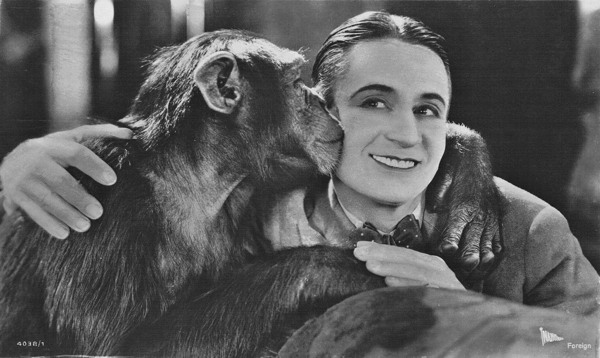
Syd Chaplin and a simian costar in The Missing Link (1927), a silent comedy with synchronized music and sound effects.
By the end of Syd’s year-long contract with Sennett, it was obvious Charlie wasn’t coming back, and while the Gussle comedies had been popular enough and reasonably profitable, Sennett let Syd go. It was by no means the end of his solo career. However, Syd did put his solo work aside repeatedly from time to time to support his brother in whatever capacity he was needed most. Some of the time, this meant playing alongside Charlie onscreen. For example, in Charlie’s Shoulder Arms.
Syd also handled Charlie’s business affairs, and negotiated Charlie’s first million dollar contract in 1917.
This is how history remembers Syd—as Charlie’s shadow. But there was that time, way back when, when Syd was a top billed movie comedian all by himself. A top-billed comedian, at that. Syd’s solo career relaunched in large measure thanks his starring role in the 1925 Al Christie-produced feature film Charley’s Aunt. This led to Syd’s own million-dollar contract, making big-budget features like Man on the Box, Oh, What a Nurse and others for Warner Brothers.
By this point, Syd had retired the Gussle character and moved on to something new—if Gussle was a sort of Charlie Chaplin-meets-Shemp Howard hybrid, the new Syd played a Harold Lloyd-meets-Shemp figure, allowing his own fairly handsome face to be seen without funny haircuts or silly mustaches.
In 1926, Syd made The Better ’Ole, a World War I farce distinguished by its pioneering application of new technology—the Vitaphone synchronized sound system. This wasn’t talkie technology, mind you, but a way to synchronize music and sound effects to silent films—and a crucial transitional step towards talkies. As the talkie era dawned, Syd was ready for the bracing changes: “I can see a time a coming when we shall have colored films, not only with dialogue, but third dimensions.” Syd said this in the 1920s, mind you.
He also said, “What is going to happen to us wretched comedians is more than I can say. Until now people like my brother, Harold Lloyd, and myself have worked almost entirely without script, depending on the inspiration of the moment for our greatest gags.”
So, Syd realized he’d need to start thinking about writing scripts for this brave new world of talkie comedies. Thus, in 1929, Syd was busy writing a feature based on the Mumming Birds music hall sketch he and Charlie had performed on Fred Karno’s stage back in 1906. Charlie had already raided this act for his silent film A Night in the Show, but Syd had ambitions to flesh it out to a larger canvas.
At the time, Syd was contracted to MGM, and working out of Elstree Studios in England. And then, kablammo, suddenly Syd left England, and quit MGM. The Mumming Birds movie was never made—Syd never made another movie at all, silent or talkie. He settled into a vagabond lifestyle, slumming around the world living off the mountains of cash he’d stockpiled during his brief stint of fame.
A lot of great silent comedians hit hard times with the advent of talkies. Some weathered the change better than others, many vanished into obscurity. But Syd’s precipitous departure from the screen is something else altogether. It’s not that he had trouble adapting to talkies, or audiences didn’t like his voice, or his physical comedy seemed odd when weighted down by sound effects, or that the studio bosses shoehorned him into the wrong kind of material—he never even had the chance to have any of that happen, never had the chance to fail. He was eager to embrace the new sound technology, had an idea, had a studio backer, had creative freedom, had money, he lacked for nothing—but nothing came of it.
He plummeted off the screen so completely that when Syd died in 1965, Charlie Chaplin’s kids were gobsmacked to read in the obits that their uncle had once made movies of his own. Decades had elapsed and nobody had breathed word one about Syd’s solo career—it was if it never happened.
What gives?
Or phrased differently, the same question: what happened at Elstree in 1929 that Syd spent the rest of his life running away from?
If you’re a fan of Roscoe Arbuckle you’ve already guessed the punchline. It was a sex scandal.
This had more than a little to do with class politics of the 1920s. Prior to 1914, serious and commercially viable motion picture production was largely situated in France. Hollywood started to take over beginning in 1914, thanks in large measure to the international popularity of Mack Sennett’s wildly anarchic comedies. The sudden economic boom in Hollywood took a lot of country bumpkins, immigrants, and other undesirables and made them rich and famous, more or less overnight. Sennett once said that “pioneers are seldom from the nobility; there were no dukes on the Mayflower.” These are wise words—pioneers take risks, brave new frontiers, face unfamiliar dangers—not the sort of thing you do when you’ve already got something to protect. So the movie colony of Hollywood was populated with outcasts and misfits, finding a novel form of success. The Chaplin boys were dirt poor in England—they crossed an ocean and got million-dollar contracts to make people laugh.
There was an old guard, of old money, represented in, among other things, the world of publishing. Many of these old money types were horrified by the new money Beverly Hillbillies. Movie stars and slapstick comedians were the rappers of the 1920s—a bunch of people whose lives and heritage knew nothing about money suddenly enriched beyond all reason, and tending to spend that money in ostentatious ways. You want to put yourself into the mindset of the time, when you think of Roscoe Arbuckle, think of the Notorious B.I.G., 50 Cent, Ja-Rule and Murder Incorporated.
So from 1914 onwards, Hollywood faced a massive influx of once paupers getting rich, buying absurd houses and flashy cars, and partying hard all the time. The old money types were offended by the boorish habits, and to continue the parallels to today there was a contingency of moralists and Bible-thumpers who were aghast at the loose morals of these Hollywood types. These were the same self-important moralists who got the country to ban alcohol outright, so naturally they had no love lost with the hard-partying movie folk.
For a long time coming, the moralists and the old money guys in the publishing business had been looking for a way to go after Hollywood, and the Roscoe Arbuckle affair—whether trumped up for the purpose or an accidental coincidence—was practically a gift from the gods. It ruined Arbuckle’s career and sent shock waves through the film business. A scandal stirred up around Mabel Normand, another Mack Sennett find, nearly scotching her comedy career. And Syd had already, in his capacity as Charlie’s business manager, helped his brother navigate his way through a few scandals attending the Little Tramp’s sexual proclivities.
Which is a long way round to saying that come 1929, Syd knew the score: sex scandals ruin movie careers and destroy comedians. The moment he was accused of sexual improprieties, he knew he had but two choices: do everything in his power to suppress the story and quietly retire from movies—or allow himself to become the target of a hungry press and angry public and be forcibly, ignominiously retired from the movies. Either way his life as a screen comedian was over, it was simply a question of how much privacy and dignity Syd would be able to maintain.
As Roscoe Arbuckle had himself discovered, there is a risk in playing an onscreen roué—people start to think it’s true. And in one of Syd’s very last films, The Missing Link, made for Warner Brothers in 1927, a disgruntled dame chuffs, “It is very evident that a lady isn’t safe near you.”
As it happened, this wasn’t just Syd’s onscreen persona. Darryl Zanuck called Syd “the greatest ladies’ man in Hollywood history—better even than Errol Flynn.”
Exactly what transpired in England is unknown—Syd did a good job of burying the facts, because that was the point after all. His strategy of removing himself from the public eye had its intended effect of keeping the salacious details safely concealed. To a certain extent, all we know is what we don’t know—it was alleged at the time he’d assaulted a 19-year-old girl. Perhaps people were mixing him up with his more famous brother, whose habit of robbing the cradle is the stuff of legend. The girl in Syd’s case was no child—birth records firmly establish her age as 22 at the time of the incident—which we know because she was sufficiently aggrieved to get her case heard in a British court.
Somehow, Syd injured her breast—whatever that means, and this is as far as the facts can take us, and none of the parties are around to defend themselves against further speculation. Writing for The Independent, journalist Matthew Sweet put in legwork worthy of an old-school private eye, but got no further than this: the young woman took her case to court, and Syd went on the lam, more or less the rest of his life.
What was once a vast and bustling enterprise of American slapstick has been narrowed by our pop cultural myopia to a singular focus on the Big Three. No longer do we have the memory or attention for the dozens of comedians who once populated the screen—and it has gotten so bad that now there’s a rambunctious competition for the honor of the fourth slot—advocates of Roscoe Arbuckle or Harry Langdon or Charley Chase all vie for their guy to be recognized as the Fourth Genius. Anything less than that is total obscurity. Because we feel compelled to compare everybody back against the Big Three, we tend to be overly indulgent of those comics whose personas are distinct and decently original, even if they’re not as funny. Billy West or Billie Ritchie—these guys are hilarious, and their films absolutely retain the power to hold an audience’s attention today, but they rarely get the chance because they are inescapably seen as second to the man they mimic, Charlie Chaplin. They don’t get judged on their raw comedy merits. This is also true of Syd, destined by that name to be always compared to his more famous brother.
The 1915 New York Times piece also had this to say about Syd: “He affects his kinsman’s mannerism, even to the mustache, but he is not so good a comedian. Charles can kick twice as often and as hard as Syd, which means he elicits twice as many laughs.” The Chaplin name was both boon and burden—it opened doors for him surely but kept him forever in comparison to his brother.
But what if he was called Sydney Hawkes? What would you have thought of him then? Would you even have read this?