
This is the story of a custard pie, a movie camera, and the very origins of American slapstick.
In the 1940s and ’50s, American popular culture took to nostalgic reflection on the bygone age of silent comedy, much like modern pop culture pines for the 1980s. If there’d been a VH1 in 1945, it would have feasted on the likes of I Love the 20s! And, like the ’80s nostalgia of today, the simplest and cheapest way to look back was with a compilation of clips. Eventually the most sophisticated of clip jobs would come along in the form of Robert Youngson and Paul Killiam’s movie collages, but many years before that, the industry was already leaning in that direction.
Another way to indulge nostalgic reveries was to bring back the superstars of the lost form to strut their stuff in cameos intended to pay homage to their art. Arguably the most prominent example of this approach was 1939’s Hollywood Cavalcade, directed by Irving Cummings.
Made the year after Mack Sennett received his honorary Oscar, Cavalcade is essentially a fictionalized version of Mack’s life story. Set aside the fact that Mack Sennett actually appears in the film, as himself—that is but a weirdly recursive moment of meta-textual loopiness in what is otherwise a sort of bio-pic with Don Ameche playing Mack. The film takes us through the broad strokes of Mack’s life, hitting all of the beats and in the right order.
With one important exception—the moment when Don Ameche becomes the King of Comedy and anoints his girlfriend Alice Faye (the Mabel Normand figure of the film) as the queen of slapstick. It involves Buster Keaton and it goes like this.
The film crew is set up to shoot a romantic drama starring “Molly Adair” (Alice Faye), and the assistant director calls out over the bullhorn that the scene will also feature “Buster Keaton as the Romantic Lover!” The scene starts to unfold, and Buster is supposed to step into a jewelry store to buy his sweetie a ring, and while he is away the villainous “Claude” (George Givot) sets his rapacious eyes on “Molly.” According to the script and the directions shouted at him by “Mike Linnett” (the Mack Sennett figure played by Ameche), Buster is supposed to swan out of the jewelry store and slug Claude. Except this goes awry fast. Buster struggles with the fake scenery, and staggers around looking for some prop with which to hit his rival. The director is going apoplectic: “C’mon Buster! We’re running out of film!” Meanwhile, Mike Linnett’s valet is sitting nearby with Mike’s lunch, including a large custard pie. “Well, needs must,” Buster apparently reasons, as he grabs the pie and flings it—straight into Alice Faye’s face.
The crew erupt in laughter, the starlet erupts in fury, and Buster looks around in “What, me?” confusion.
That is one of the most potent scenes in all of film history, in my opinion. First, let’s look at the pie itself. It’s always hard to pinpoint when the first of anything was—and the spotty survival of silent films makes exhaustive research impossible. So, with that caveat, I can report that I have in my notes that the earliest recorded pie thrown in a screen comedy was in 1913, in a Mabel Normand, Roscoe Arbuckle short called Noise from the Deep. I invite anyone who disputes this to correct me—please, if you know of an earlier pie, I want to see it.
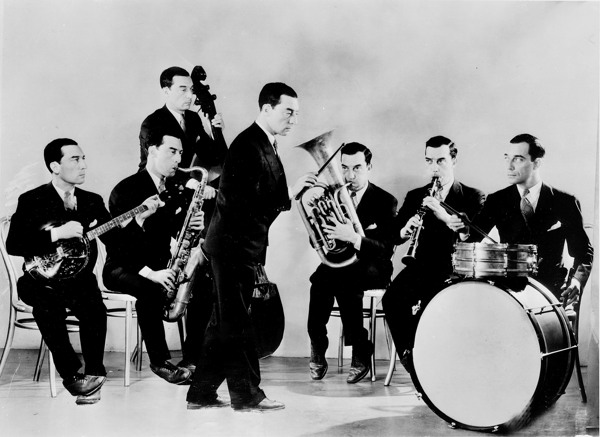
“This fellow Keaton seems to be the whole show.” As this undated publicity still shows, Buster did many things. Throwing pies was one of them.
In the pitch of slapstick nostalgia in the 1940s and ’50s, certain aspects of silent comedy would be exaggerated as defining characteristics—shorthand signifiers of the genre. Actual silent comedies were never as flickery as their mid-century copycats, nor were they ever as fixated on pies. Some comedians took to snooty objections that they had never thrown a pie. (How insulting, to be thought of as a lowly pie-throwing clown, said people who spent their screen careers throwing bricks instead.) But not Buster Keaton. He happily threw pies throughout these mid-century throwbacks, and set himself up as an expert on the art of pie slinging.
The most significant thing about Buster’s scene in Hollywood Cavalcade, though, is not that he throws a pie, but that it suggests his comic slapstick is an accident.
Buster took to the role of the accidental comedian and made it his own. Consider the made-for-television The Silent Partner from 1955, produced by Hal Roach. In it, Keaton plays a comedy has-been, beloved by die-hard fans but forgotten by the masses. It is a vaguely biographical sketch of Keaton himself (and made two years prior to the equally vaguely biographical sketch of Keaton that purported to be The Buster Keaton Story). Like Hollywood Cavalcade, it casts Buster as the bumbler whose accidental slapstick unwittingly created screen comedy.
This idea turned out to be a stubborn meme. That same year, 1955, found Mack Sennett making another cameo as himself in Abbott and Costello Meet the Keystone Kops (asked to identify himself, Mack throws a pie). The film involves Bud and Lou scammed into buying a bogus movie studio. This leads, inevitably, to that same idea that bumbling fools stumble unwittingly onto a movie set and accidentally create comic art. In a key scene, the boys stumble into the middle of a B-Western, and as a reward for ruining the shoot are given a contract as comedy stars.
There is something almost perverse at work here. Mack Sennett was a natural born anarchist who was drawn to the slapstick form through his own sense of the ridiculous; Buster Keaton was a gifted acrobat and vaudeville veteran who cultivated keenly developed philosophies of comedy. These two men worked hard at the business of comedy—yet time and again allowed their hard work to be lampooned on screen as the by-product of simple ineptitude.
It could be argued that Sennett and Keaton and their contemporaries were indeed uneducated, and that their comedy was unsophisticated stuff as compared to the screwball comedies that had by that point taken over Hollywood, and the depiction of slapstick pioneers as accidental artists merely reflects this state of affairs. But the prevalence of the accidental comedian archetype throughout silent comedy begs for some more coherent explanation.
And so we dial back to 1909, and find Those Awful Hats, a Biograph comedy directed by DW Griffith starring Mack Sennett (in costume and appearance, at least, replaying his role from The Curtain Pole). Mack and his wife elbow their way through a crowded movie theater and take their seats, rudely unconcerned with how their oversized hats block the view of the patrons seated behind them. But this creates a recursive loop—what happens if, while watching this movie, there happens to be someone in front of you wearing a giant hat? Which part is funnier—the thing happening to you, or the simulacrum of it on the screen?
Mack must have gotten this stuck in his head, because the same scenario starts to show up in his own films. The 1913 short Mabel’s Dramatic Career is a variation on the theme, with Sennett again in the audience of a film, this time becoming way too involved in the events of the Mabel Normand movie he’s come to see. This was a crucial twist—now the joke wasn’t just about disruptive patrons at a movie, but about rubes who had trouble distinguishing fact from fiction. In A Film Johnnie, Charlie Chaplin duplicates the premise of Mabel’s Dramatic Career, this time taking Mack Sennett’s role as the fool in the audience who can’t tell the onscreen action is fictional. Later in the same film, he bumbles onto the Keystone set and interrupts the filming of another comedy, mistaking staged action for a real damsel in distress. By 1916, the recursive loop closed tighter, with Mack Swain attending his own film in A Movie Star, triggering the same fact vs. fiction confusions.
Slapstick violence is inherently accidental—that’s key to what makes it funny as opposed to horrifying. The havoc in The Curtain Pole isn’t the result of a maniac maliciously smacking everyone in the head, it’s the consequence of a clumsy person who isn’t paying attention. It follows quite naturally that comedians who had built their careers on that kind of thoughtless chaos would continue the notion in all settings. Put them on a movie set and they will cause disaster, because that’s what they do, and since audiences do indeed pay to watch that kind of disaster, the characters in those movies recognize the results of this havoc as commercially viable comedy.
In the case of Buster Keaton, what we are talking about is a comic whose professional career was rooted in an audience’s enjoyment of unintentional havoc. It was what made him a star in the first place.
Back in the turn of the century vaudeville days of Joe and Myra Keaton, the two weary performers were shuffling from one ramshackle theater to another, putting on their show. The had a little kid in tow, a tyke named Joseph, whom they called “Buster” in honor of his rough-and-tumble ways. Other families divided childcare responsibilities such that the mother would tend to the little ones while the father went off to work. But Papa Keaton’s “job” was entertaining people on a stage, and it required Mama Keaton to be along his side. There was nowhere else for little Buster to go, so he ended up in the act, where his natural childish curiosity and immature misunderstandings caused problems. These problems were incorporated into the act, treated as jokes, and made into the centerpiece of the act.
In 1956, Buster told an interviewer that his family’s act consisted of a simple fact: “I’d simply get in my father’s way all the time and get kicked all over the stage.” Which meant that from Buster’s very earliest memories were about creating accidental comedy—and he never let go of the idea.
Here are just a few of the many instances in Keaton’s body of work where he played a character whose mere presence on a stage or in front of a camera resulted in accidental comedy: The Garage, The Playhouse, The Cameraman, Free and Easy, Speak Easily, The King of the Champs-Elysees, Mixed Magic, and War Italian Style. That’s an awful lot of “accidental” jokes, from a man who obviously knew exactly what he was doing.