
The legend of Buster Keaton has been passed down from generation to generation, until he has become the film world’s equivalent of Paul Bunyan—the mythic hero of tall tales.
They say a cyclone carried him out of his window when he was an infant. They say he got his name from Harry Houdini himself. They say he walked out of his place in one of vaudeville’s top comedy acts to become a Broadway star—and then walked out of that contract to be a low-paid second banana to film comic Roscoe Arbuckle. They say the first thing he did on Arbuckle’s set was to disassemble the camera to see how it worked.
None of these is strictly true, mind you, but neither are they wholly false. A myth always travels better when packaged with nuggets of truth.
What is indisputably true is that Buster Keaton was a visionary artist in two different media. He was at once a peerless physical comedian and a pioneering cineaste, who happened to reach the height of his powers in both of these forms at a propitious moment in history when audiences were hungry for both. Critics routinely compared his films to the works of Rene Magritte, Samuel Beckett, to James Joyce’s Ulysses, and T.S. Eliot’s The Wasteland. He was a genius.
You wouldn’t catch him agreeing with that statement. “You can’t be a genius in slapshoes,” was Buster’s routine retort to such claims. But a look at any one of his 19 silent two-reel shorts made between 1920 and 1923 proves him wrong: here is proof that geniuses do come in slapshoes after all. Each short is a miracle of comic invention, and while some are better remembered than others, there isn’t a clinker in the bunch. Each one exemplifies in different ways what made Keaton the artist that he was.
Although Buster is remembered as an acrobatic comic who did his own stunts (Jackie Chan has openly acknowledged the debt he owes to Keaton), his films are even more a statement of metaphysical preoccupations. The world depicted in a Keaton movie is a deceptive landscape of surrealistic transformations, misunderstandings, and implacable tricks of Fate. In some of these films, Buster is caught in a dreamscape, in others he is living a waking nightmare. Throughout it all, he struggles to stay afloat.
Buster is spry, quick-witted, and adaptive—but the universe around him is inconstant, unpredictable and hostile. These are fables of Man vs. World, and the gamesmanship between Keaton’s endlessly inventive mind against the machinations of the physical world are addictively entertaining.
Convict 13 was the second of Buster’s shorts to reach theaters, but the third he made—he was dissatisfied with The High Sign and shelved it for a later release, once his reputation was more firmly established and its defects would be of reduced consequence. That we can enjoy Convict 13 today is something of a minor miracle—the ravages of time had eaten away at available copies until only fragments remained. Then, in the 1970s, Raymond Rohauer pieced together copies unearthed around the world to reassemble a nearly complete reconstruction. Such an act of reconstitution befits a film that is itself about metamorphosis and death. The transformations of the film begin from the very start, as Buster’s game of golf starts to devolve into a fishing expedition. Buster’s handicap is so extreme, he manages to ricochet a simple putt off a nearby barn and knock himself unconscious with the rebound (the stunt is an act of absolute magic, born of such unlikely precision it must have taken ages to shoot).
The sleeping Buster is then discovered by an escaped convict, who swaps clothes with him. When Buster awakes, he finds that literally the clothes make the man. He is now, for all intents and purposes, Convict 13—chased by swarms of angry prison guards for a crime committed by another. As a sign of the unlikely irony of his situation, Buster finds he can successfully elude his pursuers by ducking inside a nearby complex—the prison itself. But Buster has absorbed an important lesson in all of this—if changing clothes is tantamount to identity theft, then a well-timed costume change can transform him from prisoner to warder, or back again. The trick will be to figure out when is the right time to change identities—because in the cruel logic of this film, the prison can change its rules faster than Buster can change clothes.
There are grim jokes aplenty here—one key sequence involves the intended execution of Buster Keaton. It takes an especially dark comic imagination to seek laughs in the hanging of an innocent man. Buster Keaton, though, finds a way to make that hangman’s noose his ally.
Transformations abound in Keaton’s movies. Even the titles can misdirect you. The Goat is not about a goat—at least not a cloven-footed mammal. But then The Love Nest isn’t about a love nest, The Navigator isn’t about a navigator, The General isn’t about a general, and while there is a butler in Battling Butler, the butler isn’t the one who battles.
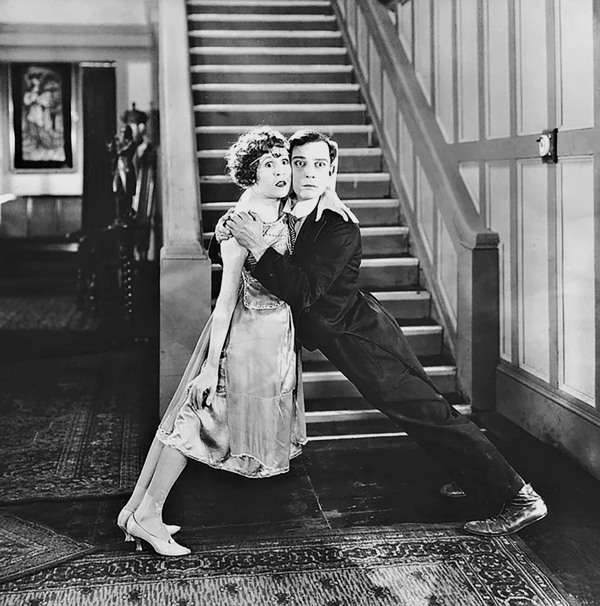
Buster Keaton and costar Virginia Fox are spooked by The Haunted House (1921).
The Goat is a two-reel study in deception and transformation, in the gap between reality and what gets filmed in the place of reality. They say the camera never lies, but in Buster’s world this isn’t so. This camera did lie, and its lie sparks the creation of an alternate universe where innocent Buster is a wanted murderer haunted by his victim—ironically, the theme of a man wrongly accused of a monstrous crime would be Roscoe Arbuckle’s real-life fate within the year. The Goat is a miasma of misdirection—dummies for people, a live Indian for a dime store statue, a carpenter for a surgeon, a phone booth for an elevator. The mistaken identity that drives the plot—if “plot” is the right word, or should we say that drives the chase—is when luckless Buster is mistaken for Dead Shot Dan the escaped murderer.
Several sources claim that Dead Shot Dan was played by Malcolm St. Clair, the man who shares directing credit on this film with Buster. It makes for a good story—as if they were interchangeable after all. Film scholars have studied photographs of St. Clair and concluded that this was just another tall tale—which is too bad, since the film does feature Buster’s other co-director from his silent shorts, Eddie Cline, playing the policeman by the telephone pole. Buster had a high regard for St. Clair, whom he called “a great director,” and placed alongside Frank Capra and Leo McCarey as examples of great comedy directors who learned their craft working for Mack Sennett. That’s some high praise—especially considering that The Goat marked Keaton’s first credited collaboration with Mal St. Clair, and one of his last—evidently Mal made a big impression on Buster.
Buster needed the services of a good co-director on something as ambitious and complicated as The Goat. Filming a two-reel-long chase sequence took its toll on the man—in one stunt fall Keaton missed his target and badly injured his hips, knees, and elbows. Keaton was out of commission for three days to recover—and then he was back at it, running and jumping and hanging off the sides of speeding cars.
Throughout this film, Buster is racing—but getting nowhere. It takes all his skill and speed and ingenuity just to stay in place, as the cogs of the universe click methodically around him. At times there is a bleak, fatalistic tone to all this—but at the same time, Buster’s keyed into that mechanistic fate just well enough to spy the escape routes no one else sees. Speeding trains, amazing stunts, breathless chases, special effects, and armies of angry coppers—if you were in a crazy hurry and only had 20 minutes to fully digest the entirety of Buster Keaton’s work, this might be the movie to watch.
Where The Goat is a representative example of Keaton’s silent shorts, The Playhouse is as marvelous as it is atypical and singular. The opening reel of The Playhouse is as sustained a sequence of comic innovation and cinematic craftsmanship as anything ever filmed. There is not one Buster Keaton cavorting here, but many. The double- and triple-exposures were challenging enough, but familiar. Keaton was not the first comedian to play two roles on screen at once. By the time he appears ninefold in the same frame, though, we know we’re in the presence of something extraordinary.
Georges Méliès had done such a thing, back at the dawn of movies, in films like The Melomaniac, but no one before Keaton had attempted something so audacious yet achieved results so seamlessly perfect. Fellow slapstick comedian Charley Chase tried his hand at something similar, playing four versions of himself at once in the Hal Roach talkie short Four Parts, but his duplicates shimmered and vanished at the edges of their overlapping domains. Miraculously, Keaton and his cameraman Elgin Lessley achieved superior results, despite working more than 10 years before Chase, in a substantially more primitive environment, with hand-cranked cameras and custom-made equipment designed by Buster himself and given life by newly hired technical wizard Fred Gabourie. No wonder he told his crew, “Keep this quiet, you lugs!” No point sharing your secrets.
The project had its roots in an accident and an in-joke. The accident: Buster had broken his ankle on the set of The Electric House, and had to suspend production on that short while he healed. Worried about falling behind schedule with his monthly releases, he realized he needed to make a film that found its laughs in something other than his typical pratfalls and physical stunts. Which brings us to the in-joke: Silent era dramatist Thomas Ince was fabled for taking excessive credits for himself (“Thomas H. Ince presents a Thomas H. Ince production, supervised by Thomas H. Ince”). Keaton poked fun at this egotism by filling the screen with himself, and chuckling, “This fellow Keaton seems to be the whole show!”
The result was mesmerizing surrealism. While that first reel tends to get all the glory and attention, it is in the second reel that things become more personal. The concept of duplicates follows Buster out of his dreamscape and into a waking dream, where one woman appears to be two, and two men act as one. Mirrors abound, and identity seems to melt like salt in the rain. Buster turns into a monkey—even his humanity is subject to transformation. The monkey is an homage to one of Buster’s onetime vaudeville peers, a performing chimp named Peter the Great. Throughout The Playhouse, Buster makes little nods to his vaudeville past—recreating a few of his old routines in a new medium for a new audience.
But the deepest tribute is not in any single gag, but the concept overall: Buster made his vaudeville debut as a toddler. His parents had an established act, but no babysitter, so they let their baby boy join them on stage, where he proceeded to do what all children do: create havoc. This became the new act for the Three Keatons—Papa Keaton would gamely try to perform some given act, and Buster would unwittingly undermine it. This idea wormed its way deep into Keaton’s comic imagination, and throughout his life he returned to it. The Playhouse is one of the better expressions of that idea, already hashed out once before in a film he made with Roscoe Arbuckle, Backstage. Time and again Buster would find ways to disrupt someone else’s show and bring his unique brand of chaos to the stage: Free and Easy, Speak Easily, The King of the Champs-Elysees, The Silent Partner, Hollywood Cavalcade, even to War Italian Style one of his last feature appearances in 1966.
The Playhouse was the fulfillment of Buster’s original eight-picture contract. It was such a hit that he was hastily and enthusiastically signed for another dozen. Once his injured ankle recovered, Keaton set out to complete The Electric House.
Many of Keaton’s films involve crazy houses—One Week, The Haunted House, The Scarecrow—but Keaton’s Rube Goldbergian innovations reach their peak in The Electric House. The premise kicks off with a confusion of identities: when his diploma gets accidentally swapped with a fellow graduate’s, the botanist Buster Keaton is mistaken for an electrical engineer, and hired by a millionaire to wire his house. “I want to be amazed,” the rich man commands.
“I want to be amazed” is perhaps the wrong thing to say Buster Keaton, who sets out to do just that. The result is genuinely amazing, and utterly singular in conception. Other comedies had riffed on the idea of modern marvels—and 15 years later, Charlie Chaplin would stuff some similar jokes into his Modern Times, but the gimmick here is that the absurd electrical contraptions are not the malevolent machinations of a heartless society bent on dehumanizing efficiency. Buster is a whimsical Frankenstein, whose wellintentioned genius goes awry only when sabotage is brought into the equation. That angry colleague, whose misplaced diploma cost him a job that was rightfully his, tracks Buster down and sets out to rewire the house to expose Buster’s incompetence.
The thing is, botany-student Buster really wasn’t incompetent. The set-up in The Electric House resembles that of One Week, but with the punchline reversed: both films find Buster unwittingly constructing a surrealistic homestead after mistakenly swapping documents with a rival. The difference here is that without the mean-spirited interference of his rival, Buster’s Electric House might actually have worked. Of course, installing a super-powered indoor escalator that deposits passengers at a second floor balcony overlooking a swimming pool is just asking for trouble.
That electric staircase leads to the film’s best, and most Keatonish, gag: Buster is doubled over, carrying a heavy trunk that, unbeknownst to him, contains a person, but he makes only Sisyphean progress up the stairs because they are running the opposite direction, at exactly the same pace. In one image, Buster is performing an impressive physical stunt, involving imaginative mechanical design, with a metaphysical fatalism. Who needs to make two-reel shorts when you can express everything you want to say in just one frame?
The Love Nest would be Buster Keaton’s de facto swan song in silent shorts. He had not yet fulfilled his contract, and still owed the studio one remaining short. But in November of 1923, the board of directors of Buster Keaton Productions met in New York to discuss the fate of the man whose name adorned their company. His run of silent shorts had been modestly successful—and while both Harold Lloyd and Charlie Chaplin outstripped him at the box office it was nonetheless obvious his star was on the rise. Both Lloyd and Chaplin were making features—and the board was thinking that it was high time for Buster to join them. For the businessmen who were to make the final decision, one fact loomed above all others: features made more money. A dollar invested in a comedy feature returned a vastly higher profit than the same dollar invested in a short. The Board voted to leave Buster’s 20th and final short unmade and ordered Keaton to turn his attentions to his feature debut, The Three Ages, instead.
As a farewell to the format of two-reel silent shorts, The Love Nest would prove to be as bizarre and distinctive as anything he made. Somber, elegiac, and full of dark humor, it also had the narrative and thematic focus he would need in the world of feature films. The Love Nest is the only of Keaton’s shorts for which he took sole credit as writer and director. At least, this is how it has appeared to scholars. It is just one of the questions asked by the damaged state of the surviving materials—studio records indicate Eddie Cline co-directed this, as he did practically all of the shorts, and the existing titles may just be an inaccurate reconstruction.
Another such question concerns Virginia Fox, Buster’s leading lady through many of these shorts. The Love Nest marked her final collaboration with Buster—and in the film as it stands today, that collaboration is nothing more than a fleeting glimpse in the opening shot, and her appearance in a photograph. However it’s hard to say what her contribution to the film originally constituted. For decades The Love Nest was considered a lost film, until Raymond Rohauer recompiled it in the 1970s from materials found overseas, primarily a print recovered from the then-Czechoslovakia. Since then, additional discoveries of material in France and the Netherlands have helped restore additional fragments, but it is safe to conclude that the original ending was not so abrupt, and the original beginning included more of Virginia Fox rejecting Buster.
That rejection propels Buster to sea—just as it would do later in the feature film The Navigator. Where The Navigator involves Buster’s travails with a cantankerous ship, Buster’s principal nemesis in The Love Nest is decidedly human. The tyrannical captain of the ship is burly Joe Roberts, Keaton’s longstanding foil and a friend of the Keaton family. He played the heavy in 16 of Buster’s shorts, and continued alongside Keaton in The Three Ages and Our Hospitality. During production of Our Hospitality, he suffered complications from a stroke and died at the age of 52.
Death hangs heavy over The Love Nest, which is saying something, given Keaton’s penchant for macabre humor. Buster had always shown a mordant streak—yet few of his gags are as bitterly funny as the one where he sinks an entire ship, drowning its crew, in order to escape in a lifeboat. Brilliantly conceived and played with patient deadpan perfection, the joke is as close to the line as Buster would dare. Meanwhile, the recurring gag of Captain Joe Roberts crossing the names of his mates off a list and tossing a wreath into the sea to commemorate their execution becomes almost a Lubitschean touch.
Speaking of running gags, some of them spill out beyond the boundaries of this film and invade his other works. The Love Nest joins Convict 13, The Playhouse, The Frozen North, and later features like Sherlock Jr.. in its dream-setting. In The Paleface, Buster had a gag where a title card alleged that two years had elapsed, with no change in his position or behavior in the frame. In The Love Nest, he reverses the gag—we see time elapse by having him reappear with a ludicrously fake drawn-on beard. Buster ran a variation on this joke in his later talkie short Ditto, in which the passing of time is conveyed to the audience by Buster’s sudden acquisition of an absurdly fake beard.
Buster copied himself because no one else could. Other comedians could do great stunts, or eye-popping special effects, but no one quite copied Buster’s worldview. Here is a man of a mechanical mind and a quick wit, but also clumsy and naïve. Who but Buster Keaton could pull off an effortless yet wholly unintentional mutiny? And who but Buster Keaton would see that triumph unmade in an instant? This is Buster Keaton in a nutshell: he needed the legendary Great Stone Face, because a man who openly expressed emotion could only face such reversals of Fate with endless tears, not stoic resolve.