
Buster Keaton has a problem.
Working backwards: (5) he’d very much like to get an audience with a certain general, so he can present his latest invention—a gun fitted with a headlight, for improved aim; (4) the general is inside a swanky casino; (3) the casino’s dress code requires formal attire; (2) renting a tuxedo costs money; (1) Buster’s broke. But Buster has recently made the acquaintance of a loudmouth (Jimmy Durante) who has explained that casinos are naturally jumpy around men with guns—they’re worried about bad publicity when people commit suicide. If a dead body is found near a casino, the house has a habit of stuffing money in the corpse’s pockets so it won’t look like he killed himself after losing.
You can see the light bulb go off behind Buster’s sparkling eyes. He needs money, he’s outside a casino, he has a gun…
And there, ladies and gentlemen, is why I love The Passionate Plumber. Keaton’s first four talkie features at MGM were hit-or-miss affairs even at their best. And while conventional wisdom would have you believe that the addition of Jimmy Durante marked the beginning of the end, in fact it was a decided improvement. I’m going to work through this thesis in more detail below, but for those of you in a hurry who just want the gist of it, just copy and paste the following formula into your head and be done with it: The Passionate Plumber = funny + stylishly made + smart Buster + appropriate use of Jimmy Durante = good movie.
That may be a bold assertion. I know I’m in direct contradiction to a bunch of Keaton fans to even speak kindly about any of the talkie era stuff. I own a few (otherwise wonderful) books on Keaton that come to abrupt stop after Spite Marriage, as if Buster dropped dead after his last silent film. Other books compact discussion of his talkie career into as little space, and as dismissive a discussion, as possible.
When silent comedy scholar and Slapsticon co-founder Richard Roberts was asked to appear in a documentary about the history of Hollywood, the producers asked him to explain why Keaton’s career was such a profound disappointment once sound came in. Richard objected. He didn’t agree it was a disappointment, and wanted instead to talk about how Buster—alone among his contemporaries—remained active, inventive, and fresh until the late 1960s. How he continued to perform terrific comedy while remaining culturally relevant, extremely busy, and quite happy—while also exploring new media. All while the likes of Harold Lloyd and Charlie Chaplin retired and faded away. The producers of the documentary didn’t want to hear any of that—it didn’t fit their narrative. Buster was destroyed by sound—everybody knows that!
In its meandering and stuttering way, this book sets forth the argument that the shift away from the slapstick comedy of the 1920s and towards the dialog-based screwball comedies of the 1930s was more a result of cultural transformations than it was technological transformations. This is not a consensus viewpoint at all. For many critics and historians, the assumption is that the advent of sound set the language of film back about 10 years. To that, I’d say, go watch Ernst Lubitsch’s first talkie, The Love Parade (discussed more fully later in this book). It is as spry and visually inventive as anything made 10 years later—or for that matter, 10 years earlier. If bolting his cameras to the floor inside a soundproof baffle and aiming them at an immobile microphone was a hindrance to technique, Lubitsch didn’t let it show.
Nor did Fritz Lang, whose first experiments in sound, M and The Testament of Dr. Mabuse, make his silent films seem inexpressive and limited, not the other way around.
While I’d agree that sound technology in those first few years of the 1930s imposed some technical limitations on filmmakers, the evidence shows that especially inventive and ambitious filmmakers found ways around those limitations and showed the promise of the new form. And if anyone was an inventive and ambitious filmmaker, it was Buster Keaton.
And Buster Keaton was eager to make talkies. MGM had to hold him back for about a year. When he did start working with sound, he showed how his kind of silent-era slapstick could work with a soundtrack. Consider a key gag from Parlor, Bedroom, and Bath. For now, don’t worry about whether this was representative of the rest of the film (it’s not) or his MGM talkie output generally (ditto, not)—I’m just offering it up as a sign that his style of comedy did not, on any fundamental ground, mismatch with sound.
Buster and his girl are going for a drive. Suddenly, one of the wheels pops off the rear of the car and it skids to a halt. Buster steps out of the car to inspect the problem, when he hears the approaching whistle of a train. He turns, and realizes in alarm that the car is sitting, dead, right on the tracks. Urgently he helps pull his girl from the car, barely getting her to safety as the train thunders across the tracks from the right of the frame to the left … completely missing the car, which is only straddling one set of tracks. Phew! Then, of course, another train approaching from left to right immediately ploughs across and destroys the car.
It is in all respects a repeat of a gag first seen in the short One Week, and adapted in The General—both of which are silent-era classics of Keaton’s beloved by posterity. Yet this talkie-era version is no second-rate knock-off. It is a perfect example of how Keaton could still perform silent-style slapstick gags in a sound film. His comedy was capable of working with a soundtrack, he was eager to explore the new medium, and he had the visionary talents to go beyond the limitations imposed by the technology.
Coulda, but didna, and therein lies our problem. The problem wasn’t that Buster and sound didn’t mix—it was the fact that poor Buster had the misfortune to work for MGM—where comedy went to die. It was a top-down corporate structure of strict control and airlessness. Not a place conducive to comedy. Not like, say, Paramount. I get the feeling that if you were to have walked out onto the floor at Paramount in those days and said in a loud voice, “I don’t believe this is a real movie studio!” the whole place would have suddenly vanished in a puff of smoke. Apparently, it had never occurred to anyone at Paramount that it was possible, not to say desirable, to check up on what anyone was doing with the company’s money. And so, anarchic comedians thrived there, as they were essentially without adult supervision: W.C. Fields, the Marx Brothers, Mae West. I mean, c’mon, they put Ernst Lubitsch in charge of the place! Lunatics in charge of the asylum!
The upside was comedians at Paramount made terrific movies that have stood the test of time. The downside was they lost money catastrophically and nearly sank the whole studio. An axiom: what’s good for comedy isn’t always good for business.
MGM was the antithesis of that. It was an exceptionally well-run corporation that kept scrupulous track of every dime. They had vast resources and knew how to use them, and the results spoke for themselves. So, let’s be big Keaton fans and own up to the dirty little secret—The Passionate Plumber outgrossed every one of the superlative classics he made in the silent era save for The Navigator. MGM had nothing to complain about in the box office returns of these much-derided talkies—they were profitable, they were hits.
But we’re not here to talk about commercial success in the 1930s. What matters to us today is aesthetic quality. Fans of Buster Keaton’s classic silents bristle at the MGM talkies—that’s why they get such bad press—but clearly some are better than others. And when I say The Passionate Plumber is one of the good ones, I’m flying in the face of almost everything ever written about Keaton.
Edward McPherson spends much of his book Tempest in a Flat Hat giving a full chapter to each of Keaton’s major silents, but dispenses with The Passionate Plumber in a single, slim paragraph, dripping with contempt. Of co-star Jimmy Durante, McPherson says he provided “an insidious torrent of mugging, catchphrases, and malapropos.”
In his autobiography, My Wonderful World of Slapstick, Keaton himself barely addresses his MGM films, and makes only a passing reference to The Passionate Plumber. To the extent he talks about those days, it is with regret that he looks back on the decision to team him with Durante in the first place. “There is no one in the world like Durante, bless him, but in my opinion we just did not belong in the same movie.”
Notice two things about that quote. One—he calls him “Durante.” Not Jimmy. And then there’s that oddly phrased not-quite-a-compliment “no one in the world” bit, softened a little by the “bless him” addition.
Buster hated Jimmy Durante. When he articulated this dislike in public, it was always couched in terms of how their comic styles clashed, how they did not function as a comedy team. But that was for public consumption: the real problem was that Buster just didn’t like him personally. He found Durante’s personality abrasive.
Now, let’s pile on: Buster was going through hell with his soon-to-be-ex-wife Natalie, he rankled at the conditions of his employment at MGM and specifically butted heads with Lawrence Weingarten, and he was drinking a full bottle of whiskey a day. So, Buster was under stress personally and professionally, had a drunkard’s natural paranoia—and didn’t like Durante as a person.
Few Keaton fans today would argue that that the pairing was a good idea—but that doesn’t mean it was inherently a bad idea either.
Here’s what Lawrence Weingarten himself has to say on the matter (as interviewed by Tom Dardis for the book The Man Who Wouldn’t Lie Down): “Keaton was doing a certain amount of business. And we thought that Durante … in this particular role [in The Passionate Plumber] would be fine, that’s all. We weren’t thinking about bolstering [Keaton]. There were a number of pictures made, we tried our best. If it wasn’t good enough, that’s another thing. But we didn’t set out to destroy Buster.”
Keaton had signed a two-year contract in June of 1930. The Passionate Plumber came out in February 1932, with the contract nearly up. If MGM wanted to get out of the Keaton business, the simplest solution would have been to just not re-sign him.
The conspiracy theories proffered by some fans and critics (e.g., MGM used Keaton to build up Durante’s career) mask what actually happened.
At MGM, Keaton had been stripped of his usual colleagues and collaborators. Gone were Clyde Bruckman, Elgin Lessley, and Fred Gabourie. In their place, he was now stuck with as many as 22 writers (!), all scribbling away to think up wacky dialogue.
Between 1930 and 1933, Buster starred in seven full-length sound features at MGM. There are bright spots: Doughboys, Parlor, Bedroom, and Bath, The Passionate Plumber, and Speak Easily all have much to recommend them. But they have no cohesive comic identity—nothing that makes these four movies seem “of a piece.” And with the exception of The Passionate Plumber, they have little in common with any idea you may have of what Buster Keaton was about.
Much has been made of MGM’s refusal to let Buster perform risky stunts—a decision that removed a key component of Keaton’s persona. But this was in fact the least of it. Lawrence Weingarten, the studio exec with the most direct influence over Keaton’s films, thought of Buster as interchangeable with just about any of the comedy players on the lot. He went around buying the rights to various stage plays that tickled him, and plunked Buster into the film adaptations without ever considering that, maybe, Buster might shine if left to think up his own ideas.
MGM had hired Keaton as an actor. He had been, in his silent films, a writer-director-star-auteur, but this was a concept fairly foreign to studios at the time (and not much appreciated even today). Keaton had rarely taken screen credit for anything other than acting, and in fact he may not have been aware at the time of how weird his production method was—how much directorial responsibility he was exercising even when he didn’t claim the credit.
At MGM, Keaton tried to lobby for the right to work on his own, but he didn’t have a contractual right to it, and the studio hadn’t granted it to anyone else, ever (if you would like to argue that Marion Davies’ private production unit had independence, that’s a fair point, but she was funded by Hearst, not MGM, and so was a decided exception). Thus, when I noted above that visionary filmmakers like Lubitsch could make talkies that had the cinematic invention of silents, Keaton was denied the chance to flex his own muscles in that regard because he wasn’t the director, Eddie Sedgwick was.
Sedgwick wasn’t bad, and you can kind of gauge what he brought to the table by seeing what happened when he briefly left. Sedgwick was busy with another gig when talkie #4, Sidewalks of New York was made, and so Jules White and Zion Myers took over.1 One early sequence in the film was later copied by White almost word for word into the Three Stooges’ Disorder in the Court, with Curly ably substituting for Buster. When Curly Howard can do the gag better than Buster Keaton, that’s a pretty sure sign that the material wasn’t suited to Keaton in the first place. But that didn’t stop Weingarten, heedlessly plucking stage plays from Broadway in which to drop Buster as a dim-witted Curly-wanna-be.
Mind you, the results weren’t always bad. Parlor, Bedroom and Bath is a fairly crappy Keaton movie, but it’s not a crappy movie overall. If you didn’t know who Keaton was and could just watch it on its own terms, it is actually quite charming. Compared to other farce comedies of its time, it holds up very well. If it had starred, say, Robert Young (then on the earliest end of his break into movies), we’d probably be celebrating it as a minor gem.
The first four Keaton talkies all made money, whatever fans might say about them today. But the fourth, Sidewalks of New York, had problems. MGM’s exhibitors wired back to the home office to complain about how unfunny it was. It was one thing for Keaton to grouse and moan, but Weingarten had to listen to the exhibitors. So concrete steps were taken to make the next one, The Passionate Plumber, an improvement.
As ever, it was a play that caught Weingarten’s eye. This time it was Jacques Deval’s Her Cardboard Lover, but mindful of the exhibitors’ complaints about Sidewalks, Weingarten spent half again as much as he had to buy the play as he did on “three scenes” for Buster. Sorry—the documentation is not clear about what those “three scenes” are, but we can guess.
The core of the plot involves a romantic triangle, which with the addition of an extra pole turns into a romantic polygon. Tony (Gilbert Roland) loves both Patricia (Irene Purcell) and Nina (Mona Maris)—and they both love him. But Tony’s a scamp—pretending to Nina that he’s married to Patricia, pretending to Patricia he’s married to Nina—and who knows how many other women orbit him beyond the view of the cameras. Patricia has enough self-respect to know this is wrong, and that she should break it off. But she doesn’t have enough self-respect to actually go and do that. So, she hires Elmer Tuttle (guess who) to play her lover—to drive away Tony—and to keep her from caving in to Tony’s entreaties. Along the way, her gigolo-for-hire starts to inspire genuine love in her (this is similar to the plot used by Ginger Rogers and Fred Astaire in the brilliant romantic comedy musical The Gay Divorcee, and we will encounter variants of it in the likes of Fifth Avenue Girl later in this book).
That’s probably what the play was. But there’s a lot of extraneous stuff cluttering the front of the movie before we get anywhere near that plotline—and I’m pretty confident that those “three scenes” occupy the front half of the picture. It is in the front half of the movie—and nearly only the front—that we find Jimmy Durante.
He is pretty grating. I’ll give you that. But look at how Buster is being presented. Buster is not just a gigolo—or a plumber—he’s also an inventor. His introductory scene finds him methodically deploying a giant clamp, a welding torch, hammers, and a handsaw in a Rube Goldberg-ish approach to fixing a broken cigarette lighter. This is the Buster Keaton I know and love from the past.
Bizarrely, Edward McPherson wrote that in Plumber, Buster played “a brain-dead beret-wearing gun-toting plumber.” Well, he’s right about the beret and the gun. But what I love about this film is that, finally, Buster is no longer brain-dead. He’s certainly out of step from other people—but it’s the geek hero’s place to be socially maladroit. His eyes are always scanning, looking for the escape no one else sees (again, this is classic Buster).
Consider what almost certainly is one of our three added scenes: Buster has provoked Tony into a duel. Keaton recycled some of this duel stuff for later films—a similar sequence appears in An Old Spanish Custom, and then recycled again into Pest From the West (produced by Jules White, no less). What’s striking here is how the filmmakers use Durante. He gets saddled with the village idiot stuff, while Buster gets to play the scene mostly silent. When he speaks, it’s a doozy—his perfectly delivered suggestion “Let him use a sword, I’ll use a pistol” is one of the best laughs in the film. But Buster isn’t there to do one-liners, he’s looking for the way out (which is what that one-liner is really about).
Look at his eyes throughout the scene—it’s the look of a man who is calculating how to cheat to win. They are the same eyes that glimmer in Keaton’s most inventive silent classics.
The duel is minor stuff, really, when compared to the standout sequence at the casino. You could pull the casino sequence out of context, give it a freestanding title, and it would rank as one of Keaton’s best comedy shorts. It nimbly mixes visual gags, cinematic style, character development, some wicked Keaton one-liners, and coherent storytelling. And to get it started, we get a hint of why the movie needs Jimmy Durante. Somehow you have to explain to the audience that the casino will shove money in Buster’s pockets if they think he’s committed suicide outside. Either he has to say it to someone, or someone has to say it to him. So, for this scene at least, Buster needs a friend to talk to—enter Jimmy Durante.
This is generally how the film uses Durante—as a means to get across verbal information so as to keep Buster from having to talk too much. Instead, Buster gets only crackerjack one-liners to say, because he no longer has to explain any plot (Buster’s dialogue in Passionate Plumber is the best and funniest of any of his sound films).
And once the film settles into its second half, it’s the Buster-and-Patricia show, with almost no further use for Jimmy Durante. He fades into the background, all but forgotten. Meanwhile, Buster tackles this romantic plot with incredible aplomb. Buster behaves strangely throughout the latter half of the movie, but it isn’t because he’s stupid—it’s because he’s single-minded. He has been given a mission to play Patricia’s lover, and he carries it out with ruthless attention, and occasional physical agility as needed.
It’s the vaguely autistic practicality of the true geek hero: the Buster in The Passionate Plumber and the Buster in The General would get along with each other just fine.
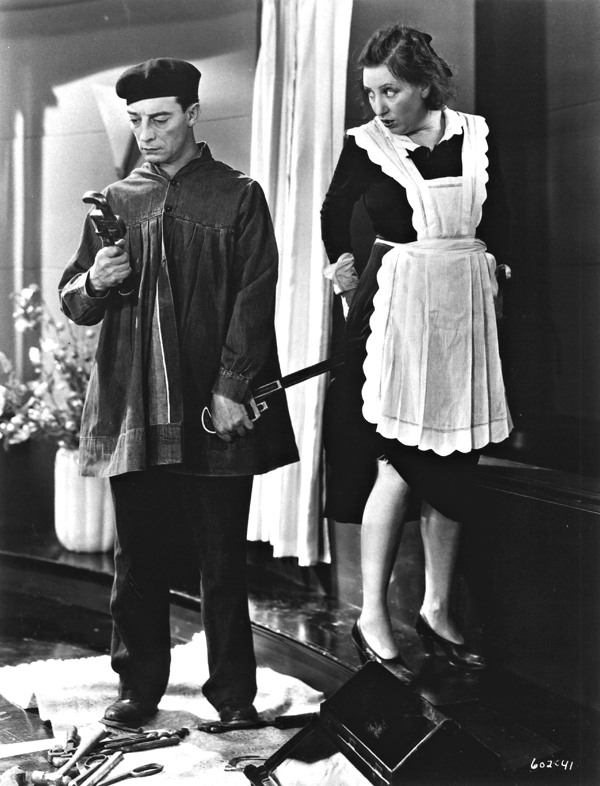
Buster Keaton and Polly Moran in The Passionate Plumber (1932).
It all leads to a clever finale, in which Buster gets to be smart and brave and in charge. No wonder Patricia swoons—he’s Buster F’in Keaton! The sexual awkwardness of Parlor, Bedroom and Bath is gone—we can credibly believe that Patricia would eventually warm to Buster, to find him a worthy lover. In fact, the hostile combat of their interaction, gradually melting into true love, is the template of screwball comedy.
It isn’t screwball yet, not fully, not yet. And the film descends into silly slapstick towards the end that undercuts some of the better humor of earlier—Buster is mistaken for a doctor who has to “examine” her with his plumbing tools (the film skirts around rude plumbing jokes, planting them in the audience’s minds without saying them openly). Buster then gets to perform another variation on the carry-an-unconscious-woman gag that he first performed in The Navigator, embellished in Spite Marriage, adapted into Parlor, Bedroom and Bath, and would continue to perform until his death. The ubiquity of this routine however points to a problem at the heart of Keaton’s comedy—he has no real use for a female costar, and functions at his best when his leading lady is passed out. This would never do in the age of screwball.
The last film on Keaton’s existing contract was Speak Easily. The studio rightly concluded there was no reason to tamper with success—The Passionate Plumber seemed to work just right, so everybody was back in place. Including Jimmy Durante. And in the end, Speak Easily was a bright spot. Even Buster himself admired it, and considered it his best MGM talkie—an opinion shared by many Keaton fans.
But, while the onscreen quality was there, Buster was an offscreen mess, and his unreliability cost the studio enormous sums. His drinking was out of control, he fought, he misbehaved, he got troubling coverage by the gossip press. MGM signed him to just one year this time, one film (What, No Beer?)—they were reluctant to hitch themselves to a sinking ship.
I’d rather have my eyeballs sandpapered than sit through What, No Beer? again, so I can’t recommend you watch it. But in case you find yourself accused of terrorism, and in Gitmo or some overseas CIA-funded Black Ops prison your torturer happens to put the thing on for you, before you cave in and confess to whatever they’ve charged you with, take a note of how Buster and Jimmy in that film share a single narrative role. They have different “personalities” but there’s really only one function being served. You could remake the film with a single actor replacing both of them and not have to juggle the plot at all. And this wasn’t because MGM wanted to team them–it was because Buster couldn’t be counted on to come in to work anymore.
But he got better. Sobered up, replaced ex-wife Natalie with new love Eleanor, and kept on working—and while they don’t get written about in the books very often, he bequeathed to posterity a wealth of talkie shorts, TV shows, industrial training films, and sundry oddities that almost defy cataloging.