
What, No Beer? is just about as unloved as a movie can be. If all the hatred and invective thrown at this 65-minute-long 1933 comedy were somehow bottled up and concentrated, it could power a small city. (And ladies and gentlemen, that’s my modest proposal to solve the energy crisis—wean us off foreign oil and start using movie criticism as an alternative fuel source.)
There are several things worth noting about this film, and strangely these things tend not to be noted, even though they’re pretty much right on the surface, as easy pickings.
The first of these is the observation that Edward Sedgwick is actually directing this cheapie comedy programmer with a fair bit of panache. The camera setups are carefully arranged, the editing is spritely, and on the whole there has been a sincere attempt to do this well.
The second noteworthy aspect is that, on paper at least, this is just about the most Keatony of Keaton’s MGM features. One of the distinctive characteristics of Keaton’s silent cinema is the way he mines reality for his comedy. From Our Hospitality to The General, from Steamboat Bill, Jr. to The Cameraman, Keaton spent as much time depicting the social and environmental milieu of each film as he did conjuring up the visual gags and stunts.
Consider Cops—the film is a 20-minute chase scene in which Buster is pursued by an infinite mob of lawmen. All he needed was an excuse to get the chase started, and then its own internal logic would take over and drive the rest of the film. He could’ve used any old MacGuffin to start the chase—and when competitors tried to rip him off, that’s what they did (for example, see Billy Bevan’s Be Reasonable, Bevan’s attempt to knock-off Cops which indeed relies on any old nonsense to get the chase started). But instead of opting for any cheap expediency, Keaton connects his slapstick mayhem to real-world traumas of anarchist terrorism (and makes a passing reference to the fad of goat gland cures, as well). Keaton’s comedy didn’t just trade in existential angst and slapstick artistry, he always kept it tethered to real history.
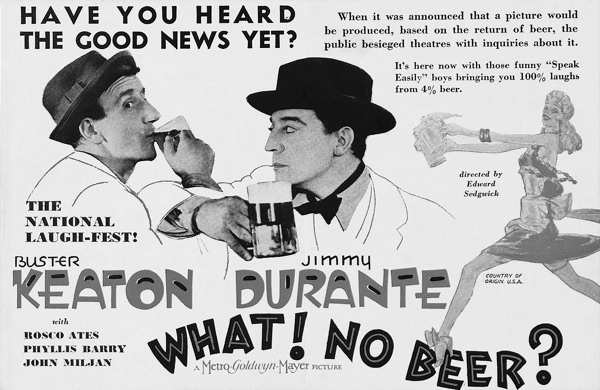
Poster for What, No Beer? (1933). This is enough, you don’t need to watch the movie too.
Of all his MGM talkies, What, No Beer? is the only one to connect so palpably to the real world. In 1933, President Roosevelt signed the repeal of Prohibition, specifically lifting the ban on beer first—and famously quipped, “Now would be a good time for a beer!” (Anheuser-Busch obliged, with a highly ceremonious delivery of some beer to the White House, thanks to a fleet of corporate Clydesdales.) Inevitably there would be an awkward transition—a moment when suddenly it was legal to make, import, and sell alcohol again, and there would be demand on that day, but that demand could only be met if alcohol had been made, imported, and prepared for sale prior to that moment—in other words, illegally.
In What, No Beer? this visionary role is Jimmy Durante’s. He plays Jimmy Potts, a barber, who realizes that the repeal of Prohibition opens up a market for legal beer—and he wants to be one of the first entrepreneurs to fill that role. He has a plan, a beer-making recipe, and an eternal never-say-die, never-shut-the-hell-up attitude that marks many a successful capitalist. What he doesn’t have is any seed money for his startup.
Enter Buster Keaton, as Elmer J. Butts, taxidermist.1 Elmer has been socking away nest eggs inside his stuffed animals, and has 10 grand he can use to help buy a brewery.
As it happens, their first attempt at beer-making misfires terribly, and results only in non-alcoholic near-beer, but this is fortuitous. The law hasn’t changed yet, and so they are raided for flaunting Prohibition—only to be released when the police realize the brew isn’t alcoholic. They then go back to the brewery, fix their recipe, and return to business, safely off the cops’ radar. Angry gangsters try to muscle in, miffed at these upstarts stealing their carefully honed market, only to mistake Buster’s blithe ignorance for supreme self-confidence, and decide to follow him as “The Mastermind.”
OK, enough plot synopsis—the big takeaway here is that in addition to the properly Keatony real-world vibe of the premise, there are also numerous sequences tailor-made to exploit Keaton’s physical comedy. Now, admittedly, each of these is designed merely as a rip-off of one of his famous routines from earlier films: Keaton trying to mix up a five gallon batch of beer inside a brewery vat designed for 500 gallons could have happily riffed on similar scenes in The Navigator, in which Keaton tried to make breakfast for two in a kitchen designed to feed dozens. Later, a rival gangster’s moll tries to seduce Buster, leading to another variation on Keaton’s “trying to move an unconscious woman” routine. And the film climaxes with Keaton unleashing an army of beer barrels down a steep street, in an echo of his famous chase scene from Seven Chances.
On top of all of this, there’s Jimmy Durante himself. Conventional wisdom has it that Durante was a terrible choice of screen partner for Buster, and mired the films in talk-oriented comedy at the expense of the visual comedy for which Keaton was known. But that’s just it—Durante was there to shoulder the puns and silly wordplay that the MGM gag writers apparently couldn’t get enough of, and thereby took that burden off of Keaton’s shoulders. In any given scene, one of them could serve as the straight man for the other, alternating the kind of comedy being performed as they go. This is not so far off how comedy teams like Laurel and Hardy or The Three Stooges work. If you want to be reminded of what would happen to poor Buster if it weren’t for Durante, go force yourself to sit through Free and Easy where one of America’s greatest comedians was forced to repeat the line “The Quoon has sweened” over and over, thanks to the dialogue writers’ mistaken apprehension this was funny.
I mean, sure, it would have been best if MGM’s writers hadn’t felt compelled to put such idiotic verbal nonsense in the films in the first place, but apparently that was too much to ask. At least in the Keaton-Durante films, Buster gets room to do his physical gags (which are largely absent from Free and Easy) while Durante handles the dialog comedy. There is more physical comedy in the Durante-pairings, not less (compared to the other MGM talkies, that is).
And so, in theory, What, No Beer? had the potential to be the greatest film Keaton made for MGM. It had a premise worthy of Keaton’s style, it had Durante as a buffer zone allowing Keaton room to develop physical gags without worrying about wordplay, and it had three comedy sequences intended as showcases for Keaton’s comedy wherein he had the opportunity to riff on and build upon past glories. And behind the camera was Eddie Sedgwick, directing his heart out and trying to make it all look good.
Of course anyone who’s seen the finished product knows how far off that mark they landed, but it wasn’t doomed from the start. The opportunity was there for this to be great—or at least pretty good. It could even have been adequate.
Wanna see why it failed? Don’t blame MGM, don’t blame Durante. Just look at Buster—the thousand-yard stare in his eyes, the sunken flesh sagging around his famous Stone Face, the gargling noise that passes for his voice, the looping swagger of his body where once there was acrobatic grace. This is a broken man. He just phoned it in. Every time the film gives him space to innovate and improvise, he just goes through the motions necessary to get the scene over with.
The fact of the matter is that Durante wasn’t brought in to handle the dialog comedy, he was brought in as insurance. Keaton was so drunk by this point he sometimes didn’t make it to work at all—causing expensive delays. But if he and Durante occupied the same narrative position, then anytime Keaton wasn’t available or able to do a scene, here was Durante to take over and keep the cameras rolling.
The uncomfortable irony watching What, No Beer? is that its depiction of Keaton as an accidental beer baron (who believes himself to be presiding over an empire of near-beer) was made by a man so drunk he got himself fired. The Keaton-Durante team was a top-money-maker for MGM, highly rated in popularity polls and responsible for a string of nicely profitable inexpensive comedies.
Louis B. Mayer didn’t fire Keaton lightly—but his unreliability was now a serious issue. In 1933, on the heels of completing What, No Beer?, Keaton’s contract expired without renewal.
To understand why Keaton allowed himself to be consumed by drink in this way, we have to skip back in time to 1921. This was the year that Buster married the wrong girl.
Her name was Natalie Talmadge. She came from a family of successful actresses such that her family name lent a certain degree of prestige to Keaton’s own up-and-coming career, but beyond that their pairing made no sense. They didn’t really love each other, and it’s hard to tell if Natalie even ever much liked him. Inevitably, as loveless marriages do, it unwound into divorce—but it unwound slowly and painfully. And instead of unwinding in a sensible, adult way, in which the two partners separated amicably, it just frayed apart stupidly.
Natalie took Buster’s sons, James and Robert, from him. Let me rephrase that—she didn’t just take them out of his life, she took him out of their lives as well. She changed their names, to remove that offending “Keaton” brand. And as a result there are direct descendants of Buster Keaton walking the Earth today—grandchildren, great-grandchildren, and great-great-grandchildren—who are denied the most basic and obvious link to one of the few true geniuses of cinema. The name Keaton was erased. Keaton lost his children, just as much as if they had died. And this happened in 1932.
No wonder the man drank. Of course he tried to find escape in oblivion—and maybe the alcohol helped soothe the pain, for a while. But if he was using booze as an escape from the wreck his life had become, it was only wrecking it further. He drowned the pain of one divorce in enough alcohol to blot out his own memory—and he awoke from a proverbial “lost weekend” in Mexico, married to a gold-digger named Mae Scribbens. How’s that for irony?
Buster bottomed out then, and he got better. He dried up, and returned to work—and died old, happy, loved, and well off. Alcohol helped him escape, and then he escaped from alcohol.
Which brings us back to What, No Beer? Jimmy Durante’s dream is to open a legal brewery that puts Americans back to work, making something of value for American consumption. He sees it as an all-American economic cure-all—but he then finds it’s a business dominated by gangsters and crooks. Prohibition itself was an attempt to ameliorate the perceived dangers of alcohol, which only ended up creating the Mafia and vastly increasing the number of alcohol-related crimes. There’s a weird balance at work in all of these interrelated anecdotes, which is perhaps best summed up by this quote from The Simpsons: “To alcohol—the cause of, and solution to, all of life’s problems!”