
There are two things Buster Keaton could have done in the talkie era that would have been successful in terms of screen comedy. Option #1 was to transition away from the kind of physical comedy for which he was known and become a more generic dialog-based comedian. This is what MGM expected of him, and by and large this was successful. His MGM talkies were profitable and popular. Films like Speak Easily and Parlor, Bedroom and Bath are excellent on their own terms. They are not what we’ve come to expect from Keaton, or what most fans want from Keaton, but these are nonetheless funny movies that function exceptionally well and Buster Keaton is funny in them.
The alternative to being a dialog comedian in the MGM mode, option #2, was something Keaton came to realize later: “When sound came, we found this out—we found this out from our own pictures—that sound didn’t bother us at all. There was only one thing I wanted at all times, and insisted on: that you go ahead and let me talk in the most natural way, in your situations. Don’t give me puns. Don’t give me jokes. No wisecracks. Give that to Abbott and Costello. Give that to the Marx Brothers. Because as soon as out plot is set and everything is going smooth, I’m going to find places in the story where dialogue is not called for. There can be two or three people working at jobs—well they work at them without talking. That’s the way I want it. So you get those stretches in your picture of six, seven, eight, nine minutes where there isn’t a word of dialogue. In those, we did our old routines.”
This idea is illustrated by that scene in Parlor, Bedroom and Bath which recreated a bit from One Week but did so with a soundtrack. For that matter, Buster’s use of the Carry-an-Unconscious-Lady gag later in the same film is another example of successfully adapting silent-era gags into talkie films more or less intact. Buster did not get much opportunity to develop this alternate approach during his time at MGM, but it flowered more fully in the years to come.
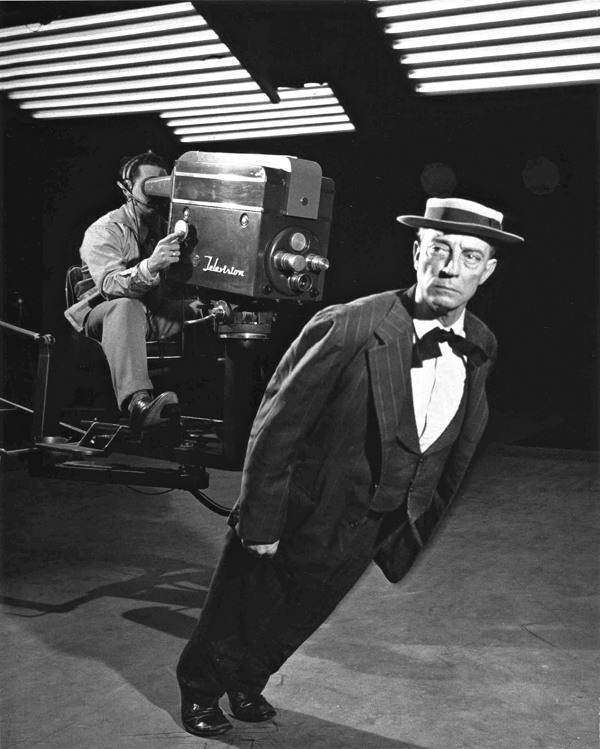
Buster Keaton had a full and lively career in the sound era in both movies and television.
In some ways, Buster’s flameout at MGM was the best thing that could have happened to him. For one thing, it forced him to sober up. Other slapstick comedians of his generation with similar substance abuse problems died young (cf Charley Chase!)—Buster hit rock bottom, rehabilitated, and got back to work. Secondly, because he didn’t have a nest egg of riches to retire on, he had to keep working—which, combined with a powerful Midwestern work ethic, meant he continued to make movies—features, shorts, industrial films, commercials, live TV appearances, television serials … he enlivened everything from The Twilight Zone to The Donna Reed Show to Candid Camera.
Other silent comedy stars, if they continued to the sound era at all, eventually gave up on their old personas. Charlie Chaplin took the Tramp into Modern Times in 1936 but went no further. When he lampooned Hitler in 1940’s The Great Dictator, he couldn’t help but acknowledge that his own longstanding appearance happened to share a mustache with the world’s most hated villain, but beyond that it is hard to see The Great Dictator as a true “Tramp” comedy. Still, let’s grant that it is—and say that Chaplin took his silent era persona all the way to 1940, and then stopped.
Harold Lloyd made it farther—reviving his “glasses” character in 1947’s The Sin of Harold Diddlebock with screwball maestro Preston Sturges. Yet this was a diminution of both men—lesser Lloyd and lesser Sturges, a whole less than the sum of its parts.
Chaplin and Lloyd, being brilliant businessmen who controlled their own creations, knew when to call it quits, and let themselves fade gracefully into retirement. Buster Keaton did not. He already had What, No Beer? on his resume, which meant he pretty much had no dignity left to maintain.
Two things about Keaton in this post-silent world.
#1. He kept wearing his old costume. There was no attempt to moderate it for the modern world, or even to acknowledge that there were once the clothes of a much younger man. Keaton remained Keaton, a stubborn and welcome intrusion of the past into the present.
#2. He shut up.
He didn’t just decide to hand over the puns and dialog gags to costars while he found moments of silent action to do his thing—he just stopped talking altogether. There was little effort expended to make his silence plausible or coherent—like his clothes, it meant he was a living relic of a bygone age still adhering to rules of a game no one else was playing.
Singlehandedly, Buster Keaton continued to fly the flag of a silent era comedy aesthetic long after his peers had retired and/or died, on deep into the swinging sixties. Because he took work wherever he found it, he ended up appearing in a number of foreign-made films. And because these are foreign films that had virtually no distribution in the United States, they are almost never discussed.
The first came in 1934, following Buster’s ouster from MGM. Le Roi de Champs-Elysees (“The King of the Champs-Elysees”) was made in France for producer Seymour Nebenzal, the man who produced Fritz Lang’s M and The Testament of Dr. Mabuse. In fact, weirdly, some footage from The Testament of Dr. Mabuse was reused in Le Roi. (It’s as close as I’ll ever get to having Buster Keaton vs. Dr. Mabuse.) Buster plays two roles in this film. One is a dangerous gangster, recently escaped from prison and ready to retake his criminal empire. The other is an aspiring but inept actor.
This second role leads to some “disrupt the performance” gags that Keaton seemed drawn to (skip back a few chapters for more detail). For example, in one key scene ActorBuster has been mistaken for Gangster-Buster and taken back to the gang’s HQ, where legions of armed thugs surround him—some of them hoping to kill and usurp him. Naturally, Actor-Buster wants to sneak out of the place before his true identity is discovered, but that’s harder than it sounds.
This was still early in the talkie era, and Keaton is still trying to find his voice—pun intended. He is dubbed for the most part throughout this picture, which gives him more dialog than he was comfortable with. As the years wore on, he gravitated away from dialog and into the weirdly mute mode described above.
For example, consider his appearance in the Italian film L’incantevole Nemica (“The Charming Enemy”). This 1953 farce was directed by Claudio Gora, a man better known as an actor, and whose acting credits tend towards the bloody end of the cult movie spectrum: Mad Dog Killer, Seven Blood-Stained Orchids, The Death Ray of Dr. Mabuse…. This was one of his rare outings as a director, and the film is intended as a social satire. According to the plot synopsis on IMDB, the story involves “a cheese factory owner [who] fears communists and mistakes a meek youth who works for him for one of them. He invites the young man to his house where the youth falls in love with the factory owner’s daughter.” I don’t understand Italian, so after watching the film I can’t dispute that description, but it doesn’t really matter for our purposes because Buster Keaton only appears in one scene and he has literally nothing to do with the rest of the story. In that scene he performs a stage act, derived from old silent comedy routines, that seems to comment on the workplace-related stuff of the story—union organizers, communists, and capitalist barons provide a satirical backdrop for this scene of a worker struggling with the means of production. But, really, you could snip this out of context and watch it all alone and it would make as much sense as it does in the movie.
Buster’s last feature film ever was the 1966 Italian comedy Due Marines E Une Generale (“2 Marines and 1 General,” also known as War Italian Style). Shot before A Funny Thing Happened on the Way to the Forum but released after, War Italian Style was the last feature film to include Keaton—and he looks ghastly pale in it. I can’t be sure if this is a sign of his failing health or a poor attempt to evoke his old silent-era whiteface makeup that misfired terribly. So many things misfire in this movie I wouldn’t put it past them. This is one of those cases where so much went so wrong that it ended up making something genuinely interesting. Maybe not entertaining—I wouldn’t go that far—but definitely interesting.
Unlike Keaton’s cameo in L’incantevole Nemica, Buster has a prominent co-starring role here—which I’ll get to in a moment—alongside the top-billed comedy team of “Franco & Ciccio.” Franco Franchi and Ciccio Ingrasia had teamed up as a stage comedy duo and become so popular in that mode they ported their act over to movies, where they cranked out some 114 films together. They’re like an Italian hybrid of Abbott and Costello mixed with Martin and Lewis, but the worst parts of each. Ciccio Ingrasia, the one who looks like Kramer from Seinfeld, was the Bud Abbott–styled straight man. Franco Franchi was the pair’s Jerry Lewis imitator, always mugging and contorting for the most grotesque of gags. Franchi, however, idolized Buster Keaton. He considered it one of the highlights of their 114-film career to have made one with Buster Keaton.
Franco & Ciccio play a pair of American GIs (!) whose incompetence so enrages their superior officers that rather than punishing the pair they are ordered onto a suicide mission deep in Nazi Germany. It’s a premise that has cropped up in a handful of strange little war movies, like Enzo Castellari’s original version of Inglorious Bastards. In this case, the two bumblers have to get far enough behind enemy lines that they can capture high-ranking Nazi strategist General von Kassler—guess who.
Yup. Somehow it’s come to this. Buster Keaton, in his final feature film, plays a Nazi General. That’s the world we live in.
But the film doesn’t paint Von Kessler as a villain. He’s somewhere between too-incompetent-to-be-dangerous and secretly-sympathizing-with-the-good-guys (in other words, he’s Buster Keaton!). So, along the way, he and the Americans forge a wary alliance—but not before the movie has suffered whiplash-inducing tonal shifts, irrational plotting, sloppy filmmaking, bad acting, and increasingly bizarre black humor.
Getting weirded out by the sight of Buster wearing a swastika and doing the “heil Hitler” salute? Well, this is one strange movie. This is all about forgiving and freeing a Nazi General–compare it to the finale of Quentin Tarantino’s version of Inglourious Basterds which is basically a reverse image of this idea. But for as strange, and incoherent, and annoying as this movie is, I dare you—I literally dare you—to watch the end and not smile. The General escapes Nazi Germany and changes out of his uniform into a very familiar ill-fitting suit and flat porkpie hat, and he walks off into the sunset in that getup.
That’s where our story ends. Buster did survive in the sound era—he wormed his way into a strange little niche that no one else was even trying, and for about 40 years after silent movies ended, he maintained his screen persona, his comedy aesthetic, and his flat hat all the way to the end.