
Laurel and Hardy’s first talking picture, 1929’s Unaccustomed as We Are, may not be their best or most representative or most important or best remembered short. As such it disappears too easily into the shadows of such bigger triumphs as The Music Box or Helpmates. But on closer examination, this unpretentious little film has a lot to offer. For one thing, Unaccustomed as We Are happens to mark the very first time that American movie audiences had ever heard any of their favorite comedians speak on screen.
Charley Chase was a close second with The Big Squawk later the same month, the Marx Brothers had The Cocoanuts in theaters by the summer of 1929. Harry Langdon’s Hotter Than Hot followed soon thereafter, and Harold Lloyd reshot Welcome Danger as a talkie for release in the fall. Buster Keaton and W.C. Fields started talking onscreen the following year. Charlie Chaplin didn’t make any onscreen vocalization until Modern Times in 1936.
It is of course obvious that sound replaced silent film generally. With the exception of the odd experimental film or gimmick, silent films are no longer manufactured. Several factors are said to be at fault. Some performers had developed screen personalities that were at odds with their actual speaking voices. Some filmmakers were accustomed to giving directions to their cast while shooting, shaping performances as the camera rolled—or in other cases, playing music on the set to establish a rhythm or mood. Such techniques had to be aborted when microphones were present. For that matter, those microphones were notoriously finicky. Scenes had to be staged to group the actors close to the microphones, which had to be somehow hidden from the camera. In turn, the camera’s own noise had to be blocked from the microphones by some kind of baffling apparatus. The result was an imposition of stodgy, stagy film techniques. Where cameras had once roamed according to the whims of the directors, they were now slaved to the limitations of the sound recording equipment. All-new studios had to be built to the needs of the new technology, at a time when the stock market was crashing and America was entering the worst economic crisis of its existence. The investment in sound was therefore precious, and to protect that investment the studio heads were reluctant to wait while silent filmmakers adapted. Instead they brought in staff from Broadway and the stage, and subordinated the silent era technicians to these new arrivals who “knew” how to handle dialogue. The aesthetics of sound film shifted in order to emphasize the new attribute: films came to prioritize talk and song. The likes of Buster Keaton and Charlie Chaplin and Harold Lloyd had been kings of a particular environment. Sound completely changed the production environment, aesthetics, and economics of their business. Like dinosaurs facing the havoc wrought by a crashing asteroid, they had to adapt or die.
At least, that’s how the story is usually told. When the subject of Laurel and Hardy’s transition to sound comes up, it is excused as an anomaly—the exception that proves the rule.
As it happens, Laurel and Hardy made the transition to sound handily. The reduced production schedule of short comedies meant it was far easier for the makers of shorts to change over than it was for comedians working in features. On May 4, 1929, American audiences enjoyed the opening day of the Laurel and Hardy two-reel short Unaccustomed as We Are.
Originally, it was to have been titled ”Their Last Word,” an ironic defiance of the fact that these are their first words. From the beginning, no special pride of place is given to their first words. You can imagine the publicity guys at Hal Roach Studios desperate to bill this as “Laurel and Hardy SPEAK!” but when the moment comes the boys get no privileged entrance. The film fades up on the hallway of an apartment building as Stan and Ollie stride into the frame in the middle of a conversation. It is as is they have always been talking.
Ollie looks like a man who’s enjoyed many a meal, and the words he uses are rapturous, almost lustful, as he describes his wife’s cooking. Stan listens to all of this, but his mouth isn’t watering yet. “Any nuts?” he wants to know. Ollie’s build up is deflated, and not for the last time.
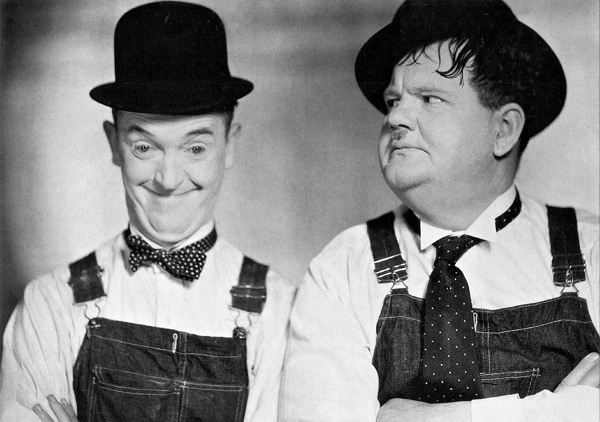
Stan Laurel (left) and Oliver Hardy (as seen in the 1933 short Busy Bodies).
Ollie stops in the hallway to exchange pleasantries with his neighbor Thelma Todd. Their conversation is immediately derailed by their mutual insistence on formality. Ollie can’t just ask how her husband is; he has to ask, “And how is Mr. Kennedy, Mrs. Kennedy?” Thelma’s responses are every bit as ridiculously mannered: “Oh, he’s very well, thank you, Mr. Hardy.” After what feels like an eternity of this, Ollie notes to Stan, “That was Mrs. Kennedy.” Stan’s bewildering response—“I was wondering who it was.”
Ollie is concerned with social propriety, to the extent that he often misses how far out of alignment appearances can get from reality. Stan, too simple-minded to be under any illusions, is the one to break the spell. Ollie can’t have a normal conversation with Thelma, because he’s so distracted by formalities that he has no mental energy left to think of anything worth saying. He introduces “Mrs. Kennedy” to Stan because that’s what etiquette demands in such a situation—and is then annoyed to learn that Stan actually needed that tidbit of information. Ollie is satisfied by the surface of things—and this is his downfall, every time.
It is not an especially good joke, but it is a kind of joke they had never before been able to do. Stan and Ollie have punctured social graces throughout their silent films, but did so by tearing buildings to their foundations or dragging live horses into the middle of tony mansions. Now they can work on a smaller scale.
They are now at Ollie’s door. Inside, he promises, is the sweetest girl Stan could ever hope to meet. To hear Oliver describe her, she must be the very definition of American femininity. Ollie calls to her in a sickly-sweet coo: “Yoooo-hooo.” From off camera comes the growling reply of some rabid animal: “Whaddya mean, yoo-hoo?”
It is a priceless moment. Mae Busch’s bleating delivery of the line sells the gag beautifully. She looks like Barbara Stanwyck but has the temperament of Jimmy Cagney. She’s the sort of dame you wouldn’t want to meet in a dark alley. She storms onto screen with a look of fury so intense it’s a wonder Oliver doesn’t burst into flames on the spot.
We understand Stan’s befuddlement at the turn of things (“Are we in the right apartment?”) but the real joke is in Oliver’s confusion. How could Oliver live with this woman, day in and day out, and have described her the way he did? How could he have honestly expected any other response from her than the torrent of abuse she starts to spew upon sight of Stan? Somewhere in his mind, Oliver Hardy has constructed the world he believes he ought to live in. It’s a place where his best friend is a competent and trustworthy figure, his wife is a loving and supportive partner, and he comports himself as if these things were true, despite all the evidence to the contrary.
Oliver and Mae are screaming at each other now, with Stan looking vaguely awkward beside them. He clearly hasn’t figured out that they are arguing about him, and is embarrassed for his friend to have such a private spat in front of him. With both performers screaming, the dialogue is completely obscured. It is as confident a moment as Ollie’s initial appearance, walking into the frame in mid-sentence. This is a film specifically designed as a vehicle for Laurel and Hardy to talk, and they are willing to let that descend into inchoate noise.
During the row, Ollie absent-mindedly turns on the record player, and Mae equally absent-mindedly finds her rant settling into the rhythm established by the music. Once she realizes how silly she sounds, more or less “singing” to the backing track, her fury burns even hotter and she storms out. We are barely five minutes into the film, and Laurel and Hardy have shown themselves to be supremely comfortable with the new medium.
Hal Roach had a separate print of Unaccustomed as We Are prepared for those markets that were not yet equipped for sound. This alternate silent version of the film is exactly the same footage, but with the soundtrack removed and title cards inserted where necessary to make sense of it. The silent version of the film quickly becomes mired in intrusive title cards that disrupt the flow of the action and fail to serve the jokes. For example, Stan’s line “Will there be any nuts?” is funnier when it actually punctuates and punctures the full description of the upcoming banquet. The abbreviated description offered by the title card is an inadequate set up to the punchline. Similarly, Stan’s improbable reaction to the endless “How are you, Mrs. Kennedy?” routine is diminished when it is cut back to a mere handful of cards—which are themselves more of an interruption than a joke.
However, writer Bernie Walker and director Lewis Foster are in a jam. If they don’t interrupt the scene with title cards, they are left with a lengthy sequence of Laurel and Hardy standing in a hallway without any interesting action. The only jokes here are verbal. In theory, you could start the film at the moment that they enter the Hardy’s apartment, but that would remove the introduction of Thelma Todd, a vital character to the remainder of the plot. Almost immediately after Mrs. Hardy storms out, the plot has contrived to have Thelma end up in Ollie’s apartment, virtually nude, and hunted by her ruthlessly jealous husband—this is what the film is really about. Short of reshooting the opening sequence entirely, the silent version has no choice but to surrender to an awkward and unsatisfying approach.
Laurel and Hardy’s first talkie is confidently and completely constructed as a talkie. It isn’t a silent film with dialogue added; removing the dialogue diminishes it. Far from robbing them of their power as comedians, the addition of sound has given them a new dimension with which to make their jokes. They even make the first utterance of a line that would become a running gag and trademark: “Why don’t you do something to help me?”
Prior to seeing Unaccustomed as We Are, it is hard to imagine what voices audiences may have imagined belonged to these two characters. Laurel and Hardy had experimented successfully with a few domestic comedies in the style of Unaccustomed as We Are—Their Purple Moment, Should Married Men Go Home, We Faw Down, and That’s My Wife—but most of their silent shorts find the boys as rough, down and out figures. They are escaped convicts (twice!), hard laborers, unemployed vagrants, sailors, street musicians, boxers…. When we finally hear them speak, it is with a surprising hint of erudition and gentility. Oliver Hardy speaks with a soft Southern accent—not a twangy drawl, but a gentle lilt atop a deep, honeyed voice. Stan Laurel has a British accent (he hailed from the same place as Charlie Chaplin and came through the same career channels). Rightly or wrongly, an accent like Stan’s has been associated with education and sophistication. These two men speak with voices that seem utterly at odds with their physical rowdiness and mental ineptitude. However, this is no Singin’ in the Rain-style scenario where their misfit voices undermined their characters. Instead, it is essential to the joke. These voices imply a certain pretension, a reach for social grace that we also find in Ollie’s awkward formality and misapplied etiquette. These voices belong to men who want to think of themselves as gentlemen.
The Three Stooges made their prolific career in much the same comic milieu as Laurel and Hardy. Several Stooges shorts are outright remakes of Laurel and Hardy films. Yet there was a crucial difference in personality. A typical Stooge gag went like this: the three of them have devolved into mayhem, and some figure of authority or social superiority tries to get their attention by calling, “Gentlemen! Gentlemen!” The Stooges look around in confusion, wondering who the poor chap might be talking to. Laurel and Hardy would never make such a joke—no matter how decrepit their circumstances, they always just assumed they were gentlemen. As with everything else, Oliver Hardy happily glossed over any discrepancy between the world he wanted to live in and the one he actually did.
Sound did not kill Laurel and Hardy’s career—if anything it propelled them to new comic heights. They continued making films together until 1951, without much changing their act along the way.