
Even if you’ve never seen his films, you’ve seen him dangling from a clock face a dozen stories high. That image, from the climax of Harold Lloyd’s 1923 feature comedy Safety Last!, is arguably the most iconic of the entire silent era.
Lloyd’s character could climb tall buildings with his bare hands—but Lloyd the filmmaker climbed Hollywood. Barely five years after arriving in Los Angeles, Lloyd had rocketed from a penniless nobody to becoming one of the most popular and beloved screen comedians of all time. That famous image is just one relic of his legacy, one marker among many of Lloyd’s impressive reach.
Ironically, Lloyd wasn’t all that keen on being remembered as a “thrill comedian,” which was only one facet of a long and illustrious career. He was that, true, but also a striver, an optimist, a winner, who sometimes stumbled haphazardly into unexpected success—in short, much like his screen persona.
Lloyd’s original ambition was to become a serious actor. Lurking about studio lots, taking low-paying jobs as a movie extra, Lloyd met fellow aspirant Hal Roach. They shared the same frustration at struggling in Hollywood’s margins, the same dreams of making it big in show biz, the same entrepreneurial drive. And they shared a realization: In those ramshackle early days of movies, a clever person with nothing to lose might as well make their own opportunities rather than wait to be discovered. Together they would make movies—once Roach had learned directing at Essanay and Lloyd had been seasoned at Mack Sennett’s Keystone factory.
Roach cobbled together the resources necessary to produce and distribute a series of one-reel comedy shorts starring Harold Lloyd. But Lloyd was no fool—if everything else about their venture was the personification of insane risk, the only sensible thing to do was to make as commercial a product as they could manage. So he stuck close to the Keystone formula, and played a Charlie Chaplin knock-off called Lonesome Luke.
To their surprised relief, audiences loved Luke—enough to pay the bills and keep the lights on, at least. But as their enterprise stabilized, Lloyd’s creative energies yearned for something more challenging and personal than the Chaplin-alike Lonesome Luke. Both Lloyd and Roach felt they could compete with Keystone slapstick by offering a very different aesthetic, grounded in everyday reality and domestic concerns. Lloyd was a conventionally handsome leading man; if he took off the comedy mustache and abandoned the self-consciously zany costume, he could play Everyman. The only trick was how to trademark that Everyman, how to turn himself into a marketable brand.
In 1917, Lloyd experimented with wearing a pair of wide-rimmed glasses. Nothing more to it than that. He put on a pair of glasses and played his role straight. Instead of a comic grotesque making jokes out of his inability to function in normal society, Lloyd inverted the formula: He would play an ordinary fellow, thrust by circumstance into outlandish situations. Lloyd’s comedies piled thrills upon thrills, chases upon chases, going as big and as absurd as physically possible while keeping the mayhem rooted in everyday reality.
Exactly who came up with the glasses, and when, is the subject of enduring controversy—everybody wants a piece of success. And success it was—even in faraway Imperial Japan, Lloyd fandom took hold and “Roido” style glasses became the height of fashion (“Roido” being more or less what “Lloyd” sounds like spoken in Japanese). He was making cheap-jack one-reel programmers for an undercapitalized start-up, but he was becoming a household name.
In 1919, Lloyd and Roach made the crucial transition away from one-reelers to the more prestigious and profitable world of two-reel shorts. The inaugural two-reeler was Bumping into Broadway. Lloyd and his team started assembling the promotional campaign to publicize this new series of comedies, starting with Bumping into Broadway. It was a propitious moment: Although the most famous image of Harold Lloyd would be that frame from Safety Last!, the most important photograph ever taken of Lloyd would be one taken to promote Bumping into Broadway—and this photograph would never be seen.
The photographer asked Harold to pose with a prop bomb, one of those cartoony round black anarchist’s balls with a sparkling fuse, and pretend he was using it to light a cigarette. Thanks to a terrible mix-up, the “prop” bomb held real explosives. The fuse ran out, it blew up, and Lloyd awoke in the hospital—blind, his face scarred, and his right hand a mangled snarl of flesh.
Roach assumed he had just lost his star, and by extension his studio. But like the indomitable young upstart he played on screen, Lloyd was not easily stopped. He recovered. He regained his sight, his face healed, and he took to wearing a trim pair of white gloves, to hide his prosthetic fingers (it would be hard to get audiences to laugh at his outrageous stunts if they had reason to believe there were serious consequences). Only his closest friends and coworkers knew the secret.
Harold Lloyd returned to work, and continued crafting elaborate stunt-filled spectaculars that were as breath-taking as they were funny. Following an amicable split with Roach, Lloyd established his own studio, and maintained ownership of his films—which were plentiful: He was more prolific than Chaplin and Keaton combined. Harold Lloyd is credited with inventing the preview system, recutting and reshooting films based on audience reactions to test screenings. Lloyd also embraced the coming of talkies, and was the first major comedian to start working in sound.
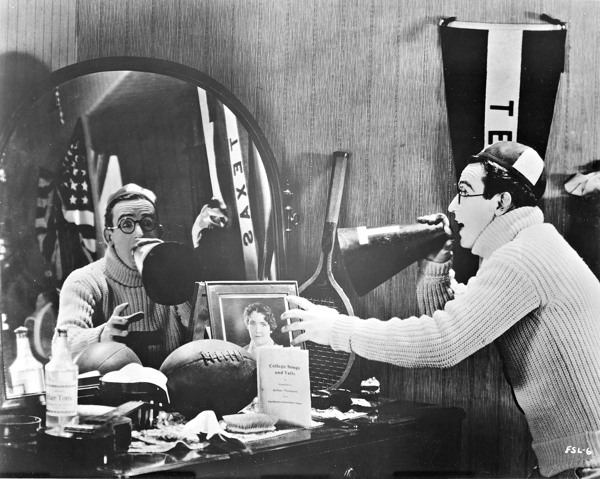
Harold Lloyd gives himself a pep talk in The Freshman (1925).
Despite his enthusiasm for talkies, Lloyd’s sound comedies were not as popular as his silents. Unlike his peers, he could not blame the bumpy transition on studio interference or problems with his speaking voice. It has been suggested that the problem was simply that his role as an earnest go-getter was out of step with Depression-era attitudes. Whatever the reason, Lloyd sensed something was off, and retreated from the spotlight following the disastrous 1938 flop Professor Beware. A real bomb couldn’t slow him down, but a figurative bomb ended his career.
Except that’s not quite true. In 1941, Lloyd produced one of Lucille Ball’s earliest comedies, A Girl, a Guy, and a Gob, and collaborated with Preston Sturges on 1947’s The Sin of Harold Diddlebock. And he took control of his back catalog, buying up the rights to his movies. In 1962 and 1963 he produced a set of retrospectives of his own work, assembling clips of his “greatest hits” into the showreel features Harold Lloyd’s Harold Lloyd’s World of Comedy and The Funny Side of Life.
Other comedians of his generation had faded into obscurity or struggled to remain relevant. Lloyd could look back on a prolific and prodigious body of work. He succumbed to cancer in 1971, but never really left. The Harold Lloyd Trust has maintained his back catalogue and kept his classics in circulation to thrill new generations.
The films made before Bumping into Broadway, however, were left to vanish. There was something about that exploding bomb that seemed to cleave his personal history cleanly in two: On the one side were the films he embraced, curated, and bequeathed to posterity; on the other were the vestiges of the Lloyd before Lloyd—his Chaplin copies, his pre-glasses films, his hardscrabble one-reelers. Lloyd left these behind and never looked back. Even if he’d showed an interest, they were out of copyright, and widely believed to have burned to ash long ago. Richard Schickel’s major biography of Lloyd in 1971 claimed that even identifying the titles of all those pre–1919 Lloyd films was beyond hope.
Let me direct your attention once again to the man dangling from the clock. Look at him—he’s holding onto the hands of time, he’s literally turning back the clock. Many of those movies once lost have been found. What didn’t exist in 1971 has now been returned to us. Harold Lloyd can cavort on our screens as if time means nothing. But here’s the deal: it’s not enough for us to know Harold Lloyd. We gotta spread the word. Each one teach one, as the saying goes. If you ever find yourself answering the question, “Who’s Harold Lloyd?,” here are some talking points.
He Was the Everyman Comedian
Silent slapstick was overrun by the Funny Mustache Brigade. But in a field crowded by buffoons in awkward costumes and silly facial hair, Harold Lloyd skipped the grotesqueries to focus on playing an ordinary, boyishly-handsome fellow. His one nod to the prevailing style was a set of tortoise-shell glasses—to brand his image and create a recognizable silhouette, but one that was real-looking. And his persona followed the image—an ordinary young man of recognizable ambitions.
Consider an early scene from the feature Speedy. Harold (temporarily) has a (fake) house with a wife and a dog. A comfortable middle-class idyll. In reality, the kid is dirt-poor ex-soda-jerk, hitching a ride on the back of a passing furniture van with his sweetie after a day at Coney Island. But for a moment his dreams are tangible, and we connect—his dreams are our dreams.
In the 1960s, a new generation of slapstick fans found Lloyd’s middle-class aspirations to be troublingly conservative, and downgraded him in favor of the vagabond hero Charlie Chaplin or the Kafka-esque existentialism of Buster Keaton—better suited to the countercultural sensitivities of the day. But time marches on, and maybe today’s audiences are ready to sympathize with Harold’s ambitions.
He Gave Good Chase
Lloyd’s films often revolve around chases, and as his canvas expanded from one reel to two, from two to five, from five to 10, his chases grew more ambitious.
Consider a climactic scene from the feature Girl Shy. The clock is ticking and our hero has to get to the church in time to stop his sweetie from marrying a bigamist. The massive, sprawling, epic chase includes a terrific moment when Harold’s car is stopped on a winding mountain road by a junker running the opposite direction. Unable to get around the blocking vehicle, and unable to convince the other driver to back up, Lloyd simply trades cars(!) and drives off (in reverse) in the junk car as the flummoxed other driver realizes how much he has traded up. Problem solved.
Thrill Comedy
A fair bit of Harold’s comedy isn’t jokes per se, but absurd, farcical situations contrived to provoke death-defying stunts. These stunts tend to elicit gasps, or shrieks, more than laughs.
South California is full of steep hills—some of them can produce optical illusions of you frame them just right. Lloyd started playing with this effect, setting up perfectly safe situations framed against the hills in such a way as to suggest that a distant street in the valley below was actually the street below a skyscraper, turning safe heights into what the camera saw as impossibly dangerous ones. He experimented with different ways of exploiting this illusion, with various contrived reasons to get him out onto the ledge of a “skyscraper” in various short films.
In Safety Last! he hit upon the prefect formula to exploit the effect. It took patient plotting—spending several reels doing nothing but establishing a series of premises, assumptions, and conflicts that in the finale all lock into place to force Harold to climb a tall building with his bare hands. The soul of the movie is the climb itself, but it works because of the skillful way in which Lloyd and his gagwriters made sure the absurdity was grounded in logic (and the logic grounded in absurdity).
There are other things to celebrate about Lloyd, of course—he pioneered preview screenings! He was the first silent comedian to make a talkie feature! He shot 3-D nudes in color! But if you need to indoctrinate a newbie, just grab any of the features I mentioned here (Speedy, Girl Shy, Safety Last!) and you can’t go wrong.