
There are two historical events that have colored Roscoe Arbuckle’s reputation and legacy, generally for the worse.
In the 1920s, Arbuckle was the center of a scandal that had lasting consequences for his own career and for Hollywood at large. Any attempt to take stock of Roscoe Arbuckle must at some point grapple with that traumatic event, at the very least to explain why he went from an international movie star one day to a blacklisted pariah the next, why he worked under the pseudonym “William B. Goodrich” and eventually returned to movies only in reduced circumstances.
However, while grappling with the scandal would be a prerequisite to a thorough understanding of Arbuckle’s career, doing so merely serves to keep that tragic event entwined with his story. He was a wronged party in the proceedings, which had nothing to do with truth or justice. By continuing to talk about the scandal, its damaging effect on his reputation is perpetuated.
Because here is something that is really, really uncomfortable for fans of silent comedy to hear: people don’t know who Roscoe Arbuckle is anymore. There was a time, way back when, when the scandal still dogged Arbuckle’s reputation and continued to haunt his name. Back then, you could carve the world into two kinds of people, and you could distinguish between them by saying the name “Fatty Arbuckle.” One camp immediately thought of a dead flapper and a ruinous trial, while the other (smaller) camp was knowledgeable enough to know that Arbuckle was acquitted, the judge apologized to him from the bench, and that he started rebuilding his screen career as a beloved comic when he happened to die young.
Time passed, and now if you mention the name “Fatty Arbuckle” you get a different set of reactions. You still have the inner retinue of informed film buffs who know the full story and resent how the scandal has overshadowed Arbuckle’s memory—but here’s the thing: the other group simply goes, “Who?”
The general public has completely forgotten Arbuckle. (And you want to really feel the sting: it’s my experience that the average American has forgotten Harold Lloyd, too. Outside of specialist audiences, ordinary people have maybe heard of Buster Keaton and Charlie Chaplin, and that’s it. End of story. Forget all those “Who’s the Fourth Genius?” debates—now there aren’t even Three Geniuses anymore.)
Arbuckle’s fans haven’t changed, but the context around them did. Once upon a time, they were his defenders, fighting against the way history had sullied his reputation. But now they are the ones who sully his reputation, by keeping the memory of the scandal alive. If we Arbuckle fans simply stopped talking about the thing, it would be quickly completely forgotten.
There is no longer any reason to argue over whether he should be called “Fatty Arbuckle” or “Roscoe Arbuckle.” His fans take umbrage at “Fatty,” since we know he hated being called that (“I’ve got a name you know” he used to respond). But nowadays nobody other than us is talking about him at all. All we have to do, as a community of film aficionados, is just keep calling him “Roscoe Arbuckle.” The rest of the world, having never heard of him, will have no reason to object, and we can quietly change his name back on his behalf without any fuss. The same thing applies to the scandal—most people have no idea that ever happened. So as long as we don’t talk about it, we can let it be buried and move on with honoring Arbuckle’s memory the way it should be—as a comedy genius.
As discussed in the previous chapter, producer Mack Sennett got his start under D.W. Griffith, helping the great man make melodramatic pot-boilers for the Biograph Company. A typical Griffithian melodrama would have a damsel in distress, a villain, a hero…. Sennett made farce comedies that used the exact same template but pushed everything to extremes. The characters in a Sennett short were grotesque exaggerations, outsized caricatures who raced through the familiar story beats like a bull in a china shop. The humor came from the mismatch between the outsize absurdity of the characters with the expectations set by the apparent genre.
Consider the issue of Arbuckle’s weight. Right from the start, Arbuckle’s size was emphasized. He was called “Fatty” throughout his run at Sennett, and to Arbuckle’s dismay that insulting nickname followed him even when he left the studio. Audiences knew what to expect from a fat comedian—jokes about his weight, of course. You know the kind: he sits down in a chair and it disintegrates beneath him; he sits on a park bench and turns it into a seesaw, flinging whoever was on the other side of the bench into the air; a gargantuan belly that doesn’t fit through doorways; an endless appetite…
These however are not the jokes you find with Fatty Arbuckle. Instead, in film after film, he is presented as agile and effortlessly strong. If anything, he seems improbably dainty and balletic. The cruel name is there to set up a fat joke that then never comes.
Similarly, Arbuckle’s silent comedies often cast him as a sexually desirable ladies’ man—or put him in drag, whereupon he is taken by the other characters as a convincing woman, despite the total lack of femininity. There are obvious jokes to be had by putting Fatty Arbuckle in a frilly dress, but his films decline to make those jokes—and instead establish an ironic distance from the usual comedy fare. His comedy starts to take on characteristics of meta-comedy, comedy about comedy.
Arbuckle’s comedy is always aware of the audience—not in the sense of Oliver Hardy looking straight down the camera lens at the viewer, or Groucho Marx breaking the Fourth Wall to talk directly to the crowd, but rather in the sense of choreographing everything with the implicit understanding that someone is watching.
Roscoe Arbuckle was a comedy genius whose groundbreaking work fundamentally defined large swaths of what silent slapstick was all about, but he is most commonly remembered today through his connection to Buster Keaton. From 1917 to 1919, Arbuckle’s movie career would be tied up with Keaton’s. And then, of course, Keaton went off to make his run of unfailingly superb solo shorts in 1920, while Arbuckle would be arrested a year later and his screen career was driven off a cliff. Here is where we cycle around to that second hiccup in Arbuckle’s legacy that I mentioned at the top of this chapter—Arbuckle’s career seemingly came to an end right as Keaton’s begins, so there’s a natural tendency to view their collaborations as being more significant in terms of Keaton’s role, since he was the rising, as opposed to waning, star. Add to that the fact that Keaton has many, many more fans than Arbuckle does—so there are many people whose only exposure to Arbuckle is through, and in relation to, Keaton. Between those two aspects, it becomes habit to read Arbuckle’s films in connection with Keaton first and foremost.
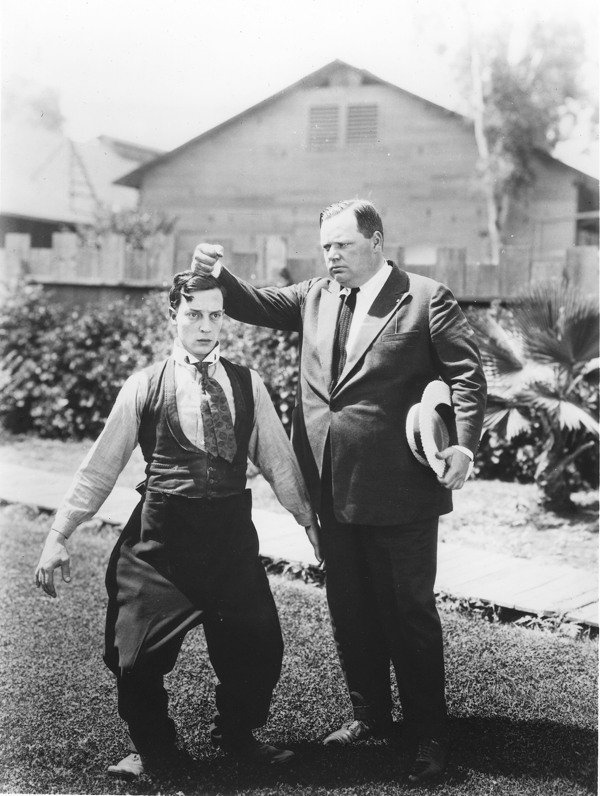
Is Roscoe Arbuckle holding Buster Keaton down in this picture, or pulling him up? You decide (courtesy Paul E. Gierucki).
Consider Backstage, a 1919 two-reeler co-starring Keaton and Arbuckle, and one of their last collaborations before Keaton went solo. Many books on Keaton observe the similarity between this film and later Keaton works—such as the fact that it features an early version of the falling wall gag Keaton famously used in Steamboat Bill, Jr. wherein he survives by standing miraculously where the window hole happens to be. Or that the opening scene in which one reality is torn apart and revealed to be a stage set being dismantled was also reused in Steamboat Bill, Jr. Or that the overall tone and structure of the short prefigures Keaton’s Playhouse. According to this brand of conventional wisdom, these similarities are evidence that Keaton was the primary creative influence at work in Backstage and the reason for that similarity.
The problem with this line of thinking is that it proceeds from a familiarity with Keaton’s films and a relative unfamiliarity with Arbuckle’s; where overlap is found between the aesthetics of Arbuckle/Keaton collaborations and later Keaton films the assumption is simply, “well that must mean Buster was the common denominator.” It seems churlish to me that critics routinely deny Arbuckle the credit for any great comedy ideas that surface in the films he made with Keaton.
There’s a signature Arbuckle gag that appeared several times in his filmography—1913’s Mother’s Boy, 1915’s Fatty’s Plucky Pup, and in 1917’s The Rough House. The bit involves Arbuckle discovering that his bed is on fire. What will he do?
If this were any other slapstick clown star, you’d probably find him running around frantically, jumping up and down, waving his arms in an expression of panic. He might rush to get a garden hose, and spray himself in the face with it. Then he’d spray the hose all through the house, destroying furniture and furnishings as thoroughly as if he’d let the fire run its course.
This is not what Arbuckle does. Instead he moves deliberately, carefully, to get a single cup of water, walk it carefully to the adjacent bedroom to splash its contents on the burning bed. Then he traipses patiently back to the sink to retrieve another. He pauses to take a refreshing drink from the third.
It’s a good gag, and worth repeating (and, it should be noted, appears to have originated with Max Linder around 1910). But part of what charges it with such comic energy is the context: Roscoe Arbuckle was one of the first stars to emerge out of the chaotic comedy of Mack Sennett’s Keystone studio. Sennett’s ethos was centered on mayhem and havoc. Sennett style slapstick was about “going big.” Small complications would lead to massive overreactions and violence. And in this world of excess, Arbuckle made his name by subverting the formula. His contemporaries would tear the world asunder for a joke—Arbuckle, faced with something as genuinely calamitous and demanding of immediate attention as a raging indoor fire, took his time to daintily fill a demi-tasse of water, one splash at a time. No hurry. Nothing worth expending any real energy on.
And in that simple gag we find the essence of Arbucklian comedy distilled. In a world dominated by slapstick, Arbuckle created his laughs out of comic irony. He was post-modern before anyone else had even gotten around to being modern.
In a gag he repeated at least as often as the burning bed routine, Arbuckle is about to change clothes when he turns to the camera, gets the attention of the cameraman, and directs him to pan up so as not to expose Roscoe’s nudity.
Keaton repeated the joke in his first solo short One Week. It’s hard not to see that as a direct lift from Arbuckle—but the connection is rarely commented on.
To fully grasp the relative contributions of Keaton and Arbuckle in their collaborations, it helps to spend some time with some of the films Arbuckle directed for other comedians. For example, Arbuckle directed an oddity called Curses! starring Arbuckle’s nephew Al St. John in a silly parody of cliffhanger-style serials. It’s the kind of gag-a-minute parody that Airplane! does for disaster movies.
Then there’s The Movies with Lloyd Hamilton. Although his career was cut short by alcoholism, during his heyday Lloyd Hamilton was a talented and funny slapstick clown with a persona not unlike that of Roscoe Arbuckle. They worked together in the 1920s when Arbuckle was forced into working as a pseudonymous director in the aftermath of his scandal, trial, and subsequent exoneration. Together, Arbuckle and Hamilton collaborated on three short comedies, of which only this one is known to survive. Hamilton makes a great Arbuckle stand-in The Movies, a film ripe with absurdity and self-referentialism. The story involves a young hayseed (Hamilton) who is warned by his country folk family to stay away from the moving pictures—but no sooner does he arrive in the big city than he is recruited by talent scouts to join the picture business. The reason they want this inexperienced rube? Because he’s a dead ringer for—wait for it—Lloyd Hamilton, who wants his lookalike to handle his more dangerous stunts for him!
In the same vein is My Stars, in which Virginia Vance plays a movie-struck gal, who can’t stop swooning over her movie mags and the pictures of her favorite stars. Hoping to get her attention back, Johnny Arthur takes to lavishly appointed impersonations of the various stars—but he can’t quite keep up with her fickle fixations. Finally, he hits on a well-timed Harold Lloyd impersonation, just in time to sweep her off her feet and into a Harold-Lloyd-esque stunt-addled chase climax.
Taken together, these are a disparate mix of films made over a spread of many years for a variety of corporate entities involving many different kinds of comedians and performance styles. Yet there is a common thread—theatrical and/or cinematic self-referentialism, and a preference for absurd sight gags over raw slapstick. And since these are the dominant characteristics of something like Backstage, it starts to be more plausible that these are the comic characteristics of Arbuckle’s vision. Perhaps they recur in Keaton’s later work not because they were unique to him, but because Arbuckle was his friend and mentor and he was profoundly influenced by him?