
THE CENTER OF THE WORLD
And the dead tree gives no shelter, the cricket no relief,
And the dry stone no sound of water.
—T. S. Eliot, The Waste Land
That anyone found it at all seems like a miracle, lost in the middle of nowhere as it is. More than two thousand miles from the coast of Chile. We leap the Pacific from Santiago on a five-and-a-half-hour flight.
Now imagine the first landfall, somewhere around 1000–1200 CE. According to myth, the island’s first king, Hotu Matu‘a, arrived from the other side of the ocean—the Polynesian Islands—with a handful of men and women on catamarans and canoes, and sixty-seven tablets covered with signs. There to welcome them was a vast and craggy coastline, three volcanoes, a triangular piece of land covered in windswept hills, and fishless waters stretching all around. Though they had no sense of it at the time, they were the final stroke in the colonization of our planet, the last to step foot on pure and virgin soil.
Palm trees and forests covered the island. Rainwater pooled in the craters of extinct volcanoes. Fresh water gushed from the earth. According to very recent studies, it was around these crater lakes that the Polynesian colonizers first began constructing ahu, the stone platforms that serve as the bases for their moai statues, clustering them near the water. The statues, like standard-bearers, loom along the horizon, personifications of the island’s ancestors, marking the water sources, like the sentinels of a past and present life. The uncorrupted guarantors of future life.
The entire planet—land, sea, sky—was concentrated in those 63 square miles: to see it was “to see a world in a grain of sand and heaven in a wild flower, hold infinity in the palm of your hand.” For its inhabitants, the island was the center of the world—Te Pito o Te Henua, in the local language Rapa Nui.
Detaching yourself from a Ptolemaic view of things can be difficult. What else would it be spinning around, this world of ours, if not us? To be pushed from center stage is disorienting, vertigo-inducing. It knocks you out of sync with the earth’s natural motion—either we’re the fulcrum, or we’re completely off axis. To make sense of the space around us, to keep from going dizzy, we must think of ourselves as the only fixed point, while everything else is moving around us. Only then can we guard ourselves against the baffling and alienating effect of infinity. It makes sense, then, that the planet is riddled with “centers of the earth,” spread out across the continents, from Istanbul, Babylonia, and Arizona to Easter Island. Every stage is a world, to misquote Shakespeare.
But mankind leaves a heavy footprint. From the moment the human beast set foot on the island, the face of Rapa Nui was marred. Towering palm trees destroyed, burned, uprooted to cremate the dead, to construct plantations and canoes, to build the moai, and for a host of other purposes we can’t imagine. It may not have been the rats’ fault after all, as many books on the collapse of the island’s civilization suggest. The egocentric stride of human beings is more than capable of doing the job. Deforestation set off an irreversible domino effect: erosion by wind and rain, agriculture in fits and starts, smaller and smaller harvests, famine, and perhaps (as oral accounts from the population attest) even cannibalism. A full gallop toward destruction. So it was that this center of the world, floating out in the far reaches of the ocean, became a patch of desolate earth.
Like space, time knocks us stupid when we step outside the present moment. All in all, it took Easter Island less than a thousand years to reach ecological suicide. One thousand years, in the 4.5 billion years of life on this planet, is the blink of an eye, a hiccup, a gunshot, Usain Bolt’s 100-meter dash. You turn and it’s already over—and in the meantime, your own center of the earth has changed its face forever.
MIRACLE
Yet in this suspended fragment of time, in Bolt’s 100 meters, in the beat of a heart or the blink of an eye, space opens itself up to surprise, to bated breath, to a reaffirmation of life. This interval can generate creative tension, impulse, discovery. On Easter Island, this creativity found expression in an astounding visual culture. There are symbols engraved in the shoulders of the moai; monumental, magnificent petroglyphs carved into basalt and volcanic rocks; and wooden tablets, densely packed with a series of signs—the Rongorongo language.
Today only a few of these illegible tablets remain, and all are held far from their island of origin. The scripts are written boustrophedonically. Boustrophedon is writing that “follows the path of the ox,” as the word’s Greek origin tells us—which is to say, every other line runs in the opposite direction, from right to left and then from left to right, in a kind of alternating zigzag. Rongorongo, however, makes things (and the lives of us decipherers) even more complicated, since it’s written in reverse boustrophedon: the signs in the second line are upside down with respect to the first, forcing the reader to turn the tablet over every other line. Not only that, but the language is read from bottom to top. It sounds truly strange, but reading a text was meant to be a kind of advanced choreography.
We rely on both sources—the petroglyphs and the wooden tablets—to make sense of this whimsical gesture, to explain this impulse, and to help answer two outstanding questions.
Question one: Are we talking about an actual script here? It seems almost a miracle that something so complex and refined could have emerged from the “wasteland” of Rapa Nui. Detractors—and there are always a few—dismiss it as a kind of proto-script. For them, to claim this series of signs as anything else is inconceivable. Or no, maybe they were used as pretty stamps, to add color to fabrics, given how beautiful and decorative they are? Icons of men, women, stars, mountains, animals, and every sort of winged creature. How could these possibly add up to a written language?
Remember our feline friend from Minos, exiled to the land of “drawings” when it was really a sign? Here we are again. It’s easy to lose sight of iconicity: distinguishing between drawings and signs is the giant pitfall hiding in all invented scripts. And the idea of invention brings us to our second question: Is Rongorongo a script invented from scratch? With no outside influence? Before diving into this second question we must tackle the first—and in that arena, we stand in strong opposition to the detractors. Rongorongo is, in the fullest sense, a script. And we can say this with certainty because the consistent structures that underlie the inscriptions make clear that a natural language is being recorded (and that these are not simply fanciful decorations).
The next logical step would have been to compile a list of all the signs—but that’s where the train jumped the tracks. Just after the Second World War, different schools (Russian vs. German) dedicated themselves to the task, though without reaching any shared conclusions (it wasn’t exactly a friendly environment). The main takeaway being that, in war, and without collaboration, you’re bound to make a mess of things: far-flung and unfounded decipherments, the list of signs overrun with redundancies, inconsistencies, dubiously patched-together symbols. Seven hundred signs, never organized into a rational inventory—but that’s where we are. The number of signs alone, though clearly inflated, tells us at the very least that Rongorongo is a syllabary, with a series of logograms. The process of streamlining and ridding this list of all redundancies is still ongoing, but we’re working on it, and we’re getting close. The end is within reach. In the meantime, we can flaunt our discovery that Rongorongo is a logo-syllabary, exactly like all the other scripts invented from scratch (except, as we’ll see, Egyptian).
Which brings us back around to our second question, regarding invention. We must leap nearly three hundred years into the past, to the day when a group of Dutch sailors disembarked on the island. It was Easter Sunday, 1722. There to greet them was a treeless expanse, the earth parched, but the same craggy coastline and the same winds found by the first colonizing king, Hotu Matu‘a. This crew, of course, did not come bearing any tablets.
What is the origin story, then, of Rongorongo? The miracle lies not only in the creation of a script in such an isolated place, but also in the possibility that this creation might have come from nowhere, from the ingenuity of the locals alone, and not from the influence of some hypercivilized foreign colonizers. The miracle lies in the invention of something new and never before seen. A lantern flicking on, glowing between the craggy coasts, between the waves of wind and water. There are those who will never admit that such a thing is possible, but I’m not one of them. Invention is within everyone’s reach—just as likely to be found between the magmatic folds of a volcanic island as it is in the crowds of a densely packed city. Invention is in our brains, lying dormant, around the corner, churning away while we’re busy distracting ourselves with other matters.
And to be honest, it makes little difference if the inhabitants of Rapa Nui were in some vague way exposed to the Roman alphabet, or to the treaties of colonizers, or to the stew of European letters before they invented Rongorongo. The inhabitants of Rapa Nui—before they became victim to egregious and invasive abuses of power, before their civilization was demolished—invented a writing system with completely new signs, one that had little to do with the elementary European alphabet. That we’re dealing with a new writing system, and therefore an invented writing system, is irrefutable. And don’t forget that it’s a logo-syllabary, like all scripts that have been invented from the ground up. Which means that its signs are iconic in form. Syllables, iconicity, uniquely formed signs—all are ingredients associated with the miracle of the inventive spark. In just a few pages we’ll be able to provide more tangible proof (more tangible, at least, than my undeniable partiality) that what we have here is a true case of invention, if you’re not yet convinced by the structural evidence. But first let’s go back to the future, three hundred years later—to the present day, that is.
DODO’S EGG
We step into a quiet room, lit as if it really were a museum gallery. Father Alberto, of the Congregation of the Sacred Heart, is there to welcome us. We’re in the north of Rome, on a nameless street—residential, deserted. We press the intercom button like we’re paying a visit to old friends, and we’re greeted with an espresso and an incredible story. Why are four of the twenty-six wooden tablets inscribed with Rongorongo in Rome, nearly ten thousand miles from their native island? What are they doing here?
Hidden behind display cases, guarded with equal doses of humility and pride, these tablets, Father Alberto tells us, were saved at the last minute by a group of missionaries. Just before the tablets were to be burned, the missionaries noticed the engravings covering them from end to end. “What are all these signs?” The Tahitian bishop Florentin-Étienne Jaussen was the first to bring fame to Rongorongo and to begin studying it. He saved the tablets and sailed them back to Rome at the end of the nineteenth century. And they’ve been here ever since, under careful watch.
Father Alberto takes immediate, passionate interest in our cause. We’re here with experts in geodesy and geomatics from INSCRIBE, whose aim is to collect 3D images, using an extremely powerful laser scanner, of all the undeciphered scripts that we study—the Aegean scripts (Cretan Hieroglyphic, Linear A, Cypro-Minoan), as well the Rongorongo tablets. We’re starting out in our own center of the world, Rome, but we’ll soon be chasing down inscriptions all over the globe, from St. Petersburg to Hawaii, not to mention Cyprus and Crete.
Our object of study today is the Mamari tablet (fig. 8). Mamari, in the language of Rapa Nui, means “egg,” even if the tablet’s shape is more circular than ovoid, with smooth and shiny edges. It’s made of wood, with numerous signs carved into both sides, intricate and densely packed, each line engraved only lightly into the surface, each sign faint and elegant in its sinuous and well-proportioned form. From this description, the tablet seems merely beautiful—and beautiful it is—but it’s also a nightmare for our scanner. In a sense, we’re trying to enact our own little miracle: to use the most effective technology possible in order to create a three-dimensional model that captures the signs in all their detail, giving us the most accurate “reading” of the text. It’s a task we’ve been laboring at for months.
Today is the decisive day, and it’s time to celebrate, because we’ve produced a “passable” result. Passable is the adjective the engineers use to describe it. Translated into layman’s terms it means “mind-blowing.” A few words should be said about geodesists, who are a species unto themselves: they are expert engineers who create models for measuring the geometric shape of the earth and its gravitational field. They’re temperate creatures, with their own reaction times and their own shared language, which I’m beginning to understand myself. They have a certain obsession with symmetry, order, and a balanced objectivity.*
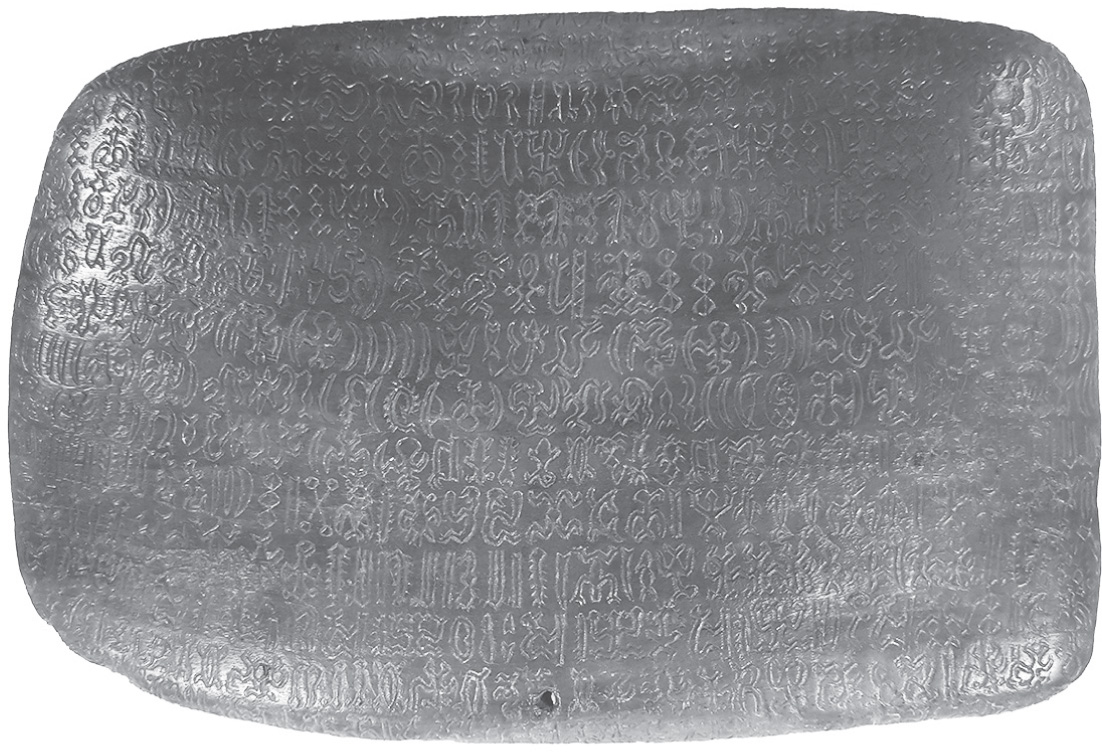
8. The Mamari tablet, inscribed with Rongorongo
Today is the first time I’ve seen them get emotional. Catching sight of a teary-eyed engineer is like finding a dodo’s egg on the shores of Ostia Antica. Witnessing three of them, no less, with half-moon smiles and rows of teeth wide enough to stretch the earth’s atmosphere, is like coming across a zoo full of dodos, alive and well.
And what will we do with these 3D models? Here’s the plan: to create the first digital archive of every existing Rongorongo tablet. To bring them to you. To make it so that everyone, if only virtually, can access these tablets, can touch them, zoom in on them, flip them upside down like they’re playing a video game. These models will help us to distinguish the exact form of each sign, down to the finest detail, to reimagine just how they were inscribed into the wood. This is crucial to making sure that we have consistent word sequences, from which we can then reconstruct the language’s morphological underpinnings (its grammar, in other words) and check to see if there are repetitions, logograms, numerals, etc.
Days like today are a source of immeasurable joy. Being able to read the signs properly is only the first step, yes, but it is without doubt the most important, the foundation of deciphering a writing system. Being able to recognize each sign, down to its finest detail, is the oboist’s tuning note that will allow us to reconstruct the entire scale of sounds in Rongorongo. If that’s not soul-stirring, I don’t know what is. The key to interpretation is within reach. Now that you, that we, have seen the signs, we’re left with the burden of finding proof that the script was an invention, as I noted earlier. To do so, we must return to the moai and take a closer look—at both sides.
WATCH YOUR BACK
From the earliest phases of construction, which date to around the very first wave of colonization, the moai proliferated and became the island’s symbol. One thousand statues, gazing inland. So taken are we with these friendly giants—so visible are they, so exposed—that all other artistic works on the island, which are far more numerous, have been relegated to obscurity. Blame it on their reticent, guarded beauty—the kind that’s harder to detect, the kind you recognize only much later, and only because you took a closer look. The petroglyphs, engraved in bas-relief or painted, are perhaps the true masterpieces of Easter Island.
At the crater of Rano Kau we find a narrative sequence of petroglyphs that stretches nearly ten feet—a swirl of sea creatures, a human-faced octopus, imaginary bird-fish (fig. 9). It looks like a mythic tale.
And there are other drawings that appear almost to have perspective, overlaid by figures of birdmen. These birdmen are everywhere, with their wide eyes and pointed beaks, their human bodies curled in the fetal position. Sacred and bellicose, they recall the strength of warriors, the matato’a. And they dominate the site of Orongo, at the rim’s highest point, one of the triangular island’s three corners, jutting perilously into the ocean. Here priests chanted for the annual egg hunt—in which the winner, who returned with the season’s first egg, would be declared “birdman” for the year.
And then there are the sea creatures, anthropomorphic figures, turtles, birds, geometric motifs, that we find engraved on the backs of the moai. These drawings are the precursors of the signs we find in the Rongorongo script. And here we must pay careful attention—we must concentrate on this art, we must contextualize it, in order to understand their writing system’s origin. Properly dating the moai and the petroglyphs is crucial. They without doubt precede the birth of Rongorongo, by nearly half a millennium, but that’s not evidence enough. The petroglyph symbols are remarkably similar to the signs in Rongorongo. Some are even identical.
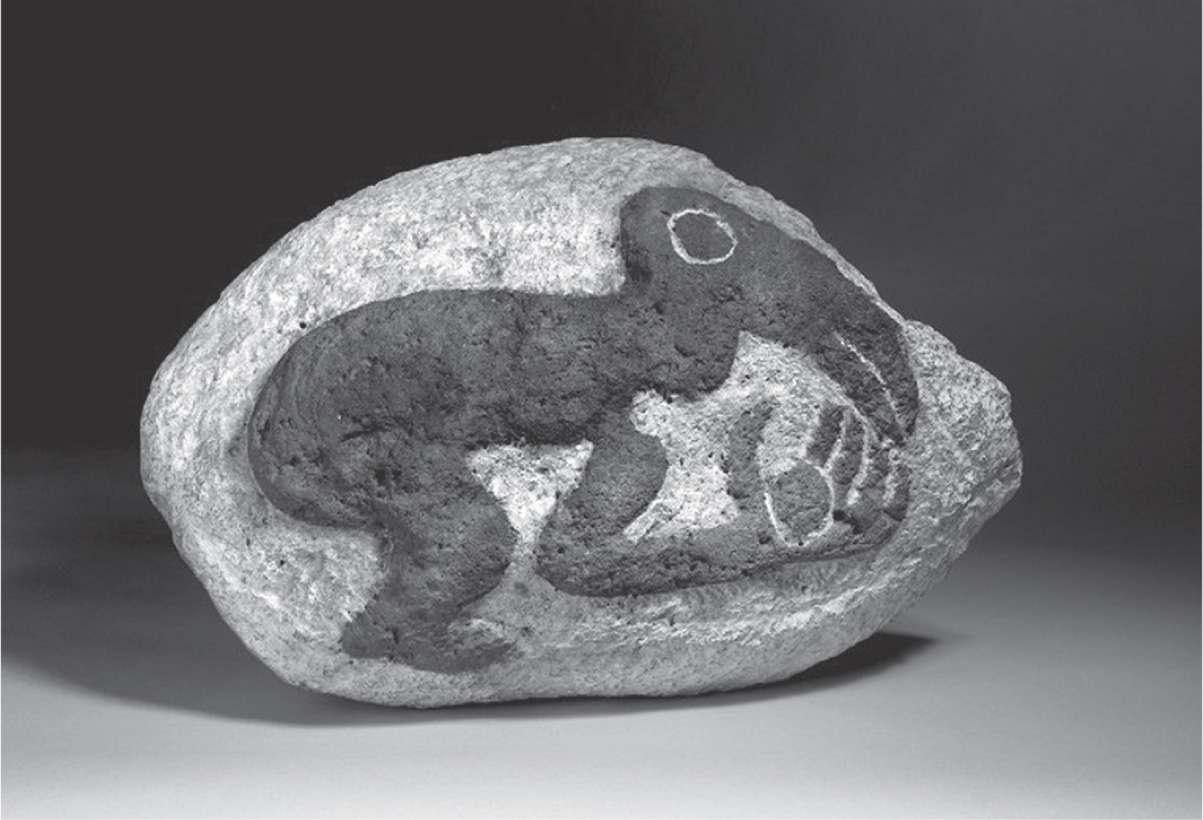
9. An image of the “birdman” from Rapa Nui
This preexisting iconography seems to be the island’s generative source, its inspiration, its raison d’être, just as fresh water is for the moai platforms. The similarities are striking, and they lead us to believe that the Europeans had nothing to do with the creation of the local script. That they couldn’t possibly have contributed. Meaning that Rongorongo would be the fruit of an autonomous, independent, free effort. A language written with no outside interference. An invention. And one whose origins are not so inexplicable, since its trajectory resembles that of other scripts formed under analogous circumstances in very different locations.
In Rapa Nui as in Crete, as in other cases where scripts have been invented, the culture’s artistic heritage forms a substratum, a foundation for a wide variety of creative impulses. Art acts as a springboard for writing, a catalyst, a life source, meanwhile endowing it with its graphic structure. Its contribution therefore comes from within, is inherent in its form and logic. From drawing to sign, with no intrusion from outsiders who couldn’t possibly understand the originating art or the resulting script.
But why birds? Why riddle the island and their written language with birds? Why set them, like precious and eternal gems, in the moai’s backs? Literally “petrified”—rendered human by art, but also immobile. Why rob them of motion? Because birds could fly away. They could escape the island and return as they pleased. An impossible feat for the islanders of Rapa Nui, forever trapped on their desolate triangle of volcanoes. Alive, but practically extinct.
TANTALUS
The undeciphered scripts of the Aegean—Cretan Hieroglyphic, Linear A, and Cypro-Minoan—may well be hiding completely unknown languages, languages we don’t even know exist. That would be a true shame, since the path to reconstructing an unknown language is much more arduous, and the decipherment can never be definitive. There’d be no way to test its validity. If the language were unknown, we’d be stuck in a kind of linguistic limbo, halfway there, our necks twisted, forced always to look behind us, mute, like the diviners in Dante’s hell who wanted to veder troppo davante (see too far ahead!).
To be stuck midway, looking back, would not be fun: it would mean that we could read the script in question, whichever it may be, by applying phonetic values to the signs, eventually reaching a complete correspondence between sign and sound. But it would also mean that we’d have to stop right there, forever locked outside the gates of understanding the language’s morphology. We would never discover how the language functions or to which family it belongs. We would become a new kind of Tantalus, trapped in a pool of water, a fruit tree above us; the water receding as we try to drink, the low-hanging fruit just beyond our reach.
With Rongorongo, it’s a different kind of torture, perhaps even more sadistic. The language recorded belongs without doubt to the Polynesian family, and is connected to the modern Rapa Nui language. Back at the turn of the last century, experiments were conducted with the local inhabitants in which they were asked to read various texts. But the results made little sense, except with signs that had a clear natural referent—the sun, a bird, a mouth (though even I could have gotten that far). This of course led to a “pictographic” reading, and to the belief that Rongorongo is a mnemonic system, and therefore unstructured. And that’s where the problems begin. It now remains for us to uncover the logical connection between the Rapa Nui language and the structure of its signs. The terms of the equation have been reversed: we know the language, but the typology of the script remains (though not for long, we hope) a complete mystery.
These two elements, script and language, seem to run along parallel tracks. With Rongorongo, it’s as if we have a photograph of the finished puzzle (the language), but we can’t figure out how to connect all the puzzle pieces (the signs). We can watch the whole film, but we can’t thread the scenes back together in sequential order. Or to be more accurate, we can’t even put our finger on the film’s plot, and the photo of the puzzle is faded, generic, unrelated to the pieces scattered before us.
Understanding the structure, a writing system’s typology, is already an important leg up. The next steps are very clear: starting from the logo-syllabary, we must reduce the number of signs in the inventory, and reconstruct the functions of the smaller pieces, the logograms, syllabograms, determinatives.* Figuring out how the pawns move on the linguistic chessboard is the only true way forward. And we’re charging ahead with confidence. Just the other day, standing before the three-dimensional image of the Mamari tablet made in Father Alberto’s tiny museum—and going teary-eyed just like our geodesists—we noticed several undeniable patterns in the Rongorongo text, from which a clear and identifiable kind of rebus began to emerge. When I suggested, with a measure of caution, “Well, now we can decipher it,” one of my researchers replied, in a firm, Obama-ish tone of voice I’d never heard him use before, “Oh yes, we can.” Technology, a paleographic eye, teamwork, and a bit of logic—I wouldn’t be surprised if another small miracle awaits us in the not-so-distant future. One day you find a dodo’s egg and, who knows, next thing we’re freeing Tantalus from his torture and Dante’s diviners from their eternal contrappasso.
REBUS
But let’s talk for a minute about that “kind of rebus,” since the rebus stands as one of the fundamental mechanisms in a script’s invention. Let’s examine how. Do you recall our friend the syllable? The syllable is essential because syllables are what help produce homophony. The more monosyllabic words there are in a language, the more easily and instinctively we land on homophony. This homophony is something we’re all familiar with. And, in technical terms, it’s called a rebus—a tool we’re constantly making use of, oft en without even knowing it.
The name itself is notable, since it comes from the Latin for “thing” (res), here in the ablative-instrumental case (“with things”), which brings us around again to the pragmatic concreteness of writing. In the early stages of writing’s development, in fact, the rebus was based on logograms, signs that represent things. The crucial point is that a logogram’s sound can carry an additional meaning, beyond the one indicated by the drawing. In Old Chinese, the logogram of a horse, pronounced ma, is the same ma sound that means mother. A logogram can mean two different things, while the sound stays the same. Using this one, small, versatile unit of meaning, we can express two things on completely different ends of the semantic spectrum, and create humor.
To better explain this, we can look to a more modern creation—a highly pictographic form of writing that functions, at least on a base level, just like scripts invented from scratch: emojis.
(And to anyone who groans with disapproval and asks, “What, so you think that with emojis we’re going back to hieroglyphs?”—I urge you to respond with a resounding yes! And I’ll explain why at the end of this book.)
Are you ready to have some fun? Or do you find emojis to be a  ?
?
There we have it—the rebus. Therein lies the spark, the spell, the beginning of everything. All scripts invented from scratch (even if Mayan is a bit more complicated to reconstruct) make use of rebuses that employ already existent signs, logograms, and expand their semantic value, even to represent concepts that aren’t easily communicated at a logographic level. Sumerians, early on, used the sign meaning arrow (ti) to represent a beautiful but abstract word, til—“life.”
Can you  it?
it?
Well, you should “bee” “leaf” it—because in English, I’m happy to report, there’s a plentitude of homophonic words (whether monosyllabic or disyllabic). I don’t have to rack my brain to find great examples in the same vein of “bee” “leaf,” which is a composite rebus—wherein two different monosyllabic words produce a third word of a completely different meaning. You don’t need to be a genius to find the perfect rebus in English, it 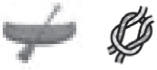 .
.
In fact, the English language lends itself so well to the principle of the rebus, you can find homophony even within the boundaries of words.  of a
of a  ! If this sounds like an obscure concept, don’t worry, it’s harder to explain than it is to understand. The rebus is instinctive, not intellectual, more intuitive than it is heady. Unravel this one and you’ll understand everything.
2  , 2 .*
A rebus is an instant trick, a miniature revelation. It doesn’t take millennia to gestate. One can only imagine how many times, throughout the course of history, someone has realized that one sound can mean two different things. But to put it down in writing—that’s something else, something more, since to do so is to set an irreversible process in motion. It’s a tantalizing discovery that marks a beginning, that opens the gates—a tiny, clever device that paves the way to real invention.
And I say “discovery” for a reason. Because the way the rebus was used in early writing systems, back at the beginning, helps us to grasp something important: that writing is first and foremost a discovery—a lightbulb of assonance flicking on, a natural turn of phrase, a spontaneous game of expanding the limits of meaning. An intuition—of finding ways to represent words that defy representation with iconic signs. And, in the process, sometimes stumbling on a little humor, which we understand immediately, without lengthy explanations. An invention is something else entirely.