THE CHECKERED HISTORY of railroads in Australia is in many respects a case study of how not to manage a railroad network. In contrast to many other countries, where the railroads acted as a great unifier and were built in a standardized way that assisted their expansion, the state-run railroad companies in Australia seemed to take an almost perverse enjoyment in making life difficult for freight carriers and people wishing to travel long distances across this vast country. In no other country in the world has the issue of the gauge of the various lines so dominated the history of the railroads and resulted in so much damage to the development of the rail network.
Given that in its infancy Australia was the destination of so many British convicts, deported there in the 19th century, it is perhaps unsurprising that its first railroad line was operated by convict-power. In 1836, a 5-mile (8-km) narrow-gauge line was built across the Tasman Peninsula in Tasmania to the Port Arthur prison settlement, enabling visitors to avoid a stormy sea passage. Convicts who had first been conscripted into building the track were then required to haul the little open-top cars that plied the line, enjoying a slight rest on downward sections, where they could hop aboard for the ride. Passengers paid the not-inconsiderable fare of one shilling. However, this human-powered arrangement could hardly be called a railroad, and it was not until 1854 that the first proper lines were opened.
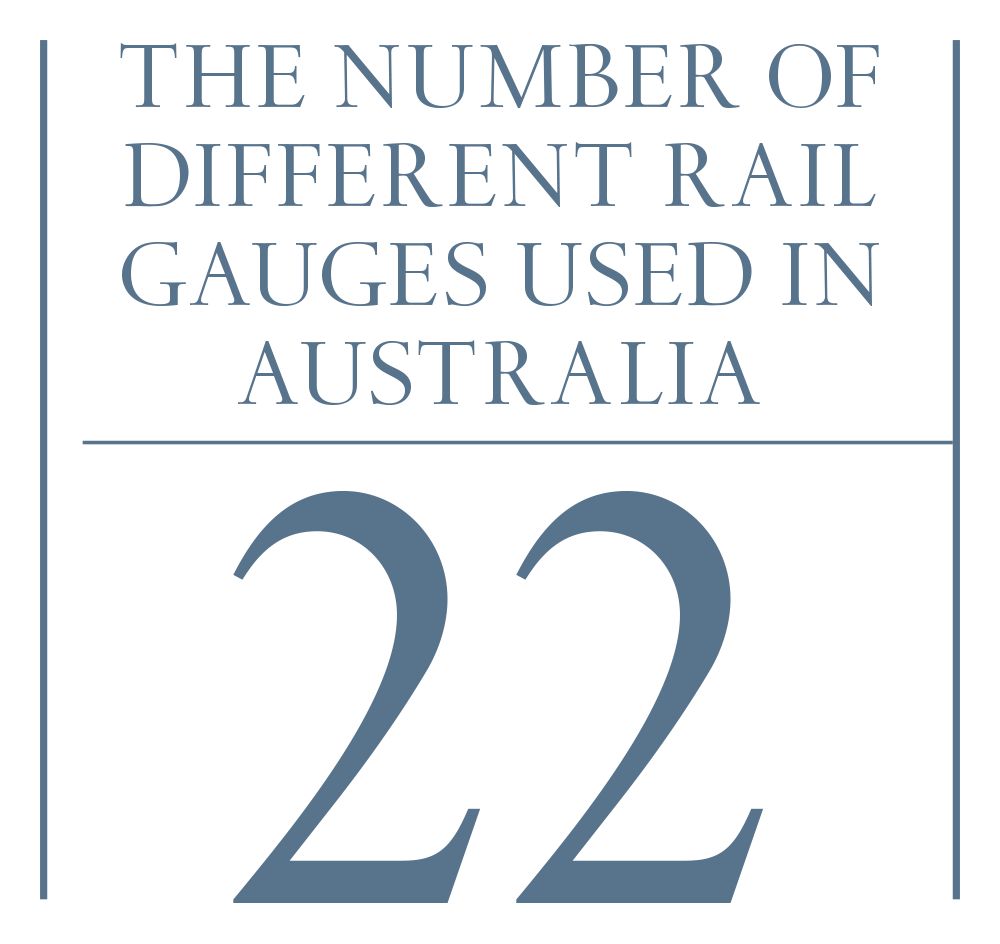
Constructed almost simultaneously, the nation’s first lines set a pattern of disconnected services that would plague Australia’s railroad system throughout its history. In South Australia, a 7-mile (11-km) horse-drawn line opened in May 1854 between Goolwa on the lower Murray River and Port Elliot, and four months later the nation’s first steam service began in Victoria, between Melbourne’s Flinders Street Station and Sandbridge (now Port Melbourne). Both these lines used the 5ft 3in (1,600mm) broad gauge, as used in Ireland, but a line opened in New South Wales the following year using the 4ft 8½in (1,435mm) standard gauge. This was the start of Australia’s failure to coordinate its railroads, resulting in—according to rail enthusiast and former deputy prime minister Tim Fischer—a veritable confetti of gauges, with 22 different track widths being used across the nation. Following the opening of these first lines, early attempts were made to coordinate the use of gauges. However, these only added to the confusion. Amazingly, the New South Wales line was first converted to the broader width and then back to standard gauge in the belief that this would match neighboring Victoria. However, Victoria and South Australia claimed that, in fact, changing to standard gauge would be too expensive, as they had bought rolling stock in broad gauge. And thus, as a historian of rail transportation in Australia put it, “the glorious bungle began.” To exacerbate matters, the three remaining states, Queensland, Tasmania, and Western Australia—all of which were separate British colonies until the creation of the Commonwealth of Australia in 1901—each chose the 3ft 6in (1,067mm) narrow gauge, enabling cheaper construction but adding to the gauge confusion.
In the last quarter of the 19th century, the railroads began to expand rapidly, mostly due to the demand for freight conveyance. The overseas export market was the catalyst, with the consequent need to carry ore from the country’s mines, and agricultural produce from the vast interior, to Australia’s ports. But any attempt to create a national network—or even merely to create links across state borders—was hampered by the gauge issue. In effect, the six Australian states each built a railroad network resembling that of an individual country, with very few connections and little cross-border traffic.
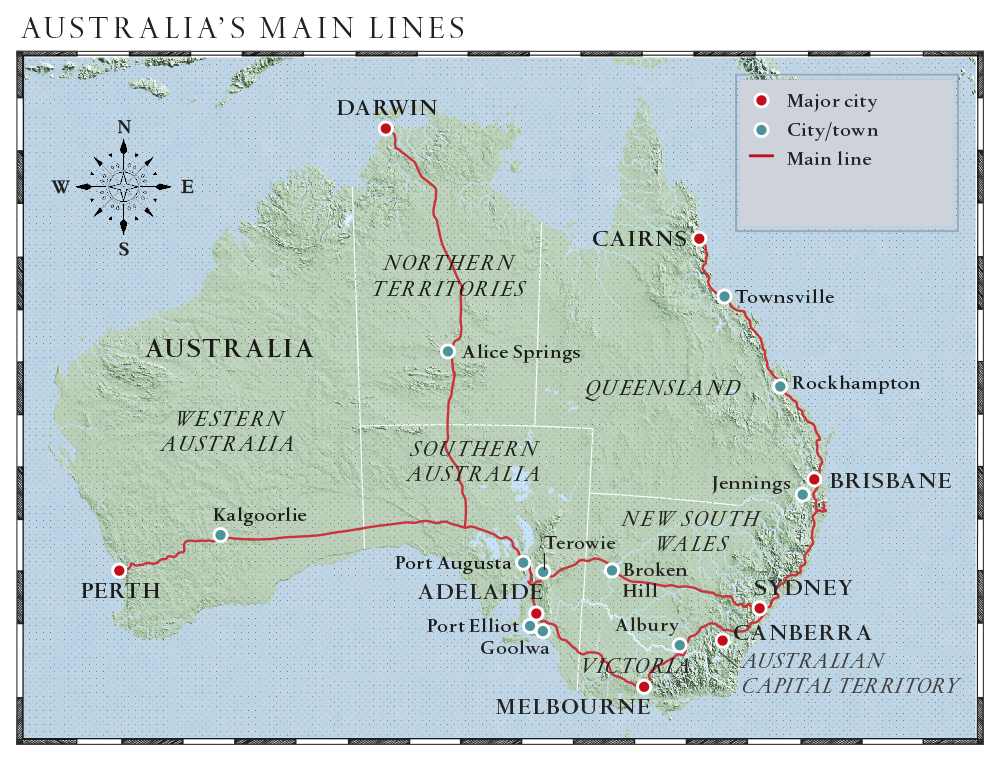
For example, when the rails of New South Wales and Victoria met at Albury in 1883, in theory linking Melbourne and Sydney, the different gauges meant that passengers had to change trains, and goods had to be transhipped for onward dispatch. The same happened between Sydney and Brisbane, when the lines between Queensland and New South Wales met at Jennings in the same year. Even at borders between states where there was no break of gauge, “huge time-wasting barriers were created to stop any kind of seamlessness,” according to Fischer. The only two adjoining states with the same gauge—Victoria and South Australia—changed locomotives at the border because each state had bought different types of engine that could not fit onto the other state’s network. This lack of standardization proved costly, as it hindered savings from bulk-buying of equipment. Coastal shipping took up the slack, handling most passenger and freight traffic between states, even though maritime transport was a slower method of travel.
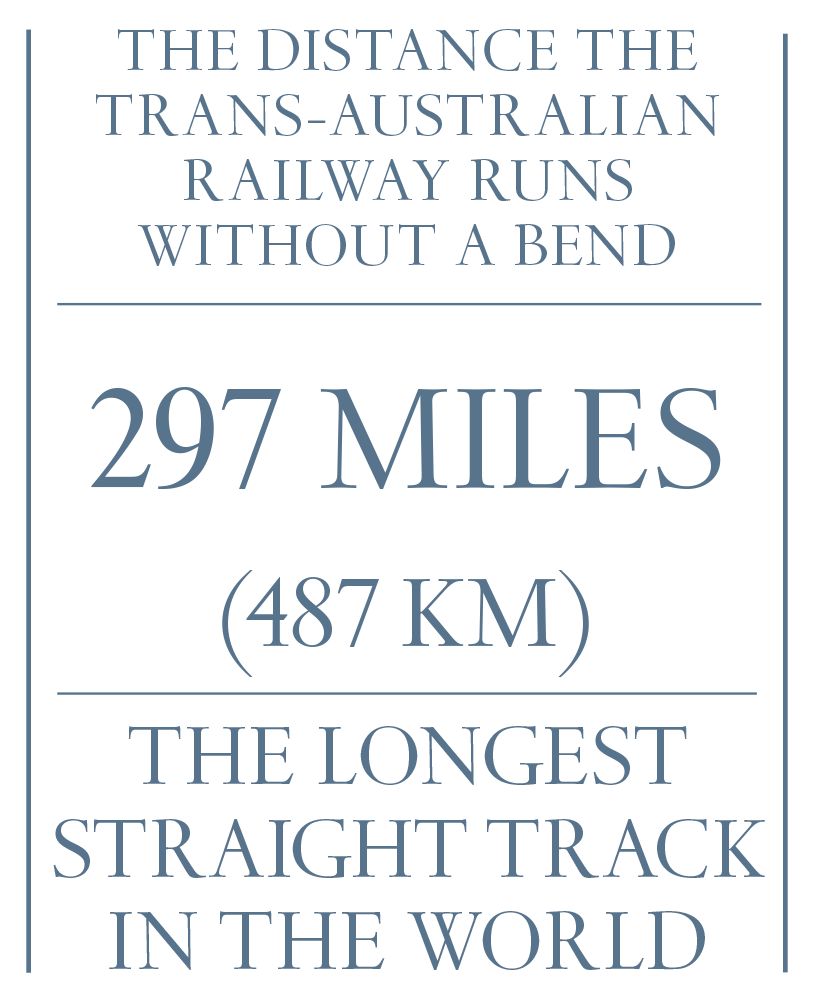
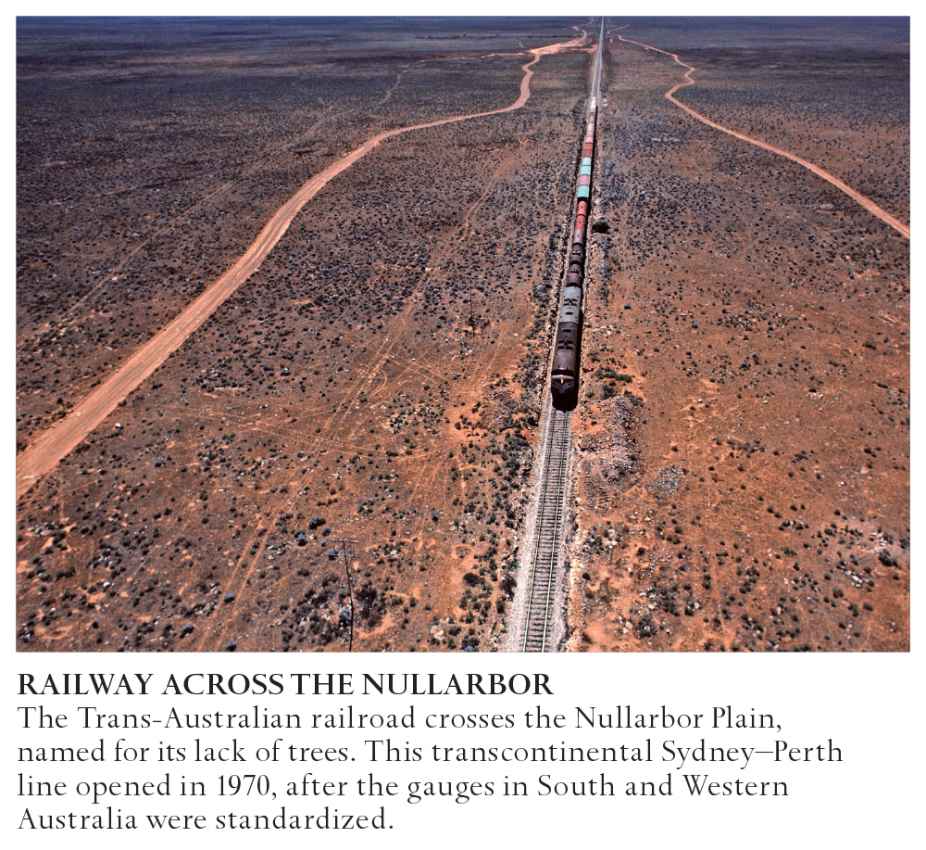
The question of whether all the railroads should adopt standard gauge had been debated as early as 1890. However, it was not until Australia became an autonomous nation in 1901 that the gauge issue was addressed, by the new federal government. Before then, the various colonial administrations had decided that the cost of standardization would be too high, making differences in gauges—known as “breaks of gauge”—inevitable. In 1917, the government built the standard-gauge Trans-Australian Railway between Kalgoorlie in Western Australia and Port Augusta in South Australia, but several breaks of gauge were required to reach connecting stations—at Kalgoorlie to reach Perth, and at Port Augusta and Terowie to reach Adelaide. Similarly, when the line between Sydney and South Australia was later completed in 1927, breaks of gauge were required at Broken Hill, where the line switched to narrow gauge, and at Terowie to reach Adelaide.
The nationwide rail system had expanded to some 26,000 miles (40,000km)—relatively small for so large a country—by the end of World War I. As in other countries, railroads lost market share between the wars as they faced growing competition from road transportation, even in the key freight market. Starved of much-needed investment from their state owners, the railroads then had to cope with the added loads of wartime, following Australia’s entry into World War II in September 1939. The railroads were used intensively for the war effort, carrying both troops and freight, but afterward a pattern of neglect began to threaten their very existence. Facing even greater post-war competition from road transportation, and with the emerging airlines picking off long-distance passengers, there was talk of abandoning the system. In the words of one historian of the Australian railroads: “they might have succumbed to the direst predictions of the critics and become nothing more than streaks of rust across the countryside…”
However, the attempt to develop a standard-gauge network would continue for much of the 20th century. The first concerted effort had been made in 1932, with the completion of a standard-gauge railroad between Sydney and Brisbane, but it was not until after World War II that real efforts were made to create a network across the whole country using the same gauge. In the 1950s, a plan was drawn up to create a national network of standard-gauge lines, but progress was slow because of the cost. It was not until 1962 that the Sydney–Melbourne route, the busiest long-distance line in the country, was standardized, and three years later the Sydney–Perth route followed suit. The Melbourne–Adelaide railway was converted to standard gauge in 1995, and the Adelaide–Darwin line followed nine years later.
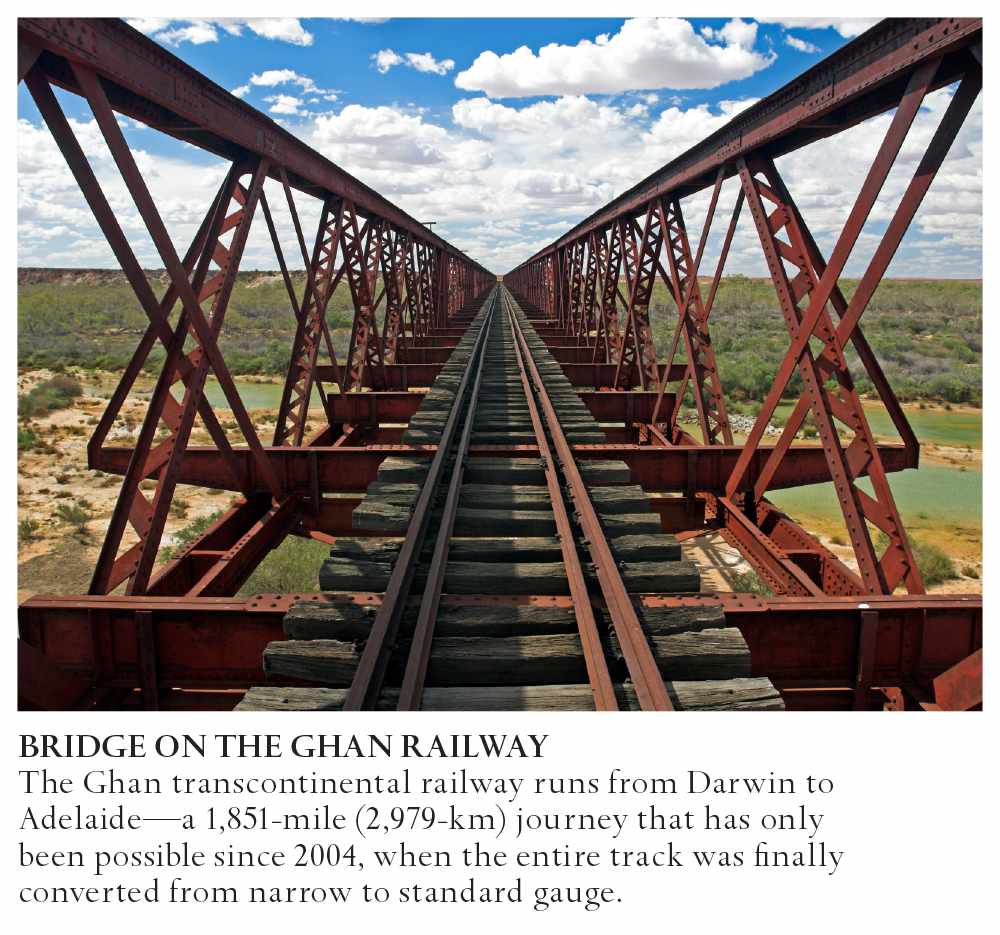
There is no doubt that the gauge “bungle” cost Australia and its railroads dearly. Changing trains is both unpopular with passengers and costly for freight. The Australian experience is in great contrast to that other vast country developed thanks to immigration—the US, where the railroads were the principal catalyst for growth. But thanks to the Australian government’s program of standardization and modernization—including the introduction of diesel trains and the closure of heavily loss-making branch lines—the railroads survived and, in places, even began to flourish, although they have never been as vital a part of the economy as in many other countries.
The experience of Australia is in sharp contrast to its neighboring country and fellow ex-British colony, New Zealand. Although the origin of the railroads was similar—the first lines were built by provincial governments, with the first one opening in 1863—central government took over in 1876. From then on, New Zealand’s railroad system was developed in an integrated manner, using just one gauge.
The government of the dominion of New Zealand deliberately expanded the railroads to provide a unifying force for the sparsely populated nation, which consists of two main islands. As the author of a history of New Zealand railroads, Neill Atkinson, put it: “since the late nineteenth century, the state used its expanding rail network to promote not just the development of agriculture, industry, forestry, and mining, but to further policies in areas as diverse as education, town planning, and recreation. Trains ferried school children to the classroom, suburban workers to factories and offices, sportspeople to competitions, and thousands of picnickers and punters to beaches, parks, and racetracks.”
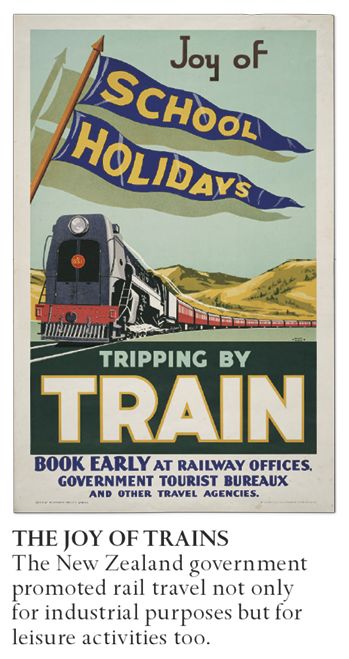
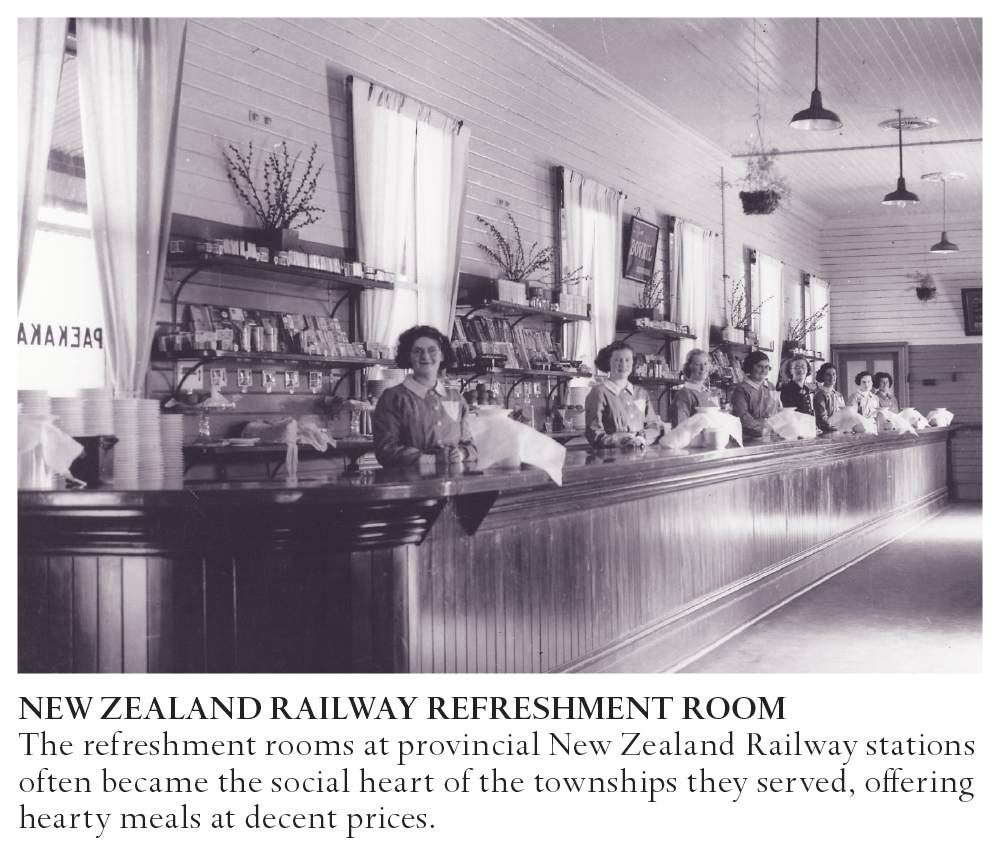
Railroad stations soon became the hub of their communities. Each station’s “Railway Refreshment Rooms,” sold appetizing, cheap food and beverages served “in the legendarily thick New Zealand Railway” cups, bowls, and plates. The railroads became an integral part of New Zealand’s economy and culture, and, by the early 1920s, more than 28 million journeys were made annually by rail in a country of a little more than one million people. The railroads were, in the words of a 1938 advertisement for New Zealand Railways, “the industry that made New Zealand—the people’s railways for the people’s profit.” The contrast with Australia could not have been greater.