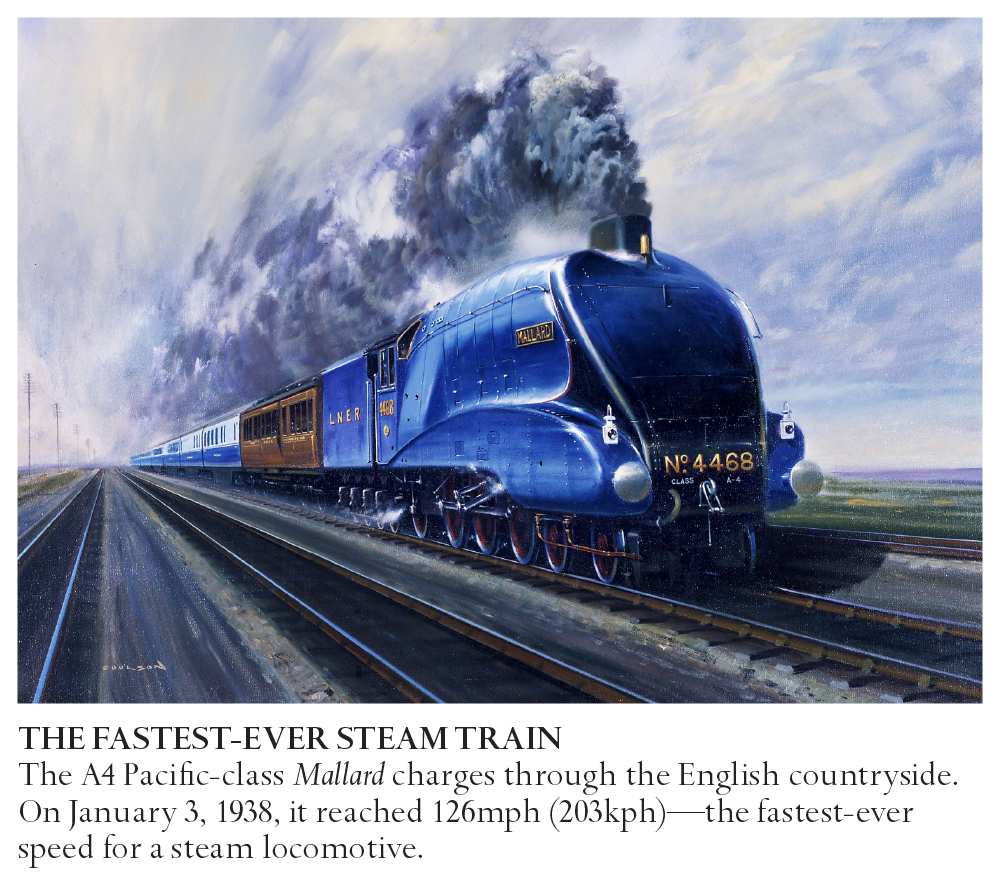
THE CRUDE “TEA KETTLES ON WHEELS” built by pioneers, such as George Stephenson in Britain and Peter Cooper in the US were transformed over the first 100 years of the railroad as steam-train technology leapt forward. The period between the world wars, in particular, saw great engineers of the time turn steam locomotives into sophisticated powerhouses.
An interesting analysis undertaken in 1889 by early “train enthusiasts” E. Foxwell and T. C. Farrer provides a comparative analysis of the speeds of trains across the world. In general, the authors were greatly disappointed by the slowness of most trains. For their research, the pair included only “expresses,” which they defined as averaging at least 29mph (46kph)—hardly speedy travel, but even so, not many qualifying trains were found. There were no such services in several major railroad nations—including India and the whole of South America—and only a few in Australia. Foxwell and Farrer found that the countries with the highest proportion of fast services were France and the Netherlands, which interestingly used mainly British locomotives. In Germany, an average of 35mph (56kph) was rare, while in Italy there was only one express—a daily service between Milan and Venice. Services in Sweden—then still a poverty-stricken agricultural country—were “poor,” but Denmark had several good trains. Hungary, meanwhile, was praised for allowing the Orient Express (see The Orient Express) to average 32mph (51kph), which was faster than in neighboring Austria. In the US, the only trains that qualified as expresses were in the east, including the best service in the world—a train that ran the 40-mile (64-km) trip between Washington, DC, and Baltimore at an average of 53mph (85kph). Otherwise, Foxwell and Farrer were disappointed at the speed of many services in the US, finding that even those with famous names, which often contained words like “Flyer,” barely qualified as express trains, averaging only around the 30-mph (48-kph) mark. The problem, they found, was that tracks in the US often had to go through the center of towns, where the trains had to travel very slowly because of potentially dangerous grade crossings.
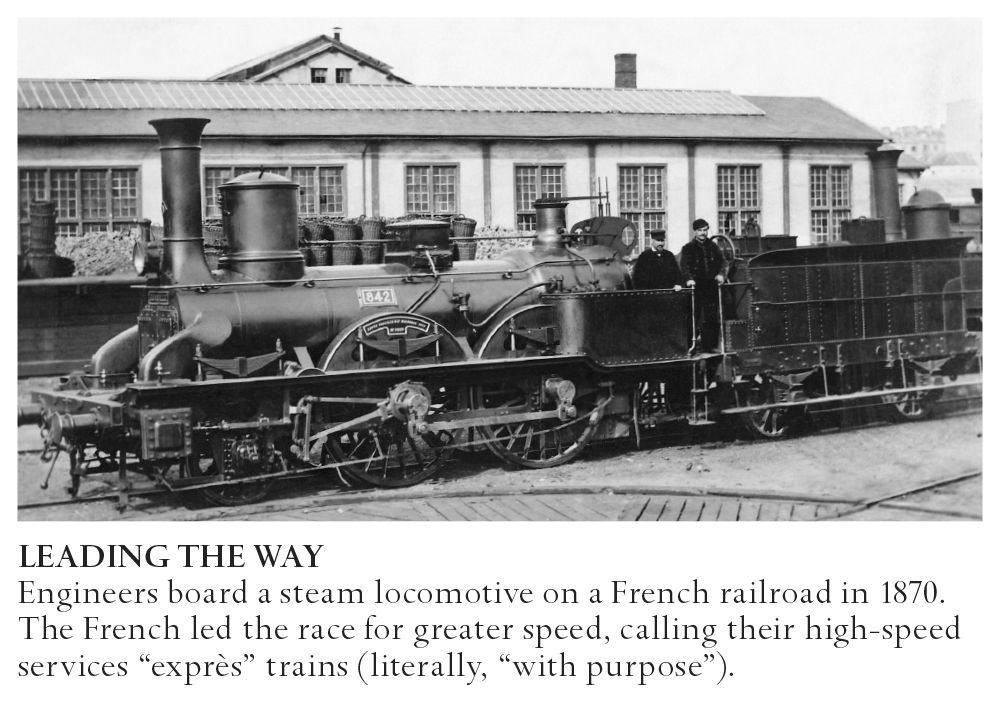
This intrepid pair of timetable-watchers returned to their task a decade later and found that considerable improvements had been made. By the start of the 20th century, France led the way with 20 daily expresses averaging at least 56mph (90kph) and a series of fast international services running from Paris that covered much of Western Europe, including Vienna and Warsaw. In Germany and Britain, too, expresses routinely averaged 50mph (80kph) or more.
Part of the reason for these increases in speed was a trend that had begun around the time of Foxwell and Farrer’s first survey—rival railroad companies would vie for the fastest journey time between two points. The first such contest took place in Britain, in a bid for the best time between London and Scotland. Two parallel lines, the East Coast and West Coast main lines, traveled between these two destinations. The companies that ran these services had a tacit agreement that journey times between London and Edinburgh would be 9 hours by the East Coast, and 10 by the longer West Coast route, which also had to contend with steeper grades. But in June 1888, the two West Coast companies—the London and North Western and the Caledonian, which together provided a joint service—announced that they would cut the extra hour from their service. A few weeks later, just ahead of the Scottish grouse-shooting season—which started on August 11 and represented a lucrative period for the London–Scotland operators—the East Coast companies (the Great Northern, the North Eastern, and the North British) retaliated. They cut half an hour from their timetable by limiting stopping times, reducing the journey time to 8 hours and 30 minutes.
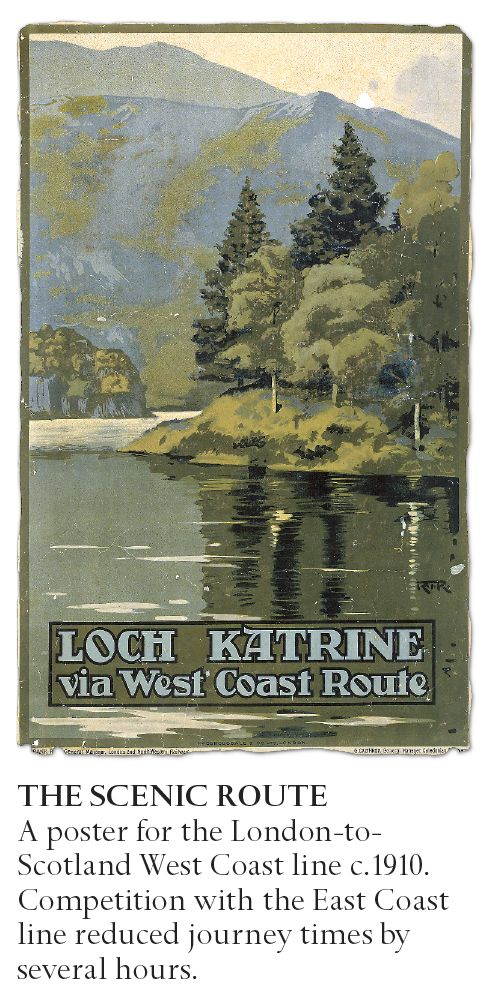
The North Western (the main company on the West Coast route) responded quickly, vowing to slash the journey time to 8 hours—a full 20 percent reduction on its previous 10-hour schedule. The East Coast companies hit back in this dramatic game of poker, promising a journey time of 7 hours and 45 minutes. As the battle reached its height, people gathered at the point of departure to see off the rival trains, and their performance was reported in the manner of weekend football games. Tower operators along the routes took special care not to slow down these prestigious trains, and teams of workers ensured that the tracks were up to standard. Eventually, the East Coast companies peaked with a run of just 7 hours and 30 minutes later that summer, but the contest concluded soon after as the rivals came to agree on a standard journey time at 8 hours and 30 minutes.
Seven years later, in the summer of 1895—following the completion of the Forth Bridge, which greatly reduced journey times to the north of Scotland—an even fiercer and ultimately more dangerous race broke out. This time the trains ran by night, and the “race course” was extended to Aberdeen—over 500 miles (800km) from London by rail, and about 100 miles (160km) further than Edinburgh, the previous terminus. For added excitement, the trains from the two rival lines were forced to share the final section of track after the Kinnaber junction, 38 miles (61km) south of Aberdeen. The first train to reach this point was the clear winner. The contest lasted for 17 days in August 1895 and attracted huge crowds at the departure and arrival points. Rival companies engaged in various underhand methods, such as not stopping at intermediate points, traveling with just two or three cars to keep the weight down, and simply ignoring the timetable altogether. By the end, the times were incredible, with the East Coast service a mere 8 hours and 40 minutes. The West Coast companies finally managed to beat this by 8 minutes with an average speed of 63mph (101kph). However, the affluent passengers arriving for the season’s grouse shooting did not welcome being turned out of their comfortable cars at Aberdeen at 5am, rather than 7am, which had been perfectly timed for breakfast.
Concerns over safety and cost caused the contest to peter out. Furthermore, the following summer a major disaster occurred at Preston on the West Coast line due to excessive speed. An inexperienced engineer failed to slow the train as it passed through the station, where a curve demanded a speed restriction of 10mph (16kph). Unlike most trains passing through Preston, the service was scheduled to run through without stopping, and the train jumped the tracks at 45mph (72kph). There was only one fatality, but the accident alerted passengers and the railroad companies to the risks of focusing purely on speed.
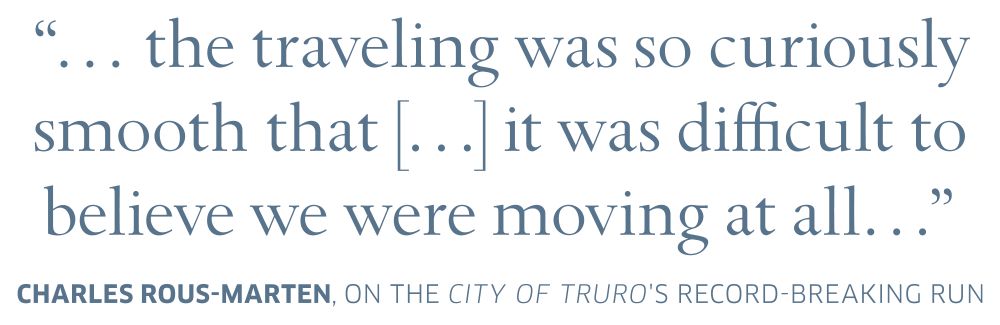
By 1900, the Great Western Railway (GWR), the biggest of the British companies in terms of mileage, was leading the race for speed. In 1904, one of its new locomotives, City of Truro, was clocked at 102mph (164kph) on a downhill stretch in Somerset. Although the exact speed is disputed, it is generally considered one of the first times in the world that the 100mph (160kph) barrier was breached. This occurred during a campaign by GWR to establish itself as the premier railroad company in Britain. The company’s ambition led to competition with the London and South Western (LSWR) company over traffic from liners sailing to and from the US. Transatlantic ocean liners had traditionally docked at the English port of Southampton, with passengers then traveling onward to London by train. However, to save time, since travel by land is so much faster than by sea, ships also began docking at the port of Plymouth—over 150 miles (240km) west of Southampton. Though further from London, passengers could rapidly cover the remaining distance by train, shaving nearly a day off the total journey. The LSWR had traditionally served Plymouth, but now the GWR also wanted a slice of the action. A full-scale war broke out as rival companies ran trains with no particular timetable, simply picking up passengers from ships as they arrived and steaming to London as quickly as possible. This was to have tragic consequences on June 30, when a special service that had left Plymouth just before midnight attempted to travel through the city of Salisbury at more than twice the 30mph (48kph) speed restriction and came off the rails. Of the 43 passengers on board, 24 were killed. While these special services were later run with more care, the race between the two companies continued until 1910.
In the US, the race for the fastest time between New York and Chicago lasted many years. It had begun in 1887, when the Pennsylvania Railroad introduced the Pennsylvania Limited—an all-Pullman affair boasting a barber’s shop, valet, and maid service. Two years later the New York Central Railroad responded with a train that covered the 436 miles (701km) between New York and Buffalo in 7 hours, at an average speed of 61mph (98kph). Then in 1902, the Central hit back with the launch of the Twentieth Century Limited express train, which covered the near-1,000-mile (1,600-km) distance between New York and Chicago in 20 hours—a reduction of 4 hours on the usual time. In response, the “Pennsy,” as it was known, renamed the Pennsylvania Limited the Pennsylvania Special, and managed to complete the journey in the same time as its Central rival. A battle ensued, with each company repeatedly trying to reduce the journey time in a series of much-publicized initiatives. However, these grand contests proved too costly for both companies, and eventually a gentlemen’s agreement of a 20-hour journey time was reached.
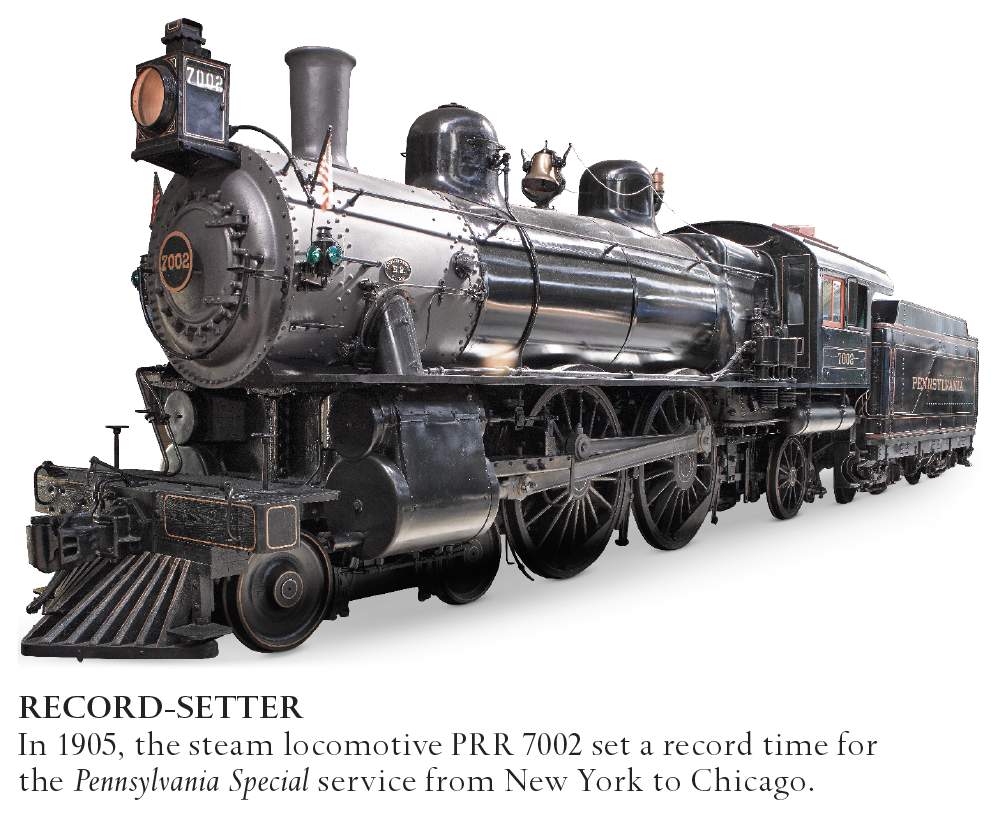
Train races of this kind largely died down until the 1930s, when they were revived as a last-gasp attempt to help steam technology see off competition from rival methods of traction. Steam engines had improved remarkably between the wars thanks to several illustrious engineers. The greatest of these was Frenchman André Chapelon, whose rigorous scientific analysis and emphasis on efficiency were widely imitated, leading to radical improvements in locomotive performance. In Britain, a contest broke out in 1937 between the two consolidated companies—Britain’s many companies had been merged into just four in 1923—serving the Scottish route. William Stanier, chief engineer at the London, Midland, and Scottish (LMS), built the Princess Coronation class of high-speed locomotives, which are widely recognized as the best British locomotives ever produced. On a specially arranged press trip, the first engine of the class reached 114mph (183kph), a speed that was intended to better the effort of its rival, the London and North Eastern Railway’s (LNER) streamlined A4 Pacifics. The LNER claimed that an A4 had reached 113mph (181kph), but when the company learned the record had been beaten, it planned a record run in great secrecy. This was eventually undertaken in 1938 when Mallard, a streamlined A4, reached 126⅞mph (202.6kph) in a specially organized run on a straight piece of downhill track south of Grantham. This record for steam locomotives would never be surpassed, although a German Class 05 locomotive had come close two years earlier when it reached 124½mph (200.4kph) between Hamburg and Berlin. In the US, the use of high-speed diesels (see Electricity Lightens the Load) on prestigious routes spelled the end of steam, and, by the 1970s, steam power in continental Europe had mostly been displaced by large-scale electrification.