
STEAM ENGINES WERE DIRTY BEASTS—difficult to maintain, temperamental, and inefficient—so a search for alternatives started early. Experiments with electric traction led the way, but once the internal combustion engine had been invented, attempts to apply it on the railroads were bound to follow. The first internal combustion engines tried out on trains were fueled by gasoline, but it did not prove efficient and was expensive, especially for large engines.
German engineer Rudolf Diesel invented and patented the eponymous Diesel engine in 1892. Instead of a spark plug, it used air heated by high compression to ignite the fuel. Two main types of diesel engine are now in use: one provides power directly; the other, the diesel-electric, uses a diesel engine to power a generator, which then provides electricity for propulsion. Both have been used extensively.
Following Diesel’s invention, experiments with locomotives began almost at once. However, there were numerous technical obstacles to overcome before they could be put into practical use, and, apart from a few appearing on a small Swedish railroad, diesel engines were not introduced until after World War I.
Efforts to build functional diesel locomotives continued through the 1920s. Despite some success on the US and Canadian railroads, the real pioneer was Germany, which began experimenting with powerful diesel engines for rail propulsion. The result was a two-car unit called the Fliegende Hamburger (“Flying Hamburger”), which represented a considerable advance for rail technology in both speed and efficiency. The Germans had, in fact, already established the world’s rail speed record with a bizarre-looking four-wheel coach powered by a gasoline aircraft engine with an airplane-type propeller at the back. It was built by BMW and reached 143mph (230kph) on a test run in June 1931, but a host of technical difficulties ensured it never saw regular service.
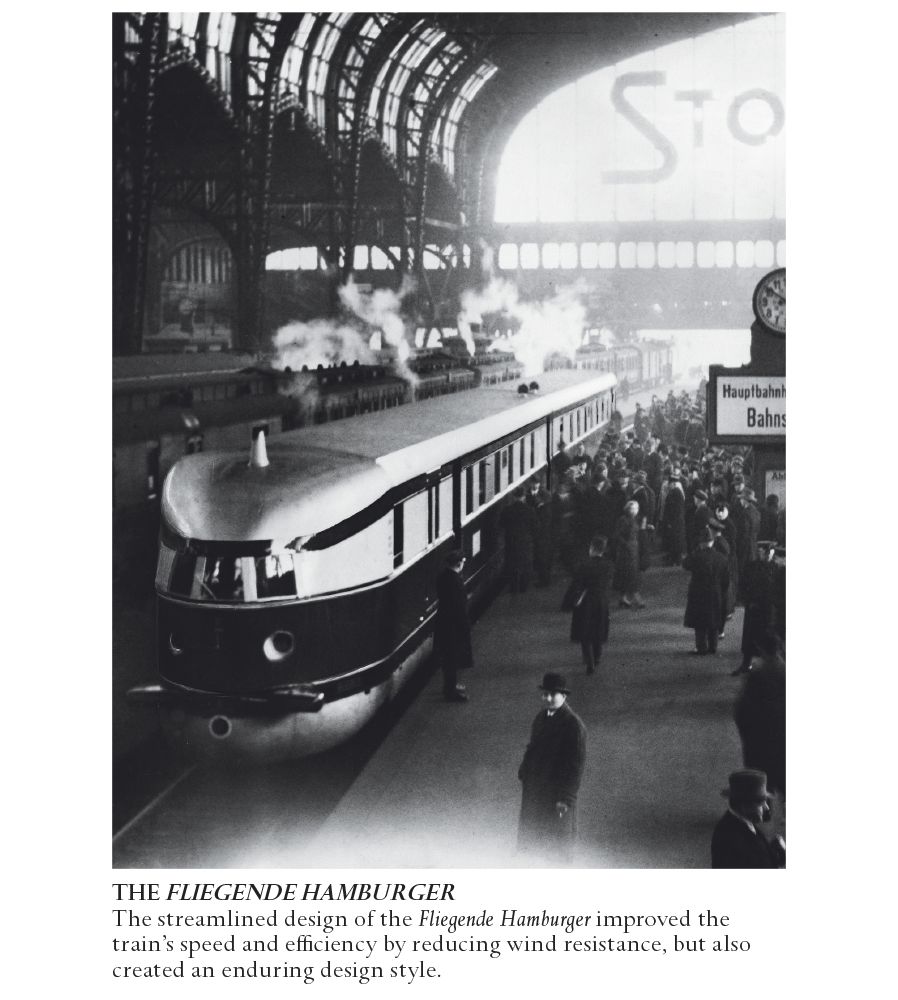
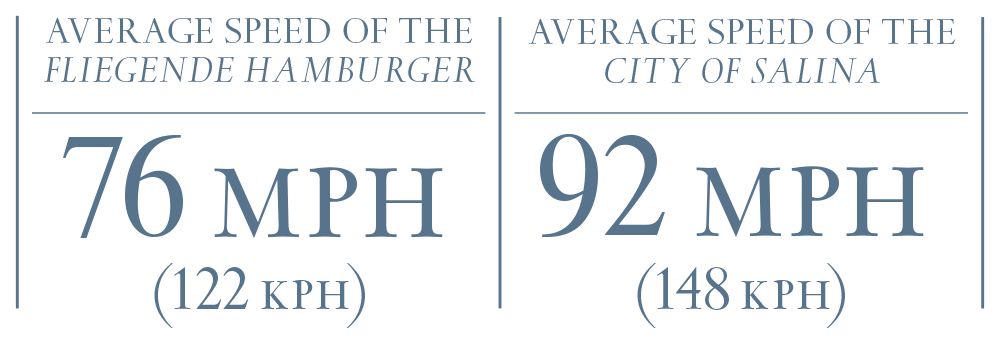
By contrast, the Fliegende Hamburger did become a widely used model on several routes, first going into service under this name in the winter of 1932–33. It covered the 178 miles (286km) between Berlin and Hamburg in 2 hours and 20 minutes—an average speed of 76mph (122kph)—which required cruising speeds of around 100mph (160kph) to maintain the timetable, making it by far the fastest rail service in the world. The train had a remarkable streamlined design, like a Zeppelin airship, the result of wind-resistance tests in a wind tunnel. Although Hitler preferred automobiles, which he saw as the transportation of the future, the Fliegende Hamburger became part of his propaganda exercise to show the superiority of the “Thousand-Year Reich.” The success of the Fliegende Hamburger soon led to the design being used on other services: two years later, a similar service was introduced on the Berlin–Cologne route, with an average speed of 82mph (132kph), and a Fliegende Frankfurter (“Flying Frankfurter”) service followed. These diesel trains represented a radical technological development, but were laid up in World War II because of fuel shortages and only saw service again briefly after the war.
It was in the United States that diesel technology was developed more widely and successfully than elsewhere. Its development took place against the background of a need to compete in a nation where automobiles and later planes were eroding rail’s market share. The US railroad companies had been taken over by the government during World War I because of their incompetence and refusal to cooperate with one another. They emerged from state control eager to improve what they offered, by using prestigious trains such as the Pennsylvania Special and Twentieth Century Limited as their trademark services.
By the late 1920s, however, these services had begun to seem slow, and their proprietors were desperately seeking a new technology to speed the trains up. This was particularly true for the railroad companies whose services crossed the vast swathes of the West. With car use still not widespread and aviation in its infancy (both the Model T Ford, the first affordable American automobile, and the first commercial domestic flight, between Boston and New York, were launched in 1927) and planes still posing a safety risk, the railroad companies began to look to diesel as the answer to their problems.
These new diesel trains were a different kind of train to the steam-hauled services. Consisting of perhaps half a dozen or eight cars, they were exclusively for passengers and provided a high degree of comfort. They were built of light stainless steel and alloys, which made them look sleek—especially compared to the heavy, conventional steam trains—and they ran fast between major cities, with limited stops to improve journey times.
While some diesel locomotives had already been introduced by various US railroads, these were confined to switching service since the powerful diesel engines were thought too heavy to be economical compared with traditional steam. Gasoline engines continued to be tried on some trains, such as the three-car Blue Bird trains of the Chicago Great Western Railroad that ran between the Twin Cities (St. Paul and Minneapolis) and Rochester, Minnesota—but again, they were simply too expensive to operate.
A key technical breakthrough for diesel engines was made by General Motors, the automobile company, which used alloys rather than steel to give a better power-to-weight ratio. The new, lighter engine attracted the attention of Ralph Budd, the head of the Chicago, Burlington, and Quincy Railroad—the Burlington, as it was known—at the Chicago Fair of 1932. Budd, one of the few railroad visionaries of the interwar period, realized the more powerful engine’s potential to revolutionize long-distance rail travel. After seeing the engine at the fair, he commissioned a new type of streamlined diesel locomotive whose sleek and elegant looks were an attraction in themselves. Called the Pioneer Zephyr (the name Zephyr, meaning light west wind, came from Chaucer’s Canterbury Tales, which Budd had been reading), it was launched amid much fanfare in May 1934 with a record-breaking “Dawn to Dusk Run” between Denver, Colorado, and Chicago. The 1,000-mile (1,600-km) trip was covered at an average of 78mph (126kph), remarkable by US standards and almost as good as the German diesels. However, a lot of special measures had been taken: patrol staff were placed on all 1,689 grade crossings along the route to stop car traffic well ahead of the train, and the train was limited to just three cars to reduce the weight. Famously, Budd reported that the fuel for the train was far cheaper than coal, costing a mere $14.64—although, at 4 cents per 1 gallon (3.8 liters), that meant 366 gallons (1,386 liters).
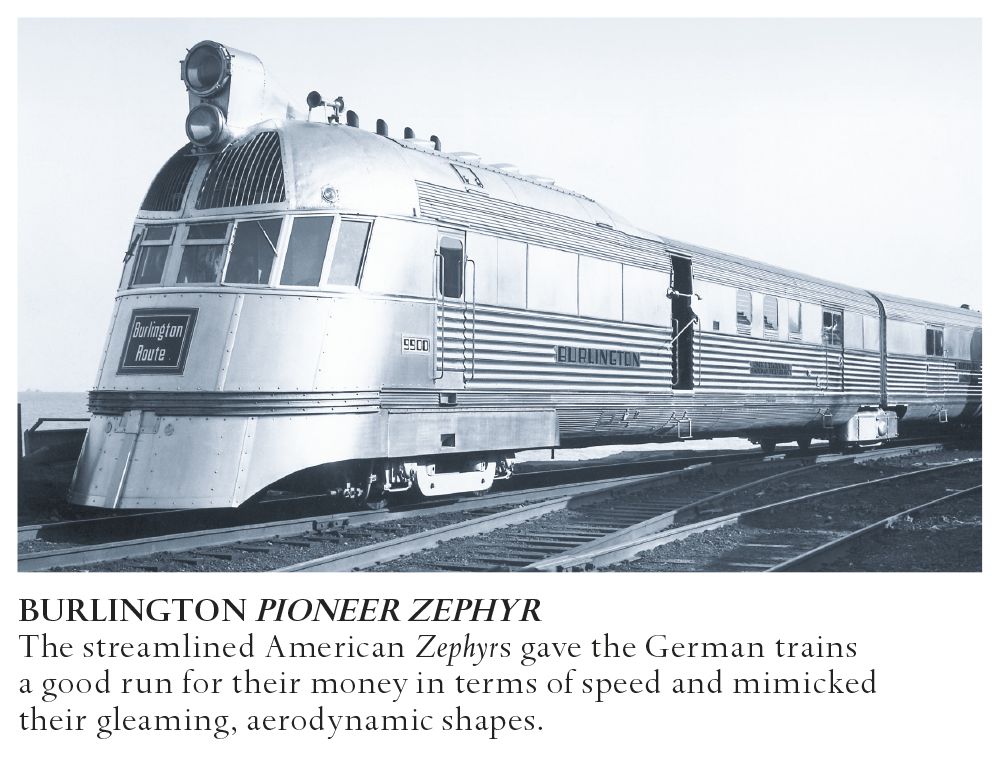
While such fast speeds could not be achieved on regular journeys, the train was far faster than any before and became the pioneer for a host of services that transformed American long-distance train travel in the years running up to World War II. A veritable family of Zephyrs and other trains sprang up on routes across the expanses of the West and along the East Coast, operated by these elegant new streamlined diesels. The Burlington, spurred on by Budd’s enthusiasm, introduced in quick succession the Twin Cities Zephyr, between the twin cities and Chicago, and the Mark Twain Zephyr to St. Louis.
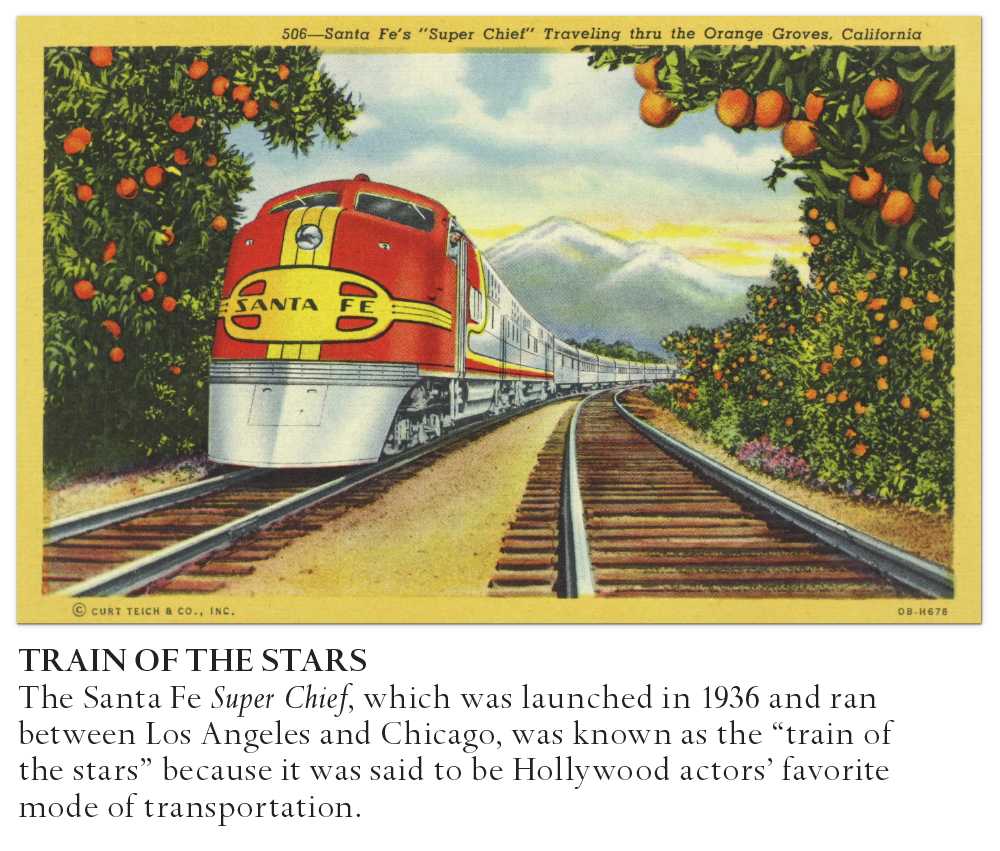
The Union Pacific’s pioneer train went on a nationwide tour in 1934 before entering active service as the Kansas Streamliner. Renamed the City of Salina in 1936, it could run at more than 90mph (145kph) for long distances, averaging a stunning 92mph (148kph) on its run across the Nebraskan plains. The pièce de résistance of the period was the record-setting coast-to-coast journey by the City of Portland, a Union Pacific six-car sleeper train, which traveled the 3,250 miles (5,230km) between New York and Los Angeles in 56 hours and 55 minutes—nearly a day faster than the regular coast-to-coast service. Moreover, the fuel cost was only $80, compared with $280 for coal. This was only a trial run, however, and a nonstop coast-to-coast service was never established as passengers had to change trains at Chicago or St. Louis.
These modern diesels later acquired observation cars and other amenities to satisfy their affluent clientele. A fabulous variety of food and drink was on offer and for a while the trains became the envy of the world, with the companies competing to provide the best facilities. These trains were the height of America’s rail system, indeed, they were probably the best the world had ever seen, but by the 1950s, as flying became safer and cheaper, they began to be phased out. Diesel remains, however, the main form of traction on US railroads to this day, with only a very small proportion of electrified railroads. Indeed, the typical image of American rail is of freight trains more than 100 cars long, being hauled by three or four powerful diesel locomotives.
Elsewhere in the world, diesels began to replace steam locomotives soon after World War II. Diesel multiple units, in particular, were a great way of saving money on branch lines. These had engines under the floor of the car, so that there was no need for a locomotive, and they could be driven from either end, obviating the need to turn around. The French even developed a rubber-tired diesel train called the Micheline, which was used extensively on minor routes.
However, electrification was often chosen over diesel. While it is initially more expensive, electric haulage is ultimately cheaper, cleaner, and offers faster acceleration. On many suburban services, steam trains were replaced directly with electric trains rather than diesels. Nevertheless, with only Switzerland operating a 100 percent electrified network, diesel remains an important form of traction, in particular for heavy freight and on little-used lines where the cost of electrification is not worthwhile. Diesel trains will be with us for a long time yet.