
CHAPTER 11

In 1879, J.P MacLean and Richard Brown, submitted the book, The Mound Builders to the Washington office of the Librarian of Congress. In the preface of this book they stated the following:
Within the last few years much interest has been developed in American archaeology, especially in that branch relating to the Mound Builders. The mystery surrounding this lost people creates a fascination, which is greatly increased in the mind of the student of nature as he lingers among the ruins, which invite his attention and rivet his eye. Standing upon one of the monuments the lover of the mysterious will lose himself in meditation, or else in imagination will behold a strange people toiling under the heat of a burning sun, or perhaps see them suffering from the effects of a winter’s wind while erecting structures devoted to such rites as are recorded in the pages of history.85
In commenting on the impressive nature of the Newark Earthworks, in his 1879 book, The Mound Builders, MacLean stated:
The most elaborate and complicated of all the works of the Mound Builders occur at the junction of the South and Raccoon Forks of Licking River, near Newark (Ohio). They are situated upon a plain elevated from thirty to fifty feet above the bottomland bordering on the stream. They consist of an extensive series of squares, circular and polygonal enclosures, with mounds, ditches and connecting avenues extending over about four miles. This wonderful series of works have not continued to remain as they were when first discovered. Some of the minor structures have been nearly obliterated and others have perhaps undergone considerable change. Fortunately very accurate surveys have been made and minute descriptions given, so that by aid of the plans something may be known of these gigantic works. In 1836 Col. Charles Whittlesey made a very accurate survey; and since then additions have been made so that it may now be said that we have the works complete.86
The University of Cincinnati produced a collection of videos available in a CD-ROM, entitled Ancient Ohio Valley, that provides an interactive, virtual journey through the Ohio Valley. Some detail is given, as part of this production, into the construction and composition of some of the Newark Earthworks mounds. There is conclusive evidence that the Mound Builders understood the properties of various types of soils and they engineered the mounds accordingly. The Great Circle, for example, is lined on the inside surface of the great circular wall with clay which is believed to serve both structural and religious purposes.87

Fig. P.I. Newark Works (Squier and Davis) 1848 Plate XXV
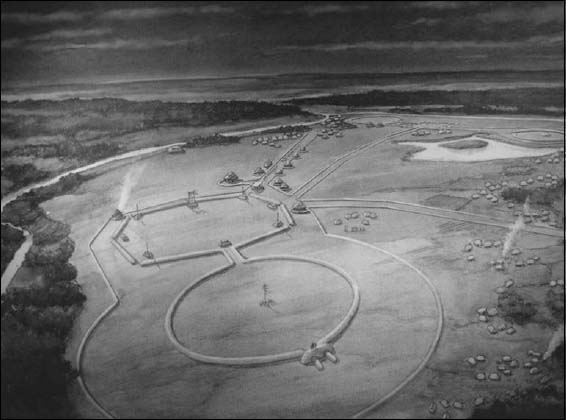
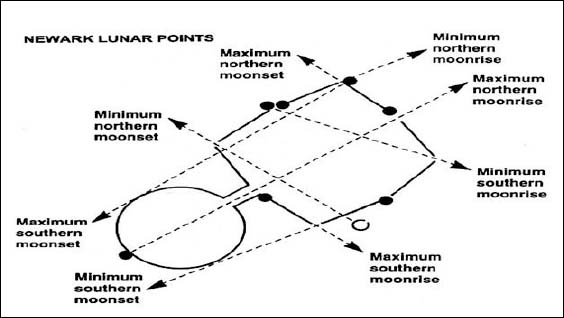
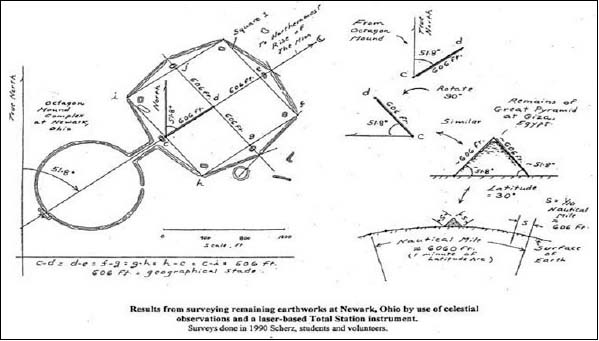
Frank Joseph described the Hopewell Ancient Newark Earthworks as a living calendar with lunar alignments.
Despite the passage of sixteen centuries, their singular greatness and impact on North American prehistory is still open to appreciation. For example, to explore the ruins…located at Newark, thirty-three miles east of Columbus (Ohio) is to experience one of the grandest miracles of ancient engineering. Its vast network of walls, mounds, and apertures is, according to achaeo-astronomers, humankind’s largest (ancient) observatory and considered to be the greatest earthwork in the world. Newark’s sacred center enfolds more than 200 square acres, including a double parallel wall running more than six miles long. The Great Circle, with its 14 foot-high embankment enclosing 20 acres, is a gargantuan proof of the Hopewell’s extraordinary powers of geometry and surveying.88
M.C. Read, Assistant Commissioner of Exposition in 1876 and 1884, and as trustee of the Ohio Archaeological Society, would publish in 1879, Archaeology of Ohio, in which he gave his assessments of these intriguing earth works: “The ancient earth works of Ohio, in their variety, magnitude and extent, excel those of all the other States. Single mounds of greater size are found elsewhere, but no other State has such a variety of these works, or such numbers of them as in Ohio.” If they truly had no beasts of burden and “no metal tools of a size or character to be of any use in their construction; that all the material must have been laboriously carried to its place in baskets, it will be obvious that the real labor expended upon some of them was not much, if any, less than that expended upon the largest pyramid of Egypt. Such works could be constructed only by a people who had a compact, civil organization, with a central authority, which could control the labor of the masses, and with dominant civil or religious ideas, which would induce the masses to submit to long-continued labor. The more extensive works peculiar to the State, indicate large, fixed communities, which involves the practice of agriculture and habits of life very different from that of the hunting tribes, roaming over the State, upon its first occupancy by the whites.”89
E. O. Randall, Secretary of the Ohio State Archaeology and History Society, commented in his 1916 book titled: The Masterpieces of the Ohio Mound Builders as to what they were finding:
… many writers and students conclude that if the Mound Builders of the territory now embraced in the United States had a central government, it must from all evidences, have been located here in the American Bottom of the Mississippi valley. Here in were found the greatest number of their largest monuments, which bear testimony to their patience and industry and long sojourn.90
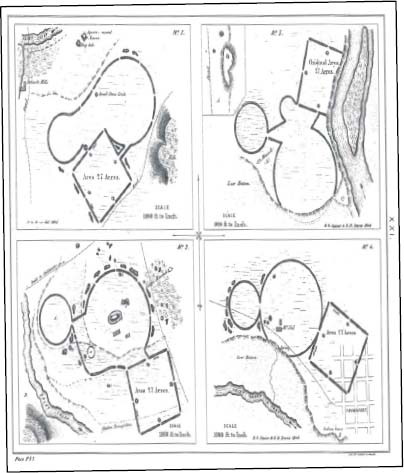
Ancient Monuments of the Mississippi Valley, 1848, Squier and Davis, Plate XXI
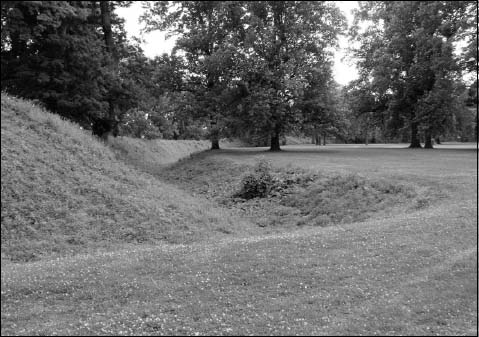
Earthwork Embankments, a Common Design
Courtesy of Wayne May, Ancient American Magazine
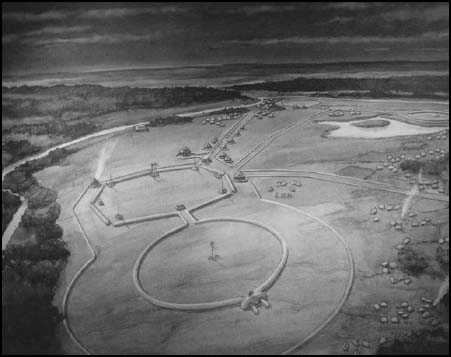
Ancient Works, Marietta, Ohio
One of the most impressive elements of these ancient Mound Builders was the vision, design, and planning that went into the selection of locations for the building of their cities and fortifications.
In January 1883, an article titled Ancient Village Architecture in America, Indian and Mound Builders’ Villages, edited by Rev. Stephen D. Peet, as shared with the American Antiquarian Society; he explored the forward thinking and planning that went into the selection of these ancient Mound Builder communities:
We would call attention to the location of the works. If we are to trace out the villages site, their location must be considered as a prominent factor, for these sites would be naturally chosen with view to the advantages of soil, situation and other circumstances. Proximity to streams, where there would be the presence of game and abundance of fish, natural barriers, such as high bluffs, or a morass, or river, or anything which would serve for defense… Such, in fact, proves to have been the case with the Mound Builder; their villages were all favorably located.91
A. J. Conant, in his book Foot Prints of Vanished Races, made this assessment as he asked some of the same questions that we are still searching for answers.
I am not aware that the opinion that the red men were the authors of the most extensive works, though maintained by some scholars of high repute, is held by any who have given them personal and thorough examination…Some of the wisest archaeologists of Europe have written learnedly upon the works and migrations of the ancient inhabitants of both continents of America. Notwithstanding all this labor and study, the great questions continually repeated, which were suggested when our antiquities were first noticed, still remain unanswered, namely: Who were the authors of these works? What was their origin, and what were the causes of their disappearance?92
E. G. Squier, in his 1851 book, Antiquities of New York, stated: “We must seek, therefore, in the connection in which these works are found, and in the character and contents of the mounds, if such there be within their walls for the secret of their origin.”93
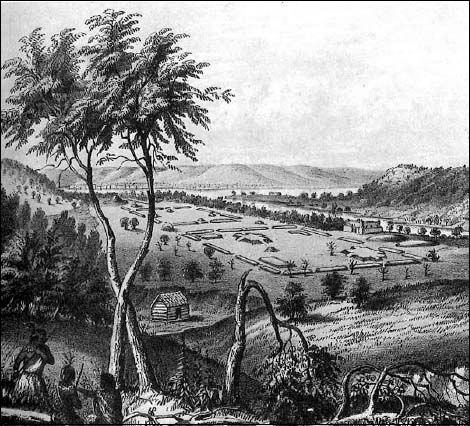
Ancient Works, Marietta Ohio, Ancient Monuments of the Mississippi Valley, 1848
In 1916, E. O. Randall pointed out that:
The Mound Builders never failed to exercise sagacious judgment in their choice of sites for habitation or the erection of their chief structures. No better place could have been found for the Cahokia and its surrounding mounds than in the upper Mississippi valley near the juncture of the Missouri from the west and the Illinois’ from the Northeast, a strategical point on the main waterways of the vast Northwest. For many miles below the mouth of the Missouri, the east side of the Mississippi broadens into a plain some eight to ten miles in width, interrupted by a line of bluffs which form its eastern boundary. This stretch of level surface composed of rich, fertile alluvial deposit is known as the ‘American Bottom.’ Several creeks cross it from its eastern limit to the Mississippi and many little lakes formerly dotted the thick growths of timber and prolific underbrush that in the early days must have clothed it…Near the center of this bottom and just south of its chief stream, the Cahokia stands to-day, as it has stood for untold centuries, the most massive and imposing monument of the Mound Builders in this country and probably in the world.94
One of the country’s earliest students of America’s antiquities was the Rev. Stephen D. Peet, who, along with Charles Atwater and Squier and Davis, observed in the 1800s the following:
The situation of the works found in Ohio at the present day would prove that village life was very common there. Squier and Davis mention that there are 1500 enclosures belonging to the Mound Builders in the State alone. In the valley of Paint Creek there are five enclosures in six miles. In the valley of the Miami there are seven enclosures in the same distance. These enclosures are all alike in their situation, and in form and character, and it is probable, from the location alone, that they were the enclosures, which contained the villages of the Mound Builders. The situation of Newark is remarkable in this respect. Surrounded by an amphitheater of hills, which of themselves furnish a natural defense, and in the midst of an extensive, rich and level plain, where the soil was susceptible of easy cultivation, with two streams flowing around their works, and an extensive pond of water in the midst of the enclosure, they show that the spot was chosen for its advantages to village life. In the opinion of Mr. Atwater, who was familiar with them when they were undisturbed, they mark the site of an ancient village. The large works were used as military defenses, and the parallel walls were intended for the double purpose of protecting persons in times of danger while passing from one work to another, and of fences with a very few gates, to fence in and enclose their fields. Watch-towers were placed at the ends of the parallel walls and along the line…Mr. Atwater is of the opinion that the parallel wall which extends to the west connected them with other villages, thirty miles away.95
It has been asserted that within the state of Ohio, is found the largest concentration of constructed masterpieces of the Mound Builders. Randall stated:
Ohio was the great “State” in prehistoric times, for over twelve thousand places in the present state-limits have been found and noted, where the Mound Builder left his testimonial. These enclosures on the hill tops, the plain or river bottoms, walled-in areas, each embracing from one to three hundred acres in space, enclosures presenting a variety in design, size and method of construction, unequaled elsewhere, exceed fifteen hundred in number, while thousands of single mounds of varying circumference and height were scattered over the central and southwestern part of the state…it has been estimated that the ‘earthly productions’ of their labor, now standing in Ohio, if placed side by side in a continuous line, would extend over three hundred miles or farther than from Lake Erie to the Ohio and that they contain at least thirty million cubic yards of earth or stone, and that it would require one thousand men, each man working three hundred days in a year and carrying one wagon load of material the required distance a century to complete these artificial formations.96
The map shown below is an archaeological map of Ohio, published in 1914. The darkened dots show locations of archeological sites; earthwork structures, mounds, and enclosures of the Mound Builders, which is estimated to be in the thousands in Ohio alone. For more information on specific locations, go to www.ohiomounds.com.

Archeological Site in Ohio dated, 1914 showing distributions of earthworks (Small black dots mark the recorded sites)
The darkened dots along the rivers of America’s heartland show the concentration and magnitude of the number of earthworks, mounds and enclosures identified. This map is patterned after the map prepared by Cyrus Gordon for the Bureau of Ethnology.
Some of the wisest archaeologists of Europe have written learnedly upon the works and migrations of the ancient inhabitants of both continents of America. Notwithstanding all this labor and study, the great questions continually repeated, which were suggested when our antiquities were first noticed, still remain unanswered; namely: Who were the authors of these works? What was their origin, and what were the causes of their disappearance?97
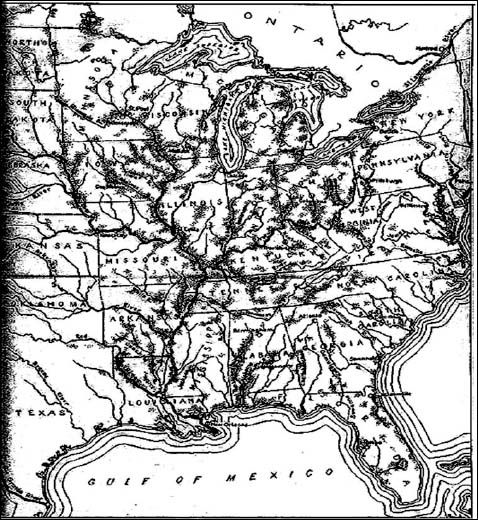
Small black dots show distribution of ancient works along the major waterways of Americas
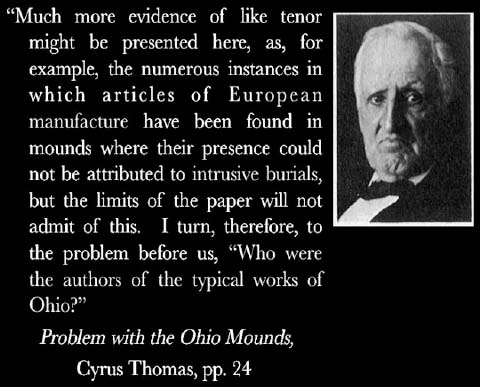
Squier’s reports raised as many questions as they answered about the origins of the ancient monuments found in America’s heartland. The fledgling Bureau of Ethnology, founded by Powell in 1879, was given the task of helping to clarify and interpret the Squier and Davis findings. Under Powell as director of the department, there began to be questions about the findings of Squier and Davis, along with other prominent studies that had explored the origins of these ancient mound-building cultures. The defining moment came years later when the Bureau took a decisive new direction. In a presentation given by Cyrus Thomas to the Smithsonian Bureau of Ethnology in 1894, he was overtly critical of the Squier and Davis work. Led by Thomas, the Bureau went on to question the idea of the diffusion of foreign cultures in the Americas prior to Columbus. From that time forward until today there have been few, if any, government funded, in-depth studies conducted on the mound-building cultures and their origins. There is also a lack of thorough explorations of the mounds, with controls put in place, greatly restricting any access to sites and artifacts. With little to no government funding available for independent research, much of what we know about these people stems from only a handful of early studies and reports conducted in the mid-1800s.
Although there has been little exploration and research into the origin of the Mound Builders since the early 1900s, there still remains a broad interest as to how these ancient ruins of immense complexity were originally constructed. Private museums and organizations have expended effort and funds researching the handful of early publications, which has helped keep interest alive in the antiquities of North America. Many today continue to wonder if there is still more to be learned about these ancient cultures and whether what we learn could have implications for our day.
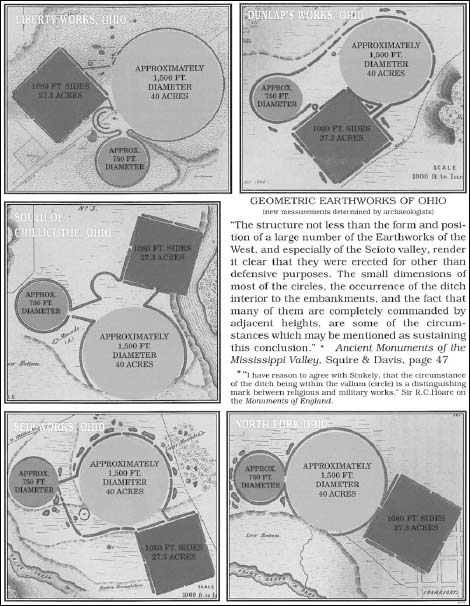
Recurring Design-Evidence of the Existence of a Centralized Government Provided by Ancient American Magazine
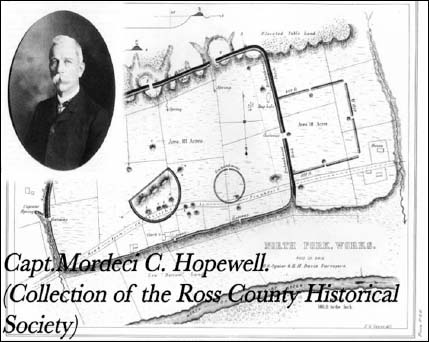
As our production team reviewed the surveys of Squier and Davis, we noticed that many of the giant earthwork structures of the Hopewell had a recurring design--a large circle and a giant square often interconnected. These recurring design features, along with other common patterns, were found at many locations stretching over America’s heartland. Such commonality of design raised the question about the existence of a centralized government, which would at one time have directed the effort and design of the many similar structures throughout the domain of the Hopewell. The Hopewell culture received its name from Capt. Mordeci C. Hopewell, a farmer whose land was located on the North Fork of Ohio’s Paint Creek, located in Ross County, Ohio. His farm had on it some of the first-to-be-excavated mounds.
These mysterious Hopewell people who built mounds, earthwork structures, and ceremonial sites were possessed of a rich and high culture. Large communities were established from the Great Lakes to the Gulf of Mexico and from the Mississippi River to the Appalachian Mountains. Archaeological findings indicate that some of these mound communities were occupied by a number of different types of societies at different times, ranging from mobile hunter-gatherers to sedentary farmers.
The wide variety of these prehistoric mounds took on many forms and fulfilled a range of functions. Many served as burial mounds, fortifications and individual or collective funerary monuments. Others were ceremonial temple mounds and platforms for religious worship. Burial mounds were very common during the Middle Woodland period (about 100 BCE- 400 CE), while temple mounds predominated during the Mississippian period, which showed inhabitants in some of these communities as late as 1200 CE.
During the Woodland period (c. 500 BCE-1000 CE) domestic native agricultural plants (sunflower, goosefoot, corn, erect knot weed, and may grass) were harvested and increased population density, which resulted in more sedentary settlements.
The Middle Woodland period (c. 200 BCE-400 CE) saw the construction of elaborate earthworks from the Great Lakes to the Gulf Coast. Large, mainly dome-shaped mounds appeared throughout the Ohio and Tennessee River valleys, some in the form of animal effigies. The Hopewell culture, centered in Ohio and Illinois, constructed giant earthen geometric enclosures in defined areas ranging from 2.5 to 120 acres with some mounds reaching over 65 ft. in height. Artifacts of mica, ceramic, shell, pipestone, and other material were traded over a vast area, indicating the growth of a central government system with evidence of widely shared religious beliefs. From the building of fortifications, the conclusion can be drawn that they were not politically unified. Analysis of mortuary remains suggests Middle and Late Woodland communities were characterized by a system of social rank. Particular kin groups are believed to have had high social prestige, differential access to rare commodities, and control over positions of political leadership.
Agricultural advancements spread throughout the eastern heartland region of America, as populations expanded and they became increasingly sedentary. Just outside of St. Louis at Cahokia, Illinois is located one of the largest earthworks in North America, a giant temple mound measuring over 100 ft. high and 975 ft. long. These large ceremonial centers with temple mounds appeared throughout the river valleys of America’s heartland. These mound structures were found to have many distinctive artifacts, such as elaborate ceremonial copper axes, breastplates, carvings and other tools.98
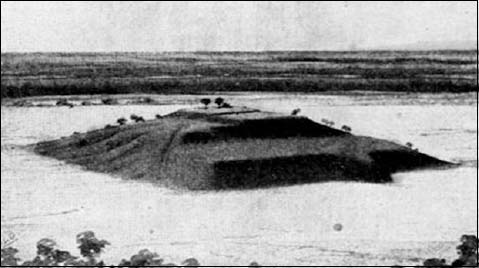
Cahokia Mound as originally appearing
Associated artifacts that were found in these giant mounds and earthworks were often found in burial cribs. These “associated artifacts came in many categories: shell beads, pearl beads, animal canine pendants, projectile points of exotic or selected cherts, stone and copper ear spools, copper ‘breast’ plates and headdresses, copper axes and adzes, stone pipes, copper, silver and even iron ‘pan flutes,’ and so on. Much of this varied array of raw materials was procured or derived from distant regions: obsidian from northern Ontario, mica and galena from the Appalachians, local freshwater pearls, exotic flints from various regions, including the well-known Flint Ridge quarries south east of Newark, (Ohio), ocean shells from the southeastern Florida and Gulf coasts…Both exotic resources and stylistic parallels in artifacts and mortuary treatment used by archaeologists to link the Ohio Hopewell sites to mound sites in many parts of the Eastern Woodlands: southern Ontario, Indiana, Illinois, Missouri, New York, Tennessee, Florida, Louisiana, and so on.”99
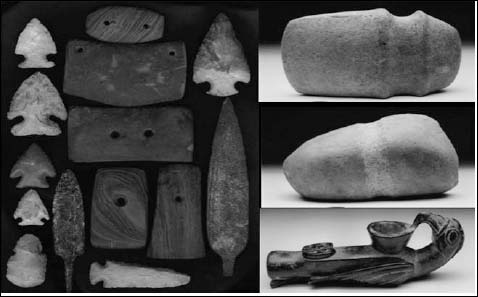
In The Indian Mounds of the Middle Ohio Valley, Susan L. Woodward and Jerry N. McDonald give a guided tour of over seventy sites in Indiana, Kentucky, Ohio and West Virginia. These were but a small sampling of the tens of thousands of mound and earthwork structures that once dotted the landscape of America. In the preface to their book they state: “We hope this book will help increase public awareness of the significance of prehistoric cultural resources and the record of human experience and of the present management strategies and patterns and their future prospects.”100
Indian Mounds of the Middle Ohio Valley, along with other books, provides a guide to the remains of these mounds, embankments, earthwork structures and fortifications. They constitute a tangible imprint of a people who were forward thinking and innovative. Of their investigations Woodward and McDonald stated:
The Adena and Ohio Hopewell were the premier builders of distinctive and sometimes truly impressive mounds, geometric earthworks, and hilltop enclosures within the middle Ohio Valley. The later Fort Ancient people and some of their contemporaries, too, built mounds, although typically these were lower, less complex, and less numerous than those of the Adena and Hopewell. Recent investigations have shown that Fort Ancient people probably built Ohio’s two unequivocal zoomorphic effigy mounds. Taken as a whole, the prehistoric mounds and earthworks of the middle Ohio Valley are masterpieces; their number, size, precision and grace, and the magnitude of the organizational and managerial effort that was marshaled to build them, required that these architectural monuments be ranked among the important pre-historic engineering-and artistic-accomplishments of mankind. They are important elements of the North American cultural landscape.101
“The most elaborate and complicated of all the works of the Mound Builders …occur near Newark…situated upon a plain elevated from thirty to fifty feet above the bottomland bordering on the stream. They consist of an extensive series of squares, circular and polygonal enclosures, with mounds, ditches and connecting avenues…This wonderful series of works have not continued to remain as they were when first discovered…Fortunately very accurate surveys have been made and minute descriptions given, so that by aid of the plans something may be known of these gigantic works.102
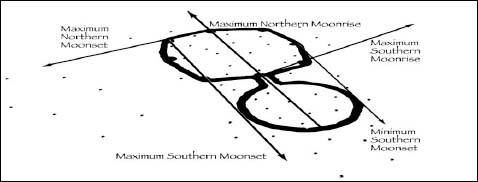
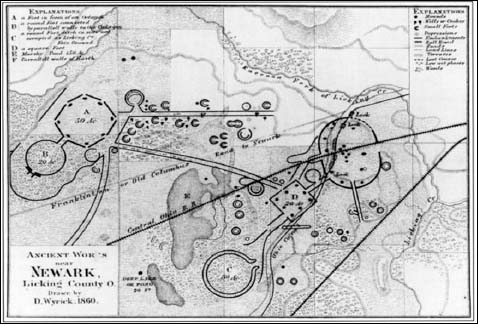
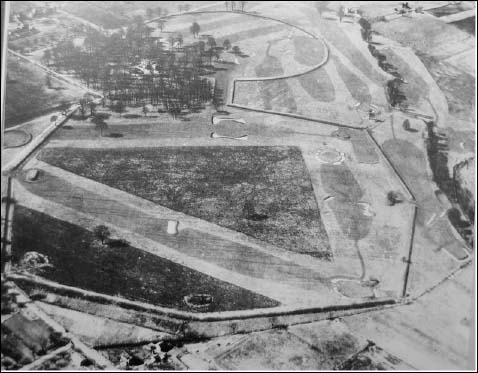
Newark Earthworks preserved as part of a golf course
_______________________
85 J. P. Maclean, The Mound Builders, (Cincinnati: Robert Clarke & Co., 1879; reprinted Colfax, WI: Hayriver Press, 2005) Preface
86 Ibid. 32
87 J. E. Hancock, Center for the Electronic Reconstruction of Historical and Archaeological Sites, College of Design Architecture Art and Planning, University of Cincinnati, Cincinnati, Ancient Ohio Valley, CD-ROM, www.earthworks.uc.edu.
88 Joseph, 86.
89 M. C. Read, Archaeology of Ohio, (Cleveland, OH: The Western Reserve Historical Society, 1879; reprinted Colfax, WI: Hayriver Press, 2005) 79.
90 See: E. O. Randall, The Masterpieces of the Ohio Mound Builders, (Columbus, OH: Ohio State Archaeological and Historical Society, 1916) 8.
91 Stephen D. Peet Ed., The American Antiquarian and Oriental Journal Vol. V No. 1, (Chicago: Jameson & Morse, 1883) 26.
92 Conant, Foot Prints of Vanished Races, (1879) Preface, iv
93 E. G. Squier, Antiquities of New York (1851), 305
94 Randall, (1916) 2-5.
95 Peet, 28-29.
96 Randall, 16-17.
97 Conant, Foot Prints of Vanished Races, (1879) Preface, iv.
98 See Artifacts found: Cyrus Thomas, Report on the Mound Explorations of the Bureau of Ethnology 1894, R. Silverberg, The Mound Builders of Ancient America (1968); W. Morgan, Prehistoric Architecture in the Eastern United States (1980); B. Fagan, Ancient North America (1991); G. R. Milner, The Moundbuilders (2004).
99 A. Martin Byers, The Ohio Hopewell Episode (Akron: University of Akron Press, 2004) 4.
100 Susan L. Woodward and Jerry N. McDonald, Indian Mounds of the Middle Ohio Valley, (Blacksburg, VA: McDonald & Woodward Publishing Co., 2002) viii.
101 Ibid. 4.
102 Ibid., 32.