
CHAPTER 12

In January 2011, in an article published in the National Geographic magazine about Cahokia, an ancient mound city found in Missouri, Glenn Hodges states, “The idea that American Indians could have built something resembling a city was so foreign to European settlers that when they encountered the mounds of Cahokia--the largest of which is a ten-story earthen colossus composed of more than 22 million cubic feet of soil—they commonly thought they must have been the work of a foreign civilization; Phoenicians or Vikings or perhaps a lost tribe of Israel.”103
With so many questions still being raised as to the history and origin of the Mound Builders, is a closer look at the ancient mound-building cultures warranted? In Abraham Lincoln’s second address to Congress, he spoke of the land which had nurtured him, looking backward to its antiquity and forward to what might be brought forth Lincoln said, “It is the great body of the republic, the other parts are but marginal boarders to it…we shall be overwhelmed by the magnitude of the prospect presented by this Egypt of the West.”104
What did the early American leaders know about these ancient cultures? Did Lincoln, Jefferson and others know about these ancient monuments that were being discovered in the thickets and fertile river valleys of the then western frontier? Was society denied the great prospects of what could have been brought forth? “Jefferson did urge that the American Antiquarian Society exert itself so that ‘the monuments of the character and condition of the people who preceded us in the occupation of this great country will be rescued from oblivion before they will have entirely disappeared.”105
Dr. Roger Kennedy, affirming the same, stated: “They have not quite all disappeared. The clues are still there towards an answer to the great questions: Why did the American Indians build their earthen architectures?”106
In looking back to America’s antiquities, could current Indian communities and all of society benefit from what could be learned? Leaders of early America were becoming increasingly aware of the artifacts and remains uncovered in the ancient cities of North America. Were these artifacts and tens of thousands of mounds providing tangible evidence of a once-advanced civilization?
Following an introduction and screening of the documentary, The Lost Civilizations of North America, I had a conversation with a woman who identified herself of Indian descent. To paraphrase her comments on this topic, she referenced the fact that the Indian people have been led to believe that they are a people without a history. In fact, their ancient history has been labeled pre-history, as if there is no written history or evidence of their people’s existence. She commented that for the sake of her children, they needed to gain a greater appreciation and knowledge of their identity, heritage and the richness of their history.
A supposition that has been made, by some archeologists is the inference that if a Diffusionist position is taken, claiming that other cultures made it to the shores of North America, providing the knowledge needed to engineer and build the massive earthwork structures, that were found in America’s heartland, that such a claim would deny the American Indian their just credit for these cultural achievements. That is simply not the case; for what it could infer is that the American Indian may be a descendant of these ancient builders and explorers who made it to the shores of the Americas. In fact, what one comes to realize is that what has been denied to the Indians is their ancestral history, the knowledge that they could have indeed been related to ancient travelers as some DNA findings are now showing.
Most of the more in-depth studies and surveys of the mounds were completed in the mid-to-late 1800s, at a time when archeology was only in its infancy. That raises the question as to whether or not there has ever been enough independent research looking into the ancient Mound Builders. Research that would be considered credible enough to make any final determinations about the peopling of North America, especially studies done devoid of political, race and religious prejudices, is begging the question of why there have been so few explorations into the mounds over the last hundred years. After all, couldn’t society gain greater insights into the human experience of these ancient cultures by further exploring the remaining antiquities of these monuments of the Mound Builders?
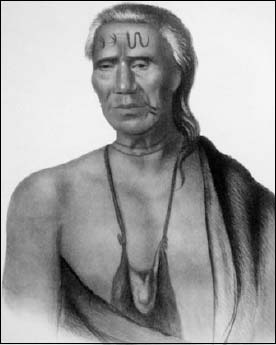
A 1735 portrait of Lapowina, a Delaware chief who signed the “Walking Purchase Treaty”
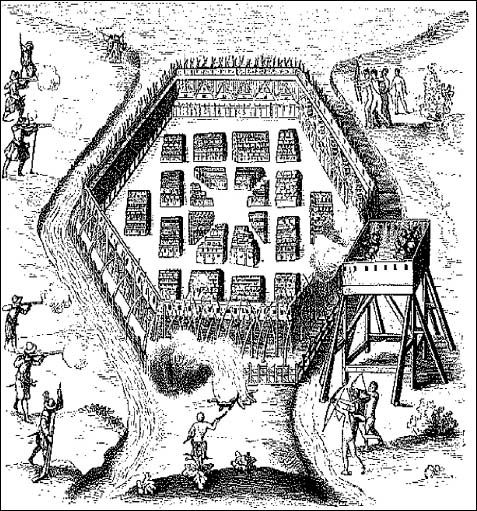
This 17th- century engraving of a French attack on s Onondaga, Iroquois Village.
This engraving is considered as one the most reliable illustration of an Iroquois settlement of the 1700’s.
_______________________
103 Glenn Hodges, “America’s Forgotten City”, National Geographic Magazine January 2011: 126-146
104 Kennedy, 243.
105 See: Jefferson to Isaiah Thomas and the American Antiquarian Society, October 14, 1820, Isaiah Thomas Papers, at the Society.
106 Kennedy, 246.