
CHAPTER 13

Shortly after Squier and Davis had turned over their report, Ancient Monuments of the Mississippi Valley, to the Smithsonian in 1847, they were already beginning to realize the political implications and ramifications that this report would have on race policy, a Manifest Destiny agenda, and on religious claims being made at the time. So instead of being overly combative with regard to some of their conclusions in their first report, which had already experienced a distribution worldwide, the Smithsonian, under the direction of Joseph Henry, would look to rehire Squier, without the assistance of Dr. Davis, to take another look at the mounds and artifacts being found in the State of New York.
Squier, who seemed to always be short of money and looking for his next job, accepted the Smithsonian’s offer to undertake a new report just looking at the mound and earthwork structures in the State of New York, which would attempt to clarify and address some of the more highly contested assessments of their 1848 report. In this effort, Squier would vary from a common view that the Mound Builders were of cultures from a distant place, or a race of Indians who were influenced by outside cultures from other parts of the world. Much of this was an attempt to provide a more politically acceptable assessment that the Indians were not as advanced as some of the Squier and Davis artifacts and early findings showed. This new report would be titled Aboriginal Monuments of the State of New York, published by the Smithsonian Institution on October 20th 1849. The title even gives reference to this new direction being taken, in the use of the word aboriginal, which suggests that the Mound Builders were always here, aboriginal to this continent.
Squier agreed to devote eight weeks to further his research on these ancient sites found in a number of counties of western New York. As he explored them, he explained that he had no exact means of dating the various earth and timber works, which he was surveying. He erroneously proposed that the irregular shape of the earth works as compared to more geometric earthworks of the Mississippi Valley would suggest that the New York sites were of “the period succeeding the commencement of European intercourse.”107 Squier went on to say:
In the short period of eight weeks devoted to the search, I was enabled to ascertain the localities of no less than one hundred ancient works, [in some of the named New York State counties included were, Wayne, Niagara, Seneca, Onondaga and Wyoming] and to visit and make surveys of half that number…I feel warranted in estimating the number, which originally existed in the State at from two hundred to two hundred and fifty. Probably one half of these have been obliterated by the plough, or so much encroached upon as to be no longer satisfactorily traced.108
In Squier’s comments one begins to see him turning to a more politically acceptable view as to who built these ancient monuments. He would refer to the Mound Builders in his 1849 new report as “Aboriginal” instead of an “Ancient” race, as reflected in his comments and referenced in the name change from Ancient to Aboriginal Monuments. Squier went on to say:
By whom were the aboriginal monuments of Western New York erected, and to what era may they be ascribed? The consideration of these questions has given rise to a vast amount of speculation…the results arrived at have been erroneous, unsatisfactory, or extravagant, it may be ascribed to the circumstance that the facts heretofore collected have been too few in number and too poorly authenticated to admit of correct conclusions…In respect to date nothing positive can be affirmed. Many of them (old fortified towns and citadels) are now covered with forests…I have seen trees from one to three feet in diameter standing upon the embankments and in the trenches; which would certainly carry back to date of their construction several hundred years, perhaps beyond the period of the discovery in the fifteenth century…
If the earth-works of Western New York are remote ancient date, they were not only secondarily but generally occupied by the Iroquois or neighboring and contemporary nations…their positions, general close proximity to water, and other circumstances no less conclusive, imply a defensive origin. The unequivocal traces of long occupation found within many of them, would further imply that they were permanently occupied…Some of the smaller ones, on the other hand, seem rather designed for temporary protection-the citadels in which the builders sought safety for their old men, women and children in case of alarm or attack.109
From his comments, one may surmise that Squier quickly learned that his first report was the cause of a vast amount of speculation and that it had led to what was perceived as erroneous and unsatisfactory political and religious conclusions. The Squier and Davis report of 1848 offered evidence that the long-since disappeared Mound Builders had, at one time, been living a more highly advanced life style than was at first thought, exhibiting an impressive understanding of higher mathematics, engineering, metallurgy, agriculture and astronomy. Their report garnered immediate and worldwide acclaim, but the notions of an ancient advanced civilization in the Americas would soon clash with political and religious assertions and, in so doing, would lead to many divisive debates. Squier, without Davis in his writing of Aboriginal Monuments of the State of New York would make an increased effort to be more politically correct, he still found himself criticized by those who felt that he did not go far enough.
To regain some favor with the Washington scientific community, Squier even attempted “to free the American Ethnological Society from the assumption of biblical ethnology and when that failed, he formed the Anthropological Institute of New York, the first such society established in the United States. The heat of the monogenist-polygenist debate about human origins had, by that time, largely subsided. Darwin’s theory of biological evolution was emerging as the new scientific paradigm.”110
Some of the most concerning assessments of how Squier was defining the artifacts were coming from Albert Gallatin and Lewis Henry Morgan. “Where Squier encountered a very different perspective on the history of the American race. There he attended a meeting of the American Ethnological Society, at the home of its ‘venerable President’ and founder Albert Gallatin. Economist, diplomat, and statesman, Gallatin had been Thomas Jefferson’s secretary of treasury…then retired from government service to finish his career in banking and pursue his interests in science-particularly ethnology.”111
“In his ethnology…he firmly believed in their (the Indian) capacity for progress up the developmental ladder from savagery to civilization, environmental circumstances permitting or demanding.”112 “It seemed to Gallatin that ‘this continent received its first inhabitants at a very remote epoch, probably not much posterior to that of the dispersion of mankind.” 113 “The dispersion he had in mind was the one following Noah’s Flood. His ‘remote epoch’ fit easily within the biblical chronology. He guessed that America was first occupied within a thousand years of Noah’s beaching the Ark.”114
“Mr. [Albert] Gallatin, in the memoir here quoted, has discussed at considerable length the question of the origin of agriculture among the American nations. His views, altogether the most philosophical of any hitherto presented on the subject, may not be without their interest in the connection, It should be observed, at the outset, that Mr. Gallatin is of the opinion, not only that agriculture on this continent was of domestic origin, but also that it originated between the tropics, --spreading thence in different directions to the north and south…If we admit its correctness, we must derive the agriculture of the mound-builders from the south, and assign that race chronologically a comparatively low date. This we are not yet prepared to do.” This was as stated and referenced in Squier and Davis’s Monuments of the Mississippi Valley 1848 report.115
Gallatin’s findings and assessments of the development of agriculture among the Mound Builders compared to how many of the Indians tribes of his region were living “proved central to his denying that the Indians had built the mounds. The idea was picked up and repeated by others, Squier and Davis included.”116 The position taken by Gallatin would make it an even more difficult hurdle for Morgan, Powell and Cyrus Thomas to address. “Cyrus Thomas, half a century later, knew he would have to refute it in order to build his own case for the Indians having constructed the mounds. Thomas also saw that it was Gallatin, and not Squier and Davis, who mostly deserved the credit, or blame, for being the “father of the theory.”117 The distinctions that were made between the Indians and the Mound Builders as viewed at that time in history raises questions even today.
It was Lewis Henry Morgan who would take a keen interest in the artifact findings of Squier, as he had been rehired by the Smithsonian to do a report on the mound constructions found in the state of New York. In Squiers 1851 book “The Antiquities of New York,” Squier would describe the insight and the sketches of sites provided by Morgan as described in Figure II “An Ancient Work,” located in LeRoy, Genesee County, New York. Squier referencing the assistance of Morgan in stating that a sketch, “by L. H. Morgan Esq. of Rochester, although not from an exact instrumental survey, is sufficiently accurate for all essential purposes.”118
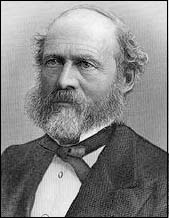
Lewis Henry Morgan
Morgan had already been to the site of Plate XIII No. 1 calling it the Ganundasaga Castle, near Geneva, Ontario County, New York. Squier, in describing that site stated: “The site of this ancient palisade slopes gently toward a little stream, called Ganundasaga Creek, which supplied the occupants of the fort with water. The ground is covered with a close greenward, and some of the apple trees planted by the Indians are still flourishing…Small heaps of stone, bearing traces of forges or fireplaces. The holes formed by the decay of the pickets are now about a foot deep. A fragment of one of the pickets was removed by Mr. L. H. Morgan, of Rochester, in 1847, and is now in the State Cabinet at Albany. It is of Oak.”119
Did Morgan understand as an Attorney for the Railroad and Mining interests, and as a politician who served in both the State Assembly and State Senate, the implications, of how the defining of these artifacts would have on the treatment of the Indians and land policy? In the interaction with these early fathers of theory, did Squier’s ethnological views of the Indians and how he was interpreting these ancient artifacts change?
One of the most interesting ancient works described by Squier in his 1851 book Antiquities of New York, is located near Victor, Ontario County, New York. This palisaded fort was located at the summit of a high hill, so steep upon most sides as to be ascended only with the greatest difficulty. Of the village below, De Noville in his letter of the 25th of August, 1687 stated: “The large village alluded to here is no doubt the one which was situated on the eminence now known as ‘Boughton’s Hill,’ where abundant traces of Indian occupancy at…the time of the first settlement of the country, was sufficiently abundant to repay the cost of clearing the ground. Indeed it was the source whence the early blacksmiths, for a long distance round, derived the iron for ordinary consumption; and even now the smithies in the vicinity consume large quantities of the metal which the operations of agriculture continue to bring to light.”120
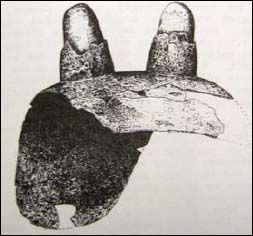
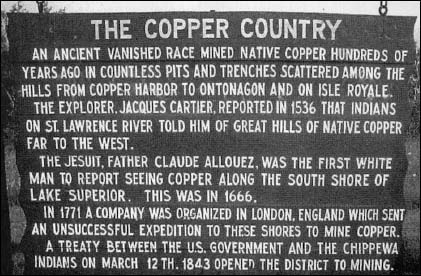
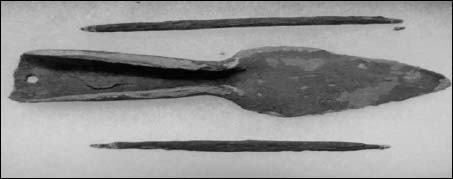
Copper artifacts
Given the fact that most of the artifacts of these once industrious people have now been destroyed, there still remain lessons to be learned and understanding gained from further study of these ancient inhabitants of North America. Dr. Roger G. Kennedy, Emeritus Director of the Smithsonian National Museum of American History stated: “In this spirit, let us return to the mounds, and risk some guesses about why and how they were built.”121
_______________________
107 E. G. Squier, Aboriginal Monuments of the State of New York, (Washington: Smithsonian Institution, 1849; reprinted Colfax, WI: Hayriver Press, 2006) 10.
108 Ibid., 11, 12
109 Ibid., 81-82
110 Barnhart, 314.
111 R. E. Bieder, Albert Gallatin and the survival of Enlightenment thought in nineteenth-century American anthropology, (Norman OK: University of Oklahoma Press, 1975) 92
112 R. E. Bieder, Science Encounters the Indian, 1820-1880, (Norman, OK: University of Oklahoma Press, 1986) 32, 35, 41-42
113 Albert, Gallatin: 1836, A synopsis of the Indian tribes of North America, American Antiquarian Society Transactions and Collections Report 2:1-422.
114 Squier and Davis, 1848 report Ancient Monuments, Meltzer’s, Introduction, 12
115 Squier and Davis, 1848, Ancient Monuments, 302 referenced Transactions of American Ethnological Society, vol. i. 207
116 Squier and Davis, 1848, Ancient Monuments, Meltzer Intro. 74: ref. 40, 302
117 Ibid. Squier: 1848, 74 Cyrus Thomas, 1894, 611-613
118 Squier: Antiquities of New York, 1851, 69
119 Ibid, See, Squier; Antiquities of New York, 1851, 86
120 Ibid, See: Squier, Antiquities of New York, 1851, 90
121 Kennedy, Hidden Cities: 242