
CHAPTER 14

“The major metatheoretical issue in the pre-professional anthropology of Squier’s day was whether humankind had a single origin (monogenism, with Native Americans often assumed to be the ‘Lost Tribes of Israel’ or other people mentioned in the Bible) or whether the races had multiple origins (polygenism, with various kinds of non-whites viewed as being created separately and comprising inferior species).”122 The question being raised was: Who were the people who built such amazing earthwork structures and mounds? “The result was that mound construction was widely and popularly attributed to a race of [Mound Builders], who no longer existed or at least no longer existed where and as they had earlier.”123
In the 1998 republication of the Squier and Davis report, David J. Meltzer states, “All this was riding on a book devoted to the questions of the origin, antiquity, and identity of the [Mound Builders].”124 Questions had surfaced after the Revolutionary War, as emigrant trains began streaming over the Appalachian and Allegheny Mountains into the lowlands of the Ohio and Mississippi valleys, where the settlers were finding a vast number of abandoned mound sites, fortifications and earthworks structures.
With the publication of Squier and Davis’s “Ancient Monuments”, many questions were being raised, as many considered the Indians too savage and primitive to have built such monumental structures. Others believed that some of the tribes of the Indians that existed in North America could be the descendants of the Mound Builders, a remnant of the Lost Tribes of Israel; and that the Mound Builders could be their progenitors, who through war and disease had experienced monumental reduction of their populations, changing the way they had once lived, causing the remaining populations, to revert to a more primitive way of existence, as “Hunter Gathers” relying on hunting and the gathering of fruits and nuts for their very existences. Meltzer states; “There was considerable speculation, among antiquarians no less than others, about who the Mound Builders were, where they had come from and when and where they had disappeared to…Nor was it clear how the [Mound Builders] related to living Native Americans: Were they linked as ancestors and descendants?”125
The speculation about the people who had built these earthworks and mound structures had escalated as a number of early colonists and religious leaders were praising the virtues of the Indians and sending out missionaries to them. The early Jesuits viewed the Indians in a different light than most, for they were seekers of the Lost Ten Tribes. Other religious leaders of the day held the view that Native Americans might be of Jewish descent and needed to be familiarized with their heritage. “Reverend John Eliot, of Roxbury, Massachusetts, in a spirited effort to convert the Algonquian tribe of Indians, made a translation of many parts of the bible into the Algonquian language. He and Roger Williams were of the branch of Puritans still cleaving to the view that Indians were people worthy of salvation.” William Penn disposed toward conversion rather than extinction of the Indians reported; “that the Indians of Pennsylvania resembled the Jews of London.”126
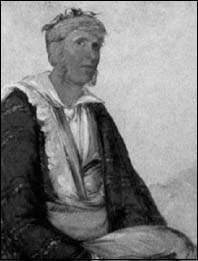
Algonquin Indian
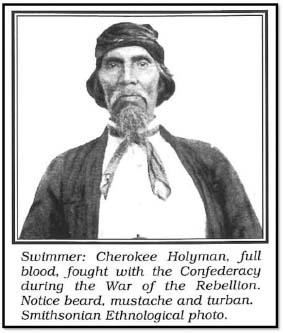
Provided by Ancient American Magazine
Not only did the Algonquians have a written language so that Eliot was able to make a translation of parts of the Bible, but they used similar Biblical words and had traditions and customs in keeping with Israelite culture. In this missionary effort, researchers using their written language have tied many of these tribes to common ancestors.
In 1491 New Revelations of the Americas Before Columbus, Charles C. Mann indicates that researchers have developed various linguistic testing techniques, among them was glottochronology, which attempts to estimate how long ago two languages separated from a common ancestor by evaluating their degree of divergence on a list of key words. “In the 1970s and 1980s linguists applied glottochronological techniques to the Algonquian (American Indian language family) dictionaries compiled by early colonists. However tentatively, the results indicated that the various Algonquin languages in New England all date back to a common ancestor that appeared in the Northeast a few centuries before Christ.”127 Their findings showed that:
The ancestral language may derive from what is known as the Hopewell culture. Around two thousand years ago, Hopewell jumped into prominence from its bases in the Midwest, establishing a trade network that covered most of North America. The Hopewell culture introduced monumental earthworks and, possibly, agriculture to the rest of the cold North. Hopewell villages, unlike their more egalitarian neighbors, were stratified, with powerful rulers commanding a mass of commoners…Hopewell religion, with its intoxicatingly elaborate funeral rites…would mark an era of spiritual ferment and heady conversion, much like when Islam rose and spread Arabic throughout the Middle East…Hopewell itself declined around 400 A.D. But its trade network remained intact. Shell heads from Florida, obsidian from the Rocky Mountains, and mica from Tennessee found their way to the Northeast.128
By the 1820’s there was among reformist Protestants a settled body of opinion holding that Indians should be handled more gingerly than mere imperial convenience might dictate. This thinking was grounded in the opinion that they were not, so to speak, Indians at all. While others were calling for extermination of bloodthirsty savages, the reformers asked some consideration at least for impoverished descendants of Lost Tribes, who might be as capable of redemption as New Testament Jews. This strain of Puritanism bore fruit again in 1823, when Ethan Smith published his View of the Hebrews; or the Lost Tribes of Israel in America; this Smith [was] no kin to Joseph Smith, the founder of the Church of [Jesus] Christ of the Latter Day Saints.129
Joseph Smith had published the Book of Mormon in 1830 in Palmyra, New York. It tells of migrations of people to America before Columbus. “Smith became the founder of the only world religion to be based in American archeology. Because the American Indians have never sought to evangelize Europeans or Africans, Mormonism is also the only world religion to place American Indian experience at the center of its creed.”130 “It is true to this day that the Mormon church, the largest denomination to accept the Lost Tribes view of Indian origins, has been consistently interested in evangelistic—that is respectful—relations with Native Americans.”131
Upon the publication of the Book of Mormon in Palmyra New York, Joseph Smith began to reach out in a missionary effort to the Indians of America’s heartland. He directed missionaries to the Cattaraugus Indians near Buffalo, New York, the Wyandot’s of Ohio, and the Delawares of Missouri, along with the Fox, Sac and other Algonquian tribes; declaring to them that they were of a remnant of the House of Israel. This idea, that the Indians were of Mid-Eastern origin, was a concept that was contrary to the political doctrine of Manifest Destiny and to the social engineering efforts that were being advanced in the 1800s. The primary political and social agenda of the late 1700s and 1800s was centered on questions as to who would control the lands of America. The desired outcome would require the removal of the Indians from their ancestral lands and the placing of them on reservations as settlers moved westward. If the Indians were to be viewed as of Hebrew or European descent, then a case could be made that the Indians were more than mere savages with rights that should be granted under a constitutional law.
The right to remove the Indians rested on some of the assertions regarding their origin, with claims relating to their origin stemming from plentiful artifacts being recovered from the mounds of the Hopewell and Adena cultures. The artifacts coming out of the mounds were giving signs of a people who had an understanding of the cosmos, advanced engineering and higher mathematics, along with a working knowledge of the smelting of iron, copper, and other metals. All of this raised questions about whether they were of a higher level of civilization then as first thought.
The Mormon efforts to befriend the Indians and Joseph Smith’s assertions that they were of Hebrew descent causing no small stir and would contribute to increased political and religious tensions in the area. Joseph Smith’s proselyting message to the Indian populations would go contrary to government efforts and European settlers’ desires to take control of the lands as part of a Manifest Destiny agenda.
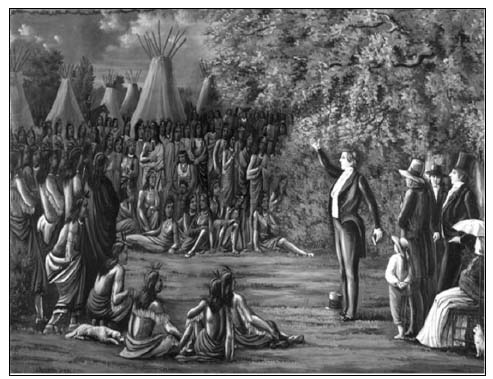
Depiction of Joseph Smith Preaching to the Indians
Though American expansionism and Manifest Destiny was a major focus in the 1800s and early 1900s, since the middle 1900s, the U.S. government anthropological and ethnological community has elevated their efforts to help society come to know and appreciate the aboriginal Indian populations. They have taken progressive steps to classify the Indian tribes in such a manner as to make it possible to assemble them in harmonious groups, based on relationship of blood, language, customs, beliefs, and grades of culture. It was found that within the area of the United States there are spoken some 500 Indian languages, as distinct from one another as French is from English, and that these languages are grouped in more than 50 linguistic families.132
Along with a large number of diverse linguistic families from hundreds of tribes that existed in North America, tribes have been found to have differing traditions, DNA and oral histories. Such findings have made it increasingly difficult for some of the mainstream ethnologist and anthropologists to hold to the traditional view that the majority of the North American Indians came across the Bering Strait as espoused by Lewis Henry Morgan. He believed, at one time like Columbus that they came from tribes found in India. Even with modern acknowledgements of this implausible hypothesis by Morgan, we still find scholars and government-related anthropologists and ethnologists that strive to hold to traditional established theories that virtually all the Indian ancestors migrated over the Bering Strait more than 40,000 years ago, and that they existed here in isolation for many millennia, with little or no outside interaction or influences from foreign cultures.
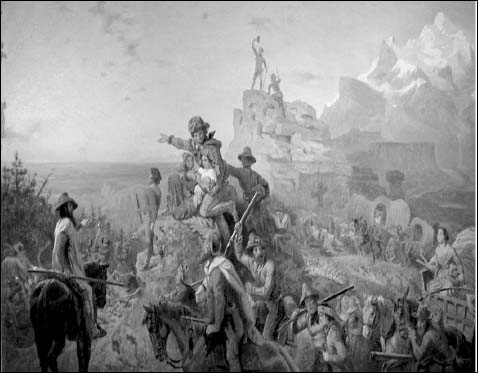
American Expansionism and Manifest Destiny
_______________________
122 Barnhart, xv
123 Squier and Davis 1848, (Meltzer, 1998, replication)
124 Squier and Davis, 1.
125 Ibid. 2.
126 Kennedy, Hidden Cities, 227.
127 Charles C. Mann, 1491 New Revelations of the Americas Before Columbus, (New York: Alfred A. Knopf 2005) 38.
128 Ibid.
129 Kennedy, Hidden Cities, 227.
130 Ibid., 230.
131 Ibid., 228.
132 See: Smithsonian Department of Ethnology Report IV.