
CHAPTER 15

As American settlers were moving westward and crossing the Alleghenies, they found abandoned mound cities and earthwork structures everywhere from western New York to the Gulf of Mexico. The greatest concentration of mounds were found in the heartland of the continent: Ohio, Illinois, Indiana, Missouri, with lesser mound areas being found in Michigan, Kentucky and western Tennessee. Clusters of mounds bordered nearly every major waterway of the Midwest.133
To some of the settlers, the mounds were nuisances to be plowed flat as quickly as possible. To others, they were places of handy refuge in time of flood. But to the antiquarian, the mounds were the work of a vanished race, which with incredible persistence had erected them in the course of hundreds of thousands of years and then had disappeared from the face of North America.
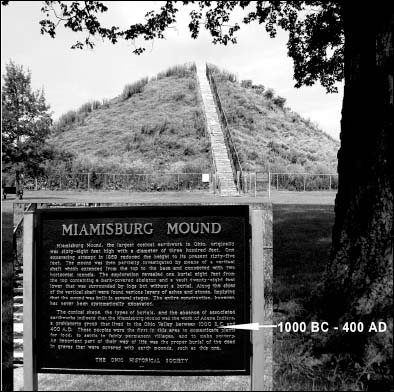
Why a vanished race? Because the Indians of the mound area, as the settlers found them, were semi-nomadic savages, few in number and limited in ambition. They seemed obviously incapable of the sustained effort needed to quarry tons of earth and shape it into a symmetrical mound…The size of these structures astonished the early settlers. One great mound near Miamisburg, Ohio was 68 feet high and 852 feet in circumference at the base, [and] was found to contain 311,353 cubic feet of soil; another mound in Ross County, Ohio was shown to consist of 20,000 wagonloads of earth. Ross County alone proved to have 500 mounds and 100 enclosures.134
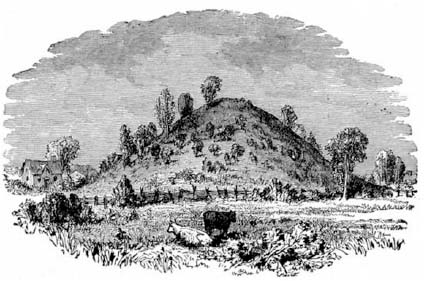
Miamisburg Mound, Ohio 135
With a flood of speculation about the origin and fate of the Mound Builders, learned men came forth to suggest that the Americas had been visited long ago by Hebrews, Greeks, Persians, Romans, Vikings, Hindus, Phoenicians; “anyone in short who had ever built mounds in Canaan, why not in Ohio? And what had become of the builders of the mounds? Why, obviously, they had been exterminated by the treacherous, ignorant, murderous red-skinned savages who even now were causing so much trouble for the Christian settlers of the New World.”136 In this way, Silverberg says, “…a myth was born that dominated the American imagination throughout the nineteenth century. The builders of the mounds were transformed into the Mound Builders, a diligent and gifted lost race. No one knew where the Mound Builders had come from or where they had gone, but the scope for theorizing was boundless.” It was in the 1870s that contemporaries from Western New York, Lewis Henry Morgan and John Wesley Powell, would begin their work to “hack away at what they saw as a luxuriant growth of fantasies.”137
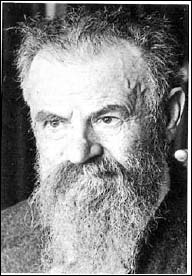
John Wesley Powell
The most vigorous demythologizer was the one-armed Major J. W. Powell, conqueror of the Colorado River and later founder of the Smithsonian Institution’s Bureau of American Ethnology. Powell himself in the 1890-91 Annual Report of the Bureau of Ethnology [stated] It is difficult to exaggerate… the force with which the hypothetic ‘lost races’ had taken possession of the imaginations of men. For more than a century the ghosts of a vanished nation have in the vast solitudes of the continent, and the forest-covered mounds been usually regarded as the mysterious sepulchers of its kings and nobles. It was an alluring conjecture that a powerful people superior to the Indians once occupied the valley of the Ohio and the Appalachian ranges, their empire stretching from Hudson bay to the Gulf, with its flanks on the western prairies and the eastern ocean; a people with a confederated government, a chief ruler, a great central capital, a highly developed religion…all swept away before an invasion of copper-hued Huns from some unknown region of the earth, prior to the landing of Columbus…138
John Wesley Powell found his professional home when he was named Director of the Bureau of Ethnology at the Smithsonian, where he would devote most of the remainder of his professional life to a comparative study of man and all that goes into influencing the cultures of a society. Much of what anthropology and ethnology focus on is the study of past societies and ancient history. In a society, future perceptions are developed and cultivated through one’s understanding of past events. This provides the mold for the shaping of the character of a nation. In public education today, many administrators and educators believe that history instruction is a necessity and should be obligatory before one can advance to any other course of study.
Powell’s integral views concerning these mound-building cultures were cultivated over time. During his early work experience as curator of the Illinois Museum of Natural History in 1867, he experienced first hand the many claims and tales of lost races, which were accompanying the ancient artifacts being recovered from the mounds.
Powell’s assessments were also nurtured through his experiences in the west as a Special Commissioner of Indian Affairs for the Intermountain West, where he would accept employment in the establishment of reservations for the western tribes of Indians. These early employment and life experiences would work together to mold and shape his ethnological views of Indians, religion, society and the Mound Builders.
Powell would become, in the late 1800s, the premier authority on the mounds, as the country looked to Powell to head the Bureau of Ethnology and future mound exploration. In these positions, what Powell would say would not go unnoticed. To Powell, to search through the mounds for artifacts would serve no good propose, as he affirmed:
“With regard to the mounds so widely scattered between the two oceans, it may be said that the mound building tribes were known in the early history of discovery of this continent and that vestiges of art discovered do not excel in any respect the arts of the Indian tribes known to history. There is there-fore, no reason for us to search for an extra limital origin through lost tribes for the arts discovered in the mounds of North America.” 139
His ethnological studies of race, religion, language and ancient societies (what today is more frequently termed cultural anthropology) convinced him that his, and others’, results would provide the best foundation for the development of society and for the advancement of government policies. Who better to advance government programs and make recommendations to help direct government energies and expenditures down a more ‘legitimate course of development’ than the Bureau of Ethnology and the men of science with whom he associated?
It is difficult to find an author who has written and studied the life of John Wesley Powell, who has not commented on his unique visionary nature as a holistic thinker. He, as a director of the Bureau of Ethnology at the Smithsonian, understood well the important role that history would play, in the molding of America.
Was it Powell’s mindset to use the men of science to provide a more rational leadership, and in charting a course for the future development of this susceptible American culture? Early in his ethnological studies he recognized that the men of science, with whom he surrounded himself, could be used as an important implement in addressing many social, political and religious issues facing this emerging new country. He believed that those of the scientific community, due to their research, were in the best position to provide the best rational leadership in directing society towards a more civilized state.
As Powell saw it:
Science should not stop with imposing a more rational order on nature. Next must come a rationalizing of society as well. ‘All the functions of society are performed in a sort of chance way, which is precisely the reverse of economical, but wholly analogous to the natural processes of the lower organic world…crooked streets of cities must be set straight, and filth and disease swept away. No famines must be permitted. No bitter partisanship in politics. The open hostility between capital and labor, now reaching dangerous proportions, must give way to harmony. Manufacturing must be reorganized to produce and distribute only what is truly needed. Wealth must be more equitably distributed.
The scientific redesign of the nation had, for [Lester] Ward [working under Powell] a promising beginning in such government agencies as the Geological Survey. Here [as Ward saw it] science was showing its potential for stable, rational leadership. “The scientific mind,” appears to be peculiarly adapted to faithful service in situations where great practical interests are involved. Scientific men are, from their very education, earnest men, and fully aroused to the importance of putting their knowledge to the best practical use…If such men had charge of drafting legislation and organizing the system of production, the welfare of every American citizen would be secured. Left in the hands of businessmen, on the other hand, a class noted more for their “coarse cunning inspired by avarice,” the nation was drifting toward instability and social unrest.
Powell knew perfectly well what a radical young man he had working down the hall. In a four-part review in Science he analyzed Ward’s book in detail, offering a few mild criticisms but overall proclaiming it to be “America’s greatest contribution to scientific philosophy.” Where Morgan had helped him understand the past of the species, Ward helped clarify where the future of the nation must lie; the story of evolution now had an end as well as a beginning.140
Lester Frank Ward, who left his mark on the scientific community of Washington, was born on June 18, 1841 and died on April 18, 1913. He became a paleontologist and sociologist and the first president of the American Sociological Association. He has been credited as one of those instrumental in establishing sociology as an academic field in the United States and was awarded the moniker of the American Father of Sociology.
Lester Ward was born in Illinois to the family of Justus Ward. His family did not have enough money to send Lester to school so he was home-schooled. However, Lester’s intellectual abilities would help to sustain him, for he had very little money to attend college until later in life, but found a job teaching in a small country school. In the summer months he worked as a farm laborer. He finally saved enough money to attend college and enrolled in the Susquehanna Collegiate Institute. He was, at first, self-conscious about his spotty formal education and self-learning, yet he found that his knowledge compared favorably to his classmates.
Being from Illinois would, however, help him to immediately connect with one of his mentors, John Wesley Powell, who had recently arrived in Washington after serving as the curator of the Illinois State Museum. Within the first year of Powell taking the helm as director of the U. S. Geological Survey, he hired Ward, who remained in office at the Geological Survey from 1882, when he was hired, until he retired from government service.
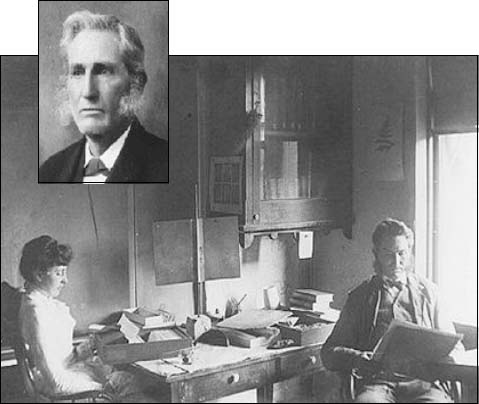
Lester Frank Ward
Lester Frank Ward held the post of assistant geologist from 1889 to 1892, and in 1892 was promoted to paleontologist. At the same time he served as Honorary Curator at the U.S. National Museum. Upon moving to Washington, Ward attended Columbian College, now George Washington University, where he went on to obtain a law degree. Ward never practiced law, concentrating his efforts in the sciences. Almost all of the basic research that he did centered in the fields of archeology, geography, paleontology and anthropology. He grew in stature in the Washington scientific community as a government scientist, and over the course of his career held many prestigious and influential positions.
In 1883 he was made Geologist of the U.S. Geological Survey. In the 1890s, he was made Paleontologist. He held this position until 1906, when he resigned to accept the chair of Sociology at Brown University. While he worked at the Geological Survey under his friend John Wesley Powell, who was the second director of the US Geological Survey (1881– 1894) and the director of the Bureau of Ethnology of the Smithsonian. Ward would help to advance ideas that in large, complex and rapidly growing societies, human freedom could only be achieved with the assistance of strong democratic government acting in the interest of the individual. The characteristic element of Ward’s thinking was his faith that government, acting on the empirical and scientifically based findings of the science of sociology, could be harnessed to create a near Utopian social order.141
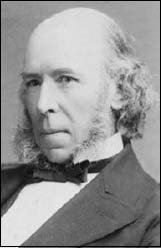
Herbert Spencer 1820-1903
Ward would follow the lead of Herbert Spencer who developed all-embracing conceptions of evolution as the progressive development of the physical world. Spencer was born on April 27, 1820 in Derby England, becoming a prominent English philosopher, sociologist and a liberal political theorist. He was credited for writing about evolution, and for being the first, even before Darwin, to coin the phrase “survival of the fittest.”
In November 1882, Spencer met at Delmonico’s Restaurant in New York with leading scientists and intellectuals toasting his brilliance. Henry Ward Beecher and Lester Ward were present. Powell was not present though he had received Spencer in his Washington office earlier. After visiting him in Washington, Spencer sent Powell a note: “Take warning against doing too much, and by way of precaution abandon that telephone in your bed-room that you told me of.”142
It was not the ending that many other Americans, particularly in the business community, saw promised in the theory of evolution. Naturally, they saw themselves as the finest product of cultural as well as biological evolution and were not eager to turn power over to the scientists. Taking up this thought was the British philosopher, Herbert Spencer who advanced Darwin’s philosophies of the “survival of the fittest,”… “No one after Darwin did more to win acceptance of evolution than Spencer.”143
Powell and Ward understood that introducing this new science as to the origin of species would not be easy, but they felt that it was necessary to chart a new course for the future of society. These men of science believed that they would be the most fit to take control of the helm of the ship and steer it into the future. Powell as director of U.S. Geological Survey after Clarence King, who had gone to make his fortune elsewhere, was… “the son of an itinerant preacher.’’ John Wesley Powell was director of two government bureaus, which were known as the “Mother of Bureau’s,” he being “referred to as the most influential scientist in Washington.” For as he saw it; “he had still another and greater opportunity before him to put science to use for the benefit of the people. What had begun as a crusade for recognition of the problems of the west had merged into a greater purpose of making science the basis of progress.” For “John Wesley Powell was no believer in laissez faire but, like his friend Lester Ward, firmly convinced that science was meant to improve that lot of men. Only a few days before he had told the Anthropological Society that modern legislators, while professing to subscribe to the doctrines of Herbert Spencer and his school, were in practice [and] chiefly employed…. There was no question of his own views regarding the need for scientific planning…His philosophy of the responsibilities of government science came out most clearly in the Allison commission hearings in 1884 [and] in 1886. He believed in the centralization of the scientific functions of the government.” 144
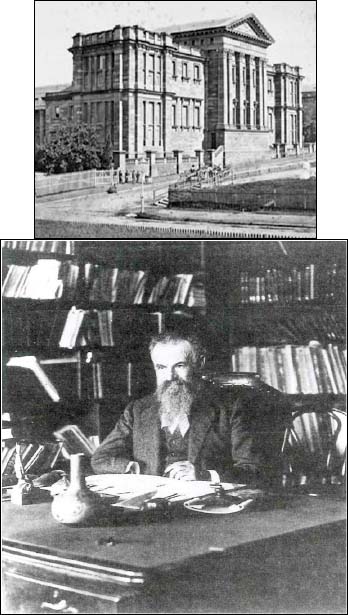
John Wesley Powell, Director of two Government Bureaus
_______________________
133 See; Silverberg, The Mound Builders, 11.
134 Ibid., 10-13.
135 Squier and Davis, Ancient Monuments of the Mississippi Valley: Figure1, p.5
136 Ibid., 15.
137 Ibid.
138 Ibid., 15-16
139 Timothy R. Jenkins, The Ten Tribes of Israel: (Houck & Smith, Publishers, Springfield, Ohio, (1883) 266 John Wesley Powell, Transactions of the Anthropological Society of Washington, D. C., (1881) 16
140 Donald Worster, A River Runs West The Live of John Wesley Powell, (New York: Oxford University Press, 2001) 448
141 See: Lester F. Ward, Glimpses of the Cosmos, A Mental Autobiography, (1913) See also: Glimpses of the Cosmos. A Mental Autobiography, (6 vols. Reprint Services) Ward, Lester F. 2005 (original 1893). The Psychic Factors of Civilization. (Kessinger Publishing) and Burnham, John C. (1956) Lester Frank Ward in American Thought. Washington, DC: Public Affairs Press
142 See: Worster, AARW. 448-449, 604. ref. John Wesley Powell, mss. July 2 (1883) NAA, file 4022c.
143 Ibid
144 William Darrah, Powell of the Colorado, foreward by William T. Pecora, Director U.S. Geological Survey; Princeton University Press viii