
CHAPTER 17

In 1863, when Congress chartered the National Academy of Sciences, Joseph Henry served as President of the Academy with the function of advising Congress on technical subjects when called upon. Upon the death of Joseph Henry, professor Othniel C. Marsh of Yale, who was a respected Paleontologist and a friend of Huxley and Darwin and a man who would become a major contributor to the documentation of biological evolution, became the president of the Academy. Professor Marsh would become a real ally of Powell for “he was more than an illustrious scientist with firsthand knowledge of the West; he was a man of power, shrewd in political manipulation, solidly backed. And he was far more of an eager ally for Powell than Henry would have been. For years they were both “engaged in a bitter and rather disgraceful running fight with Professor Edward D. Cope of Pennsylvania.”148
Then in March 1879, the Bureau of Ethnology was established within the Smithsonian Institution. Congress had transferred the ethnological investigations of the American Indians, previously conducted by the Geographical and Geological Survey of the Rocky Mountain Region, to the Smithsonian Institution and Major John Wesley Powell. The Bureau was created as the agency to continue these investigations. Powell also went on to head the US Geological Survey’s Department of Investigations, but would remain to guide the new Bureau of Ethnology until his death in 1902.
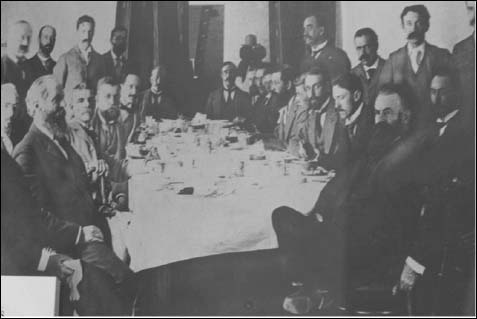
John Wesley Powell seated at the head of the table
In spite of its limited resources and with a staff never larger than twenty, the Bureau still became recognized as the foremost center for the study of American Indians. Its publications on linguistics, archaeology, physical anthropology, and Native American history were significant and diverse. Examples of its contributions include: Handbook of American Indians North of Mexico, edited by F. W. Hodge, and the three-volume Handbook of American Indian Languages, by Franz Boas. However, the Bureau of Ethnology does not exist today, since in 1965 it merged with the Department of Anthropology of the U.S. National Museum. The many authors of the American ethnological lexicon have, over the decades, provided noteworthy research, which has given society a greater understanding and insight into the American cultures and the Indian tribes that have existed in North America.
In 1882 Powell, under instruction from Congress, established the Division of Mound Explorations. One of its purposes was to explore the origins of earthen mounds found predominately throughout the eastern United States. It was the first of three temporary, yet significant, subunits supported by the Bureau. Cyrus Thomas headed the Division and published his conclusions in the Bureau’s Annual Report of 1894, which is considered to be the final word in the controversy over the mounds’ origins. With the publication of Thomas’ findings, the Division’s work came to a close. The course of the Bureau of Ethnology remained largely the same under Powell’s successors: W. J. McGee (acting director) 1902; William Henry Holmes, 1902-1910; Frederick W. Hodge, 1910-1918; J. Walter Fewkes, 1918-1928; and Matthew W. Stirling, 1928-1957. 149
Limited resources and little available archaeological expertise in the recovery of artifacts would make the task of exploring and preserving the mounds a very difficult task during the period of the late 1800s.
The problem was finding not subjects but skilled investigators. In 1879, and indeed for another dozen years, no one in the United Sates could boast any advanced academic training in anthropology or ethnology from any American university. Although William D. Whitney at Yale might be consulted on linguistic questions and Frederick W. Putnam, curator of Harvard’s Peabody Museum of Archaeology and Ethnology (established in 1879), might give advice on artifacts, there was nary a Ph.D. program in the land until the immigrant Franz Boas set one up at Columbia. Even, the great Lewis Henry Morgan had no professional training; he was a lawyer who had taken up the study of Indians as an avocation. The Bureau of Ethnology had to be staffed with self-taught amateurs.150 These self-taught amateurs were also expected to toe the line.
Agreeable as his recruits generally were, they confronted Powell constantly with a difficult question of how much control to exercise. As director, he was intent on marching his troops toward a common destination on which he had personally fixed. The bureau was his creature, the budget his achievement, the science of man his dream, the staff his collective instrument. However, he was operating in a culture where individual genius and personal freedom were the celebrated norm; somehow he must instill a counter ethos of teamwork. Yet how to do that without driving off his idiosyncratic, creative scholars? Too much direction from the top, and the troops might rebel. Too little, and he might stand accused of indulging private whims at public expense, not to mention failing to bring scientific order out of chaos.151
The greatest impediment to this enterprise was not Powell’s own assistants, but Spencer Fullerton Baird, second secretary of the Smithsonian. Somber-faced and self-assured, Baird had taken over the institution upon Henry’s death.152
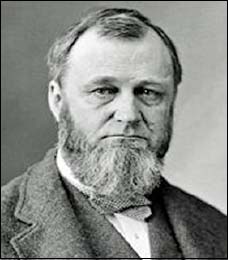
Spencer Fullerton Baird
If the subordinate missed the point, Baird drove it home in a personal letter to Powell, which could only be taken as a warning to conform or else… No day was long enough to achieve what Powell had in mind with his “Science of Man.” Remarkably, the staff he recruited drove themselves as much as he drove them. Though often frustrated by his shifting about for a way up the mountain, they nonetheless did not desert him. Powell was loyal to them-he seldom let anyone go and they were intensely loyal to him.153
What Powell had in mind for the bureau was not to do a lot of additional work exploring the origin of these ancient Mound Builders, but to halt any further explorations of the mounds. To him there seemed little reason to do any additional research for a lost race of Mound Builders, for, as he saw it, the mounds appeared quite clearly to be the work of the ancestors of the modern Indians.
“Powell was one of those powerfully original minds which, like certain streams in a limestone country, sink out of sight for a time to reappear farther on.”154 The social agenda that Powell was working to advance would go contrary to the traditional and prevailing religious beliefs of his day. Like certain streams, Powell hoped that issues surrounding the origin of the Mound Builders would sink out of sight, never to be seen or heard of again.
Over the life of John W. Powell, in his work and travels, he had been inundated with the many views and assertions as to the origin of these mound-building cultures. Powell and the departments, which he would direct, would have none of that, and he would go on to take the lead in addressing this pivotal ethnological question. In so doing, many of the more prominent mound sites would be placed in federal or state control, making them off limits to any further exploration, while many others were destroyed as they were in the path of progress and were not seen as having any historical value.
Powell did not see the work of his bureau as archaeological; he planned only to study the languages, arts, institutions, and mythologies of existing tribes, and originally had no intention of using Bureau of Ethnology funds for excavating mounds or ruins. This is evident from the First Annual Report of the Bureau of Ethnology, date, July 1880 and published the following year. This huge volume includes essays on Indian languages, myths, and burial customs, on Central American picture writing, and several other subjects; but only 8 of its 638 pages are devoted to mounds. In one of his own essays, Powell declares that there seems no reason to search for a lost race of Mound Builders; to him the mounds appear quite clearly to be the work of ancestors of the modern Indians. In a quiet, offhand way, Major Powell thus sounded the first battle cry of the coming revolution in American archaeology. On the same page he suggested discarding the concept of a single race of Mound Builders; the wide extent and vast number of mounds discovered in the United States should lead us to suspect, at least, that the mound-builders of pre-historic times belonged to many and diverse stocks.155
Though he had no plans to deal with the mounds, Powell found an odd thing happening the next time Congress voted money for this bureau in 1881, a group of archaeologists without telling him, persuaded Congress to decree $25,000 be given the bureau for further research, $5,000 must be spent in “continuing … investigation relating to mound-builders and prehistoric mounds.
Powell was not very pleased. He wanted to use all the money he could get to study living tribes, and was upset at being forced by Congress to branch out into archaeology, he however obeyed the order, and set up a division of mound investigation within the bureau. Late in 1881 Powell chose as head of this division of Mound Building Exploration, Cyrus Thomas to be the slayer of the Mound Builder myth.
Thomas came from the southern tip of Illinois, where mounds were common. He was a man of wide interests who had somehow acquired the title of “professor.” When he came to the Bureau of Ethnology he was as he said; a pronounced believer in the existence of a race of Mound Builders, distinct from the American Indians. Major Powell proposed to cure him of this belief by putting him in charge of the bureau’s mound work and letting him convince himself of his error. Powell gave Professor Thomas one clerk and three field assistants and told him to draw up a plan for a survey of the mounds.
Gradually the bureau’s main interest, as shown in its annual reports, shifted from ethnology to archaeology. The Second Annual Report of the Bureau of Ethnology, submitted in September 1882, in an essay entitled, “Animal Carvings from Mounds of the Mississippi Valley,” which was Powell’s first real blast in the war against the mound myth. Its author was Henry W. Henshaw, an expert on birds, who had not actually excavated any mounds himself and who was merely attacking some of the conclusions drawn by earlier writers about mounds.156
Though Powell did not have interest in continuing mound exploration, he found that there were members of congress who did, and that by taking control of mound building exploration, there was potential for continued government funding. Even though the Bureau of Ethnology was not interested in the continued effort of exploration of the mounds under Powell, they were interested in gathering up some of the collections and miscellaneous artifacts being recovered from the mounds. In so doing, he addressed the concerns of some Congressmen that America’s antiquities were being carried off and sold to foreign investors.
Baird, the Secretary of the Smithsonian, wrote to Powell the following letter:
“I have always found members of Congress very impatient in considering the question of pure philological work,” the Secretary wrote. “Of my arguments before the appropriation committee, I have found the most potent to be the urgency of securing, at the earliest possible time, the archaeological and ethnological aboriginal matter which could be carried off to Europe, either by travelers sent out for the purpose, or by dealers in the U.S. collecting material for export.”157
High on the list of sites to be defended from foreign fingers were the ancient burial mounds scattered throughout the eastern half of the country, but particularly in the Ohio and Mississippi river valleys. Powell was only mildly interested in excavating them, regarding their rotting contents as a vulgar curiosity offering little scientific information. But Baird and Congress were interested in the mounds, so Powell put Cyrus Thomas in charge of the work and gave him sufficient money to hire assistants. They contracted with rural landowners to dig into those large piles of earth and cart off whatever artifacts and bones they contained. The stray crania went to the Army Medical Museum for keeping, but the Smithsonian acquired a good number of human skeletons for its own vaults. Some whites could not believe that Indians had ever been able to construct such imposing structures speculated that a superior race, now extinct, must have been responsible. But Powell took the view that the architects were indeed the Indians, and that their complex social organization and funerary rites were not to be underestimated.158
With government funding and backing it didn’t take long for the Smithsonian to become a formidable opponent in any fight. In Powell’s corner was Henry Henshaw, a bird expert who would provide a serious blow to the Squier and Davis 1848 report, along with an array of jabs to any owner of any artifact that would claim their findings to be evidence of ancient European influences in America. Powell also had Cyrus Thomas, a heavy-handed assistant, who would take a major shot at Squier and Davis in a book he wrote titled, The Problems of the Ohio Mounds. The Smithsonian Bureau of Ethnology under the direction of Powell in 1889 published it. The final blow to the Squier and Davis report came by way of Thomas’ report to the Bureau of Ethnology in 1894.
In the Introduction to The Problems of the Ohio Mounds, Thomas states:
No other ancient works of the United States have become so widely known or have excited so much interest as those of Ohio. This is due in part to their remarkable character but in a much greater degree to the Ancient Monuments of the Mississippi Valley, by Messrs. Squier and Davis, in which these monuments are described and figured. The constantly recurring question, ‘who constructed these works?’ has brought before the public a number of widely different theories, though the one which has been most generally accepted is that they originated with a people long since extinct or driven from the country, who had attained a culture status much in advance of that reached by the aborigines inhabiting the country at the time of its discovery by Europeans.159
Henry W. Henshaw, though he had not actually excavated any mounds himself, would weigh in on the artifacts coming out of the mounds. “In a preface to Henshaw’s piece, Powell plainly indicates what the position of his bureau on the mounds is going to be. He denounces ‘the many false statements’ and the ‘contradictions and absurdities’ of many supposed authorities on the mounds, and asserts, ‘the garbling and perversion of the lower class of writers supplemented the phantasies of those better intentioned.’”160
In the second annual meeting of the Bureau of Ethnology “Henshaw’s conclusions amounted to a summary of the Powell position on the mounds. He wrote that no carvings had been found in the mounds that represented animals not native to the Mississippi Valley; that “the state of art-culture reached by the Mound Builders, as illustrated by their carvings, has been greatly overestimated,” and that “the theories of origin for the Mound Builders suggested by the presence in the mounds of carvings of supposed foreign animals are without basis.”161
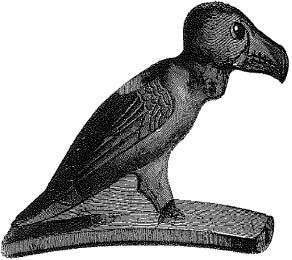
Ancient Monuments, Squier and Davis, 1848, Fig 171
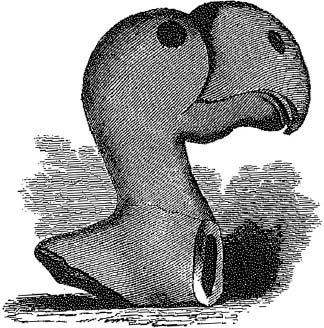
“[This figure] was taken from a mound in Butler County, Ohio. It represents the head of a bird, somewhat resembling the Toucan, and is executed with much spirit. It seems originally to have been attached to some vessel, from which it was broken before being deposited in the mounds.”
As described by James McBride Esq. in Squier and Davis,
Ancient Monuments: 1848 page 194.
_______________________
148 Wallace Stegner, Beyond the Hundredth Meridian John Wesley Powell and the Second Opening of the West, (Cambridge: The Riverside Press, 1953) 232.
149 Curtis Hinsley, Savages and Scientists: The Smithsonian Institution and the Development of American Anthropology, (Washington: Smithsonian Institution Press, 1981) 149
150 Worster, 399-400
151 Ibid., 401
152 Ibid., 402
153 Ibid.
154 Stegner, xvi.
155 Silverberg, The Mound Builders, 130-131.
156 Ibid., 131-132.
157 Baird to JW Powell, Letter 8 Nov. 1883, SA, RU 7081, box 11.
158 Worster, 405.
159 Cyrus Thomas, The Problem of the Ohio Mounds, (Washington: Government Printing Office, 1889; reprinted Colfax, WI: Hayriver Press, 2010) 7.
160 Silverberg, 132.
161 Ibid., 136.