
CHAPTER 19

After a screening of the documentary “The Lost Civilizations of North America” at the International Cherokee Film Festival, the documentary was awarded “The Best Multi-Cultural Film of the Festival”. As a producer of the documentary, I received a phone call from a woman who represented herself as the wife of the chief of her tribe. She stated that her husband wanted a copy of the documentary and wanted her to share this message with us, “that he has always known, that his people came here from the East.”
One interview for the documentary was with Donald Yates, a DNA scholar, consultant, and a past professor at Georgia Southern University. Yates, who has now made DNA studies his life work, he being part Cherokee, has also studied Indian History with great interest. In the documentary he shared this interesting insight when he said, “I have done the research and I can tell you that I don’t believe that my ancestors came across the Bering Strait chasing Woolley Mammoths some 40,000 years ago; in fact, I know better.”
Today there are many in the American Indian community who believe that they are a people without a history, still in search and wondering if anyone really knows of their history. Could the early views of Roger Williams, Thomas Jefferson and William Penn be correct? Could the American Indians have been a mix of a number of different cultures that made their way to the shores of America before Columbus? Raising the possibility that, perhaps, some of the American tribes could be of Mid-Eastern or European descent.
Early American religious leaders such as Roger Williams, the man credited as the founder of the First Baptist Church in America was the first in the mid 1600’s to draw attention to the idea that “the Indians were probably of Jewish descent of the lost tribes of Israel” and that the Indians should not be treated as sub-humans but as persons worthy of salvation.165
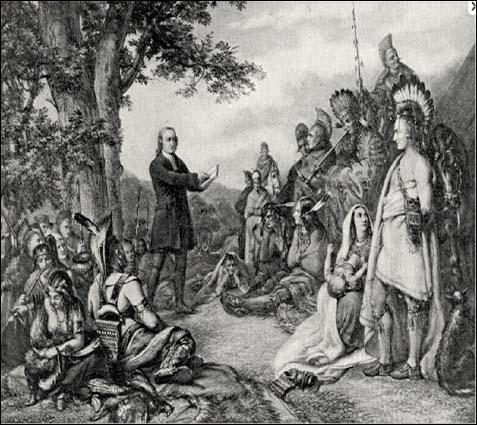
The following is from J.J. Mombert’s History of Landcaster County, Pennsylvania, page 68, being an extract from a letter written by William Penn to the Committee of the Free Society of traders, in London, England, 1683. He states of the origin of the North American Indian: “I am ready to believe them of the Jewish race—I mean of the stock of the Ten Tribes…I find them of like countenance, and their children of so lively resemblance that a man would think himself in Duke’s Place, or Berry Street, London, when he seeth them. But this is not all; they agree in wrights, they reckon by moons, they offer their first fruits, they have a kind of feast of tabernacles, they are said to lay their altar upon twelve stones, their mourning a year, customs of women with many other things that do not now occur.” 166
Josiah Priest, in his 1834 book American Antiquities and the Discoveries in the West, made the case that ancient populations of partially-civilized nations were in America centuries before Columbus. He states that the perception of his day was “that the American Indians are the descendants of the Lost Ten Tribes is now a popular one and generally believed, yet there are some who totally discard this opinion.” A number of other early colonists and religious leaders were praising the Indians’ virtues and were sending missionaries.
The Jesuits and seekers of the lost Ten Tribes, ….in the middle of the seventeenth century and since have written of their beliefs; Reverend John Eliot, of Roxbury, Massachusetts in a spirited effort to convert the Algonquian tribe of Indians made a translation of many parts of the bible into Algonquian Language. He and Roger Williams were of the branch of Puritans still cleaving to the view that Indians were people worthy of salvation. William Penn disposed toward conversion rather than extinction of the Indians reported that the Indians of Pennsylvania resembled the Jews of London.167
While others were calling for extermination of bloodthirsty savages, the reformers asked some consideration at least for impoverished descendants of Lost Tribes, who might be as capable of redemption as New Testament Jews.168
Josiah Priest in his 1834 book, American Antiquities, went on to reference Rev. Ethan Smith’s 1825 book View Of The Hebrews, stating that the Jews had cities of refuge and imitations of the Ark of the Covenant prior to the time of Moses, which traits of worship were also found among many tribes of the western Indians. He went on to say the Hebrew word alleluia and hallelujah is even found among North American Indians and adapted by them for the same purpose in the worship of God or the Great Spirit. Among some of their tribes they have a place denominated the beloved square. Here they sometimes dance a whole night; but always in a bowing or worshipping posture, singing continually, hallelujh Ye-ho-wah, Ye-ho-vah with some modern scholars believing it to be Yahweh and others believing that the true pronunciation of this word to be from the Hebrew word Jehovah.169
Extracts of a letter from the Rev. Jabez B. Hyde of Eden, Erie County, New York dated February 4, 1825, penned after reading the first edition of Smith’s View of the Hebrews states “most of the particulars observed of the Seneca Indians when I first came among them, the chiefs invited me to all their celebrations. I attended, in hopes of obtaining information concerning their ceremonies to see if I could discern what had been represented, they used the words Y-O-He-Wah and Hal-le-lu-yah. In all their rites, which I have learned from them, there is certainly a most striking similitude to the Mosaic rituals. Their feasts of fruits, feasts of ingathering, Day of Atonement, Peace offering sacrifices. Along with the way they build their cities of refuge and alters taking from them burnt offerings.”170
_______________________
165 Kennedy: Hidden Cities, 225-227.
166 Timothy R. Jenkins, Ten Tribes of Israel the true history of the North American Indian, (Springfield Ohio: Houck & Smith Publisher, 1833) 7. quoting J.J. Mombert’s History of Landcaster County Pennsylvania 1683: 68
167 Kennedy, Hidden Cities, 227.
168 Ibid.
169 See: Josiah Priest American Antiquities, (Hoffman and White, Albany, 1834) & Ethan Smith book View of the Hebrews 1825
170 Ethan Smith, View of the Hebrews, or the tribes of Israel in America: By Ethan Smith Pastor of a Church in Poultney, (Smith & Shute VT published 1825) Forward iii