CHAPTER 20

Along the scenic byways of Ohio in Coshocton is found at the Johnson Humrickhouse Museum, a display of the much talked about Decalogue Stone and Keystone. During our tour we visited this Museum where these “Holy Stones” are now on exhibit.
In November of 1860, other men accompanied David Wyrick of Newark, Ohio as they were excavating ancient burial mounds located approximately 10 miles south of Newark. As they were excavating this mound, they uncovered a sandstone box, smooth on the outside. They pried the box open to find within it a black stone that some believed at the time to be alabaster, but has now been determined to be a darkened limestone. Inscribed on the stone is a bearded man wearing, what appears to be a turban and a long flowing robe, with a fanned inscription above his head that has been translated as the Hebrew form for the name Moses. This bearded man carved into this stone also appears to be holding a book or record. Around the perimeter of the stone is inscribed a condensed version of the Ten Commandments, in what has been determined to be an ancient form of Hebrew called Monumental Block Hebrew. This is a type of ancient Hebrew script, which was not believed to be known, to any American Semitic scholars of the mid-1800s.
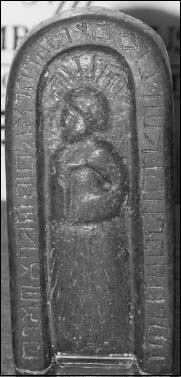
Decalogue Stone
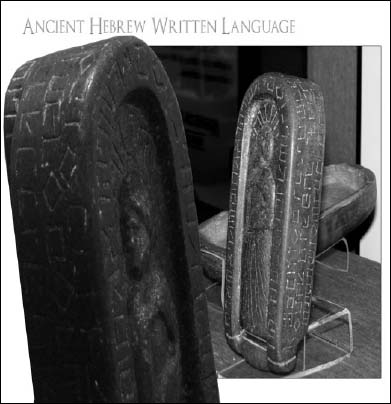
Keystone
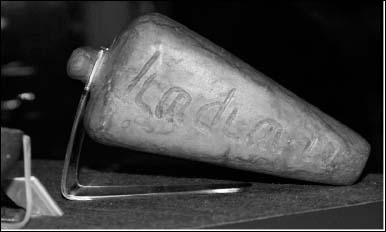
In June of 1860, Wyrick was out surveying ancient mound sites of the Hopewell and Adena cultures, sites dating from 100 BCE to approximately 400 CE. While doing excavation on some mounds at a location where other ancient artifacts had been recovered, he uncovered something in the shape of an ancient Keystone that looked as if it could have been used as part of a pendulum or plumb bob. It was inscribed on its four sides with script, which has since been identified as Hebrew, and translated as follows: Qedosh Qedoshim, “Holy of Holies” Melel Eretz, “King of the Earth” Torath YHWH, “The Law of God” and Devor YHWH, “The Word of God.”
In 1861, Wyrick published a pamphlet containing his account of these discoveries. However, questions of authenticity were raised based on a Hebrew dictionary found in his home along with some script inscribed on woodcuts. The authenticity of the stones were also brought into question because of the belief that the Hopewell people, who have been dated to have lived in that area from about 100 BCE to 400 CE, would not have had access to an Old Testament containing a record of Moses and the Ten Commands, especially given that the printing press had not been invented. As such, the idea that the Hopewell would have access to this knowledge was considered highly unlikely. That conclusion has led to the claim that the Holy Stones found by Wyrick could not be real and thus must be a hoax, even though Wyrick had many witnesses to his find.
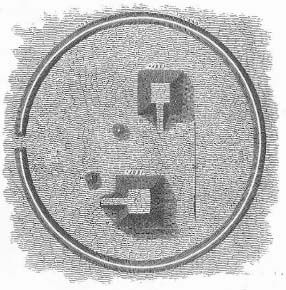
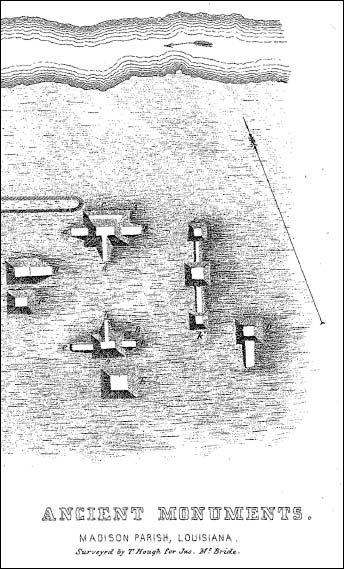
Ancient Monuments, Squier and Davis, Fig. 22
This giant earthwork embankment is two thousand three hundred feet in circumference with two truncated pyramidal structures, located in Bolivar County, Mississippi near William’s.