
CHAPTER 21

What could carvings or pottery sculptures of tropical mammals and birds and temple and ceremonial sites tell us about these ancient mound-building cultures? And why would tropical artifacts coming out of the mounds in America’s heartland be so hotly contested? Would it stem from the Bureau of Ethnology’s view as to the origin of the Indian, as they would take the position that most all of the North America Indian populations were either aboriginal or that they migrated over the Bering Strait land bridge some forty thousand years ago? Would such a view have implications on race legislation, religious views and Natural Law? Would it change how government and society has valued the American Indian and the artifacts of the ancient mound building cultures?
If the findings were determined to show that the Mound Builders had knowledge of Toucans, Manatees and Elephants, what might that tell society about the Mound Builders early travels or migration? Would such migrations of at least some of the Indian populations from tropical lands and waters have implications on race and land policy and other politically sensitive agendas?
As addressed in some of the Bureau of Ethnology’s earliest reports, were some revealing animal carvings. “[Charles] Putnam points out that if the Davenport finds are authentic they constitute strong evidence that man lived in North America while mastodons still existed…” 171 or do they? The Davenport [Iowa] carvings, which was viewed to be either a mastodon or a elephant, raises the question as to whether they once lived in the Americas or whether they saw an elephant in their travels? Putnam, went on to argue that these findings would show a higher level of civilization than first observed. Consequently Putnam’s conclusions, would conflict with the theory announced by the Bureau of Ethnology, as such “Mr. Henshaw was compelled to discredit these important discoveries… It was doubtless unfortunate for the Davenport Academy that its remarkable discoveries impeded the progress of this knight-errant of science; but if its elephant pipes and inscribed tablets were authentic and genuine then his favorite theory would seem to have been at fault.”172
Henshaw’s stated view was in fact, vulnerable, declaring them to be some kind of anteater even though Henshaw had never actually seen the artifacts in question. His dismissal of them was based on reproductions viewed from a magazine, whose illustrator had not done a faithful rendering of them. “[Henshaw] had written that the Davenport elephants had no tails, other photographs of the actual pipes would have shown the presence of these appendages.” … “This ludicrous blunder on the part of Mr. Henshaw clearly reveals the culpable carelessness of his scientific methods,” Putnam declares.173
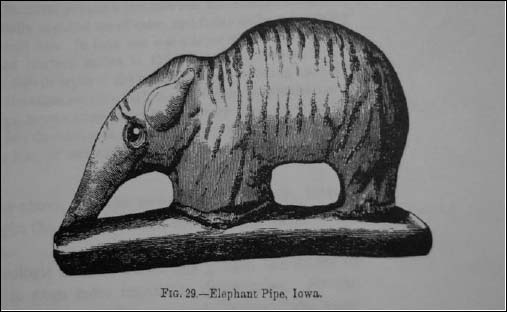
Putnam’s description of Henshaw’s methods as “culpable carelessness” is accurate and to the point. Much of American archaeology and anthropology of the period was careless. That is not so much an indictment, as an acceptance of things as they were. Both sciences were in their infancy, and standards for excavation, removal, and evaluation of artifacts were yet to be developed and adopted. Scientific bodies like the Davenport Academy, of which Putnam was a member, were working to bring some order and method to the process.
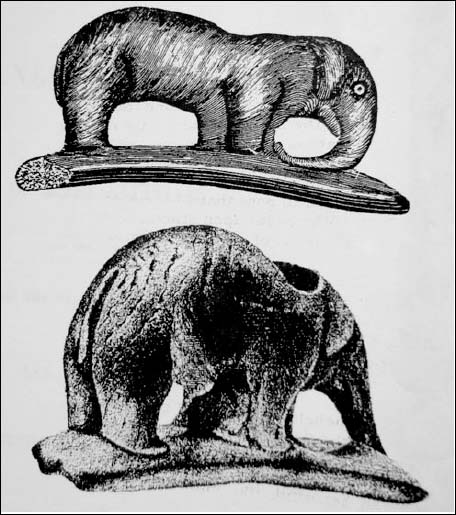
Indictment comes in Putnam’s characterization of Henshaw’s carelessness as culpable and intentional. Well meaning, self-taught amateurs have been an integral part of the foundation of scientific discovery, Galileo Galilei being just one of many examples. He had a questioning mind, used available technology, and invented his own tools. He developed and adhered to a set of processes and procedures and left mankind a legacy, not just of research and results, but of a way to go about doing the work. Not unlike Putnam, Squier and Davis, and many of their contemporaries, Galileo also ran up against an institution with a vested interest in an opposing viewpoint.
However, unlike the Roman Catholic Church, which in the face of sound, scientific evidence had the integrity to acknowledge the correctness of Galileo’s findings, the Smithsonian and the mainstream archaeological and anthropological communities have never been willing to revisit the issues associated with these ancient discoveries. They have simply accepted the decrees of the then current leadership. These were decrees made without any of today’s established laboratory and field-based artifact dating and physical and chemical property analysis advancements.
Standard methods were virtually non-existent at the time, along with appropriate tools and technology. Thus, an appropriate level of skepticism when dealing with individual claims was necessary. Henshaw, however, does not seem well meaning in his skepticism, which was based not on wanting to find the truth of the matter, but in furthering the Bureau’s views on the issues. He applied no method or process, but simply offered his unsupported opinion on artifacts, some he had never seen and knew nothing about. He did, however, agree with the view of a well-funded, influential government agency, which gave him credibility by providing a forum for his findings.
Putnam also found himself in the position of defending not only the Davenport Academy, but a number of individuals being criticized as well. Henshaw had attacked the Reverend Mr. Gass, by implying that he was salting the area with fraudulent artifacts, thus, attacking the authenticity of the finds by attacking an individual involved. Mr. Putnam correctly defended the veracity of the individual to counter Henshaw’s specious argument. Putnam found it amusing that Powell and his surrogates were working so hard to discredit the ideas that the Smithsonian itself had published the Squier and Davis report of 1848.174
Sadly, some of Henshaw’s claims were correct, relative to some of the artifacts in question, not due to any rigorous analysis of his own, but simply by claiming every find to be fraudulent. If one asserts that nothing is authentic, he is assured of some correct guesses, which then taints all other claims of authenticity.
Putnam defends of the Reverend Mr. Gass from Henshaw’s implied charge that he was busily planting mastodon carvings all over Iowa. He speaks of Gass character as ‘above reproach,’ praises his scholarly nature, and says that Gass is now preaching to a congregation at Postville, in northern Iowa, where he is, as he everywhere has been, highly esteemed by his people. Putnam attacks Henshaw for having gone outside his own special field—birds—and for trying to act as a dictator to archaeologists… Putnam strikes the David-and-Goliath theme by contrasting the little Davenport academy with the wealthy, powerful Smithsonian…Putnam sees Powell as a sinister puppet-master using the staff of the Bureau of Ethnology to further his own private theories. He finds it amusing that the ideas Powell is trying to overthrow were published by the Smithsonian itself; in the works of Squier and Davis, among many others. Powell’s attack on such works shows, according to Putnam, that the Smithsonian “has not been engaged in the ‘diffusion of knowledge’ at all, but instead, during all these years, has been scattering error broadcast through the land. We are, therefore, called upon to retrace our steps, to unlearn the lesson we have so long coined, and to take our places at the feet of strange teachers… This is certainly discouraging to American scholarship, and the thoughtful student will wisely pause and make careful inquiry as to which after all, is error—the earlier or the later deductions.
Charles Putnam’s spirited defense, even though it was unintentional defense of fraud, made a valid point. All too often powerful scientific establishments have, through scorn or suppression, stifled independent thought. Putnam feared that Powell’s new Bureau of Ethnology was using its great influence to impose an intellectual tyranny on American archaeology. Even though it happened that the Bureau of Ethnology was closer to the truth about the elephant pipes than was the Davenport Academy. Putnam’s fears were correct; in decades to come, on other subjects, the archaeologists who spoke for the Smithsonian were indeed able to impose their ideas on others—and they were not always correct…The cry of outrage from Iowa was a valiant but futile attempt to halt the new juggernaut.175
Powell was concerned that by opening up more of the mounds of the Mississippi basin, that the artifacts found might open up and encourage a whole new field to enthusiastic theorists. Ignoring the fact that many of the historic Indians have practiced the building of mounds, it was assumed that these works were the vestiges of a dense and extinct population whose advance in civilization was much superior to that of the known American Indians. From the size and the forms of their mounds, their location, and the objects contained in them, writers have set forth the origin, migrations, numbers, institutions, art, and religions of their builders… But those who have hitherto conducted the researches… (as claimed by Powell) were swept by blind zeal into serious errors even when they were not imposed upon by fraud and forgeries.
Then Henshaw takes over for a brisk demolition job. The first target is the revered Ephraim George Squier and his colleague Dr. Davis. Tactfully Henshaw pays homage to ‘the skill and zeal’ of Squier and Davis and to ‘the ability and fidelity which marks the presentation of their results to the public.’ Then he falls on them for having been too imaginative in interpreting the animal effigies seen on carved pipes from the mounds. Squier had claimed that several pipes showed manatees, large seal-like animals found only in tropical waters; the presence of manatee pipes in the Ohio mounds seemed to indicate the existence of some sort of (sea faring) trade route linking Ohio and the tropical shores of Florida, and even the possibility of a far-flung empire. Other pipes, according to Squier and Davis, showed the big-beaked tropical birds known as Toucans, giving further support to the theory of a highly developed, far-reaching Mound Builder civilization.176
Even with these kinds of findings “Henshaws’s conclusions amounted to a summary of the Powell position on the mounds. He wrote that no carvings had been found in the mounds that represented animals not native to the Mississippi Valley; that “the state of art-culture reached by the Mound Builders, as illustrated by their carvings, has been greatly overestimated,” and that “the theories of origin for the Mound Builders suggested by the presence in the mounds of carvings of supposed foreign animals are without basis.”177
Cyrus Thomas, the man whose report to the Bureau of Ethnology in 1894 became known as the final and last word on the origin of the Mound Builders, brought a swift stop to virtually all major explorations of the mound sites of the Hopewell and Adena cultures.
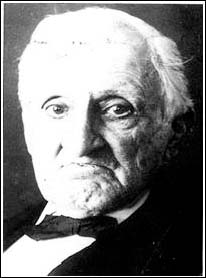
Cyrus Thomas
Thomas was born in 1825 and died in 1910, his life and work experiences varied; he worked as a lawyer, then a minister (1865-69) of the Evangelical Lutheran Church. He was associated with the U.S. Geological and Geographical Survey of the Territories from 1869 to 1873. As State Entomologist of Illinois (1874-76) and as a member of the U.S. Entomological Commission from 1876-77, he helped bring under control the insect plague that was retarding the agriculture of the border states. In 1882 he left natural science for social science, becoming an anthropologist and archaeologist at the newly established Bureau of Ethnology working under the direction of Powell, where he served until his death. Besides numerous articles on entomology and archaeology, he wrote anIntroduction to the Study of North American Archaeology in (1898) and The Indians of North America in Historic Times (1903).
Thomas’s report on the mound explorations given to the Bureau of Ethnology would alter previous assessments made as to the origin of the mound builders. It would be a catalyst in setting a new way of looking at these ancient Mound Builders.178
Powell’s tyrannical approach in a monopolistic, government-controlled scientific society, enabled him to wield great influence, not only as the Director of the Smithsonian Bureau of Ethnology and as the Director of U.S. Geological Survey, but also as the Director over Mound Building Explorations. This along with many other leadership positions in highly influential clubs and associations within the scientific community of Washington.
The Cyrus Thomas report of 1894 would lay the foundation for how these ancient mound-building cultures would be valued and viewed. Even though he only engaged a small crew, with limited resources, exploring only a modest number of the tens of thousands of mounds and earthworks of the vast interior of America, his ideas and conclusions that the Mound Builders were indeed the Native American Indians, would be quickly accepted and embraced. Yet he did not even attempt to answer which of the many Native American tribes were responsible.
The 1894 report, led to the nearly complete shutdown of further explorations into the mounds of Hopewell and Adena cultures. Many questions would remain unanswered, relating to how and why these ancient monuments were built. Were they built for defense or worship? Were they monuments to man or God? Were they inspired by fear or faith?
In addition to Cyrus Thomas and Henry W. Henshaw, John Wesley Powell would surround himself with a number of other loyal collaborators. One who would become very well known and highly influential in the sciences was Powell’s long time associate Otis T. Mason, who Powell hired shortly after taking office as Director of the Smithsonian Bureau of Ethnology. Mason would go on to become an iconic figure in the Washington scientific community.
Mason was born on April 10, 1838, in Philadelphia and attended Columbia University in 1856. Professionally, he accepted positions where he grew in stature within the Washington scientific community for the next 52 years. Then in 1872-1884, he collaborated with Powell in organizing the Bureau of Ethnology. In 1879, he became a founder of the Anthropological Society of Washington. In 1892, he served as President, along with becoming head curator of the Department of Anthropology at the Smithsonian Institution, a position he held until his death in 1908.
_______________________
171 Ibid., 140.
172 Ibid., 141.
173 Ibid.
174 See: Silverberg 141-142
175 Ibid., 143
176 Ibid., 132-133
177 Ibid.
178 See: Cyrus Thomas; report on the mound explorations of the Bureau of Ethnology 3–730. Twelfth annual report of the Bureau of Ethnology to the Secretary of the Smithsonian Institution, 1890–91, by J. W. Powell, Director. XLVIII+742 pp., 42 pls., 344 figs. 1894.