
CHAPTER 22

In 1889 on an official Smithsonian exploration into some mounds in Tennessee on behalf of the Bureau of Ethnology, Mr. Emmert, working under the supervision of Powell and Cyrus Thomas, was excavating a trio of prehistoric Indian mounds along the Little Tennessee River near the mouth of Bat Creek.
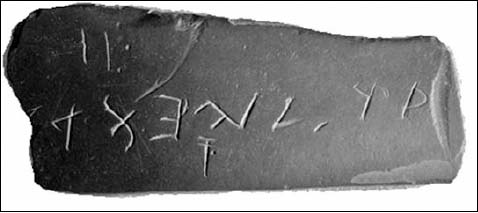
Bat Creek Stone
As they were excavating Mound #3 of the earthworks they found some wood fragments and skeletal remains of some nine adult males, being laid side by side in a single row, while one pair were positioned apart from the others. The head of the easternmost skeleton pointed south while the others were aligned to the north. “Emmert noticed that the skull of the lone southward-oriented figure was resting on something slightly protruding from its jaw. Carefully lifting the cranium he found a rectangular stone, 115 mm (about 4’5 inches) long by 50 mm, (about two inches) wide by 10 mm thick. More remarkably, the apparently shaped artifact had been engraved with five letters belonging to a mysterious script.”179
Emmert reported the find to his immediate superior. Cyrus Thomas (1825-1910) not only the bureau chief [over mound exploration] but one of the most politically connected academics of his day.
Thomas was unimpressed by Emmert’s inscribed tablet, dismissing the stone’s inscription as “Paleo-Cherokee.” This was an early 19th-century attempt by Sequoyah (cira 1770-1843), an Indian silversmith, to develop a Cherokee syllabary, making reading and writing in his native language possible. It signified the only time in recorded history that a member of a non-literate people independently created an effective writing system. Sequoyah’s syllabary was officially adopted by the Cherokee Nation in 1825.
Thomas forwarded the Bat Creek Stone to the Smithsonian Institution Museum, in Washington, D.C., where it was briefly put on public display as a minor curiosity, then shelved and largely forgotten. More than sixty years later, its photo in a turn-of the century history book came to the attention of Dr. Joseph P. Mahan (1921 to 1995), Professor of History and chief curator at Columbus Georgia’s Museum of Arts and Crafts. He recognized at once that the inscription on the Tennessee tablet was not “Paleo-Cherokee,” but Paleo-Hebrew. In their ignorance of its real identity, Smithsonian officials had first displayed, then photographed and published Emmert’s discovery upside-down.
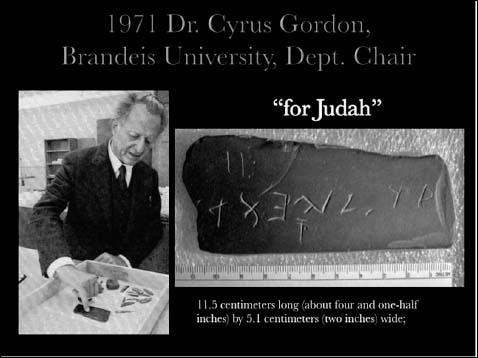
Alarmed, Dr. Mahan immediately contacted [Dr.] Cyrus Gordon (1908-2001), a Professor of Ancient Languages at New York’s Brandeis University. He handily translated the Bat Creek Stone’s inscription “for Judah” and dated it according to internal linguistic evidence between 70 and 135 A.D.. These time-parameters coincide with the statements of Flavius Josephus (37 A.D. circa 100) a 1st-century Romanized Jew. In The Jewish War (circa 75 A.D.), he told how “ The Hebrews fled across the seas to a land unknown to them before.” The term of “land” Josephus used was Epeiros Occidentalis, or “Western Continent,” a self-evident reference to America. This would mean that Hebrew-speaking war refugees from the ancient Old World arrived in eastern Tennessee more than 1,300 years before Christopher Columbus undertook his first transatlantic voyage.180
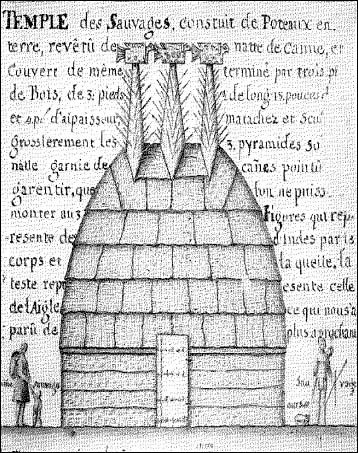
The Hebrew’s of the Old Testament times were not the only ones who built Temples as a place of worship. Found in the Peabody Museum, at Harvard University is this Acolap matting depicting a Temple as a place of worship used by the Acolapissa Indians of the Choctaw linage. Temples and ceremonial sites seemed to be held in common with the mound building cultures found in North America.
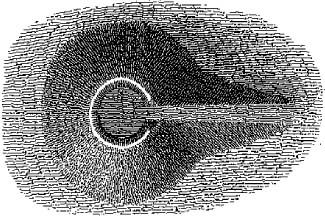
Ancient Monuments, Squier and Davis, Fig. 65
_______________________
179 Wayne May, Ancient American Magazine: Issue 93, 32-33
180 Ibid.