
CHAPTER 23

Although Mason, Thomas, Ward and Henshaw were loyal supporters and collaborators with Powell, “not all scientists working with Powell agreed with his evolutionary anthropology. Franz Boas a liberal from a Jewish-German family secured a position at the American Museum of Natural History in New York, which led eventually to a faculty position at Columbia. Even though Powell helped fund some of his travels and studies, “He may have been grateful but he thoroughly opposed Powell’s evolutionary anthropology.”181
A short while after coming into the country, Boas published a critique of an exhibit at the National Museum organized by Powell’s associate, Otis Mason…Out of the extensive holdings of the Smithsonian: Mason had selected artifacts to show the progression from savagery to civilization. Boas thought it was a bad idea. Better to show each culture as separate and unique, with no judgment about where it ranked on the evolutionary scale. Powell came to Mason’s defense by arguing that Indian cultures had undergone much shifting through time, making it impossible to display them as static or coherent. Without the map of evolution, one was thrown back on a racial or linguistic or environmental classification, all of which posed serious problems. For Powell, the issue was whether all peoples were one or not; ranking them on a single scale of evolution made them so. Boas, on the other hand, in rejecting that single scale risked dividing the species into segregated fragments.
Both men saw themselves as defending a more enlightened attitude toward race. They agreed that racial minorities should not be judged as naturally inferior when they failed to match the whites in wealth and power. They agreed that all peoples shared a common biological heritage, though Boas paradoxically could not resist trying to discover how racial differences might influence body and mind. Where they clashed was over the ranking of human cultures on a scale of progress. For Boas, such a scale was not founded on the phenomenon, but in the mind of the student.182
“Accusing Powell and Mason of blindly setting up their own culture as the world’s ideal, he called for an anthropology that examined each society in its own terms. All judgment about “higher” or “lower” was biased, and all Judgment should be avoided.”183
Powell’s, Morgan’s, and Mason’s writings on evolutionary theories and world ideals were being challenged as biased secular judgments and statements based on race and religious prejudices. Otis T. Mason would quickly respond to these accusations, claiming they [the accusations] were based on their own biased judgments due to Boas’ [and the accusers] own traditional religious beliefs and religious history indoctrinations.
The one thing that Powell’s men of science were very much in accord with was their belief in the superior nature of science, for they were all quick to challenge anyone who took issue with their newly-founded evolutionary dogmas.
Powell was convinced that science and its methods were superior in every way to the dark superstitions of a shaman or priest. Their perception of nature, though interesting, was not equal in truth-value to that of the modern scientist’s. By refusing to see the limitations of the primitive mind…Boas was in effect refusing the superior authority of science. By celebrating cultural difference, he was blocking the search for laws governing history. By idealizing pre-modern cultures, he was condemning civilization…The twentieth century, which often has been hard on the self-confidence of both science and civilization, has been good for Boas reputation, but during the last quarter of the nineteenth century, self-confidence among the evolutionists was high, and Powell’s cultural evolutionism ruled.184
J. W. Foster, in his 1873 book Prehistoric Races of the United States, pointed out that as advancements were being made in the evolutionary sciences “however strange these new views with regard to the origin of history of our race may appear, they cannot be disregarded. We must weigh the value of observations, and press them to their legitimate conclusions.”185 With this in mind, the evolutionary sciences of anthropology and ethnology would emerge. “Ethnology,” as Sir John Lubbock remarked, “is passing through a phase from which other sciences have safely emerged, and the new views in reference to the Antiquity of Man, though still looked upon with distrust and apprehension, will, I doubt not, in a few years, be regarded with as little disquietude as are now those discoveries in astronomy and geology, which at one time excited even greater opposition.”186
It would be this same Sir John Lubbock that would be credited for making this observation: “What we see depends on what we look for.” Conversely, if we never know what to look for then we will never see.
Ethnological science, so susceptible to the winds of politics and racial conflict, was turning out to be harder to pull off than Powell could have imagined. But for all his distractions and embarrassments he was succeeding to an impressive degree. By the mid-1880s, it was clear that the Bureau of Ethnology was the most important institution in anthropology America had ever seen, and indeed it would remain among the most important such institutions America ever would see. The bureau’s annual reports were magnificently produced on heavy paper, lavish with illustrations. They opened the public’s eyes to the exquisite arts, the settlement history and ceremonies, the intricate calendar systems, and the bewildering variety of languages of the native peoples. If Powell did not manage to achieve a full science of man, as he had hoped, he achieved more than any other individual of his generation toward that end.187
Powell reviewed the legislative authority he had for his operations. On a second day he came back to ask that bureaus, like his own ‘be left free to prosecute … research in all its details without dictation from superior authority in respect to the methods of research to be used.’ If supervision was necessary, it should come from the wise old heads at the Smithsonian, not a new board, a cabinet officer, or the military. Such an independent institution, run by scientists but depending on federal appropriations, was the best solution to the modern demand for governmental research support, one that was gaining ground even in the older countries of Europe.188
Years earlier, in an obituary for an obscure student of the Colorado mountains, Powell had complained that too much bad science was being done, competing against the good. “Some of our geological literature,” he admitted, “could be burned and no harm done. O that a Pope would rise in the holy catholic church of geologists —a pope with will to issue a bull for the burning of all geological literature unsanctified by geological meaning.” But administrative experience had taught him that research “cannot be controlled by some central authority, as an army by its general, from the fact that scientific men, competent to pursue original research, are peculiarly averse to dictation and official management.189
Powell was always wrestling with how much control to implement in the advancement of science as he saw it. Powell sent a message, loud and clear, to Congress that they shouldn’t try to legislate science, but leave it to scientific administrators who understood best the complexity of the ethnological issues. In a reappearance before the Allison commission in February, 1885, Powell reiterated the point: “Scientific men are, as a class, the most radical democrats in society--patient, enthusiastic, and laborious while engaged in work in which they are thoroughly absorbed, by methods which command their judgments, but restive and rebellious when their judgments are coerced by superior authority.”190 The clear message sent to congress was that they should let the scientists, who knew best how to prune the bush as needed, for these men of science could apply both basic and applied science. They would see it that —"there is no scientific research which is not for the general welfare.” He granted that government should not take over all research, but added, “private research is very greatly retarded in America because certain lines of research which only the Government itself can pursue have been largely neglected.”191
On the 12th of January, 1890 on the front page of the New York Herald, were shrieking headlines followed by an accusatory-article: “Scientists Wage Bitter Warfare…Serious charges against Director Powell and Prof. Marsh…Corroboration in Plenty…The spectacle continued for days, affording much entertainment to a public not use to seeing renowned scientists throw punches at each other…The charges against Powell were a mix of old rumors…Powell was accused of setting up “a gigantic politico-scientific monopoly, run on machine political methods.”192
Powell viewed legislative authority and control over the sciences as too intrusive and unnecessary in any case. Speaking before a Joint Committee of Congress his “clear message was that congressmen should let the scientists to themselves, and the scientific administrators who understood them best, do any pruning that (may be) needed.” Arguing that, “there is no scientific research which is not for the general welfare.”193 By this time in Powell’s life, he understood how the sciences could be used, in the shaping of policy, and in helping to provide a future course for society to follow.
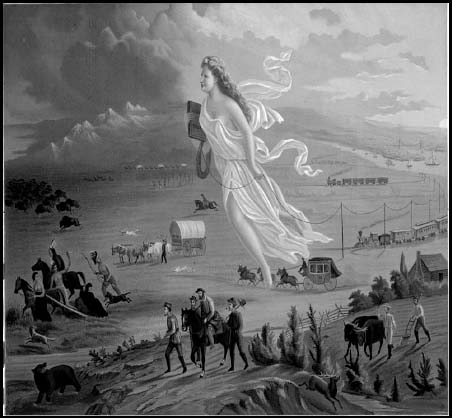
Manifest Destiny
_______________________
181 Franz Boas papers America Philosophical Society. Letter John Wesley Powell to Boas, 7 June and 3 July 1895; Boas to J.W. Powell, 19 June
182 Franz Boas; Museums of Ethnology: Reply letter, 614
183 Worster, River Running West the Life of John Wesley Powell: 457.
184 Ibid., 458.
185 J. W. Foster; Prehistoric Races of the Untied States.(1873) 18.
186 Sir John Lubbock Prehistoric Times, preface as quoted by J. W. Foster (1873), Prehistoric Races of the Untied States.
187 Worster, 408-409.
188 Administration of the Scientific Work of the General Government. 75
189 See: Worster, 425.
190 Ibid. 425 (Ref. “Testimony before the Joint Committee, 381) 602:77
191 Ibid. See: 425.
192 Ibid. 492.
193 Ibid.