
CHAPTER 31

In the book, Kinship and the Social Order, the Legacy of Lewis Henry Morgan, Meyer Fortes, providing context for much of what Morgan wrote, states: “In short, if we want properly, to understand in what ways Morgan’s work remains significant for us, we must look behind the intellectual conventions and the dominant forms of thought of his time, those in which he dressed up his observations and ideas, and we must try to see what he was really getting at. We must, as it were, read between the lines of his writings.”254 Lewis Henry Morgan, the man referred to as America’s Father of Anthropology, and the man credited for introducing Social Darwinism to America, developed hypotheses that would go on to revolutionize the whole of society, altering the human experience and the course of human history. His revolutionary ideas would be read by many of the leading anthropologists worldwide, receiving great distinction, as they would seek him out for advice and counsel.
History, we are often warned, is a fickle jade. Morgan was by all accounts as robust and uncompromising an American of his day as could have been found anywhere in the United States. Yet his ideas and discoveries, revolutionary as they were for the science of man, suffered eclipse in his own country at a critical time. Like the proverbial prophet, his following was greater outside than within his native land at that time…It was a British anthropologist, W. H. R. Rivers, whose rediscovery of Morgan restored him to his rightful place in the main stream of anthropological scholarship.255
“Even though his hypothesis of primitive promiscuity and group marriage, the preposterous scheme of stages of social evolution and the dreary additions to kinship terminologies…loomed behind him as the misguided inventor of primitive communism,”256Morgan’s theories cloaked in silence has emerged to create a more copious and secular society.
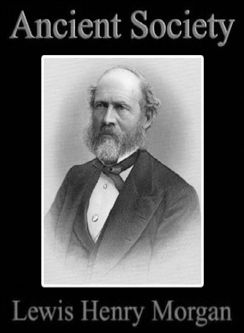
In Morgan’s book “Ancient Society,” published by Henry Holt and company in 1877, Morgan addressed his research into the lines of human progress from Savagery through Barbarism to Civilization. He explored the kinship relationships and the evolution of the family. It was a book that would become widely translated and would become Morgan’s most well-known and influential work. Yet it only enjoyed a tacit acceptance among some serious social scientists. Morgan’s findings, as viewed today, are seen to be erroneous, as his research endeavored to make an India/ Indian connection that has since been subjected to more modern and serious scientific scrutiny. In spite of this fact, Morgan’s theoretical house still stands in the minds of the world at large, even though much of the material used in the footing and foundation have eroded with time. His theoretical house still stands in the minds of many, being only supported by faltering pillars and lingering footings of academic tradition.
Morgan would look to kinship comparisons to help substantiate his theories on the origins and the formation of a family unit within a tribe. From Morgan’s observations and reflections as given in Lewis Henry Morgan, The Indian Journals 1859-62: “One custom which interested Morgan greatly was that of ‘sleeping nude.’ Whenever he visited a tribe, or interrogated an informant, he almost always asked about this. This seems rather quaint and curious to us today because we do not attach any particular significance to it. But Morgan was trying to find ways to demonstrate the Asiatic origin of the American Indian. It occurred to him that customs—saluting relatives by kinship terms, wearing the breechcloth, and sleeping nude—might yield significant evidence upon this point. Each of these was a ‘domestic custom,’ i.e., practiced within the family or kinship group, and, as such, was passed down from one generation to another. Consequently, if one found two people living in widely separated areas that practiced these customs, it might reasonably be inferred that they were descended from a common ancestry. Few anthropologists, if any today, would accept Morgan’s reasoning, but a century ago his hypothesis was certainly a reasonable one and deserved to be tested.”257
Scholars who have reviewed Morgan’s kinship research have raised questions about whether these early men of science understood the broad and sweeping effect that their theories and views would have on the whole of society. Did these early men of ethnology and anthropology realize then that the theories they were espousing would change the course of human history? Was their work pure science or were they just looking to address pressing political, religious and social issues of their day? For answers, perhaps society today should take Fortes’ challenge to “read between the lines of [Morgan’s] writings.”258
“Morgan’s speculative theories had partisans too. I am thinking not only of their adoption by Marx and Engels as the gospel source for their theory of the origin of the family and the state, nor of the cordiality of Maine or the enthusiasm of Bachofen. I have in mind rather such more respectable and influential support as these views received from people like Lord Avebury (1870), and from Sir James Frazer even as late as 1910.”259
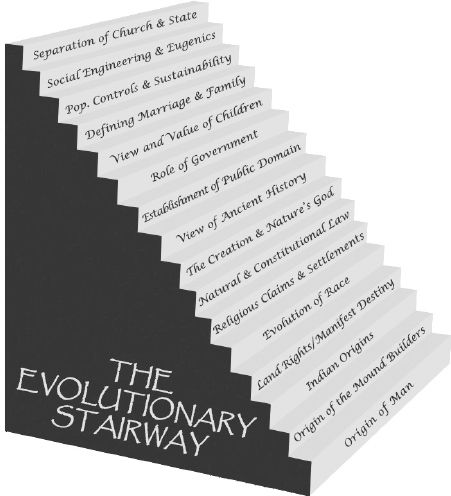
Even though Morgan theories had partisan overtones, John Wesley Powell, who had studied and admired the writings of Morgan, came to realize how these evolutionary theories, could be used as a tool to create social reform. They came to realize that many social and political concerns could be advanced through the sciences by placing them on what has been referred to as the evolutionary stairway.
Powell’s “will, to discover all the possible means by which human aspiration and belief and custom had been institutionalized, and the conviction that every variant could be placed somewhere on the evolutionary stairway, gave direction and system to Major Powell’s work in ethnology.”260
No one really knows, all the variants that Powell would have placed on his evolutionary stairway back in the 1800’s. Nor could they have ever imagined the enormous impact that their evolutionary thoughts would have had on the whole of society. But, perhaps these men of the early sciences did come to understand, that if they could get society to view the world through evolutionary lens, that it would bring about many political and social reforms.
Powell and Morgan became respected friends, and both would be elevated to important positions of power and influence within the government and scientific community. These contemporaries from western New York would go on to advance their revolutionary theories, which have changed how society has viewed and valued the American Indian, the ancient mound building cultures, the origin of man, the evolution of race, private property rights, natural law, population growth and the role of government.
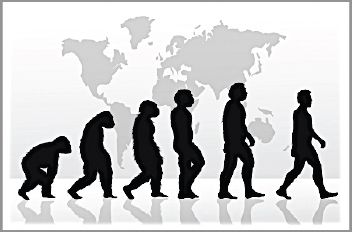
Today, sociologists and historians are beginning to understand better how insightful these early social engineers were in creating a whole new world view. These early men of American Science, did come to understand that they could bring about many societal changes by getting society to view the world through evolutionary lens.
Were the early inhabitants of ancient North America more culturally advanced and refined, than commonly portrayed?
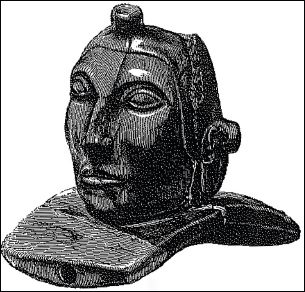
Ancient Monument, Squier and Davis: p. 245 Fig. 145
_______________________
254 Ibid., 14.
255 Ibid., 3.
256 Ibid., 4-5
257 Leslie A. White, Lewis Henry Morgan the Indian Journals 1859-1862, (Ann Arbor: The University of Michigan Press) 22
258 Meyer Fortes, Kinship and the Social Order, The Legacy of Lewis Henry Morgan: 14.
259 Ibid. 8
260 Wallace Stegner, John Wesley Powell, Beyond the Hundredth Meridian, Riverside Press, Cambridge, Boston, Massachusetts 255