
CHAPTER 32

Lewis Henry Morgan’s theories would influence social reform and public policy well beyond the borders of America. Friedrich Engels was a German political theorist, philosopher, and social scientist, who alongside Marx, fathered Communist theory. In Engels 1884 book, The Origin of the Family, Private Property and the State, on the cover page the inscription, reads: “In the Light of the Researches of Lewis H. Morgan.” Also in the 1892 edition of the book he added an appendix, “A Newly Discovered Case of Group Marriage” - ideas shared by Morgan.
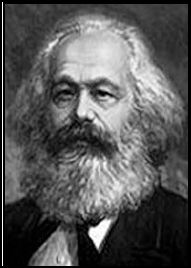
Karl Marx
In the preface to the first printing of The Origin of the Family, Private Property and the State, Engel writes:
The following chapters constitute, in a sense the fulfillment of a bequest. It was no less a person than Karl Marx who had planned to present the results of Morgan’s researches in connection with the conclusions arrived at by his own—within certain limits I might say our—materialist investigations of history and thus make clear their whole significance. For in America, in his own way, Morgan had indeed rediscovered the materialist conception of history that was discovered by Marx forty years ago, and in his comparison of barbarism and civilization had been led to the same conclusions, in the main, as Marx had arrived at. And just as Das Kaptial was for years both zealously plagiarized and persistently hushed up by the professional economists in Germany, so was Morgan’s Ancient Society treated by the spokesman of “prehistoric” science in England.261

Friedrich Engels
Engels went on to say:
Morgan’s great merit lies in having discovered and reconstructed this prehistoric foundation of our written history in its main features, and in having found in the groups based on sex of the North American Indians the key to the most important hitherto insoluble riddles of the earliest Greek, Roman and German history…Morgan was the first person with expert knowledge to attempt to introduce a definite order in the study of the history of primitive man; unless important additional material necessitates alterations, his classification may well remain in force. Of the three epochs: Savagery, Barbarism and Civilization, he is naturally concerned only with the first two epochs into a lower, middle and upper stage.262
“The family,” says Morgan, “represents an active principle. It is never stationary, but advances from a lower to a higher form as society advances from a lower to a higher condition…Systems of consanguinity, on the contrary, are passive; recording the progress made by the family at long intervals apart, and only changing radically when the family has radically changed.”… “And,” adds Marx, “the same applies generally to political, juridical, religious and philosophical systems.”263 “According to Friedrich Engels, Morgan had, in a manner, discovered anew the materialistic conception of history, originated by Marx….”264
In relation to this frame of thought, and more particularly to the nature and paucity of the observational data that could be drawn upon, Morgan’s contribution was sensational. The criticism that broke loose, even from some who were broadly in agreement which his ideas testified to this. The story has been well told by others, but what I wish to underline is that the focus of attention was then, and so remained for fifty years, Morgan’s speculative hypotheses. The glaring fallacies in his reasoning and the shaky foundations of his conjectures were easily exposed. Darwin, arguing from the analogy of sexual selection and mating habits among the lower primates, was one of the first to express reservations amounting to a rejection of the promiscuity and group marriage hypothesis. But even he couched his objections in terms of deference to the prevailing ethnological opinions of his day.265
Morgan’s book, Systems of Consanguinity and Affinity of the Human Family, is referred to as Systems and was published as Volume XVII of the Smithsonian Contributions to Knowledge.
“The investigations, of which Systems was the result, were undertaken in order to demonstrate the Asiatic origin of the American Indian. Attempts to explain the various kinds of kinship systems and to render their curious features intelligible led Morgan to formulate a theory of social evolution: human society began in a condition of promiscuity, without marriage or family, and subsequently evolved through a series of stages to the monogamous family of today.”266
“But Morgan’s supposed demonstration of the Asiatic origin of the American Indian was unsound. The similarity, or virtual identity—as in the case of the Tamil [a tribe found in India] and Seneca [a tribe found in the United States northeast]--of kinship nomenclatures does not necessarily mean genetic relationship; such similarities or identities are more properly explained in another way: as functions of like social systems. And his theory of the evolution of the family, which he regarded as ‘the most remarkable result by far of the investigation,’ has been obsolete for decades.” 267
Morgan, while living in England (1870-71), met with Sir John Lubbock, President of the Royal Anthropological Society. Lubbock had earlier served as President of the Ethnology Society for the years 1864-65, and was a close acquaintance of Charles Darwin. Darwin would go on to be very influential in helping him in the publication of his book, the Origin of Civilization, a book that also recognized group marriage, an idea that Morgan would later raise in his 1877 book, Ancient Society.
Immediately after his arrival home, in 1871, Morgan appeared rejuvenated in his writings. He had become convinced that the peculiar system of kinship prevailing among the Iroquois was common to all the aborigines of the United States and was thus spread over a whole continent, although it conflicted directly with the degrees of kinship actually arising from the system of marriage in force there. He prevailed on the American Federal Government to collect information about kinship systems of other peoples, on the basis of questionnaires and tables drawn up by Morgan. He drew the following conclusions from the data:
1. That the American Indian system of kinship prevailed among numerous tribes in Asia and in a somewhat modified form in Africa and Australia.
2. That it was completely explained by a form of group marriage, now approaching extinction, in Hawaii and in other Australian Islands.
3. That alongside this marriage form, a system of kinship also prevailed in these same islands, which would only be explained by a still earlier, but extinct form of group marriage.
He published the collected data and his conclusions from them in his Systems of Consanguinity and Affinity (1871) and thereby carried the discussion on to an infinitely wider audience. Taking the systems of kinship as his starting point, he reconstructed the forms of the family corresponding thereto, and thereby opened up a new path of investigation and a more far-reaching retrospect into the pre-history of mankind.268
This is the point at which Morgan’s chief work enters: Ancient Society 1877, the book upon which the present work is based. What Morgan only dimly surmised in 1871 is here developed with full comprehension…Morgan, however, did not rest content with this, origins of the civilized peoples has the same significance for primitive history as Darwin’s theory of evolution has for biology, and Marx’s theory of surplus value has for political economy. It enabled Morgan to outline for the first time a history of the family, wherein at least the classical stages of development are on the whole, provisionally established, as far as the material at present available permits. Clearly, this opens a new era in the treatment of primitive history.269
Did Morgan and Engels alike realize that to change society you have to change how family and property are valued and viewed? One effective way to accomplish such a task is by changing how property is owned and how estates are passed on to family. Fortes points out in Kinship that Morgan realized some explanation would be necessary, as family structure would need to be changed. He was able to produce a trump card to help bring it about, the denying of the “rights of property and the succession of estates.”270
Darwin, Powell, Engels and Marx all came to realize that Morgan found, in his kinship and evolutionary studies into the origins of man and the mound-building cultures, conclusions that could revolutionize society through introducing a whole new social order as a way of thinking.
Engels would summarize the works of Lewis Henry Morgan in this way: “Morgan filled the cup to overflowing not only by criticizing civilization, the society of commodity production…but also by speaking of a future transformation of society in [the] words which Karl Marx might have used, he received his desserts.”271
It is [also] nevertheless true that Marx paid more attention to the natural sciences (physiology, geology and, above all, mathematics) during the last decade of his life than he ever did before. He was also much interested in the beginnings of anthropology and enthused about the work of Lewis Morgan, a once much-respected writer whose scholarly reputation has not survived subsequent research. In the winter of 1880-1881 Marx drew up with great care a hundred pages of excerpts from Morgan’s “Primitive Society”, excerpts later used by Engels in his Origin of the Family. What particularly interested Marx in Morgan’s book was the democratic political organization of primitive tribes together with their communal property.272
Engels also points out that:
During the fourteen years that have elapsed since the publication of his chief work our material relating to the history of primitive human societies has been greatly augmented. In addition to anthropologists, travelers and professional pre-historians, students of comparative law have taken the field and have brought forth new material, and partly new points of view. As a consequence, some of Morgan’s particular hypotheses have been shaken, or have even become obsolete. But nowhere have the newly-collected data led to the supplanting of his main conceptions by others. In its main features holds good to this day.273
The American father of Anthropology, Lewis Henry Morgan of Rochester, New York was an author, lawyer and a premier pioneer of American anthropology and a leading contributor of his generation to the social sciences. Morgan’s technical, Systems of Consanguinity and Affinity of the Human Family was decisive. His interpretation of the genesis of kinship has played a major role in the intellectual community of the eighteen and nineteen hundreds. The author Carl Resek wrote “To ask that Morgan was the most important social scientist in nineteenth century America is an understatement. He belongs in the galaxy of brilliant New Yorkers, which included DeWitt Clinton, Joseph Henry and James Hall, who drew the attention of the whole world to New York State.”274
“He [Morgan] has been claimed as the intellectual peer of Darwin, Hebert Spencer and Edward Tyler, and the Marxists who have played up his influence on Engels…But we now understand that he was less influenced by scholars of the day than by politicians [and] by his local church and pastor, the Rev. Joshua McIlvaine and by the issues and pressures that beset the Rochester of his day.”275
Morgan’s study and understanding of ancient societies allowed him to gain a unique perspective, which would be used to advance in the science of man, evolutionary thought, and in creating a new revolutionary view of family, marriage and communal life. An understanding that was nurtured though his experiences as a politician in Rochester, New York, where he had to deal with the Indian populations and the religious zeal that was taking place in that region of the country.
Two of the most famous men in history to praise the insights of Morgan, were none other than Karl Marx and Fredrich Engels, German born social reformers who were part of a larger group of social reformers who called themselves the Communist League. Marx and Engels would team-up to publish a political pamphlet, “The Communist Manifesto,” that became one of the most influential in history. It proclaimed that the history of all hitherto existing societies were a history of class struggles. And that the inevitable victory, of the proletariat, or working class, would put an end to class warfare in society forever. This revolutionary cry for change had little immediate impact, but its ideas would reverberate with increased force into the 20th century and by the mid-1900’s, over half of the world’s population would live under Marxist ruled governments.
It was not only Fredrich Engels and Karl Marx who would praise Morgan revolutionary insights. But in 1880, John Wesley Powell would go on to write a special tribute of Morgan, which was published in Popular Science Monthly 18:114-21 titled: Sketch of Lewis H. Morgan, President of the Association of the Advancement of Science.
_______________________
261 Friedrich Engels, The Origin of the Family, Private Property and the State: In the Light of the Researches of Lewis Henry Morgan, (New York: International Publishers) 5
262 Engels, 6,19.
263 See: Friedrich Engels, The Origin of the Family, Private Property and the State: In the Light of the Researches of Lewis Henry Morgan, (New York: International Publishers) 26 L. H. Morgan, Ancient Society, 444—Ed. England
264 Engels, The Origin of the Family Private Property and the State, 1884; Preface to the first addition and Origin 26- Leslie A. White.; Lewis Henry Morgan. The Indian Journal 1859-62
265 Fortes, 8
266 White, Lewis Henry Morgan’s Indian Journals: 10,
267 See: White, Lewis Henry Morgan’s Indian Journals: 10, 11
268 Engels, 12,13
269 Ibid., 14-15.
270 Fortes, 32-33.
271 Engels, 16.
272 Karl Marx: His Life and Thought, by David McLellan pages 423-424
273 Friedrich Engels; The Origin of the Family, Private Property and the State: 16, London June 16, 1891
274 Carl Resek, Lewis Henry Morgan: American Scholar; University of Chicago Press, 1960
275 Lewis Henry Morgan / William Fenton Introduction, League of the Iroquois, Intro. VIII