
CHAPTER 52

On a quiet Saturday afternoon while traveling alone, I decided to take a scenic drive atop Bristol Mountain in the Finger Lake region of western New York. At the time, I was doing some research into the early years of Lewis Henry Morgan and John Wesley Powell, who both had been born and lived in that region of western New York. As I was driving up this quiet mountain road, I came upon a sign advertising a bookstore of old and rare books. I pulled into the driveway that led to the backside of an old farmhouse only to find an old turn-of-the-century barn, beautifully finished and temperature controlled, stocked with old and used books. One of the oldest books I found was dated 1888. It was the sixth printing of Thomas Malthus’ An Essay on the Principle of Populationpublished in London in 1798. Malthus was a Cambridge political economist and history professor and his first essay on the principles of population was published as this book. In the preface to the second edition he states, “In the course of this inquiry, I found that much more had been done than I had been aware of when I first published the Essay. The poverty and misery arising from a too rapid increase of population had been distinctly seen, and the most violent remedies proposed, so long ago as Plato and Aristotle.” 412
Thomas Malthus was convinced there were too many people in the world and that further increases in population would lead to overcrowding, wars and mass starvation. “Malthus believed that, left unchecked, population growth would far outstrip increases infood production. This was in an age when the soil was tilled by horse or oxen-drawn plows.”413
While studying in England, Lewis Henry Morgan was heavily influenced by British evolutionary theorists of his day, who at that time would tout the intriguing works of Thomas Malthus. His ideas were growing in popularity and, even then, being proposed as a tool to perfect both man and society through population control measures. Malthus affirmed, “my object was to apply it, to try the truth of those speculations on the perfectibility of man and society, which at that time excited a considerable portion of the public attention.”414

The Buffalo and Indians Unique Relationship
One of his most daunting ideas found in Malthus’ 1798 book, Essay on the Principle of Population, in the forth chapter, titled The Check To Population Among the American Indian. In this chapter he would refer to the Indians as savages living in a barbaric country. He depicted the Indians as “tribes of hunters, like beasts of prey whom they resemble in their mode of subsistence, will consequently be thinly scattered over the surface of the earth… Under such circumstances, that America should be very thinly peopled in proportion to its extent of territory, is merely an exemplification of the obvious truth, that population cannot increase without the food to support it…I would wish particularly to draw attention of the reader, [to] the mode by which the population is kept down to the level of this scanty supply.”415
One of the population controls measures in which Malthus would go on to suggest, “to keep populations in check” was that of controlling a population’s food supply. This practice was later used in America as massive herds of buffalo were killed in an attempt to drive the Indians to submit themselves to reservation life.

Buffalo Skulls
Buffalo were the primary protein food source for the Indian populations of America’s heartland.
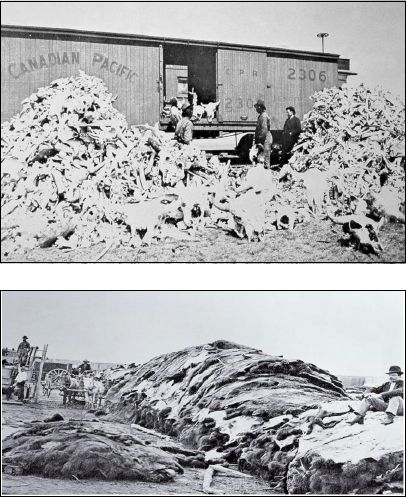
Malthus went on to make reference to the Indians as savages with barbaric instincts, a term that would also be used later over and over again by Morgan and Powell. He believed that what would govern their behavior in a time of scarcity would be the “great law of self-preservation.” The idea of keeping Indian populations in check as advised by Malthus, along with other social and political imperatives would help to influence the race legislation of the 1800s. These Malthusian ideas would be used to advance many population control measures, not only to curb populations of the Indians in the 1800s, but later these same ideas would be used to curb growth of populations around the world.
Thomas Malthus’ foundational theories on population, incorporating in it a scarcity mentality, that food production cannot keep pace with population growth. This later would be espoused, and readily embraced by key leaders of both the American and English scientific communities. Powell was left with an interesting dichotomy, for he and others were learning from western settlements that with new innovations and irrigation techniques, that in the near future there might not be any practical limits on how much food could be produced. With this divergent view to Malthus’s writings, Powell would be left to ponder how these Malthusian impressions as to the scarcity of resources might change society’s future perceptions.
Earlier in his career he had been a utopian, but one with his feet on the ground, his idealism tempered by science. Now he had given up expecting much from the West. The chance to plan a truly different society there had come and gone. He did not altogether give up on America or on the small farmer. If the public domain no longer offered much opportunity for agrarian democracy, the cities might. In an address to New York farmers, Powell predicted that the trend in agriculture was toward raising more food on smaller parcels of land. Farmers were intensifying their production, often in greenhouses, controlling the elements of nature to improve yields. So far this trend was limited to cultivating vegetables for local markets, but in the future farmers would grow even the cereal crops on very small plots, and under glass. Irrigation offered vital support to that trend all over the country, for it was capable of increasing every farmer's output by fivefold. The whole body of the 'agricultural world will gather in the suburbs of the cities and towns,’ he declared, leaving the vast hinterland to livestock and forests. “There appears now to be no practical limit to the amount of food which can be produced by mankind.”416
Yet, even today with the advancements and new innovations in agricultural science, there still exists a scarcity mentality that society cannot sustain itself going forward. Don Feder, J.D. and former Boston Herald writer, in a speech on demographics pronounced the changes that are taking place around the world.
In a talk given at the 2011 Demographic Summit at the University of Moscow in Russia he stated:
The world now has seven times as many of us, as when Malthus made his apocalyptic forecast and [Paul] Ehrlich [author of the book, the Population Bomb] looked into his crystal ball and saw mass worldwide starvation. Neither of those failed predictions has deterred the population mystics, who continue to concoct end-of-the-world scenarios based on “overpopulation.” Over the past four decades (just as over the past 200 years), food production has far surpassed population growth. It always does.
Instead of starvation, it’s now an environmental cataclysm—mountains of trash, seas of pollution and an ever-widening hole in the ozone layer. Each person is said to have a “carbon footprint,” which leaves an indelible mark on the planet. And when the latest generation of population hysterics is proven wrong, once again, the next will come up with their own forecasts of gloom and doom. Thousands of years ago, when we were all living in caves or huts, the paleoMalthusians probably thought the world was overcrowded then and confidently predicted decimation of the herds of woolly mammoths if population growth continued unabated.
When Paul Ehrlich, a Stanford Professor and entomologist (someone who studies insects), published his book: The Population Bomb in 1968, he told his readers that there were far too many of us—a conclusion he reached on a trip to Calcutta. Unless population was drastically curtailed, Ehrlich predicted with total assurance: “In the 1970s and 1980s hundreds of millions of people will starve to death in spite of any crash programs.” If you missed hundreds of millions of people starving to death in the 1970s and 1980s, that’s because it never happened. The only starvation that occurred was due to civil war, collectivized agriculture or government mishandling of food supplies.417
To understand the sustainability dogma that exists in the world today, perspective is something that is important to comprehend. The following example helps to provide perspective as to whether there will be enough food and resources on this planet to sustain continued population growth going forward.
In this hypothetical example, one assumes that if you could take the entire world population, which is close to 6.8 billion, and give every man, women and child on earth a quarter of an acre of land, a family of four would have an entire acre of ground to live on and cultivate for food. This same calculation shows that the entire world population could be placed in just one of the eleven major countries of South America, Brazil, leaving the rest of South America uninhabited, while also leaving approximately a sixth of Brazil in open space. This would leave the rest of South America totally uninhabited along with all of Central and North America, Europe, Africa, India, China and all the other continents and islands of the sea totally without a inhabitant. 418
As a speaker and invited delegate at the World Congress of Families in countries as far away as Geneva Switzerland, Madrid Spain, Mexico City, Warsaw Poland, Amsterdam and Sydney Australia, I have been able to hear first-hand from many renowned scholars; economists, sociologists and demographers as they shared their research and findings on the serious social and economic consequences that were unfolding across the world.
These scholars pointed out the negative affects that the disintegration of the natural family and the population control measures would have on countries worldwide. Nearly all of these consequences stemming directly from government policy based upon a sentiment of unsustainability, and how society values children, marriage and family in today’s world.
Some of the questions that were continually being raised at these World Congresses were whether or not population growth is good for society. Can society continue to sustain the forecasted population growth? And if so, what conservation measures should be implemented to help to protect the environment? As a result of these concerns, there have been many population control measures implemented, which are now having a huge affect on many countries future growth. As the debate continues, many countries need to weigh the future impact that these conservation measures will have on the future development and economic prosperity of their country.
In attending many World Congress of Families and United Nation conferences, I have come to realize, that most Americans do not understand the implications of the philosophies and agendas that are being advanced at the United Nations. Nor do they realize that never before has there been more legal, historical, and scientific evidence demonstrating the crucial importance of reinforcing, supporting and stabilizing the natural family. At the same time, never before has the natural family, as well as public opinion regarding its meaning and importance, been more fragile.
The natural family, founded on an enduring marriage between a man and a woman that expands through the generations with children, grandchildren, uncles, aunts, cousins, and so on, is the cornerstone of a successful civilization. Without a concerted and effective effort, the world’s most essential social structures and ideas—marriage, family, parental responsibility, childhood innocence, respect for life and religious liberty, and constitutional freedoms—may erode beyond repair as many legal norms are being continually challenged.
As executive producer of three documentaries, Demographic Winter The Decline of the Human Family, Demographic Bomb, Demography is Destiny and The New Economic Reality, Demographic Winter, our production team endeavored to find and to interview the foremost demographers, economists and sociologists from around the world. In their collective research these scholars’ findings show the economic and social consequences that the disintegration of the natural family, below-replacement fertility rates will have on the future of society.
In the first of these documentaries Demographic Winter the decline of the human family, was the prediction, of the global economic decline that took place in 2009. We called this new season of economic and social decline, a “Demographic Winter.”
In a talk written for a World Congress of Families, given in Amsterdam in 2009, and in Madrid, Spain in 2012, I began by asking a number of questions: How do we value children in today’s world? Do we value children as a blessing or as a burden on society? Or have we been so indoctrinated with the idea that the world is overcrowded and that there should be less carbon footprints to pollute mother earth, that we are now willing to sacrifice children, which have been the life-blood and the human capital necessary, for a country’s continued growth and economic prosperity?
•Can this world sustain continued population growth?
•Is the world really overpopulated?
•If so, how overpopulated is it? And to what degree?
•Isn’t population growth essential for a country’s continued security, growth and economic prosperity?
•Why are there organizations intentionally working to reduce the number of children born into this world; children that may be considered as essential, for countries’ continued future growth and economic prosperity?
•How will population control policies and programs affect the fate and future of society?
After interviewing many scholars; demographers, economists and sociologists, our production team came to realize that the continued disintegration of the natural family and below replacement fertility would continue to lead the world towards a demographic tipping-point, that has and will continue to cause serious economic and social consequences.
Speaking at a European Parliament sponsored conference in Brussels, Belgium in October of 2012. I shared statistics showing that it takes a birth rate of 2.1 children per couple to replace the previous generation, and all of Europe, is estimated only at 1.36. Demographers who understand what is happening are predicting a worldwide birth dearth. In the world today there has been a 50% decline in birthrates over the last 50 years because approximately 90 countries from around the world are not producing enough children to replace the previous generation. Even the United Nations Population Division shows that there will be 248 million fewer children under the age of 5 in 2050 than there are today.
Over the last century the media, our public schools and universities, have consistently taught that the world is over populated and that more children and a growing population is bad for the environment and society, making it politically incorrect for politicians, teachers, and professors to talk about the need for population growth. For interwoven into the tapestry of human history is the thread of academic thought that warns that food supply cannot keep pace with world population growth.
Social engineers, environmentalists, and politicians have referred to this as the “unsustainability problem.” This elite viewpoint, that the planet cannot sustain future population growth, is a claim that has been echoed around the world and throughout history. The first to make it famous was Thomas Malthus in the late 1700’s. Then in 1968 Paul Ehrlich, with his runaway bestseller book, The Population Bomb, made this idea famous once again, as he claimed that by the mid-1980’s hundreds of millions of people would starve to death due to overpopulation, resulting from his claim that there wasn’t enough resources to sustain future population growth. However, history has shown that with human ingenuity and new technology, food production can easily keep pace with population growth.
As Paul Ehrlich was making many absurd and unrealized prophecies of global starvation, Dr. Norman Borlaug, an American agricultural scientist, and a recipient of the Nobel Peace Prize and the Congressional Gold Medal for his work in developing a high yield disease-resistant wheat strains, helped farmers greatly increase the world’s wheat production. From 1965 through 1970, Dr. Borlaug introduced this seed to Pakistan and India, two of the most densely populated countries in the world. In Pakistan, wheat yields went from 4.6 million tons in 1965 to over 21 million tons by 2000. And in India wheat production grew from 12.3 million tons in 1965 to 76.4 million tons of wheat produced in 2000. This would greatly outpace the rate of population growth and making these countries not only self-sufficient but major exporters of wheat.
In our research and interviews with scholars we learned of the pronounced importance that children play as the lifeblood and the human capital needed for a country’s continued growth and economic prosperity. Statistical and technical analysis shows that consistent and sustained population growth fuels economic growth. So what will that mean to some 90 countries from around the world, which will not be able to replace their previous generation? Will there be enough young workers to pay the elderly pensions and medical care?
With most of Europe and Asia approaching a birthrate of one child per couple, the reality of this self-imposed one child policy leaves only one child to care for the needs of two retired parents and four elderly grandparents. This will leave an economic formula that will not work as one child will be left to pull the wagon while six are entering retirement and looking to ride. This is all happening in a time when the average age of nation’s populations are out of balance, with too few young to support the rapidly growing elderly population. At this time, the tax burden on the youth will be too great, to the point, that it will lead to serious and chilling economic consequences and social unrest.
Overpopulation is a myth and under-population could soon be a reality. When there aren’t enough of us to keep industries humming, to grow the food, develop the natural resources, manufacture the products and provide the services needed to keep society functioning —that’s under-population. More people equal a greater capacity for production, development of resources and innovation—which in turn leads to higher standards of living for all. As the late economist Julian Simon noted, people are the ultimate resource. Growing wealth is always accompanied by robust population growth. By the way, it’s no coincidence that the Industrial Revolution happened in Britain, which had the highest population density in Europe in the early 19th century.419
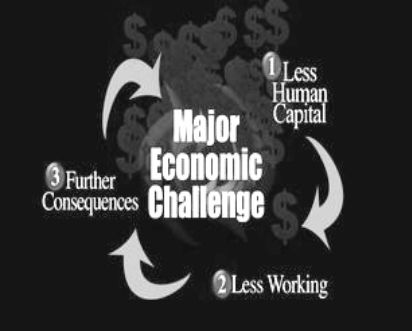
Graphic from the documentary, The New Economic Reality Demographic Winter, Designed by Director Rick Stout
_______________________
412 Thomas Malthus, The Principle of Population, London June 8, 1803, Preface to second addition: v, vi
413 Don Feder, excerpts from a talk given at Demographic Summit @ Moscow University, June 29, 2011
414 Malthus, The Principle of Population, London June 8, 1803, Preface
415 Malthus, The Principle of Population, London, Reeves and Turner, 1888 printing: 18
416 Donald Worster, A River Running West, the Life of John Wesley Powell: 532. (Referencing the Washington Post, May 25, 1902)
417 Feder, 2, 3
418 S. E. Smoot, Speech given at World Congress of Families, Madrid, Spain, 2012 (Population 6.8 Billion, Brazil 3,286,469 Sq. Miles = 2,103,340,160 Acres, Family of four would average 1.24 acres)
419 Ibid.