
TWO
Once word of Schieffelin’s claims became widely known, it was only a matter of time before the area was inundated with swarms of would-be prospectors. Cowboys, homesteaders, lawyers, speculators and even “ladies of the night” flocked to the area in droves. Soon, a quasi-collection of canvas tents and ramshackle dwellings materialized on the landscape near Schieffelin’s Lucky Cuss mine. Initially known as Watervale, or Waterville, this odd collection of souls numbered almost 100. The first man earning the distinction of meeting his death by violence after the Tombstone silver rush was Watervale resident John Hicks, shot during a card game in the fall of ’78. Despite the fact that the presence of water was the only thing to recommend the area, neighboring communities with names like Richmond, Austin City, Stinkem, Fairbank (initially called Junction City, then Kendall), Millville and Contention quickly popped up. Their creations were identical: First came the prospectors, both professional and amateur. Those who knew what they were doing knew what to look for—surface outcrops of rocks with black lines of silver-bearing ore. Others with no experience, no training and no knowledge of geology just hoped to trip and fall into a strike. They came by horseback, they came by wagon. Others defied the odds and walked into the valley with a pack burro. But come they did. Claims were filed: 600 × 1500 feet. All it took was a few piles of rocks and a stake. Find a likely spot, swing a pick and dig a hole. If you were unsuccessful, you could always jump a neighbor’s claim.
Tucson merchant John Vosburg described a typical settlement: “By this time lots of people, mostly men had come, and things were getting lively. There were lots of miners and prospectors with their attendant burros. A town of tents and hastily made adobes had sprung up like magic on the bottom land along the side of the mill site. They named it Charleston…. Ike Clanton started and ran our first boarding house in a tent and he soon had plenty of boarders.”
Predictably, after the prospectors came the merchants and drummers (salesmen) as miners needed food, clothing, tools, something to drink. Why break your back looking for silver when you could make your fortune off of those who did? Restaurants and saloons popped up like prairie dogs. Boards and wooden barrels served as tables, rotgut whiskey quenched thirsts while professional gamblers did their best to part miners from their hard-earned wealth. Dirty? If you were of a mind, bath houses and tents served to wash off the dirt. Then came female entrepreneurs; makeshift tents, saloons and dance halls served as their places of work. Most of the prospectors were bachelors, alone for weeks or months at a time, with little to entertain them. The women were ladies of easy virtue. As Chicago reporter A.H. Noon wrote, “The atmosphere is dirty and abominable, but they dance away, nevertheless—the men inanely grinning, the women evidently dancing as a matter of business.” Others didn’t bother to dance. Slowly but surely, these little camps began to expand.1
Still, it took quite a bit of financial wherewithal to be a successful miner. Anyone could dig a hole, but to be profitable, you had to dig deep, which meant equipment and manpower. Silver mining was a long, arduous, labor-intensive, time-consuming process; assay works, smelters, refineries and stamping mills all took funding. Rare were the individuals who could finance all this on their own. Due to the success of Gird and the Schieffelin brothers, the trio, along with Arizona’s third Territorial Governor Anson Safford and John Vosburg, pooled their resources to create the Tombstone Gold and Silver Mill and Mining Company. A stamp mill to process the silver ore soon followed. The people from all of the towns (actually, these “towns” were little more than camps) floated back and forth between them. But, as the mill was being constructed, residents from the outlying shantytowns began relocating into the area. Other conglomerates soon formed the Western Mining Company (later to be the Contention Consolidated Mining Company) and the Grand Central Mining Company. Means of transportation were required, so stage, freight and express lines soon started serving the needs of the newly established mining district. In October 1878, 38-year-old J.D. Kinnear pioneered the first once-a-week, 95-mile stagecoach service between Tucson and Tombstone. The one-way trip cost $10 and took 17 hours. Ten weeks later, Kinnear’s Express had become so successful that he found it necessary to implement twice-weekly runs. The following year Kinnear changed its name to Tucson & Tombstone Mail and Express. As early as September, a Tucson correspondent reported that “the new townsite is progressing finely; two stores, one barber shop and a restaurant underway already.” By December 2, a post office had been established. On March 5, 1879, U.S. Deputy Mineral Surveyor Solon M. Allis laid out a town on a mesa above the Tough Nut Mine in a place called Goose Flats, the nearest level spot closest to the mine. In honor of Schieffelin’s claim, the town was called Tombstone. Buildings were relocated from other sites, and by mid-summer correspondents reported houses were being started almost every day and “seemed to grow like mushrooms” with temporary canvas structures giving way to more substantial materials.2
Allis’s 320-acre townsite was laid out in a typical Western town pattern, with streets running at right angles to each other, thus forming a grid. This orderly design supposedly was advertised as a safeguard against overcrowding, disease and fire, but sadly, future events would show this not to be the case. Streets in a grid are numbered, lettered or arranged in alphabetical order—this was the case in Tombstone, where streets ran the length of the three-quarter-mile–long by quarter-mile–wide mesa. The numbered streets, First through Fifteenth, ran at right angles to the others, pointing north and west. The named streets were as follows: North, Fitch, Fulton, Bruce, Safford, Fremont, Allen and Toughnut. Toughnut was named after Schieffelin’s claim, Fremont for Arizona’s fifth territorial governor John C. Frémont, and Allen for John Brackett “Pie” Allen, an enterprising capitalist who sold apple pies to the soldiers at Fort Lowell and Huachuca. The resulting grid consisted of 98 individual full-lots available for $5 each with seven additional quarter-lots. Since Fremont Street, named after the famed explorer and current governor, would be the main thoroughfare, it was laid out five feet wider than the other streets. Shortly thereafter, the town’s first house was built and in October 1879, the Cosmopolitan Hotel was in full operation. Built by Carl Bilicke, the two-story building contained 50 beds, elegant black walnut and rosewood furnishings, a restaurant, bar, ladies sitting room, general merchandise outlet, cement sidewalk and Tombstone’s first piano. Prior to its construction, Bilicke’s “hotel” had consisted of a mere tent, albeit with beds, not cots—functional but not very fashionable. But he did offer his guests fresh milk from his own cow. Bilicke spared no expense in his new hotel—his hand-carved, rosewood grand piano had been shipped around South America’s Cape Horn and finally transported to Tombstone from San Francisco via mule train.3
That same year, Jim Vogan and Jim Flynn opened a wholesale liquor store, sample room and ten-pin bowling alley. The Golden Eagle Brewery, later known as the Crystal Palace and ultimately the most imposing building in town, was constructed by Frederick Wehrfritz; it quickly became the town’s social center. Its second-floor offices were occupied by coroner Dr. Harry Matthews, Cochise County Sheriff John Behan, former army surgeon Dr. George Goodfellow, attorney George Berry, justice of the peace Wells Spicer et al. (After the Earps arrived in Tombstone, town marshal Virgil Earp maintained a second-floor office.) In December 1879, photographer Camillus “Buck” Sydney Fly and wife Mary arrived in Tombstone and shortly thereafter established Fly’s Studio, first in a tent and then later in a more substantial structure on the south side of Fremont, between Third and Fourth Streets. (The next year, the Flys opened a 12-bedroom boarding house and studio called Fly’s Gallery.) Earlier in 1879, Quong Kee had opened the Can Can restaurant; the prior owner was Ah Lum, whose wife was known as “China Mary,” the absolute ruler of Tombstone’s Oriental population. Proprietor of one of the town’s better-known establishments, Kee was later buried in Boot Hill, along with the famous and infamous: outlaws, gamblers, miners, prostitutes, cowboys, storeowners and housewives. The Boot Hill property originally had been laid out as a burial plot in 1878 and bore the name “Tombstone Cemetery.” Miner John Hicks, the first person to be buried in Boot Hill, was shot down in front of Sam Danner’s saloon in 1879. Since Tombstone was home to a sizable Chinese population, Kee’s funeral procession included flying dragon kites and exploding firecrackers. The town’s Chinese district, bordered by Second, Third, Fremont and Toughnut and derisively known as “Hop Town,” contained several hundred residents and covered two square blocks. (“Hop” was slang for opium.) Selling general merchandise and lumber, M. Calisher, a California company, also opened for business that year, as did Vizina & Cook’s Saloon and Mary King’s boarding house.4
Tombstone was a most picturesque place as one visitor described its character: “On the principal street, lined with adobe buildings, large tents and frame structures, we find nearly every other building is a saloon…. Some are filled with rough-looking men, miners and others with quite a sprinkling of red-nosed bloated looking gentry, plainly belonging to the ancient order of the mining camp bummer…. Gambling is in full blast … in a stifling atmosphere of stove-heat, unwashed humanity, whisky fumes and the cloud of tobacco-smoke….” Tents and adobe buildings were followed by bare-bones wooden buildings. But nothing fancy because miners were too busy digging for precious metals to worry about lavish ornamentation. In the evenings, residents might attend the local “theater,” a rickety frame shack with a badly torn canvas roof. The surrounding mountains were heavily laden with pine and oak “in great abundance and fine growth,” while newspapers reported that numerous canyons “are often almost impenetrable with heavy growth.”
Soon, the sounds of additional hammering of nails and sawing of wood filled the air. Merchants naturally wanted something a bit more substantial than canvas and mud. Windows to keep out flies and doors to keep out the dust were a necessity. Predating the film-set industry, false-fronts were added to give the imposing appearance of stability.
One reporter observed that by early the following year, “the upper town is now growing daily and is now a town of some importance there are three restaurants now, so that one stands a chance of getting a square meal.” Gen. J.B. Allen set up a general store and nearby restaurant to take advantage of the situation: “To supply it with eggs and milk he has sent out a lot of chickens and cows, fresh butter is a regular thing there. Behind the store he has a stable well supplied with forage. In fact, the General has fixed himself to meet every want of visitors.” George Parson described Tombstone’s atmosphere in his diary: “Stores set up shop in tents, and restaurants were similarly housed.” With a rapidly increasing population, shanties and jacals housed several new families. Even the fourth estate became firmly established that fall with the publication of The Nugget. (Its better-known rival, The Epitaph, came onto the scene the following May.) Businesses of all kinds were well represented since the two lines of daily stagecoaches were always full of passengers. Kinnear’s line left Tucson on Mondays, Wednesdays and Fridays; the Tucson and Tombstone Stage Company, owned by William Ohnesorgen and H.C. Walker, Kinnear’s former agent, ran on Tuesdays, Thursdays and Saturdays. The Arizona Daily Star reported, “An enterprising sportsman has just exported a complete outfit of ‘Keno’ from Tucson to Tombstone. This indicates that money is beginning to circulate out there….”
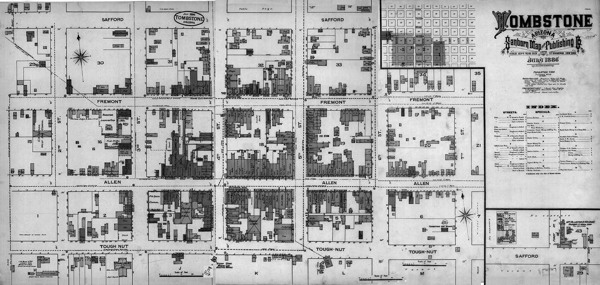
Sanborn Fire Insurance Company map of Tombstone, Arizona, July 1886. The O.K. Corral is located in the block bordered by Third and Fourth streets and Fremont and Allen streets.
The growth continued. The tent occupied by Sam Danner’s saloon provided the setting for the community’s first religious service. On December 14, 1879, A.W. Stowe opened a general store. One week earlier, the Pima County board of supervisors had officially declared the town of Tombstone incorporated; a mayor and common council were elected the following January. Tombstone’s first public school opened a month later. There even were those who wanted to change the town’s name but wiser heads prevailed. Shortly thereafter, Fred White was elected city marshal—his tenure would last less than a year.
Early in 1879, the town had 40 cabins and about 100 residents. The population swelled from 474 residents in September to 900 in October and over 1500 one month later. By February 1880, over 2000 residents called Tombstone home. (The official U.S. Census taken on June 1, 1880, tabulated 2170 individuals.) But unemployment was rampant. The Arizonian reported that Tombstone was overrun with “destitute, helpless men seeking employment and finding none. The mines are said to be good enough, but they can give work to only a few persons.” The Daily Arizona Citizen seconded that opinion: “Saloons of the lowest class and dance houses where men and women of the vilest sort herd together and make the night hideous are becoming well-settled institutions, and unless suppressed or regulated they will breed crime and death. Shooting has been a frequent thing, though happily the marksmanship has been very bad and but little damage has [been] done.” Labor crowded into the area faster than capital developments. As a result, criminal elements began to take hold of the town. By the end of 1879, there were two drugstores, three or four doctors, two lawyers, eight desperados and one genuine Western celebrity…. Wyatt Earp.5
The following year saw no decline in the expansion frenzy. Buildings were constructed as fast as material became available: “One lawyer ordered a house built and the carpenters began on a Friday. On Sunday, the lawyer moved in his library and hung out a sign.” Reporters were effusive in their praise of civic improvements: “We now have three two-story buildings in the course of construction, two of which have frontage of 60 feet, and we hear of others that are soon to be commenced, together with additional stories on buildings now in use.” The town’s improvements were rapid. By late spring, 40 brick buildings for businesses were in the works, with new stores established daily, and families were finally setting up permanent residence. Houses 40 × 80 rented for $500 per month. Schools and churches were in session and there was even talk of a permanent theater. In July, the Western Union telegraph line from Tucson to Tombstone was finally completed and a local office opened. July also saw the formation of a glee club. In direct competition to the Cosmopolitan, the Grand Hotel opened with an invitation-only ball on September 9, 1880. Later that month, the 60-member Tombstone Club opened on the second floor of the Ritchie Building. “Tastefully furnished with writing and card tables, easy chairs and reading tables,” this gentlemen’s club included “more than 70 publications comprising all of the leading American and foreign newspapers, magazines and periodicals” along with “a magnificent sideboard, well ladened with choice liquors and cigars.” The Alhambra Saloon reopened that same month with a new black walnut bar, elegant paintings and engravings in the reading room, gold and bronze chandeliers, gambling tables and a three-piece orchestra.6
By 1880, the following Tombstone businesses were well established: The Agency Pima County Bank; Arizona Trading Co.; U.S. Meat Market; Bland Livery & Feed Stable; Delmonico Restaurant; Bourland’s cigar shop; Brown, Taylor & Co, Livery Stable; Brown’s Hotel (on the second level of Hafford’s saloon); Coffee & Acker Meat Market; Dauner & Owens Saloon; Davis & Uplinger carpenters & cabinet makers; Diana Lodgings and Saloon; Eaton & Rice, druggists; Eswch & Hotz Saloon; Fry & Ackerson Saloon; H.L. Gehman, shoemaker; O.W. Greisenhofer, baker; Gray & Gray Real estate; Nevada Boot and Shoe store; W.A. Harwood, lumber dealer; Haynes, Lucas & Street, attorneys at law; Rural House; McKean & Knight, groceries; G.A. Millard, dentist; Montgomery & Benson Livery & Feed Stable & O.K. Corral; Pasquale & Co. Saloon; Ravel Robinson, tailor; Safford, Hudson & Co. bankers; Cochise Hardware & Trading Co.; Taker & Hoke, liquor and general merchandise; Walker House; Waterman & Goodrich, stoves & tinware; Rockway Oyster House & Restaurant; Seamans Watchmakers, Jewelers and Opticians, and on and on. By the end of 1880, it was estimated that 75 of Tombstone’s businesses were saloons. More than 510 building were now erected, all but one in the past 12 months. The town was booming.7
Once Kurt Russell was on board, word spread like wildfire and even though casting wasn’t yet set, the project generated interest all over Hollywood. Billy Zane, his sister Lisa and Jarre were friends at the time and endlessly discussed who should play each role. The trio put together a list of their actor friends and Jarre tried to include as many as possible in the project, including Dana Wheeler-Nicholson, Jon Tenney, Lisa Collins and Paula Malcomson. In fact, Kevin wrote the part of Josephine Marcus with former sweetheart and still close friend Lisa Zane in mind, and to a certain extent even modeled it after her by playing to her artistic strengths. In earlier drafts, Lisa’s small American Eskimo dog, Bintar, was also added as an accessory for Marcus. Powers Boothe, later cast as Curly Bill Brocius, said, “It was such a great script that, as I understand it, everyone pretty much cut their money to do it. All of the better folks in Hollywood were tripping over themselves trying to get in the film. Kevin Jarre … at that period of time was certainly one of the best writers around. The research he did, every character, right down to the color of the horse you rode, your wardrobe and all that stuff, was just [perfect].”
It is little wonder Kurt wanted to be involved: “Movies start with a screenplay, and this one is brilliantly conceived. The characters are well drawn. It’s a great story and not weighed down by what I consider a 1950s sort of mentality of what the Old West was like. There are some tough characterizations that have not been backed away from by anyone on this film. This is a script that offers drama, comedy, action and romance. A lot of people, a lot of studios, wished Tombstone would just die. Kevin Costner was gearing up his film Wyatt Earp at the same time, and it would have been easier if we had just gone away. But Tombstone had a lot of things going for it. First and foremost, it had me.”
Names of those interested in the film were bantered about willy-nilly; in some cases the interest was genuine, in others, their persona just fed the publicity mill. Some actors asked to be in the film, others were asked to be involved. And, some didn’t even know they were being considered. In late February 1993, it was announced that Billy Baldwin, who had tested very well, would play the role of Doc Holliday. Baldwin had worked with Russell in the 1991 movie Backdraft in a role supposedly turned down by Tom Cruise, Johnny Depp, Matt Dillon and … Val Kilmer. Less than a week after the announcement, Kilmer replaced Baldwin as Doc. Kilmer noted, “Kevin Jarre did a great job. The character was already there, ready for me to more or less step into. He’s never been portrayed as three-dimensionally as this. I liked being Doc Holliday. It’s fun to be insightful and aristocratic, to stand up for your friend and make sacrifices for him. It was fun to be arrogant like he was and have the goods to back it up. Although, let’s not forget that he did kill a lot of people.” According to screenwriter John Fasano, “Everyone thinks they said, ‘Go get Kurt Russell,’ because [his] son is named Wyatt. But actually Andy Vajna said, ‘Can you get Val Kilmer to be in it?’ Val was cast first as Doc Holliday. Sherayko said Jarre told him Cinergi told him they would put up the money if they could get Kilmer to play Holliday. But they didn’t have a distributer so Disney said they would distribute it if they could get Russell to play Earp.” According to Russell, the person Jarre really wanted to play Holliday was Willem Dafoe. Kurt admitted he would have been phenomenal but Disney wouldn’t go for it. Due to the controversy associated with The Last Temptation of Christ (1988), the studio wouldn’t release the film with Dafoe playing Holliday, telling Jarre, “You can go with Val Kilmer, but not Dafoe.”
Kilmer wasn’t the only one who wanted to play Doc. “It was in the spring of ’93,” recalls Thomas Haden Church, “and both Wyatt Earp and Tombstone were being cast at the exact same time and [were] sought after by most of the young actors in town. I read the script and met with the head of casting who thought that I was authentic enough to be cast in the film. At the time, I was doing a small-budget detective movie with Sam Elliott [Fugitive Nights: Danger in the Desert] and he asked me one day if I had met the casting director for Tombstone. I told him I had and that I wanted to be cast as Doc Holliday. Sam told me that that was not going to happen as Val Kilmer had the part. He started going through a murderer’s row of actors who I really admired, and I thought, ‘Shit, I’m not going to get cast in this movie.’” But Elliott suggested Church go back and read for one of the smaller parts. So Church returned, spoke again with the casting director and suggested that maybe he could play Billy Clanton. Although another actor had already been selected, they were having second thoughts about him. “A week later,” Church adds, “Sam and I had just driven to a small location in Palm Desert, California, where we were filming the detective movie. I got to the set for the first night shoot and Sam came over to me and asked me how I was doing. Then he said, ‘Well, we’re going to have to get you on a horse,’ and that was how I found out I was cast as Billy Clanton.”
Elliott had already been cast as Virgil Earp. According to Sam, Jarre handpicked the cast. “I remember going and having lunch with him at a place on the Sunset Strip in Los Angeles,” recalled the actor. “Kevin said he was having all these meetings there, like he was holding court. I think Kevin’s the one who really controlled this thing creatively before it got off the ground. The dialogue was there. Kevin Jarre wrote a brilliant script. I think across the board, every character there was well drawn. And he brought actors you normally wouldn’t associate with Westerns. I would have done any role in this film. But what I really liked about Virgil was the fact that he was about what I consider to be a kind of moral core of this story. I’m not sure how set in reality that is, but it’s always a nice kind of character to play within the context of the film you’re doing.”8
Jarre already had decided which actors he wanted for specific parts; now he just needed to ask them. “I got a phone call,” remembers Chris Mitchum. “[Kevin and I] had never met. He said, ‘Chris, I love Westerns. And I love the stuff that you have been in. I really like the picture that you and Heston did [The Last Hard Men]. I’m doing a film called Tombstone. We’ve hired Heston, I would love it if you would come and work for me about a week. I’d love to put you on film with him together again.’ So, he sent me the script.”
According to Stephen Lang, “I received the script along with an offer to play Ike Clanton. No meeting, no audition. I was surprised and pretty thrilled to be asked. Surprised because I had no expectation of being offered anything at that point in my career without having to audition. Which, by the way, I would gladly have done. When we met, I asked him why [Jarre] saw me as Ike. At the time Kevin was involved with the lovely Lisa Zane, and he had cast her as Big Nose Kate. Lisa is a terrific actress: She had played the love of my life when I played Babe Ruth for NBC. Kevin and Lisa had attended a screening of the film at the DGA. Kevin had seen me in Death of a Salesman on Broadway, and had said to Lisa, ‘There is no way Lang can play Babe Ruth!’ Well, he changed his mind when he saw the movie. So when we met, he told me, ‘I figured if you could play the Babe, you could play anything.’ That’s why he offered me Ike.”
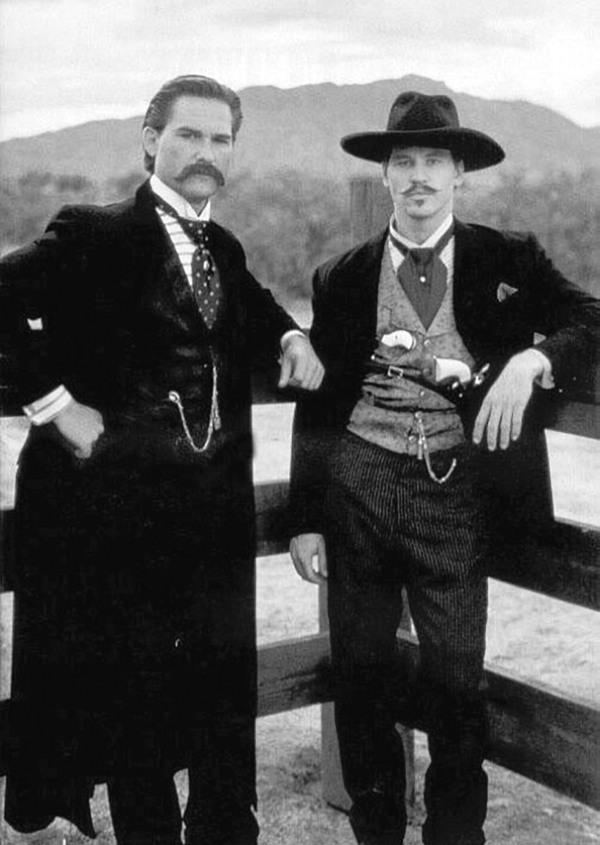
Kurt Russell as Wyatt Earp and Val Kilmer as Doc Holliday (www.moviestillsdb.com).
Frank Stallone was another actor who had a role in the film even before he knew there was a role to be had: “I was at Billy Zane’s house, and he was having a big party. At that time, my hair was real long, I had a beard. I didn’t look like the Hollywood set–type guy. There was another guy who looked exactly like me there. We were in the huge kitchen, drinking, having a cigarette and all this bullshit, talking. All of a sudden I just got on the subject of gunfighters ’cause I’ve already had a huge library of Western folklore and I love it. I’m enamored by it. He started talking about Ed Thompson, Doc Holliday, John Wesley Hardin, Dallas Stoudenmire, all these other gunfighters, Long Haired Jim Courtright, and he was keeping up with me the whole time we were talking. We were having a good old time. I realized that three hours had passed and we were still talking. People were even staring at us … at a party talking about cowboys. Everyone around us didn’t know what the hell we were talking about. I didn’t even get the guy’s name.
“A year and a half later, I got a call from my agent, who said, ‘Listen, they’re doing this movie about Wyatt Earp, and they want you in it. All you have to do is to say “yes,” and the part is yours.’ I said, ‘Sure. When do I read for the role?’ She replied I didn’t have to. It was already mine. I couldn’t believe it. Then my agent wanted to talk money. I told her, ‘Forget it. I’ll just do it.’”
It turned out the fellow at Zane’s house was Jarre, who never forgot Frank’s interest and passion. Jarre also waged a war to get his girlfriend Lisa the role of Josephine Marcus but the studio, in particular Andy Vajna, preferred Dana Delany, who narrowly beat out Jennifer Connelly in a last-minute screen test. Zane was then asked if she would play Holliday’s significant other, Big Nose Kate Horony. (Kate was born Marie Katherine Horony. At some point, other members of the family began to use the spelling Haroney.) Confesses Zane, “[It] left me cold, but I agreed because I believed in the greatness of [Jarre’s] script and in what the movie could become. I wanted to be a part of it, beyond just in its inspirational phase.” Professional that she is, she did a camera test and began to search for Kate’s props, including a Gladstone bag and bullwhip. (Zane’s brother Billy would later be cast in the small but memorable role of the devil-may-care stage actor Mr. Fabian.9)
John Philbin, who was cast as Tom McLaury, won his part without any tryout: “I didn’t have to read or audition or anything. Kevin Jarre saw my picture and he cast me based on my résumé and my picture and made the offer. I think I was in Hawaii at the time I received the offer. I came home, I was like, ‘Yeah, I’ll just do it.’ My agent called and said, ‘Listen. This is who is doing this movie,’ and I said, ‘Oh, my God. Yes.’ I wanted to do it, totally. Kurt Russell was already involved. Val Kilmer, Sam Elliott and Bill Paxton [were] involved. Maybe Charlton Heston and Powers Boothe; some of those other actors were already involved already. I never met [Jarre] before we did the movie. There may have been a movie I had done that he liked or he had seen my work in something and trusted his instincts enough based on his impression of that role to give me that part.”10
El Paso resident Nathan Simmons was in the area looking for an acting job and happened to luck out: “Actually, I’ve been in the film industry since 1987 and I was going out there for Unforgiven II, which they never made. But the lady at the casting director’s said, ‘You know, we’ve got a movie called Tombstone.’ I said, ‘That sounds good, I’m in the area already.’” Meanwhile, Wyatt Earp’s real-life fifth cousin also was interested. Born in Perkins, Oklahoma, the 6'4", 200-pound Glen Wyatt Earp was struggling to start an acting career despite his leading man looks and famous name. “Actually, there has been greater skepticism of me as an actor because of my name,” admits Glen. “Casting directors would call up my agent and say, ‘Is this guy for real?’” Once Earp heard that the two films were being cast, he contacted both. He claimed that through informal negotiations he was going to play an “unnamed role” in Costner’s film but as the script wasn’t ready and he had a chance to read Jarre’s script, he instead cast his lot with Cinergi. Producer Jacks didn’t mind: “We were very interested to see what he thought about the screenplay because of his family. It also helped the actors to be able to talk with him since, obviously, he had been researching this story for most of his life.”11
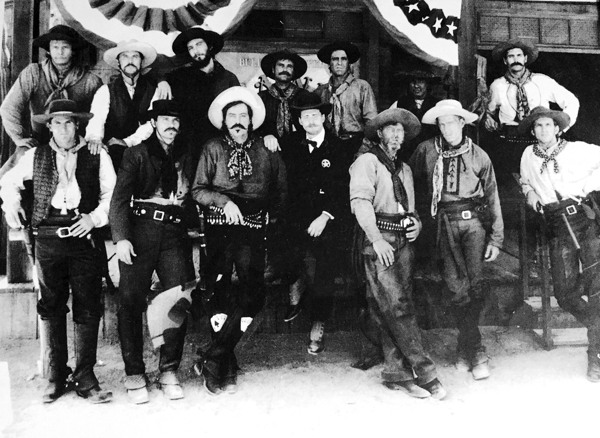
They called them “The Cowboys”: Front row: John Philbin (as Tom McLaury), Michael Biehn (Johnny Ringo), Powers Boothe (Curly Bill Brocius), Jason Priestley (Billy Breckinridge), Stephen Lang (Ike Clanton), Thomas Haden Church (Billy Clanton), Tomas Arana (Frank Stillwell). Back row: Stephen Foster (Hank Swilling), Robert Burke (Frank McLaury), John Corbett (Johnny Barnes), Bo Gray (Wes Fuller), Forrie Smith (Pony Deal), Paul Ben-Victor (Florentino), Glen Wyatt Earp (Billy Claiborne) (courtesy Larry Zeug).
While potential cast members were identified, tested and selected, other pre-production activities were already underway. Visual artists began conceptualizing the script on storyboards and a detailed schedule was created to accommodate the proposed availability and arrival timing of all the elements required for filming. Department heads—cinematographer, casting director, editor and costume designers, for example—were brought on board. Locations were scouted, props and wardrobe requirements were identified, equipment vendors were selected, and materials were rented. These and a myriad of other tasks, including the key areas of financing and budget preparation, were identified and assigned.
While actors supply a character’s appearance and personality, directors create and execute the vision, and producers pull the whole project together, it’s still the craftsmen listed in the closing credits who are critical to a film’s success. And since this was a Western, it was especially critical to create a historically authentic set that would establish and graphically depict the mood and tone of the story. Not only should size, lighting and camera placement be taken into consideration, but the set’s overall visual look should inspire both actors and audience. The “look” of a set or location is vital: It draws the audience into the story and makes a film convincing. A great deal of work and imagination goes into constructing the backdrop to any story and choosing or building locations and/or sets. Therefore, production designers are critical because they are responsible for the visual concept of a film. How better to do that than to create an exact replication of 1881 Tombstone? Enter Catherine Hardwicke.12
The 37-year-old Hardwicke was trained as an architect at the University of Texas in Austin. She designed and built townhouses, subdivisions, office buildings and low-income housing projects before entering graduate school at UCLA. “I designed and built a bunch of houses in Texas before deciding that real architecture might be a bit of a creativity stifler,” she recounted. “I applied to grad school in Film at UCLA and people said, ‘You’re an architect, why don’t you design my movie?’” While there, she won two major student film awards. An artist-animator, her first job was with Tim Burton “making little sculptures and things.”13
The typical movie set Western town is almost iconic. If you’ve seen one, you’ve seen a million: a broad, smooth, well-graded main street bordered on each side by two-story, false-front, splintered wooden structures. Saloons with bat-wing doors, wooden sidewalks, banks, a boarding house, sheriff’s office and jail, livery stable, school, hotel and perhaps even a restaurant. These were the typical features of a Western whether filmed at the Melody, Corriganville, RKO Encino, Iverson, Jauregui, Walker or Paramount movie ranches or in Kanab, Lone Pine, Red Rock Canyon, Kernville, the Alabama Hills, Moab, Monument Valley, Sedona, Apache Junction, Mexican Hat and dozens of other locations.
But Jarre demanded more. Why not show Tombstone the way it had really looked? If it was a newly constructed town, it should look new. Not gray and weathered, but alive and vibrant with period buildings and features, which was almost impossible to depict accurately because of the town’s rapid, explosive expansion. Adobe huts, canvas tents and wooden structures of variable size and shape had dotted the town’s ever-changing landscape. And Jarre insisted on accuracy. But as large as Tombstone actually was, it was physically impractical to replicate the town’s every nook and cranny. In fact, most of the historical action took place in a six-block area: Lot 2, blocks 17 through 19 (each 300 × 300 feet) and blocks 3, 4 and 5 (each 300 × 228 feet). Not only did this confined section contain hotels, cigar stores, billiard parlors and general stores, it also included 20 saloons: Tomlinson’s, Bonanza, John Lang’s, Keefe & Co., Tivoli, King & Moore, Old Palace, Pat/Lynch, Gruner & Schmidt’s, Headquarters, Hafford’s, Oriental, Arcade, Rafferty’s, J.A. Miley, Brown’s, Bank Exchange, Capital, Campbell and the Crystal Palace. No wonder that part of the West was so wild! With an initial construction budget of only $641,607, it was necessary to stretch every dollar. Hardwicke’s budget included $26,200 to recreate the interior of the Oriental, $40,000 to build Hooker’s ranch building (which was subsequently left for the owners of the ranch where the scenes were filmed), $12,000 for signage, $40,400 for general street construction and enhancements, $40,000 to recreate the O.K. Corral, $1800 to create Boot Hill and $34,000 for the interior set of the Bird Cage Theater, even though this building wasn’t in full operation at the time of the shootout. Initially, Jarre had scripted a scene for Schieffelin Hall, but after he and Morey visited Tombstone, Jarre decided the Bird Cage worked better.
The production company later increased the construction budget by an additional $140,000. (Actual costs eventually ballooned to $931,000.) Since two Western sets were already located in the immediate area, Tucson, Arizona, seemed the logical choice. While a few scenes were filmed at Old Tucson Studios (Kansas Street, Mexican Plaza and the Reno train depot; the soundstage also was used), most of the action was filmed at the standing Western town set of Mescal, located about 50 miles from Old Tucson. The Mescal set had been constructed in 1969 for Monte Walsh and, at the time, the location was known as Happy Valley. Property for the 2400-acre, $200,000 set was purchased from the Double X Ranch. A sister set of Old Tucson, the town had appeared in such films and television shows as Dirty Dingus Magee, The Life and Times of Judge Roy Bean, The Outlaw Josey Wales, Little House on the Prairie, The Sacketts, The Buffalo Soldiers, Frisco Kid, Tom Horn, The Young Riders I, I Married Wyatt Earp and many more. But by the time the Tombstone crew showed up in February 1993, the town set was in pretty rough shape and the crew only had two months to correct and dress it. “We rebuilt much of Mescal,” said Hardwicke. “Tombstone was a boom town and we wanted it vibrant and full of life. Saloons seemed to spring up almost overnight, each more gaudy and outrageous than the last, and homes were more excessive than one might expect. We often think of the West as black and white but actually the colors were wild and garish. It may have been the Wild West, but women at least tried to tame their homes. They took great pride in getting the perfect wallpaper, trim and curtains. They were very vain and conscious about their homes and décor. I took the script and did a breakdown of all the sets and I went and visited the real Tombstone and I looked at tons of research from the archives, the Arizona Historical Society and all over and then came out to this town, which we were going to convert into Tombstone, and tried to figure out how to overlay the matrix of the two and turn them into the same thing for the least amount of money and the most dazzle. I read a lot of [historical documents] from that time period and I started finding out that they really wanted to make it look upscale and flashy. In the saloon, it turns out there was some imported wallpaper and I read there were some glass-front bookcases. That they were really going for a level of elegance. The Bird Cage Theater had all these chandeliers in it. [They were] really trying to attract an upscale patron to some of these establishments.”14
The Mescal set was in such bad shape that they first had to address all the clean-up and safety issues to bring the buildings up to a workable standard. Then they could start to renovate them. They took a photo of every existing building—all the way down one side and then back up the other. They took the photos back to the art department—long shots of every existing building. Utilizing tracing paper or re-drawing it, they then created the new set the way they wanted to see it. “We worked for a couple months with my crew, constructing, building, researching, drafting, designing everything,” says Catherine. “Looking for antiques. We made everything in this room from scratch. We built the building from the ground up, built the bar and all the molding and everything we made in the shop. A lot of the wallpaper is reproductions of historic wallpaper and the light fixtures are authentic old light fixtures that we recreated just for this from a photograph. That’s why we made the town really colorful and very elegant. We wanted to give that feeling of vitality and exuberance to the town.” But sometimes you can’t win for losing: One oblivious critic wrote that “[the town] looks like it was built yesterday.” Exactly!
A professional sign painter was brought in from Budweiser to hand-paint over 300 signs that appeared in the film. Hardwicke also made incredible drawings of every building, hand-colored to show how the structures should look. “The art department shrieked at first because it looked odd because they didn’t have any aging on them. But once the whole thing meshed together, it was really very well done.” Old Tucson Studios agreed that the corner building in Mescal, known as the Saloon, would be torn down and completely rebuilt as the Oriental Saloon. Tombstone Productions had permission to leave the new building in place at the conclusion of filming without having to rebuild the old saloon as long as the new building’s exterior was “aged down with paint to fit into the look of Mescal.”15
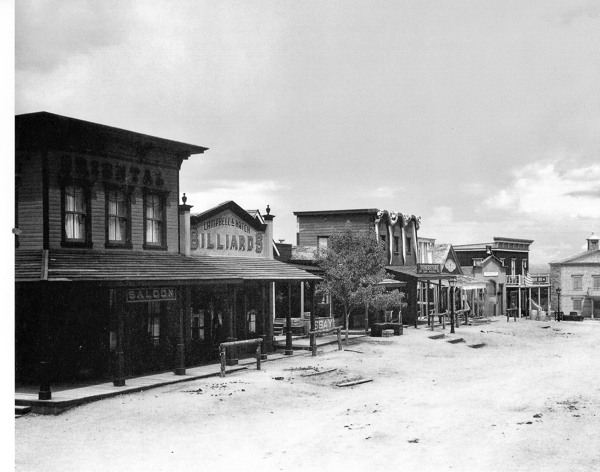
Allen Street on the Mescal Tombstone set. Left to right: Oriental Saloon, Campbell & Hatch Billiards, Telegraph/Assay office, Town Marshal’s office (courtesy Larry Zeug).
The re-enactors also helped Hardwicke achieve the richness of depth and texture that she desired. “I remember one day we were doing the O.K. Corral,” she recalls, “and I had gone to all the prop houses in LA and [got] all the period saddles, and [did] everything we could. A couple re-enactors came up to me and said, ‘You can do a lot better than that. We have the real stuff because we made it ourselves, and we’re going to lend it to you. The right kind of leather and the right design that we copied from a photograph.’ They just brought their stuff and put it in there which just elevated it so much to have somebody that cared that much. And they really did it right and they let us use it.”16
Meanwhile, back in Old Tucson, another crew worked to adapt the soundstage to accommodate all necessary interior filming. Built in 1967, the 80 × 160-foot, $190,000 facility was air-conditioned, had a 50-ton capacity electrical heating and cooling system, and housed wardrobe, production offices and general office space. The soundstage floor even had six inches of concrete under a layer of 11/8 inch plywood. An inch-thick, hard surfaced, sound-deadening board had been laid atop that so that dollies could noiselessly roll. There was even a special power hookup to shut off all electric motors and still all telephones when the director called for quiet on the set. Any of this soundstage’s existing sets, staging and light fixtures that interfered with Tombstone sets had to be moved to another location. The catwalk was raised and both the Bird Cage Theater and Denver Stage dressing room were constructed. To accommodate shows once the initial build period was completed, space on the Bird Cage set was left for two rows of seats for park visitors.17
Located at the corner of Front Street and Columbia (later renamed Kansas Street), the Red Dog Saloon had been one of the first buildings added after Bob Shelton took over the Old Tucson property’s lease in 1959. To replicate the Prescott, Arizona, saloon where the script depicted the knifing of Ed Bailey by Doc Holliday, the Red Dog was modified by replacing its chair rails and baseboards, adding valances, a removable stage floor, luan flooring and bases for the arch columns.18
Cinergi entered into a contract with Old Tucson Studios to rent both locations (Tucson and Mescal) used in filming: Ten weeks’ preparation work at Mescal totaled $18,000; six weeks of filming at Mescal, $46,000; ten days at Old Tucson Studios, $15,000; four days of prep and strike work at Old Tucson Studios, $2400; six days’ strike work at Mescal, $1800, for a grand total of $84,000. Strike and restoration alone was estimated to be almost $40,000. Periodic payments would be made by Cinergi, based on timing and deliverables.
Tombstone Productions began its preparation activities on April 26, 1993, and agreed to a complete restoration of Mescal by August 1 and Old Tucson within three days from completion of filming. Construction and scenic activity on the Old Tucson Studios soundstage was scheduled between April 27 and May 8; creation of the Prescott Saloon took place between April 28 and May 8; the train station and exteriors were completed by May 12, and re-decoration of all studio sets occurred between June 11 and June 16. As Old Tucson Studios already had other productions scheduled that summer as well as standard walk-through tours on the soundstage, the production company agreed to accommodate those activities while filming. Film department manager Nicola Hartmann said, “It will be a great boon for the community during what has traditionally been its slower season.” Seconded spokesperson Ann McBride, “Any time a film of this size comes to town, they typically use many local goods and specialty services that may be needed for production. The final result is a very, very positive economic impact in the community and surrounding area.”19
As the town of Mescal was being rebuilt, set dressers searched for period fixtures. Not only do these individuals select the items that decorate the set, they must make the scene look convincing. You’re always going to have wagon wheels, rope, barrels and crates, burlap bags, water troughs and other items typically found in a Western. But when you look at individual scenes, the set dresser’s creed is that you never want to repeat the same prop, whether it’s a chair or pot-bellied stove. So before any item is ever purchased, a great deal of historical research is conducted. They confer with the director to understand the visual style and look of the film. According to set dresser Matt Marich, “You have to make it feel like it’s a lived-in experience. Or, you’re making that set unique to that actor. When you go into Wyatt’s house, what things would Wyatt have in his house that are significant to him? There might be pictures of him and his first wife or whatever. So we have to get into the characters a lot. That is very significant when you do contemporary movies. We have to make it feel, we’re not just putting furniture in. It’s figuring out, how does that shopkeeper make his shop look. How does that hotel differ from that hotel? What makes it look lived in and real? What lighting is practical that we are adding for the cinematographer? Because he can come in and light it all day long but if the movie had oil-fired lamps, we need to put oil-fired lamps on that set so that it seems like the motion picture lighting is coming from that direction. We’re heavily involved in [tone and atmosphere]. Everything from posters printed and handbills and things that were in the Bird Cage, all that printing that was around there.”
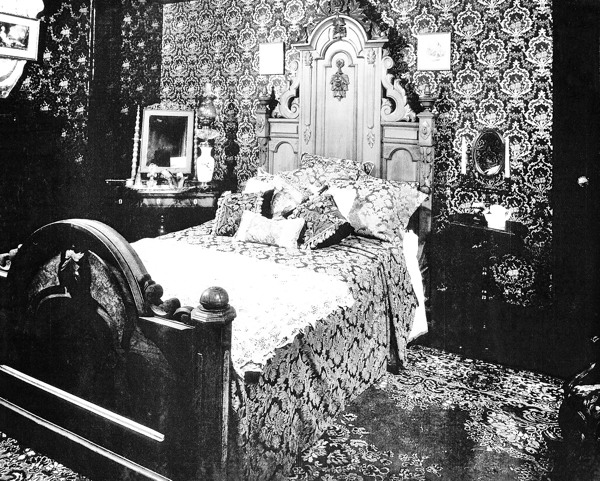
Doc Holliday’s room, located on the second floor of Mescal’s Grand Hotel. Though the room appears on-screen for just a single minute, note the set-dressing detail (photograph by Lee Gray/courtesy Catherine Hardwicke).
So the dressers hit every antiques shop in Phoenix and Tucson where they obtained western trucks, easy chairs, roll top desks, spittoons, lariats, etc. They rented a vintage billiard table from Arizona Pool Tables along with a felter who could repair the table if necessary. Some items were obtained from International Antiques in Tempe, Modern Props in Los Angeles and from studios, including Paramount. Usually the dressers would get a list of items needed, then look for things that caught their eye. Once these items were rented (for 20 percent of the face value), Polaroid photographs were taken and then hung from a large chain, with details of the item’s appropriate cost, description and where it was used in the film written on the back of each photo. This is important because actors sometimes get rambunctious and furniture often is moved in and out of sets, often when cameras are set up to film different shooting angles. So if something gets damaged, the film company ends up buying it. Propmaker Brian Stewart recalls, “We received a walnut dresser back that was missing the mirror, which is attached to the top. The mirror was not returned and, consequently, we had the option to file an insurance claim. However, because of the great number of prop furniture pieces that were used, we let it go. While watching one of the second floor gunfights, I saw the dresser mirror hit with gunfire and realized that it was blown up to make the film more authentic.” Old Tucson Studios had a huge prop and costume department, including many items previously purchased from MGM or physically created on-site. So, the dressers put together their list and Old Tucson Studios attempted to fill it: Flags and bunting, washboards, icebox, books, fabric and porcelain dolls, candelabra, maps, desk chairs, ledger books, barber pole and chair, wheelbarrows and carts, shot glasses, beer mugs, poker chips, roulette wheel, scales, baskets, cash registers, tables and chairs, wagons, tents and on and on. Each item was rented on a daily and/or weekly basis with an appropriate loss-damage value assigned. And a good thing it was as numerous items were damaged or destroyed during filming. Jay and Joanne Gammon, owners of Gammon’s Gulch in Benson, rented over 500 items to the production, including many of the items used on the O.K. Corral set.20
As items were obtained, they were stored in a large two-story industrial warehouse off Grande and St. Mary’s in downtown Tucson. The front of the building included Hardwicke’s office, several drafting stations and a large open lobby; the remainder of the floor housed the construction department and set dressing storage. Various sections of the warehouse were taped off, each identified with a scene’s storyboard. The sections stored all items necessary for a specific scene while the storyboard identified what was there and where it would be placed on the set. For example, Wyatt’s room inside his house would have a bed, dresser, basin on a stand, pictures for the wall, coat rack, etc. All of those items would be stored in their proper position in the warehouse so everyone knew where they should be placed when the set was dressed.21
Not all items were rented or purchased; the creative dressers sometimes had to fabricate what they needed. For example, the Earp cabins and Bird Cage Theater all were built onsite by Billy Holmquist. Henry Hooker’s ranch house was made from real adobe supplied by a Tucson company, while structures that neighbored the O.K. Corral were built with fiberglass adobe brick. The Oriental’s ceiling was salvaged from a building in Nogales, Mexico—stamped, metal, turn-of-the-century, embossed and very accurate. The saloon’s floor is fairly unique: luan plywood stained three different colors, cut into strips and randomly installed. As Ida Random, Catherine’s counterpart on Costner’s Wyatt Earp, said, “When you’re building sets and shooting in such a wide [anamorphic] format, you find elements that fill the frame and make it more interesting. You become very conscious of the details—door frames, door jambs, fireplace lines, how high, how low, etc. I think designers have to pay a lot of attention to what is in the camera’s eye, what the camera sees. Because that’s all there is.”
On Tombstone, there were 72 individual sets and over 70 dressers. Lights handcrafted with filigree while brass fittings were purchased from a Chicago antique lamp store. Other lamps appeared to be gas-fired, which might prove to be a safety hazard, so wires were run through the gas lines so they could be dimmed or flickered. Door hinges and hardware were resin-cast plastic. Of course, everything didn’t always go as planned. Marich recalled, “One of the guys on the construction crew came to us at Mescal and said, ‘I’m going to Home Depot. What do you guys need?’ We gave him a list of what we needed and off he went. He showed up three days later with the stuff. And we’re like, ‘Uh, we needed this stuff three days ago,’ and he goes, ‘Well, yeah, I know. But I met this girl.’ Later, the same guy had an accident and almost sawed his leg off.”22
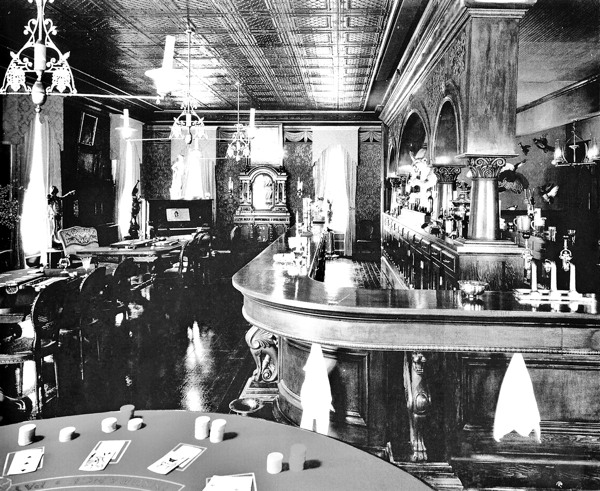
Interior of Mescal’s Oriental Saloon. Note the stamped-metal ceiling and the ornate light fixtures. Billy Bob Thornton’s (Johnny Tyler) altercation with Kurt Russell (Wyatt Earp) occurred near the faro table in the far back left-hand corner of the room. The Campbell & Hatch Billiard Parlor was constructed on the right side of the bar on the far right of the photograph. Note the stuffed animals on the wall (photograph by Lee Gray/courtesy Catherine Hardwicke).
Russell summed up all of this prep work perfectly: “I love some of the old Wyatt Earp movies, but in some of them, when you saw what a bleak, depressing place Tombstone is, you [would] say, ‘Why would Wyatt Earp or anyone else ever want to come here?’ What we wanted to do was to show people why so many wanted to come to Tombstone during the silver rush. It was a sprawling, bustling frontier town, spilling over with energy. We didn’t design this town to look like the Old West—we designed it the way people saw it in 1879, as the New West.” Buckaroo John Peel summed up the atmosphere correctly: “[In] so many of the Hollywood westerns we grew up watching, everybody in town is sort of just hanging around. Nobody’s working or doing anything. They’re either sitting in a saloon all day or sitting on a sidewalk doing nothing. [Kevin] wanted activity; it was a big, bustling, booming mining town. There were miners and whores, bars running, everything’s going on.”23
According to Robert Burke, those very factors helped the actors to get into their characters. “No refrigeration, drinking hot whiskey, 110° in Tombstone,” Burke points out. “Of course they’re out of their minds. Pulling guns on each other. Opium influence, Chinese building railroads. The rotgut they were putting in their bodies, wearing wool because polyester wasn’t invented yet. A lot of these elements were brought home to you as a modern-day person who could go back to an air-conditioned trailer after riding a horse for six hours. The elements: the heat and the sand and the dust. Kevin brought a whole bunch of actors there to have this experience. You wouldn’t otherwise have it to that degree. It really put you in a mind [of] who these people were. The flavor, the layers—that was a tribute to Kevin to his artistry.”24
You can’t have an authentic set without authentic costumes. But even though Tombstone would begin filming more than two months before the start of Wyatt Earp, both productions were still competing for the same wardrobes … and Costner’s film had already usurped all of Hollywood’s available Western costumes; and Tombstone’s producers were forced to look elsewhere. Russell wasn’t overly bothered: “It forced us to go to Europe, which in fact is where the nouveau riche of Tombstone bought their clothes in the first place.” Jarre’s attention to detail was paying off in atmospheric richness but at what expense? The original wardrobe budget was $402,692, but due to availability issues, it was increased to $544,286. Several costume designer applicants submitted their portfolios and were interviewed—but they failed to realize Jarre’s envisioned concept. Brown, beige and earth tones were not what Kevin wanted. Hardwicke: “If you look at clothes left from that period, if you look at wallpaper samples and paint samples and books, people have very wild use of color, they use lime green and purples and very jarring color schemes and this director really wanted to see that because a lot of westerns they do go for that sepia tone brown amber gold.”
Costume designer Joseph Porro had never worked on a Western before: The Blob, Fright Night Part II, Death Warrant, Kickboxer II, Universal Soldier and many others, but no Westerns or period films. “Actually, I did a Western-style vampire film in the ’80s before Tombstone,” admits Porro. “It was called Near Dark. But it was modern day, so that probably even wouldn’t count. … I really didn’t have much period experience on my résumé or any Westerns but I went to the interview dressed in vintage Western clothing and [Jarre] just loved it. That had a lot to do with me getting [the job], and I brought a lot of research and information with me.” It turned out he desperately needed such material because there were at least four Westerns in simultaneous pre-production: Tombstone, Wyatt Earp, Geronimo and Geronimo: An American Legend. “It made it really, really tough,” Porro admits. “There wasn’t even a cowboy hat left [to rent] anywhere at any of the studios. And I freaked out. I went to the places…. American [Costume] wouldn’t let me rent from them. Kevin was going to use Luster Bayless. Then he heard of some problems with Luster, so he passed on him and he ended up with me. And then I stupidly go to [American] and [Luster’s] angry because he just got fired from Tombstone. I had no idea that he even had been involved with it and he sits there and berates me for 15 minutes and tells me to leave his costume house. So the only other costume houses are Warner Bros. and Western, and their stuff was all cleaned out by the three other movies that were shooting at the same time. So I had no choice but to make everything, which I did.” And that’s where Sherayko and the Buckaroos came in.25
Peter had created Caravans West Productions several years before the start of Tombstone. Manned by period-authentic re-enactors, Sherayko’s group helped out filmmakers by providing casting services, wardrobe, guns, ammo, technical advice, horses and special effects. Each Buckaroo would provide his own costume, be it cowboy, soldier or townsperson. Most were members of the Single Action Shooters Society and carried at least three weapons, including a rifle, shotgun and pistol. Excellent riders with period saddles and well-trained horses, they had to be able to handle their weapons with safety and skill. According to Peter, Jarre “knew his saddles, and he wanted exact period stuff. He knew the look he wanted and that look made the film.” Sherayko even had a huge collection of artifacts and a library of over 5000 Western books. “I visited the set of Wildside in 1985 and noticed all the guns and rigs were wrong for the timeframe,” Peter says. “When I mentioned that to Monte Laird, the technical advisor, he said, ‘A gun is a gun. The audience is stupid, they don’t know any better.’ That planted a seed in my head. I started around 1987 or ’88 [by] bringing my own [historically correct] guns into movies. [I told producers,] ‘Let me bring these guns in, I’m not going to charge you for them.’ I started doing that and by 1990 word got out and I started renting stuff out and people [began to call me] to do guns on the set. Act in a role, that was my ploy. Getting acting jobs by renting stuff. That’s how Caravans West was born.”26
Porro then worked with Sherayko and the Buckaroos to farm out the wardrobe requirements. “Since this was a non-union film…. I had most of the stuff manufactured in downtown LA [in the garment district]. I had a Filipino shirt-maker who worked out of her house, and she made all the shirts. Preparation was nasty. I think I had four weeks at the most, and we were [making costumes] through the whole shoot. Long six-day weeks, 16 to 18 hours a day. Everything was being manufactured at all these different places. Nothing was made in a costume house. I think I may have rented, all together, a rack of clothing. I did rent for the ladies’ background. I did some rentals in England and some derbies and suits.” However, because of his lack of “period” experience, Porro somehow had to translate historical research into reality. Jarre wanted something different as he was determined to avoid the Stereotypical Western Look. Tombstone would be the first Western film to be authentic in all departments. According to Sherayko, “Jarre wanted to capture the Victorian look of the cosmopolitan boom town of 1881–1882. He wanted a very clean, colorful, affluent look around Tombstone as was the fashion of the day. Joe would send his people out to my house. I said, ‘Joe, come out. Go through my books, go through my stuff. Look at that.’ And then he designed everything. He designed all the outfits but I had the people make stuff for him. He would buy the material and they would make it.” According to Buck Taylor, who played Turkey Creek Jack Johnson in the film, “A lot of the shirts and hats were based on clothes depicted in paintings by [Frederic] Remington and Charley Russell.”27
The first staff meeting between the director, writer and department heads set the tone and direction Jarre wanted to take. Sherayko: “We had the prop guys and the set guys and Joe and I’m there, of course. [Kevin] said, ‘Peter, bring in the Buckaroos, let me see what these guys look like. I haven’t seen anything yet.’ Well, I put them in alphabetical order and the first guy…. There’s a famous photo of a guy from the Hashnut cowboy outfit in northern Arizona in 1880. What he did was recreate that guy’s outfit and he modeled the picture in the same way that the original photo was done. He did it in sepia. So, I gave him the picture. Well, Kevin looked at the first picture and said, ‘That is an 1880s Arizona cowboy. That’s what I want the Red Sash gang to look like! This is it. Joe, take a look at this picture.’ Joe looked at the picture and said, ‘Okay, fine,’ and then he looked at the pictures of the other guys I brought in. When the meeting was over, [Porro] came up to me and said, ‘What book did you get this picture out of?’ I said, ‘Joe, that’s not a picture from a book, that’s one of my Buckaroos I’m bringing in.’ He stopped, his jaw opened and he said, ‘Oh, my God. I can’t have the extras looking better than the principals.’ And I said, ‘We can help you.’”
A variety of suppliers fulfilled Porro’s requirements: Island Girl Clothes, using material supplied by Porro, manufactured over 300 shirts, while the Stetson Hat Company provided 100 hats. “We gave them an original of the period,” said Porro. “They copied it, they did the block, we did it in different colors. Just made a slew of them and then by shaping them and having different bands, … each one [was given] a little bit of character.” Island Girl was the nickname of Lanier Clark, the wife of Logan, one of the Buckaroos. The Montana Boot Company supplied 20 pairs of Stovepipe and Coffeyville boots while R. Gang made a majority of the gun belts. “[The playing card] boots was Kevin’s idea,” explained Boothe, “but I just thought they fit so well with the character. One of the things about the cowboys of that era was that they enjoyed dressing up, especially when they came to town. It was really the only chance they got.” The Tucson Opera Company made all the women’s costumes, including Dana Delany’s. Most of the men’s suits were made by a Korean Hollywood tailor, Mr. Oh. Kurt Russell’s long coat “was based on actual clothing,” said Porro. “That coat exists, absolutely. No one ever used it in a movie before. It was probably a little more full and I might have thinned it out for him. That coat is in one of my tailor books, those giant tailor books with swatches from the 1870s. I have two tailor books from that period. You would go into a tailor shop and they would have a book, and they would have pictures of the style and then they would have fabrics, wools and stuff that you could pick from. That coat was in a tailor book of the period and we had it copied.”
Even so, Porro wasn’t entirely satisfied with his results: “It’s not 100 percent period when I look at it now. My eye has changed. There was too much padding in the shoulders. That was my tailor. Another part of that was the help of the actor’s shape. Today, I would have had no shoulders pads at all. It would have been all much softer. But that’s really the only thing, otherwise the clothes were pretty accurate. I used a lot of clothing of the period, original pieces, and had them copied. The only thing that bothers me now to look at it is the shoulders didn’t fit quite right.”28
Although some claimed that Jarre added the red sashes as “gang colors” or to merely identify the outlaws, Porro says the sashes were period-correct. Period pants normally didn’t contain belt loops, and braces, galluses and suspenders always got in the way, so sashes often were used as belts on high-waisted trousers. They also protected fabric from gun oil. Porro: “I don’t know where it’s written but somewhere historically it says that they wore this red sash. [It was Kevin’s direction.] We had to make those. I had those made at the Opera company.” It could also be that Jarre’s hero was Bill Hickok. Jeff Morey indicated that the source for Kevin’s sashes idea was Tombstone resident John Pleasant Gray as quoted by Paula Mitchell Marks in her book And Die in the West. “Gray remembered [Billy] Leonard as ‘a man much above his fellow rustlers in intellect and education.’ Leonard performed a service for [Gray] and received in payment a copy of a book chronicling the life of Wild Bill Hickok. The delighted Leonard gathered his fellow rustlers around ‘and then spent the rest of the day reading to them,’ with the result that Hickok was ‘the hero, henceforth, of the rustlers.’” The obvious connection was that as Hickok wore a sash, so should the rustlers. One day, future director George Cosmatos told the various Cowboys why he thought they wore the sashes. Says stuntman Dickie Stanley, “He explained it as the Batman bad guys. In the Batman series, all the bad guys wear the bubblegum shirts so you knew who the bad guys were. He used that as an example. That was so the audience could tell who the bad guys were.”29
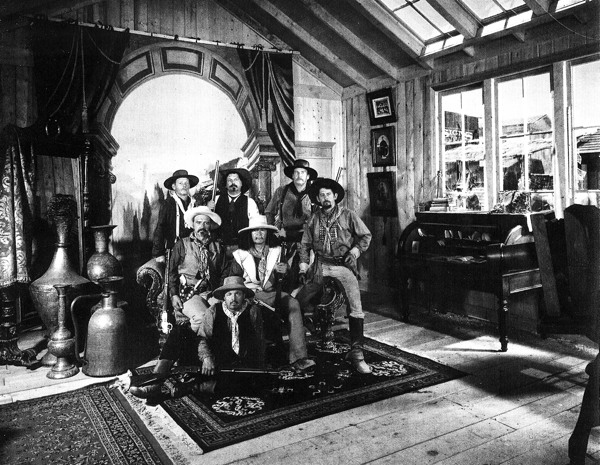
Members of the Red Sash gang pose inside Fly’s Studio with Peter Sherayko (middle row, far left). Seated in front is Larry Zeug. Middle row: Sherayko, Reggie Byrum, Logan Clark. Back row: Rick Malone, Garrett Roberts, and Jeff Dolan (courtesy Larry Zeug).
“The Tombstone wives, a couple of their dresses were rentals,” adds Porro. “I did make all of the female leads, Dana Delany, all her dresses I made. But some of the lesser female characters were rentals from England. And they were good, they were quite accurate, they were just so much better quality than the few that were left in America. I was at least able to do all of Dana’s stuff, which was fun.” When Porro couldn’t manufacture everything, Old Tucson Studios once again came to the rescue and met the designer’s requirements, providing moccasins, concho and beaded-belts with knife holder, a vintage Prince Albert frock coat, vests, pants, robes and skirts, corsets, handbags, pinafores, long johns, socks, shirts, boots and sombreros. If Old Tucson had it, it rented it out, usually for anywhere from $1 to $5 per day.30
Frank Castanza, a saddle-maker from Montana, was brought in to help the actors with their chaps. Buckaroo Rick Terry describes Frank’s approach: “[The chaps] were brand new and they needed somebody to help make them look antique, or make them look used and worn. Frank … grabbed all their chaps and threw them out on the parking lot there and had them pick up certain chemicals and some brushes and other things, and in 15 minutes they had worked-over chaps. If they would have done it by hand it would have taken hours, but the way Frank had them do it, it took just a very short period of time.” Many of the clothes were worked over as well-washed and rewashed and rewashed yet again to give them that worn feeling.31
As for historically correct hats, that’s where Tom Hirt came in. Hirt had worked with Sam Elliott on Conagher and other films, so it was no surprise that Hirt received a call asking if he was available to help out. According to Tom, he was hired four or five months before the start of production and “most of the wardrobe people in town were booked to do [Costner’s movie], so they were a little bit behind on people that were capable of doing [Tombstone]. People like Sam … kind of pulled these [specialists] out of the woodwork.” Hirt then met with Jarre and discussed the style of each character’s hat. They needed to be consistent with the era and of a style that would have been available in Tombstone at that time. All the Earp brothers wore the same style of hat, consisting of a 75 percent beaver and 25 percent rabbit blend, and Russell’s hat had a low, open crown, derby-style, with flat brim showing a southwestern influence. Most of the actors either came in, or contacted Hirt and/or Jarre, to discuss what they wanted to see. Buck Taylor designed the hat he wanted to wear, the actor deciding everything from style to color to type of brim. It usually took about ten days to hand-make each hat, including time to block and shape. Each character had at least three duplicates of his hat in case one was damaged.32
As for Holliday’s hat, Kilmer was one of the few people who never made contact with Hirt. Says Tom, “Kevin and I were sitting in wardrobe talking about Doc. We had a black hat just sitting there. I picked it up and took the edge of my hand and hit it like a karate chop and creased it in the front. As I was holding it, my hand was rolling the brim up on that one side, but not to a big degree. Kevin said, ‘Hey, that looks pretty cool just the way you did that.’ So I steamed it a little bit, and it worked out really good. The hat only had a little three-eighths inch ribbon band on it with the tails hanging loose off the side. We just left it like that without any type of formal bow on the side, or any formal type of hat band. Val Kilmer put it on and it just seemed right.”
As for Johnny Ringo’s chapeau, he had a “horse-haired hat band with the bow on the left side. The brim curled up on the right side, the opposite side of the other hats, to add a little individuality.” Hirt admits that it drives him nuts when he sees Biehn in the shootout scene with Kilmer: “I wasn’t on the set the day they filmed the shootout set. If you look closely, you will see the hatband is on backwards with the bow on the right hand side. The hatband must have fallen off and somebody must have put it on backwards.”33
Initially, Jarre checked out everyone’s wardrobe but soon, given all his other responsibilities, turned that job over to Hirt. He told him, “Tom, I don’t have the time to critique everybody as they come out here. I want you to be my eyes. I want all the wardrobe, all the costumes, I just want you to look at it. And if you see something out of place that doesn’t look right, doesn’t look historical, doesn’t look like it belongs, tell me about it and I’ll take care of it.” Porro was irritated, but two weeks into filming, the costume designer approached Hirt. “Tom, I came out here and I had some ideas what I wanted to do,” confessed Porro, “and you were out here and it irritated me. But we’ve been getting our dailies and getting really, really great reviews and saying how well the costuming is. I just wanted to thank you for your input because you’re making me look really good.” Tom shook his hand as that meant a lot to him.34
Peter Sherayko and Porro had a handshake agreement that for $5000 Sherayko would buy all the costumes for Caravan West Productions after filming was complete. “Well, Joe left the movie about two weeks before we were finished,” recalls Peter, “because he had another job. We went over. We were only supposed to film 10 or 12 weeks, and we ended up going 17 weeks. He had already booked another job, so he left. After the movie, I went up to the line producer who was in charge of everything and I said, ‘Joe and I made a deal for buying all the costumes.’ And he said, ‘Yeah, yeah. I want to sell them but [someone else] offered me $25,000 for them. If you can match $25,000, you can have them.’ I said, ‘Joe and I made a deal for $5000.’ He said, ‘No, no, no. I can’t do that. I need to get some money back.’” Although many of the principals and Cowboys still have their own costumes (Russell, Kilmer, Taylor, Rooker, Sherayko, etc.), all the rest were purchased by … American Costume.35
Renee Clothier was in charge of the wardrobe, art, scenic and prop departments at Old Tucson Studios. “[The costume department] was housed up in the High Chaparral [building],” recalls Renee. “They had a workshop set up there where they had stitching equipment. We had a lot of [items from] Western Costume, MGM, Warner Bros. We had big bins of shoes and boots and all of Barbara Stanwyck’s stuff. We had so much stuff. [The studios] would have come in and selected pieces that they wanted to rent. We would just write up the rental agreement and usually I would let them take whatever they wanted. If it didn’t work, they could bring it back so we could charge them for the actual used pieces. Either they would come to me and say, ‘These are my people. Can you dress them up?’ Or they would be a movie company like Tombstone that already has crew people and they have stitchers and so forth and they would get supplementary pieces from us for the extras. They would use some stuff, not the whole thing. Because we didn’t have tons and tons of stuff, but we had a good amount they could use. It varied. They had some stitchers. One of the gals they had on stitching was Maggie McFarland.”36