
THREE
In 1803, the Louisiana Purchase opened 828,000 western square miles and stretched the boundaries of the United States from the Mississippi River to the Rockies, from Canada to New Orleans—virtually doubling the size of the country. Encouraged by the concept of Manifest Destiny, migration to the western edge of the continent was deemed essential—both justified and inevitable with the unintended consequences of assimilation and acculturation. Fur traders and mountain men crossed the Rockies into Great Britain’s Oregon Territory while pioneers and adventures went south and west into Mexican territory. In 1836, Texas won independence from Mexico and nine years later joined the Union. The 1848 Treaty of Guadalupe Hidalgo ended the Mexican War; a million square miles were added to the county. Included were California, half of New Mexico, most of Arizona, Nevada and Utah, and parts of Colorado and Wyoming. The 1846 Oregon Treaty had already added Oregon, Idaho, Washington and parts of Wyoming and Montana, and in 1853 the Gadsden Purchase brought in an additional 30,000 square miles of Mexican territory—southern Arizona and southwest New Mexico. These actions effectively defined the current borders of the continental United States. Migration into these new territories implied annexation and occupation. As Jeff Guinn noted in The Last Gunfight: The Real Story of the Shootout at the O.K. Corral—And How It Changed the American West, initially, these hardy souls only wanted to grow enough produce to feed their families, and hunt enough game to survive in minimal comfort. But expansion meant increased population and opportunities. Soon “subsistence farming was no longer the main goal for some of these frontier landowners; capitalism became primary. Settlers needed manufactured goods, markets back east needed raw materials.”1
At the end of the Civil War (or the War of the Rebellion, or the War Between the States, or the War of Northern Aggression, or whatever one chooses to call it), Confederate veterans, wearing little more than the tattered remains of their ragged uniforms, returned to villages and farms only to find their homes destroyed, crops razed, livestock stolen or killed, their families destitute. Given one last chance, some decided to repair what was broken, turn over the soil anew, plant whatever crops they could and pray that they would somehow survive. Others returned to the cities and looked for new opportunities: telegraphists, railroad men, lumber mill workers, schoolteachers, hotel employees and storekeepers. Still others decided to pack up their families and belongings and move west, filled with the frontier spirit of adventure; to plant roots in another state where land was more favorable, climate more temperate and opportunity boundless. “Where all men were equal,” wrote Western novelist Louis L’Amour, “where each had his right to his own. The open land beckoned, offered the vastest empire man could desire, providing the space and riches needed for the accomplishment of the nation’s manifest destiny.” A place where a man could change his identify, forget who he was or what his problems were. A popular period song asked, “Oh, what was your name in the States? Was it Thompson, or Johnson or Bates? Did you murder your wife and fly for your life? Say, what was your name in the States?” It was a place where one could ignore Yankee occupationists and the Federal government, a place where people could do as they pleased with minimal interference. Expansion was an opportunity for anyone, honest man or fugitive, to make a new life for himself. Said noted author, historian and professor Paul Hutton, “The victory of the Union in the American Civil War is a victory for the forces of incorporation for the West. But what happens after the Civil War surprises even those that dreamed of settling the West because it happened so rapidly. What had taken 300 years to accomplish now is wrapped up in a generation.” Before the war, most Western migrants originated from Northern and Midwestern states; after the war, Southern states were more than well-represented. And along with their presence, these hearty adventurers brought along their values and beliefs: independence, loyalty, self-reliance, dedication and responsibility. Most Southerners were Democrats and opposed both the anti-slavery Republican Party and the Federal government. “Support and defend me when necessary. Otherwise, stay the hell out of my business!” These beliefs permeated wherever the pioneers choose to settle: Topeka, Laramie, Deadwood, Wichita, Dodge City, Abilene. Wide-open and lawless. Anything goes, 24 hours a day!
And, in the entire West, what greater riches could be found than those in Texas! Just the word brings to mind land speculators and cattle ranches, railroads and wagon trains. Mountains and canyons, deserts and rivers. Cotton and bluebonnet, Longhorns and sheep, barbed wire and open range. Cowboys and Indians. And outlaws!2
And it was a dangerous time. Gunfights, murder and robbery were commonplace among these ruffians and scoundrels. Ravaging and plundering, they took what was not theirs, they gambled, they drank, they stole horses and cattle. Robbers of both trains and banks, they also ambushed and murdered innocent farmers, ranchers and townsfolk, showing contempt for both people and the law. They arrived from all over the country: James Brown Miller and John Selman from Arkansas, Sam Bass and Sherman McMaster from Illinois, William “Curly Bill” Brocius and John Peters Ringo from Indiana, Elliot Larkin Ferguson (aka Pete Spence) from Louisiana, and a thousand others like them. They were the law when the law was the man whose gun was fastest and true. And Texas was enormous! For miles and miles, all one could see was miles and miles. Endless prairies, hardwood forests and rolling hills, desert grasslands and valleys, mountains, hills and swamps. It was just impossible to maintain order over this vast area when all one was concerned about was the threat of Indians. And the outlaws had an infinite number of places to hide. As Jeff Guinn wrote, “Texas became a magnet for fugitives from every other part of the country. All across Texas, towns and ranches were terrorized by packs of armed thugs who broke laws with impunity because there was no one to stop them.” But time was running out for these desperados as more and more townsfolk demanded respect for the law and would do whatever they could to assure it was upheld. But first things first.3
During the early 1800s, there were over 50 Indian “nations” who roamed the prairies of Texas, among them the Cherokee, Apache, Tonkawas, Wichitas, Kiowa, Caddo and the Comanche. The latter had a ruthless, well-earned reputation as the most relentless and feared war machine in the Southwest—great warriors and masters of cavalry tactics and horsemanship. With an intense brutality, they butchered their prisoners for entertainment and prestige. Some tribes were indigenous, others migratory. A few tribes were agriculturists who lived in permanent dwellings, others were fishermen, still others survived on buffalo, deer and small game. They were skilled traders, extraordinary artisans. Over time, some tribes were ravaged by cholera and smallpox epidemics and virtually ceased to exist while others were decimated by the advance of civilization. Many tribes resisted this invasion into their land and occupation of their hunting grounds, responding with devastating settlement raids, murdering pioneers and their families, stealing horses, cattle and in some cases women and children. Settlers lived in constant fear of attack. In December 1838, the Republic of Texas’ second president, Mirabeau Lamar, stated in his opening Congressional address, “If the wild cannibals of the woods will not desist from their massacres, if they continue to war upon us with the ferocity of tigers and hyenas, it is time that we should retaliate their warfare.” And so they did, for the next 40 years. Since these Native Americans hindered American advancement and settlement into Texas and threatened the lives of newly arrived families, extermination of their race was the only solution. Campaigns were waged against all Native Americans, peaceful or otherwise. As villages were burned, the defeated tribes moved to other areas and settlers quickly took their place. While the intent was never to commit cultural genocide, by removing these indigenous peoples from their hunting grounds and overland trade routes, and slaughtering buffalo, the effect was just that.
A complement of 10 “rangers,” so called as their duties required them to range over the entire country, had been formed by Stephen F. Austin in 1823 to protect Texan colonists from the Indians. Over the next several decades, this organization increased in both size and responsibility, and operated under varied conditions and demands for service. Its numbers rose and fell, influenced by threats to the Texas Republic. In 1835 the legislature created three 56-man companies known as Texas Rangers. Lamar added eight more companies in 1838. Known as guardians of the frontier, they were said to “ride like Mexicans, shoot like Tennesseans, and fight like the very devil.” During the Revolution, they served as scouts and guerrilla fighters; during the 1840s and ’50s, they pacified the Mexican border and stopped feuds in the state. But always, they addressed the Indian issue; numerous battles occurred from the Red River to Brownsville. At the end of Reconstruction, the Texas legislature met again to reorganize the Ranger outfits. Two 500-man units were created, one led by Major John B. Jones to assist the U.S. Cavalry in fighting Comanches and Kiowas, the other led by Capt. Leander H. McNelly to address the ever-increasing criminal activities of outlaws who had virtually overrun the Western frontier. McNelly was given specific responsibility to restore order out of chaos along the Nueces Strip, a portion of land between the Rio Grande and the Nueces where the two rivers run parallel to each other. Texas claimed the Rio Grande as its southern border; Mexico claimed the Nueces as its northern boundary. Here, cattle-rustling was rampant, not only on local farms and ranches, but across the border in Mexico as well. Bands of outlaws would cross the Rio Grande, liberate foreign cattle, re-cross the border, and then sell these freed bovines to legitimate ranchers in Texas. Mexican bandits would respond by conducting guerrilla operations against local Texas ranchers. So severe was this issue that McNelly’s Special Forces were financed by the very ranchers whose cattle were stolen.
Over a two-year period, Jones’ Frontier Battalion engaged in numerous major battles (15 in 1874 alone) and by 1875 finally eliminated the Indian threat. McNelly was equally successful and when the two units joined forces, it was only a matter of time before over 3,000 outlaws were killed, jailed or forced to relocate to more favorable climes.4
The bad men moved further west, first into New Mexico and then into Arizona. Its rugged mountains and virtually inaccessible canyons provided the last refuge for outlaws on the run. As Marshal Trimble, Arizona’s official state historian, wrote in Arizona Outlaws and Lawmen: Gunslingers, Bandits, Heroes and Peacekeepers, “its wild, untamed country, lack of good roads and proximity to the Mexican border made it ideally suited to men riding the ‘Owl Hoot Trail.’ The rich boom towns, stagecoaches and railroads carrying express boxes loaded with gold coins, along with large herds of cattle, were easy pickings in the remote regions by bands of outlaws and cow thieves.”5
By the late 1880s, the Southwest territories had become very well-established. The first to arrive in the area were Spanish explorers and conquistadores in search of riches and glory. In 1541, Francisco Vázquez de Coronado failed in his quest to discover the legendary Seven Golden Cities of Cibola but he brought with him the first domestic livestock, horses and churro sheep, which significantly changed the way of life for the natives. These intrepid adventurers were quickly followed by the Spanish clergy seeking to convert native Apache, Navajo and other indigenous tribes to the ways of Christianity. As the Spanish military presence increased, settlers soon arrived and established permanent communities such as Santa Fe, Taos, Albuquerque, Las Cruces and Tucson. French-Canadian and American trappers and traders arrived in the late 1700s, and commerce began to expand. Pottery and baskets, jewelry and weavings, woodwork and religious icons were transported to eastern markets via the Santa Fe Trail. The 1846 California gold rush turned the Southwest into a major thoroughfare for prospectors on their way to the West Coast. The Butterfield Overland Stage Line crossed the territories in 1858 and the coming of the railroad in 1879 provided easy access to full-scale trade and migration. The mid-century saw an extensive growth in the Southwest; its land and people were a primary destination for businessmen looking for opportunities to sell or manufacture their goods, adventurers and gold prospectors, lawyers and politicians hoping to provide a legal and political system for the lawless territory, and ranchers and homesteaders looking for cheap land. Due to the arid nature of the country, cattlemen could more easily use the land than farmers could.6
Most of the cattle herds were driven in from Texas and California to supply federal troops and Indians with beef. Wrote J.J. Wagoner in the Arizoniana journal, “Hundreds of emigrants were coming into the new cow country to begin an experimental exploitation of the luxuriant grasslands. They settled along the rivers where there was water and an abundance of native forage. They ran their cattle on the unfenced and unregulated public domain. Though they did not own the grass or land, it was understood among neighbors that the appropriation of water entailed the possession of certain range rights.” From what was once a meager 20 to 75 head of cattle on a handful of scattered Mexican ranchos, now came an industry of tens of thousands of cattle in the Santa Cruz, Rillito and San Pedro valleys of Arizona. Among them were the “English boys” Empire Ranch of Vail; Hislop and Harvey, which grazed 5000 head; the Cienega Ranch, which had 1000 cattle and 23,000 sheep; and the Babocomari with 3600 head. Most other holdings were 50 to 250 head each, with virtually every water claim adaptable to the cattle business holding livestock. (By 1880, New Mexico supported three to four million sheep and over 130,000 head of cattle; in 1891, there were nearly 721,000 head of cattle on the Arizona tax roles.)
And along with all the cattle came cattle rustlers—the Clantons and McLaurys.7
As costumes were sewn and buildings constructed, actors were still needed to round out the Tombstone cast. Whether you were a main character or a background extra, the role still required someone. And that’s where Holly Hire came in. Wife of actor-stuntman Don Collier, she had started out as a casting agent in Los Angeles. Collier joked he married Holly to advance his career. According to Collier, they met in L.A. when he was auditioning for a chili commercial. “I went in for an audition and got the job. I got a couple of more jobs and figured the best way to get more work was to marry her.” Holly had a Hollywood background and had lived there for years (she began working in casting in 1968) before the two married. The Colliers later moved to Tucson where, due to her local connections as well as those in Los Angles, she continued to work in casting. It was an ideal situation: She knew who was available and what they could bring to a production and, as a result, many Tucson extras just called in and had a job. Naturally, Collier was cast in the film.
Said extra Glen Gold, “I had been doing films [and] I’ve done some things for Holly and other stuff in Young Riders, so when they started Tombstone I got a spot on there…. There was a bunch of us around here and she knew she could count on us if she needed us.” Extra Eddie Perez said, “Holly contacted me and said [she needed] some people who understood the ropes.” Other actors had a somewhat indirect connection to Kevin Jarre, which didn’t hurt. Charles Schneider got involved because he was fortunate enough to be at a dinner party with Lisa Zane, whom he had gone to school with in Chicago. “At this dinner party was Kevin Jarre, who Lisa Zane was dating,” explained Charles. “He and I instantly hit it off. Throughout the evening he kept looking at me with a certain fascination as if he had something in his mind. At this point, of course, he was set to direct the film. He came up to me towards the end of the dinner party and said, ‘Charles, do you know how to juggle?’ and I said, ‘No, but I can learn.’ He said, ‘I think you would be just perfect for this character, Prof. Gillman. You’ve got about six months to learn.’”8
Others, such as Montana cowboy Forrie Smith, had to work a little harder. “They were looking for Pony Deal, and I’m a half-breed Indian from Montana,” said Smith. “I had to go to, I don’t know how many times, I had to audition for the local casting lady. Then the casting people from L.A. came out and then I got to go in front of Kevin Jarre….” Smith finally got the role and Jarre even escorted him to wardrobe to pick out a costume.
But Smith wasn’t the only one who had to audition; even Sherayko’s Buckaroos had to prove they could fit the bill. Jerry Crandall explains. “In early 1993, I received a call from longtime friend Peter Sherayko. In the past we had worked together in Wild West shows and other similar projects. He asked if I wanted to be in a major Western movie. He explained that the writer and director, Kevin Jarre, was a collector of Western history, including memorabilia and art. As a result, he knew of my paintings and interest in the history of the Old West. They put out this bulletin that they needed 30 cowboy-type guys for extras for Tombstone. (Actually, 50 Buckaroos were required, but due to budget constraints, the number was reduced to 30.) From what I understand, about 300 guys applied, ’cause everybody wanted to be a cowboy in the movie. But the problem was you had to furnish your own horse, guns, saddle, bit, everything, hats, and they had to be authentic to the period. Well, 90 percent of the guys that do this have no real clue what the stuff should really look like. They all have modern or semi-modern chaps and hats and all that. So, right away, Kevin Jarre … rejected most of them. But it came down to about 30 guys that they needed so we had to send in photos of our outfits, saddles and our horses. (Applicants and Buckaroos Kane Rubalcaba, Jake Johnson, Reggie Byrum and Curt Stokes were from California, Frank Castanza, Montana, Jerry Brown and Tom, Paul and Charley Ward, Oklahoma, and John Peel, Garrett Roberts, Rick Terry, Jerry Crandall, Jeff and Sam Dolan and many others were from Arizona.) We had to get our stuff ready and report down to the location on the Babocomari Ranch in southern Arizona. We got down there (May 6) and they announced they were going to have a test for all of us to see our ability; see how our horses do under gunfire and all.”
An embarrassed Tom Ward relates, “Well, we were all out there: Terry Leonard, Terry’s wife (Teri Garland), one of the producers, [director of photography William] Fraker, [Kim Burke and Kevin Jarre]. I’m sitting there on my horse and it bucks me off right in the middle of the crowd. Right there in front of everybody. First thing you do is jump off and look around to see if anybody saw it. Everybody saw it! Well, that’s a good way to start.”
Kane Rubalcaba: “And then we had the shakedown … we rode around. We did drills ’cause a lot of us were military, Civil War re-enactors. We did military-type drills on horseback, kinda get everybody tuned up. And then by the time it went down to the horsemanship test … we’re all laughing. We’re like, ‘You got to be freaking kidding me.’” Crandall continues, “Thirty of us were there in a field and we had to mount up, lope down to the end of the field, fire a pistol, come around a barrel, kick the horse into a full-gear run and fire again and then come to right where the judges were and skid the horse to a stop. Spin him to the left, spin him to the right and drop the reins to see if he would stand still. Unfortunately, some of the guys, they looked good, they knew their dress and all but they weren’t real great horsemen. So a couple of guys fell off their horse, and the horse didn’t perform well.” Buckaroo John Peel explains the evaluation system: “They gave everybody a score; five being the best, one being the poorest. Most of the guys were threes and fours, there were a couple of twos and a couple of fives. The better horsemen were fours and fives, the guys that were a little less so were threes and twos, and there might have even been a couple of guys that were ones. Some of the guys literally bought a horse and a gun to work on the film. Other guys already had wardrobes of historical clothing and lots of guns, horses and saddles.” And they were well-paid for their time: $350 a week for their work and another $450 a week to rent their horses, guns, saddles and gear. Not bad for ten weeks’ work. (One evening several years later, Tom Ward visited the Leonards, and Teri asked Tom if he ever was a Buckaroo in Tombstone. “Yes, I was,” Ward replied. She continued, “I remember at the riding audition there was one of the Buckaroos that got bucked off.” Tom, thinking he’d better end this conversation before someone got too embarrassed, admitted, “Well, that was me.” Teri laughed and said, “Well, I thought it probably was somebody who didn’t know how to ride a horse.” All Tom could do was confess, “At that particular time, I guess I didn’t.”9)
Four of the Buckaroos were upgraded to Screen Actors Guild members and given speaking roles; along with Charley Ward, Jake Johnson and Frank Costanza, Jerry was one of the lucky ones. He knew it was going to be a tough shoot. Wrote Sherayko in an instruction letter to all Buckaroos, “We’re all in this together. This will be a lot of fun and a good time but also hot, hard, long work. But you know what you’re in for. When you sign on, you sign on so no bellyaching.” Unfortunately, if you were upgraded, it was both good news and bad as once you were in SAG you were paid a higher wage and as the production crew didn’t want to incur extra costs, your tenure on the film was short-lived. Jarre was so impressed with Charley Ward’s natural ability that he asked the lad to audition again. Afterward, Jarre told Charley, “Listen, I don’t have a part for you right now. But I’m going to write a part for you tonight.” Kevin later told Charley’s father Tom that he did so because Charley “reminded him of himself when he was 15.” Charley, so excited after he saw what they were going to pay him, didn’t even read the rest of the contract—he just signed it. Five weeks’ work and 25 to 30 lines—not bad for a 15-year-old.
After the test, Jarre evaluated each Buckaroo costume and made the necessary suggestions. Larry Zeug recalls, “We got a call one day—they wanted to see us down in Tucson at the Holiday Inn, dressed in costume. Kevin Jarre came by and he looked at everybody and he said, ‘Okay, you with the long hair, go get your hair cut or put it under your hat.’ Five or six had long hair. He looked at everybody’s costume and okayed it or didn’t okay it. The only thing he changed on me, he gave me a scarf.” Jarre reached the end of the line of candidates and then addressed everyone: “My name is Kevin Jarre and I’m the director. I just want you all to know if you ever have any questions or problems, come look for me. I’m the guy wearing the black hat.” After Jarre walked away, the AD spoke up. “Yeah, what he just said,” they were told. “If you ever have any problems, come to me, not the director. He’s the boss of everybody, but I’m your boss.”
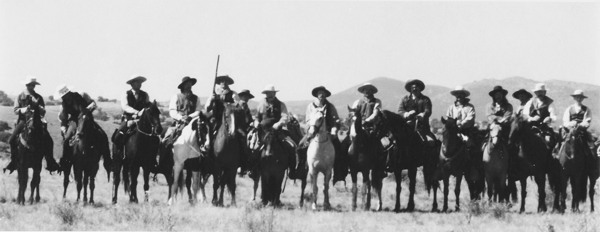
Buckaroo members line up at the horsemanship tryout on the Babocomari Ranch (courtesy Jerry Crandall).
Sherayko previously had run into Zeug at a parade in Palm Springs. As Larry recalls the encounter, “Peter comes riding up to me and saw that I had a ’76 Winchester and he goes, ‘Hey, you want to sell that?’ I said, ‘No. I got three of them.’ ‘Well, do you want to do a movie?’ I said, ‘Sure,’ and that was how we met. After the parade, he learned that I did gunsmith work … and we started getting together. He said he was supplying the guns for this movie and he wanted somebody working on the guns that knew what they were doing.”10
Production was originally set to begin on March 29 but due to Costner’s involvement or lack thereof, the turnaround issue, finances and Russell’s late acceptance, it had to be delayed until April 26. In the meantime, the Hollywood publicity mill continued to churn out obligatory announcements: April 5, David Strathairn signed on to play Johnny Behan. At that time, Bill Paxton, Powers Boothe, Michael Biehn, Sam Elliott, Jason Priestley, Michael Rooker, Stephen Lang, Billy Zane and Glenn Ford were already on board; April 29, Variety belatedly announced that Ford would join Robert Mitchum and Charlton Heston on Tombstone; May 5, Dana Delany was hired and flew immediately to Tucson for rehearsals. One week later, Variety announced that Frank Stallone was added to the cast. Even though filming had not yet started, Disney, determined to get their film out before Costner’s, had already announced its release was scheduled for the next spring or early the next summer. And, just to show you can’t believe everything you read, The Hollywood Reporter stated on August 3, 84 days after filming started, that William Baldwin was in the film.11
Jarre worked on additional script development: additions, deletions, modifications. Dialogue was moved from scene to scene and, in some cases, given to different characters. Extraneous lines were eliminated, others consolidated and still others expanded. He continued to revise his previous draft, which was completed on January 30, 1993. The opening sequence of photos, historical prints, silent live-action vignettes and voiceover narration remained unchanged. However, rather than show the aftermath of a border family massacre in the first scene, the event is now merely mentioned in conversation between the Mexican Rurale and his captain. This was a typical change—entire scenes being consolidated or eliminated, but with their context only being referred to in passing. As a result, the third draft was reduced from 165 scenes, 135 pages and 88 characters, to 152 scenes, 123 pages and 81 characters. The script now was tighter, the flow improved.
The ambush of the Mexican patrol and murder of its captain remained in the script. Wyatt Earp’s arrival in Tucson, his refusal of U.S. Marshal Crawley Dake’s offer, and Earp’s subsequent greeting from his brothers and their wives, remained unchanged although the role of the young boy who commented on Wyatt’s horses was eliminated. (That role, albeit without dialogue, was re-added in later revisions.) As the Earps and their wives camp for the evening on their way to Tombstone, a scripted risqué conversation about Wyatt’s horse Dick Nailor was also dropped. The next several scenes, including the Earps’ arrival in Tombstone, their introduction to Cochise Country, John Behan and Marshal Fred White, and the rental of three small cottages on the edge of town, didn’t change, but White’s explanation of local politics and graft was shortened. The memorable dialogue from Wyatt’s confrontation with Johnny Tyler and subsequent meeting with Doc Holliday and Behan didn’t change from the prior draft. Similarly, the next 11 scenes, which included the introductions of Turkey Creek Jack Johnson and Texas Jack Vermillion, the stagecoach arrival of a theatrical acting troupe, Marshal White’s identification of numerous Cowboys at Shieffelin Hall, the stage performances, the six-gun-tin cup-Latin duel between Ringo and Holliday, and Curly Bill’s sojourn to the opium den, are identical to the previous script.
Marshal White’s murder scene is modified to include Wyatt’s subsequent confrontation with Ike, Billy Clanton and six other cowboys. This confrontation is important because it inflames and enhances the antagonism between the two factions. In the tightened script, the next 30 scenes remained relatively unchanged although the murder of Old Man Clanton is now just referenced rather than shown. The remainder of the script was almost identical in content to the second draft although Scene 83 (the implied rape at a Mexican wedding) is gone, as is Scene 89, the attempted assassination of Mayor Clum and his wife. Also eliminated is Scene 98, the sale of Wyatt’s holdings in Tombstone to a high-roller.
The epilogue voiceover narration is modified to eliminate any reference to Tombstone, the Cowboys, John Behan and Ike Clanton:
EPILOGUE, like the prologue, v.o. narration over a series of images and live-action vignettes. First, pictures of Tombstone in various stages of development followed by scenes of dust and desolation giving way to tourist events….
After the famous gunfight, the power of the Cowboy Gang was broken forever but it hardly mattered in the end. In 1886, the mines flooded out and Tombstone was a boom town no more, by the end of the century dwindling into just another dusty small town in the Arizona desert. But the immense fame it gained during its lawless era left an enduring legacy of myth and legend and Tombstone was reborn in the 20th century as a tourist attraction. It remains so to this day, the big draw its annual ‘Helldorado Days’ celebration, the highlight of which takes place at the O.K. Corral with a highly fanciful re-enactment of the famous gunfight.
But Jarre wasn’t satisfied, making subsequent changes on March 18 and 29 as well. When completed, the 128-page script consisted of 158 well-defined, relatively accurate and emotionally charged scenes. Jarre’s final version also eliminated Prof. Gillman’s cigar boxes, Morgan and Josephine’s discussion of the hereafter, Judge Spicer’s trial scene, and Ringo’s murder of an old prospector in Galeyville. Jarre also re-inserted the ambush and death of Old Man Clanton in addition to the implied rape of a young Mexican woman.
While Jarre fine-tuned his script, location manager Lauren Ross and unit production manager Terry Collis scouted potential locations. Ross was charged with finding sites that would meet both the script’s requirements and the director’s creative vision. Once the appropriate locations were identified, Jarre flew in to check out their feasibility, transportation captain Billy Getzwiller having picked him up at the Tucson airport. Ross also negotiated the terms of use and secured the necessary permits. Several factors are considered when searching for a viable location: logistical feasibility and distance from base camp, sources of daylight, lighting requirements and time of day when used, electrical sources, ambient noise limitations, evaluation of surrounding geography, budget restrictions, availability of parking, housing requirements, local weather conditions, and a myriad of other issues. (Base camp is an area, as near as practical to the set, where the actors’ trailers, food facility, honey wagons, main equipment trucks and crew cars, etc., are assembled.12)
Naturally, Old Tucson and Mescal were at the top of her list. Other Arizona filming locations included the Babocomari Ranch, Fort Crittenden and the Empire Ranch (all located in Sonoita), Patagonia, Elgin, Texas Canyon, Little Dragoon Mountains, San Simon Valley, Sonoran Desert, Skeleton Canyon and Harshaw.
It was rumored that Costner wanted to shoot his Earp film in modern-day Tombstone and had offered the city $9 million if it would allow him to construct period-correct store fronts along Allen and Fremont Streets. After the town council voted down his proposal, he decided to shoot the film at various New Mexico locations including the Santa Fe area’s Cook, Ghost and Eaves movie ranches where portions of Silverado had been filmed. However, a search of the Tombstone town council records failed to show any discussion regarding this proposal. And, as the various buildings fronting Allen and Fremont are owned by individuals and not the town, the council would not have any authority to accept the proposal anyway. In any case, Costner would have had to contact each owner for specific approval, no doubt a cumbersome task. Failure to receive approval from just a handful of owners would have doomed the concept. (Ironically, while filming Tin Cup in Tucson, Sonoita and Nogales, Costner returned to Tombstone in the fall of 1995 with his kids. As nobody would leave him alone long enough to eat, he once again left town.) Catherine Hardwicke says that she, too, looked to see if the real city of Tombstone could be used, but quickly decided it was impractical: “When I went there, I saw that it was super-touristy. It accommodated tourists and it just wouldn’t work at all. We couldn’t have done it because we would have to take over the town. I was [at Mescal] for over six months building the set, changing the set and shooting and transforming everything. We just couldn’t demolish the whole tourist industry of Tombstone. We would have to have access to everything, take out all the modern elements. When I looked at all the things that would have to be changed, including the street itself … this would never fit in our budget.”13
Local resident Victoria McLaren didn’t mind that the town wasn’t used. “It’s just too modern here,” she explained. “It would have been too difficult to film the way the town is now. They would have had to change too much. We have paved streets, and cars, and it would have disrupted business.”14
Dressed in his black leather jacket, Jarre, along with Ross, Collis and Getzwiller, drove all over the countryside and scouted pre-selected locations. According to Getzwiller, “When we were scouting, we would look at locations and he would say, ‘I’d like to put an insert car in here.’ ‘And then I’d like to have a nice rising shot coming over the hill with cranes.’ [But the powers that be] said, ‘No. No insert car. No cranes.’ They just really cut him back and wouldn’t let him do what he wanted to do. And as soon as [the replacement director] came in, my [transportation] crew was another third bigger just in special equipment. They gave [Cosmatos] everything he wanted. They had an insert car on the set all the time. They had cranes on the set all the time. Special effects water.”15
Most of the Buckaroos arrived on the Arizona location in mid–May and set up a base camp on the Babocomari Ranch. Sherayko had purchased a few military-style tents and even though they were erected, no one really used them. Most brought their own accommodations: horse trailers, campers, pup tents, bedrolls, even a wigwam. Several chain-link fences were set up as corrals for the horses, the corrals adorned with green and blue plastic tarps for shade. Recalls Larry Zeug, “There were squares where you had your horses. We had to get up, clean them every day, clean out the stalls, haul it out. We lived like real cowboys with our horses. They brought in a shower trailer so we could get a shower every morning and night. Sometimes that didn’t work, either. They didn’t have gas for it and we’d all be raising hell. When I was out there with my two horses, you lose track of everything. No worries. We rode them to the set every day. If you went to craft services, you got something for your horse, too. You rode your horse, took off his saddle, brushed him down and then went to sleep. Sometimes you even slept with your horse. Take care of your horses, live like a cowboy. And that’s what we did. They said, ‘Just stay [in the camp] until you get a call to go to work.’”
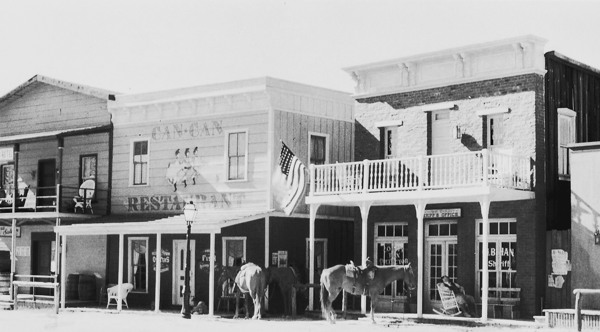
Alhambra Saloon, Can Can Restaurant, and the Sheriff’s Office—Mescal.
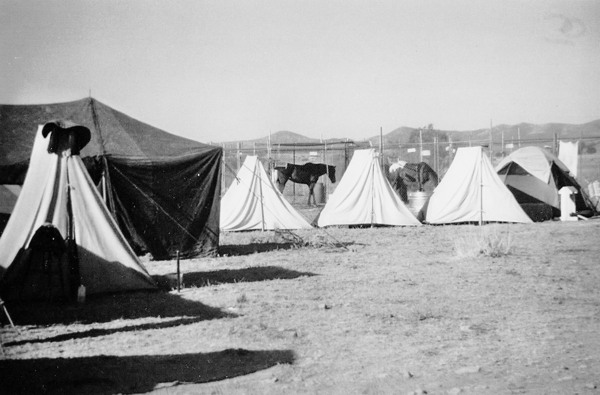
Buckaroo base camp, Babocomari ranch. Horses are housed in chain-linked corrals, Buckaroos in tents and trailers (courtesy Larry Zeug).
While the Buckaroos were setting up camp, the production company staked out the Tucson Holiday Inn on Palo Verde Boulevard. More than 150 rooms were rented, including rooms for production offices. According to Holiday Inn executive Elly McFadden, the hotel had 300 rooms and half of them were suites: “They took over half the hotel. We couldn’t close it to the general public but, especially back then, if you had ten percent occupancy, you’d be lucky. So I was a real hero, booking in that many rooms for the whole summer. I gave them a really good deal; I gave them what they wanted and then some, [so] they accepted the bid.”
Terry Collis coordinated the rentals with McFadden, but Terry’s secretary handled all the arrangements. “Terry Collis’ secretary … she was kind of crazy-busy all the time with details,” says McFadden. “She would call me up on a Friday afternoon just before I’m ready to go home and say, ‘We need another suite for tomorrow. We have another star coming in.’ And I’d say, ‘Well, you know what? You have all my suites already. You already have them all.’ ‘No. We have to have one per contract.’ I said, ‘Okay, I’ll try to build one by tomorrow.’ What could I do … kick somebody out? She was so frantic all the time [that] we gave her a little basket from the front desk.” Later, when production ran longer than scheduled, it became an even bigger problem for McFadden. Other guests had reservations for that same time period but once someone is in a hotel room, you literally can’t evict them. Fortunately, while houses were on loan for many of the principal actors, others stayed in the Freedom Park apartments as well as at the Rancho Mirage, Silverado and the Los Portales.16
Several Buckaroos arrived a day early and it’s fortunate they did, as a member of the production team drove out to the Babocomari and said, “Hey, I need four or five guys by the hotel at five o’clock tomorrow morning.” So Bob Vincent, Jemison Beshears, Garrett Roberts and John Peel got up at an ungodly hour, piled into Peel’s pickup and drove about one hour to Tucson. Jarre walked out of the hotel, looked at their clothing and, after approving them with some modifications, drove west of the city where they were filming trailers with Kurt Russell. According to Peel, “This is before any of the other guys showed up or real production even started. We got out there … and Thell Reed was there. They just shot some stuff, four cowboys coming up over a hill drawing their guns. Sort of like shadows, silhouette. They shot some scenes with Kurt flipping a silver dollar in the air and when [it] lands on the ground, it’s a U.S. marshal’s badge. Kurt picks it up and pins it on. Teasers they call [them].”17
Many filmgoers believe that the lightning seen in the movie was the result of special effects, but that wasn’t always the case. The lightning often was real and it was constant, which impressed many. Some called it unnerving, amazing, and that they’d never seen it as intense as it was on that movie set. It put on quite a show the day after most of the Buckaroos had arrived at the Babocomari: There was a huge storm and one gigantic lightning strike only 300 yards from where they had camped. Seeing the subsequent flames, one fellow got in a truck and called the fire department. They were told, “Let it burn.” And so they did. Eventually, a fire marshal came out and told the Buckaroos they had to move out due to the danger.18
Actors and crew members were given an hour-by-hour schedule that detailed all the various activities for that particular pre-production day. For instance, the schedule for Saturday, May 15, 1993, was as follows:
7:00A to 11:30A and 12:00P to 1:15P, Hair and Makeup session in the MKUP/HAIR trailer.
7:00A to 11:00A, Buckaroo riding/Weapons rehearsal at the Main ranch house on the BABOCOMARI ranch.
9:00A to 11:00a and 3:00P to 7:00P, Wardrobe fittings in the WARDROBE trailer.
9:30A to 10:30A, Choreography session in the DIRECTOR’S office. [In addition to filling the role of Big Nose Kate, Lisa Zane was also budgeted as the dance director and was given an allocated portion of both Alphaville’s production fee and Jarre’s directorial earnings.]
9:30A to 1:00P and 2:30P to 6:30P, RIDING rehearsals at the BABOCOMARI corral. Conducted by Kim Burke, riding rehearsal participants included Dana Delany, Michael Rooker, Buck Taylor, Glen Wyatt Earp, Jon Tenney, Jason Priestley, John Philbin, Powers Boothe, Michael Biehn, Stephen Lang and Robert Burke.
The day finished with a pool party that was scheduled to run from seven to ten p.m.19
“Kevin Jarre wrote a brilliant script,” says Michael Biehn. “And everyone flocked to it—you can tell by the cast. I immediately was interested in who they were going to cast as Curly Bill because we’d be working together. I knew Powers from his Jim Jones performance, which was incredible. Powers was always a real presence on film. There are certain people—like Lee Marvin—who just have character in their face, in them. You just know that they’ve lived a life and it’s been an interesting one. Before we went to Tucson, [Boothe and I] went out to dinner. I said, ‘I’m going to take my car out there. It’s only going to be a seven- or eight-hour drive. Why don’t you come along with me?’ So, we drove to Tucson together.”20
Robert Burke was excited to be a part of the project. “[I was offered the role] pretty early on. [Jarre and I] hit it off. [Kevin] called my guys the same day [of the interview] and said, ‘It’ll be Ringo if Biehn isn’t settled in, it’ll be [Mayor Clum] if Jon Tenney’s pilot gets picked up, or Frank McLaury. One of the three.’” Burke was very agreeable to coming on board and said, “Hey, listen, pal. This script is so strong, you give me a spear and tell me what corner to stand in and I’ll be there.” According to Burke, “I really wanted to be a part of the show.”21
But before filming began, several days of rehearsals were required. “I arrived in Arizona for a read-through and rehearsal with Kevin Jarre,” John Philbin recalls. “When I got there, the whole cast was there: Jason Priestley, Stephen Lang, Billy Bob Thornton, Sam Elliott. We did a read-through and it was fucking great and hysterical with Kevin and he was really nice, people asking questions and it was super cool and we were all so excited to be a part of this. I think the reason all those actors agreed to do the movie was because of the script that Kevin Jarre wrote. And I think the reason the movie got funded was because Kevin Jarre was able to get all those actors who loved Westerns and the history of Westerns and identified with Westerns and wanted to play a real-life cowboy from that time with such a historic event like the O.K. Corral and law enforcement and Wyatt Earp and Doc Holliday. It’s a dream come true for an actor. A lot of those guys ride horses; shooting guns is always fun for an actor. So Kevin Jarre, based on his script, got all those huge actors together, because they had juicy, juicy roles, almost all of them.”22
Prior to rehearsals, several actors did their own in-depth research of their characters. “Sure, I did the research,” said Stephen Lang. “Read the transcript of the inquest, which I’ve always felt would be the basis for a good piece of theater—kind of a Rashomon. Also histories and newspaper stuff—lot of rehashing. Mostly I just cowboy-ed up—roping, shooting, riding, and lots of drinking.”
The veteran stage actor continues, “In the end, after the research, I let the script fire my imagination. I used the facts, the historical record, in a Shakespearean way, which is to say that Julius Caesar or Henry V were resource material, points of entry (or departure) for Shakespeare. He shaped history to his own ends, so his histories are historical fiction. That is a fair characterization of my approach. I felt that Ike could occupy a singular and colorful niche in the saga.”
Fellow actors Sam Elliott and Bill Paxton took it to another level, as resident Tombstone historian Ben Traywick recalls: “What they did, they came out and asked me how [their characters] cut their hair, what their mustaches looked like, where they wore their guns. Sam borrowed an old pickup truck from Old Tucson and spent the whole afternoon with me.
“I had never seen Bill Paxton before,” admits Traywick, “and Sam says, ‘You know who we are?’ I said, ‘I know who you are but I don’t know the gentleman with you.’ [Paxton said,] ‘It won’t be long before you know who I am.’ My wife [was] upstairs and she can hear us talking through the ventilator, and we talked quite a while. When she came down, she had her hair in those big tin can rollers and she said, ‘Who are those people?’ And I said, ‘That’s Sam Elliott.’
“‘Oh my God!’
“Said Sam, smoothingly, ‘Marie, don’t worry about it because I see Katherine like that most every morning.’”23
Michael Biehn took a slightly different approach to his research. “Any time I do a role for a film, and certainly if it’s based on a real character, I read as much literature as I possibly can on the subject. There is a lot of literature about Wyatt Earp and about the shootout at the O.K. Corral, and some out there about Johnny Ringo, too. The stuff about Johnny Ringo, about the way people remembered him, and what kind of guy he was, actually and realistically intrigued me. So what I originally did was read as much as I could about not only Johnny Ringo, but Tombstone in general, and also about the Earps and Curly Bill Brocius. I wanted to know what people thought about them back then and back there. When an actor plays a historical man, it serves him well to take a look at what was written about that person by people alive at the same time, not just the scholars who wrote about him later on, in a different time period than Ringo’s.”24
In addition to rehearsing their lines, several actors needed to hone their riding skills. Some were skilled horsemen, others (like Powers Boothe) brought their trainers along with them. Still others looked like a monkey on a football. Wrangler Gary Gang was assigned the task of training them while Frank Trigani provided saddles they were comfortable with. “I had all the actors at my stable one day,” admits Gang. “It was a fricking zoo. It was a testosterone day. Everybody was there—Kurt, Val, Jon Tenney, every actor. Michael Rooker. Michael had his horse with me, too. All these guys and half of them were trying to out-macho each other. I’d been working with quite a few of them for riding, like Michael Biehn. He wasn’t afraid of horses, he just wasn’t comfortable on them. Trying to get these guys to look like they were 1800s riders. To have the look that Kevin wanted as far as horsemanship. I took Val for a ride and prior to that, I kinda thought he was a dick. I didn’t realize he was a method actor. And he was [in character as] Doc Holliday. I took him for a ride, and we’re talking and he suddenly became this guy from San Fernando Valley: ‘You’re kinda cool. I’ll hang out with you.’”
Others, like Robert Burke, were experienced horsemen: According to Burke, “Kevin Jarre said, ‘Can you ride a horse?’ [I replied,] ‘Like the fucking wind.’ My whole family in Ireland are horse people: trainers, vets, so I knew how to ride. One day, the guys are coming out of the jail, my horse is fucking around … how the hell do I … Terry [Leonard] said, ‘Come on, Robert. You’re a cowboy. Just throw yourself up there.’ I ran beside my horse and threw myself up there and I landed on my you-know-whats. And I had to ride out of town. I don’t think it made the picture but we did that scene seven or eight times because my horse kept shying. There were some guys who told Kevin they could ride but they were found out very quickly in an embarrassing, almost hazardous type of way. Kurt had this goddamn stallion—two of them I think. And this horse was piss and vinegar. Kurt is a horseman through and through. And that horse didn’t give him an ounce of grief. There were some fellas who just didn’t like riding. You can’t blame them if you’re not used to it.”
In some scenes, the less-skilled riders needed a little assistance. Says Larry Zeug, “I’m the guy that runs into the scene and holds the horses for Jon Tenney and Jason Priestley [after the death of Romulus Fabian]. Priestley and Tenney didn’t know how to ride a horse. They couldn’t jump on a horse and go off riding. So what I did, I turned around and slipped the stirrup over Jason Priestley’s foot so that he could turn and ride out of the scene. And the same thing with Jon Tenney. If I remember right, the only one they pick up on the scene is Jason Priestley, but that’s just so he can ride out of the scene.”25
Gang was also involved in acquiring horses for the production. Although the Buckaroos brought their own mounts, several horses were rented from Red Wolverton in Phoenix. Gang recalls, “We looked at horses for production and were primarily looking for black horses for Wyatt Earp. We had this guy bring over his stallion. Beautiful black stallion had some white on him [and] was one of the nicest horses ever, well mannered, just perfect. I told Kurt about him and they didn’t want to use him because he was a stallion and you can’t have a stallion on the set. I showed Kurt the video and said, ‘This horse is perfect. You couldn’t ask for a nicer horse. He models everything Kevin envisioned with his horses.’ [Kurt] said, ‘Well, we can do whatever I want.’ I said, ‘They don’t want to use this horse.’ He said, ‘I’ll buy the fucking horse. That’s the horse I really want. If I want that horse in the movie, that horse will be in the movie.’ Kurt didn’t buy him but that horse was in the movie.” Many of the horses were short-term rentals and, of course, the Buckaroos bringing their own horses kept the costs down. Jarre even had two horses there—Brocius and Jake. Jake was a bay horse but wasn’t used much as he was there for Kevin. Brocius was a big black thoroughbred. According to Gang, “You couldn’t buy any black hair dye in Tucson because I bought every bit of [it]. Half those black horses were chestnut horses that we dyed black.” Lisa Zane also trained for months at Gang’s ranch, learning to ride sidesaddle on her horse Phoenix while Michael Rooker rode one of Gang’s two palominos, Topper or Sargent. These two horses were both full brothers and wound up doubling each other. Rooker rode Sargent because he was a golden palomino and a little flashier than Topper but also was a bit more of a handful.
Due to the extreme heat, many horses lost a great amount of weight and became ill. According to Robert Burke, “My horse was named Chaisey and [she had] bronchitis.” He mentioned it to head wrangler Kim Burke, but was told, “No, no, no. She’s already established. We can’t switch her out.” Robert adds, “So one day we were walking into town and [my horse] collapsed. As it went down, it went to the left side so I was able to step off. I told Kim, ‘Do you believe me now? The damn thing’s dead.’ It had bronchitis so they switched it out. The horse was snorting and green was coming out of its nose and I’d wipe it but they did change the horse out for another shot we were doing.” Jarre’s horse had an issue with a cactus needle but Gang was able to treat it with Bute (an anti-inflammatory for horses), poultice and rest, and soon it was right as rain again.26
While looking for horses, they also kept their eyes open for wagons and carriages. On a trip to the Tombstone Western Heritage Museum, Gang saw and rented several carriages as well as a large ore wagon. Hauled by a team of four draft horses, the wagon was ten feet tall but its size and difficult handling nature made it something you rarely see on film. Although interested, production didn’t want to spend the money. Instead, they obtained a replica 12-passenger stagecoach from rancher Red Wolverton. Red explains its construction: “Buffalo Bill Cody had a 12-passenger coach that he wrecked up around Cheyenne in 1882, and somehow or another, the wreck was in a barn for a long time. (Eventually, the owner sold the wreckage to someone in Oklahoma.) [The buyer] didn’t have any blueprints so he took all the broken parts and pieced them together on a big table … in the middle of his shop and laid all the pieces out there. When we went to build the coach—people were much smaller back then—we made the coach six inches longer, three inches higher and three inches wider than it was originally. It’s a brand-new coach; they just used the metal parts out of the old coach. None of the wood was usable. [It took about] six months and 3000 man-hours of labor [to build] a coach like that.” Built in Oklahoma City in 1975, the stagecoach appears thrice in the film. It is seen first in scene #18 when the theatrical troupe arrives in Tombstone. It next appears in scene #121 when the Cowboys and Behan stop the coach on the road to Hooker’s ranch with passenger Mr. Fabian lying dead in Josephine’s arms. In scene #122 it’s outside of Hooker’s ranch house when Wyatt bids goodbye to Josephine. While Red drove the stage in the first scene, his son Kip commanded it in the other two. The stagecoach was pulled by a six-horse “hitch,” or team, consisting of three pair of horses: the wheelers, which were next to the coach; the swing team in the second row; and the leaders in the front row, which actually led the team. Pairs of horses often worked together and they also may be hitched the same way as well—each animal always placed on the right-hand or “off-side,” or the left-hand side or “near-side.” For Tombstone, Wolverton used six pairs of Morgans: Breeze and Gandy Dancer, Sherwood Roulette and Royal Brightstar, Bandido and Houlihan, Guidon and Sherwood Drifter, Singleshot and Sherwood Hondo, and Sherwood Gambler and Cisco.
Driving a stagecoach is a particularly demanding challenge but the Wolvertons are experienced horsemen and expert drivers. Stagecoaches were built to go straight down a road as hard as the horses could run, turning no more than a few degrees either way. If turned too sharply, the coach rolls up on the wheel and tips over. Red and Kip made sure theirs didn’t. In the scene when the stagecoach arrives at Hooker’s ranch house, Kip was driving with Red as the outrider. However, one of the grips felt the coach was coming in at too fast a clip and would hit a cable coiled on the ground. So he reached out and pushed one of the horses as it went by. Red went into action and reminded the grip, in no uncertain terms, never to touch his horse ever again. The grip didn’t.27
After several delays, filming began on Monday, May 17. But even before the first frame of film was exposed, an amusing incident occurred. Traditionally, canvas-, vinyl- or leather-backed deck chairs are provided for the director and principal actors to use between takes. It is customary that the film’s title and actor’s name are lettered or embossed on the back of each chair. So, on the first day of filming, the prop master carefully unfolded the chairs and set them up for Jarre, Russell et al. As he stood back to admire his work, a Buckaroo stepped up and said, “I hate to tell you this, bub, but the name of the film is ‘TOMBSTONE,’ not ‘TOMSTONE.’” “Oh, my God! I’m going to be fired!” yelled the crew member as he hurriedly grabbed the chairs. The backs were quickly replaced with the title properly spelled and no one was the wiser. (The chairs were sold at auction after the filming for a pretty penny.28)
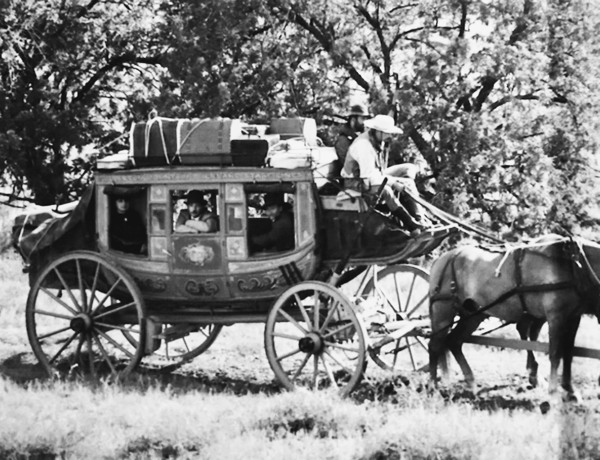
Red Wolverton’s Wolverton Mountain stagecoach. The extras prepare for their wild ride. Kathy Tarantino is Dana Delany’s stand-in (courtesy Jerry Tarantino).
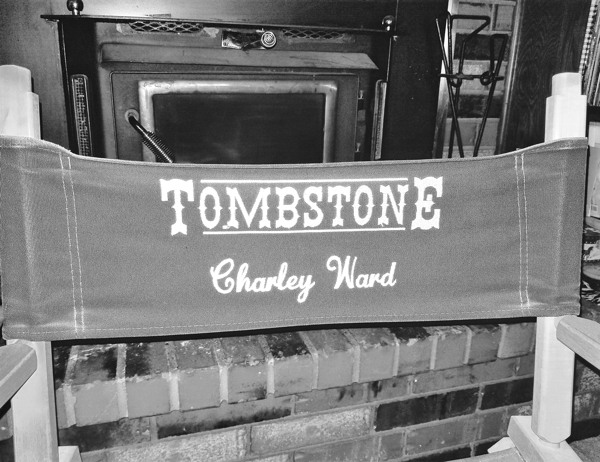
The Tombstone director’s chair of Charley Ward. The main actors had their own chairs; the remaining players sat in “Cast” chairs. Makeup artists Cheryl Nick and Patricia Androff pooled their resources and bought Ward a personalized chair for his 16th birthday. Ward said, “It was the most kind thing that ever happened to me in the business” (courtesy Charley Ward).
Jarre Initially planned for a six-day work week, 62-day filming schedule. The Memorial Day and July 4 holidays would be observed on Mondays with no work scheduled those days. Movies are not usually filmed in chronological or script order. The weather, day vs. night, interior vs. exterior, soundstage vs. location, and most importantly, actor availability—these all determine the sequence in which scenes are filmed. The first series of scenes were shot in the Los Encinos area of the Babocomari Ranch, west of Hwy. 83, just south of Elgin. Located 65 miles from Tucson, the area was known for its rich savanna rangelands, lush native grasslands and wetlands, desert and mountains, and cottonwood-lined Babocomari Creek—a perfect location for Henry Hooker’s ranch as well as the Cowboy and wagon train camps. The Buckaroos would either ride or tow their horses to the site while a caravan of vehicles brought actors and crew members from Tucson. Budget Rent a Car mini- and maxi-vans, props and FX vans traveled, in order: ADs and makeup-hair, cameramen and wardrobe, grips and electrical, cast and finally, a white Lincoln with the director of photography and producer.29
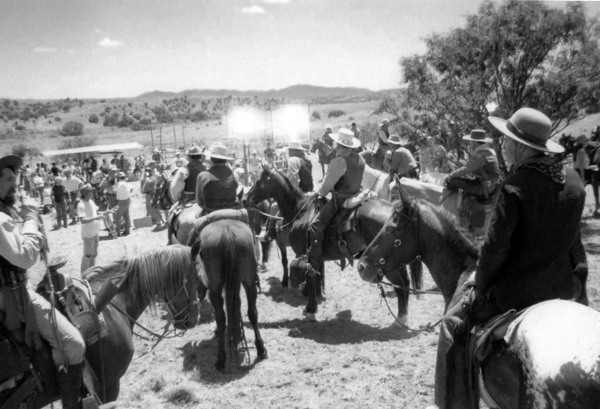
At Babocomari Ranch, Kevin Jarre directs the scene in which the Earp posse surprises the Cowboys (courtesy Larry Zeug).
The first scene Jarre filmed on May 17 was #105 (partial), “Wyatt and his men trap the Cowboys.” As originally written, Pony Deal and a party of ten Cowboys are pushing a herd of stolen cattle. They spy Earp and his posse and start to chase them. Turning the tables, Earp and his men eventually ambush the Cowboys, killing all save one. Said Buckaroo Larry Zeug, “It was a bowl area and that’s where Jon Tenney and Jason Priestley and Stephen Lang [were] supposed to ride in and tell us we can no longer be rustling cattle because of the Earps. Then they turn around and see the Earp posse riding towards us and one of the actors hollers out, ‘Now it’s time to get a working job.’ And we all turn and scatter. You see all these Cowboys going out in every different direction riding balls-out over this hill and that was the way the end of this movie was supposed to go. It was like bees out of a bee’s nest and it’s kind of a neat scene, ’cause … it looked like everybody was scattering.” That scene, along with many others filmed during the first several weeks of shooting, was reshot later in production.30
Later that day, scene #44, the horse race between Wyatt and Josephine, was filmed. Although Delany had learned to ride sidesaddle, in several shots in this sequence, you can see her legs astride the saddle in a standard fashion. Stuntwoman Teri Garland doubled in the scene in which Josephine gallops downhill. In one shot, you can clearly see Delany’s right leg on the off-side of the saddle. The saddle actually had stirrups on each side and sported a fake leg attached to the camera side, simulating a sidesaddle approach. Dana freely admits her greatest challenge was “wearing an authentic corset under period costumes and pretending to ride sidesaddle in 114° in Tucson in August. And I’m not good with horses. It was kind of a tough one. I wish I could say they paid me lots of money. Actually, I had met the director on Monday, I was cast Wednesday, I was in Tucson on Thursday, and I had to learn to ride in five days—sidesaddle! That was really hard for me.” She added, “[The funniest moment in the film for me was] seeing my fake sidesaddle leg flap as I rode. [The saddles used by Delany and her double were provided by the Davis Leather Company.] But I got to learn how to ride horses, I got to sing and dance, and I got to act like I was in 1880 and kiss Wyatt Earp. I mean, that’s pretty great.”31
Jarre continued to shoot portions of scene #105 the following two days as well as on May 29 and June 4. Numerous stunts and gags were required, many of which appeared in the final cut, albeit in a different sequence: horse drags, falls and a scene where Wyatt hangs along the side of his galloping horse and shoots at Pony Deal from under the horse’s neck. Although Kurt Russell is an excellent horseman, Cliff McLaughlin doubled him in this stunt, and Clint Lilley stood in for Pony Deal. Close-ups with Russell were later filmed to complete the gag. Jarre also filmed one of the scenes he wrote for young Charley Ward. Charley’s father Tom describes it as follows: “There was a kind of wash, gulley there. You could tell where the flash floods had come through but it was dry [and] had six-foot walls. Kevin wanted Charley to see the Earps [posse] coming, and he’s scared. He twirls his horse around, goes up this little ravine, an arroyo that has lots of flat river rocks in it, mesquite trees on either side and a [fairly steep] rise. We’re all going up there to watch and Sam Elliott [is right next to me]. As they set up the camera, Kevin tells Charley what to do and then tells [D.P. William] Fraker what he wants to see. [While] Charley is sitting on his horse, Kevin has his back to him, so I walk over to him. I said, ‘Listen, son. Let’s make this look good. They don’t know what they want. Let’s make this good.’ He said, ‘What do you mean, Dad?’ Charley carries a quirt like I do. I said, ‘They don’t know what little old Dish (Charley’s horse) can do. I tell you what: When all this happens, you whirl your horse around and take off in a wide-open gallop. Turn around when you get about a hundred feet, look over your shoulder and you whop that horse with your quirt, except don’t hit your horse. Hit your leg, hit your chaps. I think it’d look pretty neat.’ So, Kevin comes over, talks to him again. Of course, Kevin doesn’t know I talked to [Charley]. ‘Action!’ Charley pursues this routine, turns this horse around, ‘Whap!’ As he goes up this ravine, it’s river rocks and it sounds like a machine gun going off. When he gets to the top of the arroyo, there’s a tall yucca plant and doggone it if the kid don’t jump that plant with his horse. Kevin was excited, ‘I had no idea [he could do that]. I just wanted him to walk up there, trot.’ Sam turns and says to me, ‘I tell you what. If we had 12 more guys like that, we could make a Western.’”32
The first scene in which Charley had lines involved Powers Boothe, which must have been a bit daunting. Curly Bill was in a train car and Ward’s character was supposed to report to Earp and his posse. “Powers Boothe was really helpful,” remembers Charley. “I was pretty nervous. Kevin Jarre had said to me, ‘Just do your deal. Don’t worry about it. Don’t act. Just be you. And you’re okay. I don’t need you to act like something. Just you be you and you’ll be fine.’ Powers Boothe said, ‘Hey, will you do me a favor? I’d like to go over these lines. I just feel like I’m missing something. I’d appreciate it if you’d do them with me and do yours and maybe I can get a better feel for it.’ We went through it several times, there really wasn’t anybody around, just me and him. The whole time, all he was doing was helping me and coaching me, but saying it was [for] him. It really loosened me up a little bit.” Unfortunately, this was yet another one of Charley’s scenes that ended up on the cutting room floor.33
On Thursday, May 20, the wagon camp sequence was filmed. The camp was located in the same general area as the Buckaroo base camp on Gas Line road, west of the Elgin-Canelo road. Extra Nikki Pelley recalls, “When I first arrived there, you’re going on this road and you’re just driving and there’s a little sign on the side of the road. You go up the dirt road for three or four miles and I was pretty sure it was the wrong place, a little dirt road out in the middle of nowhere. It opens up to this valley and then you saw it—a huge encampment. It didn’t matter what end of the encampment you went to.
“I was looking for newcomers coming on set. They took me to where I was supposed to be. I was just looking around because there were so many people there, asking people, ‘Oh, what are you doing on the show?’ Some people were just there. One gentleman said, ‘Oh, I just took off from work so I could be here.’ ‘What’s your part?’ I asked. ‘I’m just going to be here in case they need me.’ There was someone sketching pictures. It was surrealistic when you saw it. They were all camped up. It was cowboy cooking, everybody outside with chuck wagon cooking. I’ve never seen anything like it. It was just amazing.” Nikki played the part of a pregnant pioneer woman and was filmed walking around the encampment and climbing into horseless wagons.34
In these scenes, Wyatt rides into a camp and meets the wagon master, played by a leather-fringed Hugh O’Brian. Later, Holliday, McMasters, Vermillion and Johnson arrive and are deputized. Years earlier, Russell’s father Bing had appeared in two episodes of O’Brian’s television series The Life and Legend of Wyatt Earp. Bing also played a deputy in 1957’s Gunfight at the O.K. Corral. Said publicist Patti Hawn, Goldie’s sister, “It was a wonderful opportunity to have the older Wyatt and the younger Wyatt meet.” Added Sherayko, “The scene called for Wyatt coming in and talking to Hugh O’Brian. Doc goes and gets Turkey Creek and my character and we ride in. Wyatt wants us to become his deputies. Mike Rooker rides in, and that’s when he throws down the sash and says he’ll join them. The five of us go riding out from the wagon train. Hugh O’Brian literally handed Kurt Russell something. The feeling of it was the old Wyatt Earp … now giving his blessing to the new Wyatt Earp. As we ride out, the wagon train is behind us, O’Brian is watching us ride off, this little kid gives this speech, waving his fist in the air [and] the five of us simultaneously make a jump over a fallen tree. It was just a great shot.” Unfortunately, neither the camp scenes nor the jump would appear in the final version.35
Dana Loraine Goodge, another extra in this scene, had an entirely different experience than Nikki Pelley: “The wagons were all in a circle. They had me come stand in the middle of the circle—I had no idea what I was doing. All of a sudden, Val Kilmer comes on horseback, leans over the horn of the saddle, points his gun at me and says, ‘Take off your clothes.’ I was like, ‘What?’ (He was either playing his sarcastic self or he was flirting.) Later, it was so hot we were sitting by the trailers trying to keep cool and we had these bonnets on that covered some of your face. Kurt Russell, Val Kilmer and the other guys were standing in a circle in the middle of this wagon train circle and Kurt kept looking over at me. Then you would see him look around everywhere else. He kind of walked up [to me] and then turned around and came back. I didn’t find out until later what was going on: Somebody told me that when they were over in the circle, he thought there were hidden cameras on him and that they had snuck Goldie Hawn on the set. [Everyone thought Dana looked like Goldie.] When he came over to get a cigarette, he wanted to see what I looked like up close.” For the rest of the summer, Goodge was known as either Dana #3 (Delany was Dana #1 while Wheeler-Nicholson was Dana #2), or Goldie.36
While Jarre filmed the wagon camp scene, Terry Leonard continued to film horse drags, saddle falls and other stunts. Usually, they first break down the script into action sequences and then assign them to a second unit director. Leonard had an added advantage: Not only was he a director, he was also the film’s stunt coordinator. Explains Leonard, “We do all the action sequences in harmony with the first unit director, the producer and the writer. It’s an amalgamation of putting the action sequences in the proper perspective on the film. The quickest way to lose a job as a fledgling director is to start shooting stuff that you think is right, even though it might be, and you’re not adhering to the wishes of what was laid prior to you going in and shooting it. We don’t go out there without weeks and weeks of preparation. I hire [all the stuntmen, and] I don’t tell a stuntman how to do his stunts. That’s the way I work. It’s just stupid. I’m not the guy to be telling people how to do stunts. I’ve done them all and I know when it’s a good piece of business or when a guy doesn’t have the moxie to get it done. Everybody talks about the [stunt] and the horses we’re going to use and how we’re going to lay it out. I’m going to tell them where I’m going to put the cameras and what I need to see; it’s all a composite effort, everybody putting in their two cents worth. But the final say-so is me. And if it doesn’t work, they all turn and look at me. And if it works, everybody gives the guys a cheer, and that’s what it’s supposed to be.

Kurt Russell (Wyatt Earp), Michael Rooker (Sherm McMasters) and Peter Sherayko (Texas Jack Vermillion) chase the Red Sash gang. Second unit director Terry Leonard stands behind the camera in a white shirt (courtesy Jerry Crandall).
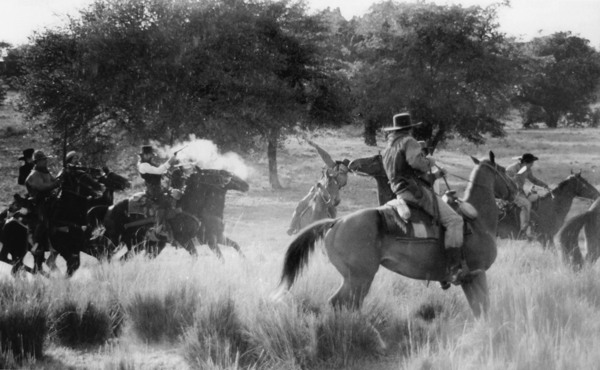
Cowboys begin to scatter on the Babocomari as Cliff McLaughlin, stunting for the character Wyatt Earp, shoots a red-sash–wearing Cowboy. The members of the posse are stunt doubles; the sequence was directed by Terry Leonard.
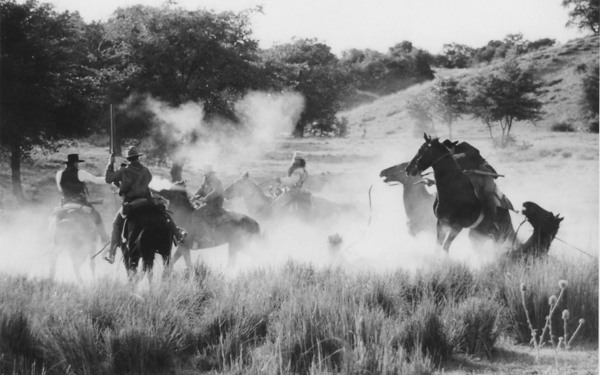
Gunsmoke fills the air as the Earp posse attacks the Red Sash gang on the Babocomari Ranch (both courtesy Jerry Crandall).
“I never like to do a stunt more than once, ever. Because that’s like putting another bullet in the gun: Russian roulette. I want to make sure we rehearse the daylights out of it, and if something goes really wrong, yeah, we gotta reshoot it. But I hate to reshoot stunts. I have an incredibly vivid imagination. When I sit down with the director, I need to look at the storyboards because I need to see what he wants to shoot and how he wants to shoot it. But I read the script, I see the scenes unfold in front of him; and when we’re talking about action sequences, I can visualize it and go to the director. I can see it all. I don’t mean to sound overbearing but I grew up with imagination, so … I lay it out and talk to the director about it. I come in harmony with the concept. So when I’m laying out the stuff for stuntmen, I see exactly what it’s supposed to be and what it’s supposed to look like. And we talk about it. I don’t hire guys the first year in the business, I hire guys who have done their stuff. So they know what I’m talking about.”37
Recalls Jerry Crandall, “One day we did some wild things: galloping across rivers, skidding down mountains. One of the mountain things we did was pretty scary. We were way up on top of this ridge and [they] had us come, almost at a run, skidding down this rough mountain, bouncing over rocks and stuff. It’s dangerous but it’s real flashy and looked great, I’m sure. We were doing our stuff with the stunt guys who were dressed like Wyatt Earp and his posse. I was with the bad guys. Horses rearing up, horses falling over. One of the stunt guys broke his jaw. There were about eight or ten of us in this mêlée of horse action. That was when the Wyatt Earp posse caught the bad guys and we had a big shootout but, unfortunately, it was all cut when the new director came in.”38
But even the best-laid plans of mice and men often go awry. Leonard told Buckaroo Jerry Crandall that his character would be killed in a specific scene. Crandall, 58 at the time, was asked if he preferred that a professional stuntman perform the saddle fall during which Crandall would be shot off his horse. Having performed this gag numerous times in the past, Jerry felt confident he could do it again. His main concern was his gun. Jarre had told him they might want to take some close-ups of Jerry firing a Colt Single-Action revolver, so the weapon had to be the correct version for 1881. Explains Crandall, “Guns that were made before 1898 have a different configuration than the later Colts. You can still buy a single-action but they have a little different [appearance] and Kevin was aware of that. [Said Jarre,] ‘I want you to have a black powder frame single action,’ so I went out and bought a nice [custom-made] replica [from Cimarron Arms], and had it nickel-plated.” His concerns were swayed when Leonard told him not to worry as rubber guns were available for the gag. However, when Leonard called for the stunt gun, none of the rubber guns were available right then so Jerry had to use his own expensive pistol. “Terry told me not to land on my feet,” said Crandall, “as they would be filming the entire fall all the way to the ground. No problem, I thought. When Terry clapped his hands, this would be the signal for me to take a dive off my horse, Apache. They stripped my saddle down, took one of my stirrups off and put an angle iron [bracket] on it so I could get a better way to [leap] off the horse. ‘Action!’ He clapped his hands and, throwing my pistol way up in the air, I took off. Unfortunately, I put out my right arm to soften my fall and, as a result, my rotator cuff cracked and my upper arm snapped. I continued to work for another few days but my arm kept slipping out of the socket, so I was told to leave and seek medical attention. Regrettably, I was unable to return to the set.” Meanwhile, Crandall’s revolver landed in soft ground and came through unscathed. Jarre considered the fall so unique and different from what a professional would do, they decided to leave it in the film.39
Leonard filmed a variety of memorable stunts: “Oh, we did a bunch of stuff. I designed a shot where Bobby McLaughlin gets knocked off of the back [of] the horse—he does a backover. We put the blood bag in the stock of the rifle and Tony Boggs comes through and hits him in the face and he turns over backwards. You see [Bobby] bleed; a really neat shot from them galloping away from the town.”40
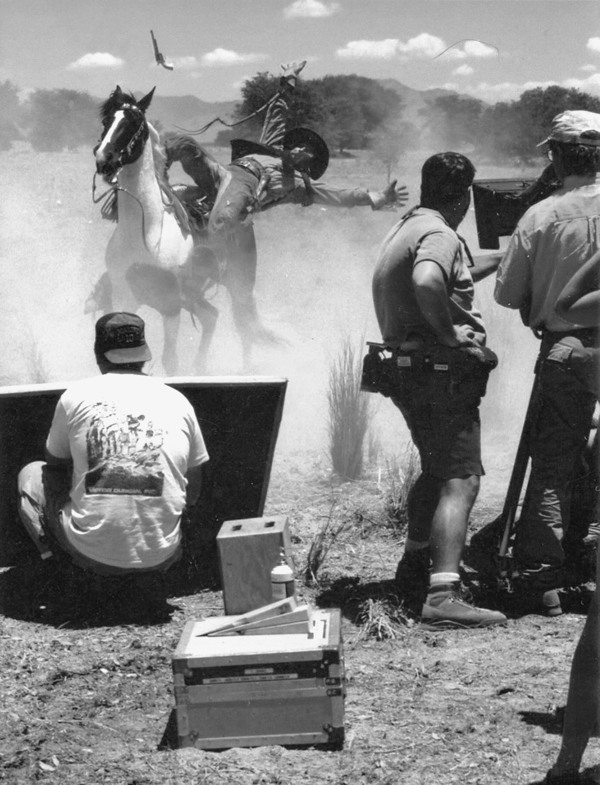
Buckaroo Jerry Crandall is shot off his horse Apache. This second unit scene was filmed by Terry Leonard on May 25, 1993. Jerry broke his arm and was later forced to leave the production (courtesy Jerry Crandall).
Crandall’s incident wasn’t the only accident. On June 2, Teri Garland (Terry Leonard’s wife at the time) was injured when her saddle broke while she was riding sidesaddle. Since most of the saddles were authentic, the leather on them was quite old. She was examined by the set medic Chris Swinney and released back to production. The scene was re-filmed and she used a new saddle. In another stunt, Mark Warrick did a saddle fall into a drag, but the horse ran so fast and Mark bounced so hard that he couldn’t get his hand on the release cable. It was only through the quick reactions of Leonard, Swinney and a few horse wranglers that the horse was stopped and Warrick saved.41
At the end of the first week, Kevin filmed scenes #116 and 117. In this sequence, Earp and his posse, atop a plateau, watch a Ringo-led, badge-wearing posse of outlaws. The very sick Holliday suddenly faints and is caught as he falls. Kilmer wasn’t the only one to fall off his horse during these scenes. Billy Lang recalls that one of the outlaws accidentally fell off his horse as they were filming the posse galloping in the distance. Obviously, it put a damper on filming.42
On May 26, Jarre moved his operation to the Hooker ranch set. Henry Clay Hooker, a wealthy and influential cattleman, had owned the Sierra Bonita, a 250,000-acre ranch in the Arizona Territory, located in what was later known as Sulphur Springs Valley. A friend and supporter of Earp, Hooker also aided the lawman’s posse during the Vendetta ride after the Iron Springs shootout. The film’s three-sided “Hooker ranch house” was built about two miles east of the wagon camp site on the Babocomari and constructed with adobe provided by a Tucson supply company. Although interior scenes were filmed inside the building, there wasn’t an actual rear wall. Most of the hardware seen inside the house (hinges, etc.) were resin-cast plastic provided by set dresser Matt Marich. After filming was completed, the building was disassembled and all the adobe blocks were taken to the Babocomari ranch house where they still lay, unused and crumbling.
Not surprisingly, the Hooker character’s persona significantly changed once veteran actor and screen legend Charlton Heston took on the role. Jarre had initially described Hooker as hesitant, unwilling and reluctant to be involved in the Earp-Cowboy conflict. When asked by Wyatt for information about the Cowboys, Hooker declines and hangs his head in shame. Naturally, the actor’s resonating, distinctive voice, chiseled jaw, broad shoulders and larger-than-life, commanding appearances in such films as The Ten Commandments, El Cid, Ben-Hur and Khartoum wouldn’t jive with Jarre’s description. As a result, Heston played the role as … Heston. Seventy years old at the time, his stooped, hunched-over, frail appearance fooled the other actors. They may have thought him tired and weakened by age and injuries, but when the bell sounded, Heston, the total pro, stormed from the gate in full stride, his six-foot, two-and-a-half-inch frame ramrod-straight. When the director yelled, “Cut,” he would collapse. Several extras commented that they couldn’t believe this change in appearance. Said Buckaroo Zeug, “The breakfast wagon was out there and Heston was over at the wagon. He stooped over, fixing coffee. We’re sitting there watching him and thinking, ‘How’s he going to shoot this scene?’ And as soon as they said ‘Action!’ he stood up, rigid as hell and he was ready to go.” Between takes, Heston would sit on the ranch porch, regaling extras with stories from his fabled life and sharing pearls of wisdom. Several extras were waiting with bated breath for the next scene, chomping at the bit, as it were, to act with Heston. One observed, “How cool is this? We’re hanging out with Moses. How freaking cool is that?” Moses then spoke unto the assembled multitude: “Guys, just remember. They pay you to wait. Your acting is for free.” When asked if he wanted to go to his trailer, he would say, “No. I’m holding court here.” An Arizona monsoon rolled in with a tremendous crack of thunder and a crew member exclaimed, “Oh my God! Look at that!” He then felt a hand on his shoulder and The Voice intoned, “Boy. Fetch me my staff.”
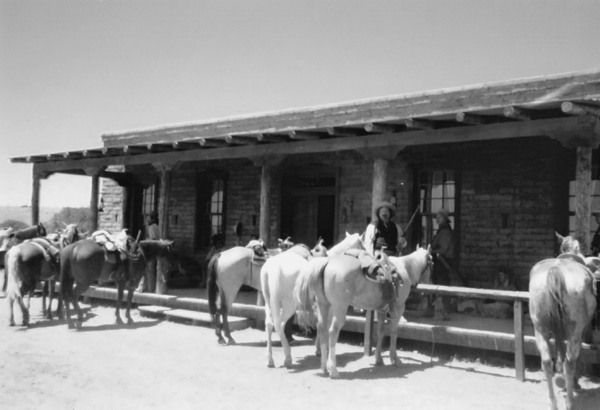
At Babocomari Ranch, Henry Hooker’s Sierra Bonita ranch house. This adobe building was later torn down and the blocks moved to the Babocomari main house where they remain today (courtesy Garrett Roberts).
Surprisingly, Heston had a wicked sense of humor. After filming a scene with Russell, Kilmer, Taylor, Sherayko and Rooker, Heston and assistant director John Cameron walked behind the camera. Hat maker Tom Hirt was sitting in Heston’s chair and was told to move by Cameron. Heston said, “No, that’s Tom. That’s okay. You go ahead and sit there, Tom. I’m going to sit in Kurt Russell’s chair. It’ll drive him crazy.”43
During one such session, while Heston held court on the porch with Sherayko, Buck Taylor, Chris Mitchum, Michael Rooker and a handful of extras, Russell and Kilmer were inside the ranch house filming a scene. And it was literally taking all day. Kurt wasn’t happy with it: “We gotta do it again. We gotta do it again.” Several additional scenes were scheduled to be filmed that day as well, and Rooker got tired of waiting. One observer noted that Rooker eventually stormed into the room where they were filming and yelled at Russell, “Goddammit. … I’m not on this movie to be sitting around outside while you’re fucking with these lines. Now, get this scene over with because I want to do [my] scene!” Whatever Russell replied apparently wasn’t satisfactory because Rooker stomped out of the building, slammed the door, got in his car and roared off to the hotel. Whether this incident actually occurred is debatable but it is a fact that several actors, including Rooker, had their parts significantly reduced in subsequent drafts.
Despite his prestige and mystique, Heston, from his very first day on the set, just wanted to be one of the guys. While other folks used the honey wagon—a mobile multi-stalled rest room with washrooms—Heston preferred to wander in the desert and commune with nature. One time, Buck Taylor, Forrie Smith and several other actors were standing in the Holiday Inn parking lot, waiting for the van that would take them to the set. Smith had already agreed to ride with Taylor. A large black limousine rounded the corner. It stopped, out stepped Heston, and an aide directed him to his own van. “Oh, hell,” Heston said. “I’m going to ride with these boys right here, by God. I’d rather ride with Buck Taylor and … who’s this guy?” From then on, Smith rode in a different van.
Heston also was extremely courteous while on location. When he arrived at the set, he would go to the first PA. “What do you want me to do? What do you need? What do you want? I’m here to work. Do you want me to go to wardrobe, makeup?” Recalls Smith, “Everybody was the same [to him]. It didn’t matter if you were the lowest PA on the show or whatever. Heston treated everyone as human beings and that energy carries over to the film.” During lunch hour, he would go through the line, get a tray for his wife Lydia and himself, and carry them back to his trailer. When asked, “Can I help you, Mr. Heston?” he would invariably reply, “No, no. Thank you. I’ve got it.”44
Asked why he accepted the cameo role, Heston didn’t hesitate: “The character … intrigued me. And, like most actors, I like doing Westerns. I hadn’t done one for a while, so it was a welcome thing for me.” He was impressed by his real-life character’s strength: “In the case of Henry Hooker, though he is not central to the action in the film, he is crucial to it. Hooker was a historical figure. He was indeed the largest rancher in the area. And his concern was not who was right or who was wrong in these conflicts, which to him was not important. But he knew that the area had to be stable and was determined to make a personal stand if necessary—in essence, when he says, ‘Not on my land, not in my house.’”45
But not all the scenes Heston appears in actually feature Heston, who was on location for just three days. It was only after his departure that the filmmakers realized they had a major problem on their hands; in all of Heston’s over-the-shoulder shots, his hairpiece was crooked. (In an over-the-shoulder shot, the camera is placed behind the shoulder of a character whose head and shoulders are seen in the foreground and are used as a framing device for the shot. Most often, a second character is the subject of interest.)46
What to do? Fortunately, Jeff Dolan, one of the Buckaroos, bore an uncanny resemblance to Heston. After a change of wardrobe, Jeff was taken to makeup and given a haircut, yak-hair mustache and sideburns so he could stand in for the departed actor. After his hair was grayed, the first AD took Dolan over to the director for approval: “Yeah, sure. We’ll give it a whirl.” Dolan was more than a Buckaroo, he was also a professional actor; earlier in his career, he had studied under Marie Dent at the Palos Verde Playhouse in Los Angeles (Marie was part of Lee Strasberg’s Actors Studio). But according to Dolan, “Nobody knew that. I was just some dumb cowboy from Arizona. And Sherayko’s a wreck. So, they were afraid. ‘Oh, Jesus. He’ll screw up the lines.’ The initial stuff was an over-the-shoulder where I was doing a scene with Michael Biehn. And Biehn was doing his mean [persona], and he truly was, too. A mean, evil-looking appearing Johnny Ringo. Very intimidating, especially to a novice. So, all I had to do is stand there and react to his dialogue. Sherayko was off-camera reading Heston’s dialogue because they didn’t know if I could do it. Basically, I just had to react.”47
Chris Mitchum vividly recalls being on the set with Heston. “People said, ‘Chris, why did you do that movie?’ I said, ‘It’s a nice little part.’ I had scenes with Val, I had scenes with Kurt. Every time there was a scene at the [Hooker] ranch, [Jarre] would give me dialogue and he would work me into [it]. It was a nice little cameo appearance. I’m in the movie on the porch [but] you can’t see me because I’m in the shadows. In the script there was the killing of Rooker’s character where they throw him into the fire. Everything was different. Rooker comes riding in. I say, ‘Rider coming in.’ He comes in [and] there’s a whole lot of dialogue. There was so much stuff. There was a lot of dialogue in the bedroom with Val recuperating in bed. There’s a big scene in there with Chuck, Kurt and myself talking with Val. There’s a lot of stuff in there that was cut. There’s a scene outside with Kurt on horseback and I was standing there with Chuck. Because my character was not scripted, [Kevin] wanted to make me the foreman of the ranch. So every time Chuck was in the scene, I was standing next to Chuck and we were doing dialogue. Chuck and I were very good friends and [they’d] say, ‘Chris, I want you to do that line instead of you, Chuck,’ and Chuck would say, ‘Great, give it to Chris.’ I was like splitting dialogue with Chuck. It was the best script I’ve ever read. Kevin would throw in an added line for me to come in to say something. I’d say, ‘Kevin, this is so beautifully written. Please don’t spoil it just to give me a line.’ I would talk myself out of dialogue.48
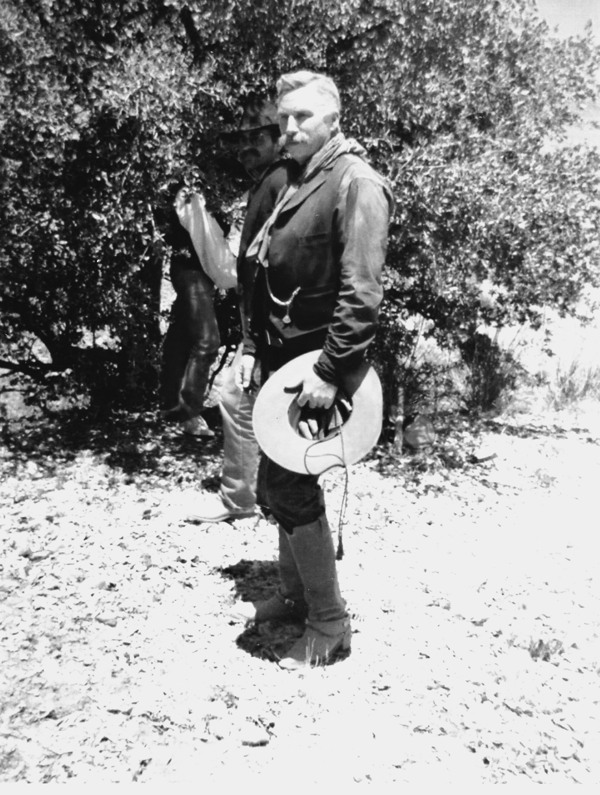
Jeff Dolan, a Buckaroo and Charlton Heston’s double (courtesy Jeff Dolan).
Jeff Dolan: “When you see all of the guys standing on the porch at Hooker’s ranch, it’s a shot from the distance. Chris Mitchum, Heston and Buck Taylor, all the guys standing there on the porch. That’s actually me, not Heston. He was long gone [by then]. The sunset scene at Hooker’s ranch when the stagecoach shows up and Dana Delany’s all upset because her friend the actor is dead, and she says goodbye to Kurt Russell, that’s Chris Mitchum and me in that scene, too, not Heston. They used me a lot. The close-ups where you can see his face are the only ones he’s actually in. I’m a lot cheaper than Heston. They had me for $750.”
Pickup shots were later filmed during the time the crew was located at Mescal. Although the adobe house had long since been dismantled, Jeff also was featured in wide master shots of Hooker riding up to meet Wyatt, and in a reshoot of the Cowboys riding up the ranch to call on McMasters for a parley. So, if you see Hooker from behind, or if his face is seen in the distance in profile, chances are it’s really Dolan.49
Michael Biehn also had a few scenes with Heston that didn’t make the final cut. “I had a couple of great scenes with Charlton Heston where I am nose to nose with him,” Biehn told an interviewer. “I wish I had those scenes. You know? Just for my grandchildren. Or my grandchildren’s grandchildren. Where they could see me going nose to nose with Charlton Heston on this porch. At one point, the Cowboys ride out and try to break into his house. Charlton Heston says, ‘You guys aren’t coming in here!’ I go up on the porch and have a conversation with him. This guy is such a big name actor, like playing opposite Sean Connery. It’s something I would really liked to have had in the film. I wanted to have that in my library. It’s gone.”50
Of course, some folks couldn’t tell the difference between the real Heston and the screen Heston. Eddie Perez recalls sitting and chatting with Sam Elliott one day, having sneaked over to where the stars were eating. “I figured I was hungry and didn’t want to sit and wait,” says Perez. “I was actually sitting across from Heston as he was having a conversation with Elliott [and] I didn’t know who he (Heston) was. When the movie came out, my wife’s grandmother said, ‘Oh, yeah. That’s Charlton Heston.’ ‘Yeah, I sat across from him for lunch,’ said I. ‘And you didn’t get his autograph?’ cried the lady. ‘That’s the man who parted the Red Sea.’” Perez sheepishly adds, “I never heard the end of it until the day she died.”
Heston stayed with the rest of the cast and crew at the Tucson Holiday Inn. The Phoenix Suns and Chicago Bulls were playing in the NBA finals that year so the lounge was fairly busy. Heston would come down, have three Scotches and go back to his room: very nonchalant, very unpretentious. Supporting actor Grant James (Dr. Goodfellow) said, “Some wag from the crew went around and put the word ‘Doc’ in front of every Holiday that was there. It soon became the Doc Holiday Inn.”
At the time, the hotel was quite the place to be. Stingray’s lounge was known as a real trendy place: sunken bar, dance floor, DJ booth, pool tables, dart boards and disco glitter balls. Cast and crew would congregate there after a hard day’s shoot for rest, relaxation and drinks. Jarre said that every Saturday night was a “Mandatory party. I buy the first round.” Peter Sherayko recalls, “Every night, we’d come back from the set, and when you walked in the bar, there were always two or three tables with the Cowboys—Powers, Michael Biehn, Thomas Haden Church, all those guys were sitting there. And way at the other end of the room it was Bill Paxton, Sam Elliott, myself, and Buck [Taylor].” Remembers employee Victor Vizcarra, “[Stingray’s] was a humongous lounge … a happening place. It was really popular, a real hot spot.” Evening manager Brett Hust recalls, “About every three weeks, they throw a party at the bar. They do drink quite a bit.” The gatherings hadn’t attracted much interest but according to Hust, “Quite a few teenagers are bopping around here trying to find Jason Priestley.” Next to the lounge was John Q’s Hammons Fine Dining Restaurant, a full-service establishment offering a complete complement of meals throughout the day. As production sometimes required filming at night, the hotel kept room service open from 2:30 p.m. to 5:30 p.m.—times when it was normally closed—to accommodate the variable schedule. Housekeeping didn’t begin until after the normal 5:00 p.m. call time.51
Both Vizcarra and James Brooks, another hotel employee, recall that the actors pretty much stayed by themselves: “[They] were generally pretty nice. They were able to mingle. I didn’t see any fans going into the restaurant asking for autographs. Nobody bothered them and they were decent tippers. We automatically [got] a built-in tip and then they gave us money on top of that. That was always a plus. [They chose our] hotel because they had over a dozen hotels out at the airport. They get all the fanfare [but] celebrities want to get away from all that—have some peace and quiet. They were isolated enough that they knew the hotel wasn’t around anybody else that would be a threat. They could let their hair down but, [we] did have security.” As a small perk, “They gave us a chance before they got started to be a part of the cast,” said Brooks. “They needed a piano player [and some employees auditioned]. I didn’t make it.”52
When a pre-production party was scheduled in the hotel’s upper and lower terrace, ropes and stanchions were set up to segregate the actors and crew from other hotel guests. A Weight Watchers convention was being held in one of the rear ballrooms, and when the meeting was over, the participants departed past the terraces, with predictable results: Once they recognized Sam Elliott, the place went crazy. Ladies rushed the ropes, guards tried to hold them back. One lady negotiated the obstacles and boogied with the actors. A good time was had by all. Robert Burke remembers another incident: “We were there one week and there were quilters—big old gals in their 50s, 60s and 70s. Sam [Elliott] came through the lobby and he found himself in the middle of a pack. We were over in the corner and somebody said, ‘Look at Sam. He’s too much of a gentleman to go out of his way.’ He signed everything, he did pictures, tipping his hat. Later that afternoon, we saw him run through a doorway. They were on his tail again and he was trying to duck away from them. [But] he made time for everybody.”
But some hotel patrons found the celebrities … weird. One guest told storyboard artist Donna Cline, “Wow! The actors, they’re just [always] in character. The never get out of character even when they talk to us. Sometimes the actors come up to the front desk and they act like they’re still cowboys.”53
Cast and crew members availed themselves of the hotel’s amenities, which included the swimming pool and Jacuzzi. After filming was done for the day, you typically could find Kilmer, Priestley, Delany, Boothe and numerous others hanging around the pool, many partaking in alcoholic libations and chemical substances—sometimes to the point of excess. One wasted actor, holding a long box, was seen stumbling around the pool’s edge, barely keeping his balance. He suddenly lost his equilibrium and the box, containing an eight-foot party sub, sailed into the pool, where it floated for the rest of the evening, a long Italian submarine. On another occasion, Kane Rubalcaba recalls, “One night we were sitting there with Peter [Sherayko] in the hot tub, me and Kurt and him. And of course, Peter had a bottle of Jim Beam, just sitting there B.S.ing. I don’t know how he got it but Powers Boothe got a big box of roses from somewhere, somebody must have left it. [There was] Powers Boothe, lit off his ass, dancing around the pool, singing to the roses. I said, ‘That dude’s going to fall in and drown.’ It was just insane.”54
On another occasion, Dana Delany went swimming “bare-assed naked” in the pool which naturally resulted in several guys standing around the pool’s edge watching her swim. Unaware, Chris Swinney walked up and asked, “What are you guys looking for?” Swinney ruefully adds, “Right then, [Dana] swam up and put on an earring. And I look at these two guys like … ‘Yeah, right. That’s exactly what you’re looking at.’ So I go, ‘Oops,’ and accidentally knock both of them in … [actor] Terry O’Quinn and another guy. Monday I show up for work and they’re all like, ‘Do you still have a job?’ ‘Why?’ ‘Do you know the guy on the right that you pushed in the pool?’ ‘No. They were staring at the boobs and the butt and I got them.’ ‘That was [producer] Jim Jacks.’” Not a wise career decision.55
Jarre insisted upon absolute authenticity in his characters’ appearances, so his actors were encouraged to work on their tans to produce darkened, healthy glows. No man-tan or QT for this director. Naturally, some took his recommendation to an extreme, as Sherayko wryly recalls. “I had to fire three guys because they were idiots,” he admits. “I wouldn’t have fired them, I kept on trying to tell them what to do. Kevin hired one to be Ringo’s right-hand man. He was supposed to be a Buckaroo in the morning, and in the afternoon after lunch he was supposed to go down to do this other scene with Ringo. And he got there an hour late because he fell in the water on his horse, riding over to the new set. Got all dirty, went back to the Buckaroo camp, took a shower, changed his clothes and went back and he was late. They already replaced him. They said, ‘Where the hell were you?’ ‘Oh, I got muddy.’ That’s how stupid he was. Some of the Buckaroos had never worked on movies before. They were good cowboys, they were good shooters, they were good horsemen, and I brought them on, but they were idiots. [The aforementioned Buckaroo] actually got sunburned feet at the pool and then went to the medic because he couldn’t put his boots on. He told the medic a horse stepped on his foot. So the medic let him have a couple of days off. So what the idiot does, [he] sits down at the pool during the day while all the production officers were there. One producer came up to me and said, ‘This guy’s getting paid to sit down at the pool because he can’t ride? Send him home.’”
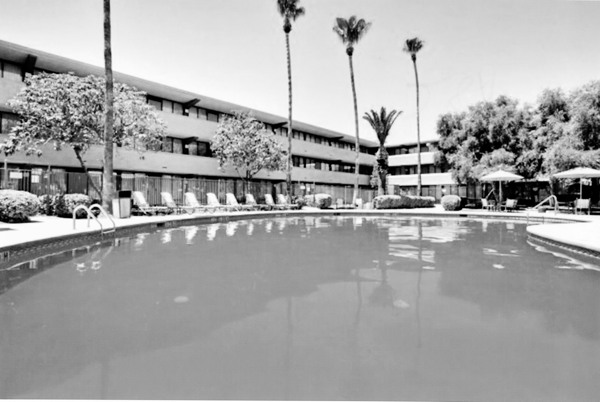
The infamous Holiday Inn swimming pool where an Italian submarine protected the occupants. Many wild nights were spent around the pool.
Sherayko recalls another scene where they wanted four Red Sash gang Cowboys to ride over a hill and down toward the camera. Three of them rode down the hill; the fourth rode around it. The director screamed, “What the hell are you doing?” The Buckaroo said, “Well, it was easier to ride around.” “I don’t give a damn if it’s easier going around. I need you to ride down in the shot.” Needless to say, the horseman was let go.56
On May 28, Jarre filmed the scene in which Ringo becomes head of the outlaw gang after Curly Bill is killed. Sheriff Behan and Deputy Breakenridge both look on as Ringo says, “Now, gather ’round, children. Gather ’round and raise up your right hand.” After the gang is sworn in, all received badges. Unfortunately, the prop department later ran out of badges as these particularly popular items had a tendency to walk off the set. Confesses Greg Poulos, “One day the Buckaroos were not playing in our unit, so we gave the badges to the second unit who was using it that day. It turned out [first unit] wanted the Buckaroos there so we quickly made some badges out of cardboard, which from ten feet away, you wouldn’t have known. And these people are further away from that. It just so happened that one of the Buckaroos rode by the camera and [the director] saw this cardboard. ‘What the heck is this? You were my favorite department,’ [he yelled]. ‘What kind of a cheap production is this? Now, why are you ruining this movie with these horrible cardboard badges?’ [A chagrinned Poulos could only reply,] ‘It was offsetting unit. It wasn’t on the list.’”57
Forrie Smith remembers one of the many scenes that didn’t make the final cut: “There’s a scene where me and Michael Rooker are in a camp and I’m sitting there cooking at a fire with my knife out, stirring whatever I had in the frying pan. When [Wyatt Earp] came riding into camp, I gave him a look. [My character] hated everything about him, everything he represented. Kurt Russell fell apart. ‘Why are you looking at me like that? [Your character] wouldn’t do that… My God, Pony Deal would think I was special when I walked into a room.’ I said, ‘No. I’m a killer and you’re nobody to me. You’re nothing. All I’ve heard about you is whacking people with your pistol. I’m a true-blue killer and I’ll kill you before I let you come in here and disband the Cowboys and put me back on the reservation.’ And Kurt was upset. ‘No, you don’t look at me like that.’ Kevin took me aside and said, ‘Yeah, you are right.’ Bob Misirowski tried to settle Kurt down. He threw a fit, then we did it a couple more takes.”58
The telephone rang early one afternoon. Just shy of his twenty-seventh birthday, Adam Taylor was taking a siesta; his young wife Anne answered the phone. “Hello. This is the production office in Tucson. The AD has been fired and we’d like to speak to Adam Taylor.” She said he’d call right back and quickly ran into the bedroom to wake her husband. “Get your ass out of bed,” yelled Anne. “They just called from Tombstone and you need to call them back!”
Apparently, AD John Cameron was a Directors Guild of America union member, and DGA bylaws specifically state that members cannot work on non-union projects. “The DGA tracks all non-union … productions, investigates any situation in which a member is suspected of working on a non–Guild–covered project and takes disciplinary action as appropriate,” said DGA spokeswoman Sahar Moridani. “In no way do we allow members to work non-union.” Someone must have called the union about it because once it was determined he was working illegally, Cameron was fired. Enter Adam Taylor. Adam had been a production assistant and first AD on numerous low-budget movies for first-time directors but now he had a chance to work on a major project. He had previously submitted his résumé to the production office and never received a reply. His father Buck was already on the film and may have said, “Oh, my son’s an AD. Why don’t you talk to him?”
Adam took about 20 minutes to wake up and compose himself before he returned the call. Negotiations continued throughout the day; he then packed a bag, flew out of Burbank the next morning and was hired. (Cameron stayed on location for an additional 48 hours to facilitate the change.)59
The first AD is critical to the success of a film. He is in charge of scheduling each day’s shoot and decides which actors will be called at what time. On a Western such as this, the first AD is an extremely busy person, scheduling the horses, wranglers, gunsmith, paramedic, etc., planning how many extras are needed. He also tracks the daily progress against the production schedule, prepares call sheets, maintains safety, security and order on the set and, at the end of each day, signs off on time sheets to assure each actor’s time is properly recorded. When all was said and done, the first AD provides the key link between the director and cast and crew. Adam fit this role to a T. According to his wife Anne, as well as numerous other actors and crew members, “Everybody adored him. He could make people do anything he wanted because he treated them all with respect. He could say to someone, ‘Hi. You see that port-a-potty there? I want you to go over and dive in head first.’ And he could make them think they thought of it first. He had an artistic eye for setting up shots and he knew how to manage disputes between people.” Taylor was a valuable, much-needed asset for the production team.60
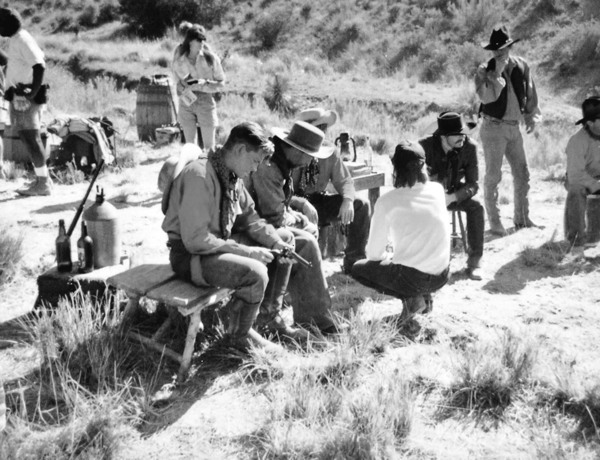
At Babocomari Ranch, Kevin Jarre discusses a scene with (left to right) Thomas Haden Church (Billy Clanton), Stephen Lang (Ike Clanton), Powers Boothe (Curly Bill Brocius) and Michael Biehn (Johnny Ringo) (courtesy Christian Ramirez).
And they desperately needed it. A dark cloud was building on the horizon, one that would soon come down on Jarre with its full wrath and fury.