
FOUR
In 1873, Newman Haynes Clanton arrived in the Arizona Territory and settled in the Gila Valley near Camp Goodwin. Born in Davidson County, Tennessee, Clanton, like many pioneers, lived a nomadic existence, traveling from state to state looking for a pot of gold at the end of the rainbow. In 1840, he was married in Missouri; ten years later he left his wife and three sons for one year—an unsuccessful California sojourn in search of gold. Upon his return, he moved to Illinois; two years later he moved to Texas. After the Civil War, Clanton traveled to Fort Bowie, Arizona; a year later, after his wife passed away, his family of four boys and two girls left for California. Some time between 1869 and 1873, he returned once again to Arizona, settled on the Gila River and claimed a desert water hole on the trail between Yuma and Phoenix.
In 1877, he moved first to the San Pedro River and then to Lewis Springs, four miles south of Charleston, where he built a large adobe house known as Clanton Ranch. Known either affectionately, or derisively, as “Old Man,” Clanton brought along his sons Joseph Isaac (Ike), Phineas Fay (Phin) and William Harrison (Billy). Given the vast number of cattle in the area, and the increased need for beef, it only seemed natural that Clanton—rancher, farmer, businessman—would provide needed supplies to miners, soldiers and farmers. Entrepreneurship must have run in the family as in 1878, son Ike opened the short-lived “lunch counter” Star Restaurant in nearby Watervale, this after his father had previously operated an inn at Fort Thomas in the mid–1870s. Neither was very successful. But they were undeterred in their efforts as the June 16, 1880, census humorously listed the family occupations as “keeping dairy” and “freighter.”1
The local demand for beef was overwhelming; for example, the San Carlos Reservation alone required over 3.5 million pounds annually! If you raised cattle, you had a willing market, but you also needed to have a herd. Those who did were flush; those who didn’t either let the opportunity pass by or became cattle rustlers. The Clantons chose the latter. Mexican cattle, American cattle, it didn’t matter. “Obtain” what you need, change the brand and sell it to the highest bidder. As a result of overgrazing, drought and an abundance of cattle, many herds were driven from Texas into New Mexico and Arizona. J.J. Wagoner wrote in Arizoniana that shipments “were especially numerous because of the passage of the Texas land law of 1879 … which initiated a mandatory leasing system providing for the payment of nominal fees. Texas ranchers objected to the new system and many of them moved their herds to Arizona where they found unrestricted grazing.”
Along with these herds came drovers, wranglers, cowpokes, buckaroos and, more than likely, Tom and Frank McLaury and Curly Bill Brocius.2
Although some documents stated that they were born in Mississippi, both Thomas and Robert Findley “Frank” McLaury were actually from Courtright Center, New York, at the foot of the Catskills. The family was educated and relatively prosperous: father Robert was an attorney and brother Will was a successful judge in Fort Worth, Texas. Ironically, while the family was living in Belle Plaine, Iowa, some even said the brothers studied pre-law at a local academy although there isn’t any evidence to support that contention. Upon the death of their mother during a typhoid epidemic, their father married a woman only slightly older than the brothers. Upset by her young age and the lack of time their father had spent grieving, the two brothers abandoned their studies and traveled west to seek their fortunes. They eventually settled along the Babocomari River in Hereford, Arizona, where they built a windowless, doorless shelter. Since no paperwork exists to determine the legitimacy of their claim, they could have been either actual homesteaders or mere squatters. No matter: They purchased a herd of Mexican cattle with money they brought from Iowa and sold it for a good profit. They also grew alfalfa hay and developed a herd of horses. It was at this time that they became associated with the Clantons.3
Very little is known about the Arizona origins of Curly Bill Brocius aka Curly Bill aka Brocious. In reality, his name may have been an alias. Some said he actually was one William B. Graham from Kansas although historians tend to discount that claim, He could have arrived from Texas, Missouri or even Mexico in 1878 with a herd of cattle for the San Carlos reservation. How he obtained them is unknown. In 1880, during conversations with the murderer while Wyatt Earp transported him to Tucson for the death of Marshal Fred White, Earp got the impression Brocius was an escaped outlaw from Texas. Bill admitted that years earlier he had been convicted of a crime in which a man had been killed in El Paso during an attempted robbery. According to comments made by Earp to the Tombstone Epitaph, “we learn that the man who killed Marshal White is an old offender against the law. Within the past few years he stopped a stage in El Paso County, Texas, killing one man and dangerously wounding another. He was tried and sentenced to the penitentiary, but managed to make his escape shortly after being incarcerated. The facts leaked out in this way: On the road to Tucson, Byoscins [sic] asked Earp where he could get a good lawyer. Earp suggested that Hereford & Zabriskie were considered a good firm. Broscins [sic] said that he didn’t want [James] Zabriskie, as he had prosecuted him once in Texas.”
Further research suggests that Brocius was really William “Curly Bill” Bresnaham, who was convicted in a U.S. Army robbery attempt in Texas in 1878 along with another Tombstone area cowboy, Robert Martin. The men were convicted and sentenced to five years in prison, but both escaped, presumably to the southwest Arizona Territory. Since both Martin and Curly Bill became known as leaders of the rustlers in Arizona Territory, they are likely the same Robert Martin and Curly Bill of the Texas crime.4
Along with assorted cattle rustlers, horse thieves and road agents, Martin and Brocius were based in Arizona's San Simon Valley. Among those included in this semi-organized band of outlaws were Charles Ray (Pony) Diehl, Charley Snow, Dick Lloyd, Johnny Oliver, Jim Wallace, Jerry Barton, Billy Leonard, Johnny Ringo, Joe Hill, Tom Harper, Pete Spence and Jim “Six-Shooter” Smith.5
Little is known of Johnny Ringo that isn’t questioned. Born in Missouri, “one of the West’s deadliest pistoleros,” was fluent in Latin and knowledgeable about Shakespearean literature—or so they said. All untrue. Born May 3, 1850, in Washington, Wayne County, Indiana, John Peters Ringo did go to school in Gallatin, Missouri, but only received an elementary education. Distantly related to the infamous Younger clan, Ringo and his mother lived for a year on the Younger ranch near San Jose, California, before he returned to Missouri in 1870. He later moved to Texas, and after a series of misadventures that included murder and vengeance, ended up in an Austin prison where he met the notorious John Wesley Hardin. Ironically, after Ringo was released, he won an election as constable in Loyal Valley, Texas, and served for almost a year before he left for the Arizona Territory. It was rumored that while in New Mexico, he murdered two brothers in a saloon and escaped to Arizona where, after shooting a bar patron for his choice of liquor, he joined Robert Martin and Curly Bill Brocius.
In 1880, Ringo became a delegate to the Pima County Democratic Convention and served as an election official in San Simon, located in southern Arizona near the New Mexico border. Deserved or not, Ringo’s reputation always preceded him. Claimed the Grant County Herald, “During the past few years 32 men have dared to doubt his honor. They now fill 32 graves…. [A]lthough he had many competitors in his line, he had no true rivals, and Curly Bill and Billy the Kid will not bear comparison with him.”6
Some say Ringo was silent, dour and but they really didn’t know him. In reality, he was … well … silent, dour and severe with a no-nonsense attitude, similar to a man named Wyatt Earp.
Wyatt Berry Stapp Earp was born March 19, 1848, to Virginia Ann Cooksey and the prolific Nicholas Porter Earp. The sixth of nine children, Wyatt was preceded by brothers Newton, James and Virgil, and by sisters Martha Elizabeth (who died when she was ten) and Mariah Ann (who died when she was two months old). Over the next 16 years, the Earp family moved back and forth between Monmouth, Illinois, and Pella, Iowa, before traveling to the San Bernardino Valley in California. At 17, Wyatt was employed as a stagecoach swamper, and worked with his brother Virgil, who drove a stagecoach between the Valley and Los Angeles. Eventually, the brothers were hired to drive a ten-animal, mule-and-oxen freight team between San Pedro and Prescott, Arizona. The next year, Wyatt drove a 16-animal team between San Bernardino and Salt Lake City. From 1868 to 1869, Wyatt held such occupations as railroad grader, boxer, promoter, gambler and referee.
In 1869, the family moved to Lamar, Missouri. Wyatt’s father Nicholas was named justice of the peace while Wyatt replaced him as the town’s constable. In Lamar, Wyatt married Urilla (Aurilla) Sutherland, who died while giving birth nine months later. In early 1871, still in grief over the death of his wife and child, Earp began a downward spiral when he was accused of not repaying a $20 debt and then later, along with Ed Kennedy and John Shown, of stealing two horses in the Indian Territory. The trio was eventually caught, arrested and jailed. Kennedy was later acquitted, and although some say Earp was let go after Kennedy’s acquittal, in fact, Earp and Shown escaped.
In 1872, while buffalo-hunting along the Arkansas River, Wyatt met Bat Masterson, who invited him to join his hunting party. Earp declined, left for Peoria, Illinois, and worked in a brothel as a bouncer. While there, he may have “married” 16-year-old Sarah Haspel, who worked in the same house of ill repute. After a short stint in Ellsworth, Kansas, the Earps moved to Wichita, where, falling back on his experience as a peace officer, Wyatt became a deputy marshal in 1874, albeit not a full-time position … and, once again, a bordello bouncer. In April 1875, he was appointed a regular member of the police department, reporting to Marshal Mike Meagher. At some point during this time in Wichita, Sarah departed for parts unknown and Wyatt “married” his third wife, Celia Ann “Mattie” Blaylock, who may have followed him from Peoria. Earp’s tenure in Wichita ended after he assaulted Bill Smith, Meagher’s opponent in the 1876 election. Shortly thereafter, Earp was fired for conduct unbecoming an officer and even though Meagher was re-elected, a Wichita commission voted against re-hiring Earp. Fed up with local politics, Wyatt packed his bags and he and Mattie left for Dodge City.7
Founded in 1872, this western Kansas cow town was originally named Buffalo City before the name changed to the legendary Dodge City. It was known as the buffalo capital of the west, so it was only natural that the railroad would establish a line to haul all the hides east. Once the Atchison, Topeka & Santa Fe Railroad arrived that September, the town was never the same. Frame structures, tents, saloons, grocery stores and restaurants sprang up overnight and the stench of slaughtered buffalos filled the air. Wrote Robert Wright, one of the directors of the Dodge City Town Company, “Hardly had the railroad reached there, long before a depot could be built … business began; and such a business! Dozens of cars a day were loaded with hides and meat, and dozens of carloads of grain, flour and provisions arrived each day. The streets of Dodge were lined with wagons, bringing in hides and meat and getting supplies from early morning to late at night…. I have been to several mining camps where rich strikes had been made, but I never saw any town to equal Dodge.” Along with the railroad came buffalo hunters and traders, drifters and drovers, gamblers and gunfighters. Although by 1876, over 1.5 million hides had been shipped from Dodge City alone, the buffalo trade was short-lived, and the great herds that had roamed the west were no more. But they were replaced by cattle. Earlier that year, the cattle trade had shifted from Ellsworth and Wichita to Dodge, and with it came the cowboys. That year, over 250,000 head of cattle traveled through the city. Eager to blow off steam after long, hard cattle drives, the drovers were rowdy and flush with cash—prime ingredients for disorder. The town needed a police force to curb this lawlessness, so in 1876, Earp was contacted by Dodge City’s mayor and asked to leave Wichita to help rein in this chaos. Upon his arrival in May, Wyatt was appointed deputy marshal. His first duty was to fill out the police force, which he did with the addition of the Masterson brothers, Bat and James. Along with Ford County sheriff Charlie Bassett and his undersheriff Bill Tilghman, the lawmen were charged with taming the town.
Supposedly, it was also during this time that one Edward Zane Carroll Judson, aka Ned Buntline, commissioned five custom-built, single-action, long-barreled Colt revolvers, and presented them to Wyatt, Bat, Bassett, Tilghman and Neal Brown for their peacekeeping efforts. The fact that Judson wasn’t anywhere near Kansas that year, or that Colt has no records of the custom-made weapons, or that Wyatt and Bat weren’t yet famous, is irrelevant. When fact becomes legend, print the legend. Later that year, when Bat Masterson left Dodge to search for gold, Wyatt’s younger brother Morgan was appointed to replace him. Once the cattle drives had ended for the year, Wyatt’s meager salary, augmented by an additional $2.50 per arrest, took a significant hit as there were fewer cowboys around to cause trouble. As a result, in early 1877, he and Mattie took a short sojourn to Deadwood, South Dakota, where Earp removed his badge and fell back on his earlier professions: freight hauler and stagecoach guard.
As usual, that didn’t last long. The allure of Dodge was too strong and once again, Wyatt was back to peacekeeping. Masterson had also returned and was now an undersheriff reporting to Bassett. After the election of 1878, both Masterson brothers held positions of authority: Bat was elected Ford County sheriff and Ed was the Dodge City marshal. But after Ed was murdered by Jack Wagner on April 9, Bassett took over as marshal and Wyatt was named deputy marshal, so once again, Wyatt had an air of respectability. Due to his several years of capturing desperados and defusing difficult situations, Earp’s reputation had traveled far and wide. And, through timely information provided by one Doc Holliday, Wyatt notified Bat Masterson, who was able to capture the outlaw Dirty Dave Rudabaugh. That spring, Holliday and his paramour, Kate Elder, arrived in Dodge, and later that year he literally saved Wyatt’s life. In subsequent years, Earp described the incident: He was out in the street, surrounded by a crowd of desperados. Holliday, seated inside at a monte table, noticed the confrontation, borrowed a revolver, burst out through the saloon doors and yelled to the crowd, “Throw up your hands!” This sufficiently distracted members of the crowd and gave Earp the opportunity to draw his weapons and arrest them. Said Earp, “On such incidents as that are built the friendships of the frontier.” Earp’s subsequent relationship with Doc lasted to the latter’s dying days. Wyatt called Doc “a loyal friend and good company. He was a dentist whom necessity had made a gambler; a gentleman who disease had made a vagabond; a philosopher whom life had made a caustic wit; a long, lean blond fellow nearly dead with consumption and at the same time the most skillful gambler and nerviest, speediest, deadliest man with a six-gun I ever knew.”
Kevin Jarre was a marvelous writer—historically knowledgeable, extremely well-researched and effective, terribly creative and brilliant. His prose was smooth with memorable dialogue that almost flew off the page. And he was really into both his characters and the West; he’d walk around the set in boots, spurs—the exact same pair that Kurt wore—and an old-time cowboy hat.
As talented as he was as a writer, that’s just as bad as he was as a director … at least according to several actors on the set. But, to give him his due, he had never before directed any film although he may have fancied himself a modern-day John Ford. Ford had a distinctive style that Jarre tried to emulate. Film journalist Ephraim Katz described it as follows: “Of all American directors, Ford probably had the clearest personal vision and the most consistent visual style. His ideas and his characters are, like many things branded ‘American,’ deceptively simple. His heroes … may appear simply to be loners, outsiders to established society, who generally speak through action rather than words. But their conflict with society embodies larger themes in the American experience. Ford’s films, particularly the Westerns, express a deep aesthetic sensibility for the American past and the spirit of the frontier…. [H]is compositions have a classic strength in which masses of people and their natural surroundings are beautifully juxtaposed, often in breathtaking long shots. The movement of men and horses in his Westerns has rarely been surpassed for regal serenity and evocative power. Ford also championed the value and force of the group, as evidenced in his many military dramas…. [He] expressed a similar sentiment for camaraderie.”
With more than 46 years in the film and television industry, working with directors such as Alfred Hitchcock, Blake Edwards, Clint Eastwood, Norman Jewison and Steven Spielberg, storyboard artist and senior illustrator Joseph Musso unfolds the Ford mystique even further. “How many Westerns are out there that look like they’ve been made by John Ford?” asks Musso. “That’s what makes John Ford, John Ford. Everybody wants to make a [John Ford] movie. Shots like Alfred Hitchcock or John Ford. Ford just knew when to shoot master shots and then cut in the camera. He would do a master shot and then he’d have the actors leave out a key line of dialogue and he’d put it in the close-up. He forced the producer or studio to cut it the way [Ford] wanted to cut it. He’d cut in the camera. He knew what he was doing.”
Actor Harry Carey, Jr., further details Ford’s technique: “It was the simplicity. He didn’t waste time doing close-up, close-up, close-up. What they do now is just big heads of everybody all the time. Very few of the modern directors do it the old way. Ford loved the country more than the actors. In those days they staged a scene, as a group shot, and you could see the interplay between the actors, and for a key line they would have a close-up. It’s harder to do it that way. It takes more knowledge of what you’re doing to get the looks right; that’s why directors duck it now.”8
A master shot, filmed from an angle that keeps all the actors in view, contains most or all of the action for a given scene. Often a long shot, it can also function as an establishing shot. Generally, all other shots in a given scene are related to what happens in the master shot. The master shot is then augmented by additional coverage: other camera set-ups that help shape the film’s story. Experienced storytellers compose scenes using multiple shots that allow them to change camera angle and framing for both practical and cinematic purposes. From a practical perspective, it’s simply easier to capture each element separately, particularly with live actors. From a cinematic perspective, moving between close-up shots of each character and other kinds of shots helps keep the viewers interested.9
Jarre valiantly tried to copy that style but didn’t really understand the underlying foundation of the concept. Or maybe he did but struggled with its execution. Or perhaps it was even deliberate. Even the actors knew something just didn’t feel right about the way Jarre was directing. The general mood on location was upbeat and expectant, but strong opinions and gossip filled the air regarding the progress of things. One concern was, were the dailies capturing what was on the page? “I stayed aloof of the politics,” says Lisa Zane, “but I had this sense of a slow-motion train wreck.” Producer Buzz Feitshans told Jarre he couldn’t shoot only master shots. Replied Kevin, “If I shoot coverage, then [the studio] can cut my vision.” Countered Feitshans, “Kid, you can’t keep directing this movie if you only shoot master shots.” Nevertheless, he sadly failed in his efforts. He knew exactly what he wanted, though, almost to the point of being obsessive. As he was responsible for the overall vision of the film, he felt he could micromanage, as it were, and tell the actors how to walk, how to move, where to place their hands, how to act. There are few things actors hate more than being told exactly how to deliver a line. Part of an actor’s character development is figuring out what tone, emphasis and inflection a particular line may need or works best. Experiment, and through repetition and change, make the final decision. One never, ever, tells the actor how say a line in a specific way. This faux pas is called line reading.10
Sherayko offers a typical example of Jarre’s obsessiveness: “There was a scene between Kurt and I where I’m telling Kurt that he had no chance against Ringo, Ringo’s going to kill him. So we did a take of that. ‘Cut.’ Kevin comes over to me and gives me a line reading and tells me, ‘I want you to say it this way.’ So, I went back, I did the scene again. ‘Cut.’ Kevin grabbed me again, pulled me on the side and tells me, ‘I want you to move your hand this way. I want you to do that.’ Okay, I go back, do the scene again. ‘Cut. Okay, I want you to do this.’ Then he grabbed Kurt and he walked Kurt away. [I’m thinking] ‘Oh my God, he’s telling Kurt there’s something the guy doesn’t know what he’s doing.’ Comical. That’s how I was feeling. Every week we would have an actors meeting with Kevin … we’re at the actors meeting and we’re all sitting there. And Michael Biehn raises his hand and says, ‘Kevin, please. I cannot do a line reading for you. Let me act. Let me do what I have to do. Do not tell me how to move and how to talk and how to do every little nuance.’ Dana Delany was sitting three feet away from me and I looked over and had a surprised look on my face. I said to her, ‘Oh my gosh. I thought it was just me.’ Dana looked at me and said, ‘No, Peter. It’s all of us.’ That’s what he was doing, whether it was Val or Kurt or Michael or Powers Boothe or Dana or Mike Rooker, or anybody. He was giving them line readings, he was telling them how to move. When you walked into a doorway, into a room, he wanted you to put your hand in a certain way on the door jamb. If you’re sitting down at the faro table, he wanted you to have this posture, and he would tell you how to do that. ‘Cut.’ It finally got to all the actors, because when you’re acting, you create your own character.
“Now, my belief is that when Kevin wrote the script, he envisioned every scene, every nuance, every way that a person would stand, would walk, would talk, would handle a gun. He would picture how Doc is going to hit Big Nose Kate on the ass, ‘You’re not wearing a bustle.’ He would picture that. He would say, he’s directing, you would have to do it the way he envisioned it. But you don’t know what he envisioned, so it’s impossible for you to do that. That’s what took so long. He would do a scene over and over again. There were a lot of takes with Kevin telling people what to do and he was getting frustrated. Everybody was getting frustrated by it.”11
This frustration also boiled over to Cinergi in Tucson. Filming had begun on May 17; two weeks later Jarre was already behind schedule. But it wasn’t for a lack of effort. By June 2, Jarre and Leonard had filmed 27 scenes, 183/4 pages of script, 45 minutes of coverage and 272 set-ups in just 14 work days, an average of almost 20 per day. Not great but acceptable, though it wasn’t what the studio wanted. According to producer Jim Jacks, “[Kevin] wasn’t getting a lot of support from [executive producer] Andy Vajna. Andy had no real confidence in Kevin. At one point the actors began to have less confidence in him. When that happened, the flame was burning out.”
Although action films were always popular, this genre really came into its own in the 1970s and ’80s with films such as Dirty Harry, The Poseidon Adventure, Earthquake, The Towering Inferno, Star Wars, Raiders of the Lost Ark, Superman, Beverly Hills Cop, The Terminator, Death Wish, Rambo, Lethal Weapon, RoboCop, Die Hard and on and on. That’s what the studios wanted, that’s what they expected. Computer-Generated Imagery (CGI), special effects and unlimited, non-stop action. Granted, although a bit more difficult, Westerns could still fulfill that requirement. In fact, cinema viewers experienced the first 2-D animated effect in Westworld (1973) as well as 2-D digital compositing and 3-D CGI in Futureworld (1976).12
Featuring heroes, villains, magnificent landscapes and good over evil, Westerns explored our history and reflected our current politics and self-image, i.e., The Wild Bunch, Butch Cassidy and the Sundance Kid, McCabe & Mrs. Miller and Heaven’s Gate. But a review of Jarre’s early dailies revealed a failure to provide that type of action. According to those present, the first-time director wasn’t getting nearly enough coverage and was shooting nothing but master shots. He struggled with composition and many of the scenes he did shoot couldn’t be cut into other footage. Scene composition is the invisible structure that organizes shot elements into the imagery needed to tell a story. Consisting of point-of-view, focal point, paths of motion and the illusion of depth, a three-minute, wide-angle shot of four horsemen equally spaced across the screen and riding toward the camera, for example, can be excruciatingly boring without close-ups, framing angles, reaction shots, sound effects and music. Film editing is the art of assembling these various shots and scenes into a cohesive whole. Jarre was a marvelous writer, both energetic and forceful as evidenced by his insistence on period costumes and authentic saddles and firearms. But he didn’t have the necessary directorial experience to bring his vision to fruition. Dialogue that had leapt off the page in the script now sounded wooden and artificial when filmed, and many actors’ performances seemed forced and pedestrian, without emotion or flair. Experienced directors can evoke a unique atmosphere and even provoke heretofore unknown actor characterizations. With some exceptions, first-time directors can rarely do so as well. Jarre seemed oblivious to all this.
And to make matters worse, by June 5, Jarre was already $398,983 over budget. Executives viewing these dailies weren’t pleased with what they saw and communications began to fly back and forth among the various parties. Producer Bob Misiorowski and unit production manager Terry Collis reviewed the script and eventually pulled five days out of the schedule and reduced the page count on other days to make filming more practical. Misiorowski knew the cast loved the script and feared they’d be upset at a point in production when unity was paramount. Nevertheless, executive producers Vajna and Feitshans told Jarre the cuts were required in order to meet the 62-day shooting schedule. However, they did offer an alternative: “If you disagree with these cuts—you are welcome to make your own cuts which will have the same result—but as of now—I have instructed Bob Misiorowski that the following scenes must be removed from the schedule—or be altered to make the schedule work.”13
Entire scenes were cut and the roles of Kilmer, Boothe, Jon Tenney and Liza Zane were affected. Eliminated scenes included:
Scene #10: Doc Holliday and Kate Horony escape town after Prescott saloon incident.
Scene #13: Sheriff Behan shows Earps three cottages in Tombstone.
Scene #18: Josephine Marcus and actress discuss tall man.
Scene #19: Sherman McMasters helps Josephine in the Grand Hotel lobby.
Scene #21: Mr. Fabian and actress conversation backstage Shieffelin Hall.
Scene #27: Curly Bill Brocius, Ike Clanton and Johnny Ringo go after a Chinaman.
Scene #27B: Curly Bill full of hop outside opium den.
Scene #29: Wyatt and Virgil Earp outside of jail after Wyatt locks up Curly Bill.
Scene #42: Wyatt misjudges Cowboys, wants to go into the cattle business.
Scene #42A: Old Man Clanton and four others ambushed in Guadaloupe Canyon by Rurales.
Scene #47: Josephine is photographed inside C.S. Fly’s studio.
Scene #57: Ike sends a telegram.
Scene #62: Ike, Billy Clanton, Frank and Tom McLaury have conversation in lot behind O.K. Corral.
Scene #64: Behan warns Cowboys that the Earps and Holliday are coming.
Scene #72: Behan confronts Josephine outside of Nellie Cashman’s, Morgan Earp defends her while Curly Bill watches.
Scene #73A: Curly Bill and Ringo burst in on Mexican family in their adobe house.
Scene #75: Nightfall on Allen Street.
Scene #76: Interior of Oriental during storm.
Scene #77: Curly Bill gathers Cowboys at Rustler’s Park.
Scene #78: Behan enters Josephine’s hotel room.
Scene #90: Doc leaves Kate at Tucson train station.
Scene #103A: Wyatt and posse ride through blazing Cowboy camp.
Scene #107: Curly Bill plans ambush.
Scene #108: Wyatt plans to go to Iron Springs.
Scene #111: Turkey Creek Johnson and Texas Jack Vermillion give back money to Wyatt.
Scene #113: Billy Grounds and Zwing Hunt desert Cowboy camp.
Scene #114: Ringo faces Behan with newspaper.
Scene #115: Ringo, Behan and Billy Breakenridge ride into Cowboy camp.
Scene #120: Grounds and Hunt rob stagecoach.
Scene #121: Cowboy camp, Josephine speech regarding Mr. Fabian’s death.
Some of these scenes had already been filmed but wouldn’t be included in the film while others would subsequently be added back with different dialogue and/or characters.14
Aware that the young director was struggling, the studio even offered the assistance of award-winning writer-director John Milius. Known for Dirty Harry, Jeremiah Johnson, Magnum Force, The Wind and the Lion, Apocalypse Now, Red Dawn and other films, Milius volunteered to assist his friend without screen credit, but the offer was rejected. “They wanted me to come out there,” admitted Milius. “I offered. I said, ‘Yes, I will come out there. I will help Kevin. I will do everything.’” (However, according to author Michael Blake, Hollywood and the O.K. Corral: Portrayals of the Gunfight and Wyatt Earp, Jim Jacks told him that Milius declined the offer and claimed Jarre was okay.) Jarre would do it his way without any help whatsoever. This stubborn, my-way-or-the-highway attitude was doomed to fail.
“If we weren’t afraid with a first-time director,” says Vajna, “we’d all be nuts.” By the first week in June, the studio executives were so concerned with what was being filmed, they inquired whether director John McTiernan was interested in taking over. McTiernan, known for Die Hard, Predator and The Hunt for Red October, had previously directed Cinergi’s first production, Medicine Man, starring Sean Connery. Although attractive, the offer was rescinded when McTiernan requested a two-week shutdown to prepare and to review existing footage. An Entertainment Weekly article stated that according to sources on the set, Jarre wasn’t thinking visually and even shunned advice from his own cinematographer, six-time Oscar nominee William Fraker (WarGames). According to remote head technician James Danicic, “One thing that drove Fraker absolutely nuts [was that] he wanted to shoot establishing shots last and do coverage first. But, wherever he wanted to do coverage, there was always shit in the background.”
One episode in particular typifies Jarre’s inexperience. Before a scene is filmed, it must be blocked. Blocking refers to the preparation activities that occur before the camera rolls. These activities include but are not limited to: determination of camera position and placement of actors on the set; lighting of the set; rehearsal of crew and actors; adjustments based on rehearsal; filming of the scene. This particular scene was filmed outdoors and as it was being blocked, Jarre insisted on moving the camera position. However, in doing so, the camera now faced the base camp. Advised Fraker, “Well, we can shoot here while they move the base camp a little bit at a time and then we can shoot there. The light’s better this way; you don’t have all the trucks.” Jarre was adamant, “No!” So they would sit and wait while they moved the entire camp, then shoot that particular angle, and then turn the camera around. But now, the base camp was in view again so they had to wait once again to move it. Naturally, Fraker informed the director that wasn’t practical: “Let’s do a big establishing shot and we can see what we’re going to see.” Jarre wouldn’t have any of it and demanded that the base camp be moved—a time-consuming and very expensive undertaking. The end result was a day’s lost efforts.15
There were numerous rumors on the set: Jarre was out riding his horse all day, he was drinking, he was going too slow, he was doing drugs and one even said he was deliberately being sabotaged: “[A crew member] had the shot list and [Kevin] would say, ‘Did we get everything we need for this scene?’ They’d say, ‘Yes.’ And he was missing two close-ups.” One on-set rumor said that the only reason Jarre was directing was because the studio wanted his script; once they got that, they found a reason to get rid of him. Sam Elliott said, “A week into the fucking thing—a day if you were really watching—you knew this kid couldn’t direct. It was shocking and, at the same time, it was heartbreaking, because he was a real nice-looking guy and a soft-spoken kid, and you just wanted him to fucking succeed because of the thing that he put together. If he had any talent—he could’ve sat back and had conversations; none of us were inexperienced actors at that point, and he had one of the best DP’s in the business in Bill Fraker—he could’ve gotten through it. But he didn’t. And what he was turning in was no good. A guy named Jim Jacks was producing that movie, and he was a very close friend of Kevin’s. I think he’s probably the one that got him the job directing it. He convinced the studio to stick with him.” Fraker confided in one actor, “I keep telling [Kevin], I can’t cut this.” Added Jacks, “Kevin was shooting in an unconventional, old-fashioned, John Ford style, with very few close-ups, [and] Andy Vajna and others finally felt that when Kevin was finished, the movie wouldn’t work.”
Other actors were also worried, as Michael Biehn noticed: “[Jarre] wanted everything in this long master shot. That’s the way they used to shoot in the ’40s, and that’s the way he wanted to shoot his movie. Val and Kurt and Jim Jacks were looking at dailies, thinking, ‘This is not a modern telling of an old story. This looks like an old Western that is being shot back in the ’40s.’” Added Biehn, “I had a conversation with Kevin … and said, ‘Listen, Kevin. It’s collaborative. Kurt’s been doing this since he was three years old. He knows what he’s doing. Listen to him. Or listen to Frank [Urioste, the editor]. Listen to Val. These guys are smart, they’re filmmakers. They know what they’re doing. Listen to them. Don’t just turn your back on them like their suggestions don’t mean anything.’” Russell himself even warned Jarre, “It’s not working, and they’re going to come in here and can you.” “I was very disappointed with Kevin,” admitted Biehn. “I told him he was going to get fired.”16
Seconded Stephen Lang, “[Jarre] didn’t know what he was doing. It was pretty demoralizing being on set with him as he sabotaged his own fine script, making it static and lifeless. He didn’t create master shots so much as [he created] tableaux that didn’t really have a start or a finish, just a frozen picture in the middle of something. That’s fine if you are a painter or photographer, but it don’t play in the movies.” Catherine Hardwicke agrees: “It was interesting because [Jarre] had such a great knowledge of history and the period and his screenplay is fantastic. It’s so detailed…. [But] I realized he didn’t have pre-visualization skills, and most writers don’t. He couldn’t make the leap even though he had beautifully described it. He had a very limited view and he’d watched a lot of John Ford Westerns that were static camera and simpler. He wouldn’t collaborate with his production designer and cinematographer. He was very stubborn; maybe he’d done too much research … and he wasn’t open and spontaneous and creative.”17
Over the next few weeks, Jarre continued to film such scenes as Hunt and Grounds preparing to rob a stagecoach, various vignettes at the Cowboy camp, the arrival of Fabian’s dead body in a stagecoach, Ringo’s death, and Wyatt’s and Josephine’s wild ride and subsequent kiss. Virtually all of this footage was either re-shot and/or eliminated from the final cut. Buckaroo Jake Johnson recalls a scene he filmed twice: “It was during the Vendetta ride. The Earps’ posse was chasing the Cowboys. Stephen Lang turns to me and says, ‘Kill ’em. Kill ’em. There’s only four of them.’ And I look at him and say, ‘I think it time to start working for a living,’ and I spur my horse and ride out of the scene. They shot my scene again at the end of the movie. I don’t know what the situation was but [they] felt the line needed to be in it, so they shot the scene again. Knowing what the SAG day rate was, I did everything I could to get myself connected to the right people and have an opportunity to do that again before they found somebody else. I got in costume again, showed up with my horse and I got a second try at it but they still didn’t use it.”18
On Monday, June 7, Kevin filmed the scene where Wyatt rides to Rustler’s Park and retrieves his stolen horse from Billy Clanton. Curly Bill avoids a confrontation and insists Clanton return the horse. After Earp asks, “How come you call yourselves Cowboys? Cowhands ride for the brand,” Curly Bill replies, “Oh, we ride for a brand, all right,” and gives Earp the finger. Naturally, this scene wasn’t used.
Some cast and crew members believed that Tombstone’s too-tight shooting schedule stacked the deck against Jarre. “From the beginning they allotted too little time to do this movie,” says Michael Rooker (Cliffhanger). “Kevin was trying to do it in the amount of time contracted for, which was way underestimated. No way in hell.” Key Grip Mark Rainsford agrees: “I remember sitting down at one point before we shot the movie, because the schedule, it was 69 or 70 days. It was a pretty tough schedule and the first AD told us, ‘You’re not going to get this done.’ They wanted to cut it to 63 days. He said, ‘You’re going to cut days from it and you going to need at least a week more to do this show.’”
After four weeks during which he says he gave Jarre every chance to improve, Vajna finally fired Jarre. “There was no goodbye,” said Powers Boothe. “Kevin was incredibly crushed.” True West magazine executive editor Bob Boze Bell was present when Jarre may have filmed one of his last scenes: “They were filming [the] scene of Earp rid[ing] into the cowboy camp [during the Vendetta ride,] on the Research Ranch property near Elgin. When [we arrived], several people wanted to kick us off the set … it was like, ‘What are you doing here?’ and that kind of thing. I had a Canon camera … and [the AD] turns to me, ‘Hey, no pictures.’ Very intimidating. There was a scene where … Val Kilmer, Kurt Russell, Buck Taylor and Peter Sherayko … have ridden across [a] wash and they [ride up in] sight of [the Cowboy] camp, and … exchange words. Russell and Kilmer start improvising a scene where the posse rides up and over several rustlers and confronts them. Russell quirts one of the bad guys, tosses his hat to Kilmer and gets down to beat the daylight out of [the rustler.] (The hat takes off in the wind on the fifth take.) This seems totally made-up on the spot. When Russell punches, he actually says, ‘Pow!’ and ‘Bam!’ So Kevin comes up; ‘No, no, no.’ You can see he didn’t like it and [Jarre] came in and model[ed] a Queensbury rules kind of fistfight where you had to use your fights in that exaggerated kind of old-timey kind of thing. Then Kevin backed away and said, ‘Action!’ Kurt would go into this really typical Hollywood kind of blocking the blow, it’s like kids in the backyard to me. [Then, Jarre] said, ‘Cut.’”
Jeff Dolan remembers, “Kevin had Kurt Russell punch a guy out. And the way he wanted him to punch him … it might have looked good for [the] camera, or he might have thought it looked good for [the] camera but it just wasn’t a good solid guy punch. They almost argued over it. ‘No, I want you to do it this way.’”19
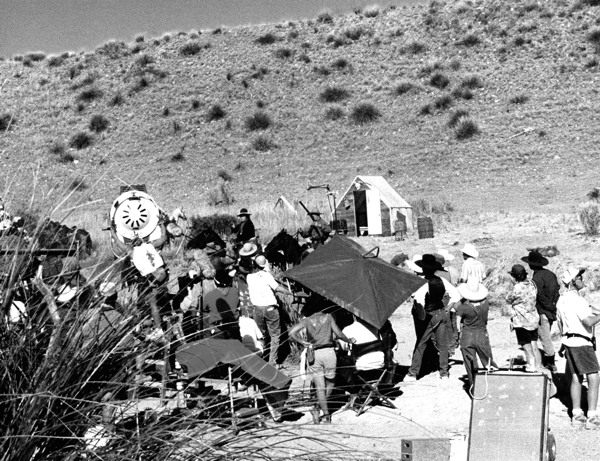
In one of the last scenes Kevin Jarre directed, Sherm McMasters and Turkey Creek Jack Johnson get the drop on several Cowboys (courtesy Bob Boze Bell)
Billy Lang is the Cowboy that Russell fights with. “Rick Terry and I had a really good scene that was cut out,” says Billy. “We were just shooting the breeze at the campfire. You hear a gunshot, Rick and I walked out, and there’s a riderless horse come running to us—it was amazing how the wrangler got it to do that. We walked out to get him, ‘Oh oh. There’s blood on the saddle.’ We turn around and here comes the posse and Kurt gets off his horse and he and I get into a fistfight. He threw some pretty good punches.”20
Jeff Dolan was also a part of this sequence: “I rode my horse over and showed up early that day. Adam Taylor, the first AD, called over because he knew who I was and said, ‘I got a job for you. I want you to be a Cowboy riding into camp and we’re going to do a POV.’ I ride into camp past a bunch of guys and the camera films me doing that. Then they turn around and put the camera on a dolly and the camera becomes me. So basically, they’re using me as a vehicle to show the different characters that are in the camp. It’s my POV of the camp as I’m riding in but it was cut.”21
“At the end of the scene,” continues Bell, “Turkey Creek Johnson remarks that Florentino is getting away and turns to fire a Winchester at him. The first time he does this, he pulls, cocks and aims right at the gunsmith. Being a bevy of gun-savvy extras, they all dive out of the way. Turkey is oblivious to their very existence. In fact, each time this is re-enacted, Turkey’s horse starts walking and he has to rein in and aim, several times per take. [After about 45 minutes,] Jarre walked towards us [and] sat down next to Jeff [who] was the historical consultant on the movie. [Kevin] was very slight, very small, almost fragile looking.”
Constantly smoking, Jarre looked like he’d lost 15 or 20 pounds. One week earlier, scene #105 was filmed in which Earp and his posse attacks the Cowboy camp. Morey stated, “Every time I was on the set, Kurt Russell was at a distance from Kevin and I could hear him complaining about Jarre. I never saw [Russell and Jarre] together. I saw them once when they were filming a scene when the [posse] ride to the Cowboy camp when Wyatt [kills] Florentino. [The camp] was fairly large, almost 25 people. Russell was complaining to the producers that it didn’t make any sense that the Cowboys wouldn’t just shoot Earp as he came into view. He was very bothered by this and I remember him talking to Jacks about it. And I can’t argue that point but that’s not the way it’s in the script. Kevin was adamant and he was going to do the script that he wrote.”22
Several scenes were filmed the day before Jarre’s dismissal. Bob Palmquist remembers, “My wife Laurie and I went out there the day before and we watched [Jarre] shooting a couple of scenes. A bunch of cowboys are sitting around the campfire, one guy doing a dance on top of a beer keg. And Stillwell comes roaring in and yells that Old Man Clanton has been killed at Guadeloupe Canyon. [Stephen Lang] says, ‘I guess that makes me leader of the gang.’ And Powers Boothe says, ‘You ain’t got enough in your britches, boy.’ That never made the cut. And the other one was the death of Indian Charlie (Paul Ben- Victor). He was killed by Wyatt and the posse. They ride up to the Cowboy camp and gun him down. In the version that Kevin shot, that’s where Wyatt gives the famous, ‘The Cowboys are finished in Cochise County and Hell’s coming with me’ speech. That occurs here rather than at the killing of Stillwell in Tucson. I got a chance to talk to Paul Van Victor a little bit after that scene was shot and actually gave him a copy of the coroner’s inquest into Florentino’s death. The next time I saw him, I said, ‘How’d you liked that transcript?’ ‘Oh, it’s great stuff.’ Then he looked kind of sad and said, ‘But I don’t think my death is going to wind up in the picture after all.’”
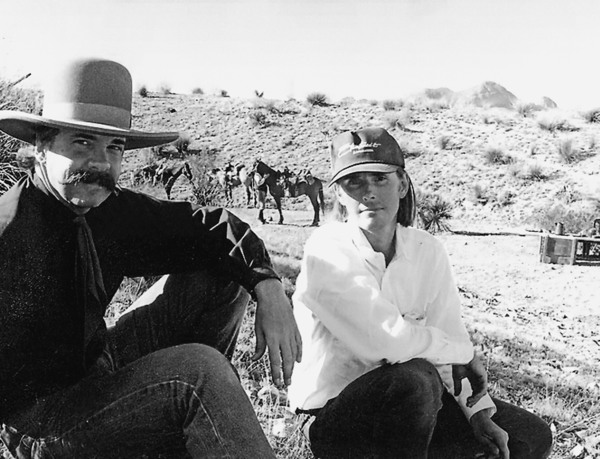
Historical consultant Jeff Morey (left) and director Kevin Jarre during a break on the Babocomari Ranch. Days after this photograph was taken, Jarre was fired and George Cosmatos was brought on to direct (courtesy Bob Boze Bell).
Adds Palmquist, “[We] were behind Michael Rooker and Val Kilmer and Russell as those couple of scenes were [filmed]. Kilmer was very, very silent, Russell was doing a lot of complaining about Kevin Jarre and his direction of the picture. Michael Rooker was spewing forth some sort of obscenity-laden discussion about this and that and the other thing.”23
The dancing Cowboy Palmquist was referring to is Jerry Tarantino, who was very impressed by Stephen Lang’s horsemanship: “They had a camp setup, it was during the day and they had a small campfire going. They had me doing a kind of Irish jig around this campfire and [Curly Bill and Ike] were shooting at my feet, making me dance. [Jarre] asked all of the Buckaroos if they could [do an Irish jig]. I was the only one that came forward. I’d never done one before but they taught me how to do it. I got the nickname Dancing Jerry. We were drinking and falling and laughing. I filled the whole frame and they cut it. We were so disappointed. A Cowboy comes into this scene, pushes me aside and he went to Curly Bill and said Old Man Clanton has been killed. So Curly Bill and Ike have this close-up where they’re having this conflict where Bill says, ‘Okay, boys. This is what we’re going to do.’ [But] Ike says, ‘Wait a minute. I’m the next in line. I’m the son. That was my dad.’ Ike gets mad, runs and jumps on a horse, puts his foot in the stirrup, hikes his leg over the saddle and rides out of the camp. That was the end of the scene. They did that like 20 times, I am not kidding you. And every single time, Stephen Lang hit that stirrup, put his butt into the saddle and went out of the camp perfectly. It wasn’t uncommon, at least in Tombstone, to do 10 to 15 to 20 takes. It was mind-numbing. But these guys would do it over and over and over and every single time it was perfect.”24
In the Indian Charlie death scene, Russell and the posse ride in and Buckaroo Jemison Beshears was so keyed up, he bit his pipe in half. Reggie Byrum explains, “It was [Jemison’s] birthday, they came right at him and he got so excited he bit his pipe in half. They were trying to get Buck Taylor’s horse to run into a guy and the horse wouldn’t do it, so the guy had to bounce off the horse himself.”25
According to Rick Terry, “The last scene Kevin directed before he got fired was a night shot at the Babocomari. There was a hillside, kind of a steep hillside, almost a cliff, and they positioned a lot of the Buckaroos on their horses on this hill. And then Curly Bill comes and stands on the top of this hill and gives this speech, ‘It’s time to get wooly, boys…’ and that was the last time I saw Kevin Jarre. In fact, when we finished shooting that, it was really late, Kevin Jarre was shaking all of our hands as we rode past him. Thanking us for the work that we did and making it look great and patting us on the back. Little did we know. That was the last time I saw Kevin.”26
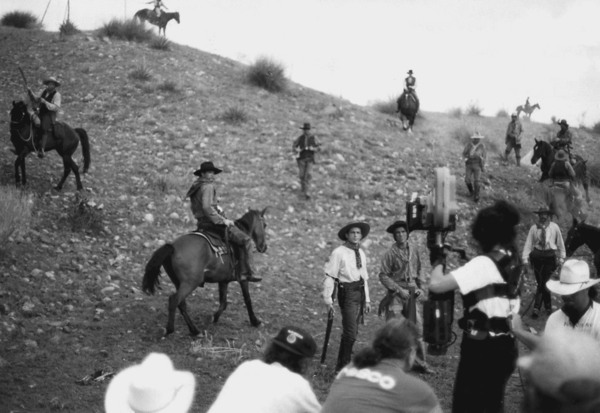
In this behind-the-scenes shot, Cowboys meet with Wyatt Earp at Rustler’s Park on the Babocomari Ranch, near Sonoita, Canelo and Elgin (courtesy Larry Zeug).
Jeff Dolan may have witnessed Jarre’s actual dismissal: “At the end of the day, everybody’s leaving, and we’re all riding our horses back to the camp. I saw [Jarre] talking to Jim Jacks a couple of times, just standing in the pasture, the two of them talking. And the conversation seemed kind of intense and it wasn’t like it was a fun conversation. I thought, ‘Oh boy. Something’s up. This is not good.’ And then I heard that they just weren’t happy with his work. They weren’t happy at all with how the film was coming out.”
But Jacks told Morey that he fought to keep Jarre. He thought the film could still be salvaged even if Jarre was the director and pushed the studio to keep Jarre right up to the very end. Nevertheless, it was Jacks who gave Jarre the word he was let go because in Jacks’ words, “I knew [Kevin] best. [The conversation] wasn’t pleasant.” In retrospect, Jacks regretted not insisting Jarre direct a couple of smaller films before “attempting something as demanding and complicated as a big western.”27
Continues Bell, “Jeff [Morey] called the next day and was very upset. He said, ‘Kevin Jarre just got fired. I want my name taken off the movie.’” Morey said, “I didn’t like the way things were going. I heard Curly Bill was killed in the river and Hugh O’Brian’s scenes were cut. After I learned that the scene with the wagon master was eliminated, I told Jim Jacks that I wanted my name removed from the credits. That scene was important to me because it clearly indicated when Wyatt Earp first started to become mythologized. I worked for Kevin and was very unhappy how things transpired.” Bell later interviewed Michael Biehn, who said that Jarre wanted to do a different fight scene than Russell wanted and it pissed him off, so the producers fired Jarre. Word quickly spread around the set that the director was dismissed. Many were very surprised and angry, others expected it and still others thought their days were numbered. They expected the new regime would clean house and that those too close to Kevin would be gone. Sherayko felt the only reason he was kept was because of the Buckaroos: “Due to my relationship with Kevin, I probably would have been fired if I hadn’t supplied the guns, saddles and re-enactors. I couldn’t believe it.” Buck Taylor noted that for all his years in the business, he’d never experienced anything like it. Parties were usually held every Saturday night in the hotel’s bar and Kevin always insisted on buying the first round. But that day, after everyone heard the news, “it was like a morgue … everyone was walking around in shock.” No one knew who would be fired next.28
Jarre took it like a gentleman, and insisted that those associated with him should carry on. The next day, Biehn ran into Kevin settling up his bill at the hotel front desk and thought that was a touching, classy gesture: “If that would have been me,” admitted Biehn, “I would have driven away and never even done anything.”29
It is not known if Russell was involved in Jarre’s dismissal, but Kurt was fairly blunt in his opinion of the situation: “I had backed [Jarre] as the director. The biggest surprise was, he was as lost as a director as he was found as a writer. He was a brilliant writer, but it’s a different job. Bringing it to life is a different job. He was really in trouble there. I told him early on, ‘It’s a shame you can’t do Tombstone after you’ve had ten movies under your belt.”
Production ground to a halt during the search for a new director. According to Stephen Lang, “Disney was going to pull the plug on that movie because it wasn’t going well [but] Kurt Russell flew back to Hollywood and convinced these guys to not shut us down and that we could make a really great movie if we could bring in a shooter.” In a 2006 True West interview, Kurt stated that the studio asked him to take over the project. “I said, ‘I’ll do it but I don’t want to put my name on it. I don’t want to be the guy.’” Russell had previously worked with Sylvester Stallone on Tango and Cash and knew that Sly had ghost-directed Rambo: First Blood Part II with George Cosmatos. Cosmatos followed that up with another Stallone flick, Cobra, and there were rumors Stallone ghosted that as well. So Sly not only knew what Cosmatos was capable of, he knew George could be controlled. Kurt called up Stallone and said he needed a guy. How about George? Russell must have convinced the studio of the practicality of this decision as just a few days later, both Cosmatos and John Fasano were assigned to the project. “I was in the [Cinergi Productions office] developing a script for Die Hard 3,” said Fasano, “and [Cosmatos] was developing a Washington mystery, The Shadow Conspiracy. [We were talking in the hallway] when Andy Vajna opened the door to his office, saw us standing there and said, ‘You. You. Come here. You are going to direct Tombstone. You are going to re-write it.’ Before we knew it, George and I were on Andy’s [Gulfstream GV] private jet headed for the set.” Fasano received $40,000 for services rendered, including 11 revisions, all looping dialogue, and several rewritten opening narrations. (According to Fasano’s widow Edie, John was supposed to receive writing credit but Jarre objected. The dispute either went into negotiation and/or WGA arbitration, and Fasano was awarded an associate producer’s credit. As he didn’t own the script’s copyright, he never received any residuals. At the time that he worked on Tombstone, Fasano had already signed a deal with New Line to write and direct the movie Battle Tech which never materialized due to his efforts for Cinergi.) Cosmatos, who died in 2005 of lung cancer, recalled that the transition was quick, to say the least. “It was very tough. It’s tough enough to prepare for any movie, so to be ready in three days and move in…. I read the script on a Wednesday, we made the deal on Thursday, and I was on a plane on Friday. Saturday, I changed some locations, some of the sets, some of the costumes. I changed some of the actors on Sunday, and on Monday we had a production meeting. By Tuesday we were shooting. So there was a kind of psychological turmoil on the set.”
Stephen Lang was convinced that it was the right decision: “George knows how to swing a lens real good. When it came to the visuals, George was as good as anybody. Remember, he was working with no prep time and while George, I believe, loved and appreciated westerns, but he wasn’t a student of western culture. But he was fortunate: He had Val and Sam and Kurt and myself and Paxton. He had a lot of actors who knew what they were doing and so, in a way, it was a little bit [of] ‘Stand back and you let us do what we’re doing and you capture it.’ There’s a lot of truth in that, but it’s also slightly unfair because George does bring a very strong point of view to everything.”30
However … if one analyzes various internal Cinergi documents, it’s clear that Cosmatos was hired before Jarre was fired. In the director’s aforementioned comment, he states that he finalized a deal with Cinergi on Thursday. The call sheets for Thursday (June 10) through Saturday (June 12) still listed Jarre as the director, which should not be a surprise—why announce the change before Jarre was notified? (Utilizing the director’s shot list, a call sheet is distributed to cast and crew to notify them when and where they should report for the next day’s filming. Usually developed by the second AD, then reviewed by the first AD and/or unit production manager, the final call sheet then is circulated around ten p.m. to all pertinent parties.) Virtually all of the film’s principal actors were involved in scenes #43, #44 (partial), #77, #102–03 and #121 (partial). The second unit filmed that Friday as well. Kevin was even scheduled to direct scenes #102–03, and partial scenes #116, #121 and #146 on that Saturday. Cosmatos’ name doesn’t appear on any daily production report until Tuesday, June 15. So, if he was on location as he stated, he must have been ensconced somewhere out of sight. Having Kevin’s name on Saturday’s call sheet is not unusual. Even though many actors and crew members had a hunch Jarre might be dismissed, call sheets with his name still on them preserved the illusion that all was under control. And, although Cosmatos was already signed, something still could have changed that. Better safe than sorry.31
Known as a savior of troubled productions, Cosmatos was the beneficiary of an extremely lucrative contract to take Tombstone’s reins. While Jarre received $200,000 for the script and $150,000 as a director, $7500 of which would be given to Lisa Zane, Cosmatos received $1 million, $250,000 of which would be deferred until the adjusted gross receipts equaled cash breakeven. In addition, he also had back-end participation: ten percent of 100 percent of the production’s adjusted gross receipts in excess of cash breakeven until second breakeven was achieved at which time he would receive 15 percent of 100 percent. After filming was complete, he received an office in Los Angeles for one year from the commencement of post-production, a shared secretary, and two round-trip business tickets from his home in Vancouver to Los Angeles.
Tombstone was initially a non-union project. But once Cosmatos came aboard, it fell under the auspices of Director Guild of America (DGA) guidelines. To determine their eligibility to continue working on the film, a list of all assistant directors and other personnel under DGA jurisdiction was developed. Further, a schedule was provided that detailed the number of days each individual had with the DGA for purposes of working on the production, and all pay scales had to be brought up to minimum requirements. And, as mentioned previously, since it had been necessary to reshoot numerous scenes, each actor and his/her agent was contacted so that appropriate pay arrangements could be made for additional time, if necessary. The net effect was a significant increase in the film’s revised budget—an additional $3.547 million that included $760,000 of current overage. The film’s budget had now swelled to $25.333 million.32
With the production in a state of complete turmoil, in order not to lose their completion bond, some sort of filming was necessary. Among other activities, a completion bond guarantees the actors that their salaries will be paid in the event of project cancellation. So, as shooting had already been scheduled for Saturday, June 12, up stepped first AD Adam Taylor. Relates Buckaroo Reggie Byrum, “When they fired Kevin, the next morning we’re on the set and here’s Adam Taylor wearing a [white shirt and a] tie, and he announces to us that Kevin has left the film. He didn’t use the word fired, but Kevin had been let go and left the film. [Adam] said, ‘I’m first AD today and I just want to make sure they understand I’m serious about this because I want to be here until the picture is over. For the time being, I am the director of the film and hopefully in a few days another director will show up and I can take this tie off.’” According to Taylor’s wife Anne, “That was his thing—a tie on Friday. He did wear the tie while directing and every Friday thereafter.” It’s likely Taylor shot some stock footage during this period; the producers knew nothing may be used but at least it showed the cameras were rolling.33
The production meeting mentioned by Cosmatos was held on Monday, June 14. As expected, many of the participants were less than supportive because most had been hired by Kevin or had joined due to the nature of his script. “If you think about it logically, there had to be something special about the particular project,” mused Boothe, “or they never would have attracted the cast that they did. That, in my opinion, was extraordinary writing. Every character was a principal; every character had a beginning, middle and end that reflected the life of Tombstone in that era. No one was written as a typical good guy or bad guy, they were written as human beings.” With Jarre now gone, many feared the quality of the production would severely suffer and that their roles would be diminished. As a general rule, production meetings are typically held to address concerns, discuss resolutions, share ideas and suggestions, explore new developments, insure that everybody is on the same page, and—a key element—inform cast and crew of sensitive issues and topics. Entering this meeting in the hotel, Fasano admitted he felt like a Christian entering the Coliseum. (Numerous little casitas on the hotel’s grounds housed various production offices, including Accounting, Editing, Transportation and Production.) “Everyone in that room was angry, they want[ed] to kill each other,” said Fasano, “and their dream project was on the verge of falling apart. Some wanted to know why I was needed. Andy [Vajna] says, ‘Here’s your new director, and your new writer.’ Everyone was arguing against us, and it was huge.” The hotel pool had been drained for re-plastering, so the various hotheads had nowhere to cool their tempers. Vajna told the group there was no way the current script could be finished in the time budgeted. (And if it could, the resultant film would be over four hours!) According to Fasano, “It wasn’t enough to cut the script. [By the time Fasano released his first set of revisions on June 24, he had already cut 70 scenes and added 29 more.] Scenes would have to be conflated so that many of the great moments that got these actors to commit to the movie would not be lost.” The actors were still unconvinced. “We didn’t hire George because we wanted an action movie,” says Vajna. “We’re certainly not saying it hurt, because George made the action scenes crackle, but he also helped supply a visual element that we felt was badly needed. A lot of recent Westerns have deliberately gone for a drab, colorless look. I think people were ready for a truly gorgeous-looking Western.” After Vajna said he supported Cosmatos, Russell stepped up and said he believed George could do it. That seemed to calm the waters a bit and the meeting concluded.34
In a January 1994 interview, Russell explained, “When we ran into the situation where Kevin was having problems, there were feelings that the script could provide an opportunity to make a better movie than was being made. It was also becoming apparent that we weren’t moving fast enough. Because I spent so much time with Kevin and Jim Jacks on the screenplay, and because of my position in the movie, it was my position as well to make sure that this thing didn’t fall apart. I wanted to give George all the help he had to have. Somebody had to step up and say, ‘We’re going to get this movie made, but it’s not going to be easy.’ It wasn’t Powers Boothe’s position, it wasn’t Val Kilmer’s position. It was mine. I had gotten the movie financed. I could not shirk that responsibility. So I banded the actors together and I explained to them that we had to make this thing happen—it was too good a project to give up on. And they did. They were champs, every one of them, and George was a champ as well. We all worked together from that moment on to do something that we felt was important—that was, bring Kevin Jarre’s screenplay to the theaters.”
Continues Russell, “There was no way George could have withstood the onslaught from everybody—wardrobe, props, action. He needed lots of time and help. I spent 20 hours dealing with Tombstone the movie in every other sense than my role. I didn’t have a chance to play Wyatt Earp.”35
Added Powers Boothe, “Kurt was our leader. He’s been in the business all his life. But he’s a team player all the way, and, in this case, he had to be. Because we got behind a bit with Kevin, when George came in, the first thing the producers did was rip out 20 to 25 pages of the script. And to Kurt’s credit and Val’s credit, they fought to put a lot of that stuff back in, even though a lot of it didn’t have anything to do with their characters on the page. It’s because, in my opinion, Kurt was smart enough to know that the writing was brilliant—and that if those scenes weren’t there, it made his character and the story less. Realistically, we got almost everything back in the script—and I give Kurt, and certainly Val, and Jim Jacks a lot of credit for fighting to keep this great script together and to shoot it. Our attitude was, ‘Hell, yes! Let’s do this movie.’ We had really juicy roles and you could see everyone just chomping at the bit to get at them. All of the distraction just brought us closer together.”36
Dana Delany agreed: “[Kurt] was our leader, the captain of our ship. Wyatt Earp had a really good sense of justice and right and wrong. Kurt’s very much like that in real life. He was able to mediate between all the egos. It’s very difficult when you have a lot of good actors. They have to all have their little moments and get the attention they deserve.”37
Michael Biehn acknowledged that Jarre’s dismissal was hard to take: “It was sad for me. I liked Kevin a lot. He really wanted that script to be the way he wanted it to be. He wanted to cast it the way he wanted to cast it. He wanted the saddles to look the way he wanted them to look. He wanted the spurs to be a certain way. He wanted the mustaches to be a certain way. He wanted the dialogue to be a certain way. He wanted it shot a certain way. He wanted everything exactly the way he wanted it. And, you know? The filmmaking business is a little more collaborative than that.”38
While the actors may have been a bit upset, many in the crew took it as a positive change. “I think a lot of people said it was about time,” confessed camera focus puller Michael Walker, “because they could tell things were running roughly. I think they were almost happy about having the change because it was a tough set. They were open to the idea of getting a new director—fresh blood to put some life back into the crew and the movie. Time is of the essence when making a movie. Producers want things to run smoothly and quickly. Otherwise they’re spending a lot of [needless] money.” Bill Fraker may have been pleased as well. A crew member suggests, “[The dismissal] probably relieved Bill from the frustrations that he had with that director. He was frustrated with the way things were happening and the obstacles that the director put up against him to try and make a movie. From a camera experience point, the way things should be done, and the way a traditional camera director at the time is used to doing. I think he was kind of happy about it.”39
Yorgo Pan Cosmatos was born in 1941 to a Greek family in Florence, Italy. He studied film at the London Film School and, in 1960, was an assistant director to Otto Preminger on Exodus. After experiencing success in Europe with Massacre in Rome (1973), The Cassandra Crossing (1976) and Escape to Athena (1979), he migrated to North America where Of Unknown Origin (1983), Rambo: First Blood Part II (1985), Cobra (1986) and Leviathan (1989) quickly followed. Known for blockbuster and action films, Cosmatos “developed a reputation for his ability to handle complex action shoots, aerial photography, and for turning around troubled projects.” According to director Richard Donner, “George was just a wonderful, bigger-than-life character. You never forgot his entrance and hoped there would never be an exit.” The loud, profane, cigar-chomping, chain-smoking Greek was often blunt, gruff and politically incorrect. These traits would be soon experienced by one and all on the Tombstone set.40
Despite Russell’s apparent support of the incoming director, all was not what it seemed. Cosmatos had never directed a Western. He had never even worked with horses. Actor Tomas Arana observes, “Cosmatos showed up knowing almost nothing, not even which actor was playing which role. He obviously hadn’t done research or prep or any of that, due to being hired shortly before.” Despite his credentials and experience, how could he possibly take on a project of this genre? The only answer was a “ghost director.” In this scenario, one director gets credit for the film while another is silently calling all the shots and working with the actors and crew. Over the years there have been numerous relatively successful films where a more-experienced director or even an actor has stepped in to assist a struggling novice. In some instances, the ghost director didn’t want the credit; in others, they were contractually blocked from “officially” directing for whatever reason. The following films may have been ghost-directed: Black Magic (1949) director Gregory Ratoff–ghost director Orson Welles; The Thing from Another World (1951) Christian Nyby–Howard Hawks; Poltergeist (1982) Tobe Hooper–Steven Spielberg; Return of the Jedi (1982) Richard Marquand–George Lucas; Rambo: First Blood Part II (1985) Cosmatos–Sylvester Stallone; Cobra (1986) Cosmatos–Stallone; Tango and Cash (1989) Andrei Konchalovsky–Albert Magnoli, Stuart Baird; Dances with Wolves (1990) Kevin Costner–Kevin Reynolds; and Super Mario Bros. (1993) Annabel Jankel, Rocky Morton–Dean Semler, Roland Joffe.
Kurt Russell ghost-directed Tombstone. Not only have several cast and crew members vouched for that statement, but Russell himself confirmed it. Explained Russell, “I said to George, ‘I’m going to give you a shot list every night, and that’s what it’s going to be.’ I’d go to George’s room, give him the shot list for the next day, that was the deal. ‘George, I don’t want any arguments. This is what it is. This is what the job is.’ And I said to George, ‘While you’re alive, George, I won’t say a goddamn thing.’
“The vision that Kevin had as a writer, he couldn’t realize as a director. That’s an unfortunate reality. Within three weeks he was replaced by a man who had no concept of the screenplay but a very good eye. At that point, George and I had to become bed buddies … here’s this poor guy coming in on one day’s preparation, and what’s he supposed to do? Because of my position in the film, the task fell to me to make sure the whole thing didn’t just fall apart…. I believed in the material and in Kevin’s vision.”
Some of the issues were very basic. “Logistical decisions—the base camp was an hour-and-a half’s drive from the location,” explained Kurt. “From the beginning we needed to cut 25, 30 pages of the movie but Kevin never got around to doing that. And I was the only one left who knew the script.” Extra Glen Gold agreed: “It was quite obvious that [Russell] had quite a bit to say about how things were set up and how they were going to do them…. Russell would [give instructions], or they’d be talking and you’d see him change the lighting or change the camera angle. It was quite obvious that Russell was [directing activity]. Russell had some input on what they [were] doing.” Another extra observed, “Kurt was essentially, very much an ad-hoc director. He was always consulting with George and when they would film a scene, Kurt would say, ‘Hey, let’s do it this way.’ George would acquiesce without argument. [Cosmatos] would say, ‘Do another one?’ Kurt would say, ‘No, that’s good.’ Or George would say, ‘Okay, I like that,’ and Kurt would say, ‘Let’s do it one more time this way.’”41
As Russell had indicated, he, Kilmer, Fasano and Jim Jacks would convene each evening in Kurt’s room where they would craft the next day’s schedule. Conspicuous by his absence was Cosmatos. Seconded Kilmer, “[Kurt] and I worked so hard, I eventually moved in with him and slept on the sofa when Goldie wasn’t in town, so we could use the extra 20 minutes writing or going over [the) schedule, etc. We had to do a lot of work—lobbying for ways of looking at the screenplay to allow for stuff that was missed. We had challenge after challenge. Kurt is solely responsible for Tombstone’s success, no question. I was there every minute and although Kurt’s version differs slightly from mine, the one thing he’s totally correct about is, how hard he worked the day before, for the next day’s shot list, and [the] tremendous effort he and I both put into editing, as the studio wouldn’t give us any extra time to make up for the whole month we lost with the first director. We lost our first director after a month of shooting and I watched Kurt sacrifice his own role and energy to devote himself as a storyteller, even going so far as to draw up shot lists to help our replacement director, George Cosmatos, who came in with only two days prep. I was very clear and outspoken about what I wanted to do with my role, and actors like Powers Boothe … and Bill Paxton, were always 100 percent supportive, even in the blistering heat and sometimes as the day would fade, at the possible expense of their own screen time. Kurt did this for the film virtually every hour. I would even go up to him and whisper, ‘Go for another…’ meaning another take when I thought he could go further, but in the interest of the schedule, he would pound on. Very Wyatt-like, come to think of it. I have such admiration for Kurt as he basically sacrificed lots of energy that would have gone into his role, to save the film. Everyone cared, don’t get me wrong, but Kurt put his money where his mouth was, and not a lot of stars extend themselves for the cast and crew. Not like he did.”42
Fasano had a similar recollection regarding the process: “We shot all day (or night), checked out the dailies from the day before, then after dinner Kurt and Val Kilmer would convene in my hotel room and we would dissect the scene [that] was going to be shot the next day. We argued. We talked about research they’d done on their own. They read the scene out loud. We played with variations, combining scenes to make the original point. As they paced and talked, the whole time I was typing—putting these new ideas into Kevin’s original scene, stopping the bull session to read the complete scene to them when I thought it was ready. It went that way for seven weeks.” Admitted Russell, “I ended up working every night until I had to pass out. After we worked all day, I would work on the script and on the directing. Usually after shooting I get a beer with the boys every time. But, I didn’t do it this time because I had to work on the script every night.”43
Robert Burke speaks for almost everyone when he describes Russell’s work ethic: “Say what you like about Kurt Russell, but he put his heart and soul into it. He was trying to pick up the pieces. He was the guy staying up late. He was the guy saying, ‘No, the camera angle’s wrong.’ And, goddamn it, he was always right. He had a feel for this thing. George was terrific but [Kurt] was coming in with camera shots and shot lists the next day and passing them to George. ‘Oh, we need to get this,’ or ‘Oh, I want another rain truck here.’ Very rarely do you see somebody of his caliber just want to push that up the hill every day. Could he be abrasive? Yeah, sure. But he was under a lot of pressure and it was always, I believe, with the best intention. Kurt was up at four o’clock in the morning, get to the set at five, shoot four scenes from six o’clock to four in the afternoon and now he’s done. Yet he’s still in costume, standing behind George’s chair for another five or six hours. This guy wasn’t [just] punching the clock, he was definitely [its] heart and soul.”44
Slowly, steadily, by shaping, rewriting and eliminating, the group created a newer, leaner script to accommodate the revised schedule. But even though there seemed to be a tentative agreement with the new regime, many disgruntled actors were still leery, mostly about their roles and how they might be modified. Russell even volunteered to have his own lines cut and scenes reduced. Some, such as Boothe, felt Russell’s involvement was the most essential ingredient: “Kurt took on something that no actor should be asked to do and he held this movie together. He fought for scenes for everybody. It wasn’t just saving himself.”
Fasano challenged the actors on their roles. “On their days off,” explained the writer, “the individual actors would come to my room and I’d say, ‘Okay, Bill [Paxton], you have these four scenes. We can only have three. What is important in this third scene to you?’ That way I reduced the length of the script to fit the rest of the shooting schedule.” But, he was also sensitive to the actor’s needs and desires. He sat down with each lead actor and asked, “Why are you doing this role? What is it about this role that is important to you?” Based on their replies, he tried to make sure their character’s important lines were not lost. While some feared their best lines and scenes would be eliminated, Kilmer wasn’t so discouraged. Fasano: “I remember one day where I was a little frightened to tell Val that some of his lines had to be cut out of a scene we were about to film. He smiled and said, ‘I have this makeup on. I have this accent, and I have my cup. You could cut all of my lines and I’ll just sit there and cough quietly and steal the scene.’” (“I went to a dinner and Kirk Douglas was there,” says Kilmer, “and he started poking me in the chest, laughing about the Doc Holliday thing, and he said, ‘I don’t know if it was true for you, but the hardest thing was [deciding] when to cough, ’cause you never know how much or how little.’”)
Michael Biehn believes the film was saved by tearing scenes out: “Powers Boothe would lose a scene. I would lose a scene. Bill Paxton would lose a scene, or two scenes, or three scenes. Everybody’s ego had to be massaged at that point. We were watching our characters disappear. Without Kurt’s leadership, that movie would have folded at that point.”
Others weren’t as positive about these developments. Says John Philbin, “Some actors were upset about their parts getting smaller. That’s normal for actors of that caliber when they sign up to do a thing and it turns into something else. A lot of actors were really fucking pissed, because they [had] signed up to do Kevin Jarre’s script. [Then] when they got the new draft that they were going to be shooting, obviously, most of their parts had been cut. And they were pissed. I just watched that drama and said, ‘Wow. This is tense.’ George was not a friendly, warm, fuzzy, understanding director, so he’s yelling at all these people that are great actors who decided to do this thing, and George just doesn’t know how to direct actors. So there was tension.” Tomas Arana agreed: “When Jarre was fired, the studio chopped the script apart and then eliminated all the Clanton base scenes and the Old Man Clanton role. They also then blended together many of the Earp scenes, maintaining most of Kevin Jarre’s wonderful dialogue using words of the 1800s, but combining different scenes. So Stilwell’s part and various other Clanton gang scenes were gone along with their various backstories and it became just all about the Earps and we Cowboys would just interact with them. It was a pity, because I believe Jarre wanted to show that the Clantons and the Earps were not all that dissimilar and that they had many common family things, etc.” Some cast members even felt the production had turned into the Kurt and Val Show. Said one unidentified actor, “A lot of guys, Buck Taylor, Peter, all the other guys, even Sam Elliott [originally] had a lot more lines and a lot more [to do] in it. Paxton and all of them, and they took all their lines away. Kevin’s script was more into the town and the people, the individuals that were in the movie, they had lines and more into their life … it was completely different than just an action show. And that’s what we called it, the Kurt and Val Show. [However], I don’t know it would [have] sold with Kevin’s way of doing things. I think it would have sold but it wouldn’t have been such a power-packed sell.” Another actor claimed that most of the story “was about the five guys in the Vendetta posse. So Kurt cut all that out. He said, ‘No, it’s about Doc and I. Give us all the lines. Give us all of that stuff.’” Even producer Jim Jacks supposedly was upset about the direction the script was taking, and asked, “What about [everybody else in the film]?’ Russell reportedly responded, “Rooker pissed me off. Buck Taylor is a has-been and nobody knows Sherayko.” (Of course, one must consider who said this, and the circumstances under which this statement was made, in order to determine the veracity of the claim.) According to Philbin, Sam Elliott said that had he read the script the way it was finally filmed, “I wouldn’t have agreed to do this shit.” When Elliott nursed a beer in a bar one evening, someone approached and said, “Sam, you should have been playing Wyatt Earp.” Sam just looked up at him with that look that he gives, and he said, “Tell me about it,” and went back to his beer. Others weren’t even sure they wanted to continue with the production.45
Jarre had hired Forrie Smith and the actor was extremely loyal. “When I was going to quit, I went in to talk to Val Kilmer,” recalls Smith. Val quickly reached the heart of the matter: “What we have here is a Shakespearean play and we lost our Shakespeare.” Forrie protested, “Well, I didn’t come here to talk to Doc Holliday. I came in here to talk to Val Kilmer,” to which Val replied, “Val Kilmer does not exist. Only the characters he portrays.” Smith then went to see Kurt and Sam, who immediately changed Forrie’s mind. “Are you crazy?” asked Sam. “You’re going to quit this job. You’re healing up from a broken leg and getting paid all this money while you’re doing it. Don’t be crazy.” Forrie remained.46
Smith wasn’t the only one who wanted to leave. Lisa Zane recalls, “While on set, I heard Kevin got fired. I seriously can’t remember if I was stunned by the news or not at all.” She confided to a Buckaroo, “I don’t know what I’m going to do. Looks like I don’t have a job.” That night, she and Jarre (already back in L.A.) were on the phone, and he urged her to stay on the picture if possible.
Matt Marich spent an entire day with her and discussed the scene she was going to perform at the Bird Cage. “I took a lifecast of her that day,” remembers Marich. “Started sculpting the face and then I was supposed to have dinner with her and Catherine [Hardwicke] that night. So I called her room. Catherine answered and said, ‘Man, it’s a really, really bad time, I’ll talk to you later.’ Well, the way things happen in Hollywood is, you go back to your hotel and they have your stuff packed up and they tell you to leave. It was very abrupt and very short and I’m sure heartbreaking for that young lady.”47
Tuesday, June 12, 1993. Iron Springs set, Sabino Canyon, Tucson. The cast and crew finally got to meet their replacement director, whose inauspicious greeting—“Where’s my god-damn director’s chair with my god-damn name on it?!”—quickly disabused any who thought they’d be working for a lightweight.
Billy Lang: “[The] first day George was on the set, we all go down to the set [in our] badass-looking costumes. We’ve got our guns on and our red sashes. Here comes George walking down the road. He takes one look at us and he screams at the top of his lungs, ‘Adam!’ Here comes Adam [Taylor]. ‘Yes, George?’ ‘Who are these men with the rags? I want them out of my movie! Get them off the set!’ ‘Well, George,’ Adam replied, ‘they’re the red sash gang. They’re the bad guys.’ George kind of looks at us and strokes his chin a little bit. ‘Ah, I like these guys.’”
Cosmatos’ bluster would set the tone for the rest of the production. Loud, crass, abusive, creative and talented, George deliberately set everyone on edge with his outrageous behavior. But why did this surprise anyone? Cosmatos had viewed this technique first-hand from the “apoplectic Prussian bully” Otto Preminger while on the set of Exodus. Demanding, confrontational, manipulative, abrasive and spectacularly ruthless with an intimidating treatment of actors, Cosmatos seemed to emulate the aforementioned traits of the man known as “the greatest producer and worst director in Hollywood history.”
“[Cosmatos] was a whole different animal,” said Sam Elliott. “George came into an impossible situation, and he came in with great passion. You can never say the man does not have great passion. Treated everybody not too good. I always go to the set and stand around when I’m not working, just to watch. I remember George coming up to me with his dark glasses, looking up at me from the top of his glasses, sticking his nose right in my face. And he said, ‘Am I going to have trouble with you?’” Sam paused a second, looked him right back in the eye and said, “I don’t know. Am I going to have problems with you?” George just laughed and replied, “Ah, we’re gonna get along fine.” They did. Stephen Lang agreed: “George had very rough edges, he didn’t communicate in the best way some of the times, but once you got to know him, you had tremendous affection for him.” Cosmatos was an acquired taste; he wore a ridiculous, cheap, straw cowboy-type hat, black socks and white tennis shoes, smoked five packs of cigarettes and drank 40 cups of coffee a day. No wonder he was so wound up!48
Property master Steven Melton remembers, “When I met George, he just kind of screamed out in front of all these people, ‘What was the last thing you worked on?!’ ‘Well,’ I said, ‘I just finished Hard Target.’ He goes, ‘Okay, I like John Woo. He’s good. You’re okay. You’re okay.’ And that was it. I was very fortunate that he liked the movie I had just done because many times someone new would show up on the set and George would scream at them, ‘What are you doing on my set? What do you do?’ And they would reply whatever. ‘That movie is a horrible movie, horrible. We don’t want that on this film. I don’t want you.’ So, that was George’s interviewing process. He was really, really mean. And I remember so clearly Catherine Hardwicke, who if you didn’t know she was a production designer back in those days, you’d think she was just an art department girl. Because she always had shorts on and a fanny pack and she was just full of energy. She came in with an original drawing she had done and George tells her how terrible it is and literally just crumbles it up and throws it on the ground. You could see tears in her eyes, she’s on her knees picking up this drawing and George is saying, ‘You dress horrible. I’d never, ever hire you as my production designer. You have no style!’ Just screaming at her and walks away.”49
Catherine clearly recalls her first meeting with Cosmatos: “I put out my hand to shake hands with him, and I was not only left hanging, he stared at my hand like it was a dirty diaper. He looked at it with disgust and said, ‘You are the production designer? Who hired you?’ He did not want to work with a woman; he told me I should have been a man. He said I should have been tall, with an English accent and wearing safari clothes, and not a woman. He was disgusted that he had to work with me, sight unseen. He would berate me all the time. ‘You dress like shit.’ And I’d be wearing stylish cut-off jeans and work boots. I didn’t look like shit, but he did. ‘What on Earth do you want me to be wearing?’ Hardwicke asked him. ‘I’m working out in the desert with rattlesnakes. I have boots and a water bottle and a hat. What do you want me to be wearing?’” Cosmatos’ reply, “I want you to be wearing a long black dress and carrying a cigarette holder,” was surprisingly weird, and Catherine was nonplussed. “At least what he said was kind of funny. But it was outrageous on a daily basis.”50
According to medic Chris Swinney, “I made it all the way through without getting yelled at because I had kids and Cosmatos liked [my] kids and was always asking about [them]. The last day of filming, one of the actors came up to me and said, ‘I don’t have any footage. Here’s my little camera. I’ve gotta go and do this scene. Would you shoot some footage for me of people and cast and crew and stuff?’ So I was walking around shooting here and there and they did the scene and George yells, ‘Cut!’ And he looks straight at me and goes, ‘You!’ and he points right at me. ‘Who gave you permission to shoot on my set. Get off of my set!’ The actor came by, ‘Oh, dude. I’m sorry.”’51
Even animals weren't safe around George. One day the crew was on the Babocomari and Cosmatos wanted a simple shot of a horse drinking water. But he didn’t tell the wranglers beforehand, so the horses had already been watered. George commanded, “Set up the cameras here. This is what I want. I want the horse drinking water right here.” The jittery horse was now scared because Cosmatos was hollering. Bo Gray, who played the part of Wes Fuller, recalls watching all this with Sam Elliott. According to Bo, “Sam’s right next to me and I’ll never forget his words. Cosmatos just went off on this poor wrangler. Cosmatos said, ‘Goddammit. He’s not drinking. What do horses eat? They eat meat.’ And everyone started to snicker. And the wrangler replied, cool as hell, ‘All the horses on this set are vegetarian.’ Sam elbowed me in the side and went, ‘Goddammit, Gray. They shouldn’t allow a director on this set that doesn’t know that about horses.’” So, production was halted about 45 minutes while this poor wrangler “is hauling ass in his pick-up, dirt’s flying, to go get some oats to put down. Meanwhile, Cosmatos went over to craft services and threw some meat in front of the horse. “Have the horse stay right there,” he yelled at the wrangler. According to onlooker John Philbin, “Russell and Elliott looked at each other and went, ‘This fucking guy has no clue.’”52
Too bad Cosmatos didn’t ask Buckaroo Jeff Dolan for advice. “Directors generally don’t know anything about horses,” admits Jeff. “Show me where you want the horses in the scene, you block the scene. We’ll put the horses where you want them and once you’re satisfied with where the horses are standing, we’ll take the horses away and then you can finish lighting the scene, getting ready. Then when it’s time for the horses to come back and you’re actually going to shoot, we’ll bring the horses in and put pellets on the ground and they’ll stand there for you. They won’t have to have halters on them and lead ropes, they’ll just stand there. I’ll just give them a snack and that should work for the length of time that you need to get your scene shot. It’s stuff like that that a lot of guys don’t know. They just don’t understand—that happens a lot … planning and not being aware of what horses will do and won’t do.”53
“One time Kurt Russell kind of screwed up and George was very upset,” notes Lee McKechnie. “And [Cosmatos] can’t get upset with the actor, so he looks for an extra or someone who is expendable. [Then] he took an empty water bottle, and he was so upset when he was looking at the monitor, he looked around. He wants to throw it at Kurt and, of course, he can’t do that. So he took the bottle and hit an extra with it who had nothing to do with the scene.”54
With the replacement director’s debut thus featuring such a bombastic series of tactless behavior, members of the production doubtless were asking themselves just what they had gotten themselves into. And why was the new fellow so belligerent? Perhaps it was insecurity. He had never directed a Western or a cast of this caliber before. Also, in many cases, a lack of confidence and uncertainty often manifests itself in self-doubt, nervousness. In other cases, recognition, bragging and narcissism with lacerating attacks against those who oppose them. Some directors are notorious for doing anything they can to get the performance they want and need on film. It may mean firing multiple people, making enemies, raising their voices and terrifying people, as opposed to gently holding someone’s hand and working with them. Said one crew member, “I remember George Cosmatos looking around on the first day of shooting and he said, ‘You know what the problem is? There’s too many actors in this movie.’ ’Cause he had to deal with all these fucking actors, and good actors who have opinions, and he knew nothing about Westerns.” Cosmatos said to an actor, “You know why this film is going to be wonderful? Because I’m cutting all the women out.”55
Nevertheless, Cosmatos knew how to ramrod an action film, which is what Tombstone turned out to be. And he knew what his role would be. Cosmatos angrily admitted, “I know what’s going on. I know what I’m doing. My reputation is to rescue movies. I rescue movies from defeat and that’s why I’m here and we’re going to make a great movie.”56
The first scene Cosmatos scheduled was the Iron Springs ambush where Wyatt kills Curly Bill. It was filmed over a three-day period at the lower Sabino Canyon recreation area of the Coronado National Forest, about 200 yards upstream from the dam. A popular area for hiking, jogging, wildlife-viewing, photography and picnicking, the location offers mountains, canyons and plants and animals in great abundance as Sabino Creek winds its way through miles of canyons before reaching the Sonoran Desert.
Cosmatos’ concept of Curly Bill’s demise wasn’t what Kevin Jarre had in mind. Explains makeup artist David Atherton, Curly Bill was going to be] killed with a shotgun “which almost split him in half … it was [to happen] just somewhere out on the ground, it wasn’t in the river. And so in pre-production I had built a whole apparatus for Powers to wear. It was a body and you buried Powers into the ground halfway and you’ve got a body that’s just shredded by a shotgun. So in the meetings [Cosmatos] would be telling me the things he planned to do differently so we could be prepared. He changed that whole scene into a river scene and Powers was just going to get shot … and that was that. There was nothing prosthetic-wise or anything fancy.” However, according to Blumes Tracy, second unit SFX, “That might be giving George a little more credit than he is due. The reason the water shot was changed was because we had a flood. When we scouted it, it was different than when we actually went and shot there. That was because there was still water there when we shot it.” Changing the film’s direction by Cosmatos, or the focus of particular scene, was not unexpected as the director had previously reviewed Jarre’s footage and rejected almost all of it.57
The production team was ensconced at Sabino Canyon for several days. According to the script, Wyatt and his posse attempt to ambush the Cowboys at the waterhole. They dismount and creep toward two cowboys sitting around the campsite, seemingly undetected. Doc Holliday has a coughing fit and suddenly the opposite side of the creek explodes in gunfire. It’s an ambush! Vermillion takes a graze, Johnson is hit by a ricocheting rock, Holliday is dragged to a tree truck for cover. All hide behind whatever cover they can find. Soon they are almost surrounded. Curly Bill laughs and baits the posse. Unexpectedly, Wyatt, with an almost supernatural calm, takes his shotgun, rises to his feet and advances toward the Cowboys. His clothing jerks as bullets rip through it, yet he remains unharmed. Curly Bill waves away his men’s fire and walks out to meet his nemesis. He empties his six-shooter at Wyatt to no avail. He then raises his shotgun to end this shootout. But before his is able to do so, Wyatt fires both barrels of his shotgun, shredding Curly Bill and ending the dispute.
The first segments they filmed were of Wyatt’s posse riding into camp, Turkey Creek and Texas Jack getting pinned down in the crossfire, the posse cleaning its guns after the shootout, etc. They also filmed an interesting scene featuring several Apaches watching the gunfight from the canyon’s rim, but it was not included in the film. As this was Cosmatos’ first day on the set, he was naturally a bit nervous, which translated into tension on the set. Stuntman Dickie Stanley attempted to ease the strain: “While we were practicing … everybody was saying bang for their intended shots. Another person [and I] starting joking about something less mundane than bang, so we designated a different sound effect to all the outlaws. Ping, pow, pop, zing, whiz, etc. Well, when we set up for the next practice, everybody had new sounds for their simulated shots and when ‘Action’ was given they followed suit. As the sounds were being made, the posse stood up and was bewildered at what was going on. Before long, Kurt and Val started shooting imaginary machine gun fire at us and throwing fake grenades. It was a very interesting exchange. Most of the crew started laughing and it really calmed the mood. George came over and asked who was responsible. Several of the guys pointed at me, and he said he was grateful. ‘But we really need to get back to work.’ The rest of the day was very calm and pleasant.”
Almost. Explains Cosmatos, “This was the first scene I shot in the movie … it was written on land but I put the river between them to give it more quality, make it … walk in the water and splash, it helps, an added dimension. Another level. I was waiting for a crane for this, a small [python jib] crane. I waited one hour, it was late [and] really delayed me the first day.”58
George Cosmatos gives instructions to Kurt Russell, Val Kilmer, Peter Sherayko and Buck Taylor on the Iron Springs set at Sabino Canyon north of Tucson. Powers Boothe can be seen through the branches on the far right (courtesy Larry Zeug).
Film aficionados know that all the elements of a particular scene—dialogue, action, stunts, special effects and sound—are not usually filmed or recorded at the same time or even at the same location. Weather, actor availability and many other factors come into play. And so it was with the Sabino Canyon scenes. At times the creek that ran through the canyon was bone-dry. “So, what they had to do is take white buckets and fill them full of water and put squibs in them,” explains Buckaroo Larry Zeug. “As they’re fanning down the Cowboys, if you see water popping up it’s because they had squibs in these water buckets [to give the effect of bullets hitting the river’s surface]. As this was the only scene of the Cowboys shooting, they could lay the camera track right down in the bottom of the river.” (Squibs were also used to kick up the sand in front of both the Cowboys and the posse.) At other times, the creek was a mere trickle so water trucks were brought in to fill the stream bed. Then, the cameras were turned to the opposite bank to show gang members shooting at the posse. Some of the gang members were Buckaroos while others were stuntmen. Continues Zeug, “At first we only shot from the angle of Wyatt’s posse firing and you never saw the Cowboys [in the brush]. I was running around helping everybody load. Being a gunsmith, I was helping the armorer because he couldn’t take care of all the various scenes. So I was loading the guys but you don’t see anybody, you just see the gunfire and smoke coming through the trees.”59
A special effects guy who was shooting dustball hits at Wyatt’s posse accidentally shot a hole in Kurt’s hat that was lying on the ground. Russell blew up, saying he wanted to keep the hat and the special effects guy ruined it. Pressures and tensions were high and Peter Sherayko, who was within five feet of the incident, said the dressing down Kurt delivered wasn’t pleasant. After that segment was complete, Cosmatos began to film the next portion of the scene when Earp shouts, “No!,” emerges from his cover, and starts to cross the stream toward Curly Bill. The Buckaroos were shooting their rifles from across the stream and production had previously informed them, “Okay, when Kurt gets to the water, stop shooting for dialogue.” Prior to filming the scene, Powers Boothe gave the team a real pep talk and told them they were unstoppable bad asses, whereupon several members apparently got carried away and kept shooting their rifles. According to John Peel, after this happened a second time, “Kurt walks all the way across the creek, still in full Wyatt Earp mode, walks up the bank right in the middle of where we are, looks at us and gives us an ass-chewing. He says, ‘Guys, this shit is costing us about $5000 a minute and every time you fuck up this setup, it costs money! And when I say stop firing when I get to the edge of the water, that mean stop fucking firing!’ And, of course, we’re all as small as we can be as we’ve already seen a lot of guys get fired. No one wants to get fired.”60
Rick Terry was also present that day but has a slightly different memory of why they were told to cease firing: “The reason for that is safety. There’s a little wadding in the blank that actually comes out the end of the barrel and it’s not a very long distance but we didn’t want to take a chance of hitting Kurt with one of those wads. [After Kurt got upset,] we got this big lecture about safety and the next day when we got our call sheets, there was a big notice on there about safety, safety, safety, and being retold to be careful.”61
Based on Garrett Roberts’ suggestion in an attempt to ease the tension, Boothe gathered all the Buckaroos together and told them, “One last photo before we’re all killed,” and posed with 12 Cowboys: Logan Clark, Garrett Roberts, Rick Terry, Jeff Dolan, Bill Luce, Chris Ramirez, Charley Ward, John (Bronc) Peel, Reggie (The Apache Kid) Byrum, Billy (Billy Concho) Lang, Chuck Milner and Tom Ward. Other Buckaroos were present but were not included in the scene. Jerry Tarantino was bluntly told by Cosmatos, “Hey, you! Wild Bill Guy. Outta here!” Apparently, Jerry’s Hickok appearance was so unique and recognizable that the director didn’t want him appearing in too many scenes. Jerry had been hired by Peter Sherayko, as had four other Norco Desperados: Curt Stokes, Marty Kottler, Len Ellonero and David Bireo. Jerry was the only one to appear in the film; his wife Kathy was Dana Delany’s stand-in.62
The scene continues as Curly Bill and Wyatt meet in the middle of the stream. During rehearsal, Boothe is brought out into the water in a small boat, then steps off into the river. Once filming starts, Bill fires a shotgun, misses Earp, throws the weapon into the river and pulls out his six-shooters. “Well, that was my shotgun,” said Zeug. “I didn’t see the gun until we’re shooting this scene and they brought it out and somebody was blowing it out with an air hose. I said, ‘What the hell did you do to my shotgun?’ All of a sudden I hear my name called over the speakers. Everyone’s hollering, ‘Where’s Larry? Where’s Larry?’ So I go down there. ‘What’s the matter?’ Right before lunch, they broke the mainspring in that Stevens shotgun. There are two mainsprings because it’s double-barreled and there are two locks on each side. ‘Larry, we need you to see if you can fix this gun. The production company doesn’t know it’s broken.’ They’d shot one scene with Kurt Russell and now it’s broke. We’re out with our trucks and stuff. I said, ‘Got my tools out here but there’s no power to run an air compressor.’ And I didn’t have an air compressor with me. What we did, we went up to the special effects trailer, hooked an air hose to a nitrogen bottle and I made a mainspring during lunchtime. The production company never knew it broke and after lunch we went back to shooting that scene.”
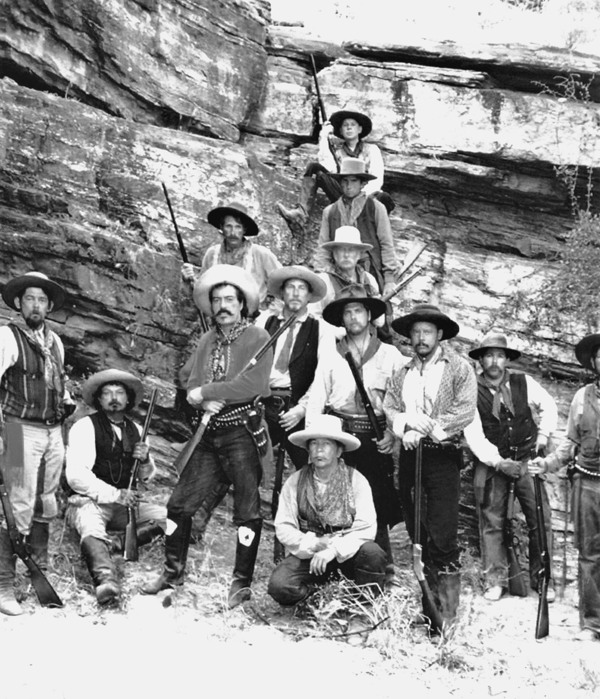
“One last photo before we’re all killed.” Powers Boothe and the Red Sash gang at Sabino Canyon. Front, left to right: Logan Clark, Garrett Roberts, Powers Boothe, Rick Terry (behind Boothe), Jeff Dolan, Reggie Byrum (kneeling next to Boothe), John Peel, Billy Lang, Chuck Milner, Tom Ward (photo’s edge). Middle three, top to bottom: Charlie Ward, Chris Ramirez, and Bill Luce (courtesy John Peel).
The shotgun that Kurt Russell used was a J. Stevens three-trigger shotgun: When you pull the front trigger, it allows the barrel to tilt forward to eject the empties. Explains Zeug, “Fred White loaned the real Wyatt Earp his shotgun, which was originally a Stevens shotgun. So, Peter had picked [one] up and we had it re-blued. Three stocks made by Bishop. But there was only one shotgun.”63
They filmed that portion of the scene several times and, apparently, when the shotgun discharged, it didn’t sound loud enough. So someone had the bright idea of adding additional powder to make a louder explosion. Rick Terry describes what happened next: “So when Kurt marches out to fire the gun off, there was a cameraman who was holding the Steadicam pretty close to [him]. When he fired that shotgun off, that powder set that guy’s clothes on fire. Of course, everyone ran and put the fire out; it was kind of an embarrassing deal because after we had the big safety lecture, those guys on the other side of the creek went and did something like that.”64
Interestingly, dialogue that embodies the essence of this film is included in the scene’s aftermath, yet it wasn’t even written for Tombstone. As Wyatt sits by the river’s bank, Holliday, Sherm McMasters and Turkey Creek Johnson squat near a tree. After Holliday has yet another coughing fit, Johnson asks, “Doc. You ought to be in bed. What the hell are you doing this for, anyway?” Doc simply replies, “Wyatt Earp is my friend.” “Hell, I got lots of friends,” says Creek. Holliday’s response (“I don’t”) says it all. According to historian Jeff Morey, this exchange came from a script Kevin Jarre had written for a proposed but unproduced new version of The Magnificent Seven. Apparently Jarre didn’t care for John Sturges’ version.65
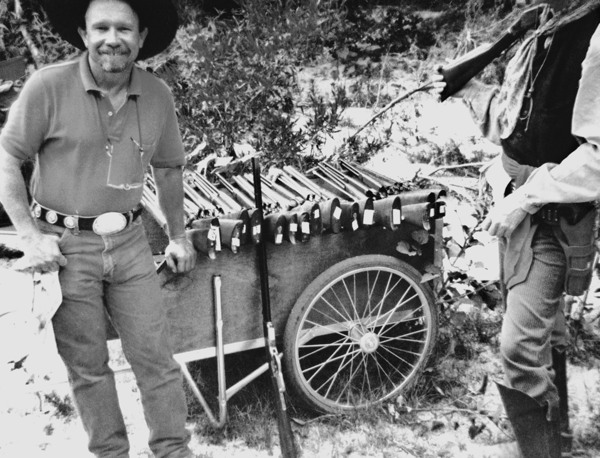
Exhibition shooter, armorer, stuntman and consultant Thell Reed guards the weapons at Sabino Canyon (courtesy Christian Ramirez).
Buckaroo Larry Zeug was also the production’s gunsmith. One day there was an issue with the 1873 Winchesters. Peter Sherayko told Zeug, “Larry, I got a real serious problem. All the original ’73 Winchesters … when you kick the level down and pull it forward, the firing pin sticks back and the bolt goes forward and the gun’s jammed up. Well, there’s a part that goes in this action that goes into the firing pin which drags the firing pin forward that stays in the bolt. Oh my God, What are we going to do? All these guns are missing this part—they’re all not working.” Zeug was able to solve the problem but when they were filming the scene at Sabino Canyon, a more serious issued raised its ugly head. Says Larry, “Buck Taylor was shooting an original Winchester ’73 and [he told me,] ‘I don’t know what [second unit armorer Johnnie Mitchell’s] done with this thing but I told him I wanted an empty casing to fly out of the gun when I lever it for this scene.’ [The scene Taylor is referring to is the one where a bullet hits the tree in front of Texas Jack and scatters wood all over his face.] I looked at it and said, ‘Buck, somebody’s jammed a .45 in this thing.’ These are all original rifles—they’re .44–.40s. So I had to strip the gun down to get this [bullet] out. I told Buck, ‘I’ve got .44–.40s dummies in my gun belt but I got to go back to the truck.’ Buck said, ‘Don’t worry about it, Larry. The hell with it. I’ll shoot the scene without it.’ About that time, Mitch came out and said, ‘What did you get out of it?’ I said, ‘Somebody put a goddamn .45…’ He said, ‘They’re all .45s.’ ‘No, they’re not. The originals were .44–.40s. They never made .45s.’” Problem solved.66
The company later convened near a small stream on the Babocomari to film Texas Jack and Turkey Creek discussing the battle’s aftermath. As Wyatt “walks on water” in the background, Jack asks, “You ever seen anything like that before?” An incredulous Creek can only reply, “Hell. I ain’t never even heard of anything like that.” On Saturday, August 9, they finalized the Iron Springs shootout and returned to Sabino Canyon, but the stream was dry. So they went back to Mescal, built a small wooden platform and as Russell shouted, “No!” and fired his shotgun about two dozen times, they filmed him with the sky as a backdrop. That cut lasted less than two seconds but it showed Earp’s determination.67