

This chestnut tobiano Paint complements the beautiful scenery. Maria Dryfhout/Shutterstock
American Paint Horse Association
P.O. Box 961023
Fort Worth, Texas 76161
www.apha.com
The ideal horse’s best qualities should be intelligence, willing disposition, sound conformation, versatility, athletic ability, and strength. Add to this some beautiful colors in a seemingly infinite number of distinctive coat patterns, and that is the best description of the American Paint Horse, one of the most popular breeds in the world.
These desirable qualities were first and foremost on the minds of the breed’s founders. As a result of the efforts of tens of thousands of people involved with Paints over the past forty-six years, the American Paint Horse has become one of the most favored horses worldwide. Its popularity has grown to include Paint owners in about forty nations and territories, as well as the United States. The breed registry has become one of the fastest-growing in the world, issuing pedigree certificates at a rate of about thirty-five thousand every year.
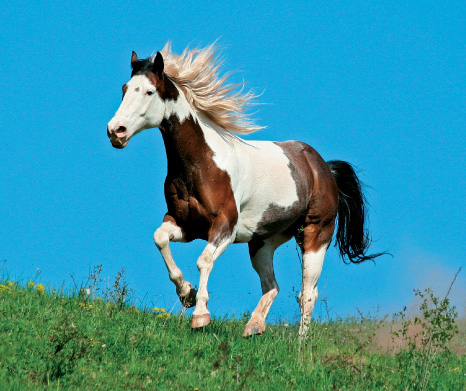
Paints are colorfully marked, and each is different from any other. Zuzule/Shutterstock
History
In 1519 the Spanish explorer Hernando Cortes sailed to the North American continent to find fame and fortune. Along with his entourage of conquistadors, he brought horses to help his men travel across the New World in search of riches. These excursions left behind a profound legacy—the bloodstock that would provide the foundation for a variety of unique, distinct, American-bred horses. According to the Spanish historian Bernal Diaz del Castillo, who traveled with the expedition, there were a few horses among the sixteen warhorses brought on the expedition that had Paint spotting patterns. It is thought that these spotted horses laid the foundation for what is today the American Paint Horse breed.
By the early 1800s, the plains were generously populated by free-ranging horse herds which included the same spotted type horses. Due to their flashy color and performance, they soon became a favorite mount of Native Americans. The Comanche, who were considered to be the finest horsemen on the plains, favored loud colored horses and had many among their immense herds. Evidence of this favoritism is exhibited by drawings of spotted horses found on the painted buffalo robes that served as records for the Comanche.
Throughout the 1800s and late into the 1900s, spotted horses were called by a variety of names: pinto, paint, skewbald, or piebald. In the 1960s, groups began to organize in an effort to preserve these peculiar animals.
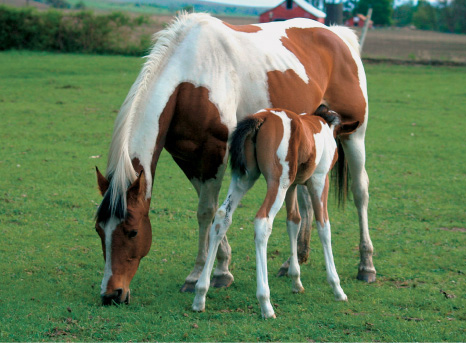
A classy-looking mare and foal with beautiful tobiano patterns. Paula Cobleigh/Shutterstock
The Registry
Rebecca Tyler Lockhart was one of the admirers of these beautifully colored horses, as well as sound, western stock horse conformation, so she sought the best of both worlds. Overcoming nearly unanimous opposition among breeders, Lockhart forged ahead with her plans for a new stock-type breed that was spotted and a standard to go with it.
In 1962 she called a meeting with a special group of enthusiasts for spotted horses in Gainesville, Texas, which founded the American Paint Stock Horse Association. It was dedicated to preserving horses of color with stock-type conformation. Following a merger with the American Paint Quarter Horse Association in 1965, it became the American Paint Horse Association (APHA).
This group liked the varied, distinct coat patterns of the American Paint Horse, finding them very appealing. Being devotees of western stock-type horses, however, it insisted that stock-type conformation had to be a major criterion for its registry. Western stock horses were appreciated for their talents in working with livestock, as well as their strength, intelligence, speed, and agility. They were typically well-balanced and powerfully built animals.
Lockhart remembered seeing a continuing trend of discrimination against horses with distinctive coat patterns such as Paints. “People looked down on Paints,” she remarked. “They just didn’t understand. They thought [Paints] were inferior. If a breeder [of solid-colored horses] had a Paint foal, he was ashamed. He thought it was a bad reflection on his herd, that it was connected with inferior blood. He was afraid someone would think there was something wrong with his breeding program. So a lot of ranchers would get rid of them.” She recalled that Paints would often be relegated to back pastures, or in some cases suffer a worse fate.
“There were many good Paints that were destroyed back then,” agreed Junior Robertson of Waurika, Oklahoma. Robertson was one of the few ranchers in the country who actually admired and owned Paints at the time. One of his most notable horses, even before there was an association for Paints, was Wahoo King. This colorful sorrel Paint set the standard for top competition horses in the 1960s and was well known as a legendary roping horse.
Today, the American Paint Horse breed standard has become widely respected and admired. The breed is now recognized not only for its beautiful coat, but for its sound conformation and musculature as well. It is also highly regarded for its superior intelligence and willing disposition, making it an easily trainable horse.
Standards
While the colorful coat pattern is essential to their identity, American Paint Horses have strict blood-line requirements and a distinctive stock horse body type. To be eligible for the Regular Registry, horses must come from stock horses that are registered with one of three recognized organizations: the APHA, the American Quarter Horse Association, or the Jockey Club (U.S. Thoroughbred Registry). At least one parent must be a registered American Paint Horse.

Paints naturally stand out from solid-colored horses. Zuzule/Shutterstock
The APHA also maintains minimum color requirements for registration in the Regular Registry. Stallions, mares, and geldings that meet the bloodline requirements must have a “qualifying area” of solid white hair (with underlying unpigmented skin) on a non-white horse, or dark hair (with underlying dark skin) on a white horse with unpigmented skin, in order to be included in the Regular Registry. Spots must be on the horse at the time of birth, and Appaloosa spotting is not allowed. Horses with minimal spotting can qualify with a minimum of one spot on the body area that is at least two inches in diameter.
Those horses that do not have sufficient qualifying spotted areas for the Regular Registry, but meet the bloodline requirements, can be considered for the solid Paint-Bred Registry.
Pattern Types
Spotting patterns of Paint Horses have an added attraction over that of most other breeds. They not only have the colors of other breeds, but also superimposed over these colors are a variety of beautifully individualistic spots.
Each Paint Horse has a unique combination of white patches and any background color of the equine spectrum: black, bay, brown, chestnut, dun, red dun, grullo, sorrel, palomino, buckskin, gray, cremello, perlino, and blue, red or bay roan. Markings can be any shape or size and located virtually anywhere on the Paint’s body.
Although Paint Horses come in a variety of colors with different markings, there are only three specific coat patterns recognized in the Regular Registry: tobiano, overo, and tovero.
The tobiano pattern may be predominantly dark or white and is distinguished by oval or round spots that extend down the neck and chest of the horse. White often crosses its back between its withers and tail. The tobiano’s head markings may be completely solid, or may have a blaze, strip, star, or snip. Generally the legs are fully white, or at least below the knees and hocks. The tail is often two colors.
The overo pattern can be mainly dark or white. Typically, the white will not cross the back of the horse between its withers and tail. Overos often have bold white head markings, such as a bald face. Also, the body markings will be irregular and scattered, and one or all four legs will be dark. The tail is usually one color.
Overo patterns can also be broken down into three different spotting patterns: frame overo, sabino, and splashed white. Frame overo horses usually have large amounts of white on the head and white spots arranged horizontally on the sides and neck. The feet and legs of these horses are usually dark, although they can have white feet or socks, just as the non-spotted horse can. Frequently frame overos have one or two blue eyes.
Sabino patterns have white on the legs and head, and the white usually creeps up on the body in the form of belly spots. These horses are usually flecked and roaned, although some are crisply spotted. Sometimes sabino horses have blue eyes.
The last pattern, splashed white, is much rarer than the others. Horses with this pattern have white legs and bellies, as well as a great deal of white on the head. The edges of the white are quite crisp. Many splashed white horses have blue eyes.
Since not all coat patterns fit precisely in either the tobiano or overo categories, the APHA expanded its classifications to include the tovero pattern, which has characteristics of both tobiano and overo.
These patterns—tobiano, overo (frame overo, sabino, and splashed white), and tovero are the color patterns that distinguish Paints from other horses. Their colors, markings, and patterns, combined with stock-type conformation, athletic ability, and agreeable dispositions, make the American Paint Horse an investment in quality. Owning an American Paint Horse is an enjoyable, positive experience.
Paints Today
The breed is experiencing an increase in popularity. There are now more than 1,200 approved APHA shows every year around the world. The annual World Championship Paint Horse Show can run up to fourteen days with thousands of horses participating.

A beautiful American Paint Horse. Zuzule/Shutterstock
Paints have a high profile by proving at several venues around the nation that when it comes to intelligence, versatility, and athletic ability, they are at the top of the class. Paints continue to stand out in reining with impressive victories at competitions such as the U.S. Equestrian Team (USET) National Open Reining Championship, the National Reining Horse Association (NRHA) Futurity, and the prestigious U.S. Team Roping Championships. The Pacific Coast Cutting Horse Association Futurity and the National Cutting Horse Association (NCHA) Futurity are other competitions where Paints have proven themselves.
Since 1966, when APHA officially recognized the sport of racing, the Paint racing industry has made major strides forward. In that inaugural year, seventeen starters ran for $1,290 in just two states—Texas and Oklahoma. In 2005, however, more than 600 starters competed in nearly 800 APHA recognized races for purses totaling more than $4.5 million. Today, a total of eighteen states feature Paint racing, including Arizona, California, Colorado, Idaho, Kansas, Louisiana, Michigan, Montana, Nevada, New Mexico, North Dakota, Oklahoma, Oregon, South Dakota, Texas, Utah, Washington, and Wyoming. Paint racing is also offered in Canada.
The American Paint Horse has established itself as an accomplished athlete in and out of the show arena. Whether racing, trail riding, or performing before thousands at worldwide competitions, the American Paint Horse’s combination of beauty and performance are unmatched.
Credit: American Paint Horse Association