
American White and American Creme Horse Registry
90000 Edwards Road
Naper, Nebraska 68755
http://awachr.com/home
There is nothing so eye catching as white horses. They are like a neon sign flashing for all to see, like an automatic spotlight constantly shining on them. The whiteness of their coats glows like light in the dark, causing other horses to blend into the background by comparison.
Riding a white horse is the dream of almost every young girl or she envisions her hero mounted upon one. White horses are stately and picturesque, often being mistaken for statues in photos. Their presence is associated with something of definite beauty, honor, or royalty. It does not seem to matter what color tack they wear in a show or parade, they just catch the spectator’s eye, irresistibly drawing them in.
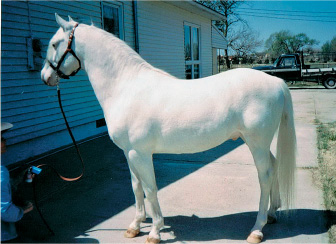
American White Horse colt.
Audiences focus automatically on white horses before anything else, and a white horse in motion is positively mesmerizing. Circuses use running or rearing white horses with flowing manes and tails to attract the crowds. Movies and TV programs have featured white horses ridden by the stars to draw more attention to the heroes, as bad guys never rode white horses. Leaders of nations have favored riding white horses, like the first president of the United States, George Washington, or the emperors of Japan, since white horses are associated with the qualities of goodness and nobility desired in a leader.
Cream colored horses experience the same fame and fascination, as they are often mistaken for white horses. Unless a cream colored horse stands alongside a white horse, the difference cannot be noticed.
America’s White Horses
In 1906 a white horse known as Old King was foaled. Owned by Professor Newall of Illinois and used for breeding circus horses, Old King was a snow white, pink-skinned, brown-eyed stallion of unknown breeding. He matured to 15.2 hands and weighed approximately 1,200 pounds. He had a thick neck, stocky build, strong legs, and great intelligence with good disposition. His long, heavy and wavy mane and tail added to his attraction and completed the picture of the perfect kind of horse suitable for such events as a circus.

American Creme Horse. Carley Daugherty
In 1917, Old King was bought by cattle ranchers Caleb Thompson and his twin brother, Hudson. Crossed with their herd of predominately Morgan mares of various dark colors, Old King produced white foals much like himself. In time, the Thompson ranch established the American White Horse breed and its breeding program. Caleb and his wife, Ruth, eventually bought out Hudson’s share of the ranch and began showing their horses at local events.
They originally named their new horse breed the American Albino and organized a breed registry in 1936, registering much of the stock descended from Old King. In 1937 they incorporated the American Albino Horse Club (AAHC), a registry and studbook for white horses. It eventually included a subsidiary, National Recording Club, in which all non-white foals were recorded, including cream colored horses, which were registered as non-white or off-colored. (The American Creme Horse was not officially recognized until about 1980.) The registry eventually moved away from the use of the word “albino” in succeeding title changes, since, genetically, the American White Horse is not a true albino, and neither is its close cousin, the American Creme Horse.
In 1938 the Thompsons moved to a ranch of nearly 2,400 acres in Naper, Nebraska, and named it El Rancho del Caballo Blanco. The local residents, however, called it the White Horse Ranch; this name stuck and a legend began. The Thompsons began a training and riding school for children and started touring with their White Horse Troupe, staging performances that included the children along with the horses from the school. In the 1940s and 1950s the White Horse Troupe became internationally famous and toured all over the United States and Canada. The popularity of the White Horse Ranch also attracted many visitors to its grounds.
In 1945 Life magazine visited the ranch and ran an article on it. The White Horse Ranch was subsequently featured in many other magazines, and in 1946, Warner Brothers Studios made a movie short about the ranch. Warner Brothers Studios visited the White Horse Ranch again in 1952 to make another movie short. The two movies, Ride a White Horse and Ranch in White, are at the Lincoln, Nebraska, state archives and can still be viewed on video there.
Many times the horses the Thompsons used for the entertainment industry were the same ones they used a few years later at their white horse training and riding school. Some of their horses, such as the mare Snow White, served as multipurpose horses. Snow White was a fine jumper and very fast runner. She once raced a stock car on a quarter-mile track and won! She knew a variety of tricks, was used as a driving horse, and in a pinch could be hitched to the plow. Being extremely gentle, she very popular with the training school students and lived into her thirties.
In 1963 Caleb Thompson died, and Ruth had to close down the ranch to tourism and sell the herd. She placed breeding stock horses with friends and white horse breeders to preserve the bloodlines of Old King’s descendents. She also continued the studbook and, in 1970, re-incorporated the registry as the American Albino Association, Inc., in Oregon. At that time, the corporation began registering Creme horses in their own registry because a better division between white and cream colored horses was necessary. The apparent confusion as to what a true white color looked like led to the creation of two distinct divisions, the American White Horse Registry and the American Creme Horse Registry (although the “breed” was still registered with the American Albino Association). Additionally, Ruth was now registering horses internationally.
Carley and Dean Daugherty then became involved in the White Horse Ranch. Carley had a history with the Thompsons, as they had been her legal guardians when she was young and had remained close friends. As a little girl, Carley had ridden with the White Horse Troupe. When she was ten years old, she rode and showed the Thompsons’ highly schooled stallion, Wings, a horse that knew an awesome number of tricks. Carley directed him through his trick routine for the visitors at the ranch and rode him bareback every morning to bring in the herd of show mares. In 1988, Ruth entered into a contract with Carley and her husband, Dean, to start restoration of the White Horse Ranch.
In 1990 Ruth died and the White Horse Ranch was listed on the National Register of Historic Places. The board of directors of the International American Albino Association voted in 1994 to declare the American White Horse and American Creme Horse two distinct breeds and to promote them as such, rather than using the “American Albino” term. Formerly, they had been promoted as two types within the same breed, but neither the White nor the Creme Horses were true genetic albinos, just horses with light colored skin.

American White Horse. Don and JoAnn Anderson
Today, the American White Horse and American Creme Horse Registry continues with many registered Whites and Cremes involved with children or doing ranch activities. This includes 4-H programs, children’s parties and other activities. They are especially suited for trained horse trick routines, jumping routines, or similar attractions.
Breed Basics
The “dominant white” and the “dilute cream” are not alike in their genetic makeup, nor, when reproducing, is there any similarity in the effect these two color genes have on the foals produced. The Whites are mostly descendants of Old King, but only a few Cremes can trace their roots to him. Most Cremes, in fact, are from registered Quarter Horse stock.
White horses are born white and do not change color. They should not be confused with cream colored horses, as they come from a different, dominant white gene, while cream colored horses come from a dilute gene.
White horses will reproduce color as follows: a white horse bred to a colored horse has 50 percent chance of producing a white or colored foal. A white horse bred to a white horse will produce a 75 percent crop of white foals. The off-colored foals of a white horse can be any color, with chestnuts seeming to be in the higher percentage.
The cream color is caused by a recessive gene, meaning that a Creme bred to a horse of color will dilute the color; that is, a Creme bred to a bay will produce a buckskin, and a Creme bred to a chestnut will produce a palomino. A Creme bred to another Creme will produce 100 percent cream colored foals.
Cremes are mostly produced by horses other than whites: usually buckskins, palominos, duns, or other cream colored horses. The dilute (recessive) gene carried in a palomino, buckskin, dun or cream colored horse is what causes cream color. If two of these horses with the dilute gene are bred to each other and that recessive gene is passed on from both parents, it produces the cream color. Cream color is only produced from two dilute gene carrying parents. A white horse can only produce a Creme if it is bred to a Creme and the white horse carries the dilute gene. One of the white horse’s parents or ancestors must also have been a dilute gene carrier, from which it had received that gene.
As an example, Carley had an American White mare with blue eyes that she bred to an American White dark-eyed stud whose dam was a cremello that came from several generations of Whites. This pair of White parents produced a Creme foal because the blue-eyed mare (note eye color) had an ancestor with the dilute gene. Both she and the stallion had to each donate a dilute gene in order for the foal to be a Creme Horse. The blue eyes of the White dam indicated a recessive gene in her background and the White stud carried the gene from his dam—thus the Creme foal.
American White Horse
The original American White Horse breed had Old King as a foundation sire, although the studbook is now open to other unrelated horses of like color. The American White Horse is a color breed, thus individuals within the breed will vary in conformation and type according to their background breeding. For example, one from Arabian bloodlines will differ greatly from one with Quarter Horse breeding. The main requirement to be classified as an American White is the horse must have a uniformly, true-white coat and pink skin. No mottling of skin, such as is common with Appaloosas, is acceptable. Since some horses develop a few tiny black spots on their skin in the area of body extremities as they age, these are permitted.
Eye color will vary. White horses have been known to have the following colors of eyes: dark brown, dark blue-black, blue, very pale blue, and multicolored (sometimes called parti-eyed). They do not have hazel eyes; only the Cremes do.
The American White Horse is bred not only for white coloring, but also for a good disposition. The breed as a whole is known to be sociable and intelligent with a willing attitude when treated properly. The American White Horse does not go blind or deaf or otherwise is affected adversely, either physically or mentally, because of its coloring, as many preconceived stories have stated.
When given proper care, American Whites live long and useful lives. Many have lived into their late twenties and early thirties. Being pink skinned does require some extra precautions, however. They can be pastured outside, but like the Cremes, it is better if they can be in the shade from 10 a.m. to 4 p.m. and during midday in particular, when ultraviolet rays from the sun are at their strongest. Otherwise they should be handled just like any other colored horse.
White horses are renowned for their temperament and trainability. Carley owned and showed a gelding named White Mystery that was the 1963 Champion Gelding for the White Horse breed. He knew a variety of tricks, was a great jumper, and was used in Roman teams. When Carley was nine years old, she taught him to jump with his eyes covered with a blindfold! That same summer, he was introduced to a saddle for the first time. One week later, Carley was using him for saddle trick riding while on tour. She could ride him bareback with no bridle for performances in which he jumped a four-foot hurdle. He was so gentle that children could learn to ride on him. If he was caught napping in the pasture, children would climb on his back and he would get up and take them for a quiet trip around the pasture. One winter, it snowed so badly that he had to haul a makeshift travois with a fifty-gallon barrel full of water up a hill to the horse pasture, never having been in harness before. He made five more trips up the hill with more barrels without hesitation or trouble.
White horses are beautiful and stunning to watch. An American White, TWHR Westwind Paris, owned by Don and Jo Ann Anderson of Texas, was cast in three movies. He was featured as the main horse in Secondhand Lions, along with four other American White Horses also owned by the Andersons. Paris was featured as the main horse. He was also cast in the 2004 movie, The Alamo, starring Dennis Quaid as General Sam Houston, the 2006 movie Rain, and several other films.
The American White Horse has proven to be truly versatile and has been used for parades, shows, movies, driving, jumping, gymkhana competition, western and English pleasure, youth camp activities, and handicapped riding programs. It was bred for gentleness, intelligence, beauty, and color. Along with its excellent disposition, the American White has proven to be physically sound and strong, and to have good straight legs. It has no diseases or weaknesses particular to the breed.
American Creme Horse
The American Creme Horse Registry was founded by Ruth Thompson in 1980 to be a registry for cream colored horses with pink skin. As such, the American Creme Horse breed is a color breed, so horses from all major breeds that qualify by color may be registered. If the horse is a product of registered parents, its pedigree is preserved and its bloodline recognized on its registration certificate (such as Quarter Horse, Arabian, or other breeds), as long as documentation of its breeding is provided. In the event that the horse has no proof of its breeding, it may be registered by color without its lineage and it would be identified as to type.
The American Creme Horse must have pink skin. Its skin may be of a darker shade, more like a tan, but must not be gray or black. It cannot have mottling on the skin, such as is common with Appaloosas, nor can it have spots, such as what Paints and Appaloosas have. It must have a solid cream colored coat, which may vary from off white to fairly rich cream, but lighter than palomino. It may be born either nearly white or a darker cream that looks almost gold, similar to a palomino. This may lighten to near white as it ages, or in rare cases may become a darker cream color. The skin will remain light, however.
The mane and tail may vary from white or cream, to a rich russet coloring. Cremes descending from buckskins or duns may have darker cream points on lower legs. White markings—such as blazes, stars, and socks—are permitted.
Cremes have eyes that can be any color, but most commonly they are pale blue or very pale amber. They can have hazel eyes, which American Whites never have. Cremes never have truly pink or red eyes, but the iris may be such a pale blue that it appears nearly white and the pupil of the eye will reflect pink. This effect, however, is reflected lighting, not eye coloring.
American Cremes have proven to be of good disposition, are intelligent, and perform well according to each horse’s particular type. They have been used as jumpers, trail horses, gymkhana competition horses, barrel racers, and driving and ranch horses, as well as pleasure and show horses.
The American Creme has a normal life expectancy if given appropriate care. Like the Whites, their lighter skin is somewhat more sensitive to sun exposure than a dark skinned horse, and it is recommended that shade be provided for them from 10 a.m. to 4 p.m., particularly at midday. This time period may need to be extended for desert or tropical regions. Sun sensitivity varies among different individuals, but only affects the areas where there is no hair covering, such as the end of muzzles and, in some horses, around the eyelids.
Recent research has proven that the light colored hooves of Cremes are just as healthy and durable as dark colored hooves. Cremes do not go blind or deaf or become mentally unstable. Some horse people have stated differently, but this only shows a lack of understanding for these unique horses.
Credit: Carley Daugherty and the American White Horse and Creme Horse Registry